Showing posts with label Doug Bucha. Show all posts

Thursday, April 30, 2015

The Fishing Photographer with Doug Bucha


Just wanted to keep up with Bill Sonnett when it comes to fishing with antique fishing tackle. I caught these two trout north of Dowagiac today, using my old Alcedo Micron ultralight reel mounted on an old five foot ultralight buggy whip. The reel has given me a lot of trouble free service for over fifty years and it still works like a jewel. I've owned this reel since I was a kid.


Good fishing with old tackle,

Doug Bucha

Wednesday, December 31, 2014

The Fishing Photographer with Doug Bucha: Happy Holidays!


HAPPY HOLIDAYS FROM THE GANG AT TONIGHTS HEDDON MEETING


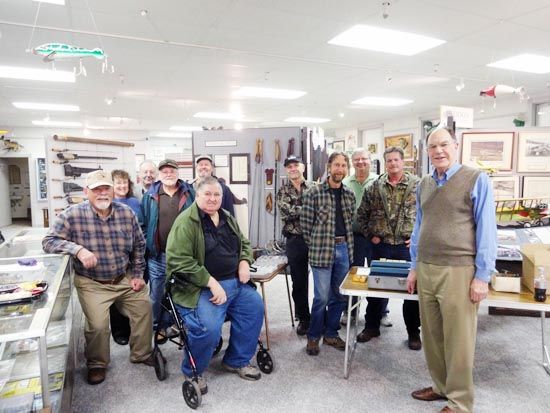
In attendance: Bill Sonnett, Mike Kechkaylo KECH, Ric Ladonski, Randy Sherrill, Tom Coleman, Erick Norris, Max Merrill, Dean Rudasics, Doug Bucha and Don & Joan Lyons.

-- Doug Bucha

Wednesday, October 1, 2014

The FIshing Photographer with Doug Bucha: Seth Green


SETH GREEN

Father of Fish Culture 1817-1888


Seth Green is called the father of fish culture because of his early work in fish propagation in 1864. He also built the first fish hatchery in the United States near Rochester, New York, at this same time. Green was not only the father of fish culture in the United States but this honor would be bestowed on him world wide.

After watching the series on PBS, called THE ROOSEVELTS, it reminded me that Green was also a good fishing buddy of Mr. Robert Roosevelt of New York. They became very close friends and would spend weeks fishing from Mr. Roosevelt’s yacht. There is a very good article that can be accessed on the internet called Rochester History by Sylvia R. Black that I would recommend as good reading. It will cover the history of Seth Green in great detail.

In the foreground of this photograph is a fly pattern tied by Edith Nieboer in the late 1920’s, which is named in Green’s honor. This is just one pattern of fly from over 130 of her master fly patterns that I am lucky enough to own. Edith started her fly tying company in Sparta, Michigan in 1928. She would sell her company to the Paw Paw Bait Company in 1934. Paw Paw would keep her on to manage the new fly tying division of the company until 1938.

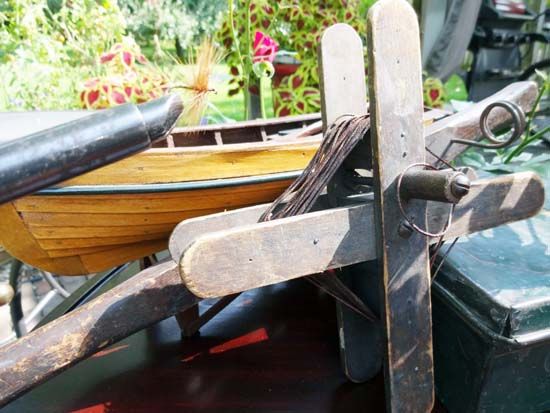
In the background of this photograph is a very old fishing rod/or line drier. It was sold to me as possibly being an item made by Seth Green.

In the 1850’s, Mr. Green was the most successful commercial fisherman in the state of New York. Could this be a short rod that was used over the side of a boat on Lake Ontario? If anyone has knowledge of Mr. Green and the fishing equipment that he used, I would like to hear from them.

Thank you,

Doug Bucha dbucha@att.net

Wednesday, August 20, 2014

A Rare Paw Paw Piece


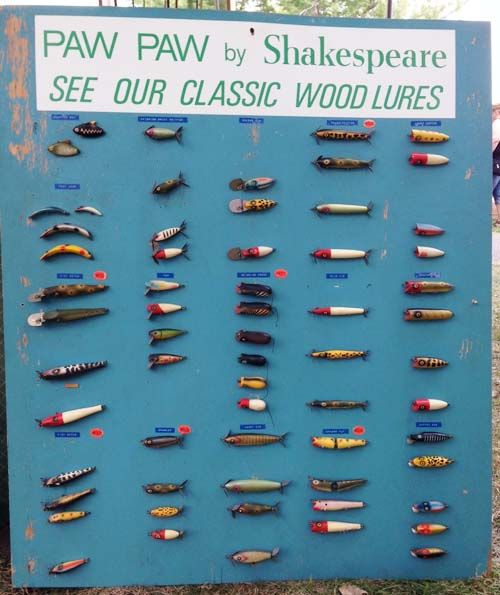
Every year Doug Bucha helps set up the Niles Riverfest antique tackle display, and every year he sends in amazing photos. This one may take the cake. Doug writes:  "This is the most interesting historical item to come into this years Niles Riverfest. It was brought in by the son of a man who designed and build advertising layouts for Shakespeare and others. I think you will enjoy this. Picture from: Mike Kechkaylo."


Oh. Yes. It is an incredible piece, and we appreciate you sharing it with us!

-- Dr. Todd

Wednesday, August 13, 2014

The Spring Activated Coil Fishing Rod by Doug Bucha


The Spring Activated Coil Fishing Rod

by Doug Bucha

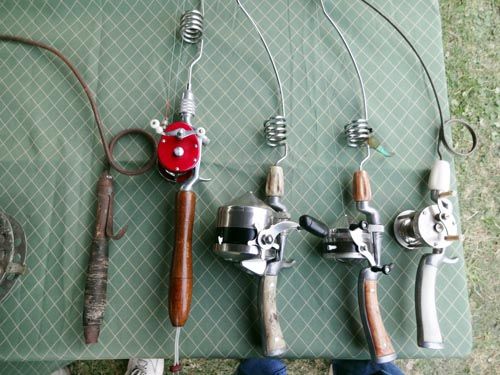
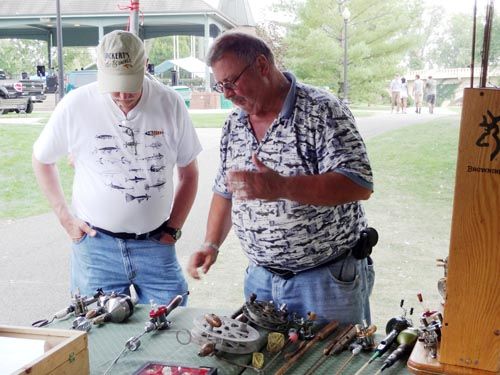
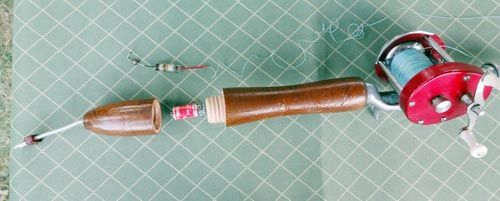
At the recent Niles Riverfest, I was able to photograph some of Ric Ladonski's collection of spring rods. Some people who stopped by thought these rods were designed for ice fishing. The truth is, the rods were designed to be broken down into two parts so they could be stored in ones tackle box for easy transport. The concept behind the coil was to make up for the rod not having any length to it. Believe it or not, the rod does have a good action when playing a big fish. They were popular from the 1920s trough the '50s.


Photo of Harold Dickert and Ric Ladonski discussing some of Ric's Spring Rods.


The most interesting of Ric's Spring Rods. Electric ???? We can not figure it out either.

Maybe someone one on the blog can? If anyone has an answer they can email me at dbucha AT att DOT net

-- Doug Bucha

UPDATE

The following was sent in by reader Mike of Dayton and illuminates a bit more on the Spring Coil Rod:

I don't know if you ever get to the Friendship, In. Flea Market they have twice a year or not. But I went there twice a year every year for about 3 years. (That was about 4 years ago.) And every year there was a younger guy there selling spring rods.

Anyways the story he told me was his grandfather was the guy who invented spring rods or came up with the ideal or something like that. Anyways his grandfather had the patent on them. When his grandfather passed away none of the relation wanted to take over the business. So when he (the guys grandson, or maybe it was a great grandson) got old enough and got some money ahead he took over the rights for the spring rods and had them re-produced by the same company his grandfather used years ago. Then he bought a big ol' RV and traveled all over the country selling his grandpa's spring rods at flea markets.

I knew about them as a friend of mine collected spring rods. My friend had one from England that came with 3 different spring rods and 1 handle. There was a light, medium, and heavy.

Anyways the guys grandson went into his RV and took out an old looking spring rod that was what he claimed to be his grandfathers first spring rod and he put it next to one of his and everything was the same! I asked him how someone could tell the difference from the new ones and old ones? He said they can't they are one and the same.

So when ever I see one for sale I always try to pass this info on as it might be a new spring rod and not an old one.

Thanks Mike!

Wednesday, May 21, 2014

The Fishing Photographer with Doug Bucha: Tulips and Talbots


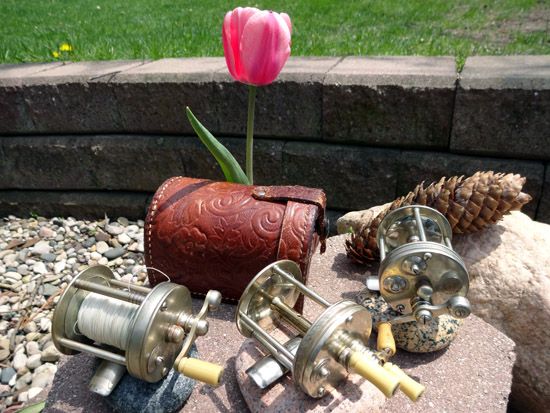
Spring is the time for tulips in Michigan. The addition of a few nice Talbot reels in the photograph can only enhance their beauty.


-- Doug Bucha

Wednesday, April 23, 2014

The Fishing Photographer with Doug Bucha: BLACK LIGHT PHOTOGRAPHY: A NEW PHOTOGRAPHIC TOOL


BLACK LIGHT PHOTOGRAPHY: A NEW PHOTOGRAPHIC TOOL

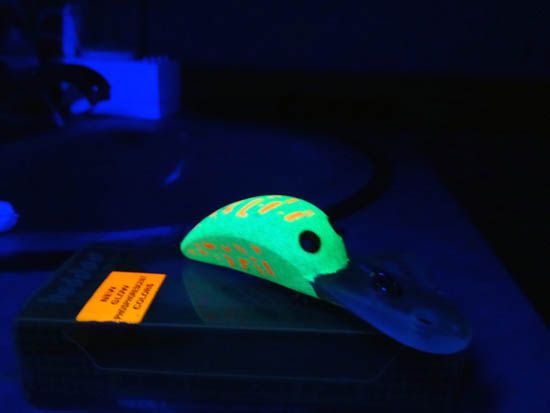
I first saw the black light photography method used by Frank Cristao a few months ago. It got me thinking about some other ways that it might be used by collectors. It could be a useful tool when either buying or selling lures on the internet. Example: As the photograph of the solid black South Bend Vacuum bait shows, the repainted area under black light photography stands out.


As you can see, this method even works on lures that do not glow in the dark.


A good example/use would be when a buyer is unsure of a lure that he is interested in, he could ask the seller to take some black light photographs of it and send them to him. The reverse would be true in that a seller could show a lure he was trying to sell, was not touched up. This method could save a lot of time and hard feelings. Black light photography seems to work with any good digital camera. It’s a lot of fun. Maybe some other uses can be found? Let me know.

Your Fishing Photographer: Doug Bucha

Thursday, March 20, 2014

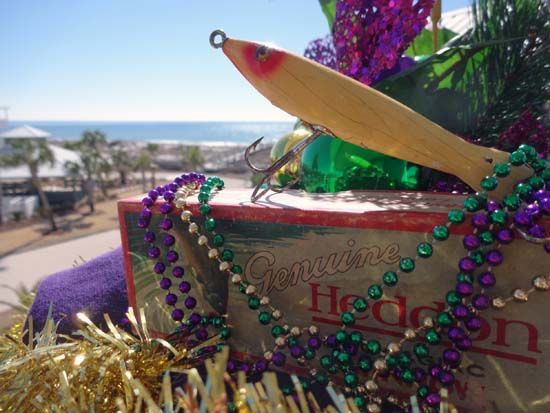
The Fishing Photographer with Doug Bucha: Mardi Gras Baits


Fun things to do when living on the Gulf Coast. Mardi Gras parades and hunting for Pier Baits.


-- Doug Bucha

Wednesday, January 22, 2014

The Fishing Photographer with Doug Bucha (January 2014)

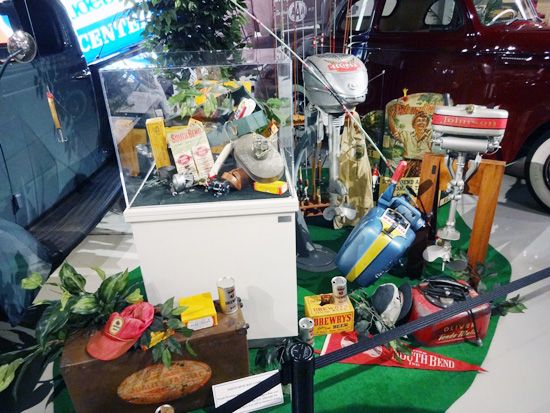
Visiting the South Bend area!!


I just wanted to let collectors know what the South Bend area has to offer in the way of museums as they relate to fishing.

The photograph shows a display of fishing related items that can be found at the Studebaker National Museum in South Bend. The museum features many fine Studebaker automobiles and is one of the finest auto museums in the country. It is fantastic!!

In addition, The Center for History is located just next door. It houses all the records from the South Bend Bait and Tackle Company going back to its beginnings. These are available for private viewing for research purposes.

There are three museums just across the state line in Michigan which will be of great interest to the collector. The city of Niles offers the Fort St. Joseph Museum that has a small collection of local fishing items, including the Harris Frog.

The city of Dowagiac not only has the Heddon Museum but it also has a museum downtown. This little known museum features one of the finest displays of Heddon items that can be found anywhere.

Please do not forget to visit the University of Notre Dame. It has over one million visitors every year and is the largest tourist attraction in all of Indiana. You will not be disappointed.

Have a great 2014.

Doug Bucha

Wednesday, November 20, 2013

The Fishing Photographer by Doug Bucha: Is This The Rarest Heddon Catalogued Color?


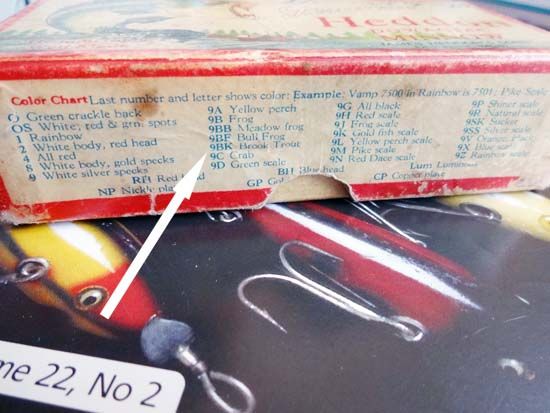
Brook Trout (No.9BK) was used on the Tiny Tease from 1929-1933. It is even considered rare on the Tiny Tease. The color is listed on the side panel of some Heddon boxes. Does this indicate that other lures could be ordered in this color? Has anyone seen another lure in this color pattern? if not, does this make Brook Trout the rarest color?


-- Doug Bucha

UPDATE

Joe Stagnitti writes in:

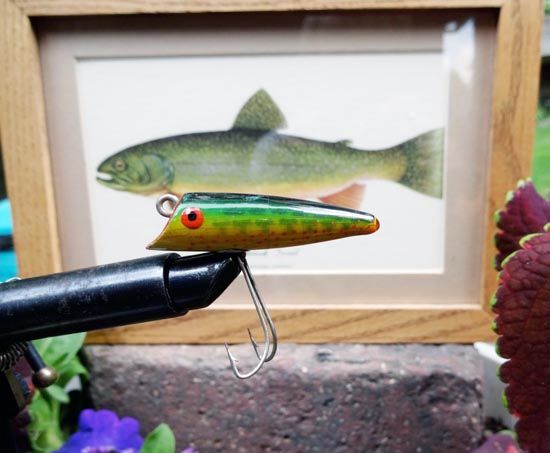
Here is what Brook Trout looks like on a Heddon. The reason that people do not see brook trout on a Heddon bait is because they are looking for the Tiny Tease version of brook trout. This bait came in its' original box stamped 150BK. There are a couple 150's and a couple 250's known in this color.


Wow! Amazing color, and now I know what 9BK looks like on a lure! Thanks, Stag!

-- Dr. Todd

Thursday, October 17, 2013

The Fishing Photographer by Doug Bucha: Fall Colors of Michigan


FALL COLORS OF MICHIGAN


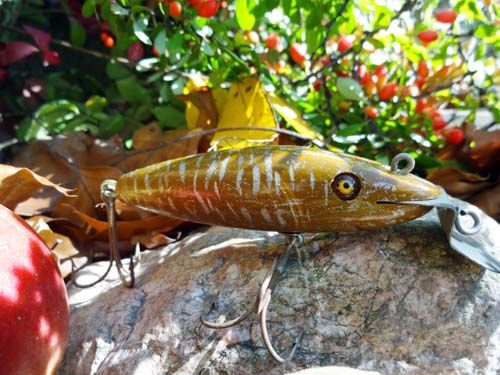
It’s fall in Michigan and the colors are fantastic. The time is right to have your camera handy. I was lucky enough to catch a shot of this old Creek Chub rustling around in the leaves the other day.

This is possibly a preproduction model!! The lure does have all the typical features that an early 100 would have, such as a slanted head, no washer tail, flat cup hook hanger, unmarked lip and so on. This lure, however, has a few other things going for it that gives me deep thought that it may be a preproduction lure.

The lip is not only unmarked, but un-plated. The other hardware is also unfinished. It does have the belly weight. The thing that really stands out is that the holes for the eyes and the line tie are very crudely drilled and look like they were hand painted over to cover up the bare wood. I have seen other lures painted with this same brown color pattern but they all had gold markings. This one has silver markings.

The lure was purchased from a lady and her husband who stated that it had come into their possession from a great aunt who would have been well past her 90’s, if still living. The great aunt was from Garrett and “had worked for the bait company in town”. To give you a perspective as to a time frame, a very early Shakespeare Baby Revolution with Mickey Mouse props was also acquired from the same party.

Your thought’s or knowledge of very early Creek Chub 100’s would be welcomed.

Doug Bucha (dbucha AT att.net)

Wednesday, August 28, 2013

The Fishing


SOUTH BEND MYSTERY REEL

This is the reel that Jim Madden calls the “Mystery Reel”. The reel is the only one South Bend offered that was not made for them by Shakespeare. It was made in 1913 and the maker is unknown. This reel was owned by a former engineer from the old Studebaker Automobile Company. He was a longtime employee who had developed wartime projects such as the Weasel amphibious vehicle during WW2.


Please note the shamrock on the side of the reel. One other clue as to who may have manufactured it may be the handle.

Doug Bucha

Wednesday, July 10, 2013

The Fishing Photographer with Doug Bucha


WHAT’S IN YOUR …….. TACKLE BOX?

Sometimes we find objects in old tackle boxes other than lures and reels and we classify some of these items as cross-collectables. Most of these items are such things as fishing knives, mosquito dope, etc. and have become collectables in their own right.

On rare occasion, we find objects in tackle boxes that do not directly have anything to do with fishing but were still prized possessions of fishermen. A good whisky flask during Prohibition would be such a possession. There’s nothing like sharing a little nip with your best fishing buddy on a cold morning on a lake or stream. Having a fine whiskey flask in the bottom of ones tackle box would be a must.

Fine art advertising posters which combine fishing with spirits, would also fall into the realm of being called a cross collectable. When you are going through the contents of an old tackle box don’t over look those other little items. Keep in mind that some of these flasks have patent dates going back into the 1870’s, which makes them true antiques and very collectable.

It would be fun to make a list of strange objects that collectors have found in tackle boxes over the years.

PS. I find it a little unusual that I have never found a flask with any contents….Strange!!

-- Doug Bucha

Wednesday, June 12, 2013

The Fishing Photographer with Doug Bucha


JUNE IS STRAWBERRY TIME IN MICHIGAN

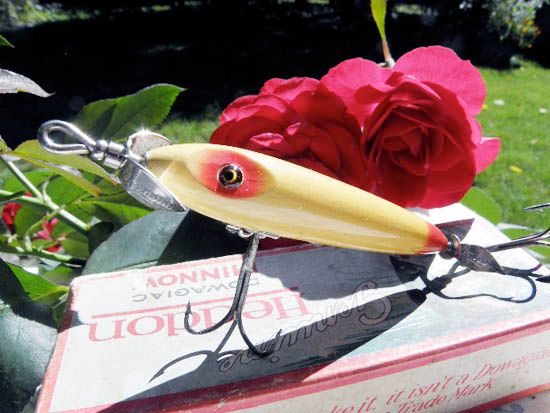
Yes, June is strawberry time in Michigan and as you can see, strawberry can have a second meaning. This would be the classic Heddon “Strawberry” finish, to be exact. Heddon called it spotted, or simply “S” if you were ordering a lure in this color.

Where did this name come from and who was the first collector to coin it? As we look at the lure, it is easy to see where the name came from. The color seems to show up for the first time on the 1911 Swimming Minnow. The next lure to use this color was the 1913 Dummy Double. The name spot or spotted was the cataloged color for both lures. I was unable to find the name Strawberry used in any Heddon catalog throughout the years.

The oldest published use of the name Strawberry appears in Kimball’s early reference books. The book says, the #11 had white with red and green decorations- referred to as “strawberry”.

I checked with a few collectors who have been collecting for years and none of them knew who coined the name. One collector has even been an advanced strawberry collector from the 1970’s.

I will now open the question up to you, the collecting fraternity. Who was the first collector to use the name, Strawberry? If anyone has a good answer, please write or call me so I can post it for everyone to see.

Thank you,
Doug Bucha (dbucha@att.net)


Wednesday, May 8, 2013

The Fishing Photographer with Doug Bucha: Those Pesky Unknown Lures!

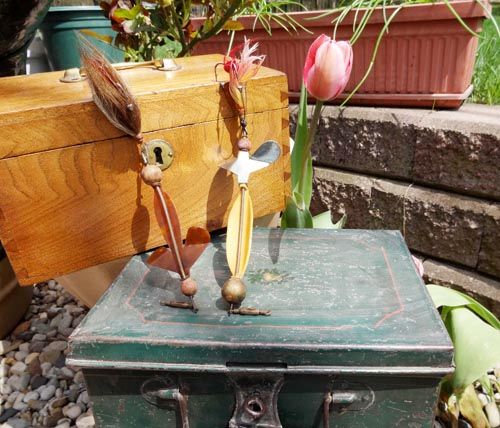
Most lure collectors probably have a manufactured lure or two in their collections that they have never been able to identify. It helps, however, when lures in this category have a story to go with them. Even the story might help in their identification. The two lures in the photograph have such a story.

Many years ago, Mike Kechkaylo, Harold Dickert, and I took a week- long fishing trip to the Upper Peninsula of Michigan. While on this trip we ran across an old bait shop just west of Land O’ Lakes, Wisconsin. The elderly gentleman who owned the shop for many years was getting ready to retire at the end of the season. During the hour-long discussion with him we found out his life story. He had started out in the 1920’s as a trapper and Musky guide. After a period of time as a Conservation Officer, he went into the tackle business.

After another hour of conversation, he invited us back into his storage room. WOW! Hundreds of old lures hanging up on the walls. There were a few dozen lures that we had never seen before. He stated that he had picked these lures up from clients over the years, who had either left them behind or had just given him the lures for putting them on a good fish.

Another hour passed and he agreed to let each one of us buy a few lures for our “Musky fishing trip”. We jumped at the chance and each one of us picked out a half-dozen larger lures. Because of their uniqueness, I just had to have the two unknown lures shown in the photograph.

I have taken these two lures to shows for the past twenty years and have had little luck in finding out who made them. The spinner on one of the lures appears to be made of tortoise shell while the other appears to be made of horn. After checking the materials using the smell test, I have come to the conclusion that they are both made of natural materials. Tortoise and horn can both be bent to unusual shapes using heat. The lures do have considerable age to them and were made to catch larger fish.

Does any of this help in formulating any ideas as to: who made them? Well, it’s up to you now. Your input is welcome and if you would like to add your thoughts, go to the COMMENTS so everyone can have a look.

Thank you, Doug Bucha (dbucha@att.net)

Wednesday, April 10, 2013

The Fishing Photographer: THINKING OF SPRING


THINKING OF SPRING

Thinking of spring and the beauty it will bring.

Thinking of spring rains and the flowers they will bring.

Thinking of spring brings the mushrooms out to bare.

Thinking of spring brings out the Heddons from their secret winter hiding places with a flare.

Alas my old friends, jump in your car and travel the countryside looking for flowers, mushrooms, and an old Heddon or two.

“…that which we call a rose, by any other name would smell as sweet” Romeo and Juliet---Shakespeare!

“A Heddon by any other name is still a Heddon:”

-- Doug Bucha 2013

Thursday, March 21, 2013

The Fishing Photographer by Doug Bucha

I just made it back from living on the Gulf in Orange Beech, Alabama for the past two months. I stopped off at the Orange Beech Indian and Sea Museum to look at their displays. The Museum Guide, Gail Graham, was kind enough to let me take some pictures.

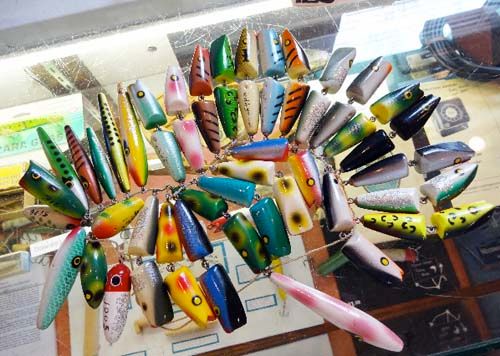
This picture is of a salesman's sample ring of Sam Griffin's lures that I thought everyone would enjoy. Sam made his lures in Moorehaven, Florida. In my opinion, I think he did an outstanding job of painting them. Some great eye-catchers!!

-- Doug Bucha

Wednesday, May 23, 2012

The Robert Page Lincoln "Bob Lincoln" Fly

The Robert Page Lincoln "Bob Lincoln" Fly

So it's Robert Page Lincoln week here on the blog. For those who've read Bill Sonnett's great piece on the Robert Page Lincoln spoon last Saturday, you know that this popular casting spoon was named after Lincoln. As the advertising copy from Superior Door Catch noted, "no greater tribute could be paid to a fishing lure than to have it recommended by a sportsman as famous as Robert Page Lincoln."

As an aside, having grown up in Duluth, Superior Door Catch Co. was in my back yard. K-B spoons were so common you could not buy a tackle box without finding a half dozen K-Bs inside. You can find them with different stampings--for a brief time they were made in Duluth and stamped as such, and later ones are stamped Mankato--but the lure itself was made on the same stamping press. They also caught fish, which is why they are still being made today, eighty years after their introduction from old Ben Gallinger. My brother works with the grandson of the founder of Superior Door Catch so one of these days I'll get an interview with him and set the record straight about this interesting company.

But we're talking Robert Page Lincoln today. Noted collector and historian Doug Bucha sent in an email after Bill's article ran and brought up an interesting fact. Doug wrote:

Saw your clip from Bill today on items named after Bob Lincoln so I thought you might like to see one more.  Edith Nieboer was noted for the development of two flies, the Max Sandy and the Bob Lincoln.  This is a page from her 1933 catalog and a photo of one of the flies. The photo of the fly is from her MASTER FLY SET.
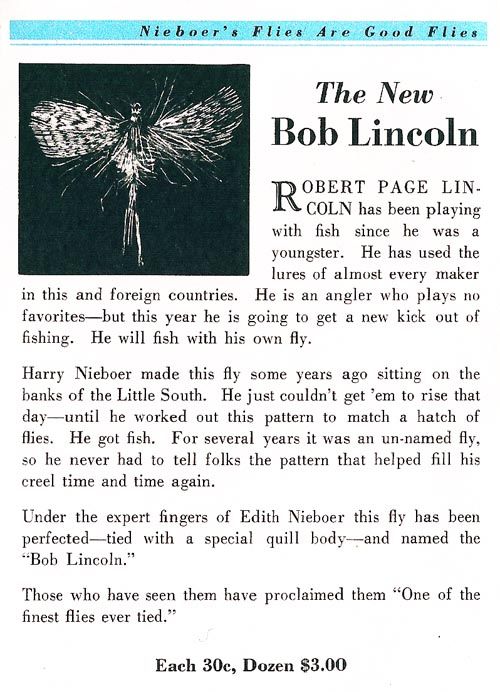


Edith Nieboer was a wonderfully gifted tier and probably best remembered for tying all of Paw Paw's flies, which come in the great "Indian Head" boxes. Doug recently penned a fascinating article on Nieboer in the NFLCC Magazine.

This was a popular fly for its time and its name is a bit of a play on words -- A bobolink is a common bird that is sometimes referred to as a "Bob Lincoln." It has almost receded from memory that the only google reference I could find to the fly was a lone Northwestern fly tier looking for a recipe to tie it, and getting no response.

Robert Page Lincoln is well worth remembering today as one of the leading outdoor writers in American history, and the namesake of both a casting spoon and a dry fly.

Thanks to Doug Bucha for sending in the pictures!

-- Dr. Todd

==========================================

UPDATE

==========================================

Count Bill Sonnett as another fan of Robert Page Lincoln. He sends in one of his favorite RPL quotes, from the article “Daybreak Fishing” by Robert Page Lincoln in Sports Afield, April 1945:

“Several advantages obtain to this early morning fishing. First your bass hit hard and without any canvassing as to whether the lure is 'Vittles' or hardware. Second, as in night fishing the light is poor and it is difficult for the fish to size up the lure. Therefore it strikes first, aiming to make out afterwards if it is friend or foe. Third, and most important of all, is the fact that many fish are inshore, more probably than you would dream possible. Therefore the competition is hot and heavy, the law of nature being everyone for himself, the devil take the hindmost. When you get more than one fish heading for your lure at the same time as you often do, you can rest assured you are not going home fishless.”
Sunday, August 21, 2011

1000 Words

1000 Words

Every year we look forward to seeing what Doug Bucha runs across at Niles' Riverfest. This year he sends the following picture and commentary:

Just wanted to show you a sample of some of the lures that came into this years Niles Riverfest.  These are three of the most colorful ones.  All three are mint!!  One nice Paw Paw Crab and her two "Kissin-Cousins."