Showing posts with label voices from the past. Show all posts

Friday, June 24, 2016

Voices from the Past: The Death of Ed. K. Tryon Jr. (1894)


The following obituary for Edward K. Tryon, Jr. comes from the September 29, 1904 issue of Iron Age magazine. It gives a brief overview of one of the most important men in fishing tackle history. It was under Ed. K. Tryon Jr.'s watch that the firm that carried his name became the largest fishing tackle wholesaler in the nation. His impact on the tackle trade cannot be overestimated; Tryon is a major reason so many tackle firms succeeded, from Hendryx to Penn. At their peak the Tryon tackle catalog was 400+ pages. It's an amazing legacy, and he appears to have been a decent human being, too.

DEATH OF EDWARD K. TRYON, JR.

EDWARD K. TRYON, JR., senior partner of the firm of Edward K. Tryon, Jr., & Co. of Philadelphia, died suddenly at his home at two o'clock on Monday, September 19, from appoplexy. Mr. Tryon had been ill for about two weeks, but had shown such marked improvement that his physicians had given every assurance of his speedy recovery.


Mr. Tryon was in his sixty-first year, having been born in Philadelphia April 14, 1844. He received his education in Friends schools and the Germantown Academy, but at a very early age he entered the employ of the Tryon firm, then composed of his father, Edward K. Tryon, and brother, George W. Tryon, Jr., who were established in business at 625 Market street, and also at 220 North Second street, the site of the original establishment, which was founded in 1811 (The Sign of the Golden Buffalo). In 1863 his copartnership was dissolved, the senior Tryon retiring. Edward K. Tryon, Jr.. and his brother forming a partnership under the name of Tryon Brothers, which partnership continued in existence until 1868, when George W. Tryon, Jr.. retired. The firm then changed to Edward K. Tryon, Jr., & Co., which name the copartnership retains at the present date, Edward K. Tryon, Jr., having remained the senior partner until the time of his death, the firm now occupying the premises at 10 and 12 North Sixth street and 611 Market street.

While Mr. Tryon was still a boy the family moved to his father's country place. Pittville, near Germantown. where Mr. Tryon spent his boyhood days, which property has been purchased by the United States Government and is now one of the national cemeteries. Mr. Tryon had been in active business all his life, but about ten years ago relinquished part of his business affairs, determining to devote the time thus gained to charitable and philanthropic work. At the time of his death he was a member of the Board of Directors of the Home Missionary Society of Philadelphia, a director of the Evening Home and Library Association for Boys, of which institution he was one of the founders and for a number of years its president; a member of the Board of Directors of the Women's Medical College and Hospital, a director of the Trades League of Philadelphia, a member of the Academy of Natural Sciences, a member of the Historical Society of Pennsylvania and a trustee of the "First Unitarian Society of Philadelphia."

At the time of the battle of Antietam, when President Lincoln issued his call for 75,000 men, Mr. Tryon enlisted and served a short time with the Pennsylvania Volunteers. He Is survived by a widow and two children, and his surviving copartners in the firearms firm are Edward B. Mears, Jr., Evan G. Chandlee and Charles Z. Tryon. In the death of Edward K. Tryon, Jr., the community loses a clean man, one whose voice was always for right methods in business, and whose integrity, fidelity and honesty endeared him to his many friends, who profoundly mourn his loss.

Wednesday, January 21, 2015

Voices from the Past: Hildebrandt's Night Bugs (1919)


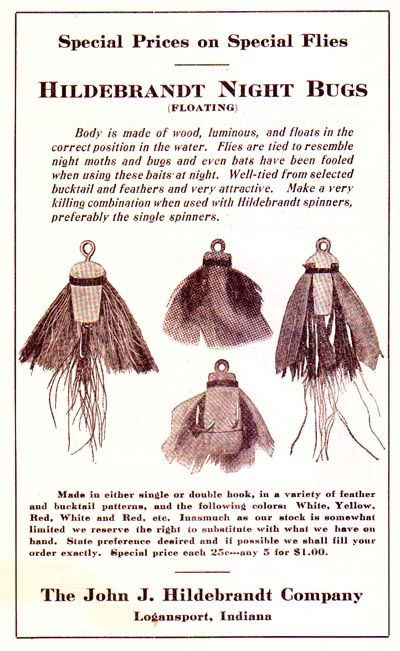
HILDEBRANDT NIGHT BUG AND BUCKTAIL SHINER.- Made by the John J . Hildebrandt Co., Logansport, Ind. These two new lures of the Hildebrandts are right in line with the new era in the fly game. The Night-Bug is tied to resemble a night moth and the yellow, brown and white combination with the luminous body makes a cracking good lure for night fly-fishing. This is a floating fly and used with a small aluminum spinner it makes a strong play for the bass at night and that is the time to get the big ones. The fly is well tied and has twin hooks working out of the under side of the body. The Bucktail Shiner is light enough for the fly-rod and still large enough to be attractive, and the move of the bucktail hair in the water makes a rather enticing lure for game fish. More and more the hair fly will be used and this bucktail minnow tied on a No. 1-0 sneck hook is a pleasing departure from the usual run of flies. This fly is a good lure for a dark day especially and I have found it successful for both bass and trout. Both these lures are well made and tied with the usual skill of the Hildebrandts and for the angler who delights in trying the 'new stuff, and wants to try it with the idea that it will help him land the big ones, these two flies can be recommended as good dope and worthy of the try on the next fishing trip.


Night Bug ad from 1920 courtesy Jim Jordan.


-- Dr. Todd

Thursday, January 8, 2015

Voices from the Past: Dixie Carroll on Wilson Wobblers


Over the next several months, I’m going to feature the fishing tackle writing of one of my all-time favorite writers, Dixie Carroll (Carroll Blaine Cook). These famed pieces of tackle were featured in his great book Fishing Tackle and Kits. They are fascinating write-ups of the tackle from a contemporary perspective. Below is Dixie’s write up on the Jamison Fly Rod Wiggler, one of the earliest true fly rod lures.

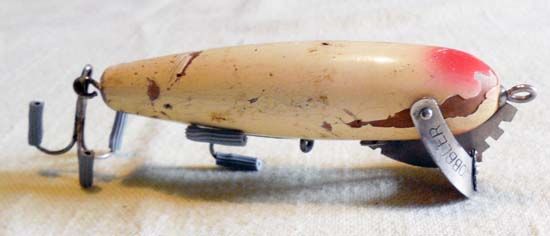
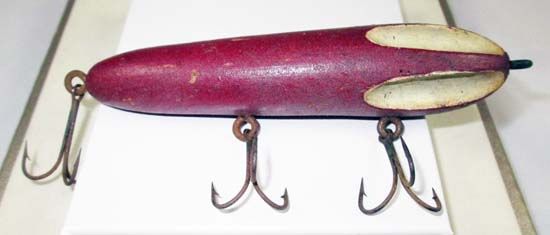
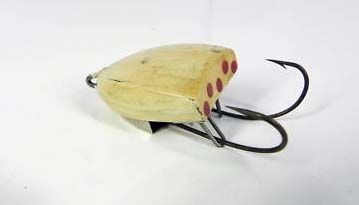
Wilson Wobblers And Getsem Bait.— Made by the Hastings Sporting Goods Works, Hastings, Mich. The whole family of Wilson Wobblers are good baits but the one that stands out way ahead of the rest is the old reliable fluted wobbler. This little old bait has a record as a fish getter that will make the rest of the family wiggle some to beat it. It has the most natural travel through the water possible to obtain by whittling a chunk of red cedar and it darts in through the water in a smooth swing that resembles the live bait to a fare-you-well. I know of many old musky, husky to the weight of from 25 to 35 pounds, that have answered to the last call at the inviting wiggle of the white Wilson wobbler with red flutes. And bass, say old-timer, it makes 'em crazy to get at it. The cupped Wilson wobbler is a good surface bait for the shallows, it travels on the top and has a bit of an erratic crawl that attracts attention, while the winged wobbler dives to a depth of about four feet and is especially good for the warmer weather when the fish are down deep looking for a little cool spot. The Six-in-one wobbler has an adjustable visor that can be moved to regulate the diving depth and make the wobbler do anything from a surface crawl to as deep as a six foot underwater swim and the motion it takes is attractive to the game fins. Of the whole outfit, however, I personally stack my chips on the white, red fluted wobbler, I am never without it on the fishing waters. The Getsem bait is a weedless plug in imitation of a chunk of pork and it can be cast right into the middle of a bunch of weeds or lily pads and come out without bringing the weed bed with it. It is a weedless bait. It should be reeled slowly and make the strike quickly when the fish strikes and don't be afraid to give it a strong strike as the arrangement of the hooks to keep the bait weedless make this necessary. For the weedy places where the big ones hang out, the Getsem is a livewire winner. The whole Wilson family of Wobblers and the Getsem are A-1 in material and workmanship and they are good lures.


Wilson Six-in-One Wobbler.


Wilson Wobbler.


Wilson Getsem.


— Dr. Todd

Tuesday, December 30, 2014

Voices from the Past: Heddon's Baby Crab Wiggler (1920)


Over the next several months, I’m going to feature the fishing tackle writing of one of my all-time favorite writers, Dixie Carroll (Carroll Blaine Cook). These famed pieces of tackle were featured in his great book Fishing Tackle and Kits. They are fascinating write-ups of the tackle from a contemporary perspective. Below is Dixie’s write up on the Jamison Fly Rod Wiggler, one of the earliest true fly rod lures.

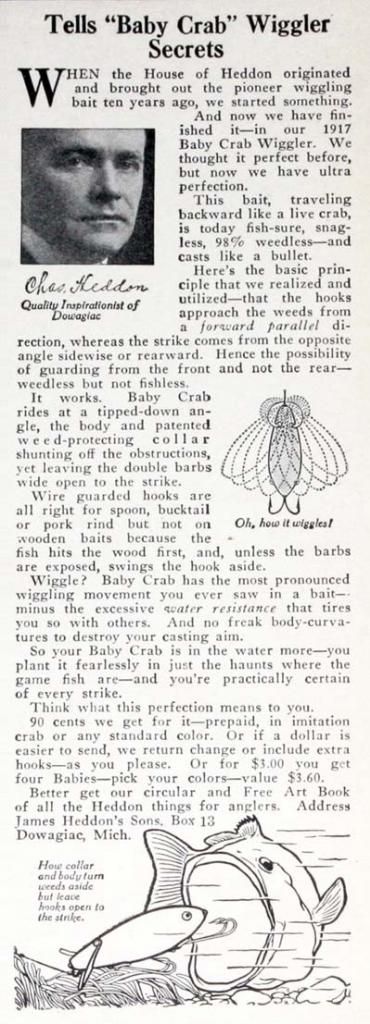
BABY CRAB WIGGLER.- Made by James Heddon's Sons, Dowagiac, Mich. When Heddons thought of imitating the little old crab, that succulent food of the enterprising bass and other game fish, they sure hit the bull-eye right plumb in the center. For a something different bait in the artificial line with a wiggle, dive and crawl of the crab tied up in its make-up the crab wiggler has been making the game fish strike in that swirling curve that almost takes the hair off the head as the game rascals drive into it. I have had very fine luck with the crab wiggler finished in the natural crab color, especially for bass and big wall-eye pike and the smaller baby crab wiggler is a wonderfully good lure for stream bait-casting for small-mouth bass. It is a floater and sure has a great wiggling crawl in the water. I had the best results by working the crab wiggler through a series of short jerks of the rod, that is by giving the tip of the rod a slight jerk, then making a couple turns on the reel handle followed by another slight jerking movement and so on until finally reeled in. About the second jerk, which gives the crab wiggler a sort of backward, darting crawl like the real crab, some old " he-bass" generally gave it a crack and the fun was on. Like all of the famous line of Heddon's Dowagiac baits, the crab wiggler is made right both in material and workmanship. The enamel finish of the bait is excellent and it stands up under mighty rough usage without cracking or chipping. The new scale finish, underlaid with red and with a golden tint to the side scales is a rattling attractive lure any time, while the white finish I have found particularly good for night and moonlight-fishing as well as on a cloudy or dark day. The natural finish crab color makes a 100% winner for fall casting when the crabs have become a bit scarce, although this finish I have found good all through the season. The crab wiggler is a worthwhile artificial in any kit.


Classic Green Crackleback baby crab wiggler.


Baby crab wiggler in downward leaping bass box with papers.


1917 ad for baby crab wiggler.


— Dr. Todd

Tuesday, December 16, 2014

Voices from the Past: Dixie Carroll (1919)


Over the next several months, I’m going to feature the fishing tackle writing of one of my all-time favorite writers, Dixie Carroll (Carroll Blaine Cook). These famed pieces of tackle were featured in his great book Fishing Tackle and Kits. They are fascinating write-ups of the tackle from a contemporary perspective. Below is Dixie’s write up on the Jamison Fly Rod Wiggler, one of the earliest true fly rod lures.

HEDDON's DOWAGIAC CASTING RODS.- Made by James Heddon's Sons, Dowagiac, Mich. The Heddon's split-bamboo bait-casting rod is a mighty fine one and made right all the way through and at the same time you can get it in price from four dollars up to twenty-five and a good rod that does not stagger your bank roll. Even from the lowest priced ones up you get a good rod and the topnotcher is a winner. I have used these rods from the old one piecer up to the No. 15 and they all work well. The bamboo is selected, the ferrules of German sil- ver, shouldered, hand welt and satin finish while the guides are agate and hardened steel. The construction of these rods is on the one-piece demountable style and that gives you a long tip and short butt; this style allows free whip to the tip giving the bam- boo a chance to bend with all its natural resiliency, throwing the bait with practically no strain on the wrist or arm. They are full of action, yet strong and sturdy and a tool that you can handle with pride on any lake or stream. They look and act the part of a thorobred. The fact that the ferrule is set well below the center of the rod, down towards the butt eliminates the chance of breakage at the ferrule as the bend of the rod centers well above the ferrule. Care in selection of bamboo, thoroughly seasoned, and then care and skill in manufacture as well as the Heddon name behind the rod as a guarantee for workmanship and material means that the Heddon rods are right in every way.


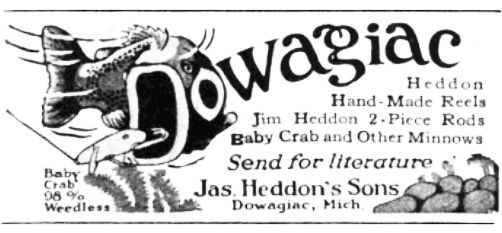
1910 Heddon rod ad.


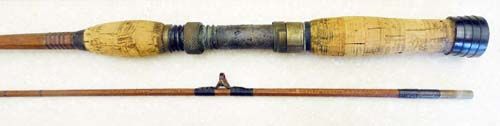
A Heddon baitcasting rod ca. 1920.


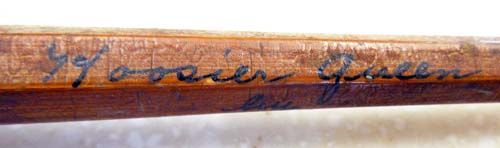
The “Hoosier Queen" by Heddon.


A 1921 Heddon rod ad.


— Dr. Todd

Wednesday, November 26, 2014

A Heddon Luny Frog Dealer Poster


The following image of a Heddon Luny Frog dealer display poster was printed in a 1927 fishing guide. It’s an outstanding image that I am 100% sure was printed in glorious color … the question is, has anyone ever seen this dealer display??? Note the treble hook on the Luny ... it was offered with both a double and treble belly hook direct from the factory.


— Dr. Todd

Tuesday, November 11, 2014

Voices from the Past: The Ocean City Casting Trophy (1921)


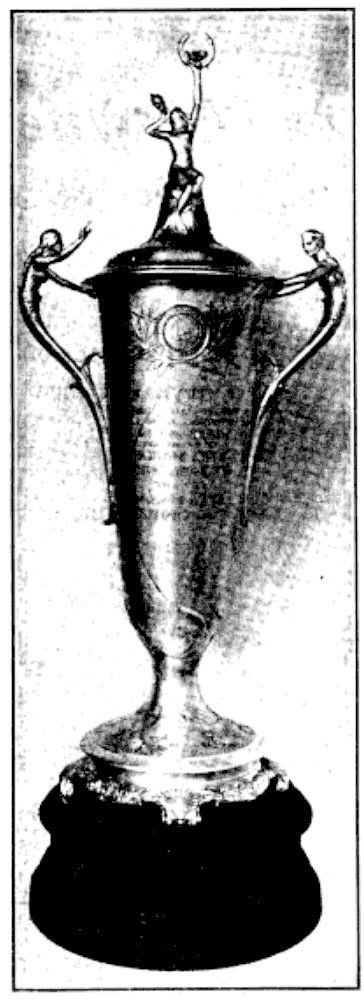
The following article came from the October 26, 1921 Jeweler’s Circular. It covers the creation of a new casting trophy for the Ocean City Fishing Club.

Ocean City Trophy Cup to Be Awarded at Annual Contest in Casting


THE Ocean City Cup, a perpetual trophy for annual competition in casting, which was presented by the citizens of Ocean City, N. J. to the Ocean City Fishing Club, is being displayed by J. E. Caldwell & Co., Juniper and Chestnut Sts., Philadelphia, Pa.

The trophy, valued at $1,500, was made by the Caldwell firm to replace the original trophy which was lost in a fire at Ocean City during the past Summer. The new cup which was finished recently, is a replica of the original which was also designed and made by J. E. Caldwell & Co.


The Ocean City Cup is made of sterling silver. It is 37 inches high and fitted with a cover which is artistically chased with decorations of sea shells and sea weeds. Surrounding the cover is a fully modeled figure of a Mermaid who holds in her right hand a conch shell with which she is calling fish to the Ocean City waters, while she holds aloft in her left hand the emblem of the club enameled in proper colors.

The cup is fitted with two handles, one being formed by the fully modeled figure of a Mermaid and the other of a Triton. The Triton holds in his hand a fishing line, which extends to the lower part of the body of the cup where a fish is shown on the end of the line. The Mermaid on the other handle has her hand extended, protesting against the fish being taken from the sea.

Mounted on the upper part of obverse side of the cup is the seal of Ocean City, X. J., surrounded by sprays of laurel, crossed fishing rods and reels. Below the seal is the following title and inscription: "Ocean City Cup, a Perpetual Trophy for annual competition in casting. Presented by Ocean City, New Jersey, to the Ocean City Fishing Club."

On the lower part of the body of the cup is produced by fine chasing a suggestion of the waters of the ocean through which fish are seen swimming. The base is decorated with sea shells, sea weeds and crabs, suggesting the bottom of the ocean; and the four feet on which the cup rests are formed with an ornamentation of scrolls and conventionalized Dolphins' heads. The cup is mounted on an ebonized base.

-- Dr. Todd

Tuesday, October 21, 2014

Voices from the Past: Remembering Oliver Prouty's Trout (1906)


The following article came from Edward A. Samuels' "Fish Chat" in the April 7, 1906 issue of Forest & Stream. It references a famed fishing tackle man, Lorenzo Prouty, formerly of Bradford & Anthony and later of Prouty & Appleton (which became Appleton & Litchfield soon after it was formed in 1882). Here we learn of Prouty's great reverence in the fishing world. Here we remember Prouty's contribution to fish culture.

In the early '60s there was a gentleman named Prouty, who was a fishing tackle salesman in the establishment of Martin L. Bradford, of Boston—later Bradford & Anthony. He was a genial soul, kind-hearted and generous to a fault, and I verily believe that he did more at that time than any other man in Boston in the way of helping out anglers, both young and old, in making up the kits for their outings, and in giving the advice which was almost always asked of one who occupied a position such as his.

He was an ardent fisherman, and was familiar with the various localities in New England to which anglers resorted. His advice, therefore, as to choice of flies, tackle, etc., for any given waters was accepted as dictum without hesitation.

He had a little homestead near South Canton, Mass., and in a field not far from the house were several springs of considerable volume, which by little brooklets united into a small brook, which flowed down to the Canton Fowl Meadows, finally emptying into the Neponset River.
The water in these springs was as clear as crystal, and even in midsummer was almost icy cold. The lay of the land was such that by erecting a dam at the lower end of the little field, which was almost bowl-shaped, the water could be held back and a pond of several acres in extent could be flowed. After devoting considerable thought to the subject, Mr. Prouty decided to erect the dam and start a little trout pond.

The work was finally accomplished, the pond was made, and eventually it was stocked with fingerling trout. How, when and where he obtained these fish I never ascertained. In those clays trout breeding establishments were not as abundant as they now are; but in some way he obtained them, and hundreds of them, too.

I often visited his little fish farm, and felt almost as much interest and satisfaction in watching the troutlings as did he. They were very tame and accepted food from his hands. Those little fish grew apace, and as the months went by and a year had passed, attained a length of six inches, and Mr. Prouty's undertaking seemed an unqualified success. But, alas! fatality came, and in a spring freshet of unexampled height and force, the dam was carried away, and the pond, together with its valuable stock of trout, were swept down the former bed of the brook and soon disappeared into the river. At that time the Neponset was the abiding place of great numbers of pickerel, huge fellows, too, some of them were, but any and all of them were large enough to pouch a sixinch trout, and without much effort, too; and it was decided by all who knew of the accident, that Mr. Prouty's fish had become victims of the merciless "shovelsnouts."

But one day, greatly to my surprise and satisfaction, I discovered that all the trout had not become food for the pickerel. I was snipe shooting on the Fowl Meadows on a morning in September following the accident, when, as I was moving along by the side of a large brook which emptied into the river some three miles or more below Prouty's stream, I saw what was unmistakably a trout dart up the brook and disappear below the shelving edge. I was greatly surprised at this discovery, for never before had I known of a trout being seen in that brook.

The stream was, in most places, nearly six feet in width, and was full of deep holes and excavations in the banks of a foot or more in depth. It was by all odds the largest brook that emptied into the Neponset anywhere in that neighborhood, and it was of no mean dimensions for a length of several miles, and took its rise, I think, somewhere in South Dedham. To make assurance doubly sure, I followed the bank of the stream a considerable distance, stamping heavily on the sward as I moved along, and it was with no little gratification that I succeeded in dislodging from their lurking places .1 half dozen or more of the trout, which darted up the stream and hid themselves from view. It is hardly necessary to state that, armed and equipped with rod and creel, I hurried to the brook on the following morning, and before the shades of evening fell, I succeeded in picking out a dozen or more of Mr. Prouty's trout, and on several occasions afterward made two or three more catches of quite satisfactory dimensions.

Now, that these fish should have run the gauntlet among voracious pickerel through three or four miles of river, and succeeded in finding and establishing themselves in the onlybrook of considerable size and purity of water there was for miles in any direction, and that, too, under the most adverse circumstances possible, for the meadows had been heavily flooded by the spring freshet that swept the dam away, seems to me a remarkable instance of the adaptability of this species to a complete change of conditions and environment.


-- Dr. Todd

Tuesday, September 23, 2014

Voices from the Past: Fly Rodding for Bass (1917)


The following neat article on fly fishing for bass appeared in the July 1917 issue of Forest & Stream. It’s an early and interesting article on one of my favorite past times, fly rodding for bass.

Fly Fishing for Black Bass

By JOHN BARLOW

We shall soon be thinking pleasantly of our favorite streams and lakes, where that lord of the waters—the black bass—is to be found. When the tackle box is being packed make room in it for a few flies; they will not add much to the weight of your tackle, but they may make a surprising difference to the weight of your creel.

There is an idea amongst men who have never used the fly for bass that only small fish can be caught in this way. But that is as true of any other way—the big fellows are not caught every time on any kind of bait. I have caught bass weighing four pounds on a fly, and no doubt many other fishermen have caught much larger fish in the same way. I find, too, that many have discarded the fly because they had no luck with it. When I see some of the contraptions that are sold as bass flies I am not surprised. One may as well bait his hook with a submarine.

The outfit for catching bass with the fly is very similar to that used for trout fishing: the only difference is the rod should be a little longer and heavier—say a rod weighing about seven ounces and ten feet long. The leaders should be six feet, and, of course, a little stronger than one used for trout.

THE flies should be large trout size, a number 5 or 6, tied on a Sproat hook. These are the sizes with which I have had most success. The usual bass fly is much too large and heavy and can only be used successfully as a troll with a spinner. This, I believe, is the reason why some have failed to get any good results with the fly—it has been too big. The four flies that have filled my creel, or helped in that direction, are Scarlet Ibis, Dark Montreal, Jock Scot and Royal Coachman.

This list might be lengthened considerably. Any fisherman could add some good flies to it; I am simply naming those that have done me good service. I would say to the beginner: Get these four flies to start with, have them tied on different size hooks, from Ss to 8s. A variety in size is far more important than a variety of colors.

Cast them as you would for trout and you will get fish in almost any lake or river. I have caught more bass on the Scarlet Ibis than on any other fly, and nearly always have one on my cast. Early in the season bass will often rise better to the Royal Coachman or Jock Scot, but about July the Ibis always takes the biggest fish. From about the middle of August the fly season is practically over — the fish have gone into the deeper water, and then it is more profitable to go after them with bait.

It is best to fish the fly from a boat, keeping about sixty or seventy feet from the shore, then one can fish both ways— towards the shore and the deep water. Get someone to row the boat and let him push you first, then cast to right and left ahead of you. If no one can be found to do the rowing let the wind drift your boat in the desired direction; should this carry you too fast lower your anchor stone about three feet; this will reduce the speed and steady the boat. When you come to a good place anchor your boat and fish all round, not fearing to cast three or four times over the same water.

The best places to fish are the rocky bars, any wall or disused pier. On a hot day cast around trees that overhang the water or near a boat that has not been used for some time. Do not pass any lily pads or the roots of sunken trees without casting over them. Above all, if there is a solitary post that sticks up out of the water, cast round it every time you go that way. You will often get some good fish there.

Early in the season do not hesitate to fish in a foot of water if it is on a quiet and rocky part of the shore. I have seldom had much success in water over twelve feet deep, though flies can be trolled over almost any depth of water, and at times with great success. In casting the flies it is best to let them sink two or three inches and retrieve them slowly. A gentle ripple on the water is very helpful, but it must not approach roughness. I have never had any success in a high wind, with rough water, on a lake.

The best time with the flies is from about 3 o'clock in the afternoon till an hour after sundown, though some of my friends have done well fishing in the moonlight; but then you need the larger flies. The best time of all is the afternoon, before the break comes after a spell of dry hot weather. Then bass will take flies as trout take worms when there is a freshet in the brook. If you are not a good weather prophet always take your flyrod with you and try a few casts every day.

If you have never had a healthy two pound bass on a flyrod with seventy feet of line out there is something owing you that I trust will be paid before this season closes.

— Dr. Todd

Tuesday, September 16, 2014

Voices from the Past: James Grant (1878)


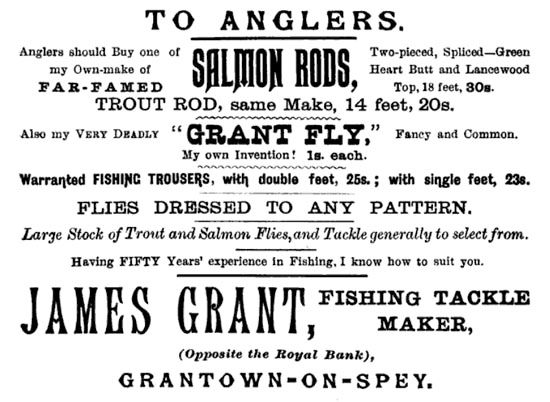
There is nothing more delightful than coming across a reference to a fishing tackle maker in an unexpected place. In my “other job” as a history professor I try to keep up on recent research. A fairly recent book I picked up called Gwen Raverat: Friends, Family and Affections by Frances Spalding had been on my reading list for some time, as I waited for my recovered hard drive to boot I decided to read it. Raverat was the granddaughter of Charles Darwin and an active member of the Bloomsbury Group, as well as being a fine writer and artist in her own right. It’s a great biography enhanced by the fact on Page 9 we get this reference:

In 1878 James Grant, a fishing tackle maker, wrote to [Charles Darwin], wanting to know whether or not his discoveries had destroyed the evidence for God, as found in nature’s phenomena. Darwin’s reply is lost; but from Grant’s subsequent letter it is evident that Darwin had replied in a “kindly spirit” with a solution that neither upheld nor destroyed his correspondent’s beliefs but encouraged independent thought. “I do not feel,” Grant replied sadly, “that I can plan any reliance upon instinct or intuition in relation to the existence of God.”

Grant was one of the legendary Spey rod builders and, as the ad below from the book Grantown and the Adjacent Country: A Guide to Strathspey (1895) shows, active in all aspects of the tackle field. That he was an inquisitive and intelligent man goes without saying.


— Dr. Todd

Tuesday, September 9, 2014

Voices from the Past: A Grenade Launching Rig (1945)


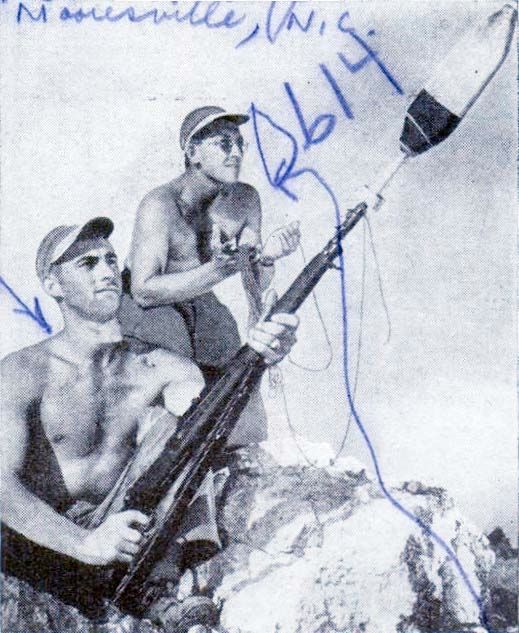
The following blurb, entitled "Grenade Launcher Casts Line for Yanks Fishing in Pacific" features a novel way of fishing. The two soldiers pictured were Robert R. Sloop of Moorseville, NC (left) and Thomas P. Williamson of Padua, Kentucky (right). It was published in Popular Mechanics in January 1945.


Deep sea fishing, wartime style, at an Air Force base in Mariana islands is accomplished by adapting the line-carrying wooden float to a regulation grenade-launching rifle and shooting it out into the surf. The discharge of the combination hunting-fishing weapon carries the baited hook and line 200 yards.

-- Dr. Todd

Tuesday, August 5, 2014

Voices from the Past: An Elementary Course in Fly Tying (1922)


I like vintage articles on fly tying like this April 1922 piece published in Hunter-Trader-Trapper. It's a nifty overview of fly tying with a great first sentence.

AN ELEMENTARY COURSE IN FLY TYING

Fly fishing is an art in itself. It is the poetry of fishing. Fly tying is more or less of a cult. Many are the fishermen who play the game the year round. When not fishing they are creating patterns to experiment with. The thrill is complete when the big fellow is enticed by a dainty fly built for the purpose.

Fly tying may well be divided into three fundamentals—tools, materials, and the operations necessary to dress the fly. Each will be considered in the order of mention.

The tools necessary to successful fly building are not many nor expensive. A jeweler's pin vise may be purchased from any supply house that deals in such articles. This vise should be mounted on a small board by tapping out the end so a bolt can be passed through the board. The board may be clamped into position on the edge of a table by use of a small wood clamp. A small pair of scissors, a pair of tweezers, a safety razor blade mounted in a block of wood, a stubbing needle made by thrusting a large needle eye foremost, into a handle, a small clamp that opens when the sides are compressed and hold when they are released. The latter is necessary to use as hackle pliers. A snooding wax is convenient to coat the tying silks. This wax may be made by the following formula: Five parts Burgundy pitch, two and one-half parts white resin, one part mutton tallow. Melt together in water baths then pour into a basin of cold water. Work by pulling like candy until ready to shape into sticks.

Now we are ready to gather materials. We must sort of dissect a fly, or the fly to be patterned after, to know what material is necessary.

A fly is divided into the tail, the tag, the body, the heckle, the wings and the head. The tail is the few strands of feather that protrudes at the bend of the hook. Next to the tail or at its base is a narrow band of tinsel, silver or gold, or a bit of silk different in color from the body. Now the oval shaped body that extends about two-thirds of the distance of the hook from the tag. The body may be made of several materials: floss silk, or rope silk, yarn, dubbing (which is hair or wool teased out and twisted around a waxed thread), herls (which is the strips of the ostrich or peacock plume), and chinelle are all extensively used in body building. Combinations of color and ribbing may be worked out as in the drakes, palmer flies and the McGinty or bee.

The hackle is the legs of the insect. Hackle feathers are obtained from the neck and back of the barnyard rooster. Often, however, feathers from the hen are used but they are not so easily worked as they are softer and the strands or herl will not separate so easily. Grouse, guinea hen, quail, pheasant, all furnish some hackle feathers. Often it is necessary to resort to dyeing the rooster hackle. This works no hardship as a quantity of different colors may be dyed in a little while.

The wings are from many sources. It is best to use natural color wings and so a variety should be collected. All wild duck pelts for the feathers are especially desirable. The duck feathers have the oil in them that make them water proof. Domestic fowl and all wild game will supply some useful feathers. The gathering of a stock is fascinating and when you inform your hunter friends of your new hobby they will swamp you with feathers.

A small quantity of good shellac dissolved in grain alcohol and a spool of 000 silk completes the stock of material except the hooks.

Do not use the ordinary cheap hook. You are wasting time on them. A trout loses no time in expelling a fly after he discovers the deception and the hook must set and hold. The turned down eyed English hooks are not excelled. The shape depends on the angler's fancy. Stock in some from size twelve to fours.

Now let us tie a fly. A well known universal for trout or bass is the Professor. He is diagnosed as follows: Tail, red ibis; tag, gold; body, yellow ribbed with gold; hackle, brown; and wings, grey mallard.

Catch the hook in the vise at the bend. Cut a few inches of rope floss and untwist it. Smooth the silk strands into a solid mass. Wax well some fifteen inches of the 000 silk and fasten it with a few turns to the hook at the place where the tail is to begin. Now place the tail, the silk for the body and the gold tinsel for tag and ribs on the hook, ends toward the head and fasten with a few turns of the waxed silk. A half hitch or two will help hold these secure. Now wind the body loosely at first along for about two-thirds of the distance toward the head and then turn with other windings according to the size of body desired. The last wound tight to make the body solid. The tying silk is now hitched around the end of the body and the surplus floss chipped away. The tinsel is now wound a turn or two at the tag and then' around the body to the head where it is likewise tied off and chipped.

Now a couple of brown hackle feathers are selected. The down at the quill end is stripped off and holding the feathers by the tips they are stroked downward to separate the fibers and make them stand out They are now caught at the tips and fastened at the end of the body. Holding the fibers straight out from the hook wind slowly around, smoothing the fibers toward the tail to prevent the binding of them. When your judgment tells you the fly has enough legs tie off the hackle. Pick out all fibers caught underneath in winding.

There should be left a vacant space between the eye of the hook and the hackle for the wings. You may use a match wing as two feather tips that fit each other in shape and color or a piece of the web about one-half an inch long clipped from a mallard wing or tail feathers. If a web is used double it and hold by thumb and forefinger on edge just above the hackle. Bind securely with the silk that should have been carried through all operations underneath the work, and is now protruding from beneath the hackle. Place a bit of shellac at the tie on the head of the fly and lay aside to dry.

It will no doubt seem a hard job to,get the knack of fly tying, however, after a few attempts the operations will 'become easier and soon you can tie a dozen or more in a short while after dinner.

Confidence in a fly when fishing it will help catch the fish. The fish will rise to a fly well handled and no fly will be well handled unless the caster believes it will attract fish. Many are the variations you can work into your fly when tying it that the other fellow who designed a similar one never thought of. A study of any pattern will show its construction. You can tie them all, but do not be entirely a copyist, but, create for your own satisfaction.


-- Dr. Todd

Tuesday, July 15, 2014

Voices from the Past: Samuel Camp (1909)


The following piece by Samuel Camp, noted outdoor writer, entitled "The Reel and Its Handling" was published in Outing Magazine for April 1909. Its subject was the multiplying reel, which by this point had become commonplace. It's a neat overview of the outdoor writing style of the day.

Contrary to the ideas of a good many anglers the speed of a quadruple reel is strictly not for the purpose of getting in the line as speedily as possible, thereby endangering tackle and courting the loss of a hooked fish, but merely to facilitate casting. The gearing of the reel, four revolutions of spindle to one of handle, is such that, in practiced hands, long casts are easily made. In the handling of the quadruple reel the most common mistake is to keep the reel constantly in an upright position. The rod should be so held that, in casting, the sides of the reel are almost parallel with the water, the rod being turned in toward the angler. In this way the reel reaches its highest efficiency and, too, the friction of the out-running line against the rod is reduced to a minimum. The quadruple reel most suited to baitcasting is long in the barrel and of small size. When choosing a reel of this sort it should be remembered that, for casting purposes, only very fine lines are practicable, "tournament," size H, or the very largest line that will give good results and the one most used in fishing, size G. So the reel, to hold fifty yards of regular casting line, need be no larger than the size known as "sixty yard." The use of a small reel is very desirable since it tends to lighten any outfit, and it is especially desirable for use on split-bamboo casting rods under six feet in length, since these rods are usually of very light weight. The angler should bear in mind that a good quadruple casting reel is built like a watch —watchmakers made the first Kentucky reels and their descendants are still at it— and that while it will indefinitely stand intelligent use, it will most certainly not stand abuse. The reel should be oiled at intervals, but only sparingly so as not to flood the mechanism. Also it should be kept clean outside so that small particles of sand or other matter may not work in; and at times, the inside mechanism should be cleaned, but this should be delegated to the maker or some professional—the average amateur has mighty little business with the "insides" of a casting reel. German silver is the most satisfactory material, and it is preferable to have a casting reel of solid metal. For the single-action click reel, german silver and hard rubber is recommended; the metal being placed in the form of a band around the outside of the reel plates to guard against cracking the rubber in case the reel is accidentally dropped.

The uses of the double-multiplying reel are many, and the average fisherman, who is neither a bait or fly-caster, usually employs this sort of "winch." It may be used to advantage in worm fishing for trout with a regulation bait rod, that is, a rod with reel-seat above hand-grasp, and also in still fishing for bass or other fishes. For trolling purposes the double multiplying reel is preferable to the four-multiplier, for the reason that as you increase the speed of a reel there is a resultant loss of winding in power. The chronic bait- or fly-caster is usually too nervous and restless, as a consequence of the activity of his favorite angling methods, to be a good still-fisher; and so, when casting the minnow, artificial bait or fly fails to interest the fish, he generally resorts to trolling. The retrieve of the single-action reel is much too slow to handle efficiently the usual long line used in trolling.

-- Dr. Todd

Tuesday, July 8, 2014

Voices from the Past: The Tarpon (1905)


The following selection is from the March 1905 Outing Magazine, and features the great Tarpon -- one of the cagiest and most powerful saltwater game fish of all time. It was written by Edward H. Hudson and was entitled "The Giant of the Mexican Gulf."

THE GIANT OF THE MEXICAN GULF

By EDWARD H. HUDSON

A dozen years ago our stock of knowledge relating to the tarpon, or tarpum as it is sometimes called by sailors, was very limited, and practically nothing was known of it as a game fish. It is only within the past five years that close, accurate and systematic study has been made of its nature and habits, and even yet our knowledge is far from complete; there remain some doubts to be cleared away concerning its winter habits and home; and there are some disputed points to be settled among anglers in regard to the most successful and sportsmanlike manner of taking.

Tarpon fishing had been engaged in to a limited extent in the waters of the Florida shore for a number of years in a precursory way, but it remained for Mr. E. M. K. Green to conceive the idea of organizing a Tarpon Club, making original investigations and giving the tarpon its deserved place on the list of game fish.

The site chosen for the club house was the little island of St. Joe, which is thirty miles in length and in width varies from one to three miles, being off Rockport's eastern shore is washed by the Gulf of Mexico and its western beach is swept by the swift and treacherous currents of Aransas Bay — a narrow strait separating it from the mainland of Texas.

It was stated in a book on fishes published in New York in the year 1884, that no man was strong enough to hold a tarpon unless provided with some kind of drag or buoy attached to a hand line. In the light of recent accomplishments in tarpon fishing this statement appears to have been made without much observation or foresight. A tarpon over six feet in length has been taken at the Texas Club by a boy under thirteen years of age, and another as large by a woman weighing less than ninety pounds. Mr. Robert Grant, in 1896, said that no less than one hundred tarpon had been taken with rod and reel. So we see that tarpon fishing was yet in its infancy in 1896. In the "Encyclopedia of Sport," published in England in 1897, it was stated that at that time something like two thousand tarpon had been taken, the largest of which was 7 feet 2 inches. During the first season at the Texas club, according to its official bulletin for the year, two hundred and forty-two tarpons were landed by members and guests of the club. The catches to date number 2,961. The shortest time made in a catch, according to the records, was ten minutes, and the longest six hours. The largest catch to date was made by Mr. C. W. Dawley, of Dallas, Texas: it measured 7 feet 10 inches and weighed 175 pounds, girth 42 inches. The smallest catch was in length three-fourths of an inch and weighed 17 grains.


-- Dr. Todd

Tuesday, July 1, 2014

Voices from the Past: An Ancient Reel


The following article is from the Sept. 1, 1900 Forest & Stream magazine and features a writer up of a purported 1830s fishing reel. It was penned by the magazine's editor A.N. Cheney.

An Ancient Reel.

A gentleman who has on several occasions furnished me with interesting information on fishing subjects, has put me under fresh obligations by sending me an old fishing reel, of which he says: "The reel was given to me by a man who told me his grandfather made and used it seventy years ago. The man is now forty years old, so it is quite probable. I do- not know that there is any particular history connected with the reel or whether it ever helped any one to land a fish. You will see that one of the bars which hold the disks together is removable by taking out two screws in either end, and when the bar is removed a screw driver can be inserted to reach a screw hole in the reel seat, and this makes it evident that the reel was fastened to the butt of a rod with a screw. Reel seats were probably not in use when this reel was made, or if so the maker did not know of them. I think I would prefer to fish with a hand line than such a weapon. Do not sent it back, as I will present it to you as a relic of old times."

If my correspondent had said the reel was reputed to have been made 170 years ago, the reel itself bears no evidence to dispute it. The disks are of brass and the spindle a bit of iron wire bent on the outside to form a crank handle, and the reel has no click or check of any sort, but otherwise it closely resembles a modern reel in form. The bearings of the spindle are much worn, and other indications are such as to convince me that the reel has seen much service. I think a proper abiding place for this relic is the case in Forest And Stream office, and there I will send it to bear witness that long ago some enthusiastic fisherman made for his own use. in all probability, a reel that was "the best he knowed."

-- Dr. Todd

Tuesday, June 17, 2014

Voices from the Past: Heddon (1906)


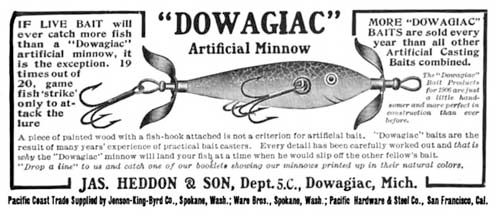
The following article was published in The Western Field: The Pacific Coast Magazine for April 1906. It contained the accompanying ad which is an interesting piece of Heddon history in its own right. It's certainly hard to believe today, but in 1906 lures were still considered a "novelty."


SOMETHING NEW IN BAITS.

A most artistic book showing the famous "Dowagiac" casting and trolling baits and their peculiar blended colors, is being distributed this year by Jas. Heddon & Son. of Downglac. Mich., whose advertisement appears in this Issue. The color plates, which must cost many hundreds of dollars, are simply perfect, and the perfect workmanship of "Dowaglac" bait is shown in a perfect piece of printing. Every sportsman will be interested in seeing this exceptional booklet. It will be sent free on request by Jas. Heddon & Son.

These manufacturers have certainly established themselves generally in the good graces of sportsmen throughout the United States and Canada by the high quality of their novel and unique productions. They have established a new standard in design and quality, all their products and their goods representing the very highest attainment in fishing tackle productions.

Reports reaching us from many parts of the country indicate that lovers of the rod are breaking records with the use of the "Dowagiac" casting and trolling halts. The advantages of artificial bait are being conceded more and more even by those who formerly thought that live bait alone served the best purposes. It is pretty well known that in the great majority of cases game fish strike only to attack the lure, and if the artificial bait is made right It will attract more fish and certainly will keep the fish on the hook when he might slip off ordinary bait.

A piece of painted wood with some twisted metal attached is no criterion for artificial bait, and the sportsman cannot judge the value of artificial bait by any such standard.

A perfect trial with the right kind of artificial bait quickly convinces you that you can catch more fish and bigger fish than with live bait, not to speak of the many conveniences of the artificial bait.

We are glad to say – and most sportsmen will agree with us – that the Dowagiac casting and trolling baits represent the acme of fishing tackle productions. The manufacturers Jas. Heddon & Son, of the Dowagiac, Mich., have set a new standard in the design and qualitv or their products. This year they are issuing a book showing their minnows from beautifully blended colors, the printing of which cost many hundreds of dollars. These color plates are as perfect and beautiful as any we ever saw. "Drop a line" to Jas. Heddon & Son Dowagiac, Mich., and you will catch one of the booklets.


-- Dr. Todd

Tuesday, May 6, 2014

Voices from the Past: A Tour of Abbey & Imbrie's Fly Factory (1897)


The following description was published in the June 12, 1897 issue of Forest & Stream magazine, and describes as well as anything to date a trip through a fly tying factory in Brooklyn. The fly tying factory was that of Abbey & Imbrie, the well known tackle house of Fulton Street.

IN A FLY-TYING FACTORY.

While the angler of this country stands far ahead in his expertness in casting the fly, it is very doubtful if many know much about the surroundings of the art of fly-tying, or that there is in New York city the only fly factory in this country, and that it is the largest in the world.

At one time Great Britain held the palm for artificial flies and exported them to this country. Now the American flies are exported to England. The superior system of supervision of every process of manufacture and inspection of the finished product is one reason for this; but, undoubtedly the method of "team working" almost universally employed in England is largely to blame for the loss of their trade. By team working is meant that the fly-tying is done at the tenements of the workers and not in a regular factory. In this way one family will, for example, work for years on a very few patterns, and this work becomes mechanical and the tiers lose all interest in it.

In this factory the workers are recruited from the vast population, and no one is employed who does not seem to bd likely to take an interest in her work and who is not pretty well educated. Add to this, the American (as in most business) is on hand personally looking after every detail in his factory, pulling the loose ends together, active and intent on getting the very best individual work he can out of bis intelligent help.

The factory is on the top floors of a building with the best of light and ventilation, and the first section is the feather storage, where in tin-lined bins are stored feathers from almost every known bird of brilliant plumage, Europe, Asia and Africa not excepted. These are divided in the first instance into skins of seafowl and landfowl. The former are most preferred for flies wherever their colors are right, because of the greater amount of oil contained in them, which renders the fly more serviceable and more durable in the water. These feathers are bought from every available source, and so hard is it to keep an adequate supply of the smaller types that it is necessary to carry a stock for four years at least. There is no known or recognized market for them, no set price; the manufacturers find a supply here, there and everywhere, and fix the price according to the quantity. For instance, the barred feathers vary from a quarter of a cent to four cents each. These bulk feathers have to be carefully selected and sorted by girls trained to the work, and they are sorted first to colors, then to quality, then to size. The quality is determined by the closeness of the bars to each other. The size ranges from "14," which are about 1/2 in. long, to "2," which are about 4 in. long; these numbers representing the size of the fly they are intended for. Very few feathers are died, the bulk are used in their natural colors. It takes a girl about twelve months before she is considered competent, as the eye must be educated to' tell the distinction between the close running numbers at a glance. Roughly speaking, there are every year about 150 girls taken on for the various departments, to eventually become fly tiers, and out of these not more than ten have the requisite delicacy and quickness of eye and hand.

When the girls sit down to tie, there are ten girls to every hundred told off simply to wait on the fly-makers and bring them the various supplies called for; and these ten girls are kept hustling all the time. The hooks with the gut snells attached are taken in hand, and with the low-priced flies the body is first formed by deftly wrapping around the shank a piece of suitable worsted, this being the base, in varying colors, for the majority of that grade; then a strip of feather is taken of the type suitable for that particular fly, and this is wound around the upper part of the body, so that the quill section (if one may so term the film of skin) lies its full length next to the body, while the bars of the feather stand out in every direction direct from and at right angles to the body like the spokes In a wheel. This sounds very easy, but it is quite a trick to do it properly, and on this point depends the ultimate success of the fly. Then the wings are added, these being another strip of feather bars, deftly tied so that it stands up behind the collar-like strip just adjusted, at an angle of about 45°, and this effect is secured by a peculiar twisting, whipping and knotting of the silk which holds the tiny artistic creation together. While the British files have wings lying almost flat on the shank of the hook, the American fly has wings standing well up; this being necessary by reason of the more rapid streams in this country.

In the higher class of fly this process of manufacture is reversed to a great extent. Then the bronzed hook, specially tested for temper and strength, having a full hollow point, is taken, and the wing is at once whipped on to the shank, lying flat forward from the barb; then the body of chenille, etc., is whipped on securely, then the tinsel, or whatever the species calls for, and then, the body completed, the wing is bent backward and whipped in its proper position. Thus each portion is separately whipped, and all doubly whipped by the finish at the head, which is then cemented and varnished.

A girl can tie five or six dozen per day of the high grades, and of the cheaper grades a good worker ties from twelve to sixteen dozen per day. This record varies much according to pattern and minutia.

It is found necessary to take all these precautions of separate tyings, cementings and varnishings to make the fly as strong throughout as possible, for none but a fly manufacturer, possibly, fully appreciates the terrific strain placed upon a fly quickly whipped through water, a pressure to the square inch which nothing but the natural elasticity of the feather enables it to bear.

As to the designs of the flies, they are almost all modeled on some insect or bug in nature, the exceptions being certain combinations of colors which have, for some little grasped reason, proved successful in the past. Now a new feature is being taken into consideration, and that is the appearance of the natural fly when wet, and the appearance of the artificial fly when wet. In the water most blues become nearly black, reds become purple, yellow grows several shades lighter, etc., etc., according to the water, and if the insect has, for instance, a pale blue fuzz on a gray skin, and the fly should have a pale blue wing rather long and a slightly darker blue body, in the water it will look to have a body almost black with the wings widely different from the natural insect.

The flies made vary from the tiny "midge" to the great flies which would overlay a dollar; and these are all for trout. The flies for Colorado and Montana are nearly all whipped on double hooks which point out in opposite directions about Jin. apart. The most gaudy and impossible-looking specimens, which go to country sections, where there is a demand for them which must be filled, and which are of little use anywhere else in this country, prove good killers in Maine, where the waters are deep, clear and cold. These are the Silver Doctor, Jenny Lind, etc. The very large flies go mainly to Canada and California, and the Northwestern States, where there is very rapid and deep water, and the fish are plentiful; but an Eastern expert would look askance at any fisherman using them in Long Island waters. In the very high priced flies many designs are special, invented by private individuals, who in Europe would carry their own kit and tie them themselves, but who in this busy country of ours have neither time nor inclination so to do.

Some little idea of the detail in manufacturing flies may be gleaned from the fact that at this factory there are turned out every year about 5,000 flies of different kinds, qualities and sizes, and that each individual one of these is made (with few exceptions) in about 500 varieties, such as sizes of hooks, quality of gut, etc., etc , and that about 10,000 of the more commonly asked for varieties are kept in stock from day to day.

When the flies are completed, each separate one is passed before an inspector and inspected for flawless gut, perfect knotting of snell, perfect whippings of fly, perfect cementing and varnishing, and then goes down stairs into stock with a number which shows who made the inspection; and so, if after the flies have been sold and guaranteed as perfect, anything is found wrong and the customer returns the card, etc., which bears the faulty fly, the poor work can be immediately traced. This system works as a preventative and complaints are very few. This is not done in any European factory.

Eighteen years ago Mr. Imbrie (of Abbey & Imbrie, the proprietors of the company) went to Spain and made arrangements for securing proper and adequate supplies of silkworm gut. This gut on which the fly-hooks are snelled plays an important part in the factory, and is all imported from Europe, being the sac in the silkworm, which nature gave it to generate the silk. These sacs are withdrawn from the insect, and then, tightly held between the thumb and finger of each band, are stretched to about 10 or 12in., in fact, as long as the gut continues round, this being continually tested by the tip of the tongue of the operator, both hands being employed. Quality is roundness rather than weight, and as long as it is round the area of tension is more evenly distributed and the grain of gut uninjured. Thickness only indicates great strength when round, and a flat gut of great width is weaker than a thin round gut as a rule; The quality is judged by appearance, freshness, etc., and it comes ten bundles in a hand, selling by the 10,000. When these are received at the factory each bundle is opened and sorted in sizes as near as possible, and then goes to the knotter, who makes the loops at the opposite end to the hook, drawing them tight over a screw hook in a bench, thus cutting the ends very close, which when the gut (being soaked before tying) dries out, is as hard and tight as if welded. The leaders of various length are no longer lashed in the old way, but by means of a new process are closely whipped and cemented with a waterproof composition which becomes harder with age and more perfect in every way.

It may be remarked that the annoying "snapping" of the fly, breaking it off the line when casting is occasioned, as is well known, by the caster not letting his line get a perfectly straight extension before whipping it forward, but there are also other reasons. One is that the gut is too dry, and that if the gut had been adequately soaked before casting this annoyance would be minimized. Another feature is the new reinforcing of the gut for the higher priced flies, which by bringing the gut back to the free snell, strengthens the snell just where it "snaps," and incidentally gives it a certain stability which makes it "drop" better and straighter. Every piece of gut in this American factory is graded to the hook on which it is to be used, and this is done nowhere else in the world.

Thus the American fly presents almost perfection of art, graded feather, graded gut, graded book, scientific reinforcement of weak parts, waterproof cementing and greater spring to the feathers by reason of their adjustment, rendering the. domestic trout fly, as claimed by the enthusiastic manufacturer, a work of art not ranking behind the paintings of the old masters. In conclusion, the prices of these flies range from 18 cents per dozen to the fisherman, up through the grades of 25, 40, 45, 60, 80 cents, $1, $1.50, $2, $2.50, and salmon flies from $4 to $12 per dozen. Think of the endless detail of the skilled work and then look again at the prices.


-- Dr. Todd

Wednesday, April 2, 2014

Voices from the Past: The Huffman Saddle (Baby) 1909


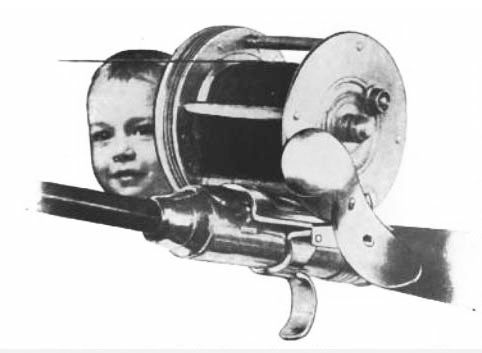
The following blurb was published in the October 1909 Field & Stream magazine. It is a description of one of the many new devices intended to help avoid backlashing reels, in this case the Huffman Saddle. But that's not why this is interesting; take a look at the image.

What's the deal with the baby? Seriously. Why would they have put a baby's head behind the reel? What image is this supposed to bring to mine? It just defies logic.


The copy read:

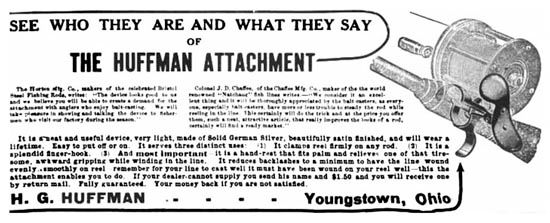
Something of especial interest to anglers is here illustrated -- the Huffman attachment for reels, manufactured by H.G. Huffman, 100 Federal Street, Youngstown, Ohio. Its uses are threefold: it is a reel and rod support, a finger-hook, and a positive reel lock. Moreover, it greatly facilitates laying the line out smoothly in reeling, and it is therefore a decided help in bait-casting, doing away with the tiresome gripping to hold the rod in proper position. In such work the hand tires before the arm, and that which should be sport becomes weariness. Though the fishing season is waning, another year should find us prepared, and it is therefore advisable to know something of this device. Write the makers for circulars.

Later in the issue, as was so often the case, there was also a Huffman ad, reproduced below:


-- Dr. Todd

Tuesday, March 18, 2014

Genio Scott, the First Anti-Spearing Advocate?


Ice spearing is still a fairly controversial subject. Some feel it takes too many large fish from a body of water, and that it isn't sporting. Proponents point out the long history and tradition of spearing. The following commentary, from Genio Scott's Fishing in American Waters (1869), is one of the early attacks against this practice.

Throughout the interior of our vast territory there is an ornamental tracery of running, sweet, and healthful waters, well supplied with food-fishes. The working of these waters is free to all fishermen, with the unimportant exception of a few depleted rivers, consequent on their having been overworked, but which are now being restocked and protected by legislative enactments during the process of recuperation. These are all near the sea-board. The lakes and lengthy rivers of the interior are still free; and where no regular fisheries are established,the inhabitants take what fresh fish they want, either with the angle, net, or spear. The poaching proclivity of some indolent persons has induced them to use the spear too freely in our small lakes during winter. In the State of New York there is a law against it, with fine and penalty attached, but it is still done in defiance of law. These poachers erect a board shanty on sleigh-runners, furnished with a foot-stove, and a hole in the ridge of the roof for the spear-handle. This shanty they draw out on the lake, cut a hole through the ice under it, lock the door, and commence spearing all the fish that come near their hole. If the constable raps at the door, no reply is meant to signify that the occupant is absent. Thus poachers squat in villages on our lakes in winter when the ice is thick, and spear the fish at a season when they are unwholesome for food. In Canada, for attracting the maskinonge to the spear, in one hand the poacher holds a line attached to an artificial minnow, which he keeps playing in the water, while with the other hand he holds the spear. The maskinonge darts to within a foot of the minnow, and, while hesitating there, the spear takes him.

-- Dr. Todd

Tuesday, March 11, 2014

Voices from the Past: Sports Shows and 'Rasslin Bears (1974)


Unless your from Boston, you probably don't recognize the importance of the Boston Herald American. It seems its main rival, The Boston Globe, has attracted most of the national attention, but the Herald is still in business, and doing quite well. This article below is from their Sports Afield columnist Arthur Sullivan from Jan. 25, 1974. I print it here because it is interesting, but also because it sheds light on the nature of sportsmen's shows, the season for which has just ended. Pay close attention to the special guest attraction.

Malden Anglers Will Be There, Too

There will be many other fresh and salt water anglers dropping by the Herald American booth, too. These include George Seeley, of Plum Island, who has been one of the top saltwater rods on the East Coast for over a decade. He is ready to swap talk or tell where the big ones hide.

Floyd Roman, who tours New England looking for striped bass, is another who will be on hand to tell how he snags out the blues and bass with plugs he designed.

But there will be many others including Augie Macone, sports good store owner from Concord: who recently gave Bobby Orr, a few tips on skeet shooting; Bob Estell, Bay State Dog Training School; Roger Conant, of Melvin, N.H., a blue water specialist; Billy Verrier, the "guaranteed stripers" skipper from the Merrimack; Art Lavallee, Narragansett Bay authority, maker of Acme lures; Bunny DiPietro, the Rod Top Bait expert and many others who will come in for a day or night during the nine-day stay.

Headlining the show which will find the popular "rasslin bear" featured at the pool show will be Bobby Riggs, the tennis ace and Carlton Fisk, Red Sox catcher who is not a rookie with a fishing rod though he does not claim to be a Ted Williams.

In addition there will be many sportsmen's clubs with booths and you can find Malden Anglers demonstrating fly tying among them.…

If you read carefully, you'll notice the show was headlined by a "rasslin' bear." This bear happened to be named Victor, and David Pincus over at Deadspin wrote a fascinating history of this undefeated bear and the spectacle that followed him everywhere he went. It's a rather incredible long-read story and well worth your time, as it captures an era like the one mentioned above very well.


-- Dr. Todd