Showing posts with label Jim Jordan. Show all posts

Saturday, November 16, 2013

Letterheadings: The Montague Rod & Reel Co. by J.K. Garrett & L.P. Brooks


We have a great fondness for the Montague City Rod and Reel Co., the men who built it, the products they produced, their intricate and convoluted history, and the catalogs and letterhead that trace their accomplishments in the tackle industry. We have attempted to purchase examples of every one of their reel models, with every trade name and retailer stamping we could find. We covet all issues of Montague catalogs, paper and photos; especially those prior to their acquisition by Ocean City during the 1934-35 period.


Our interest was such that in October of 2006 my wife and I drove to the old factory site (about 6 hours, just under 400 miles) and stayed in the area for several days. We did research in local libraries and historic societies. We had lunch with workers long since retired from the rod factory who told us what it smelled like and sounded like in its glory days. We visited assisted living facilities to talk to women who had done piece work on the rods from their homes, affixing the guides with intricate threading patterns and colors. There were employees who had played on the baseball team sponsored by the factory on the ball diamond in its front yard. We talked to septuagenarians who as children had played hide and seek among the stacks of lumber beside the main office building. Where a piece of the company history was missing, we sought out surviving family members who generously shared their stories and photos and memories.
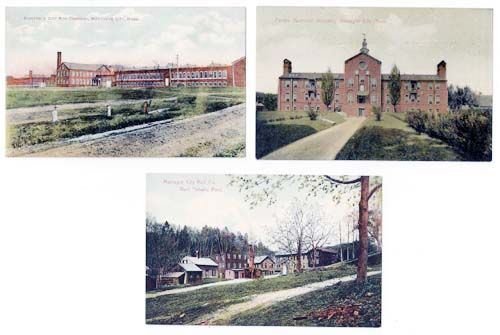
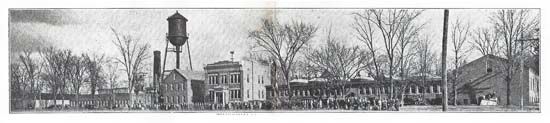



Photo of the old Montague factory, courtesy of Steve Vernon.

We took photos of the disintegrating corpse of the old brick factory building, and compared them with images of the factory in its prime, said to be (for a time) the largest producer of bamboo rods in the world. Some few of the rod models (Red Wing and Manitou) were of such quality as to be much sought after by collectors today. There were stories, perhaps apocryphal, of workers during the great Depression dropping finished rods out the windows into the bushes for retrieval at quitting time. The taller men were said to occasionally walk stiff legged out of the plant with a Red Wing Fly Rod hidden in their trousers. If they had tried to sell the rods they would have been fired in a heartbeat but for fishing in nearby waterways much could be ignored or forgiven.

The only building on the old factory site still occupied (now a bachelor's residence) was the headquarters building; A pleasant young man opened the door and asked if we would like to see inside. Everything else was silent, save for the barking of a small black and white dog staring at us from a distance. The rooms were absent of wooden desks with large black typewriters, clacking keys or the ping of the carriage return to give a sense of urgency and purpose. Once a fire in the factory had consumed so many finished rods that the officers had taken steps to ensure a loss of that magnitude would not happen again. Central to the building, a monstrous walk-in safe had been installed where large bundles of high end rods had been stored pending shipment. Now the huge black door was wide open, its interior empty. It reminded me of an empty tomb with the stone rolled back.

We walked the abandoned railroad spur in back of the factory where red-brown colored boxcars used to wait for supplies to be unloaded and crates of rods take their place. Across the street we visited the old hospital building that treated workers injured in the performance of their duties; the school next door that educated their children and the general store that sold them their necessities.

If you are interested in a wonderful summary of Montague Company history, A. J. Campbell's "Classic & Antique Fly-Fishing Tackle" is indespencible. However, it was never intended as the definitive study, much less an attempt to describe their various product lines. It is our hope that some day a more complete history of the company will be written with a careful documentation of their rods, reels and other products . A small book could be written focusing only on their wooden floats with four different sets of hardware and sixteen different name imprints. We can not even begin to guess the effort and paper it would take to adequately document their multitude of rod models. Few collectors know that Montague operated a paddle and oar factory not many miles from the headquarters building or that they made ski poles for the military. It would take multiple volumes to correctly cover the rich variety of pre 1934 Montague reels with plates of hard rubber or German Silver or nickel plated brass in models intended for casting, fly and ocean fishing - there are literally hundreds.

We are mindful of the brief space allotted here to discuss Montague letterhead. The point I would like to make is that if you really want to enjoy collecting letterhead from Montague or any other tackle production company, get to know the important officers of the subject company through research. Find out something about the letter's addressee. Look at period maps of the area. Talk to natives of the area who have a story to tell, even if you have to do it by phone. Helpful research librarians across the country are one of a letterhead collector's greatest assets.

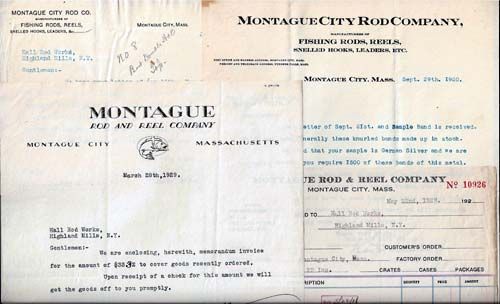
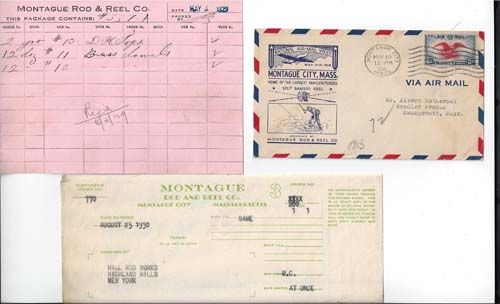
We have reviewed over 100 Montague letterhead for this article. We have chosen the one reproduced below for illustration in the hope of bringing this company to life for the reader.

The fictional snapshot of Leander Bartlett's Saturday on 29 May 1909 provided below is based on the content of the letter, our knowledge of the man, the factory and a study of the area surrounding the factory.
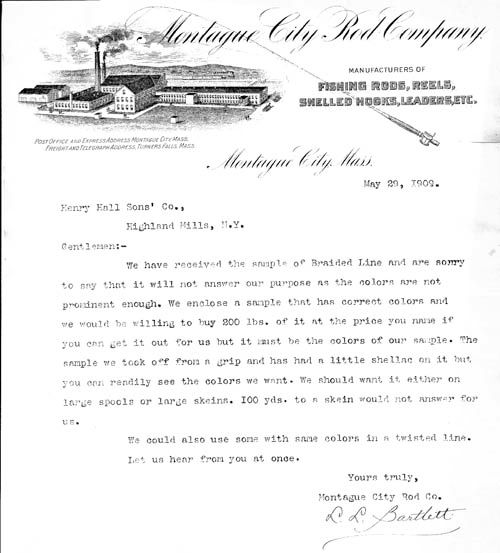


Leander Bartlett picked up the letterhead and admired the engraved vignette of a rod and reel alongside a reasonably accurate depiction of the Montague City, Mass. factory. His factory. As he studied the artwork his lips moved, but he did not quite give voice to his thoughts, This Is Who We Are. This Is What We Do. He had two other partners, a business man by the name of Charles Hazelton who acted as Treasurer and a famous civil engineer, Banard W. (Barney) Farren, who had deep pockets and acted as President. Farren and Hazelton were businessmen and did not know squat about what it took to build fishing rods. But Bartlett knew and one of the things it took was line.

Bartlett might have smiled, as he often did when he looked at the factory letterhead. It said, "Manufacturers of fishing rods, reels, snelled hooks, leaders, etc." Who we are. What we do. But for once the classy letterhead failed to brighten his day. His dark mood was due to the reply letter he was about to sign addressed to Henry Hall Sons'. Bartlett's gaze drifted to the calendar on his office wall, Saturday, May 29th 1909. He had written Hall almost a month before on May 5th, enclosing a sample of line needed to wrap rod grips and asked them to quote a price on producing it. The sample of line Hall sent back with their price quote was the wrong color and quoted in lengths far shorter than what was needed at the Montague Rod factory to continue production. Several hundred people worked there and others, mostly women , worked from home applying thread and line wraps to bamboo rod pieces. Their jobs depended on having supplies delivered on time and as ordered.

The letter comprising his reply did not adequately express Bartlett's growing rage at the delayed, useless and faulty response by Hall to a request for a line quote. Neither was Bartlett's reply a sycophant's attempt to encourage celerity and accuracy from a line company known best for sloppy work, poor communication and overdue order completion. The reply, like the man, was unpretentious and stoic. However, it was good to keep in mind that Hall & Sons did have one important virtue, that of being singularly cheap.

To clear his head Bartlett opened the office window and was met with the familiar wall of noise and smells endemic to factories of the time. The guttural throb of a locomotive idling on the spur out back of the factory underlay the higher pitched sounds of saws, staccato hammer blows, shouted instructions and the squeal of machinery on the factory floor. Bartlett squinted at the Catholic hospital across the street. In the far distance Nuns in black and white habits who worked as nurses were coming and going with the shift change.. The hospital had been built by his partner Farren, he of the deep pockets, in honor of his dead son. With the window now wide open, Bartlett could see and smell the stocks of lumber stacked in the yard outside his office. Equally noticeable was the aroma wafting up from various vats of varnish, paint, oil, and the perspiration from over two hundred hard working employees.

He briefly considered redrafting the letter in a harsher tone, but this would cause even more delay and it was Saturday afternoon and time for his secretary to leave. He sat back down at his desk, picked up his pen and slowly inked his signature, L.L. Bartlett, simply and legibly with a sinusoidal curved line beneath it at the bottom of the page.


We hope the above images of Montague letterhead, post cards and photographs will help instill an interest and appreciation in the reader for one of the greatest American tackle companies ever established!

-- Jim Garrett & Skip Brooks

Saturday, November 9, 2013

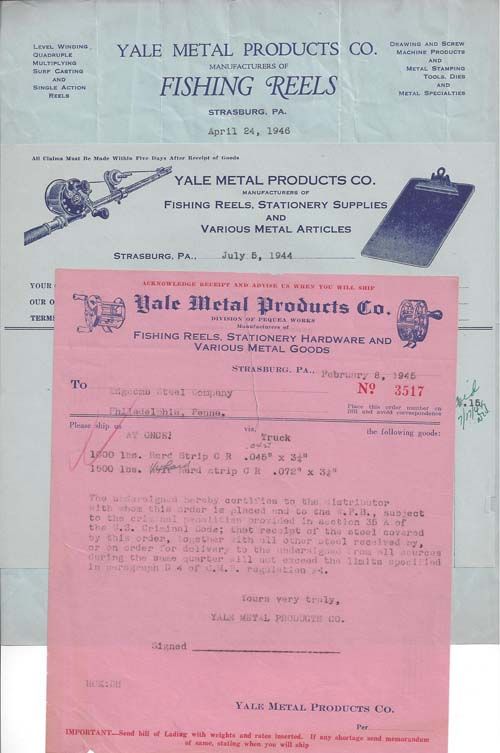
Letterheadings: Yale Metal Products by Jim Garrett and Skip Brooks


YALE METAL PRODUCTS

by Jim Garrett & Skip Brooks

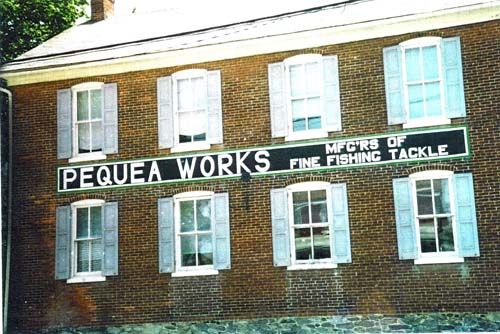
The history of Pequea Works (and its predecessors) is fairly straight forward. We have briefly covered this information and a selection of their letterhead during the last three weeks. It is axiomatic that Pequea Works (pronounced Peck-Way) was named by Harry Kaufman and Edwin Brown after the Pequea Indian tribe living in what would later become Pennsylvania. However, the history of Yale Metal Products, a subsidiary of Pequea is not so straight forward. We do not know why it was named Yale or who actually named it.

The well respected tackle historian, Dr. Harold G. Herr (1931-2001), made a modest start on this research in an article published in the ORCA News Winter Issue of 1993. With limited and incomplete information he did the best he could. In the summer of 1999 a brilliant article by Phil White entitled "The Carlton Descendants" appeared in the ORCA Reel News Magazine adding additional clarification to Yale activities. More on this article below.

Perhaps the greatest contribution of Yale historical data was provided thanks to a couple from Maryland named Oberender. After seeing an ad in a local paper in the summer of 1986, John and his wife Evelyn drove from Whitehall, MD to Strasburg, PA for an auction. The old Pequea factory contents, including all manner of fishing tackle, was going piecemeal to the highest bidders. And bidders were going a lot higher than John had anticipated or was prepared to go.


John tried to focus on the remaining tackle items still available in the oppressive heat. The heat had not seemed so bad during the drive that morning (a little over an hour, the distance just over 60 miles). But trying to concentrate on the treasures being auctioned in the old factory building, with just a couple fans to move the air around, was increasingly difficult. Soon the auction was concluding and he had little to show for his efforts. Perhaps he was thinking that coming to Strasburg had been a mistake. In this he would have been monumentally wrong. Coming here would turn out to be one of the most beneficial days of his life and the lives of tackle historians through the years.

When the auctioneers began closing things down, John asked the man in charge about the dozens of boxes of factory records remaining in the stifling attic space of the old red brick building. The attic could only be accessed with difficulty through a small rectangular opening. The auctioneer asked the few remaining people if anyone else was interested in the dusty boxes. It is lost in the memories of those then in attendance as to whether it was John or the auctioneer who suggested the price of $10, but that is the price that was agreed upon for the entire archive remaining in the attic. No one but John and Evelyn Oberender had the foresight to rescue those precious historical records worth thousands and thousands of dollars. If it had not been for them the boxes would have ended up moldering in the dump because the factory space was being cleared for major renovations. Over the years the Oberenders sold off those boxed documents, catalogs and letterhead at auction, at shows, by direct sale and through eBay. This author has tried to reassemble as much of the original package as possible. The vast majority is still out there somewhere.

The earliest dated paper (currently available to this author) concerning the business located at 380 Canal St., New York City, is a tax return for the year 1919. The names on "Schedule A" are typed so we do not have to rely on the capricious interpretation of fading handwritten information nearly 100 years old on the rest of the form. The metal fabricating business was a co-partnership between Leibinger and Joseph Masin. The name "Yale Metal Products does not appear anywhere on these forms and was likely not in use at the time.


By 1921 Leibinger was apparently out of the picture and W .S. Torrence had taken his place in the co-partnership. The company was manufacturing metal parts for completion of both tackle and non-tackle related items. This wide ranging application of metal fabricating skills at Yale would continue all the years of its existence. It was especially useful in obtaining contracts for war related goods during WWII.

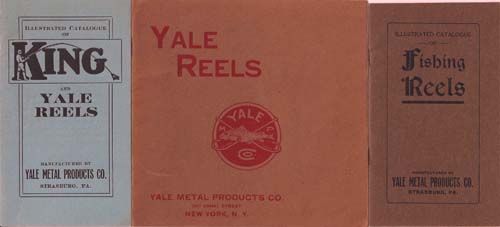
It was also during the early 1920's that Yale reels began to make their appearance. Let us return to Phil White's 1999 article referenced above, which on page 9 discusses these initial Yale reel appearances:

"The cover of a c1920 catalog lists some of Yale's products: "Lightweight, Phantom, Fly Weight, Ideal and Gem Single Action Reels/Good Luck Wood Reels/Handy Reel Seat, Good Luck Fish Scaler". On this list we note some "Rochester" reels, and some Meisselbach products. Perhaps Yale Metal Products was the fabricator of the Rochester fly reels. Or perhaps they bought the tooling for these successful products when Heineman emptied the Meisselbach factory."

By the second day of Dec. 1922 Joseph Masin had applied for a patent on a new type of bearing especially useful on fishing reels. On the 24 day of July 1923 the patent was granted. Reels of this new design with the Yale trademark, along with the Meisselbach/Carlton designs with Yale markings were widely advertised and sold.


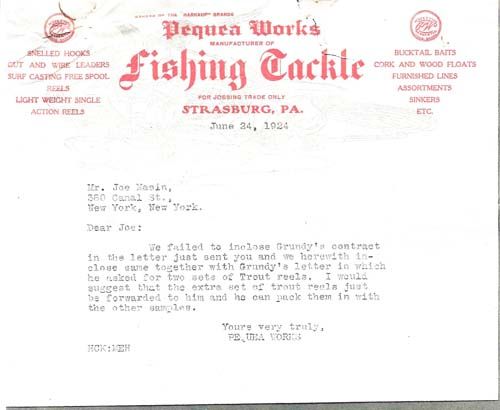
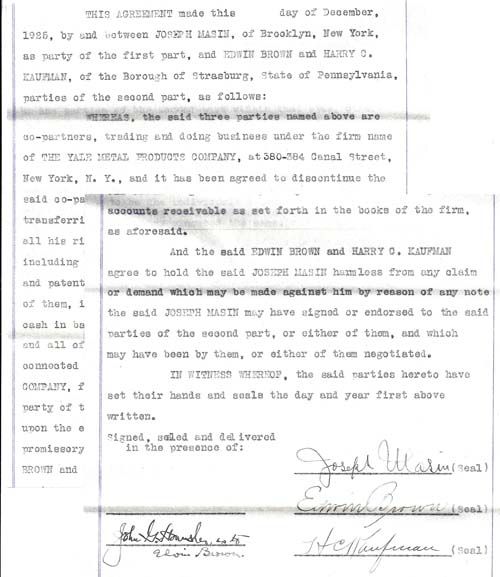
By 1924 Harry Kaufman and Edwin Brown were co-partners with Joseph Masin. Masin was still directing company operations in New York. However, a letter to Masin from Pequea discussing a contractual agreement between L. Kay Grundy (acting as manufacturers representative in Los Angles) and Yale Metal Products was originated by Harry C. Kaufman in Strasburg, PA. On the 17 of December 1925 Kaufman and Brown bought out Masin share of Yale. Masin's rights, title, property, good will, stock on hand, machinery and most important, his patents, were purchased for the sum of $7,225.


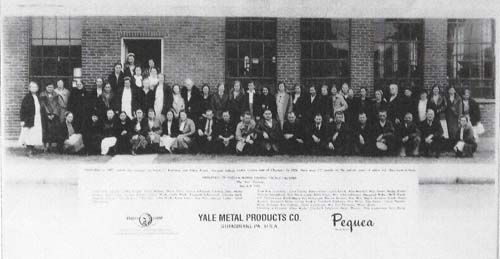
Shortly thereafter, Yale Metal Products was moved to Strasburg. Although it is not known how many, if any, workers moved with Yale from New York to Pennsylvania. I would speculate that many of them did because reel production does not seem to have been much affected. During this transition period, dozens of retailers were offering these reels at competitive prices across the country. A picture of the Yale factory and its employees in Strasburg dated 4 March 1935 is shown below.


Since this article is intended to focus on Yale letterhead and related paper, and not on an analysis or taxonomy of its reels, perhaps it is best to close here. The rest of Yale Metal Products history is closely associated with that of Pequea and that story has been told in earlier articles. I would like to close with these thoughts: There are only a small hand full of tackle companies whose records have survived their demise. With the possible exception of the aggregation of paper from the Hall Rod Works factory in Highland Mills, NY, no other tackle related collection of paper has been so informative, comprehensive and important to our hobby as the Pequea records. They contain correspondence from almost every tackle maker and retailer, large and small, from the turn of the century to the 1960s. Not only U. S. companies are included but dealers from around the world. For this we have John and Evelyn Oberender to thank. Tackle historians will always be in their debt.


The description of the auction at the Pequea factory in 1986 was provided as a courtesy by Evelyn Oberender. However, any errors contained in this article are solely the responsibility of the authors.
-- Jim Garrett & Skip Brooks
Saturday, October 26, 2013

Letterheadings: Pequea Part II


Pequea Part II by J.K. Garrett and L.P. Brooks
Last week we discussed the emergence of Harry Clay Kaufman from carefree teenager crafting lures in his spare time to the role of wunderkind tackle producer in Philadelphia, PA. Kaufman, born in Philadelphia on 14 October 1885, had at least two failed tackle businesses under his belt by his twenty-second birthday . It is understandable that he wanted to start over in Strasburg (where his partner Edwin Brown was principal of the Public school) when so many Philadelphians were left with unpaid debts from Harry's earlier failed ventures. Fishing tackle was in the Kaufman blood, as Harry had an older brother and nephew who worked for well known tackle houses and could be of use buying his products, if only he could make the Pequea Works a success.
 
You can count on one hand the number of early tackle companies whose records still exist in sufficient quantity to show much insight into the internal workings of the company. Pequea is one of these few companies. With the reader's permission, we will stray from the usual practice of showing an array of the most artistic and rare examples of their letterhead and turn our attention to paper which focuses on internal Pequea operations and how these related to his customers. In this edition we will discuss the early years when Pequea was just hitting it's stride. Next week we will discuss the golden years of the company and the death of its president.
 
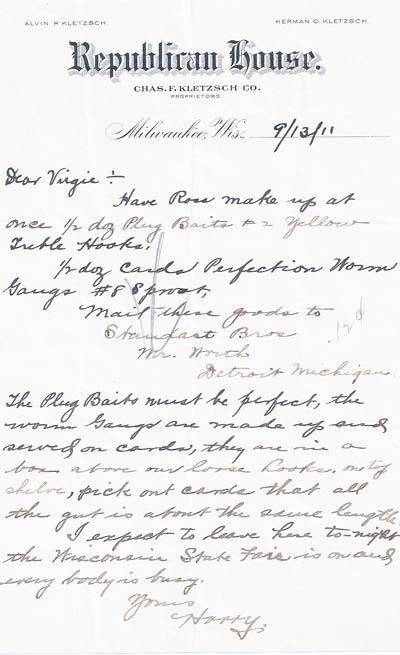
By 1909 Harry had taken a wife (Virginia, who he called Vergie), who was a salaried employee at Pequea. The handwritten letter dated 13 September 1911 (shown here) was penned by Harry from the Republican House hotel in Milwaukee, WI, to Vergie back home. Harry was on a road trip hawking his wares and seems to have met with some success at the Standart Brothers Hardware Corporation of Detroit, Michigan. Apparently Standart wanted to see some Pequea "Plug Baits" and some "gang hooks" with gut leader for fishing with earth worms. He asks Vergie to ensure that the Plugs were perfect in all respects and the worm gangs on the card were of uniform length. We may wonder from this admonition to Vergie if off the shelf items might not have the same quality control as sample items. It is this lack of quality control that would be a constant strain on relations between Pequea and their customers for decades to come. Letters to Pequea may be found by the bushel , sent by irate retailers because of defective Pequea workmanship. Many times the returned items were replaced by Pequea with goods as bad or worse than those which caused the complaints.


Why, we may ask, would retail companies continue to do business with such an undependable bunch of folk. The answer is two fold. First much of what Pequea sold did meet the average fisherman's needs. Equally important, the goods were sold at about the lowest prices possible compared to other manufacturers in the tackle industry. Second, Harry was a born salesman. He would promise the moon and stars on his sales trips, Pequea production schedules and quality would be found wanting, and the following year he would show up again and somehow kiss and make up with buyers not yet fully convinced of his duplicity.
 
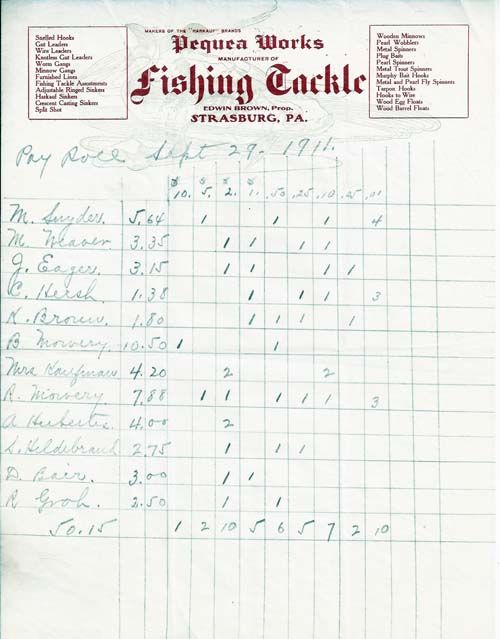
Our next piece of Pequea paper shows a handwritten payroll list on company letterhead. The payroll is dated for 29 September 1911. A comparison of this list with earlier payrolls shows that he took many of the employees with him to Strasburg that had worked for him in Philadelphia. Even more informative is the inclusion of relatives of his partner Brown and a salary for his wife Vergie. He would have found it hard, if not impossible, to fire friends and relatives, even if his business suffered by their incompetence. Truth be told, Harry had a soft spot for his old friends even if they occasionally proved to be deeply stupid or infirm in their older years.


Our next example of internal Pequea paper is page one of a five page order by New York Sporting Goods dated 4 January 1912. The massive amounts and diverse styles of products available from Pequea is stunning. Of course some of the items were produced by other wholesalers and touted as Pequea's own. The five page list  contains great varieties of snelled hooks, leader, sinkers, plug baits and spinners. Not included on this order were many other products available from Pequea such as bobbers, hand lines, swivels, flies, etc. Even if Harry did not always deliver all the goods he promised or in a condition to be usable, he delivered enough to help retailers make money and keep them coming back for more. We repeatedly see invoices from large companies like Shakespeare buying Pequea items and companies like Enterprise Mfg. Co. acting as suppliers to Pequea. Many times we see the same company acting in both capacities (i.e. G. W. Frost of Stevens Point, WI). There must have been very few significant tackle makers or retailers that Pequea did not interact with in some capacity through the years. The vast archive of their available correspondence proves it so.


Next week, the golden years of Pequea.

Saturday, October 12, 2013

Letterheadings with Jim Jordan: Sticker Baits (1933)


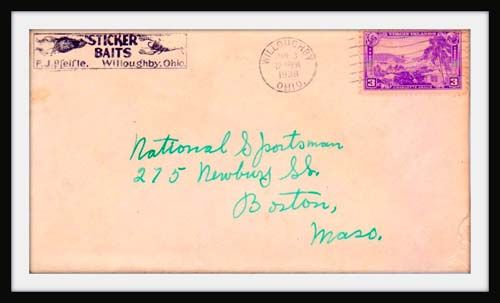
I love finding paper from old obscure lure makers. This envelope is one of my favorites. It features the name F.J. Pfeifle, the name "Sticker Baits" and images of two of the companies baits. Frederick John Pfeifle was an Ohio business man and inventor. In 1913 Pfeifle started the Mechanical Mold & Machine Company. The company made molds and dies. Pfeifle held a number of patents, most of which were related to his mold & die business. He held at least one patent for an artificial lure. He filed for the patent  on Feb. 28 , 1933. Patent 1,993,018  was granted on March 5 ,1935.


The lure would feature a body made of sponge or crepe rubber having a natural rough porous water-pervious surface , whereby the lure may in some cases be used either as a floating lure or as an under-water lure. The soft body of the bait would conceal the hook and prevent the hook from becoming snagged by weeds, logs, or other obstructions when the lure is drawn through the water. His patent states that his invention could be used for simulation of any desired live bait, such as a mouse, minnow, frog, etc. His patent drawing shows three separate forms, Fig. 1  is a mouse type. Fig. 7 is listed in the patent as a modified form of a lure ( Minnow shaped). Fig. 8 is listed as a pork chunk simulation.


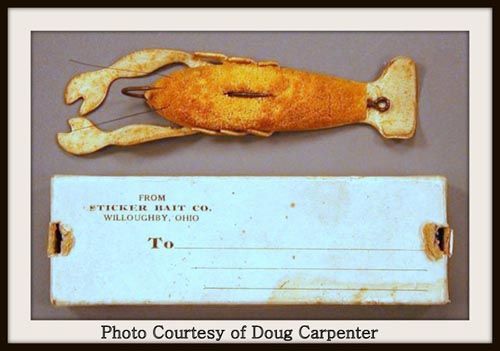
With the images on the patent drawing and those of the frog and crawfish on the envelope, I am hopeful Pfeifle produced at least five lure variations. I have not been able to find any advertisements for this company. Perhaps the correspondence originally in this envelope addressed to National Sportsman was an inquiry about ad space in the magazine. I have only seen one example of a Sticker Bait and it is a crawfish with the original box. I'd like to give a big "Thank you" to fellow collector Doug Carpenter for sharing the photo of this rare bait & box. If anyone out there has any other info. about Sticker Baits, I' be very interested in learning more about this Willoughby, Ohio Company.


Best Regards,

Jim Jordan

Saturday, September 28, 2013

Letterheadings with Jim Jordan: Shoff Fishing Tackle (1932)


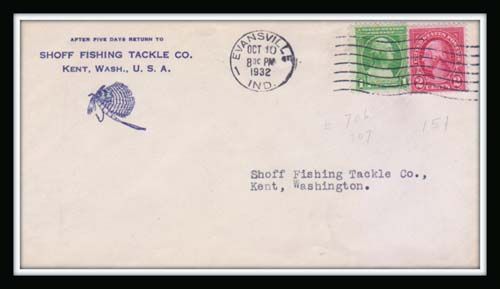
This weeks feature is an advertising envelope from Shoff Fishing Tackle Co. The envelope is postmarked Evansville Ind. Oct. 10 ,1932. It is self addressed and has pencil notations of # 706 ,707 and 15 cents. Perhaps it was sent by a Shoff Representative back the company.The envelope shows a small illustration of one of the companies large line of flies.


Clarence Henry Shoff was born April 30, 1894 in Kent ,Washington. After graduating from high school, Clarence attended Washington State College for one year. After leaving college, Shoff worked at the Navy Yard as a ship joiner. When the United States entered the first World War, Clarence enlisted in the Naval Aviation Service.

In 1922 Shoff began manufacturing fishing tackle in Kent, Washington. His Company was known for selling high quality fly making materials and flies. Early on Shoff traveled throughout Washington and California fishing and selling his flies at fishing camps and along river banks. Shoff was known to make custom flies to order for individual anglers as well as for other tackle dealers. In 1934 Shoff received a patent for a method of making a fish bait and the product thereof. This patent was essentially a blueprint for Shoff's Hair Mouse.

As the company grew Shoff's wares were sold by large Hardware and Sporting Goods houses and through catalog sales. Some of Shoff's mice have turned up on cards marked Western Auto and Sears Roebuck .

Sometime around 1950 Clarence Shoff partnered with Dick Snyder to make fibre glass fishing rod blanks in the back of Shoff's Kent, Washington Sporting goods store. They were said to be the first to make fibreglass fishing rod blanks. This partnership was the start of the famed Lamiglas Company. Lamiglas played an important role in modern fishing rod history and at one time employed such rod making icons Don Green and Gary Loomis. Green formed Grizzly rods which later became Fenwick. After leaving Fenwick Green created Sage. Gary Loomis started Loomis composites/ G. Loomis.

Best regards,

Jim Jordan

Saturday, September 21, 2013

Letterheadings: Marvel Hook Company (1915)


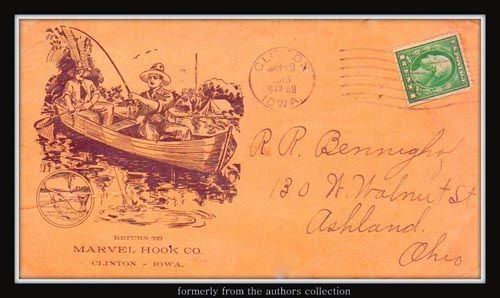
This 1915 Clinton, Iowa postmarked envelope is from the Marvel Hook Company. It has a nice fishing scene with two men in a boat one is reeling in a fish caught on a Marvel hook and the other standing at the ready with a landing net. It also shows a close up inset image of a Marvel Hook catching a fish. This close up image is almost identical to artwork used in early Japanese Novelty Company ads.


The Marvel Automatic fish hook was invented by Andrew A. Paysen. He was quite the inventor,  he held two separate lever type gaff hook patents. One granted in 1910 and the other in 1911. Paysen also received a patent for a gas engine in 1913.

The Marvel Fish hook was being heavily advertised from 1911-1913 by the Japanese Novelty Company and the Marvel Hook Company simultaneously .These two firms were based in Clinton, Iowa. According to early Andrew Paysen paperwork, the Japanese Novelty Company was the only one having license to manufacture the Marvel fish hook. It is unclear whether the Marvel Hook Company belonged to Andrew Paysen or if it was part of the Japanese Novelty Company.
   
Best Regards,
                 
Jim Jordan

Saturday, September 14, 2013

Letterheadings with Jim Jordan: More Creek Chub


This weeks feature is another Creek Chub Bait Company envelope. This envelope carries an illustration of an angler in a rowboat fighting a jumping bass, hooked up on a Pikie minnow. The text on the envelope boasts 44,000,000 Pikies have gone fishing! 


Even when you consider the number of Pikie variations and the duration of their production, that number is an astonishing.  I have never seen an example of this envelope with a postmarked date. On the back of this envelope it says "Nikie rhymes with Pikie". The mention of the Nikie bait helps date this to no earlier than the introduction of the Nikie.

Variations of the Nikie were available from 1956 through 1978. This style Creek Chub envelope is fairly common. These envelopes as well as a number of other unused Creek Chub factory leftover paper items turned up in great numbers at antique tackle shows in the 1990's. The following items also came out of that same cache of factory leftovers.


Best regards,

Jim Jordan

Saturday, September 7, 2013

Letterheadings with Jim Jordan: Creek Chub Bait Company (1945)


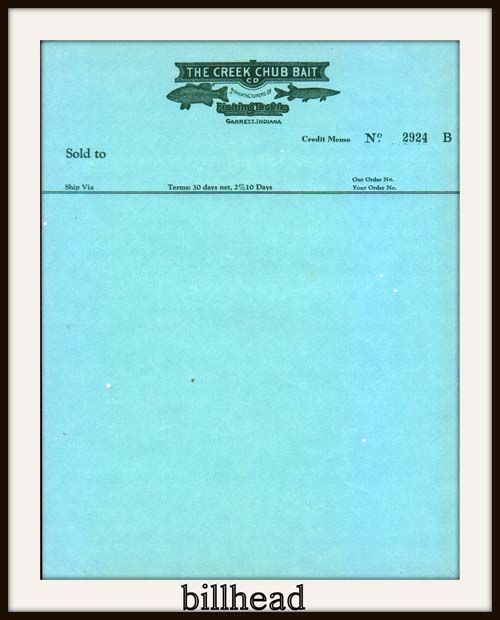
It is surprising how tough most early Creek Chub Bait Company paper is to find. Early letterhead and billheads from the company rarely turn up. This weeks feature is a 1945 Garrett, IND. postmarked Creek Chub Bait Co. envelope. It shows a nice illustration of Creek Chub's signature bait "The famous Pikie Minnow" complete with dual line ties and hand painted gills. I have seen this style envelope with postmarks as early as 1937 and as late as 1952. With all the business this company did, a lot more of these should turn up. I only see one or two of these a year come up for sale.


Best regards,
 
Jim Jordan

Saturday, August 31, 2013

Letterheadings with Jim Jordan: Peter Henkenius (1900)


This Jas. M. Kane , Fort Wayne , Indiana billhead lists some of his companies wares, Toys, Fancy Goods,Bird Cages, Fishing Tackle and Notions. James M. Kane was a prominent Fort Wayne businessman. He started in business during the 1850's with a sidewalk street stand located on Calhoun street. By the 1870's Kane claimed to have the largest assortment of notions in the State.
 
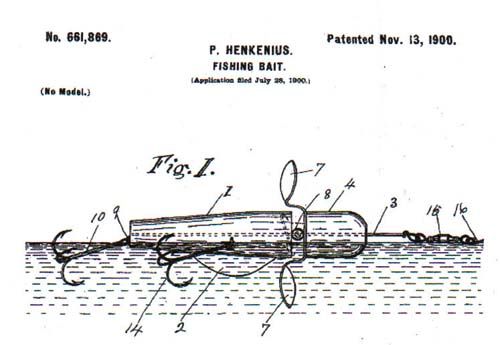
Kane was assigned 1/2 of the patent for a fishing bait created by Fort Wayne candy maker Peter Henkenius.  The bait was designed to be a surface plug with a revolving member with an attached propeller blade and a keel. In other words, it is what lure collectors refer to as a rotary head bait. Over the years collectors have called this particular bait the Henkenius/Kane plug for obvious reasons. Prior to their patent approval Henkenius & Kane simply referred to the bait as an Aluminum spinner . Language in the patent mentions that it is preferred that the propeller & keel were made of aluminum and present a bright attractive surface.  Sometime after the patent was issued on Nov. 13, 1900 , the makers referred to the bait as the "Only" Patent Spinner. I believe this plug to be the first patented rotary bait of its kind. It is unknown how early these baits were available to the public. They were available prior to the turn of the Century. Examples have been found with Pat Appl stamped on the prop, others with the patent date stamped on the keel and some with no markings at all.


This  August ,1899 bill addressed to Drug Store owner Paul Klinkenberg lists an order of 1/2 dozen Aluminum Spinners. Klinkenberg must have found the baits to be satisfactory sellers. Another Kane billhead has turned up listing an additional order which had been placed by Klinkenberg for a dozen more baits within that same month.

Best Regards,
                 
Jim Jordan

Saturday, August 24, 2013

Letterheadings with Jim Jordan: The Pacific Shiner (1939)


The Pacific Shiner was a product of  Army Air Corps veteran A.L. Gower. The Pacific Shiner was a hollow fish shaped metal bait. They were available in 1 3/4", 2 1/2", 3" and 4"  sizes. Throughout the years Gowers manufacturing operation was based in California. Initially located in Malaga, then Burbank and by 1950 they relocated to Madera.


Pacific Shiners were available as early as 1939 and as late as 1950. It is likely that production ceased during the war years. Historic accounts show that Gower was involved in the making of Aircraft hand tools as early as 1939. This May 15 , 1939  envelope is one of the earliest  Pacific Shiner  advertising pieces I have come across. The envelope is addressed to National Sportsman. I can't help but wonder if  this mailing had anything to do with Gower possibly advertising his bait in the magazine. I'll have to keep my out for any Pacific Shiner ads in the National  Sportsman.

Best Regards,
   
Jim Jordan

Saturday, August 17, 2013


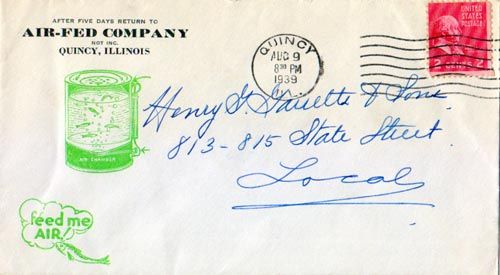
This weeks feature is a 1939 advertising envelope from the Air- Fed Company, Quincy, Illinois.  It has a neat image of an Air-Fed Minnow Bucket. The image is done in a cut away style allowing one to see the minnows swimming among the bubbles provided by the Air- Feeding feature. The Air-Fed bait receptacle is based on the Nov. 2 , 1926 patent design of  Frank A Churchill and Henry E. Baxten of Quincy, ILL. The basis of the idea was to prolong the life of the bait by introducing air. The receptacle featured an air chamber which could be filled via an attached pump or by a pump at a service station. The air could be automatically released from the air chamber at a controlled rate into the attached portion of the bucket which was designed to be partially filled with water and live bait.


The company offered a variety of receptacles, round and rectangle shaped, floating and non-floating. Three capacities could be had, eight, ten and twenty quarts. Interestingly in 1927 the Air-Fed Company was listed as incorporated, but the 1939 envelope featured here specifically lists the company as NOT INC. In 1931 the Air-Fed Company offered a free booklet on live bait fishing. (I'm still looking for that one).The last advertisement I have found for this company is from 1941. I can't help but wonder if the onset of WW2 brought about the end of this Quincy ILL. Company.

Best Regards,
             
Jim Jordan

Saturday, August 3, 2013

Letterheadings with Jim Jordan: Pepper


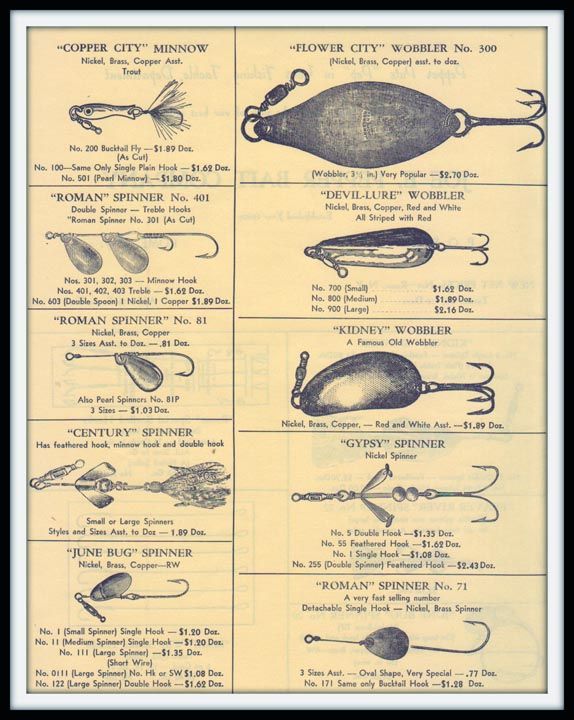
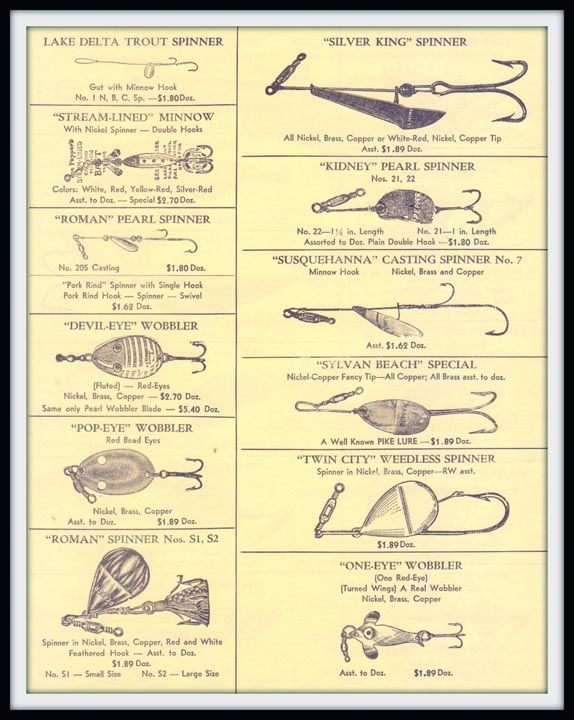
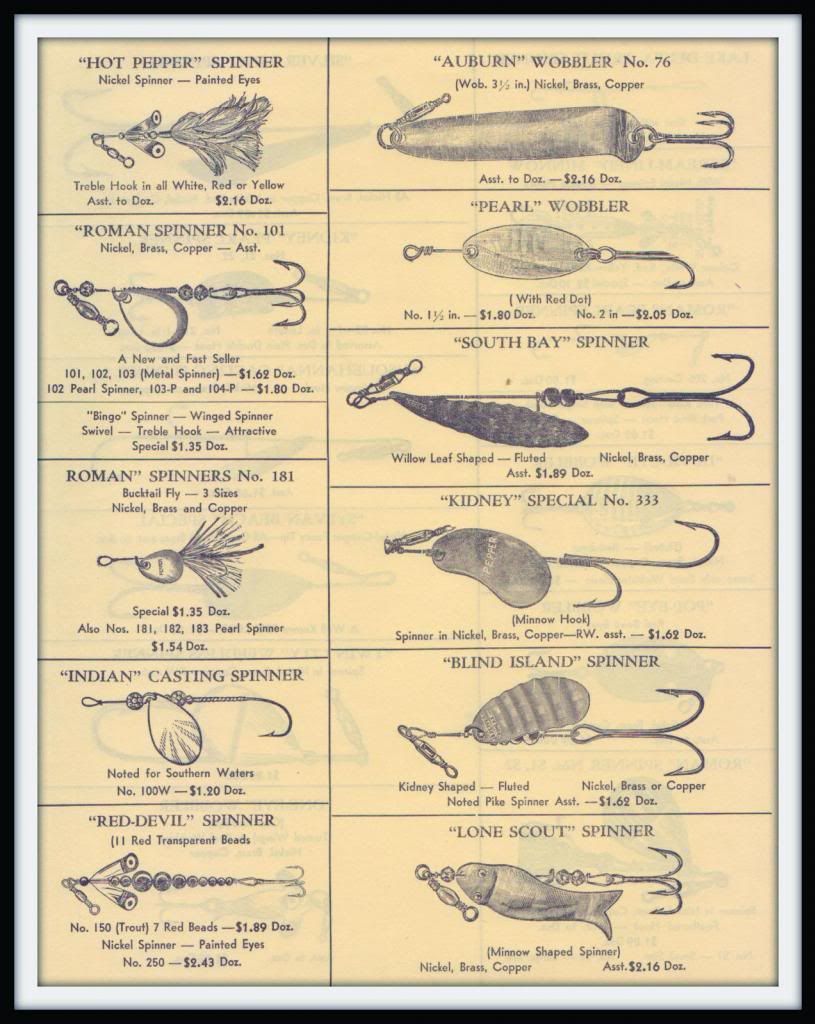
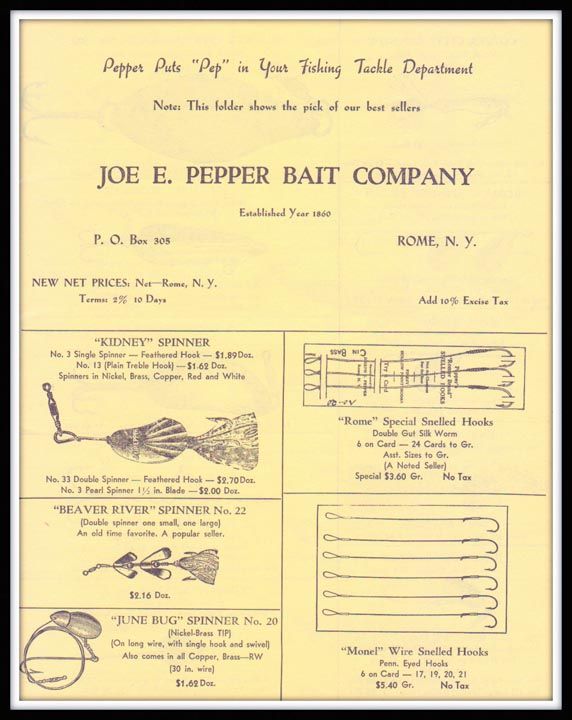
This four page folder is undated, but due to the P.O. Box 305- Rome, N.Y. listing  and the baits offered, I believe it to be from around the same time period as the Pepper advertising cards recently featured. The heading on this piece  "Pepper Puts 'Pep' in your Fishing Tackle Department"  gives the indication that these folders targeted tackle resellers, rather than individual anglers.

The folder cover states "Established Year 1860". This must be a reference to the Pepper who started the family in the tackle business, Johan Franz Pepper, who started making fishing rods in the 1860's time period. This folder lists approximately thirty lures as well as snelled hook cards. Some of the companies early baits were still being offered in this folder.  The Century Spinner was simply an example of the circa 1902 New Century Ball Spinner with an updated name.


Best regards,
         
Jim Jordan