Showing posts with label Jim Garrett. Show all posts

Saturday, November 16, 2013

Letterheadings: The Montague Rod & Reel Co. by J.K. Garrett & L.P. Brooks


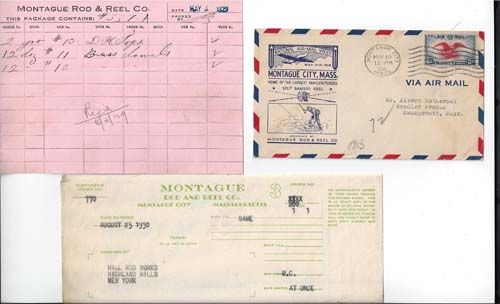
We have a great fondness for the Montague City Rod and Reel Co., the men who built it, the products they produced, their intricate and convoluted history, and the catalogs and letterhead that trace their accomplishments in the tackle industry. We have attempted to purchase examples of every one of their reel models, with every trade name and retailer stamping we could find. We covet all issues of Montague catalogs, paper and photos; especially those prior to their acquisition by Ocean City during the 1934-35 period.


Our interest was such that in October of 2006 my wife and I drove to the old factory site (about 6 hours, just under 400 miles) and stayed in the area for several days. We did research in local libraries and historic societies. We had lunch with workers long since retired from the rod factory who told us what it smelled like and sounded like in its glory days. We visited assisted living facilities to talk to women who had done piece work on the rods from their homes, affixing the guides with intricate threading patterns and colors. There were employees who had played on the baseball team sponsored by the factory on the ball diamond in its front yard. We talked to septuagenarians who as children had played hide and seek among the stacks of lumber beside the main office building. Where a piece of the company history was missing, we sought out surviving family members who generously shared their stories and photos and memories.
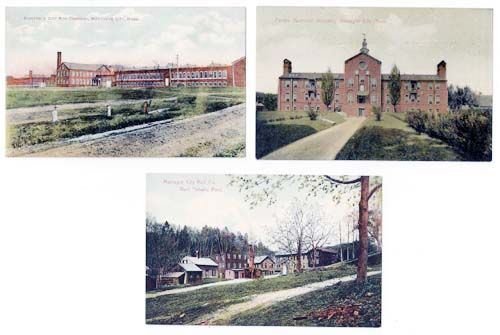
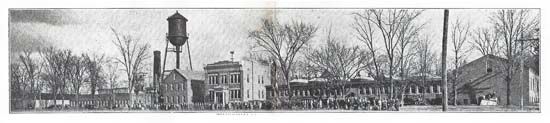



Photo of the old Montague factory, courtesy of Steve Vernon.

We took photos of the disintegrating corpse of the old brick factory building, and compared them with images of the factory in its prime, said to be (for a time) the largest producer of bamboo rods in the world. Some few of the rod models (Red Wing and Manitou) were of such quality as to be much sought after by collectors today. There were stories, perhaps apocryphal, of workers during the great Depression dropping finished rods out the windows into the bushes for retrieval at quitting time. The taller men were said to occasionally walk stiff legged out of the plant with a Red Wing Fly Rod hidden in their trousers. If they had tried to sell the rods they would have been fired in a heartbeat but for fishing in nearby waterways much could be ignored or forgiven.

The only building on the old factory site still occupied (now a bachelor's residence) was the headquarters building; A pleasant young man opened the door and asked if we would like to see inside. Everything else was silent, save for the barking of a small black and white dog staring at us from a distance. The rooms were absent of wooden desks with large black typewriters, clacking keys or the ping of the carriage return to give a sense of urgency and purpose. Once a fire in the factory had consumed so many finished rods that the officers had taken steps to ensure a loss of that magnitude would not happen again. Central to the building, a monstrous walk-in safe had been installed where large bundles of high end rods had been stored pending shipment. Now the huge black door was wide open, its interior empty. It reminded me of an empty tomb with the stone rolled back.

We walked the abandoned railroad spur in back of the factory where red-brown colored boxcars used to wait for supplies to be unloaded and crates of rods take their place. Across the street we visited the old hospital building that treated workers injured in the performance of their duties; the school next door that educated their children and the general store that sold them their necessities.

If you are interested in a wonderful summary of Montague Company history, A. J. Campbell's "Classic & Antique Fly-Fishing Tackle" is indespencible. However, it was never intended as the definitive study, much less an attempt to describe their various product lines. It is our hope that some day a more complete history of the company will be written with a careful documentation of their rods, reels and other products . A small book could be written focusing only on their wooden floats with four different sets of hardware and sixteen different name imprints. We can not even begin to guess the effort and paper it would take to adequately document their multitude of rod models. Few collectors know that Montague operated a paddle and oar factory not many miles from the headquarters building or that they made ski poles for the military. It would take multiple volumes to correctly cover the rich variety of pre 1934 Montague reels with plates of hard rubber or German Silver or nickel plated brass in models intended for casting, fly and ocean fishing - there are literally hundreds.

We are mindful of the brief space allotted here to discuss Montague letterhead. The point I would like to make is that if you really want to enjoy collecting letterhead from Montague or any other tackle production company, get to know the important officers of the subject company through research. Find out something about the letter's addressee. Look at period maps of the area. Talk to natives of the area who have a story to tell, even if you have to do it by phone. Helpful research librarians across the country are one of a letterhead collector's greatest assets.

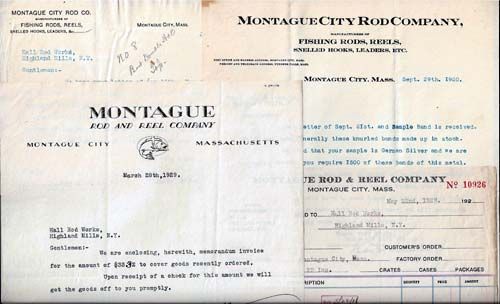
We have reviewed over 100 Montague letterhead for this article. We have chosen the one reproduced below for illustration in the hope of bringing this company to life for the reader.

The fictional snapshot of Leander Bartlett's Saturday on 29 May 1909 provided below is based on the content of the letter, our knowledge of the man, the factory and a study of the area surrounding the factory.
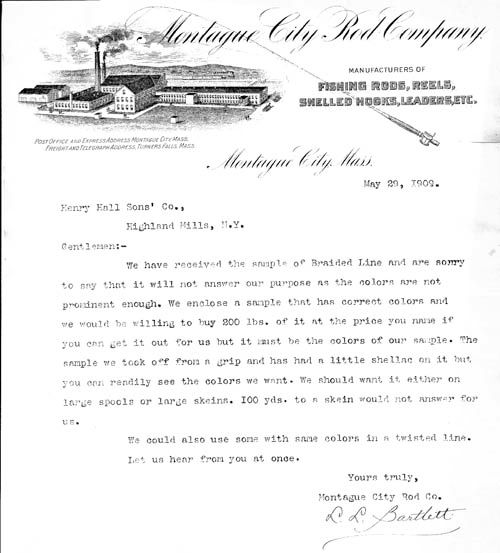


Leander Bartlett picked up the letterhead and admired the engraved vignette of a rod and reel alongside a reasonably accurate depiction of the Montague City, Mass. factory. His factory. As he studied the artwork his lips moved, but he did not quite give voice to his thoughts, This Is Who We Are. This Is What We Do. He had two other partners, a business man by the name of Charles Hazelton who acted as Treasurer and a famous civil engineer, Banard W. (Barney) Farren, who had deep pockets and acted as President. Farren and Hazelton were businessmen and did not know squat about what it took to build fishing rods. But Bartlett knew and one of the things it took was line.

Bartlett might have smiled, as he often did when he looked at the factory letterhead. It said, "Manufacturers of fishing rods, reels, snelled hooks, leaders, etc." Who we are. What we do. But for once the classy letterhead failed to brighten his day. His dark mood was due to the reply letter he was about to sign addressed to Henry Hall Sons'. Bartlett's gaze drifted to the calendar on his office wall, Saturday, May 29th 1909. He had written Hall almost a month before on May 5th, enclosing a sample of line needed to wrap rod grips and asked them to quote a price on producing it. The sample of line Hall sent back with their price quote was the wrong color and quoted in lengths far shorter than what was needed at the Montague Rod factory to continue production. Several hundred people worked there and others, mostly women , worked from home applying thread and line wraps to bamboo rod pieces. Their jobs depended on having supplies delivered on time and as ordered.

The letter comprising his reply did not adequately express Bartlett's growing rage at the delayed, useless and faulty response by Hall to a request for a line quote. Neither was Bartlett's reply a sycophant's attempt to encourage celerity and accuracy from a line company known best for sloppy work, poor communication and overdue order completion. The reply, like the man, was unpretentious and stoic. However, it was good to keep in mind that Hall & Sons did have one important virtue, that of being singularly cheap.

To clear his head Bartlett opened the office window and was met with the familiar wall of noise and smells endemic to factories of the time. The guttural throb of a locomotive idling on the spur out back of the factory underlay the higher pitched sounds of saws, staccato hammer blows, shouted instructions and the squeal of machinery on the factory floor. Bartlett squinted at the Catholic hospital across the street. In the far distance Nuns in black and white habits who worked as nurses were coming and going with the shift change.. The hospital had been built by his partner Farren, he of the deep pockets, in honor of his dead son. With the window now wide open, Bartlett could see and smell the stocks of lumber stacked in the yard outside his office. Equally noticeable was the aroma wafting up from various vats of varnish, paint, oil, and the perspiration from over two hundred hard working employees.

He briefly considered redrafting the letter in a harsher tone, but this would cause even more delay and it was Saturday afternoon and time for his secretary to leave. He sat back down at his desk, picked up his pen and slowly inked his signature, L.L. Bartlett, simply and legibly with a sinusoidal curved line beneath it at the bottom of the page.


We hope the above images of Montague letterhead, post cards and photographs will help instill an interest and appreciation in the reader for one of the greatest American tackle companies ever established!

-- Jim Garrett & Skip Brooks

Saturday, November 9, 2013

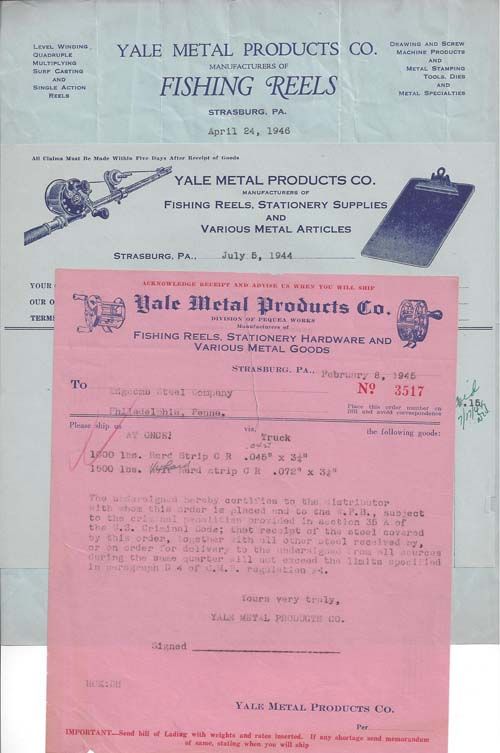
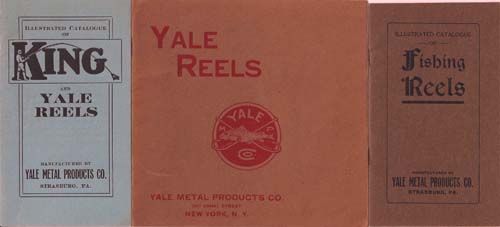
Letterheadings: Yale Metal Products by Jim Garrett and Skip Brooks


YALE METAL PRODUCTS

by Jim Garrett & Skip Brooks

The history of Pequea Works (and its predecessors) is fairly straight forward. We have briefly covered this information and a selection of their letterhead during the last three weeks. It is axiomatic that Pequea Works (pronounced Peck-Way) was named by Harry Kaufman and Edwin Brown after the Pequea Indian tribe living in what would later become Pennsylvania. However, the history of Yale Metal Products, a subsidiary of Pequea is not so straight forward. We do not know why it was named Yale or who actually named it.

The well respected tackle historian, Dr. Harold G. Herr (1931-2001), made a modest start on this research in an article published in the ORCA News Winter Issue of 1993. With limited and incomplete information he did the best he could. In the summer of 1999 a brilliant article by Phil White entitled "The Carlton Descendants" appeared in the ORCA Reel News Magazine adding additional clarification to Yale activities. More on this article below.

Perhaps the greatest contribution of Yale historical data was provided thanks to a couple from Maryland named Oberender. After seeing an ad in a local paper in the summer of 1986, John and his wife Evelyn drove from Whitehall, MD to Strasburg, PA for an auction. The old Pequea factory contents, including all manner of fishing tackle, was going piecemeal to the highest bidders. And bidders were going a lot higher than John had anticipated or was prepared to go.


John tried to focus on the remaining tackle items still available in the oppressive heat. The heat had not seemed so bad during the drive that morning (a little over an hour, the distance just over 60 miles). But trying to concentrate on the treasures being auctioned in the old factory building, with just a couple fans to move the air around, was increasingly difficult. Soon the auction was concluding and he had little to show for his efforts. Perhaps he was thinking that coming to Strasburg had been a mistake. In this he would have been monumentally wrong. Coming here would turn out to be one of the most beneficial days of his life and the lives of tackle historians through the years.

When the auctioneers began closing things down, John asked the man in charge about the dozens of boxes of factory records remaining in the stifling attic space of the old red brick building. The attic could only be accessed with difficulty through a small rectangular opening. The auctioneer asked the few remaining people if anyone else was interested in the dusty boxes. It is lost in the memories of those then in attendance as to whether it was John or the auctioneer who suggested the price of $10, but that is the price that was agreed upon for the entire archive remaining in the attic. No one but John and Evelyn Oberender had the foresight to rescue those precious historical records worth thousands and thousands of dollars. If it had not been for them the boxes would have ended up moldering in the dump because the factory space was being cleared for major renovations. Over the years the Oberenders sold off those boxed documents, catalogs and letterhead at auction, at shows, by direct sale and through eBay. This author has tried to reassemble as much of the original package as possible. The vast majority is still out there somewhere.

The earliest dated paper (currently available to this author) concerning the business located at 380 Canal St., New York City, is a tax return for the year 1919. The names on "Schedule A" are typed so we do not have to rely on the capricious interpretation of fading handwritten information nearly 100 years old on the rest of the form. The metal fabricating business was a co-partnership between Leibinger and Joseph Masin. The name "Yale Metal Products does not appear anywhere on these forms and was likely not in use at the time.


By 1921 Leibinger was apparently out of the picture and W .S. Torrence had taken his place in the co-partnership. The company was manufacturing metal parts for completion of both tackle and non-tackle related items. This wide ranging application of metal fabricating skills at Yale would continue all the years of its existence. It was especially useful in obtaining contracts for war related goods during WWII.

It was also during the early 1920's that Yale reels began to make their appearance. Let us return to Phil White's 1999 article referenced above, which on page 9 discusses these initial Yale reel appearances:

"The cover of a c1920 catalog lists some of Yale's products: "Lightweight, Phantom, Fly Weight, Ideal and Gem Single Action Reels/Good Luck Wood Reels/Handy Reel Seat, Good Luck Fish Scaler". On this list we note some "Rochester" reels, and some Meisselbach products. Perhaps Yale Metal Products was the fabricator of the Rochester fly reels. Or perhaps they bought the tooling for these successful products when Heineman emptied the Meisselbach factory."

By the second day of Dec. 1922 Joseph Masin had applied for a patent on a new type of bearing especially useful on fishing reels. On the 24 day of July 1923 the patent was granted. Reels of this new design with the Yale trademark, along with the Meisselbach/Carlton designs with Yale markings were widely advertised and sold.


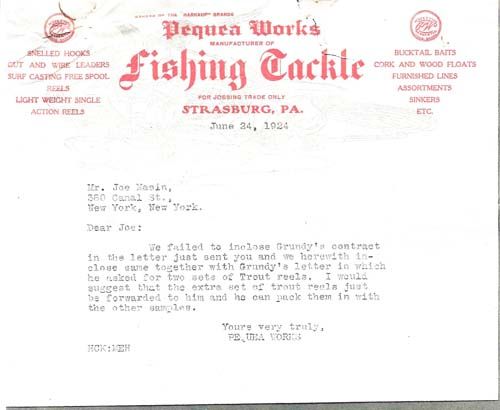
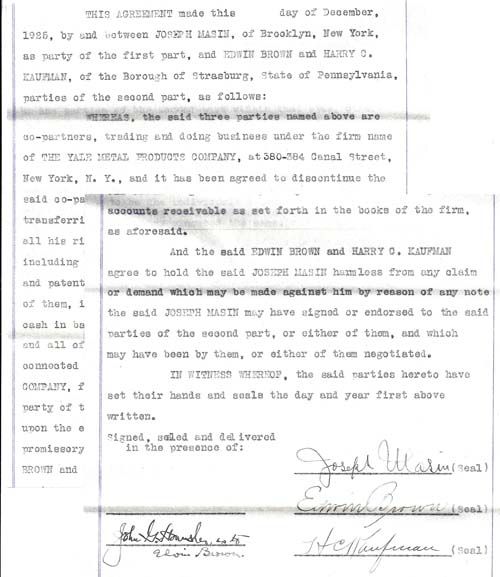
By 1924 Harry Kaufman and Edwin Brown were co-partners with Joseph Masin. Masin was still directing company operations in New York. However, a letter to Masin from Pequea discussing a contractual agreement between L. Kay Grundy (acting as manufacturers representative in Los Angles) and Yale Metal Products was originated by Harry C. Kaufman in Strasburg, PA. On the 17 of December 1925 Kaufman and Brown bought out Masin share of Yale. Masin's rights, title, property, good will, stock on hand, machinery and most important, his patents, were purchased for the sum of $7,225.


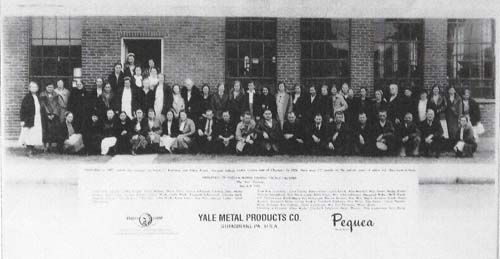
Shortly thereafter, Yale Metal Products was moved to Strasburg. Although it is not known how many, if any, workers moved with Yale from New York to Pennsylvania. I would speculate that many of them did because reel production does not seem to have been much affected. During this transition period, dozens of retailers were offering these reels at competitive prices across the country. A picture of the Yale factory and its employees in Strasburg dated 4 March 1935 is shown below.


Since this article is intended to focus on Yale letterhead and related paper, and not on an analysis or taxonomy of its reels, perhaps it is best to close here. The rest of Yale Metal Products history is closely associated with that of Pequea and that story has been told in earlier articles. I would like to close with these thoughts: There are only a small hand full of tackle companies whose records have survived their demise. With the possible exception of the aggregation of paper from the Hall Rod Works factory in Highland Mills, NY, no other tackle related collection of paper has been so informative, comprehensive and important to our hobby as the Pequea records. They contain correspondence from almost every tackle maker and retailer, large and small, from the turn of the century to the 1960s. Not only U. S. companies are included but dealers from around the world. For this we have John and Evelyn Oberender to thank. Tackle historians will always be in their debt.


The description of the auction at the Pequea factory in 1986 was provided as a courtesy by Evelyn Oberender. However, any errors contained in this article are solely the responsibility of the authors.
-- Jim Garrett & Skip Brooks
Saturday, November 2, 2013

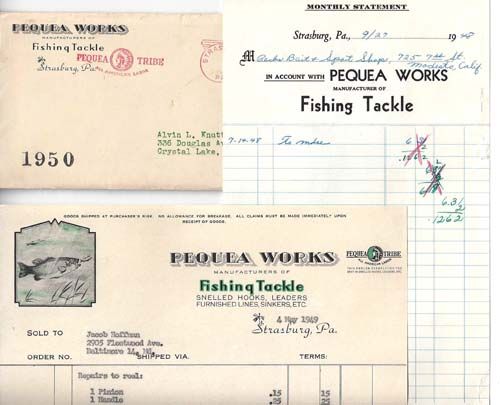
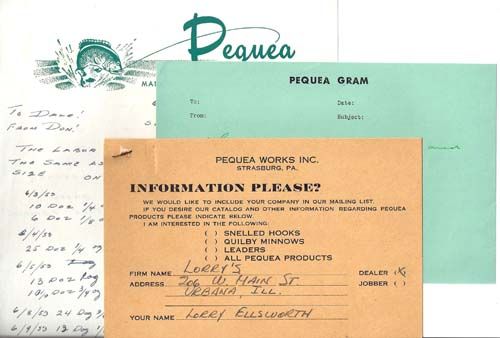
Letterheadings: Pequea Part III


Most Americans would not look back on 1926 as a year filled with spectacular headlines. A general strike in Britain brought that country to a temporary standstill, Robert Goddard launched the first liquid rocket, U. S. Marines landed in Nicaragua to put down a revolt and Chiang Kai-shek ascended to leadership of China's Revolutionary Party. None of which had much of an impact on the average American's employment opportunities or recreation hours. However, an article buried in the August 1926 edition of the Sporting Goods Dealer on Page 164 did describe a monumental sea change in the production of U. S. fishing tackle. This article, echoing a report by the Department of Commerce, confirmed that the U. S. tackle industry was now the largest in the world. And this fact would very much have an impact on the average American family.
 
"Where a few years ago this country imported most of its tackle from Great Britain and Norway, it now exports more than $300,000 worth of this merchandise annually. Great Britain is now the second largest manufacturer of fishing tackle, with Norway third. Ninety-five per cent of the domestic demand is supplied by home industry."
 
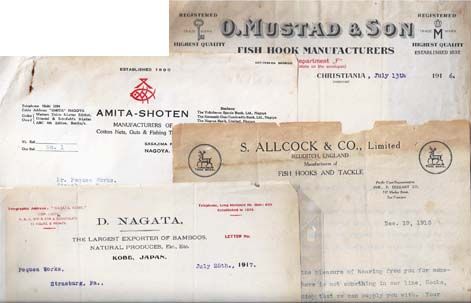
Harry C. Kaufman as president of Pequea Works was in the thick of a considerable scrum with other U. S. manufacturers to buy up raw materials. What he could not buy domestically he bought overseas. There was silk fishing line from D. Nagata of Kobe, Japan, sailing on the Toyama Maru to Seattle and thence by rail to Strasburg. Kaufman purchased Japanese gut line and leader from Amita-Shoten of Nagoya. From England he purchased porcupine quills for bobbers. And, of course, ever increasing orders for hooks from O. Mustad & Son of Christiania, Norway to keep his huge production line of snelled hooks moving at a frenzied pace. When supplies were undependable, priorities for unfilled orders had to be established. Pequea Works placed a priority on suppling goods for their largest customers (i.e. E.K. Tryon, New York Sporting Goods and Horrocks-Ibbotson) as well as orders for their oldest customers (i.e. Simmons Hrdwre, Suplee Hrdwre, Farewell, Ozmond and Kirk Co., and Enterprise Mfg. Co.). Other customers would just have to wait, regardless of who ordered first or what promises had been made.


Tackle producers like Pequea were growing larger every year, producing more, offering more varied product choices and hiring more workers (including a large percentage of women). In select cities the average American could find work in the tackle industry if he or she had appropriate skills or the willingness to learn new ones. Even better, they could buy reasonably priced tackle of every description, either through catalog orders in rural areas or at a wide variety of local shops in urban areas. In the 1930's Pequea tackle was sold by many counter-intuitive businesses such as gas stations, drug stores, tobacco shops, radio and tire stores, to name just a few. And Pequea products were well represented in these corner mom and pop stores  through out the pre-WWII period.


Harry Kaufman checked into the Hotel Pennsylvania in New York City with plenty of time to spare. The ninth annual meeting of the Associated Fishing Tackle Manufacturers was to occur from December 7-9th. Representatives of all the leading members of the U.S. tackle industry were to discuss, among other items the allocation of materials for the manufacturing process. On Sunday morning, December 7, 1941, radios began blaring non-stop. The Japanese had attacked our bases in Hawaii and other Pacific locations. The men who had gathered to discuss the production of tackle were not stupid. They knew that their industry would be of little importance compared to the need for the production of war goods. They quickly changed their thinking, their factories and their lives to accommodate this new reality.
 
The eighteen month period following the end of WWII was the apogee of the business life of Pequea Works. In 1945 the company employed 8 men and 47 women for a total of 55 workers. The next year, 1946 they had 12 men and 239 women for a total of 251. They would never equal this level of manpower or production again. By 1950 they were down to 88 souls including 10 men and 78 women.

Not only was foreign competition for the American tackle dollar fierce, competition for raw materials was equally difficult. These difficulties were compounded when on June 24th 1950, North Korea invaded South Korea. U.S. Government war related contracts with Pequea added another level of difficulty. An extracted paragraph from a letter dated 3 May 1951 from Pequea to E.K. Tryon is quoted below:
 
"There are several reasons beyond our control why shipments have been rather slow. We have had several unsolicited orders with D. O. priorities thrust upon us and we have experienced an abnormal amount of pregnancy among our female help. Please be assured that the Pequea Management was not directly implicated in either of the above."
 
The most critical factor in the ill fortune of Pequea was the increasing absence of its President and founder. By 1949 Harry Kaufman was visibly slowing down. By 1950 he was no longer taking an active role in the business of his company. Although he was only 64, his health was quickly failing and his place at the helm of Pequea was turned over to his Nephew, Dale Kaufman.
 
On Monday, April 14, 1952, at the age of 66 Harry Clay Kaufman passed away. The Associated Fishing Manufacturers, of which Harry had been a member for many years on the Executive Committee, passed the following resolution:
 
"Whereas, Almighty God in His Infinite Wisdom has called our dear friend and former associate, Harry Kaufman, to his eternal resting place; be it therefore RESOLVED, That we the members of The Associated Fishing Tackle Manufacturers assembled in Milwaukee do hereby express in behalf of the fishing tackle industry our heartfelt sorrow at his passing and unite in expressing to his family and Pequea Works, Inc., our profound sympathy in their great loss, with the sincere hope that some measure of comfort may be theirs in the sure knowledge that his years of unselfish service to his associates and the industry will ever stand as a source of inspiration….."


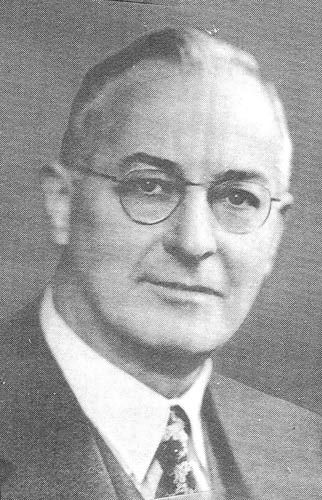
HARRY CLAY KAUFMAN (14 Oct 1885 - 14 April 1952)

 
The Kaufman family was unable to maintain the business and it was sold to Donald Z. Esbenshade in July 1954. After a long and colorful history the company was finally dissolved and sold at auction in 1986. The old factory building was converted into apartments.


-- J.K. Garrett & L.P. Brooks

Saturday, October 26, 2013

Letterheadings: Pequea Part II


Pequea Part II by J.K. Garrett and L.P. Brooks

Last week we discussed the emergence of Harry Clay Kaufman from carefree teenager crafting lures in his spare time to the role of wunderkind tackle producer in Philadelphia, PA. Kaufman, born in Philadelphia on 14 October 1885, had at least two failed tackle businesses under his belt by his twenty-second birthday . It is understandable that he wanted to start over in Strasburg (where his partner Edwin Brown was principal of the Public school) when so many Philadelphians were left with unpaid debts from Harry's earlier failed ventures. Fishing tackle was in the Kaufman blood, as Harry had an older brother and nephew who worked for well known tackle houses and could be of use buying his products, if only he could make the Pequea Works a success.
 
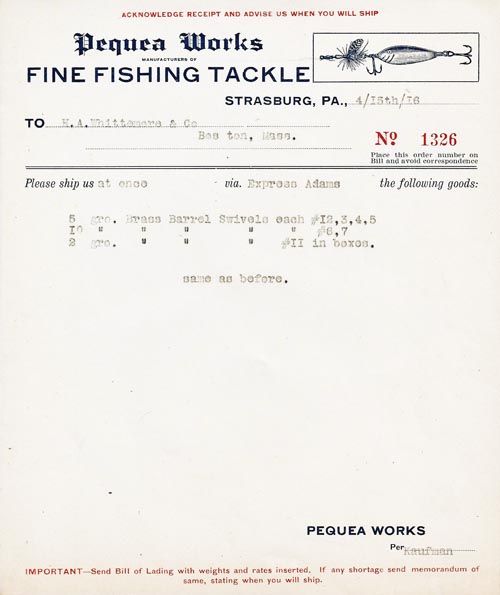
You can count on one hand the number of early tackle companies whose records still exist in sufficient quantity to show much insight into the internal workings of the company. Pequea is one of these few companies. With the reader's permission, we will stray from the usual practice of showing an array of the most artistic and rare examples of their letterhead and turn our attention to paper which focuses on internal Pequea operations and how these related to his customers. In this edition we will discuss the early years when Pequea was just hitting it's stride. Next week we will discuss the golden years of the company and the death of its president.
 
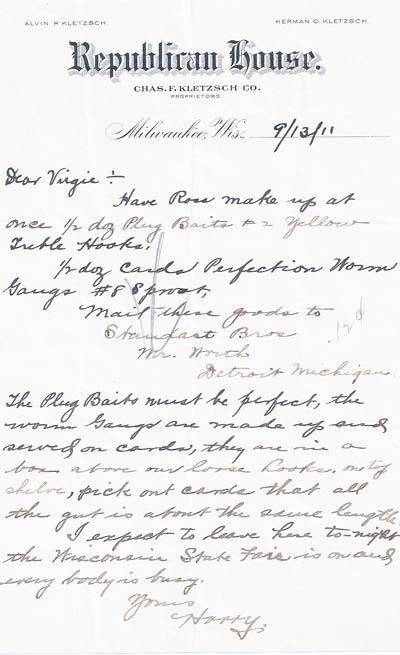
By 1909 Harry had taken a wife (Virginia, who he called Vergie), who was a salaried employee at Pequea. The handwritten letter dated 13 September 1911 (shown here) was penned by Harry from the Republican House hotel in Milwaukee, WI, to Vergie back home. Harry was on a road trip hawking his wares and seems to have met with some success at the Standart Brothers Hardware Corporation of Detroit, Michigan. Apparently Standart wanted to see some Pequea "Plug Baits" and some "gang hooks" with gut leader for fishing with earth worms. He asks Vergie to ensure that the Plugs were perfect in all respects and the worm gangs on the card were of uniform length. We may wonder from this admonition to Vergie if off the shelf items might not have the same quality control as sample items. It is this lack of quality control that would be a constant strain on relations between Pequea and their customers for decades to come. Letters to Pequea may be found by the bushel , sent by irate retailers because of defective Pequea workmanship. Many times the returned items were replaced by Pequea with goods as bad or worse than those which caused the complaints.


Why, we may ask, would retail companies continue to do business with such an undependable bunch of folk. The answer is two fold. First much of what Pequea sold did meet the average fisherman's needs. Equally important, the goods were sold at about the lowest prices possible compared to other manufacturers in the tackle industry. Second, Harry was a born salesman. He would promise the moon and stars on his sales trips, Pequea production schedules and quality would be found wanting, and the following year he would show up again and somehow kiss and make up with buyers not yet fully convinced of his duplicity.
 
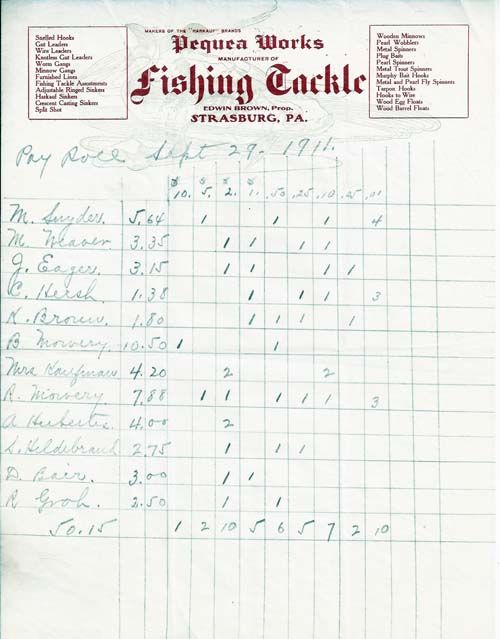
Our next piece of Pequea paper shows a handwritten payroll list on company letterhead. The payroll is dated for 29 September 1911. A comparison of this list with earlier payrolls shows that he took many of the employees with him to Strasburg that had worked for him in Philadelphia. Even more informative is the inclusion of relatives of his partner Brown and a salary for his wife Vergie. He would have found it hard, if not impossible, to fire friends and relatives, even if his business suffered by their incompetence. Truth be told, Harry had a soft spot for his old friends even if they occasionally proved to be deeply stupid or infirm in their older years.


Our next example of internal Pequea paper is page one of a five page order by New York Sporting Goods dated 4 January 1912. The massive amounts and diverse styles of products available from Pequea is stunning. Of course some of the items were produced by other wholesalers and touted as Pequea's own. The five page list  contains great varieties of snelled hooks, leader, sinkers, plug baits and spinners. Not included on this order were many other products available from Pequea such as bobbers, hand lines, swivels, flies, etc. Even if Harry did not always deliver all the goods he promised or in a condition to be usable, he delivered enough to help retailers make money and keep them coming back for more. We repeatedly see invoices from large companies like Shakespeare buying Pequea items and companies like Enterprise Mfg. Co. acting as suppliers to Pequea. Many times we see the same company acting in both capacities (i.e. G. W. Frost of Stevens Point, WI). There must have been very few significant tackle makers or retailers that Pequea did not interact with in some capacity through the years. The vast archive of their available correspondence proves it so.


Next week, the golden years of Pequea.

Saturday, October 19, 2013

Letterheadings: Philadelphia Bait Company (Part I)


EDITOR'S NOTE: Jim Jordan has had to take a (hopefully) brief leave of absence from Letterheadings. Filling in for him until he gets back will be some guest posts from a pair of great fishing historians, Jim Garrett and Skip Brooks. Here is their first offering; many thanks to G & B for filling in at the last minute!

Hello Folks - for this session and the next couple we're going to discuss one of the major tackle producers of the Twentieth Century. Strangely, it is one of those companies that flies beneath the radar of many collectors. Anecdotal evidence indicates that Harry C. Kaufman was making fishing baits in his home as gifts and for sale at least as early as 1902. By May 1905 these baits were advertised in The Amateur Sportsman Magazine under the name of H. C. Kaufman & Co. located at 1835 Cumberland St.Philadelphia, Pa. We have not seen any correspondence from this early period. Whether this business failed or was voluntarily dissolved is unknown.

The Philadelphia Bait Company was the next variant of Kaufman's tackle endeavors. In July, 1906 he signed a three year lease to rent factory space on North Franklin St, Philadelphia. The Rent was paid until August 1907 when the company became insolvent. Anticipating that all would not end well, Kaufman began moving assets out of the factory to a new location in Strasburg, PA before they could be attached by the sheriff for payment of debts. Dozens of creditors were left comfortless when the company went under (i.e. E.K. Tryon Co. and the Supplee Hardware Co.). In characteristic Kaufman style Harry requested preferential treatment in his demands for $600 in salary he claimed the company owed him in back pay as its President.

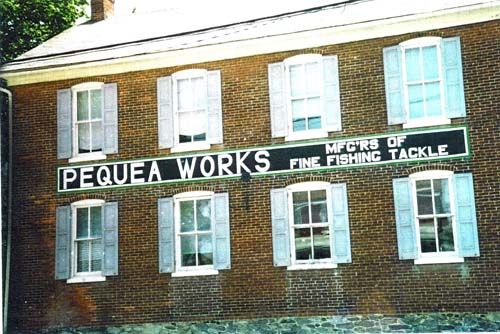
Kaufman would rise again, like the Phoenix, to form a new tackle company headquartered in Strasburg, PA. Edwin Brown, principal of the Strasburg Public School, became his partner. Early correspondence from the company can be found dated as early as April 1910 but it was likely trading under the name, Pequea Works, at least a year or two earlier. A hand written pay roll dated 12 April, 1909 lists 25 employees in addition to Harry. Success at last! The company was known at various times as Pequea Works, Pequea Tribe and Pequea Fishing Tackle. These names and other variations were sometimes used simultaneously in the later years of the company. The company expanded rapidly buying manufacturing facilities at other nearby locations and by acquiring the Yale Metal Products Company located on Canal Street in Manhattan City, NY. Yale Metal Products was quickly moved to Strasburg for the production of reels and other tackle Ephemera. Edwin Brown died on the 19th day of April, 1941 and Harry bought his share of the company from the Brown estate. Harry Kaufman died in April of 1952. After a long and ultimately successful history the company was finally dissolved and sold at auction in 1986. At this auction dusty cardboard boxes detailing the life's blood correspondence of the company and its predecessors was scattered among eager bidders intent on owning a piece of its history.

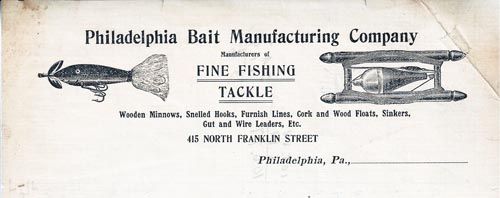
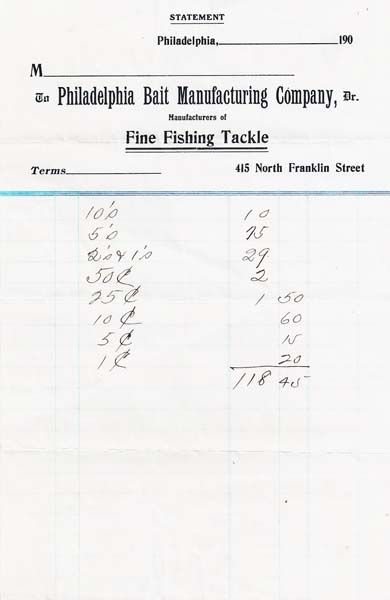
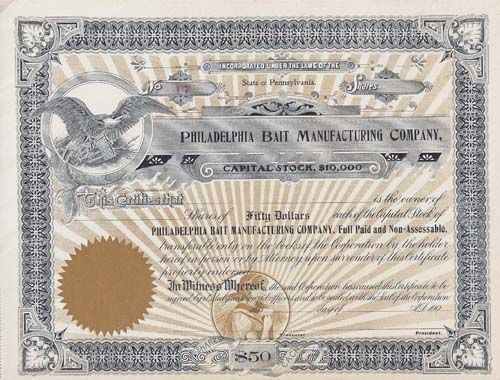
In this segment, three of the four known styles of The Philadelphia Bait Company letterhead will be shown. The fourth style, not available to this writer, shows an early involvement by Edwin Brown in this company but his position is not detailed. Also shown is a blank stock certificate from the Philadelphia Bait Co. In the next two segments letterhead from Pequea and Yale Metal Products will be discussed.


-- Jim Garrett & Skip Brooks
Wednesday, October 16, 2013


FRAUD ALERT: Fake Redifor Reels by J.K. Garrett & L.P. Brooks


FRAUD ALERT: Fake Redifor Reels

By J.K. Garrett & L.P. Brooks

Observation: Recently a REDIFOR reel was offered for sale.  The upper right quadrant of the head plate had extensive surface sanding which created a shallow depression. 


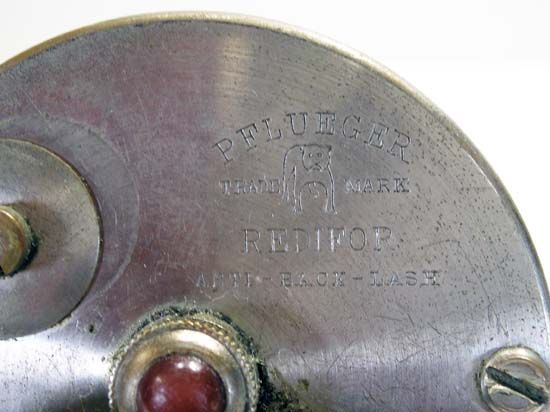
Analysis:This reel, although described as a product of the REDIFOR Rod and Reel Co., Warren, OH, was actually a Pfluegar REDIFOR.  Other aspects, to include patent information and patent numbers listed on the butt plate and end caps were identical to the Pflueger REDIFOR model.


Further analysis revealed what appear to be the remaining traces of the paws of the Pflueger Bulldog logo located over the letters "D" and "F" in the word REDIFOR on the headplate. Note the placement of the Pflueger Bulldog logo on the following picture:


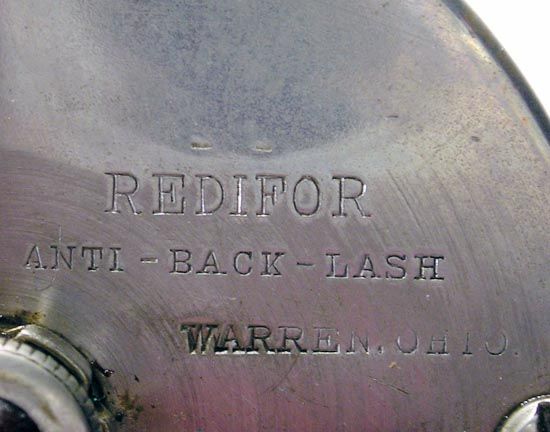
now note the traces left of the Pflueger Bulldog logo on the reel below over the letters "D" and "F" in REDIFOR:


Note the picture above for the added counterfeit "Warren, OHIO" imprint.  It is obviously a different application than the imprint above it.
 
Conclusion: Someone went to substantial trouble to disfigure this reel.  Typically, an original REDIFOR reel carries with it a greater collectable value  than the newer Pflueger REDIFOR Models. 
 
Since the perpetrator of this fraud not only sanded off the Pflueger marking but also went to the trouble to make a  "Warren, OHIO" stamp, it is likely there are other copies out there waiting for the unwary or novice buyer.  We are ALL potentially vulnerable to such fraud, be it lure, reel or paper and the hobby we all love is so much diminished by its presence. Thanks for your attention.

Saturday, April 11, 2009

The Mysterious United States Reels by J.K. Garrett & L.P. Brooks

This weekend we have a bit of mystery submitted to Fishing for History by Jim Garrett and Skip Brooks. I've written about the United States reels before when I penned a "Reels of the Trade" article about the VIM Company of Chicago, whom I believe sold these reels. Can you help out their research project?

The Mysterious United States Reels

by J.K. Garrett and L.P. Brooks

The reel series designated as "United States" reels are thought to be examples of standard inexpensive Bronson manufacture so far as is known. It is suspected they were made for and sold by the VIM company of Chicago in the 1930's but no advertising for them has yet been identified in available VIM catalogs. Reels were named after either States or in one case a River (Algonac) in available examples.

Three classes of reels are known to have been sold and they are as follow:

1) Casting (Ohio, Penn, Illinois and Indiana)
2) Fly (Algonac, Dakota, and Idaho)
3) Salt Water (Florida).

Although the boxes for Fly and Salt Water reels are clearly marked as United States reels and the model (i.e. Florida) is printed on the box, the reels themselves in available examples are unmarked as to maker or seller. This is not the case for United States Casting reels. In each of the three cases where we have a reel, the name is stamped on the headplate. We have a box for the Ohio but have not seen an example of the reel. If it follows the example set by the other United States casting reels it will also have the name stamped on it. It is worth noting that, although we have a very small population of boxes to study, in cases where we have multiple examples of boxes for the same reel, (i.e. Penn and Florida) there are substantial differences in box color or labeling.


If anyone has a box, a reel, or any advertisement for United States reels which will add to the information presented above, please contact us at reelguys AT aol DOT com.


Thanks to Jim and Skip for this neat little piece. Hopefully other collectors with United States reels will chime in!

-- Dr. Todd

Sunday, April 29, 2007

Lang's Discovery Auction Review

I am pleased to present a review of Lang's recent discovery auction, written by J.K. Garrett. It is a beautiful piece and I very much thank Jim for penning this.

Anyone wishing to contribute a report/piece/editorial/commentary/research to this blog can contact me at whitefishpress@yahoo.com.

-----------------------------------------

Albert Einstein and the Lang's Discovery Auction

by

J.K. Garrett

Albert Einstein observed that time can be a malleable commodity, stretching and compressing as the speed of an object varies in relationship to the speed of light. His views on time fluctuations at Lang's Discovery Auction are not recorded as he was not widely known to have been a dedicated tackle collector plus the fact that he has long since been deceased. I can report to you that the three hours allotted to review over 1000 heaps, piles, stacks, and boxes of tackle and tackle-related ephemera seemed to pass by in the same equivalent time it would take to barbecue a steak, medium rare. However time is measured, three hours is not long enough to properly examine 1000 plus lots of tackle.

The most beneficial, and at the same time difficult, aspect of the Discovery Auction is that only people attending the auction can view and bid on the items. There is no catalog, with items lovingly photographed, to peruse at leisure days beforehand. There are no pictures on eBay to puzzle over and prioritize and snipe at. There is only a list, available at the door for $3, which provides the skimpiest of lot descriptions. To my certain knowledge, unscrupulous attendees have tried to gain early access to Discovery lots the night before the auction as they were being unloaded from trucks by attempting to bribe, threaten and cajole John or Debbie Ganung. No one to my knowledge has been successful in this or any other attempt to gain unfair advantage. Not with John. Not with Debbie. Not once. Not ever.

When the doors open at eight o’clock a large cavernous room unfolds before you. Rows and columns of seats are located in the front with the auctioneer's podium foremost. In back of the chairs are long tables overflowing with tackle, the floor under the tables is inhabited by cardboard boxes of every size and shape. The lots are numbered sequentially, each lot composed of from one item (like a Kentucky reel) to several tackle boxes containing hundreds of items. You enter the swarming throng of other Discoverees overwhelmed by the universe of unexamined tackle knowing there will not be, cannot possibly be, enough time to give each lot the attention it deserves. What is amazing is how courteous these people are with each other. Many are strangers to each other, some are old friends or enemies, men and women, old and young, large, medium and small, and some who are not sure or care which category they fall in. However, without exception each one is in a great hurry to begin the search for treasure.

To compete effectively, what is needed is a plan and a friend. My plan was to concentrate primarily on reels at the Discovery Auction, though we avidly collect all categories of tackle. My reasons are these: If an item were both rare and valuable, as well as in good shape, it would properly be placed in the catalog auction. Although I dearly love and collect many lures that are imperfect, they are purchased in the hope that some day they can be upgraded. No one I know would be satisfied with a whole collection of place holders. Rare and valuable reels in the Discovery Auction, on the other hand, may only be missing an end cap or have a filed footplate or be missing screws. I know there are purest, conservative collectors who are horrified at the prospect of altering a reel in any way from the condition found. But I tell you truly I can not be made to admire an individual who would deny an otherwise beautiful old reel the proper identical part that is missing or broken to make it whole again.

I pass by boxes with only recently manufactured reels or only common reels, or boxes that have only broken or corroded reels with only the memory of their perfect beginnings. I go from one lot to the next, reaching across tables, squatting on the floor amidst the boxes, pardoning my way through the throng, allowing access to those who ask it or merely need it. Herein lies my advantage, my edge over most of the other people I see: I use both hands to search through the items and softly dictate the details of my discoveries to my faithful friend, my helpmate, my wife. Others must keep a list in one hand, pencil between their teeth, and reserve the other hand for the search. The freedom of movement this gives me helps my speed enormously and the expanded detail I am able to record on deserving lots will pay big dividends.

Let’s be clear. This is my tackle obsession (there is no other fitting word), not any interest in tackle on the part of my wife that has led us to this place. She has volunteered to accompany me to this unexceptional and remote corner of Massachusetts. The long drive, expensive accommodations and purchases, the hours of boredom for her, the sorting and packing, constitute the search for my Holy Grail, not hers. The results of this crusade will leave her unimpressed and exhausted. And yet here she is again, helping me in every way she can think of, just as she has helped me in the past. In this fluorescent-lit unromantic cavernous room, amidst these piles of used and often dirty and oil encrusted reels, dressed more for hard work than appearance, she has never been more beautiful to me. I have never loved her more than in that moment.

As I side step down the aisles, paper lots are another category I spend valuable time considering. I covet the knowledge, the information, the data they contain, regardless of the stains or smudges or smears as long as their secrets are intact. My goal is to make it as quickly as possible through the 1000 plus lots so I can have time to refine and prioritize my choices. Deliberations are made in chairs near the front my wife has marked with our names on paper tags. Other people use different strategies, sitting at the back of the room where they can keep an eye on other bidders and flash their bidder’s cards quickly so others will have difficulty knowing who their competition is. I care only about making certain that the auctioneer cannot miss my raised card. I will leave the card up until either I have won, or the price has passed me by. I take two aspirins to quiet the mutterings of dissatisfied muscles and joints unaccustomed to the awkward positions required during my search. The free coffee provided by the Ganungs is restorative and deeply appreciated. Three hours equals one hundred eighty minutes equals ten thousand eight hundred seconds has flown by and I am finally ready, barely, for the auction to begin.

My first win comes early with lot 6. It is a group of seven reels including a Yale German Silver No. 88 King Duz-Wine in the correct box. The footplate has some solder but that can be repaired or the footplate replaced, as I have a beater version at home. There is also a Montague Catalina in the lot in excellent condition. The lot goes for only $95. This is a great start.

Lot 58 has thirty reels, including two nice Meisselbachs and a Hendryx I need. The bidding ends at $115.

Lot 177 has ten reels, including a huge wooden Meisselbach ball bearing reel in excellent condition. The lot goes for $155.

Lot 285, seven reels including an Airex Vic reel in correct box. The reel is hard enough to find in decent shape, the box impossible. $150

Lot 315 is a German Silver version of a Yale fly reel. It is almost identical to reels produced earlier by Rochester/Carlton. $120.

Lot 406 consists of 10 reels, among them a Montague Gulf, 100 yd hard rubber reel I need. The lot is sold for $125.

Lot 414 has a Meisselbach Neptune in the correct box, a print block, and a line spool. It goes for a mere $55.

Lot 481 contains twenty miscellaneous lures and a mix of early paper, including a Meisselbach advertising sheet, a trade card from Hall Line Works and a damaged Jamison trade card. My bid of $150 takes the lot.

Lot 570 contains four reels, two knives as well as a large, spring-loaded metal bobber in the original box with instructions. This lot goes for $100.

Lot 714 contains eleven reels including a raised pillar Kiffe Reel. It is not perfect now but I hope to make it so. The lot goes for $45.

When the Discovery Auction ends, I have won 18 lots containing reels, lures, paper, gaffs, floats and other miscellaneous unidentified items buried in the boxes, perhaps known only to God. The buyer’s fee must still be added to the hammer price but I know I have done well, even so.

There are still two days of the catalog auction to come as well as the individual tables of tackle the attendees have brought for direct sale. I wish I could tell you that these auctions and table purchases were the end of my purchases on this trip. However, even as I sat in our room that night reviewing my purchases, I couldn’t help wondering what the occasional antique shop or flea-market might hold for me as we found our way, leisurely, home.