Showing posts with label South Bend. Show all posts

Sunday, March 24, 2013

1000 Words: Ivar Hennings (1920)

Here is a great photo of South Bend Bait Co. president Ivar Hennings with a big string of bass. It's a cool photo that appeared in the October 20, 1920 issue of Hunter-Trader-Trapper.

-- Dr. Todd

Saturday, March 9, 2013

LETTERHEADINGS: 1929 South Bend


This weekend inaugurate a new feature here on the blog, about a subject near and dear to my house: letterheads! I love fishing tackle ephemera, and so every Saturday we'll feature a new letterhead along with a brief discussion about the artwork and the content.


This week we are featuring a 1929 South Bend Bait Company letterhead featuring Louis Paeth's iconic artwork "Fish and Feel Fit." It's a colorful and interesting letterhead (I wonder if Paeth also drew the black-and-white line art in the corners). The content is pretty bland, although the fact that they printed and distributed 250,000 copies of their 1929 catalog is of real interest. Additionally, the fact that retailers could use the wholesale catalog to procure tackle for their customers was an interesting touch.

-- Dr. Todd

Tuesday, March 5, 2013

Voices from the Past: South Bend and the FTC (1922)


We've been on a bit of a South Bend history kick lately. Today, we're looking at a rather dark day in South Bend Bait Co. history -- how the firm was caught by the FTC for discrimination in pricing controls. It's a rather interesting decision covered in depth by the April 1922 issue of Hardware Review. Of greatest interest is the fact that South Bend sold 5-8% of all fishing tackle sold in America during this time, and that -- shockingly -- they only sold in the 1921 season 2.2% of all net sales directly to customer.

South Bend Bait Co. Must Cease Discrimination

Federal Trade Commission Rules Against Arbitrary Classification of Purchasers by Manufacturers — All Buyers Entitled to Same Price on Same Quantity of Same Products — Decision Detrimental to Jobbers

The South Bend Bait Co., South Bend, Ind., its officers and agents and employees have been ordered by the Federal Trade Commission to cease and desist from discriminating in net selling prices by any method or device between purchasers of the same grade, quality and quantity of commodities. Transportation Costs Legitimate

The commission's order, which was dated March 14, provides nothing therein contained shall prevent discrimination in price between purchasers of commodities on account of differences in the grade, quality or quantity of the commodity sold, or that makes only due allowance for difference in the cost of selling or transportation, or discrimination in price in the same or different communities made in good faith to meet competition.

This order is the result of an investigation made by the commission and is founded on facts as follows:

That the total net sales of fishing tackle and artificial bait in the United States by all manufacturers is approximately $7,950,000 net per annum, or about one-third of the volume of all "sporting goods" manufactured and sold within the United States. That the South Bend Bait Co. sells from five to eight per cent of all such fishing tackle, artificial bait and similar products sold within the United States.

Classified Customers

That during the three years last past the South Bend Bait Co., in the course of its business has put into effect a plan for the allowance of trade discounts and the making of prices to purchasers in the marketing of its products, substantially as follows, to wit: It has classified its customers in four classes, namely, "jobbers," "wholesalers," "dealers or retailers" and "consumers," and sells to "consumers" at fixed or list prices named in catalogues, circulars and other advertising matter and in some cases marked upon the article offered for sale; that respondent sells its products to purchasers who are "retailers," by it so classified at a discount of 33 1/3% off list prices, provided that if said "retailers" or "dealers" purchase $300 worth net, or more, at a single purchase, said "retailers" or "dealers" so buying are given a discount of 40% off list prices; that respondent sells its products to purchasers who are "wholesalers" by it so classified, at a discount of 40% off list prices regardless of the amount purchased; that respondent sells its said products to purchasers who are "jobbers" by it so classified at a discount of 50% off list prices regardless of the amount purchased: . that respondent suggests to retailers that they shall sell such products to "consumers" at prices identical with list prices to "whole salers" and "jobbers" that they shall sell to "retailers" at a discount of 33 1/3% off list prices; that respondent insists on the maintenance by "jobbers," "wholesalers" and "retailers" and "dealers" of such suggested resale prices to the extent of, in one instance, cutting off the supplies of one dealer who failed to maintain list prices to consumers; that in exceptional cases other and different discounts are given in the sale of its products to purchasers who are "jobbers," "wholesalers" and "dealers" or "retailers" by it so classified and designated; that respondent in making said classification defines purchasers as follows: "Jobber" that they must be a recognized jobber—meaning that they travel salesmen, issue a catalogue, and conduct a jobbing business, that is, calling on and selling to the retail trade and not doing a retail business; "wholesalers" as customers doing a combination retail and jobbing business; "retailer" or "dealer" as a "customer who maintains a store, carries stock and sells fishing tackle to the consumer;" "consumer" as the "user; he is the party who buys the tackle to fish with.

How Sales Totalled

That sales of said products made by respondent to single customers who are "jobbers" for a period of twelve months ending in July, 1921, varied in volume from $15.92 net, to $12,351.39 net, and that many sales to purchasers who were "jobbers" in said period were in volume less than $300 net; that sales made to single or individual purchasers who were "wholesalers" as classified for a period of twelve months ending July, 1921. varied in volume from $10.80 to $635.79 net, and that respondent made many sales to said class of "wholesalers" in said period less in volume than $300 net, and respondent made several sales larger in volume than $300 net; that sales made to single purchasers who were "retailers" or "dealers," as classified, varied in volume from 55 cents or less net, to $312.27 net and that several sales made by respondent in said period to said "retailers" or "dealers" were greater in volume than $300 net, while the great bulk of sales to "dealers" or "retailers" were less than $300 net in volume during said period; that the average purchase by "jobbers" was $1,460; by "wholesalers," $410; by "dealers" or "retailers," $57; that the total volume of sales to all purchasers for the eight months ending May 31, 1921, were $427,568 net, of which $9,363 net or 2.2% of the whole were made to purchasers who were "consumers" as designated; $65,888 or 15.4% of the whole to "dealers" or "retailers;" $50,499 or 18.8% of the whole to "wholesalers:" and $301,865 net or 70.6% of the whole to "jobbers" that the business of respondent has been and is rapidly expanding in volume of sales; that the total volume of net sales for the year ending September 30, 1912, the first year of its business career, amounted to $10,546; that for the year ending September 30, 1920, the total volume of business had increased to $399,879 net; that for the eight months ending May 31, 1921, the volume of respondent's business totaled $427,568.

Trade Discounts Discriminatory

That said plan of trade discounts made and applied in the sale of its products, as described, are discriminations in price between purchasers of products for use, consumption and resale within the United States; that the tendency and effect of said plan of discounts so made and applied is to make discriminating prices to purchasers who are distributors, and to compel purchasers who are consumers to pay a fixed or list price for said products from whatever source said consumers may purchase; that the effect of such discrimination in price between distributors of its products may be to substantially lessen competition in the sale of fishing tackle, artificial bait and like products in the sale of such products in interestate commerce. This plan the commission states is not a discrimination in price between purchasers of said products that made only due allowance for cost of selling or transportation; that cost to respondent of selling and transporting its products to some purchasers classified as "retailers" or "dealers" has been a less percentage of the selling price of said products than the cost of selling its products to some "jobbers" or to some "wholesalers," such latter cost being reckoned also as a percentage of the selling price.

Also the plan is not a discrimination in price between purchasers of products because of difference in quantities sold to purchasers; that some purchasers designated "dealers" or "retailers" and allowed a trade discount of 33J/$% off prices made in its catalogues, etc., actually have purchased at a single purchase or for a fixed period, greater quantities of the products than did some purchasers, designated as "jobbers," at a single purchase or for a similar fixed period, but said "jobbers" were allowed trade discounts of 50% off lists and that the plan was not a discrimination because of differences in grade or quality, that said respondent sells but one grade or quality of products; nor a discrimination in price in good faith to meet competition; nor a selection of customers in bona fide transactions and not in restraint of trade.
-- Dr. Todd

Tuesday, February 26, 2013

Voices from the Past: South Bend's Customer Service (1921)

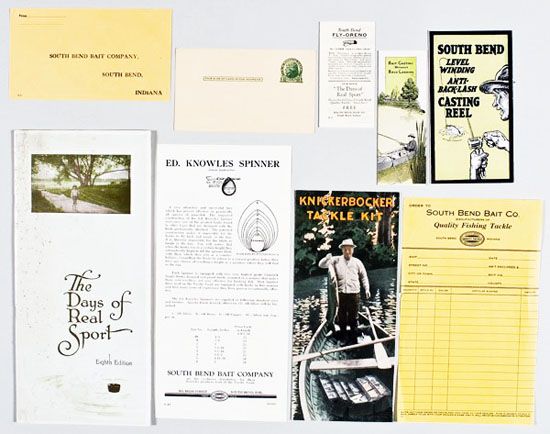
The following article appeared in the trade journal The Printer's Ink for October 1921. It covers in enormous detail the customer service department for South Bend Bait Co. of South Bend, Indiana. If you ever wondered why the firm grew so large so quickly, look no further than the manner in which they tailored letters to their prospective customers. Ivar Hennings, South Bend president, had it down to an art form, with different letters for different writers. Note that they, like all makers, asked each writer to notate what magazine they saw the ad in (Dept. G for example, designating Field & Stream) so they could tailor their response accordingly.  History proves this was an enormously successful business practice, and helps explains why companies like South Bend and Shakespeare had so many different tackle flyers.


A mint collection of 1921 South Bend catalogs and flyers that would have been mailed out to responders. (Courtesy of Lang's Auctions).


How to Make Follow-Up Letters Fit the Prospect

South Bend Bait Company Grades Them According to Mediums That Bring in the Inquiries

By C. M. Harrison

DOES an inquiry received through a general magazine advertisement require a different treatment from one gained from a similar advertisement in a class magazine? Or, to put it another way, should a prospect be automatically classified on a mailing list on the basis of the medium which brought in the name?

The South Bend Bait Company, of South Bend, Ind., after much experimentation in letter writing, is prepared to answer "Yes" to each of these questions. It manufactures bait and fishing tackle and advertises its goods in various classes of mediums. It believes that it is just as important to make the follow-up letter fit the prospect as it is to devote the same attention to the matter of individual copy. The letter, therefore, is made to conform as closely as possible to the general tone of the advertisement which produced the inquiry.

When an inquiry is received at the South Bend office it is at once classified by a key number which indicates the particular advertisement and publication that brought it about. Then the reply is sent out on a specially printed letterhead, on the back of which is reproduced the advertisement that caused the prospect to write.

New supplies of the stationery are printed each month so that the advertisements on the back shall always be up to date. The idea behind the procedure is that the prospect will be doubly impressed if he can see on the letter the advertisement which first induced him to write for the catalogue.

When a man writes the company in reply to an advertisement coming from a certain list of general or national publications, the South Bend theory is that he does not take an outdoor magazine and therefore he probably is not a dyed-in-the-wool angler. The letter written him therefore reads like this:

"1921 Fishing Season.

Dear Fellow Sportsman:

You will be interested, we feel certain, in the true-to-life boyhood fishing tale related in the first pages of this book.


As a sportsman—you are no doubt active in several sports which keenly delight you, which take you out in the open, close to nature.

But are you an angler? Do you know the thrill—the excitement—the genuine joy of baitcasting—the sport of casting for game fish? If you do we need not urge you further to carefully read through this book.

If you have never experienced the thrill which a fighting black bass will give you, turn to pages 6 and 7—also pages 16 and 17— of this book. We'll wager that you'll then read it entirely from cover to cover.

Tackle shown in this book is handled by the live sporting goods dealers in jour city. Go to them— ask to see the new South Bend Level-Winding Anti - Back-Lash Reel, which makes every cast a perfect cast. Also—inspect other articles of Quality Tackle. Thenclosed flier on Selected Game fish Lures may further help you If your dealer cannot supply you. we will gladly fill any order direct. Please mention your dealer's name when writing.

Many thanks for your inquiry —hope that we can count on you as another South Bend Tackle booster.

Faithfully yours,


But the man whose request for a catalogue is inspired by an advertisement in a sportsmen's magazine gets a letter like this:

1921 Fishing Season.

Dear Fellow Angler:

The first few pages of 'The Days of Real Sport' will take you back to those good old days when 'goin' fishin" required little preparation outside of a 'can o' worms' and a cane pole.

Nowadays it is different, as you well know. These days are 'the days of reel sport'—the days of game-fishing sport with the proper tackle.

To simply leaf the pages of this book will at once impress you with the extensive variety of South Bend Quality Tackle.

More careful study of this book, along with the enclosed bait folder, will prove of great assistance in selecting the right baits for the species of fish you are going after.

In making selections, of course, we prefer that you patronize your home dealer. Quality Tackle is handled by the live sporting goods dealers in your city. However, if you prefer we will be glad to fill any order direct. Please mention your dealer's name when writing us.

Many thanks for your inquiry —will count on you as another South Bend Tackle booster.

Faithfully yours,


P. S.—Read carefully the green and black folder enclosed, telling about the 'Masterpiece of Casting Reels'—the new South Bend LevelWinding Anti-Back-Lash Reel.

ATTENTION POINTED TO THE ADVERTISING

The advertisement which brought the inquiry answered by the first letter tells about the joys of angling and as such is calculated to impress the person who may not be proficient in that kingly sport. The second class of inquiry, however, was produced by a presentation of "Lures They Fight For I" In each case the letter calls the prospect's attention to the advertisement on the back.

All inquiries brought in from boys' magazines are answered by a special letter which is changed each month to correspond in spirit and in fact with the advertisement printed on the back. It reads like this:

1921 Fishing Season.

Dear Friend:

Instead of sittin' still waiting for 'em to bite—instead of being contented with 'nibbles' and a string of little five-inch 'punkin seeds' or blue gills—the boy of today is getting the thrill and excitement of going after the 'big ones.'

It used to be that casting with reel and rod was the sport of onlydad and the older fellows. Nowadays it's the sport of real, redblooded, regular boys.

When you've read the story about the boy and his dad, on the first few pages of this book— turn to pages 6 and 7 and learn why angling is a hobby which every boy and man should have.

Then turn to pages 16 and 17 —learn about the art of casting. Then read on page 19 about the South Bend Anti-Back-Lash Reel —the reel which makes every cast a perfect cast.

You can learn a mighty lot about bait-casting for game fish by studying this book—and it's sure real sport that a real boy should have.

Ask the sporting goods dealer in your town .to show you the South Bend Reels and Tackle you see Here pictured. Show this book to your dad—ask him how you can earn money to get an angling outfit. Then go out and enjoy the sport of all sports—bait-casting for game fish. Make it your hobby now—and it'll be your hobby always.

Here's luck to you—we'll be glad to hear of your catches.

Faithfully yours.


The letters are varied in accordance with the subject advertised. The advertising department does this on the basis that an interesting letter is just as important in making a sale as is an interesting presentation in paid space, and that it is a costly mistake to devote much effort and expense to good copy and illustrations and then have the effect minimized by faulty form letters.

All of which is saying nothing against form letters. The South Bend letters are exactly that kind. But they are constantly changed to keep them absolutely in step with the advertising.

When a magazine advertisement tells about bait that can lure to his doom the mighty muskallunge, the resulting inquiries are answered by what is known as a "muskie letter." This gives an up-to-date message about the joys of muskie fishing and refers to certain pages in the catalogue where that grade of bait is listed.

In some of the February magazines the South Bend copy told about its four types of flies especially suitable for trout fishing. The inquirers got this trout letter:

1921 Fishing Season.

Dear Fellow Angler:

A noted English angler very fittingly describes the appetite of the wily trout as being 'a bit particular and most discriminating.' As an enthusiastic trout angler you will no doubt agree with him.

Fly-rod fishing for trout requires, first of all, skill—but of equal importance is the selection of the proper light lures to appeal to the trout's fastidious taste.

The Fuzz-Oreno (formerly Fuzzy-body) Buck-tail Flips have proven mighty killing. Also the new Fly-Oreno and Trout-Oreno baits are wonderfully effective lures. They are designed for flyrod use, are of the wobbler type, and dive, dash and wiggle the same as the famous Bass-Oreno.

Other lures, to which we wish to call your attention, are the well-known Emerson Hough Buck-tail Flies and the Pacific Coast Bucktail Fly. They will be found unusual killers and very enticing lures for fly-fishing.

Tackle shown in this book is handled by the live sporting goods dealers in your city. Patronize them. However, if they cannot supply you, we will gladly fill any order direct. Please mention your dealer's name in writing us.

Many thanks for your inquiry. Will count on you as another 'South Bend Tackle' booster.

Faithfully yours,


There is a "salt water letter" sent to those answering advertisements relative to salt water fishing. Christmas advertisements feature the use of reels and lures for gifts and invite inquirers to send for "The Days of Real Sport" in order that full information regarding such useful and welcome gifts may be had. A special Christmas letter goes to all inquirers. It is written so as to bring out the Christmas spirit and on the back of it is the advertisement which inspired the request.

The company regards a form letter as just that and nothing else. Consequently all the letters are printed in ordinary type. There is not the slightest attempt made to make them look like typewritten messages.

HOW LETTERS GET PERSONAL TOUCH

But the personal touch which is of the greatest use in all business-getting letters is there just the same. It is in the letter's wording and in its general atmosphere rather than the physical form of its presentation.

Some of the coldest, dreariest, driest, most stereotyped letters in the world are sent out in proper typewritten form with the addresses matching up nicely and the signature correctly appended.

There is no occasion or inclination here to discuss the relative pulling power of typed letters as against the printed kind. But it certainly is not amiss to suggest that the personality, the selling force, must be in the wordinq of the letter.

"We believe," Ivar Hennings. president and general manager of the company, said to Printers' Ink, "that the letter is one of the most sadly neglected phases of advertising. When a person answers one of our advertisements we have in him a potential customer who may have a realiy great effect upon our business in years to come. We either must see him personally and thus clinch the good effect of the work the advertising has done or we must attempt the thing by mail. Obviously the mail is what we use.

"Therefore we cannot take any chances. Each and every letter must be highly personalized— something which is absolutely practical and possible even though letters be of the form variety. If a form letter is highly personalized after this manner it does as much good as a letter dictated to a prospect personally and signed by me as president of the company."

The South Bend company regards its mail so great an asset that it makes full use of the enclosure idea. Little pamphlets go out with every letter and with every box of goods.


-- Dr. Todd


Wednesday, January 12, 2011

Louis A. Paeth: The Man Behind the "Fish and Feel Fit" Logo by Peter Paeth

Louis A. Paeth: The Man Behind the "Fish and Feel Fit" Logo

Recently I received a wonderful series of emails from Peter Paeth, the son of painter Louis A. Paeth. Peter has graciously agreed to allow me to reprint pieces of this correspondence on the blog to share this information with everyone. In return, he would love to hear from anyone who might have information about his father's work. At the end of the article, I'll give some contact information.

Louis A. Paeth: The Man Behind the "Fish and Feel Fit" Logo

by Peter Paeth
 
I believe my late father, Louis A. Paeth, is the artist of the “fish and feel fit” man.  In his sizable art files I inherited after the death of my mother three years ago, there is an artist’s proof of “Fish and Feel Fit.”  I am hoping that others might lend their expertise on sporting catalog and magazine matters as I attempt to piece together my father’s artistic life story across nearly a century.  


 I’ve been trying to discover his early art and illustrative career in the ‘20s and ‘30s, since a day five years ago when I came across a book he had illustrated in the ‘20s, The Business Guide, which had been reprinted and was being sold on Amazon.com.  I’ve subsequently been able to verify his enrollment in both the Chicago Academy of Fine Arts and the Art School of the Art Institute of Chicago.  I have also learned of his employment from 1919 to 1921 at the prestigious art agency, the Charles Everett Johnson Studio of Chicago, where he worked with such famous artists as McClelland Barclay, Andrew Loomis and Haddon Sundblom.
 
Besides his ‘20s business card, I’ve included a scan of an illustrative work of Louis A. Paeth’s that appeared in the December 1921 edition of Outdoor Life, as well as a cover of the January 1934 edition of Outdoors Magazine, featuring his wild turkeys.  Between the years of 1921 and 1928, my father produced an abundance of “sporting and outdoor illustrations” which I’m trying both to locate as to place of publication and occasionally to verify. 


I’ve also included two of his fishing scenes—an oil of a  fly fisherman midstream and one of two sportsmen in a birch bark canoe.  I’m wondering if anyone may have encountered either of these works as illustrations in vintage outdoor or sporting magazines.  I suspect they were used as fishing advertisements; but perhaps they may have even been featured as cover illustrations.


If you Google search my father you'll came across the cover illustrations for Sporting Goods Journal on the MagazineArt website.  While apparently my father’s desire for the listing in the DuPage County Directory (Naperville, Illinois is located in DuPage County) was to be registered as an artist employed by the Callender-Sullivan Press, actually in fact, he relied on his free lance work throughout the ‘20s and ‘30s. Certainly this work for The Sporting Goods Journal provided him the opportunity for obtaining clients for his “sporting and outdoor illustrations.” Indeed, in the collection there remains illustrated catalogs for skis, skates…even some illustrative work for Louisville Slugger baseball bats.


The 1924 South Bend catalog also was part of his collection…this catalog is a trade catalog that was mailed directly to Louis at his home address in Naperville—surely a courtesy of providing the artist a final specimen of his work.  I use the word “was”…regrettably, in my ignorance three years ago, I sold this catalog on eBay. 


When I first discovered The Business Guide five years ago, I showed it to my mother and she had never seen it. They had met in Chicago in 1935, eleven years after this book containing my father’s illustrations was first published in 1924.  Shortly thereafter, I discovered another ‘20s book, published by the same Naperville publishing house, reprinted and being sold on Amazon.  Safe Counsel (“safe counsel” on the facts-of-life) was actually on my mother’s bookshelf, and, a cursory examination of it revealed some signed illustrations by Louis A. Paeth!  Due to the sexual frankness of the book, my mother was well aware of the book; but she was unaware that the reason the book was retained in the home library was for her husband’s art featured in it. 

This led to many bouts of exasperated inquiries…how could she have not known about any of this?  Why hadn’t all of this been part of our family story? She, being fifteen years younger than Louis, was still in grade school when my father painted his illustrations of the mid-‘20s.  I now know that her ignorance was similar to my ignorance with the South Bend catalog.  The research into my father’s art and illustrative life is akin to private investigative work...my mother and I wouldn’t have made good detectives...I’m now on the path of changing that.

If you have encountered any of his illustrations or paintings and can help me place them to their publication, I would be most appreciative.  If you have any further suggestions on how I may proceed in the task of locating and verifying my father’s illustrative artwork, I would be most grateful.

What a great story! If our collector friends out there could check their magazine and catalog collections, and see if they might have some Paeth material, I'm sure Peter would be grateful. Thanks, Peter, for sharing your father will all of us! You can contact him with any questions/comments at petpa AT blackfoot DOT net.

-- Dr. Todd

Sunday, December 5, 2010

1000 Words

1000 Words

In keeping with our theme of vintage tackle window displays, this week I give you the mother of all South Bend Dealer Displays!


Anyone ever see one of these?

-- Dr. Todd

Saturday, June 6, 2009

Deconstructing Old Ads with Bill Sonnett


Deconstructing Old Ads with Bill Sonnett

The Origins of South Bend

In the May 1910 issue of The Sporting Goods Dealer Magazine there appeared the following notice:

“New Goods From South Bend Bait Company

The South Bend bait Company of South Bend, Indiana is placing on the market sixteen different styles of bucktail lures, wooden minnows in four different styles, casting rods, weedless hooks and casting floats....”


I believe this is one of the South Bend Bait Company's earlyest public announcements that they are in business. That same month Elmer Doddridge of South Bend, Indiana applied for a patent on his weedless hook and assigned the rights to the South Bend Bait Company. In August 1910 this ad appeared in Field and Stream. It is one of the earliest ads in an outdoor magazine for the South Bend Bait Company that I am aware of and the only one I've seen for the Doddridge Hook. The Doddridge hook by the way was last seen in the 1912 South Bend Catalog.


After a long search about 10 years ago. I finally located a Doddridge Weedless Hook and added it to my collection. Feeling quite proud of myself, I told fellow collector (and long time fishing apprentice) Warren Platt that I had found an elusive Doddridge Weedless Hook. He immediately said, in a somewhat indifferent manner that he had three of them on the card. I told him that I doubted that as they were last made in 1912. The joke was on me as he really did have three he'd found in a flea market that were still on the cards. I don't think he had any idea of how rare his find was. As far as I know they are still the only three that have been found on there original cards. Needless to say after telling him he probably did not have the real thing, I was put through a lot of friendly hoops acquiring this one.

-- Bill Sonnett

Saturday, May 23, 2009

Deconstructing Old Ads with Bill Sonnett


Deconstructing Old Ads with Bill Sonnett

The Worden Combination Minnow

The Sporting Goods Dealer Magazine was often used to introduce new items to the dealers. This ad for the Worden Combination Minnow appeared in the July 1905 issue and leaves little doubt as to when the Combination was featured. Advetising featuring the three and five hook underwater minnows followed in 1906.


-- Bill Sonnett

Saturday, May 16, 2009

Deconstructing Old Ads with Bill Sonnett


Deconstructing Old Ads with Bill Sonnett

The Worden Bucktail of 1903

This advertisement is not a rare one, having appeared in many publications in 1903. What does make it unique is the fact that it features an actual photograph of the bait in question and the lettering appears to have been hand done. Notice that Worden does not mention any wooden minnows in his advertising. His minnows of course featured a spinner that have the patent date December 1903 stamped on the blade. This was not Worden's patent but rather one he contracted for use with Mr Junod of Celina, Ohio the holder of the patent. When did Worden start making wooden minnows? That question will be answered in another advertisement next week.


-- Bill Sonnett

Tuesday, March 10, 2009

Voices from the Past: R.K. Snyder, South Bend Rep (1930)


From the December 1930 Sporting Goods Illustrated comes a neat little blurb about a South Bend tackle rep of some renown. R.K. Snyder was hired to cover the states of Washington, Oregon, California and Nevada, and even spent a couple weeks learning the trade from Wes Jordan, legendary rodmaker for Cross, South Bend and Orvis. Snyder was a five-time West Coast champion surfcaster. The article was accompanied by a photograph of Snyder as well.


A nifty piece that gives us a name and face to put into South Bend history!

-- Dr. Todd

Tuesday, February 24, 2009

Voices from the Past: South Bend at the Start of the Great Depression (Dec. 1930)


South Bend at the Start of the Great Depression (Dec. 1930)

My friend Jim Garrett sent me this article detailing South Bend Bait Company's fortunes at the start of the Great Depression. It comes from The Sporting Goods Illustrated for December 1930, which should not be mistaken for The Sporting Goods Journal, a completely separate entity. While it may seem counterintuitive, some firms did astoundingly well during this dire economic era, and South Bend was one of them. A great article and I thank Jim for sending it our way.


--Dr. Todd

Wednesday, July 30, 2008

Dr. Todd's Mailbag, 30 July 2008


Dr. Todd's Mailbag


Its been a while since I answered questions, and I've gotten quite a few. Here is this month's edition of the Mailbag.

Dr.Larson,

I have an old bambo fly rod. It is a Noris Kamerad with the number 214 on it. I would like to find out about the history and the worth of this rod. Everything I find on the computer is about Thaddeus Norris. Could you please give me information about how I can track down info on my rod. (Note: The rod name is spelled with one "r" in Noris and Thaddeus Norris' name is with 2 "rs".

Sincerely,
Jerry K.


After some digging around, and with the help of the folks over at Clark's, it appears that Noris was a German company (the "Kamerad" should have been a bit of a dead give away). Noris was in fact purchased by Shakespeare in 1965 and used as its European branch for retailing tackle. I own a couple of snelled hook packets with the Shakespeare/Noris branding on them. Apparently the rods are solidly built but don't bring high prices in America. More information can be found in the Clark's board thread by clicking here.

----------------------------------


Dear Dr. Larson,

I'm wondering if you can assist me in identifying the approx. production date of a South Bend No.29 . The rod was my late father in law rod which was hung on the wall in his wood shop.

It is a 2/1 , 7 1/2', w  D  or HCH markings. It has the comficient handle w/ grooves, however, the reel seat was some type of plastic which shriveled. Unfortunately the finish  was heavily alligatored; however, the  ferrules are in excellent condition--still has the nice pop which taken apart. All of the labels are intact, the main label is oval(yellow/red) w/ the name South Bend Bait Co., quality tackle. The rod was recently restored w/ all of the labeling intact. It's a  very nice rod.

Any information would be appreciated.

Regards,

F. Chin


Dear Mr. Chin,

You own a very cool rod. The Model 29 appears in the 1940 South Bend catalog, as well as the 1941 Trade Catalog. It was a single built rod of 7 1/2 feet, with welted and serrated ferrules and an attractive orange and black jasper silk wraps. Definitely a nice rod and well worth the restoration. Here is a pic from the 1941 catalog:


----------------------------------


No subject inspires more questions to my mailbox than that of G.M. Skinner. Here are three recent ones:

Dr. Todd,

My name is Dave B____ and I have recently acquired a small collection of early Skinner baits. One in particular has a stamp of 1874 on it and is in fantastic condition. The blade is similar to the Abbey and Imbry, though it appears to be early "buck tail". I do not believe it to have been used very much, but that is besides the point. I am having trouble finding history of the lure as well as adequate values for the lures. I can find no information on Skinner before 1881. Can you help please?

Dr. Todd:  My nephew has a lure in mint condition that is a #7 pat. in U.S. and Canada.  It looks like the picture of the one in the catalogue with the black and white speckled feathers.  It is a GM Skinner and has the year 1874 stamped on it also.  Could you please tell me more info on it?  I read the story you had in your May posting about GM Skinner and how a book is in the making on him.  I would really like to find out about this lure but am having a hard time contacting the right people.

Dear Dr. Todd Larson,

I have recently found an old spinner in my collection. The spinner blade is marked "G.M. Skinner" with "Clayton. N.Y." underneath it. On the other side of the blade reads "Pat. U.S. & Canada 1874." The Spinner is a size 4 (with a small "4" in the middle of the blade). The Skirt is a turkey pattern, with one treble hook.
 
Enclosed is a picture of the lure. Any information surrounding this lure would be greatly appreciated!

Thank You,

Charles


Dear Skinner Owners,

Ah yes, the famed Gardiner Mills Skinner fluted bait! No other lure has sent more collectors, pickers, and dealers' hearts into a flutter than the Skinner Spoon Hook, as it was popularly known. This is because nearly every blade ever stamped (and there were probably twenty million sold over the years) carries the same marking:


On the left side of the blade is stamped the words "G.M. Skinner, Clayton, NY" and on the right side of the blade is "Pat. U.S. & Canada, 1874." This, of course, leads many to (understandably) believe they are holding a very old and very rare piscatorial piece.

The truth, however, is that even into the 1970s, G.M. Skinner blades were stamped exactly the same as they had been 90 years before. Combined with the fact that the Skinner Spoon Hook might very well be the most popular American fishing lure ever made, it means that the standard nickel-plated blade with these stampings is very, very common and not worth very much ($5-$10 in good shape).

Based on Skinner's 1874 patent for "flutes" that would reflect light in a better way, it spawned a mania and was (and is) one of the most effective lures ever made. For this reason every tackle box had to have a handful, and nearly all of them were nickel plated models.

There are, however, variations of the Skinner spoon hook that are worth more. For example, the blade was made in Sizes 0, 1, 2, 3, 4, 4 1/2, 4 3/4, 5, 6, 7, and 8 (and 9 and 12 in Willow Leaf pattern). The smallest Size 0 can bring $50 or more, as it is much harder to find, and the #1 and #2 bring more than the middle sizes. #7 and #8 blades are still purchased by smart musky and northern anglers, and thus are usually worth a bit more as well.

Additionally, the spinner was made in a number of metals: nickel plated, brass, copper, gold plate, and enamel. All Skinners that are NOT nickel plated are usually worth 2-3X more than their common cousins. The rarest are the German Silver models, which we will get to in due time.


Most Skinner spinners are found without packaging, but if you happen to find one on an original card or in an envelope, it certainly increases value by as much as 10x. The vast majority of Skinner Spoon Hooks were sold on the common wire form body, but some (pre-1940) were sold on wire and gut leaders. These, too, command higher prices.


The rarest Skinner spinners come from the 19th century. Originally produced in Canada, if you find a spinner which on the left side reads "Gananonque, Ontario" you have a really, really rare bait and one that is now pushing $500-$750 if you can find one. These are the earliest baits and date from the mid-1870s. Not long after the patent was issued in 1874, Gardiner Mills Skinner moved across the river to Clayton, New York, and the blades began to reflect this move almost immediately.

The earliest Skinner blades marked "Clayton, NY" are relatively easy to spot, if you know what to look for. The size marking number (i.e. 7) on most blades is always found in the middle of the spinner. When you find a Skinner with the number stamped at THE TOP of the blade, you have a pre-1895 G.M. Skinner spinner. Additionally, for a time the firm produced blades in German Silver, which can be spotted by its unique tarnish and patina. These early Skinner blades are valued from $75-$100.

But even these pale in comparison to the rarest of the G.M. Skinner fluted spinners. If you find a Skinner Spoon Hook with a patent date of 1891 on it, you have a real gem. This date represents the moveable clevis that Skinner patented that year in an effort to keep a monopoly on his fluted spinner patent (which expired that year). It didn't work AT ALL and was quickly pulled from the market. These 1891 patent blades are worth $300-$400 if you can find one, but in some senses these are badly underpriced. They are 30 times rarer than an equivalent Turkey Foot or Turkey Wing (two of Skinner's variants, one shaped like a kidney blade with flutes and the other with a design resembling a turkey foot) that sell for twice as much.

The very latest blades can be found with a clevis connector, instead of a soldered one. Believe it or not, these are pretty scarce and I would say valued twice what a normal blade is worth.

The Skinner Spoon Hook is my all-time favorite lure. I have nearly 600 of them, including three full sets of nickel plated blades and I am desperately working toward full sets of copper and brass (if anyone has a Size 0 in either drop me a note!). G.M. Skinner made other lures--the coveted Turkey Wing, Turkey Foot, and others--but it is the Spoon Hook that is his lasting contribution to the world of fishing. Long live the Fluted Spinner!

-- Dr. Todd

Wednesday, April 9, 2008

South Bend, E.V. Selby and the "Double Action" Legal Action

Last week I wrote about a potential lawsuit between South Bend and Paul H. Young over the "comficient" grip for fly rods. I casually mentioned that South Bend had a history of being, how shall we say, extremely litigious. Jim Jordan wrote me and noted that South Bend threatened legal action against a small lure company by the name of E.V. Selby. He had recently posted this info on Joe's Board and has graciously allowed us to repost it here.
South Bend, E.V. Selby and the "Dual Action" Legal Action

by Jim Jordan

E.V. Selby invented the Flat-head lure and sold his baits out of Decatur, Illinois. This bait came in at least 7 colors. Selby advertised his flat-head lure as a Dual Action lure much to the dismay of South Bend Bait Co. who took legal action against Selby for Trademark infringement for using the word Dual Action.


Selby was pretty slick and changed one letter in his advertising to avoid South Bend's legal action. He simply changed the letter "A" in the word Dual to a "B".


A classic case of a big company (South Bend) having its way with a smaller one (Selby). Obviously, Paul Young had REAL worries on his hands!

-- Dr. Todd

Wednesday, April 2, 2008

Get A Grip: South Bend, Paul Young, and the Comficient Controversy

Get A Grip:

The South Bend Bait Company, Paul H. Young, and the Comficient Controversy


© 2008 Dr. Todd E.A. Larson


I thought about beginning this little epistle with a terrible pun, something along the line of “grips get a bad rap,” but decided instead to just jump in head-long into one of the more entertaining fly rod controversies of the immediate post-war era. It involved a monolithic big shot (the South Bend Bait Company), an endearing little guy (Paul H. Young), and a nearly expired rod handle patent. While this little episode in fly rod history may not be earth shattering, I think it does illustrate nicely that fly rod design is sometimes dictated by powers outside of the rodbuilder’s control, in this case, an overlooked fishing rod handle patented in 1933 by William Bayard Sturgis of Chicago, Illinois.

Sturgis applied on 14 July 1932 for a novel development in a fly rod handle, specifically a new form of cork grip. On 17 October 1933 he received patent #1,931,303 for “a much more comfortable and firm grip obtained with less effort on the part of the angler.” Sturgis’ development was simple and elegant—a cut out in the grip where the thumb went that allowed the flycaster to more comfortable grasp the handle. Sturgis did not appear to be aligned with any tackle firm at the time, and as this grip does not show up on very many 1930s vintage rods, probably was not widely used.


All of that would change in 1940. That year, the South Bend Bait Company began to use the Sturgis patent grip on a line of fly rods, applying for a trademark on the word “Comficient,” which was coined to describe the Sturgis grip. The trademark was granted by the Patent & Trademark Office on 10 December 1940. Whether they purchased the patent from Sturgis outright (a likely development, as the firm had a voracious appetite for tackle patents) or paid a royalty is not known at this time. What is known is that South Bend received exclusive rights to market the patented grip.

It has been written that the Comficient Grip, as it came to be known, was used by South Bend as early as 1937 or 1938, but the author has examined complete South Bend catalogs dating 1936-1942, and the first sign of this rod handle is the 1941 catalog that announced it on Page 2 as a “new grip for new casting ease.” It was originally offered on only three models (#59, #159, #359). The term was derived from a melding of the words Comfortable and Efficient, and in true South Bend style (they did, after all, invent and market a whole host of “Oreno” tackle), the firm designed a snazzy circular logo to go with the catchy name.


Introductory ad for the Comficient Grip (1941 retail catalog)


South Bend series with Comficient Grips (from 1941 South Bend Trade Catalog)


South Bend had gotten into the bamboo fly rod market through the purchase of the Cross Rod Company of Massachusetts in 1926, a move that fortuitously brought the firm the great Wes Jordan, who oversaw production of South Bend Cross rods until the late 1930s. By 1941 South Bend was producing an impressive array of rods, ranging from the top-of-the line Jordan-made models at $35 to the new Comficient models at $7.50. The new grip must have been popular, as by 1942 the Comficient was now offered on 18 models, all of which received top billing in the catalog. World War II brought production of fly rods to a halt, although the firm issued a truncated 24-page book of fishing photos (its first new mailing since the 1942 catalog) in which it declared “our factory is in the process of manufacturing fishing parts.”


Comficient Logo #1


Comficient Logo #2, note the “patent pending” on this 1941 version


A little over 200 miles east of South Bend, another fishing tackle manufacturer was tooling up for the post-war tackle rush. Paul H. Young of Detroit (by way of Minnesota) had first tinkered with rodbuilding in the 1920s, but it was not as a true rodbuilder that he would first make his name. Contrary to what some have argued, as Young himself made clear in a letter to his lawyer (owned by J.K. Garrett and L.P. Brooks) dated 26 November 1946, he had never “built” rods as we might define the term today. He declared, “After procrastinating for near 20 years we have finally kicked the traces and started making fly rods right from scratch.” The implication, of course, is that he did not make fly rods from scratch before this date. Later in the letter he further elaborated: “from 1938 to 1942 I assembled good numbers of fly rods here of So. Bend, Edwards, Heddon and other sticks, making my own grips…” Again, note the careful use of the word “assembled.”


After the lean war years, Paul H. Young must have been eager to put on his new rod catalog in 1946


It was the issue of grips—which Young took great pains to declare he had always either had custom made to his specifications or more often simply crafted himself—that was at the crux of his legal inquiry. In particular, the South Bend Comficient grip. As he wrote to his lawyer (Mr. Gibson):

Starting around 1930 I purchased a good many styles of cork grips from So. Bend and used them in assembling special rods along with Cross and other glued up stock. These grips, I installed big end up and milled a thumb rest, often two, into the cork. There are a good number around here so fitted, also a number that were re-modeled, installing such grips.

Again, further evidence that Young, in addition to trafficking in custom trade rods, was also purchasing “glued up stock” and then customizing it for his clientele. He continued:

In 1933 I had [Fred] Thomas incorporate a similar styled grip on a number of custom orders that are still being used around here. From 1938 to 1942 I assembled good numbers of fly rods here of So. Bend, Edwards, Heddon and other sticks, making my own grips and putting in a single or double thumb rest, depending on the size of the rod.

This bit of history was an effort by Young to establish that he had been using the idea of the thumb rest fly rod grip since at least 1930, which means it would have predated the Sturgis patent by at least two years.

Young gets at the heart of the issue with his last paragraph:

All this leads me to the question of whether South Bend’s “Comfy” grip patent is intended to prevent me or others from using a gouged or milled out thumb rest on new rods. In as much as I am compiling a rod catalog this becomes important, and I would appreciate your companies’ reaction, as I wish to show a cut of the thumb rest.

Thus it was South Bend, who entered the post-war era with a flashy and expensive advertising campaign, that precipitated this neat bit of Young history. The Comficient Grip was being widely advertised, and since South Bend was famous for being sue-happy (it had inaugurated litigation against at least a dozen competitors in the previous 25 years), Young probably had real reason to fear a “cease-and-desist” letter.


South Bend was literally flooding the market with Comficient grip rods like this


The original copy of Young’s letter shows that Gibson received it on 29 November 1946 and likely responded soon after, for in the margins at the top are written both the trademark and patent date, which had less than four years before expiration. If there was an answer attached to Young’s later, it has been lost.

Apparently, South Bend either chose not to pursue a lawsuit or deemed it not in their best interests (Young had been a long-time customer), and the issue quickly disappeared, likely forgotten soon after even by the main participants. Yet the Young letter offers some real insight into not only his own rodmaking operation, but the minefield that was the fishing tackle field. Small fish like Young had to constantly be wary of making missteps when it came to crafting new tackle, for it would take only one costly legal mistake to force them to fold up shop. Paul H. Young clearly understood this, and penned this informative letter to avoid any future problems.


This 1947 catalog page shows that South Bend was taking up where it left off before World War II, expanding the Comficient line


What impact this little episode may have had on Paul H. Young’s fledgling career as a rodbuilder I will leave for experts like Robert Golder (who has compiled an outstanding Young rod database) and others to debate. Perhaps they can further illuminate if Young continued to use the cut-out thumb grip in his own make of rods, or whether he went in a different direction (his handles were widely noted at all stages of his career as being among the best around).

One thing is certain; Paul H. Young certainly had a grip on the subject from the very beginning, despite South Bend’s handle monopoly.


A South Bend 359 with Comficient Grip


POSTSCRIPT: Robert Golder has penned some great additional information on Young and this episode that can be read by clicking here.

-- © 2008 Dr. Todd

Saturday, July 7, 2007

My Favorite New Web Page

My favorite new web page comes from one of my favorite old web pages, Joe Yates' Web Site. Long known for his Message Board, Joe has recently posted a new page dedicated to the rare, unusual, and unique in the fishing lure world. Frequent Joe's Board users (like myself) have long marveled at the incredible tackle that circulates on this board, and now Joe has put this page up to archive some of the neatest pieces. You can access the Rare Lures Web Page and decide for yourself how cool it is.


South Bend Fly Oreno 12-Pack

My contribution is the South Bend 12-Pack, pictured as it was found (with the two incorrect painted-eye lures swapped out for correct models since this photo was taken). This is a pretty rare combo; my friend the late Cliff McDaniel owned not one but two of these beauties.

A great web site and I encourage all the readers of this blog to contribute to it.

--Dr. Todd

Friday, July 6, 2007

Introducing South Bend's Pearl Finish (1930)

Mother-of-pearl, or Abalone as it is properly known, has been a fish-catcher for thousands of years, adorning South Sea Fish Hooks since the Polynesian islands were first inhabited. Abalone fishing lures were thus an early and popular fishing lure, still quite popular in the 1920s. This makes it surprising that it took so long to try and reproduce the lustre of pearl on a fishing lure finish. It took The South Bend Bait Co. to develop the Lustrous Iridescent Pearl Finish (Catalog Code PL) for wooden and metal lures in the spring of 1930.


Beginning that summer, South Bend introduced the lure to America through a series of ads touting "Pearl Finish Lures" that were "originated and developed by South Bend." The finish was available on a variety of South Bend lures, and the copy read:

The satiny lustre of pearl has long been known to hold an attraction for fish. Now, for the first time, this lustre with its soft, variegated colorations is succesfully reproduced as a finish for metal and wooden baits. Pearl Finish is a South Bend development destined to become as popular as the famous red head, white body combination originated by us. Pearl Finish is available at present in the baits shown here. Ask your dealer.


The introductory lures were the Bass-Oreno, Babe-Oreno, Trout Oreno, Flash-Oreno, Baby Teas-Oreno, Trix-Oreno, Dart Oreno, and of course Pearl Spinners. Interestingly, it would appear this color was an additional $.25 per lure during its introductory period.

The color clearly did not sell as well as Red Head/White, and in fact can be downright difficult to find today, a testament to the fact it did not sell well. Terry Wong in his Identification and Value Guide to South Bend Fishing Lures has the PL available until 1942, but it ceased being available on a number of lures by the mid-1930s. It is identifiable by its light red and blue spots over an lustrous white, although these spots often faded. The Pearl finish was soon copied by Heddon and used most famously on their River Runt Spook, and by any number of other companies including Creek Chub, Arbogast, Helin and most all Salmon plug makers.

A picture of a very rare Pearl Dart-Oreno can be found on Marie Munson's outstanding web site.


Beautiful Pearl Pike-Oreno Courtesy Warren Platt


--Dr. Todd

Thursday, July 5, 2007

Origins of South Bend's "Fish and Feel Fit" Campaign

One of the most famous slogans in fishing history was the saying "Fish and Feel Fit," most often associated with the South Bend Bait Co. of South Bend, Indiana. The slogan was used for fifteen years by this firm and was prominently featured on the cover of its catalogs and in its advertisements, so much so that many people assume that it was a slogan coined by the firm.


I thought it might interest a few South Bend fans out there to go over the origins of this saying. The answer can be found in a March 1926 article entitled "Fish and Feelt Fit: New Slogan of Fishing Tackle Manufacturers of America." The slogan was the result of a national contest held by the Fishing Tackle Manufacturers of America (FTMA--later AFTMA). The contest judges met at Elkhart, IN and named the submission of V.A. Williams of Utahville, PA as the winner (although two others sent in the same slogan, only Williams wrote the 25-word essay explaining why it was best). Over 3500 different slogans were submitted, and the winner received a huge selection of fishing tackle from the associated firms. The article concluded:

"The purpose of conducting this contest was to determine the voice of the average angler in his conception of what the fishing sport meant to him. The prize-winning slogan will be used extensively by the members of the organization in their future advertising campaigns and literature mailed throughout the country. The new emblem will be used by each fim's stationery and on containers their product is packed in, the idea being to protect the purchaser of fishing tackle against inferior quality merchandise. Another purpose is to encourage the use of tackle made in America for Americans."

While some of the tackle firms used this slogan, only South Bend took it to heart, making it a centerpiece of its advertising campaign throughout the late 1920s and 1930s. It became so closely associated with South Bend that perhaps other firms did not want to use the slogan (and its famous image of a fisherman holding the slogan like a stringer of fish) for fear of being associated with South Bend and subconsciously promoting their goods.

--Dr. Todd