Showing posts with label Peter Paeth. Show all posts

Thursday, March 22, 2012

Louis Paeth and Outdoor Life in the Early 1920s by Peter Paeth

Louis Paeth and Outdoor Life in the Early 1920s by Peter Paeth

As you know, I frequently check through eBay listings for possible examples of Louis Paeth work. His surviving art files contained a signed, full-page magazine illustration, portraying Eliphalet Remington and the history of Remington Arms, clipped from a December 1921 edition of Outdoor Life.  Because of the existence of this work, I decided to create an EBay search for 1921 Outdoor Life magazine listings, so as to be notified by email when an issue came up for auction.


This past January, I received just such an email: a July 1921 copy of Outdoor Life was on sale.  In the listing, the seller included additional photos of some interior pages which revealed another full- page illustration of my father’s, this time a depiction of Samuel Colt and the history of Colt Firearms


Needless to say, I was thrilled by this discovery of work he had completed before his 21st birthday and made sure I won this auction. 

Now, an internet search for Colt historical information revealed that in 1957 the company had donated its Colt Factory Firearm Collection and a large manuscript collection to the Connecticut State Library.  Scrolling down the library’s finding aid for RG103, Colt's Patent Fire Arms Manufacturing Company records, under “Printed Materials/Company related,” I found the entry, “L. Paeth’s illustration of the Colt revolver.”  I immediately called the library to inquire if this entry might represent a work I had not seen.  After I sent a librarian my scan of the Colt Outdoor Life illustration, she responded that hers was identical to that which I had emailed, but with a blank textbox where the written history had appeared in the published version.  Although, as of yet, I have been unable to obtain a scan of this work, I remain cheered in the knowledge that this signed artist’s proof of my father’s has found a place in the Colt Archives housed in the Connecticut State Library. 

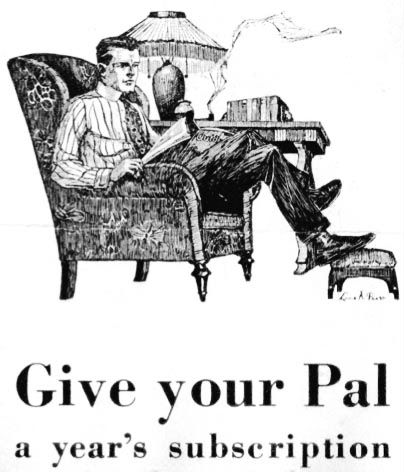
If there is one lesson that I’ve learned in my historical detective work, it is this: even though I may have inspected something carefully a number of times, it may not be until yet one more subsequent examination that a revelation appears.  Just so, on a recent night after my Colt find, I was looking through a group of several small illustrations that my father had long ago cemented onto heavy cardstock paper, probably for the purpose of portfolio display.  I was familiar with all this work and knew where each had originally appeared in publication, excepting one: a small, hand-cropped illustration of a man reading in his easy chair, his feet resting on a footstool.  The caption that remains with this illustration is “give your pal a year’s subscription.” 

I had always assumed that I would never find this in a publication and so, not given it much thought.  But on this night, it suddenly occurred to me that I needed to look at this small sketch with the magnifying glass, and when I did, I realized that the magazine the man was reading was Outdoor Life!

This discovery, in light of the two full-page Outdoor Life illustrations for Colt and Remington, took me to the website of World Cat, the world’s library catalog, to see where I might find libraries that held collections of 1920’s Outdoor Life.  A little searching and I found that the library at Washington State University, only some 250 miles from my home in Western Montana, contains a collection of Outdoor Life magazines that dates back to 1910.   Fortunately, other plans had already been put in place to visit the area in mid-February, and so on February 23, I traveled to Pullman, Washington to look through WSU’s back volumes of Outdoor Life.
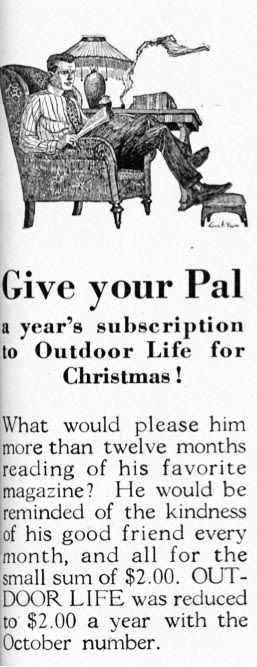
Once there at the Holland and Terrell Library, within ten minutes I located the illustration of the man in the easy chair from my father’s files; there he was on the index page of the December 1921 edition of O.L. complete with footstool and the encouragement for readers to give gift subscriptions at Christmas

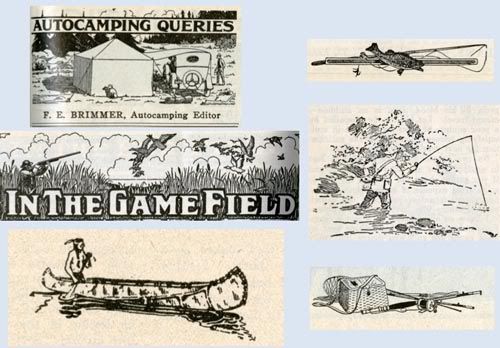
Starting into the 1922 volume, I soon encountered the signed Louis Paeth work which accompanied a February 1922 article on auto camping.
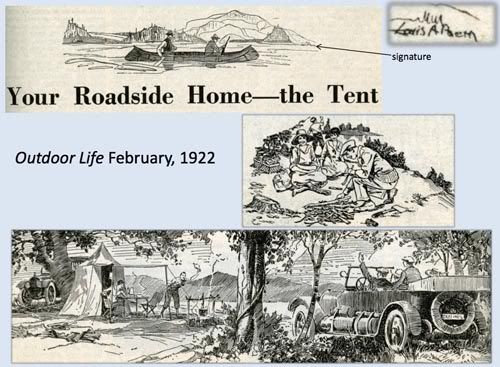

This bucolic yesteryear camping scene brought to mind illustrative work done unsigned later in the ‘20s for Harley-Davidson.


More searching through the back issues followed, during which I came upon several more familiar looking sketches illustrating outdoor articles and column headings for regular monthly features, these, too, were probably my father’s work.
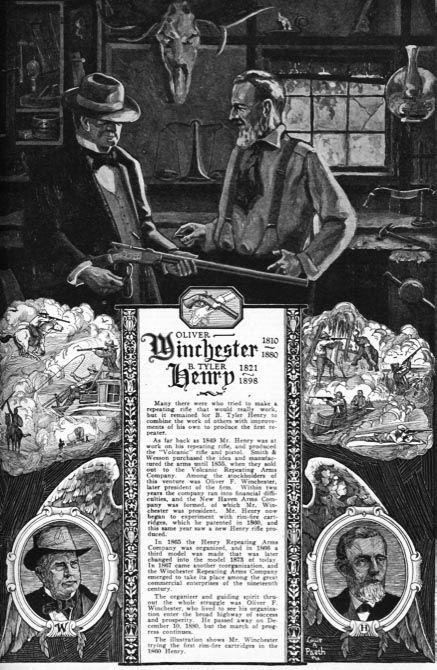
As productive as my visit had been to this point, the biggest eye-openers had yet to make their appearance.  I was making my way chronologically through the ’22 volume when the July issue happily confirmed my long-held assumption of the existence of more full-page firearms tableaus by revealing a signed Louis A. Paeth Winchester/Henry page.

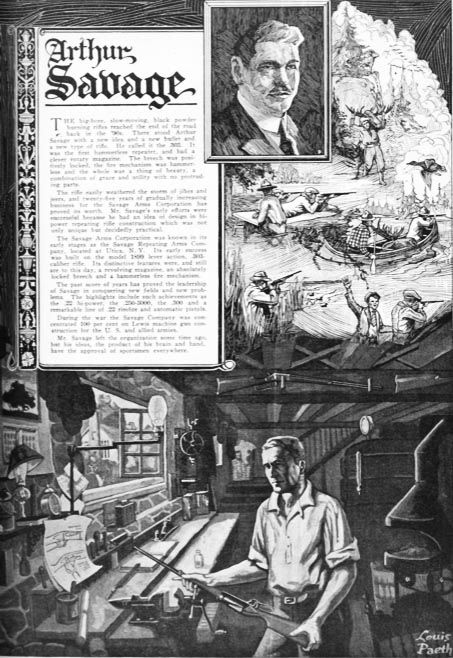
Then, an hour later, when the February ’23 issue yielded a final signed illustrative biography on Arthur Savage and the history of the Savage Arms Corporations, my trip was complete. 


With the revelations it had brought, I now better understood the beginnings of my father’s artistic timeline and felt proud to think of Louis in his early 20s, already a recognized and capable enough illustrator to have been contracted for a series of illustrative work for four of the major firearms manufacturers in the United States: Colt, Remington, Winchester and Savage.

After so many unsigned illustrations and so many dry wells, these thoughts cheered our ride home from Pullman, Washington and strengthened my resolve to press on with research into the life and work of my father, Louis A. Paeth.           


Louis and Peter Paeth ca. 1953.


-- Peter Paeth

Tuesday, August 30, 2011

Louis Paeth and Harley Davidson: Fishing for a Connection by Peter Paeth

Louis Paeth and Harley Davidson:
Fishing for a Connection

by Peter Paeth

In January ’09, I had bought a reprint of a 1926 Harley advertisement featuring a farmer in bib overalls on a motorcycle.  The illustration had the “feel” of my father’s work, and when I scanned and compared it with his verified work from two mid-‘20s books (he had illustrated J.L. Nichol’s The Business Guide and Safe Counsel), the similarities were compelling.


Unattributed 1926 Harley-Davidson advertisement.


1924 Paeth Business Guide illustration.

The farmscapes, the clouds, the trees,…even the horizontally hatched skies were identical.  Either the farmer on the Harley was my father’s pen-and-ink or it had been drawn by someone who employed an uncannily similar repertoire and style.  Later that month, on the Naperville Heritage Site of the Illinois Digital Archives, I found my father’s listing in the 1925 Dupage County Directory as an artist for the Sullivan Press (a.k.a The Callender-Sullivan Press) of Chicago.  His illustrated covers of their magazine, The Sporting Goods Journal, saved in his collection dated this employment from 1923 to 1925


xxx

Since the Press also published Motorcycling including the Bicycling World,  it seemed reasonable to assume that this connection might have brought him free lance opportunities in the cycling world, just as The Sporting Goods Journal had probably led the South Bend Bait Company to him.
 
A Google book search revealed that the entire 1919 volume of Callender-Sullivan Press’s Motorcycling and Bicycling magazine(retitled Motorcycling including the Bicycling World in 1923) had been digitized for full view. There I learned that W.D. Callender(company president) and T.J. Sullivan(the magazine’s editor)-- the press’s founders-- were members of the Motorcycle & Allied Trades Association.  Sullivan was even a race official(Slide 3) and can be seen in some incredible archival newsreel footage on YouTube as the starter of the legendary Marion 200, Labor Day 1919, http://www.youtube.com/watch?v=I1YDV2fGcOk –


Louis Paeth worked as an artist for the Callender-Sullivan Press from 1923 to 1925. They published the trade magazines Motorcycling (including The Bicycling World) and The Sporting Goods Journal

Present that day with such mythic figures as Walter and Arthur Davidson and William Harley, Sullivan and Callender were prominent members of the motorcycling fraternity that popularized, sponsored and attended such races. I remember thinking, “that’s the connection between Harley-Davidson and my father,” and thus I began examining whatever Harley-Davidson ads I could find.  Archival issues of Popular Mechanics had also been digitized by Google books, and I soon discovered that Harley had placed a full page ad in virtually all of the magazine’s monthly editions of the ‘20s and ‘30s.
 
Many of the ads featured there were designed with the outdoorsman in mind, emphasizing the motorcycle’s off-road sporting capabilities.   “Where the Big Ones Rise,” “On the Fly,” “All Outdoors is Waiting for You,” and  “The Sportsmen’s Friend,” for example, were some of the titles used in their Spring 1928 campaign.(Slide 4)  The company, at least in part, was reacting to the sensation that Henry Ford’s Model A had created at its unveiling in December of 1927. (So captivated was the American car- buying public, that in the May 2nd , 1928 edition of The New York Times, Edsel Ford announced back orders to be in excess of 800,000 cars.) 


April 1928


As had been the case with the Model’s A predecessor, the Model T, Harley-Davidson was again forced to compete with a very low-priced, four-cylinder car.  Hence, Harley’s campaign chose to target the sportsman, promising him the ability “ to ride to those hidden trout streams that never see a highway or railroad.” This was only poetic justice since legend had it that William Harley and Arthur Davidson’s love of fishing had been the genesis of the first Harley-Davidson motor bike.  That first bike, so the story goes, was designed to enable them to get up the trails leading to their beloved Wisconsin fishing holes faster.  Pictorial evidence of the company creators’ love of fishing abounds on the internet.


1928 Harley-Davidson dealer's brochure.

 So it was, one early February day in 2009, as I waded through the back catalog (1924-1932) of Popular Mechanics, that I was coming to understand Harley-Davidson’s connection with fishing, and the business model that connection had inspired.  But I was not prepared for what happened next.  There, in the January 1926 edition of Popular Mechanics, from those yesteryear pages, riding atop a Harley motorcycle, my father’s face smiled out at me.  Could it be?  Was this a revelation or a mirage?  Then I remembered: it had happened before.  When first starting to reexamine my father’s art collection in 2006, I had come upon a poultry brochure that featured a young farmer taking his baby chicks to the brooding house, who was instantly recognizable as my father(Slide 8).  Three weeks later, confirmation of his authorship of the brochure had appeared, when in yet another storage box, I happened upon the original gouache paintings of the chickens used to sell Smith Standard Incubators.
 

Photo of William Davidson and William Harley ca early ‘20s--this photo was then employed in a 1923 advertisement

That young farmer had brought me first knowledge of my father’s use of the widespread illustrator’s practice of employing self- images for characters.  As another early 20th century Chicago illustrator H.C. McBarron put it, “it was cheaper” than hiring a model.  From a September, 1991 Chicago television interview that his grandson submitted to YouTube, the eminent old painter expanded, “I found that I was familiar with myself”.- http://www.youtube.com/watch?v=bgfjXdC5__w- McBarron had become a noted American military artist whose signature ruse was to depict himself in the middle of historic battles.  (No less a figure than Where’s Waldo creator Martin Handford credits McBarron as a primary influence.)  McBarron and Paeth had attended Chicago’s Art Institute at the same time(1921), but there was probably another artistic affiliation as well, for in my father’s art collection there remains an original signed painting by McBarron from 1930(also Slide 9).  In any case, McBarron’s motives in featuring himself in his own work were evidently shared by my father.  Commercial self-portraits were cost-effective, uncomplicated and sometimes, as in the grinning Harley rider, just plain fun.  Now to some this may sound like any other son’s whopper of a fish tale about his dad, maybe so, yet I remain convinced that my father was both the poultry farmer and the Harley rider.  And I know for a fact that in later years, he was still employing this device in his work.
 
So that day in March of 2009, I had a significant time investment and quite a bit of emotional momentum when I called to try to arrange access to the Harley-Davidson archives and was turned away at the gate. Realizing then that I was left to my own resources and knowing that I had to invest still more time to make my case, I returned to the database of my father’s validated artwork.  There, over the last two years, I’ve made many, many more side-by-side comparisons, two of which I now wish to share with you.
 
In conclusion, I believe the Harley portraits, as well as the pen+ink backgrounds juxtaposed to the photos in the 1928 motorcycle ads are the work of my father.  They would mark an evolution consistent with the outdoor art genre he had been employed in since leaving the Art Institute of Chicago’s Art School in 1921. As yet no conclusive documentation has emerged linking Louis A. Paeth with Harley-Davidson; so it is the search for this corroboration that motivates my continued efforts to gain access to the Harley-Davidson archives.


Right--Harley advertisement drawing; Left--Louis Paeth in 1921. Was Louis the model for the Harley rider?


-- Peter Paeth

Tuesday, May 24, 2011

Louis Paeth: An Update by Peter Paeth

Today, we get an update to the incredible Louis Paeth--the painter of the Fish and Feel Fit painting--penned by his son Peter. It's a great story that keeps getting better. You can read the first article by clicking here.

Louis Paeth: An Update

by Peter Paeth
(All illustrations are copyright the Paeth Collection).
 
After your January blog entry for “Fish and Feel Fit,” I was contacted by Bernie Schultz who sold me a reproduction of a South Bend counter display of “Fish and Feel Fit” he had in his possession.  It’s quite impressive and I was pleased to add it to my collection.  Thanks again for the exposure your blog afforded me; I’m still hoping that one of your Fishing for History readers may yet aid me with locating and verifying other of Louis A. Paeth’s illustrations and paintings.

As the new year began, further research enabled me to date the “Fish and Feel Fit” illustration to the latter part of 1926 or the early part of 1927.  I’m enclosing two scans of South Bend’s advertisements, which originally appeared in Boys’ Life, now digitized on Google books. As far as I can determine, the “Fish and Feel Fit” man first appears on the cover of this 1927 edition of the South Bend fishing book, What Baits & When, being advertised in the March 1927 copy of Boys’ Life.
 

March 1926 Boys Life magazine.


March 1927 Boys Life magazine.


I also want to share with you some recent finds in regards to my father’s early art and illustrative career in Chicago. I have been studying the history of The Milwaukee Road Railroad’s 1926 Gallatin Gateway route to Yellowstone Park, looking for evidence of my father’s work in the abundance of advertising material the railroad created to promote its new park entrance, and its Gallatin Gateway Inn, that was subsequently built the next year.


The Milwaukee Road advertises the Gallatin Gateway route to Yellowstone Park.


The presence of some unsigned Milwaukee advertising in my father’s illustrative collection had made me suspect that Louis had done some work for the railroad. This February, while looking through the milwaukeeroadarchives.com website (that features Milwaukee Road illustrated advertising booklets and pamphlets), I found a signed Louis A. Paeth cover illustration for the Milwaukee’s 1930 Northern Wisconsin and Upper Michigan travel brochure. 


Louis A. Paeth art on the front of the CMSP&P Railroad pamphlet.


In the illustration, a fisherman is walking towards a lake as the setting sun casts its red light on the rippling water. The artist’s monogram in the lower right-hand corner is similar to one Louis used occasionally on some earlier works—a stylized “P” with an “L” at ten o’clock and an “A” at two o’clock.  After examining so many unsigned illustrations, what a surprise!  

The red setting sun motif of the illustration was also familiar: in the collection of my father’s artwork, I’ve often noticed this template incorporated into other illustrations. As a practical matter, surely the commercial artist of that day, in order to produce the substantial amount of artwork required, had to return to certain stock themes, much as the jazz musician begins with accustomed riffs while soloing.
 

Rising sun in red motif on 1928 Great Lakes Aircraft catalog and 1931 Watkins catalog.


The discovery of Louis’ participation in the Milwaukee Road’s 1930 brochure brought me to the Road’s promotional activities for the fishing and outdoor recreational possibilities of Northern Wisconsin.  The Milwaukee, shortly before World War I, had started to run an extra seasonal train during the summer that transported passengers from Chicago to the Northern Wisconsin resorts--first billed as the Fisherman’s Special, eventually shortened to The Fisherman.  The train’s 6:25 p.m. departure from Chicago assured an early arrival the next morning at a fishing resort in the Northern Wisconsin area of “big pine woods and many waters.” The Milwaukee Road even sold non-resident Wisconsin fishing licenses at its downtown Chicago ticket offices, thus eliminating the need for its fishing passengers to find a licensing outlet as they arrived to their destination lake. 


May 17, 1930 Chicago Tribune ad.

 
The Milwaukee’s advertisements also encouraged the sportsman’s family to make the trip. An unattributed June 5, 1928 Chicago Tribune illustration I unearthed shows a contented family at lakeshore. 


1928 Chicago Tribune advertisement.


This illustration is not only in the same thematic key as an earlier illustration Louis had drawn for the book Safe Counsel (Slide 5, upper left), but stylistically identical. 


1925 Safe Counsel illustration by Paeth.


In both, the whole family unit (as in the background of the original proof of “Fish and Feel Fit” itself, pictured at the end of this article) is enjoying the great outdoors: mother contented with shoreline activities, daughter occupied with sand pail and shovel, dad headed out to fish the lake, all happily recreating in the Northern Wisconsin woods made accessible by the Milwaukee’s overnight train, The Fisherman.


Unattributed Chicago Tribune drawing by Paeth.


Family in the background of the famous painting.

 
Imagine the joy and comfort of riding this train: father could leave his downtown Loop office at 5 p.m. and be seated in the diner as The Fisherman pulled out of Union Station.  After a sumptuous dinner, a trip to the lounge car would be in order, for discussion of the next day’s fishing prospects with one’s companions, accompanied by a good cigar, and perhaps a discreet sip or two from a hip flask—(Prohibition still enforced as the law of the land). 

Somewhere west of Milwaukee, he would retire to his sleeping car berth, and as the train left the mainline at New Lisbon, Wisconsin, heading north up the Wisconsin River branch line towards Wausau and Tomahawk, he slept soundly as the whistling engine of the crack flyer cut through the night (Slide 6).  At first light the following morning, before pulling into Minoqua or Star Lake, the dining car staff made sure the fishermen onboard were “all breakfasted and ready for the first cast.” 


Night train illustration by Louis Paeth.

 
Unfortunately, even then, the automobile was beginning to change this once-glorious world of passenger train travel, and decreasing train ridership would toll the death knell of this train.  The Fisherman would be suspended for a period of time during World War II, and the train finally ceased operations in 1948.  But in 1930, what a enjoyable way to travel out of Chicago and what a relaxing way to begin one’s angling vacation in Northern Wisconsin. 


Louis J. Paeth, outdoor illustrator.


Often as I search through that era’s illustrative works, I’m transported back to the age of steam trains and bucolic fishing scenes. My reverie of the pleasures of taking this overnight train to a Northern Wisconsin fishing resort brings to mind an oft-quoted line from Norman Maclean’s own classic tale of ‘30s fishing, A River Runs Through It:    

“…what a wonderful world it once was.” 

Yes…it was.
  
-- Peter Paeth

What a fantastic article. I can't thank Peter enough for sharing this information, and since I grew up in the Northern Wisconsin woods, this was a truly welcome piece. Hopefully Peter will share the results of his ongoing research with us in the future.

Wednesday, January 12, 2011

Louis A. Paeth: The Man Behind the "Fish and Feel Fit" Logo by Peter Paeth

Louis A. Paeth: The Man Behind the "Fish and Feel Fit" Logo

Recently I received a wonderful series of emails from Peter Paeth, the son of painter Louis A. Paeth. Peter has graciously agreed to allow me to reprint pieces of this correspondence on the blog to share this information with everyone. In return, he would love to hear from anyone who might have information about his father's work. At the end of the article, I'll give some contact information.

Louis A. Paeth: The Man Behind the "Fish and Feel Fit" Logo

by Peter Paeth
 
I believe my late father, Louis A. Paeth, is the artist of the “fish and feel fit” man.  In his sizable art files I inherited after the death of my mother three years ago, there is an artist’s proof of “Fish and Feel Fit.”  I am hoping that others might lend their expertise on sporting catalog and magazine matters as I attempt to piece together my father’s artistic life story across nearly a century.  


 I’ve been trying to discover his early art and illustrative career in the ‘20s and ‘30s, since a day five years ago when I came across a book he had illustrated in the ‘20s, The Business Guide, which had been reprinted and was being sold on Amazon.com.  I’ve subsequently been able to verify his enrollment in both the Chicago Academy of Fine Arts and the Art School of the Art Institute of Chicago.  I have also learned of his employment from 1919 to 1921 at the prestigious art agency, the Charles Everett Johnson Studio of Chicago, where he worked with such famous artists as McClelland Barclay, Andrew Loomis and Haddon Sundblom.
 
Besides his ‘20s business card, I’ve included a scan of an illustrative work of Louis A. Paeth’s that appeared in the December 1921 edition of Outdoor Life, as well as a cover of the January 1934 edition of Outdoors Magazine, featuring his wild turkeys.  Between the years of 1921 and 1928, my father produced an abundance of “sporting and outdoor illustrations” which I’m trying both to locate as to place of publication and occasionally to verify. 


I’ve also included two of his fishing scenes—an oil of a  fly fisherman midstream and one of two sportsmen in a birch bark canoe.  I’m wondering if anyone may have encountered either of these works as illustrations in vintage outdoor or sporting magazines.  I suspect they were used as fishing advertisements; but perhaps they may have even been featured as cover illustrations.


If you Google search my father you'll came across the cover illustrations for Sporting Goods Journal on the MagazineArt website.  While apparently my father’s desire for the listing in the DuPage County Directory (Naperville, Illinois is located in DuPage County) was to be registered as an artist employed by the Callender-Sullivan Press, actually in fact, he relied on his free lance work throughout the ‘20s and ‘30s. Certainly this work for The Sporting Goods Journal provided him the opportunity for obtaining clients for his “sporting and outdoor illustrations.” Indeed, in the collection there remains illustrated catalogs for skis, skates…even some illustrative work for Louisville Slugger baseball bats.


The 1924 South Bend catalog also was part of his collection…this catalog is a trade catalog that was mailed directly to Louis at his home address in Naperville—surely a courtesy of providing the artist a final specimen of his work.  I use the word “was”…regrettably, in my ignorance three years ago, I sold this catalog on eBay. 


When I first discovered The Business Guide five years ago, I showed it to my mother and she had never seen it. They had met in Chicago in 1935, eleven years after this book containing my father’s illustrations was first published in 1924.  Shortly thereafter, I discovered another ‘20s book, published by the same Naperville publishing house, reprinted and being sold on Amazon.  Safe Counsel (“safe counsel” on the facts-of-life) was actually on my mother’s bookshelf, and, a cursory examination of it revealed some signed illustrations by Louis A. Paeth!  Due to the sexual frankness of the book, my mother was well aware of the book; but she was unaware that the reason the book was retained in the home library was for her husband’s art featured in it. 

This led to many bouts of exasperated inquiries…how could she have not known about any of this?  Why hadn’t all of this been part of our family story? She, being fifteen years younger than Louis, was still in grade school when my father painted his illustrations of the mid-‘20s.  I now know that her ignorance was similar to my ignorance with the South Bend catalog.  The research into my father’s art and illustrative life is akin to private investigative work...my mother and I wouldn’t have made good detectives...I’m now on the path of changing that.

If you have encountered any of his illustrations or paintings and can help me place them to their publication, I would be most appreciative.  If you have any further suggestions on how I may proceed in the task of locating and verifying my father’s illustrative artwork, I would be most grateful.

What a great story! If our collector friends out there could check their magazine and catalog collections, and see if they might have some Paeth material, I'm sure Peter would be grateful. Thanks, Peter, for sharing your father will all of us! You can contact him with any questions/comments at petpa AT blackfoot DOT net.

-- Dr. Todd