Friday, June 14, 2013

The Friday Funhouse


The Video of the Week

A great little video of Harlan Major, a legendary saltwater tackle man.


12 Things I Would Buy If Only i Could Afford Them

Who wouldn't like a 1927 Sports Afield with the Heddon bass on the cover!


This is a pretty cool set of three tins marked "Maggots, Bait, Worms."


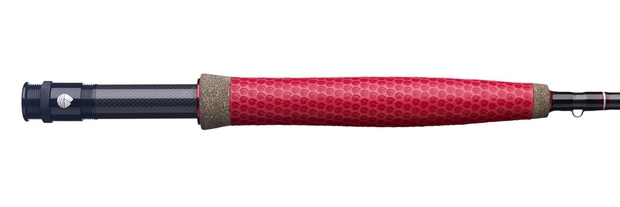
This is a superb Winston 7 foot fly rod.


Donaly clip Crazy Crawlers are always fun.


The Dummy Double is an incredible lure.


The Penn Catalog #11 is very, very popular.


A Pflueger 4 Bros. Underwater Minnow in the box would make any Enterprise collector happy.


A Heddon 740 Punkinseed in White Shore Minnow is a thing of beauty.


This Nat Uslan / Airex spinning rod has gotten really popular.


This Air-Fed minnow bucket is insanely cool.


I love this A&F Phillipson Passport fly rod!


As always, have a great weekend -- and be good to each other, and yourself.

-- Dr. Todd

Thursday, June 13, 2013

Thursday Review: Classic Angling (No. 83, May/June 2013)


The international mails brought an outstanding present in the form of the latest edition of Classic Angling. This issue had a number of interesting articles in it.

There were some neat feature articles. Ben Wright gave a great piece on the Ambidex, the reel that set two carp records; a look at the first World Championship of fishing by John Essex; five years on the Test by Neil Freeman; John Bailey on why noted angler John Wilson is quitting Britain and moving to Thailand; Judith Head on Arthur Ransome; and an absolutely outstanding article by Tom Kerr on the magic of Thomas Tout fly rods. Well done, Tom!

There are also regular features of note, including auction results, fishing news, and vintage tackle profiles. It's well worth reading!

You can learn more about Classic Angling and subscribe to it by Clicking Here!

-- Dr. Todd

Wednesday, June 12, 2013

The Fishing Photographer with Doug Bucha


JUNE IS STRAWBERRY TIME IN MICHIGAN

Yes, June is strawberry time in Michigan and as you can see, strawberry can have a second meaning. This would be the classic Heddon “Strawberry” finish, to be exact. Heddon called it spotted, or simply “S” if you were ordering a lure in this color.

Where did this name come from and who was the first collector to coin it? As we look at the lure, it is easy to see where the name came from. The color seems to show up for the first time on the 1911 Swimming Minnow. The next lure to use this color was the 1913 Dummy Double. The name spot or spotted was the cataloged color for both lures. I was unable to find the name Strawberry used in any Heddon catalog throughout the years.

The oldest published use of the name Strawberry appears in Kimball’s early reference books. The book says, the #11 had white with red and green decorations- referred to as “strawberry”.

I checked with a few collectors who have been collecting for years and none of them knew who coined the name. One collector has even been an advanced strawberry collector from the 1970’s.

I will now open the question up to you, the collecting fraternity. Who was the first collector to use the name, Strawberry? If anyone has a good answer, please write or call me so I can post it for everyone to see.

Thank you,
Doug Bucha (dbucha@att.net)


Tuesday, June 11, 2013

Voices from the Past: R.L. Stringfellow (1904)


Although the style of this poem is antiquated, I kind of like it. It's from R.S. Stringfellow and was published in the June 1904 Recreation magazine.

I GO A-FISHING.
R. S. STRINGFELI.0W.
Somewhere I have read of an angler, 

W'ho gained a wondrous fame.

He lived in the land of Israel; 

St. Peter was his name. 


"I go a-fishing." he said one day 

To his friends in Galilee; 

"I go a-fishing." 
So says the Book; 

And off he went with line and hook, 
         
A-fishing in the sea. 

Since then along that storm-beat shore 

Many a wave and billow roar; 

And in the rush of wave and blast 

Many a life has breathed its last. 
But still the anglers go!

"I go a-fishing." 'tis often said. 

Although St. Peter's long since dead. 

But the words of this reverend saint and sage, 

There on the good Book's sacred page, 

Live on and on from age to age, 
      
And still the fishers go! 

"I go a-fishing!" Three fishers, this time, 

Will be the subjects of my rhyme. 

'Twas in midsummer's sweltering days; 

The sun beat down with scorching rays, 

When off to the West these fishers went, 

With heart and mind on pleasure bent, 

Away to the West, these fishers three. 

With jocund song, right merrily 
       
They pass the time away! 

"I go a-fishing!" Three fishers bold 

Now emulate the saints of old. 

To mountain stream and shady nook, 

Afar with rod and line and hook. 

They make their way; through hot sunshine. 
To where, 'neath shady cliff and pine, 

They hope, if fortune prove so kind, 

On speckled trout they soon may dine! 
       
So lived the saints of old! 

"I go a-fishing," now each one said. 
"The spot we've reached and camp is made":
And soon beneath the cooling shade, 

With boots waist-high, the stream they 
wade! 
The joyous time flies all too fast. 

While here and there with fly they cast; 

And in each boiling crystal pool 

Some wily trout would play the fool— 
      
Much to the angler's joy! 

Rut all too fast the moments fly, 

The time has come to say good-bye. 

Rack to town and dusty street, 

Back to sun and sweltering heat. 

But memory sweet shall still be mine, 

I'll think and sing of auld lang syne; 

And the good old angler of Galilee 

My guardian saint, I trust, will be! 

-- Dr. Todd

Monday, June 10, 2013

The News of the Week: June 10, 2013


Don't have time to read 50+ fishing and tackle collecting blogs and web sites? Well, let us do it for you! Follow all of the latest news, articles, and stories on our Whitefishpress Twitter account! Hint: You don't need to be a member...just bookmark the Twitter Feed Page or click on latest links to the right!

THE MONDAY 10: The Ten Fishing Stories of the Week You Need to Know

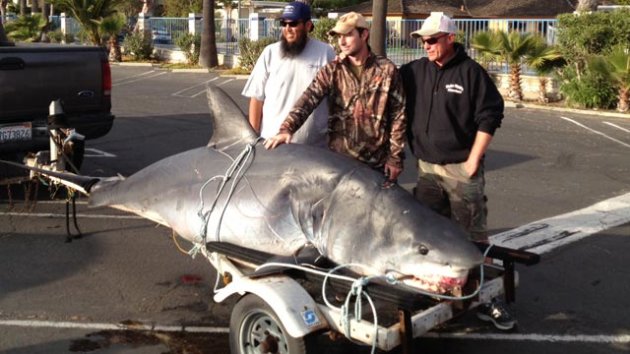
The Big Lead: Three anglers catch record Mako shark.


Some people, however, aren't happy with this catch, but they should read Ted Williams on the subject.

A generational fishing derby.

Field & Stream's vintage tackle of the week winner comes from Canada.


A crowd funded electronic one-handed fishing rod is off and running.

Bull sharks in the canal are no fun.

An Irish story about how one grandmother fed a family on the river.

New rods from Redington.


Fly angler in Russia is living the dream.

Finishing with a Flourish: Bloomberg TV finally discovers who Johnny Morris of Bass Pro Shops is, use word "avuncular" to describe him.


-- Dr. Todd

Saturday, June 8, 2013

Letterheadings with Jim Jordan: Hildebrandt


This weeks feature includes some wonderfully illustrated paper from the John J. Hildebrandt Company.

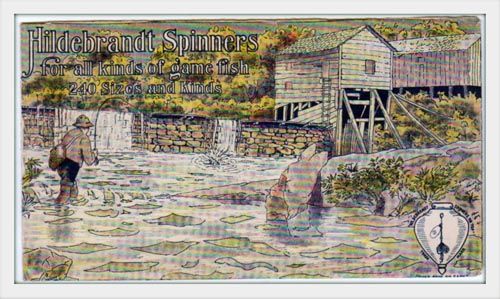
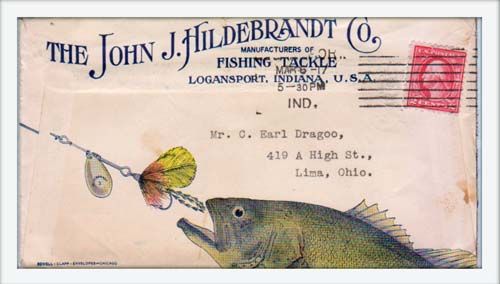
This Indiana postmarked envelope is colorfully decorated with a bass in pursuit of one of  Hildebrandt's # 3 Spinner Flies. The reverse of the envelope features a Mill Stream fishing scene. A wading angler playing his catch against a backdrop of waterfalls. The words "Hildebrandt Spinners for all types of game fish 240 Sizes and kinds" leads me to believe this envelope was only used for a short period. It is the only reference I have found which lists the number of variations in their line as 240. Various advertisements from 1908-1913 list anywhere from 7 sizes & 25 styles to 9 sizes & 50 styles. By 1916 Hildebrandt was advertising a number of variations as high as 302.

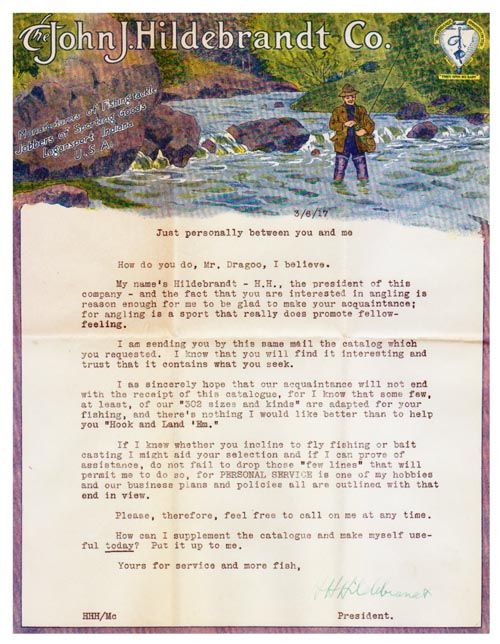
  This letterhead dated 3-6-17 features more colorful artwork. A wilderness stream fishing scene with a wading angler removing the hook from his catch.  Titled the John J. Hildebrandt Co. with a subheading Manufacturers of Fishing tackle ,Jobbers of Sporting Goods Logansport, Indiana. Hildebrandt manufactured their spinners and flies, but also sold rods, reels, fishing line and minnow pails made by others.

  This letter which accompanied a Hildebrandt catalog serves as an introduction by the son of company founder John J. Hildebrandt,  H. H. (Hiram) Hildebrandt , President.  Hiram Hildebrandt assures this potential customer that at least a few of the companies 302 varieties of baits are adapted to suite his or any type of fishing. Hiram makes a personal offer to help aid the customer in selection of baits. H.H. describes personal service as one of his hobbies, as well as the companies business model. He even extends an offer to the customer to call on him at any time.


The upper left corner of the paper shows an early Hildebrandt Trademark logo."Hildebrandt  Spinners on Top" and the words "They spin so easy." These words really capture what set Hildebrandt spinners apart from other spinners of the day.  Hildebrandt spinners revolve effortlessly, even on the slowest retrieve. This feature was a great departure from the heavy spinners offered by most other tackle makers of the day. These heavier spinners required a fairly fast retrieve or troll simply to keep the bait off the bottom.


  Company founder Big John J. Hildebrandt originated the idea of a thin spinner blade on the first spinner he created. It was made from an extremely worn dime, found swimming among his pocket change. This ten cent piece was so shiny, it glistened. This dime immediately reminded John of the shiny silver minnows which were causing a feeding frenzy among so many smallmouth bass. The silvery bait fish were so plentiful during his day of fishing that the bass would hardly consider any of the flies he presented. Hildebrandts spinner, born out of frustration of bass ignoring his flies, perseverance and the likeness of this dime to the silver minnows that beguiled the unobliging smallmouth bass. Big John pounded this shiny dime even thinner, drilled a hole near the edge and shaped the metal into a concave shaped spinner blade.This blade along with one of Johns wife's hairpins formed the beginnings of this long lived and historic Indiana Tackle Company.


Best Regards,
       
Jim Jordan

Friday, June 7, 2013

The Friday Funhouse


The Video of the Week

A story of a kayak angler, a dog, and an incredibly tragic event. Watch the video and read the update here.


12 Things I Would Buy If Only I Could Afford Them

This is a nice Playfair of Scotland fly reel.


Man is this CCBC Musky Wiggler a heck of a bait.


Loving the Chippewa.


Goldfish Punkinseeds are always popular.


A Musky 350 in the box is a nice find.


I love these Shakespeare glass minnow traps.


Instant Collection Alert: Ford Fenders.


This Tycoon Fin Nor glass trolling rod is a beauty.


This is a most interesting Inuit fishing lure.


This is a really, really odd British bait.


Pflueger sea shell spinners are rare.


I have never seen a Herbert Hatton fly rod before.


As always, have a safe and happy weekend, and be good to each other, and yourself.

-- Dr. Todd

Thursday, June 6, 2013

Thursday Review: The NFLCC Magazine (June 2013)


It's always a treat to get the latest NFLCC Magazine, and the one that arrived yesterday is another outstanding edition. There are a number of really well done articles in it.

My own contribution is a history of the Chicago trade house of Hibbard, Spencer, Bartlett & Co. -- one of the biggest tackle wholesalers in the world who sold tons of tackle under their Revonoc and OVB trade lines. I confess I wrote this article ten years ago (updated, of course, for the magazine) and set it aside, having forgotten I had not submitted it to the Magazine for publication. Duh. Well, here it is...

Dudley Murphy, our editor, gets to flex his writing chops by interviewing realistic fly maker David Martin. All I can say is OH. MY. GOD. The man is a genius. His flies are so real they look like they want to reach out and bite you.

Jerry Martin and Jim Dorr give us the third installment in their groundbreaking "Heddon Fly Rod Lures" series. It's another exemplary piece from this incredibly dynamic duo.

Bill Blauser treats us to a nice article on six very complicated (and rare) fish traps. It's the kind of article I wish more people would submit, as it's extremely interesting and well done.

Finally, Gary Smith ends with a flourish by detailing the Chicago hook of Charles Bew. Nicely done, Gary!

All in all a perfect issue...the Magazine is ably edited by Dudley Murphy and Gary Smith.

-- Dr. Todd

Wednesday, June 5, 2013

An Angling Miscellany with Gary L. Miller


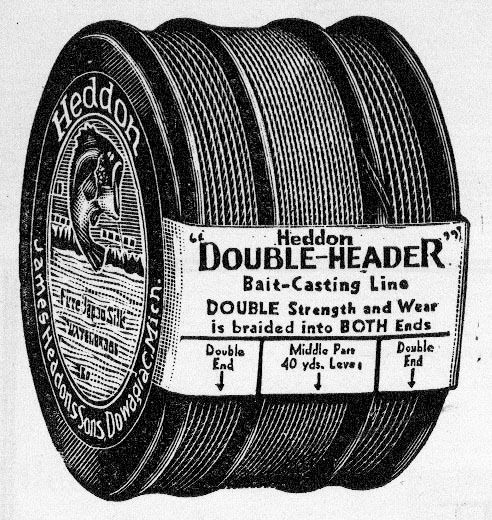
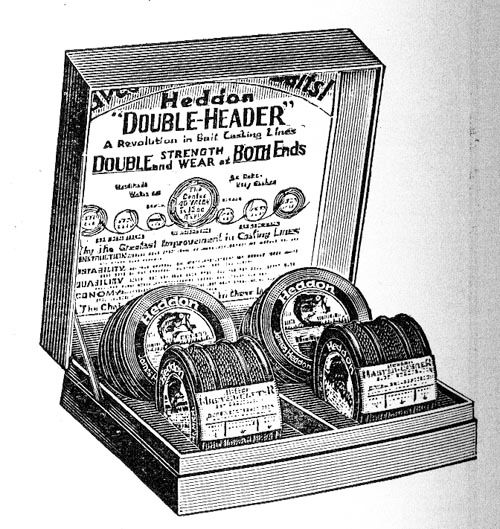
Here's something I just came across that you may find useful for those interested in line research.  I've never heard of Heddon's "Double-Header" Bait-Casting Line before. It's from a blurb in the June 18, 1931 Hardware Age Magazine.

Heddon "Double Header" Bait-Casting Line

"Double-Header" bait casting line, offered by James Heddon's Sons, Dowagiac, Mich., has ends which are double braided. Middle portion of 40 years is light test and five yards near each end is gradually reenforced by braiding in extra strands. By this extra braiding the maker states that double strength and double wear are obtained.


Line may also be reversed, giving it so much extra wear and strength. This line is particularly valuable because the extra strain on it in playing the fish close to the boat, or in landing it, is matched by the greater strength at the ends. "Double-Header" lines are handsomely packaged on individual spools with three sections, showing the heavy ends on either side and the lighter test in the center. Spools are decorated with gilt, and four spools of line in gilt paper are packed in a display box. Line is offered in three weights: 12, 15 and 20-kb. test, with ends 10 lb. heavier. List price of display box is $13.00. It includes 1 12-kb. center line No. 12/22 list, $3.00, s spools No. 15/25 with 15-kb. center at $3.25 each, and a spool of 20-kb. center line No. 20/30 at $3.50. Usual dealer discount prevails. Other combinations may be ordered.


-- Gary L. Miller

Tuesday, June 4, 2013

Voices from the Past: Chewed Ox Brains for Bait (1903)

Chewed Ox Brains for Bait

The following exchange, reported by Henry Cholmondeley-Pennell in 1903, gives the background on the subject of Chewed Ox Brains for bait…it's the first time I've ever seen this subject broached. I think I'll stick to #16 nymphs for Chub…

A winter bait which has found many advocates of late years is the 'pith' or spinal marrow of a bullock or cow, with bullock's brains as ground bait, as described at p. 234. In the 'Modern Practical Angler,' I have observed that, 'For this mode of chub-fishing the colder the weather the better, provided only that the water is not discoloured. . The pith should be used with Nottingham tackle, so as to fish the stream for fourteen or fifteen yards down, the most favourable position being deepish water close to boughs and 'rooty' banks. The bait should swim about three or four inches from the bottom, as nearly as may be, the brains being thrown in from time to time above the swim. In this mode of fishing it is not advisable to bait any one swim beforehand, as chub are shy fish and it is seldom that more than two or three can be taken out of the same place without scaring the rest; consequently it is better to move from place to place, throwing in a small quantity of ground bait at each. By this made of fishing the largest chub are to be taken; and when used by skilful hands, I have known a punt well to be half filled with fish.

The following correspondence on the subject of ox brains and pith as bait, took place some years ago in the columns of the Field, between 'Greville F.' and the editor. As the correspondence, besides giving some valuable hints, presents the pros and cons of the question in a picturesque way, I here quote it.

Sir—In reply to' E. R.,' in notices to correspondents in last week's Field the following paragraph appears: 'We never used it, as one of the first directions given by those who use it is to chew it and spit it into the water as ground bait; and as we had an intolerable aversion to chewing raw material of this kind, we never got any further with it.' Now, Mr. Editor, every angler will know by this announcement what is meant, and that it is an unequivocal denouncement of the uses of ox brains and' pith' as a bait for chub. Anglers, in verity, have quite enough to refute on the score of habits scarcely refined, when the impalement of worms, frogs, gentles, beetles, snails, and even cockroaches, is in question; but it is a Uetle too bad to add to this category of uncleanly handlings that of a process hitherto confined to Otaheite. Too hot to eat these brains may sometimes be; for let me tell you, in spite of the italicised 'raw,' they are first boiled, and many an Italian considers them, with the accompaniment of a little melted butter, as fine a dish as is brought to table. I know of no work where the instructions are that these brains should be masticated in a raw state: and if any exist, the writer must have been wholly ignorant at the time that they would be useless, for the simple reason that they could not be separated by the teeth into that state of fineness of particles necessary to form the most tempting ground bait—if that can be called so that does not sink—that was ever offered to a chub. But as some doubt does exist upon this subject, let me, for the sake oi decency, first remove the prejudice against this bait entering the mouth of the most fastidious. I have here a recipe from my late friend M. Soyer, who, it will be admitted, was not altogether an unaristocratic gastronome: 'Lay the brains in lukewarm water to disgorge, then carefully take off all the skin : put about a quarter of a pound of butter in a saute- pan, rub all over the bottom, cut the brains in slices, lay them in the pan, and season according to liking. Many prefer the brains as a dish by itself, plain boiled, and merely flavoured with salt, pepper, and perhaps a slice of lemon.' Here, then, we have the luncheon prepared for the chub, minus the condiments. They are not raw, as stated, but scrupulously cleaned and skinned. Many a poor man gets a worse dinner, and there are well-fed fishermen on the Thames—puntsmen spoiled by over indulgence—who labour under a shrewd suspicion that, when they recommend brains, it is one word for the chub and two for themselves. My only personal objection to their use is dental; and if it be so in others, they must choose their fishermen like a horse, by his teeth. When Colonel S. first saw 'Nottingham George' go through this process, and witnessed the cargo of chub that was brought to punt by its application, he is said to have astonished the company at dinner at the palace in the evening by accounting for his fatigue with the statement that, while he was fishing, a man in the same punt 'blew out his brains'—the surprise being only allayed when his friends were assured that the fellow did it for his living. In using brains, the essential is that the particles should be so minute that they should be capable of being extensively dispersed upon the water. If too large, the chub would be satisfied with this^ratuitous offering, and not come to the hook—Master Chub being somewhat like the guest of Count Beauflitte, an eminent gourmand of Louis XIV.'s reign, who, objecting to the fricassde not being sufficiently minced, was answered, 'Oui, je pense la denture de mon chef actuel n'est pas si bonne que celle de mon dernier.' But what is ' pith'? This is simply the spinal marrow of the ox, which requires some little skill to manipulate for the hook, and is the bonne bouche of the repast, the brains being but an appetising whet or preparation. It will be found that after the pith is taken from the vertebrae it possesses two skins. The outer one, which if boiled would be too tough for the hook to penetrate, is removed by first cutting the tube the entire length on one side with a sharp pair of scissors, and then with the finger and thumb pulling it off the pith, which is now perfectly white, but when boiled for a few minutes the inner skin becomes brown, and is then consistent enough to hold on to the hook. This is, perhaps, the most killing bait for chub in the winter months, even when the snow is on the ground, that has ever been discovered. 'The Angler's Instructor' on this head says: 'Bullock's brains, when nicely cleaned and cooked, are as white as a curd, and fully as sweet to eat as sheep's brains. The renowned " Bendigo" when he goes chub fishing—and he is no novice at this game— takes half a hatful with him, and he is obliged to chew the brains before he throws them in; nor can he prevent, as he says, a portion going down his throat, they are so sweet : so, you see, he fishes with one part and swallows the other. Two heads of brains are quite sufficient for a day's chub fishing.' If, however, you have an epicure in the punt with you, it may be well to provide accordingly, or you may find yourself brainless before half the day is over.

-- Greville F.

[The process of chewing ox-brains, whether cooked or raw, and sputtering them into the water all day long for ground bait is certainly (at least in our opinion) one which might raise an objection to the use of such a bait on the part of any angler troubled with the slightest feelings of delicacy in the following of his amusement. Perhaps we are over-fastidious, but we cannot help thinking that, even at the expense of a slight reduction in the weight of our bag, we should prefer some other bait. We fancy we know something about chub fishing, having made some tremendous bags of them in our time; and if chub are in the least inclined to feed, we do not believe that the superiority of brains over greaves or cheese, &c would be so great^s to make it worth our while to undergo such a process. We might like to eat ox-brains cooked; we cannot say, however, for certain, as we never tried them. We do like sweetbreads, for example, but we might have a well-founded objection to chew them and spit them in the water all day. It is perhaps a matter of taste after all, and 'Nottingham George' and the renowned 'Bendy,' though no doubt capital fishermen, are hardly the Mentors whom we should select to instruct us on a matter of that kind. As regards the question of cooked or raw, we certainly have seen it recommended that they should be masticated raw, and we well remember that precisely the same objection was raised to them as we have made. We believe that a short correspondence embracing these points took place in the Field some years ago; and we well recollect, that the answer of the advocate for chewing the brains raw was that 'they were very sweet.' As we have said, we never used them, having an objection to them, as already expressed; and perhaps it would have been better to have simply chronicled our want of experience, instead of adding thereto the reasons for it. We fear that even now, when we do know they are to be cooked, that want of experience is likely to continue, unless, indeed, our friend 'Greville F.' has any sympathy with the puntsman whom he quotes, and would really like to do the masticating and blowing part of the process for us; in which case we will test the infallibility of the bait with the greatest pleasure.— Ed. Field.]

Monday, June 3, 2013

News of the Week: June 03, 2013


Don't have time to read 50+ fishing and tackle collecting blogs and web sites? Well, let us do it for you! Follow all of the latest news, articles, and stories on our Whitefishpress Twitter account! Hint: You don't need to be a member...just bookmark the Twitter Feed Page or click on latest links to the right!

THE MONDAY 10: The Ten Fishing Stories of the Week You Need to Know

The Big Lead: Very cool cutthroat is caught in Pyramid Lake.


River Monster's Jeremy Wade gets asked the tough questions, and responds brilliantly.

There is always a good tackle find at a garage sale.
Field & Stream's vintage tackle winner this week was a Dalton Special.


Small tackle shops fear the lead ban.


Thieves steal $5000 worth of tackle.

Planning on owning an American tackle company?


New Texas catfish record on a fly rod.


Fly fishing in Russia, Part I.


Take the IGFAs Sharks and Recreational Angler survey.


Finishing with a Flourish: Fly fishing the stock market: a new book.


-- Dr. Todd

Sunday, June 2, 2013

1000 Words

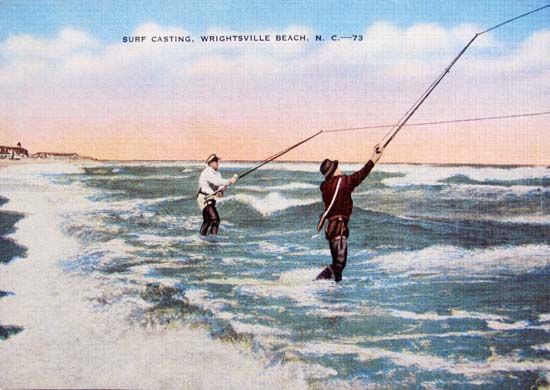
This week in 1000 words we have a great post card made from a photo of ca. 1910-1920 surf casting in North Carolina. It's a really striking image, and a great post card to boot!

-- Dr. Todd

Saturday, June 1, 2013

Letterheadings with Jim Jordan: Mit-Shell (1921)

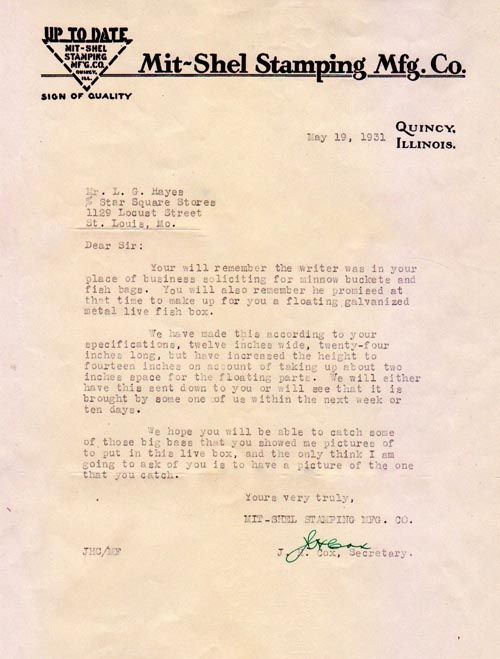
Today's feature is a Mit-Shel Stamping Mfg. Co., letterhead and illustrated envelope. The heading of this letter is rather general and is not fishing tackle specific.This style letterhead most likely was used for correspondence for all of the companies business. Mit-Shel was incorporated in 1921 by Edward H. Mitchell, Theodore Schell and William Spohr. They manufactured a wide variety of stamped steel products for farming, including brooders, feeders, buckets and troughs.

The heading includes the companies name as well as their "UP TO DATE" 1922 trademark logo and their location, Quincy, Illinois. This May 19,1931 letter is addressed to L.G. Hayes. L.G. Hayes was a respected angler and contributor to Outdoor Life Magazine in the 1930s. Hayes at the time of this letter was the buyer for % Square Stores.

The content deals with a Mit-Shel rep., J.H. Cox soliciting minnow bucket and fish bag business from the Star Square store. It appears a promise was made and perhaps a deal was in the works. Mit-Shel's, J.H. Cox writes to inform Mr. Hayes that his custom floating galvanized metal live fish box was complete. The box would be delivered within the next seven to ten days.

The custom fish box was a gift, as J.H. Cox only asked for a photo of one of Mr. Hayes future catches in return for the box. Often times vintage letterhead are found missing their original envelope or vice versa.

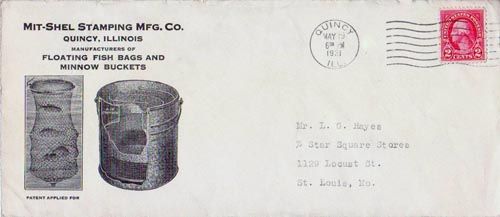
Fortunately the letter and its original envelope were found together. The envelope featuring illustrations of Mit-Shels floating fish bags and minnow buckets gives the package some nice visual appeal.

Best Regards,

Jim Jordan