Showing posts with label Finn Featherfurd. Show all posts

Wednesday, February 27, 2013

Snarls & Backlashes with Finn Featherfurd: The Long & Twisted History of the Outer's Family of Magazines


In 1901, Milwaukee's Dan Starkey (1862-1949) founded the Northwestern Sportsman Publishing Company and launched a new outdoor magazine called The Northwestern Sportsman. A former newspaper editor, Starkey was particularly attracted to the outdoors, so he launched a magazine focused solely on fishing and hunting in the upper Midwest -- which at the time was still called the Northwest. It included the Dakotas, Minnesota, Wisconsin, Michigan, Indiana, and Northern Ohio all the way over to Colorado and Montana.


In a major coup, the magazine lined up one of the most important angling voices as the day as its fishing editor -- James Heddon of Dowagiac, Michigan, one of the leaders in the bait casting revolution and maker of some of the finest fishing tackle of all time. Heddon wrote a monthly column on bait casting and other notations on fishing in the region. He covered tournament casting in detail during a very important time in tournament casting history.

Alas, The Northwestern Sportsman was not very successful, and lasted only from 1901to 1907. That year, the magazine was rebranded and renamed Outer's Book. It took on a national focus and immediately grew in popularity, becoming one of the top five or six sporting magazines in America. It attracted a lot of quality writers including O.W. Smith, Samuel G. Camp, Charles Frederick Holder, Robert Page Lincoln, and Sheridan R. Jones.

The most famous contribution by Outer's Book to American culture came in February 1910, when it published the first popularized version of the Paul Bunyan myth -- a myth that was soon expanded upon to take its place among American legend and lore.


The newly renamed magazine carried the name Outer's Book from 1907 to 1917, when the publication incorporated the old and established magazine Recreation, which was founded back in 1883. To reflect this change, it was rebranded in 1917 as Outers' Book Recreation, which remained its name until 1919. It changed its format from a compact 8" x 10" to an oversized 9" x 12" and became very slick in look. Easy to overlook is the moving of the apostrophe to after the "S" in Outer's.


The problem was that Outers' Book Recreation is an awkward name, so in 1919 it was rebranded for a fourth time. From 1919 to 1924 it was called simply Outers' Recreation. The slogan for the magazine was now "The Magazine that Brings the Outdoors In" and they continued with its oversized formatting. It was in this period that the magazine became known for its gorgeous covers.


IBut the tinkering was not done. In 1924, the magazine was renamed for a fourth time, this time taking the title Outdoor Recreation. Very little changed from the previous incarnation except the name, and it still had amazing covers and high quality writing.


The end for this magazine with the convoluted history came in 1927, when it merged with the established magazine Outdoor Life. Interestingly, the new Outdoor Life prominently carried the masthead "Outdoor Life which is Combined with Outdoor Recreation" for the first year or so. This notation became smaller over time until 1931, when the subtitle was so small on the cover as to be almost meaningless. The January 1932 Outdoor Life cover is the first that did not carry the "Outdoor Life which is Combined with Outdoor Recreation" tag, although the magazine continued referring to it until 1936. Also of interest is that it appears that Outdoor Life adopted far more of Outdoor Recreation's style than vice versa. It was only after the merger that Outdoor Life began to distinguish itself from its major competitor, Field & Stream.
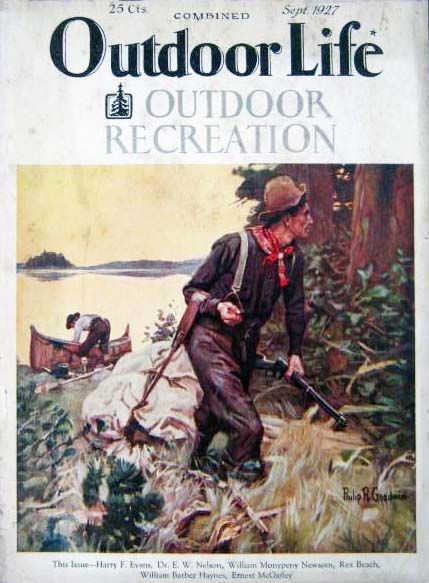


Regardless of its name, the Outer's Family of magazines were high quality publications -- especially during the years when Sheridan R. Jones was editor. NFLCC member Joseph R. Hilko has written a charming biography of Jones which has a lot of information on Outer's Recreation and Outer's Book in it. It's one of the best biographies of an outdoor writer I know of.

I have always found this family of magazines to have some of the best articles on tackle history and some of the best ads around. Early copies of this magazine are very, very rare and very difficult to locate.

What follows is a synopsis of the various name changes of this fascinating publication.

THE NORTHWESTERN SPORTSMAN: 1901 - 1907

OUTER'S BOOK: 1907 - 1917

OUTERS' BOOK RECREATION: 1917 - 1919

OUTERS' RECREATION: 1919 - 1924

OUTDOOR RECREATION: 1924 - 1927

OUTDOOR LIFE COMBINED WITH OUTDOOR RECREATION: 1927 - 1936

-- Finn

Finn Featherfurd is the pseudonym of a sad and lonely retired professor and newspaper columnist who has spent the better part of the past four decades (unsuccessfully) chasing fish in the Lower 48. A long-time collector of vintage fishing tackle of all kinds, he is currently fascinated by pre-1920 children's fishing reels (40 yards and smaller). When the spirit moves him, he will contribute occasional pieces and essays to the Fishing for History Blog. He can be reached at finnfeatherfurd@yahoo.com.

Wednesday, November 7, 2012

Snarls & Backlashes with Finn Featherfurd


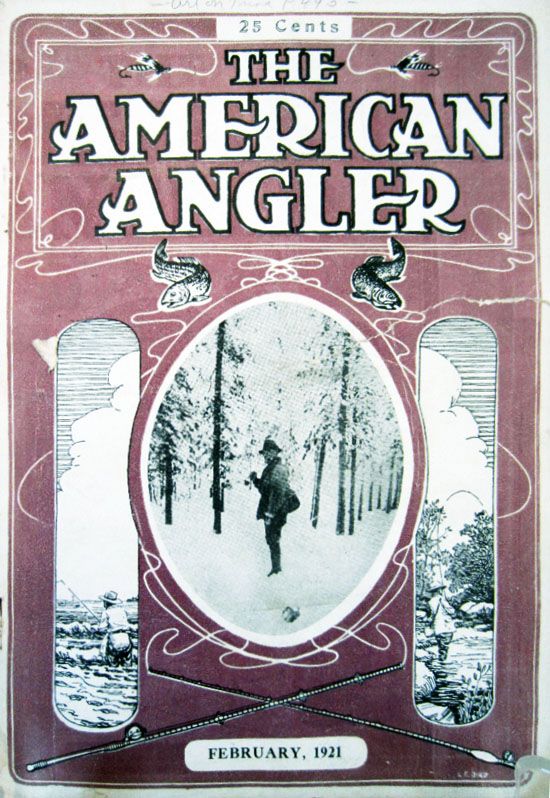
We continue our series on overlooked American angling magazines with one of my all-time favorites, The American Angler. This lovely magazine shares a title name but no other relation with FOUR other magazines over the course of 120 years.

The first and most famous of these was Charles Harris' American Angler which ran from 1881 through 1900, before it merged with Field & Stream. It set the standard for the American angling magazine.

In 1916, a new monthly magazine was born in New York. Published by J.P. Muller, this monthly had an elevated standard of writing, and of all publications of the day, it was far more interested in fishing history and lore than any others (it ran a series on famed anglers from Walton to Henshall in its first year). It ran many historical pieces, including the greatest ever on lure history -- "Whence the Plug" by Sam Stinson, reprinted in Arlan Carter's seminal Nineteenth Century Fishing Lures.

The magazine was also interested in both tournament casting and saltwater angling, two areas largely ignored by most main-stream fishing and outdoor magazines. For this reason, I find issues of this magazine far more rich for research purposes than any other contemporary publication.

Alas, it was too good to be true. It underwent a format change in 1919 but could not be saved, and was out of business by 1922. It was a great shame. But it was not the last magazine to bear this illustrious name!

Tune in next week to learn about the REALLY rare American Angler magazine!

-- Finn

Finn Featherfurd is the pseudonym of a sad and lonely retired professor and newspaper columnist who has spent the better part of the past four decades (unsuccessfully) chasing fish in the Lower 48. A long-time collector of vintage fishing tackle of all kinds, he is currently fascinated by pre-1920 children's fishing reels (40 yards and smaller). When the spirit moves him, he will contribute occasional pieces and essays to the Fishing for History Blog. He can be reached at finnfeatherfurd@yahoo.com.
Wednesday, October 31, 2012

Snarls & Backlashes with Finn Featherfurd


Today we will begin a longer series on great angling magazines of the past. In particular, I am always fascinated by the obscure, overlooked, and regional fishing magazines of the twentieth century. I hope you'll enjoy it.

Our first publication, Fishing World magazine is an often overlooked magazine that was more interested in fishing and tackle history than almost any other angling magazine of the post-war era.


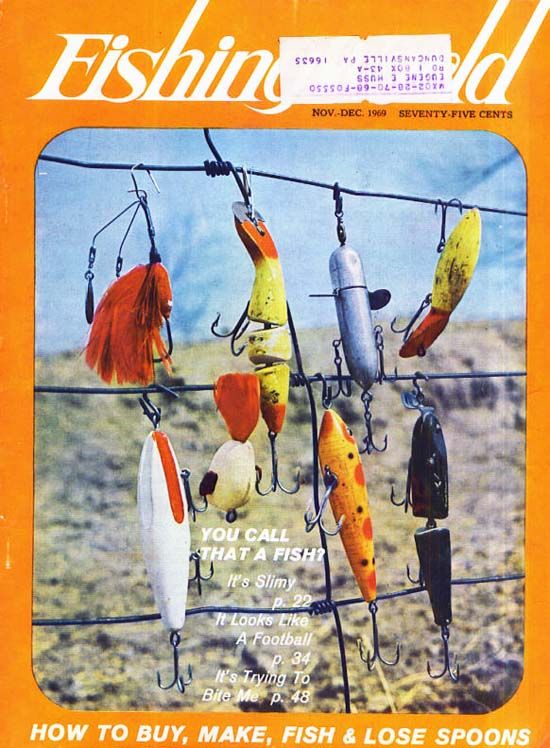
November-December 1969 cover with vintage tackle.

It was founded in 1953 in the wake of the great post-war fishing boom, and at first was a slim 32-48 page volume with very few advertisements, indicating it was taking a while to catch on. It had sparing layout and the articles, ranging from "Tips on Trout" in April 1958 to "All About Shad" in March/April 1965. It billed itself as The Magazine for Sport Fisherman, and ranged at various times from a monthly to a bi-monthly.

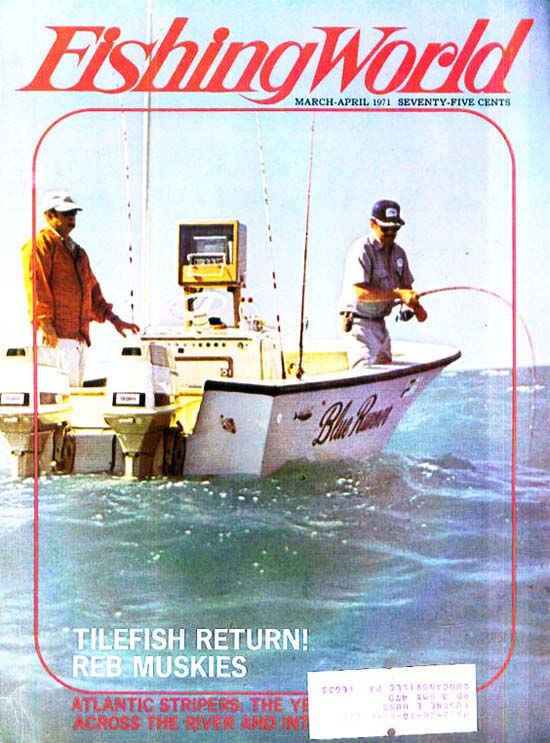
March-April 1971 cover.


One of my favorite features in the 1960s was the Fishing Patent column, in which they would dissect an odd or fascinating tackle patent. The magazine was sufficiently interested in fishing history to hire Mary Kefover Kelly -- the legendary fishing historian -- to pen a number of important columns on the subject of fishing tackle history. These articles were collected by Dr. Todd to form a portion of Mary's great book Origins of American Angling.

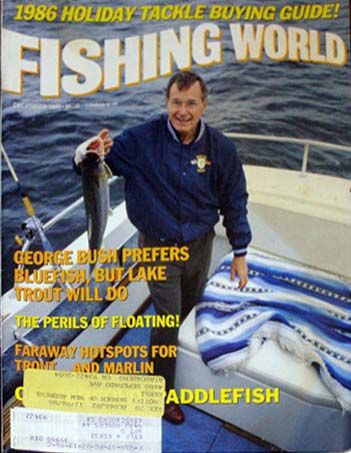
1986 cover with then Vice-President George H.W. Bush.


The magazine was still around in the late 1980s but seems to have disappeared afterward. A new magazine called Fishing World is in print today, but is an Australian angling magazine with no relation to the original Fishing World publication.

I consider this magazine both a fine publication for knowledgable fishing articles, and a solid one for advertising research. It can be a tough magazine to find, but if you watch eBay you'll be able to pick up back issues at a fairly steady rate.

-- Finn

Finn Featherfurd is the pseudonym of a sad and lonely retired professor and newspaper columnist who has spent the better part of the past four decades (unsuccessfully) chasing fish in the Lower 48. A long-time collector of vintage fishing tackle of all kinds, he is currently fascinated by pre-1920 children's fishing reels (40 yards and smaller). When the spirit moves him, he will contribute occasional pieces and essays to the Fishing for History Blog. He can be reached at finnfeatherfurd@yahoo.com.
Tuesday, October 23, 2012

Snarls and Backlashes with Finn Featherfurd


Fishing for Laughs, Part IV


Well, after last week pretty much sucked the humor out of every orifice in my body, I thought it my duty to end this little series with a look at the funniest writer to ever put pen to paper about fishing: Ed Zern, author of a huge number of great articles and books.

The greatest thing he ever wrote, and by definition the funniest thing ever written on the outdoors, is his review of Lady Chatterley's Lover, the x-rated cause celebre reprinted in the 1960s. Think 50 Shades of Grey of the era. Here is Zern's fantastic review, in its entirety, of the book, published in Field & Stream:

Although written many years ago, Lady Chatterley's Lover has just been reissued by Grove Press, and this fictional account of the day-to-day life of an English gamekeeper is still of considerable interest to outdoorminded readers, as it contains many passages on pheasant raising, the apprehending of poachers, ways of controlling vermin, and other chores and duties of the professional gamekeeper. Unfortunately one is obliged to wade through many pages of extraneous material in order to discover and savor these sidelights on the management of a Midland shooting estate, and in this reviewer's opinion this book can not take the place of J. R. Miller's Practical Gamekeeping.

I award this five fish out of five for set up and five fish out of five for delivery. Zern was the absolute best.

-- Finn

Finn Featherfurd is the pseudonym of a sad and lonely retired professor and newspaper columnist who has spent the better part of the past four decades (unsuccessfully) chasing fish in the Lower 48. A long-time collector of vintage fishing tackle of all kinds, he is currently fascinated by pre-1920 children's fishing reels (40 yards and smaller). When the spirit moves him, he will contribute occasional pieces and essays to the Fishing for History Blog. He can be reached at finnfeatherfurd@yahoo.com.
Wednesday, October 17, 2012

Snarls & Backlashes with Finn Featherfurd: Fishing for Laughs, Part III


Fishing for Laughs, Part III


While researching this series of articles I found some things that were very funny, but a great many more that were not. What follows is the single worst example of fishing humor I could find, from the author of "The Elements of Conversation, or, Talking Made Easy" in The New Monthly Magazine for 1836. Here is what our anonymous author has to say about fishing jokes:

It is allowable, when you have run a subject dry in English, to hitch in a bit of any other language which may sound to your liking. For instance, on a fishing party. You say fishing is out of your line; yet, if you did not keep a float, you would deserve a rod; and if anybody affects to find fault with your joke, exclaim " Oh, vous bete!" There you have line, rod, float, and bait ready to your hand. Call two noodles from the city in a punt, endeavouring to catch small fry, " East Angles;" or, if you please, observe that " the punters are losing the fish," "catching nothing but a cold," or that " the fish are too deep for them." Call the Thames a " tidy" river; but say you prefer the Isis in hot weather.

HILARIOUS. Oh, but wait -- it gets better.

Let me try to put this into perspective for you. This is an author who believes that nothing, and I mean nothing, should stand between you and a pun. Read on for his recommendation on how to respond to a friend who writes you about the death of a loved one:

If a mail is pathetically describing the funeral of his mother or sister, or wife, it is quite allowable to call it a " black-drowning party," or to talk of a "fit of coffin;" a weeping relative struggling to conceal his grief may be likened to a commander of "private tears;" throw in a joke about the phrase of "funerals performed," and a rehearsal; and wind up with the anagram real-fun, funeral. I give this instance first, in order to explain that nothing, however solemn the subject, is to stand in the way of a pun.

And there you have it. The worst fishing joke from perhaps the worst human being of the nineteenth century.

Not much else to say here. I award this zero fish out of five for set up and one fish out of five for delivery, if nothing else because he spelled "vous bete" correctly.
-- Finn

Finn Featherfurd is the pseudonym of a sad and lonely retired professor and newspaper columnist who has spent the better part of the past four decades (unsuccessfully) chasing fish in the Lower 48. A long-time collector of vintage fishing tackle of all kinds, he is currently fascinated by pre-1920 children's fishing reels (40 yards and smaller). When the spirit moves him, he will contribute occasional pieces and essays to the Fishing for History Blog. He can be reached at finnfeatherfurd@yahoo.com.
Wednesday, October 10, 2012


Fishing for Laughs, Part II


Again we delve into the "funny bone" of the fisherman, and up at the microphone stand is John Lyle King, author of Fishing the Nipigon (1883). For those who don't know, the Nipigon River is in Ontario and is absolutely legendary, even in King's time, for its massive Brook Trout. Regular catches even today of 20" and 5 pound brookies are made. That is a massive trout, folks. Don't believe me? Check out this brookie from Nipigon:


Yikes. That is a huge Brook trout. Anyway, King decided to put on his humorists' hat when he related the following anecdote in his famous book about Bishop Beckwith of the great state of Georgia, who was fishing with his friend Bishop Whipple of Minnesota during King's trip up the Nipigon. Bisphop Beckwith, in fact, registered a 6 1/2 pound Brook Trout in the Red Rock lodge register, of which King related:

It is no breach of the confidence shared by all the trouters of the Nipigon to refer to the general hearsay of a large joke connected with the most ponderous of the trouts. Of this the good Bishop himself is likely unaware, though the wind, "a chartered libertine," has blown the secret from Victoria Falls to Red Rock. The gist of it is, that the excellent bishop of Georgic was probably made the unconscious victim of pagan guile and machination. In the post mortem process required for the preparation of the trout for the frying-pan, the cook's carving knife struck upon several stones within its throat and jaws. There are cases of icthyolites, or figures of fish in rocks, but in icthyologic records or experiences, there is no instance of rock in fish, or of internal petrifications in living fish, or any disease of fish that may be called the gravel. The surprising phenomenon, therefore, can be due only to human agency, and the human agency strongly savors of a sleight of hand prank, and the prank no doubt was played by some one of more of the pagan half-breed guides as a joke for flatteringly enhancing the eclat of the capture with the surreptitious but more exceeding weight of glory.

"The thing we know is either new or rare--

We wondor how the devil they got there."

As the irreverent guides are illiterate, there is no reason to suppose they "caught onto" or got a hint of the glorifying scheme from Mark Twain's Jumping Frog of Calaveras.


Let's go to the replay and break this down. The Good Bishop Beckwith, fishing with his friend the Bishop of Minnesota, catches a big brook trout that weighs in at 6 1/2 pounds. When filleted, the fish is found to be full of stones. Since it is not possible the Bishop could have pulled this off, his (illiterate) guides get the blame.

Oh. I get it.

No chance the bishop might have done this himself, I guess…at least not in Mr. King's eyes. Anyway it is an interesting anecdote if not terribly funny; I award this story three fish out of five for set up and one fish out of five for laughs.

It most certainly didn't make me laugh, although it did make me suspect the bishop…

-- Finn

Finn Featherfurd is the pseudonym of a sad and lonely retired professor and newspaper columnist who has spent the better part of the past four decades (unsuccessfully) chasing fish in the Lower 48. A long-time collector of vintage fishing tackle of all kinds, he is currently fascinated by pre-1920 children's fishing reels (40 yards and smaller). When the spirit moves him, he will contribute occasional pieces and essays to the Fishing for History Blog. He can be reached at finnfeatherfurd@yahoo.com.

Wednesday, October 3, 2012

Fishing for Laughs, Part I


Fishing for Laughs, Part I


I'm going to start a different kind of series this week, dealing with fishing humor, or fishing-themed humor as the case often is. There's a ton of it out there, some of it good, some of it awful, and a lot of it that hasn't aged well. Take the following bit.

This blurb from The Chicago Day Book dates from November 7th, 1912. It's a short anecdote, the kind of thing that most papers ran as filler. It is fascinating to note that hundreds of writers made their living producing dozens of such pieces every week.

An Unwelcome Bite

As a sign of his business a shopkeeper hung outside his shop a large fishing rod with an artificial fish at the end of it. Late one night a man who had been dining out happened to see the fish, and going up to the door, he knocked gently.

"Who's there?" demanded the shopkeeper from an upper window.

"Sh-h! Don't make a noise, but come down as quickly as you can," said the man below.

Thinking something serious was the matter the shopkeeper dressed and came quietly and quickly downstairs. "Now, what is it?" he inquired.

"Hist!" admonished the other man. "Pull in your line quick--you've got
a bite."

A classic set up, a lot funnier back in the days when alcoholics were the butt of many jokes. From a historian's perspective, we get further evidence that tackle makers/tackle shop owners often lived above their shops. From a humor perspective, I award this story two fish out of five for delivery and two fish out of five for laughs.

It didn't make me laugh, but it didn't make me frown, either. Which is important.

-- Finn

Finn Featherfurd is the pseudonym of a sad and lonely retired professor and newspaper columnist who has spent the better part of the past four decades (unsuccessfully) chasing fish in the Lower 48. A long-time collector of vintage fishing tackle of all kinds, he is currently fascinated by pre-1920 children's fishing reels (40 yards and smaller). When the spirit moves him, he will contribute occasional pieces and essays to the Fishing for History Blog. He can be reached at finnfeatherfurd@yahoo.com.
Wednesday, September 26, 2012

Snarls & Backlashes with Finn Featherfurd: The Tackle Hawks, Part IV

The Tackle Hawks, Part IV


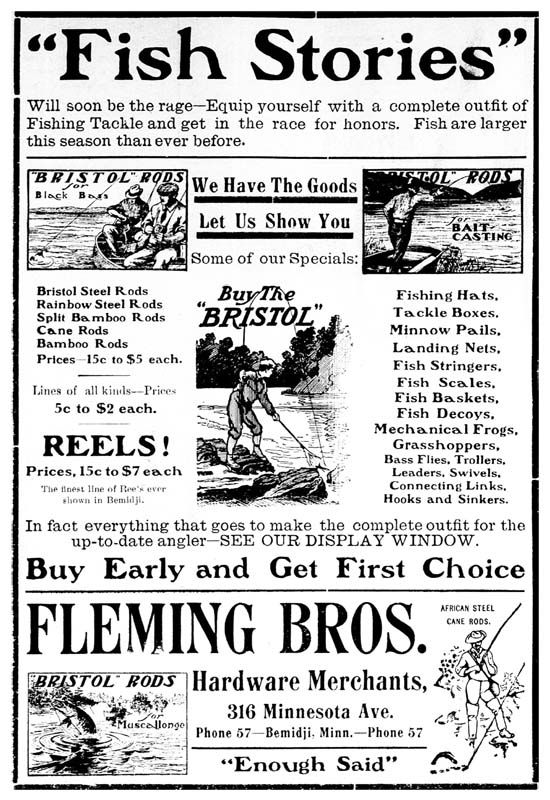
When is too much of a good thing a bad thing? That's the question that ponder while staring at this busy, busy ad until my eyeballs bleed. It's from the April 18, 1906 Bemidji Daily Pioneer and holy mother of God did they pack a lot of information into this 1/8 page advertisement. Where to begin?


Let's start with the header and tag. "'Fish Stories' will soon be the rage" it screams in 64 point font, then says "fish are larger this season then ever before." Wow. Just wow.

There are no less than FIVE pictorials in this advert. Four of them were provided by the Bristol-Horton rod company, perhaps the leader in national advertising and well known to have supplied dealers with artwork for ads. However, each of these cuts were to support a SINGLE ad, not to be thrown together in a confusing mishmash of ink.

The Fleming Bros. leave nothing to chance--listing every single possible piece of tackle, from Fishing Hats to Grasshoppers and everything in between. It's like staring at a train wreck; you can't avert your eyes even if your brain can't possibly process what it is seeing. The fifth cut, interestingly enough, I believe is a Horrocks-Ibbotson one, which I also believe is put in simply to fill space. I love their tag most of all: "Enough said." Indeed, Fleming Bros., indeed…

I award this ad four fish for aesthetics and three fish for effectiveness. It makes me want to buy tackle, but it whips me into such a frenzy I'm willing to buy it from the first tackle dealer I run into on the street.

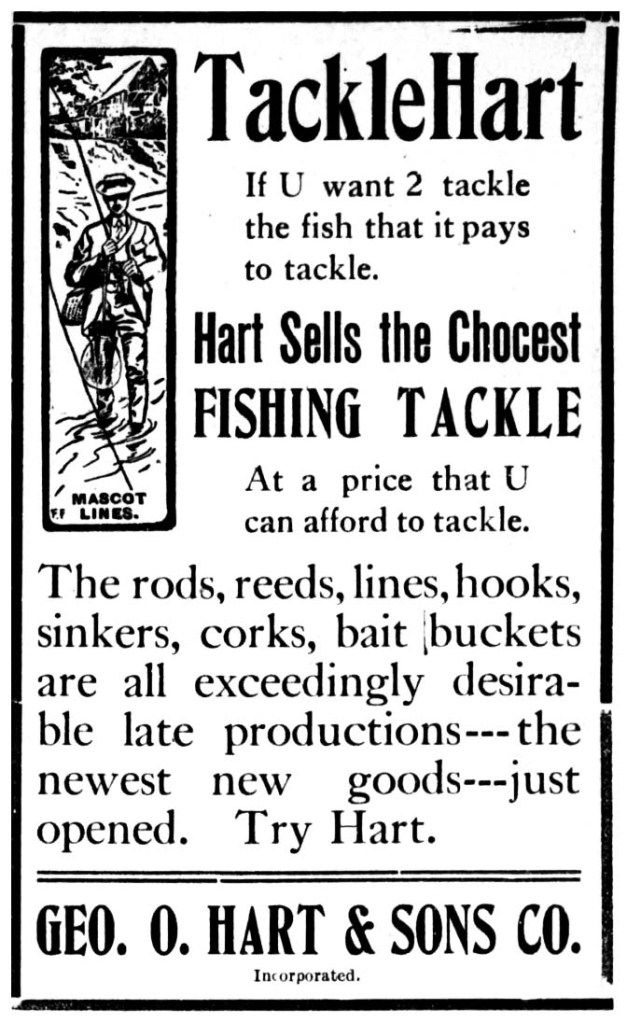
We move on to our next pictorial advertisement which is fascinating for any number of reasons. It's from The Paducah Sun and was run on June 6th, 1907. It is proof that--like almost everything--the ridiculous texting language of the youth of America is not new.


George O. Hart & Sons may have been fine merchants, but they were also prescient in the eeriest of ways. They crafted an ad over a century old that would work perfectly today, as long as it was aimed at the text-while-you're-driving under 25 set that seem to dominate the internet.

Let's begin with the text, shall we? "TackleHart if U want 2 tackle the fish that it pays to tackle. Hart sells the Chocest (sic) FISHING TACKLE at a price that U can afford to tackle." This could have been written by any of my pre-teen grandchildren and not seemed out of place. The annoying acronyms, the random misspelling, the butchered syntax…it's just a perfect ad for today's crop of mindless simpletons.

What a waste of a great piece of lithography, too! That is a world class gentleman fly fishing there, with a proper suit and fishing hat and everything. It's like putting up a picture of a Rolls Royce and printing "If U wnt a SICK RIDE U have 2 try da ROLLLLLSSS, BOYYYYY!!!" It helps to put your hat on sideways when saying this.

Their final word is "Try Hart." No, thank you, I don't believe I will.

I award this ad three fish for aesthetics and one fish for effectiveness. It does not make me want to buy fishing tackle. It DOES make me want to kidnap a roving gang of texting slackers and forcibly induct them in the army.

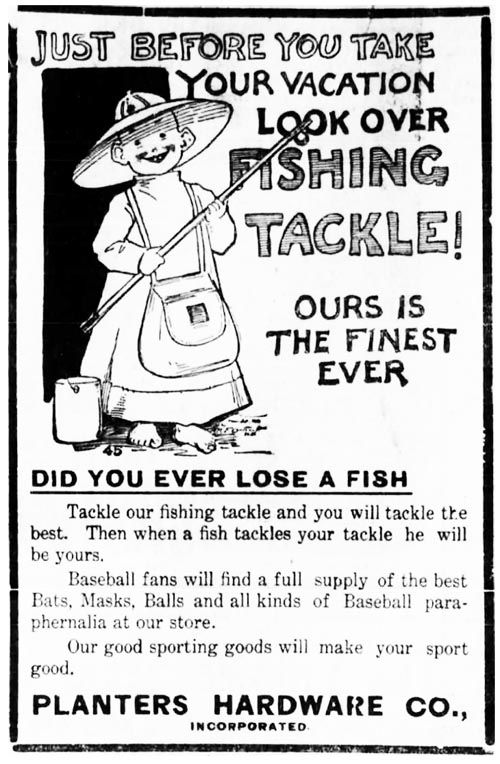
Do you like racism with your pictorial fishing advertisements? That was my first thought when seeing this beauty from the Hopkinsville Kentuckian dated July 4th, 1911. But then I looked closer and thought maybe it isn't a grotesque representation of a Chinese boy, but rather a terribly rendered figure of a barefoot and slack-jawed yokel.


Planters Hardware Co. certainly wanted to make a splash with this advertisement, but I'm not sure this idea was thought all the way through. The text says their tackle is the finest ever, yet the pictures shows a slightly disturbing image of a child holding a cane pole (and, oddly enough, a creel).

Check out the copy: "Tackle our fishing tackle and you will tackle the best. Then when a fish tackles your tackle he will be yours." Tackle. Tackle. Tackle tackle. Tackletackletackletackletackle. Tackle.

I award this ad zero fish for aesthetics and zero fish for effectiveness. Not only does it not make me want to buy fishing tackle, it may very well give me nightmares.

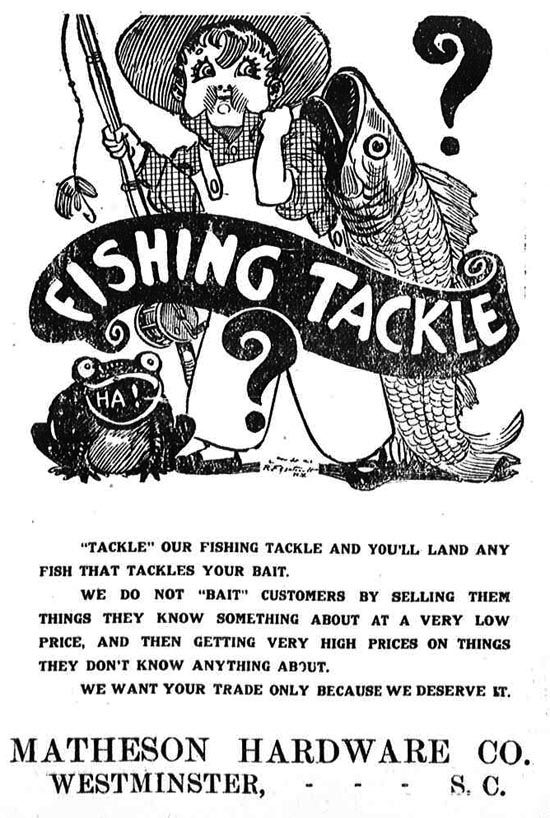
Sometimes advertisers can be too clever by half. Here's a whimsical advertisement from the Matheson Hardware Co. of Westminster, South Carolina run in the Keowee Courier for May 13, 1914.


At least the child in this pictorial doesn't give me nightmares. It's a cleverly rendered image very much of its time, and comes from the "whimsy" school of advertising. Little kid, big fish, bullfrog, big banner saying fishing tackle.

I love how, despite the obvious nature of the image (did we REALLY need the "ha!" in the mouth of the bullfrog?), they had to put the words "tackle" and "bait" in quotes.

Despite everything I like Matheson's style, which certainly comes out in their copy. "We do not 'bait' customers by selling them things they know something about as a very low price, and then getting very high prices on things they don't know anything about." That's a fantastic line right there. And the tag? "We want your trade only because we deserve it." That is a man with chutzpah.

I award this ad five fish for aesthetics and seven fish for effectiveness. It not only makes me want to buy fishing tackle, it would make me feel guilty buying it from anyone else. Well played, Mr. Matheson, well played indeed.

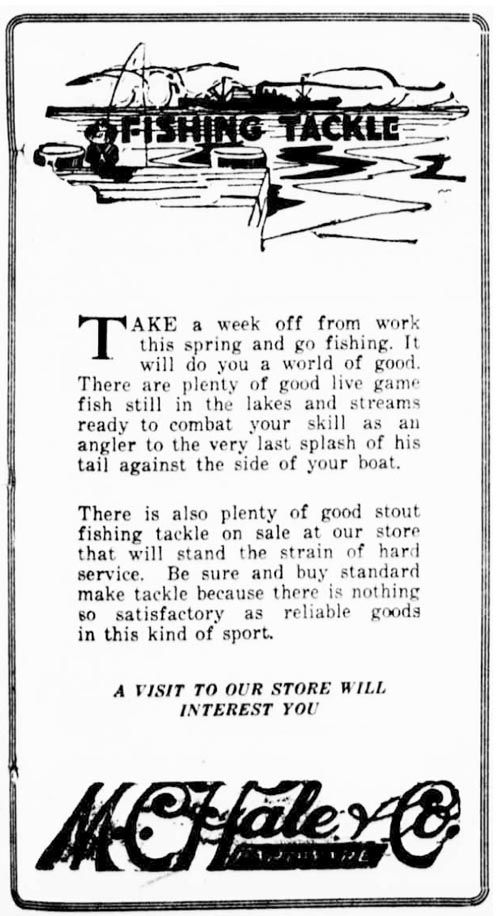
Our final pictorial advertisement is a later one, dating May 15, 1920 and published in the Tulsa Daily World. It's from McHale & Co. Hardware and is the kind of simple and to the point advertisement that's always going to get my attention.

Start with a nice clean image (don't pay attention to the poor copy as it is a product of the microfilm and not the artist) of a boy on a river bank watching a ship sail by, with the words "Fishing Tackle" in the middle. Simple and effective. The triple line border is an elegant and fitting final touch.

No hard sell here. McHale's copy is clean and literary and brings to mind warm late summer days with the smell of autumn wafting in from the range. "Be sure and buy standard make tackle because there is nothing so satisfactory as reliable goods in this kind of sport." Beautiful. Even their tag is outstanding: "A visit to our store will interest you."

Yes. Yes it would. I award this ad eight fish for aesthetics and eight fish for effectiveness. It makes me want to buy McHale's fishing tackle, and it makes me want to take that McHale's fishing tackle out on the water right after. We have ourselves a winner here.

That's it for the pictorial newspaper ads, although I have several hundred and may put them together down the road in to a little book if there is any interest.

Finn Featherfurd is the pseudonym of a sad and lonely retired professor and newspaper columnist who has spent the better part of the past four decades (unsuccessfully) chasing fish in the Lower 48. A long-time collector of vintage fishing tackle of all kinds, he is currently fascinated by pre-1920 children's fishing reels (40 yards and smaller). When the spirit moves him, he will contribute occasional pieces and essays to the Fishing for History Blog. He can be reached at finnfeatherfurd@yahoo.com.
Wednesday, September 19, 2012

Snarls & Backlashes with Finn Featherfurd: The Tackle Hawks, Part III

The Tackle Hawks, Part III


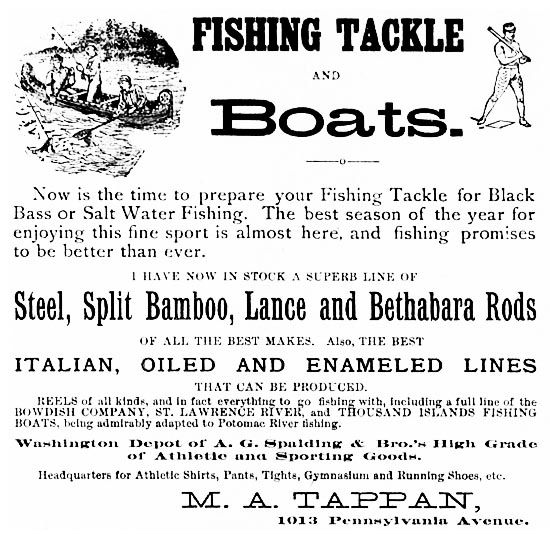
In part three of our retrospective of newspaper pictorial tackle ads, we'll look at some earlier ads. Pictorial tackle ads have been used since the 18th century, but really came in to vogue in the 1890s. The one below is from a Washington D.C. tackle shop run by M.A. Tappan and dating from August 16, 1891. It was published in the Washington Sun Herald.


Lots going on here, with a truly cool woodcut of a three person canoe and an angler catching fish (ignore the baseball player in the corner). I would not, however, recommend standing up in a canoe while someone else reaches out with a net to land your fish.

We learn from this ad that Tappan was catering to saltwater and freshwater anglers, and carried steel, bamboo, lancewood and bethabara rods -- the later a proprietary wood used by Shipley of Philadelphia. He carried lines, "reels of all kinds," and THREE kinds of fishing boats (Bowdish Co., St. Lawrence River, and 1000 Islands Fishin boats). These are some incredible boats; to check out what the Bowdish Co. boats look like, Click Here. I'd love to own one of those today.

Keep in mind that Tappan was an authorized Spalding & Co. dealer, meaning that they would have carried the Kosmic line beginning in 1892.

I award this Mr. Tappan four fish for aesthetics and six fish for effectiveness. It's an oddly effective ad greatly enhanced by the canoe image, and although it may not make me want to buy fishing tackle, it does makes me want to buy a boat.

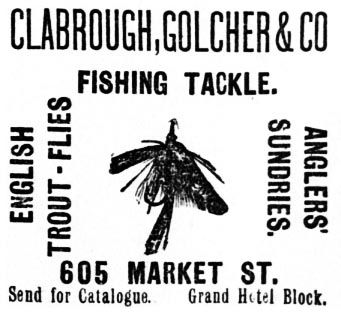
We move to the left coast for our next ad, a June 8th, 1895 advert from the San Francisco Call from the old firm of Clabrough, Golcher & Co. down on Market Street. It's a small ad and very spare; it's dominated by a single fly in the middle and subscribes to the "can be read from any direction" school of advertising. It's aimed at fly anglers and makes a point to note that it carried English trout flies that were coming in to vogue in America.

I'm not sure this is an effective ad because I don't think at a glance you can tell it is a fishing fly. It makes me want to buy something, but I'm not sure if it is a fly rod or a fly swatter. I award this ad three fish for aesthetics and four fish for effectiveness.


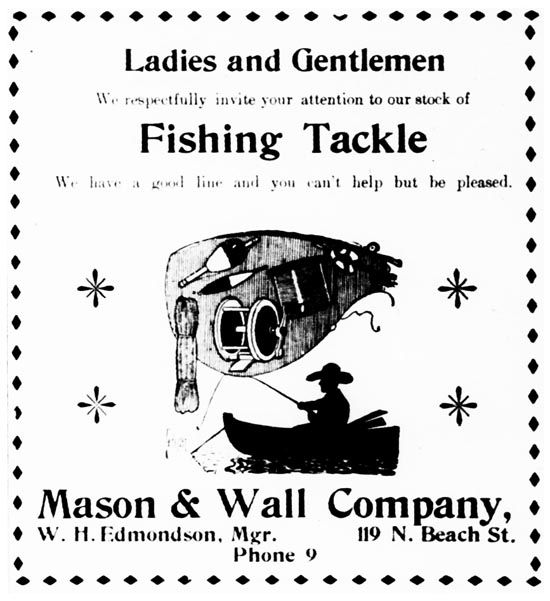
I appreciate what the next selection tried to do, as it has a (partial) silhouette drawing. It's a Florida ad from Daytona and run in the April 15, 1905 paper for the Mason & Wall Company of 119 North Beach Street. Three things stand out here. First, it lists a phone number - dial "9" for tackle. Think of that for one second. A one digit phone number.


Two, W.H. Edmundson was the manager of the firm and felt the need to stick his name on the ad. I get the feeling Mr. Edmundson had a bit of an ego. I would not buy tackle because of the ad because from past experiences, I'm sure I'd find Edmundson a monstrously large jerk. And I never buy tackle from jerks.

Third, they should have stayed with the silhouette and ditched the "dream" art above the angler's head. I guess it's supposed to represent a dream because what it looks like is a children's collage. All it is missing is dried macaroni. I like the reel but the rest is a mess and not even the filigree and border can save this ad from a failing grade.

I award this ad two fish for aesthetics and one fish for effectiveness. It does not make me want to buy tackle. It doesn't even make me want to think about tackle.

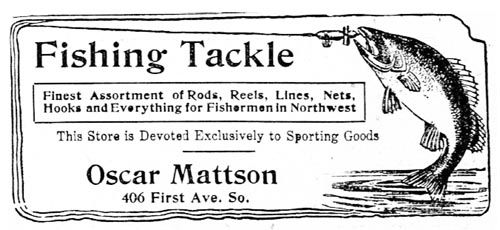
Our final piece for the day we get a snappy little ad from the Minneapolis Journal dated May 13th, 1905 for Oscar Mattson. I thought when I originally saw it it read Oscar Madison and I was irrationally happy, being a big Jack Lemon/Jack Klugman fan. But no such luck. I'm still slightly disappointed and trying not to hold it against Mr. Mattson.

This ad is striking and uses a great piece of artwork with a bass and a lure in its mouth. Do you know what lure? I do, and I'll tell you why. It's a Shakespeare Revolution, and that particular cut was used for a decade between 1902-1912 by the Kalamazoo giant in many, many advertisements. They must have made it available to dealers, but they also must not have been happy that Oscar did not mention Shakespeare tackle in his ad. A very Oscar Madison move, if you ask me (he WAS a newspaper writer, after all).


The judgment on this one is yes, I will buy fishing tackle from you, but only when I am in a general spending mood and want to wander the aisles aimlessly until I find what I want. Which sort of describes the majority of Americans, I guess… it gets six fish for aesthetics and seven fish for effectiveness.

Next week we conclude our look at vintage newspaper pictorial advertisements.


-- Finn

Finn Featherfurd is the pseudonym of a sad and lonely retired professor and newspaper columnist who has spent the better part of the past four decades (unsuccessfully) chasing fish in the Lower 48. A long-time collector of vintage fishing tackle of all kinds, he is currently fascinated by pre-1920 children's fishing reels (40 yards and smaller). When the spirit moves him, he will contribute occasional pieces and essays to the Fishing for History Blog. He can be reached at finnfeatherfurd@yahoo.com.
Wednesday, September 12, 2012

Snarls & Backlashes with Finn Featherfurd: The Tackle Hawks, Part II

The Tackle Hawks, Part II


I will continue our discussion of pictorial newspaper tackle advertising. There is not very much to learn about the tackle itself from these ads; few tackle companies advertised directly in newspapers, which is why we don't often see a Pflueger or Heddon ad carried in papers back in the day. Shakespeare seems to be the exception as I've seen some beautiful newspaper ads from the Kalamazoo giant, but then again, Shakespeare was years ahead of the rest of the tackle world for most of its history.

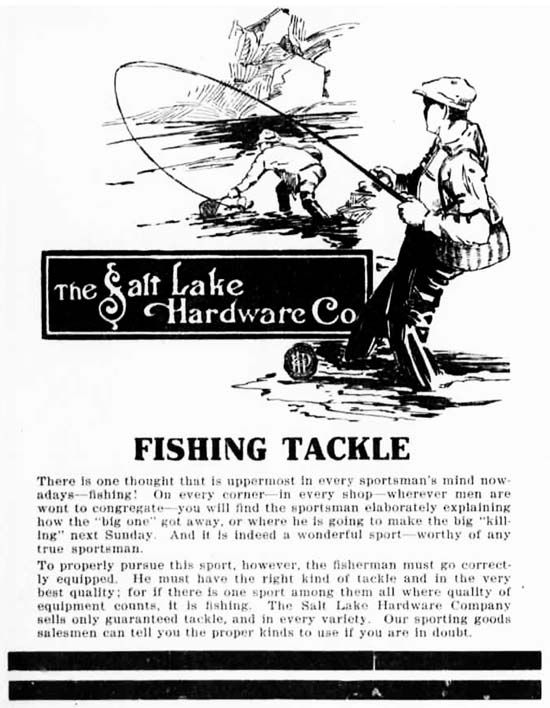
I left off talking about the beautiful Silhouette ads of the Salt Lake Hardware Company. They could have given a master class in advertising. Take for example the ad below, from a May 24, 1916 issue of Goodwin's Weekly:


While not as striking as the silhouette ad, the simplicity of design is still evident. An iconic image, sparse design--the use of silhouette in the logo and black bars at the bottom is visually striking--and the spartan text, well-written and too the point. It's just lovely. I award this ad eight fish for aesthetics and eight fish for effectiveness.

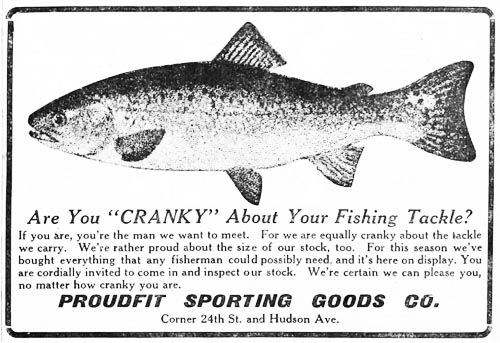
For some reason, among the more prominent newspaper tackle ads from the pictorial era are ones for the American West. The Ogden Standard from the state of Utah ran a lot of these over the years, including the rather strange one dated June 11, 1918 below:


It's not a well-designed ad, and it isn't a large one, either, but it IS oddly effective. I guess nothing gets your point across like a big picture of a fish. Plus, the appropriately titled "Proudfit Sporting Goods Co." makes me think of the passage in Professor Tolkien's Fellowship of the Rings where Bilbo Baggins is giving a speech on his eleventy-first birthday and mistakenly calls out the Proudfoot clan, to which someone corrects him that the plural is "Proudfeet."

The text of the ad is odd as well. "Cranky" being the theme, it seems as if the Proudfits were actively seeking out the most persnickety tackle buyers. I'm sure this is why no one remembers the Proudfit Company, as any firm that courts such folk is in for trouble. There is nothing on God's green earth worse than a tackle snob. I once heard an eastern sport say, in all seriousness, "I ONLY fish Jim Payne rods," as if that said anything about his discernment. Payne made great rods like Ferrari makes great cars, as any eight year old with a bucket full of matchbox cars knows. I am far more impressed when someone can come up to me and say, "The Montague Red Wing is a great fly rod," because this person has the ability to know the difference between a fine rod (the Red Wing) and a box of tomato sticks (most Montague rods).

I award this ad five fish for aesthetics and six fish for effectiveness. The lesson here: don't be a jerk when it comes to tackle, and be careful to whom you boast about your fine tackle. If you're the kind to brag about your rod and reel, I can almost promise you the majority of it is overrated.

Speaking of overrated tackle, let's talk about Winchester. Winchester collectors are crazy. This is one of the indisputable facts of the tackle collecting world. They spend ridiculous amounts of money for what amounts to Horrocks-Ibbotson quality fishing tackle, with very few exceptions (the Eustis Edwards hand-made rods being the most notable). They do this because the name Winchester holds a legendary spot in the American psyche. They also do this because, and I repeat myself, all Winchester collectors are crazy.

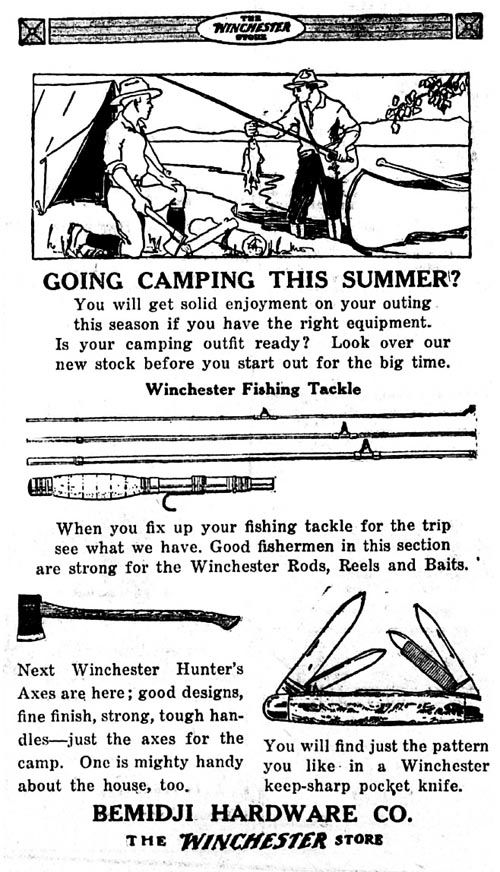
Below is an ad from the June 24, 1921 Bemidji Daily Pioneer featuring the Bemidji Hardware Co., a licensed "Winchester Store." The Winchester Stores were an effort to franchise the Winchester name by licensing it out to hundreds of existing stores all across the country. Some big names bought in to this idea--the legendary Boston firm of William Read & Co. being among the prominent ones--but it was a failed idea from the beginning and bankrupted the company after less than a decade.


One of the things Winchester did was provide the franchise stores with pictorial advertisements ready to use in newspapers. This is what we have here, a "cut-and-paste" ad utilizing catalog print blocks. It's effective if you're in the market for an axe, a pocket knife, and a pack rod at the same time. It does not make me want to buy tackle, any more than a page from an old Sears mens' wear catalog makes me want to buy a suit.

In a sense I admire Winchester collectors, because they take so much joy in even the smallest pieces of marked fishing tackle. I once knew a collector who specialized in collecting Winchester fakes, which abound. When I asked him why he said simply, "I admire the creative way people have tried to dupe Winchester collectors." He was known to pay real actual money for items he knew to be forgeries.

All Winchester collectors are crazy. I award this ad four fish for aesthetics and four fish for effectiveness, and an additional one fish for the crazy Winchester collectors.

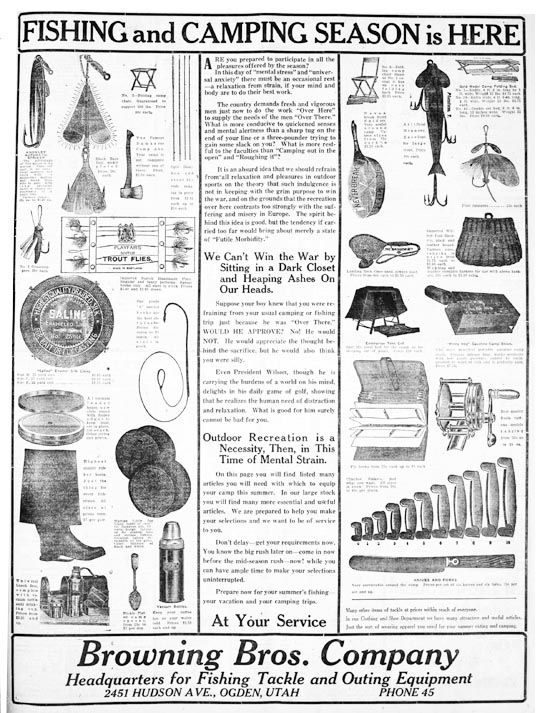
But at least the Bemidji Hardware Company showed some restraint in their advertising department. No such luck with the legendary Browning Brothers of Ogden, Utah, another legendary name in guns that sold fishing tackle. Yes, this is the same John Moses Browning of gun fame, and in my mind the finest gunsmith who ever lived. Don't believe me? Browning invented the legendary Auto-5 shotgun in 1897. The gun stayed continuously in production until 1998 -- 101 years.

He and his brothers Matthew, Jonathan Edmund, Thomas, William, and George ran the Browning Brothers Company beginning in 1872, with a retail store in Ogden that sold everything from dry goods to fishing tackle. The advertisement below comes from the Ogden Standard and shows that, despite being gun geniuses, the Brownings were not great advertisers.


Where do I begin? Could you possibly fit more tackle into a single ad? Perhaps. But it would require hard work and dedication. The Brownings clearly did not subscribe to the idea of open spaces.

Let's start with the Phantom Minnow on the left, because I was unaware that in 1918 anyone was fishing these outside of octogenarians on English chalk streams. By my count this ad depicts 27 distinct items, 17 of which are tackle related. Wow. Just wow. It appears much of the tackle is Pflueger related, as they utilized a lot of the catalog cuts provided by Enterprise Manufacturing in this ad.

The text in the center column is hard to read but I can sum it up by reproducing the bold text in the middle: "We can't win the war by sitting in a dark closet and heaping ashes on our heads." GET OUT AND GO FISHING, DAMN IT! It's actually a pretty refreshing commentary about how, even in times of war, life must go on. But it's also a bit of a desperate plea to buy tackle, presumably because the Brownings had a metric ton of it sitting on the shelves not moving because people were being too austere to go fishing.

So remember that every time you go fishing, you're being patriotic. At least according to the Browning Brothers and their aesthetically horrible ad.

I award the Browning Brothere one fish for aesthetics and three fish for effectiveness, and hope they don't take out their BARs and try to hunt me down.

-- Finn

Finn Featherfurd is the pseudonym of a sad and lonely retired professor and newspaper columnist who has spent the better part of the past four decades (unsuccessfully) chasing fish in the Lower 48. A long-time collector of vintage fishing tackle of all kinds, he is currently fascinated by pre-1920 children's fishing reels (40 yards and smaller). When the spirit moves him, he will contribute occasional pieces and essays to the Fishing for History Blog. He can be reached at finnfeatherfurd@yahoo.com.
Thursday, September 6, 2012

Snarls & Backlashes with Finn Featherfurd: The Tackle Hawks, Part I

The Tackle Hawks, Part I

Well I guess this is as good a time as any to introduce myself. I'm Finn Featherfurd, and Todd's given me a soap box every now and then to spout off from. As I'm from Todd's neck of the woods I've known him (and his father and brother, who are also incredibly sharp collectors) since the late 1980s. I watched him grow from a rail thin undergraduate to a not-so-rail thin professor. I chose the name Finn Featherfurd because I like it, and because I admired Sparse Grey Hackle and always wanted to write under a pen name. It lends just the right amount of mystery to it, don't you think?

When I approached Todd about subjects to write on for his blog, one thing he suggested was I do something with newspapers and fishing. As a former columnist for several big papers, I learned the inside workings of the paper business, and I've always had a soft spot for them. So I thought about it, and keeping with the theme of the Fishing for History blog, I suggested I pen my first series of articles about one of my favorite subjects: old newspaper ads.

Yes, newspaper ads. To be more specific, newspaper ads hawking FISHING TACKLE. And yes, I'm aware that Wild Bill Sonnett does a weekly column on fishing tackle ads -- and I might add does them better than me, or anyone else on this green earth, could hope to do. Seriously folks, you ought to be carving a statue of Sonnett out of marble for all the pearls of wisdom he's dropped into your unsuspecting laps. There isn't a single episode of Deconstructing Old Ads that doesn't have multiple revelations in it. I couldn't hope to reproduce that kind of success in my wildest dreams.

So I'm going to take a different tack.

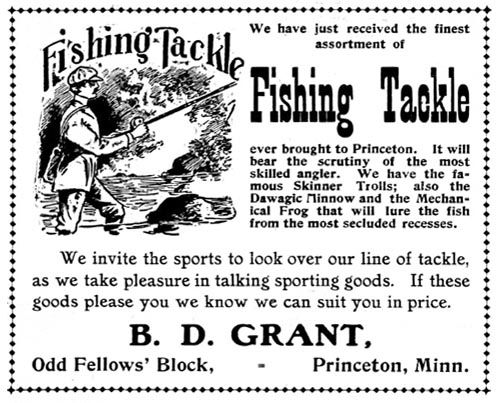
As a lover of newsprint I have always been fascinated by pictorial advertising, which really became popular in papers around 1900 and reached its apex in the '20s and '30s. While most of us are used to seeing the great magazine tackle ads ala Larry Smith (a reference you young 'uns are likely to miss), papers carried a lot of wonderful pictorial advertisements. Take for example the ad below for B.D. Grant from the May 24, 1906 Princeton (Minnesota) Union. You know what I like about this?


Every single God damn thing. Can I say God damn? I guess I'll know if it gets published. Let's start with the image. Classic turn-of-the-century (and not this lame 2000 b.s. either) styling when men fished in jackets with jaunty caps. And that mustache, neatly groomed. I'm sure this fine angling gentleman rode a velocipede to the babbling brook.

He's baitcasting for trout, by the way, which would certainly make the fly fishing zealots (like our dear blog owner) faint dead away, tut-tutting as they gently swoon to the ground, careful not to harm their $2000 bamboo fly rods. I never could figure out why it's OK to spin or baitcast for every fish on earth except trout. One of my favorite things to do is find a pod of "fly anglers" as they like to call themselves and cast a Mepps right between them from the other side of the stream.

Don't get me wrong, I love fly fishing, but it's just another way to catch a fish. No better or worse than any other, and despite what the Gingriches and Halfords say, not any more ethical either. But I digress.

Let's look at the text of the ad. Skinner Trolls, "Dawagac" Minnows, Mechanical Frogs…I'm getting excited thinking about it. If I were reading this over morning coffee in the summer of 1906 you can be damn sure I'd beat a hasty path with my horse-and-buggy down to B.D. Grant's shop; Even the address--Odd Fellows' Block--is just perfect.

Over half a continent away, the following year the Hauser brothers, presumably Germans of good, solid stock, of Salem, Oregon were putting together their own tackle ad, run in the April 22, 1907 issue of the Salem Daily Capital Journal.


It's certainly a different idea on how to run a tackle ad, along the lines of "throw everything including the kitchen sink" at the reader. It does have a nice pictographic header, but the crux of the ad is all about shoving as much tackle down your throat as will fit. Whereas Mr. Grant was content to titillate with his "Dawagac" minnow literary references, the Hausers depict a Colorado spinner, a H.J. Frost automatic fly reel, the "Yellow King" fly and a trunk rod (7 pieces mean a hell of a lot of ferrules and the action of a dead branch). Fortunately the 010 rod shown was only $3. I'm sure it made for excellent kindling.

The "Yellow King" intrigues me most. I did a Google search for it but gave up after about a minute as I was inundated with slightly disturbing links. Ah the internet. You're always only a click away from your eyeballs boiling in their sockets. Anyway, I'd love to know what the "Yellow King" looked like. It looks too big to be a dry fly, probably not a wet either. Likely either a bass fly or streamer…

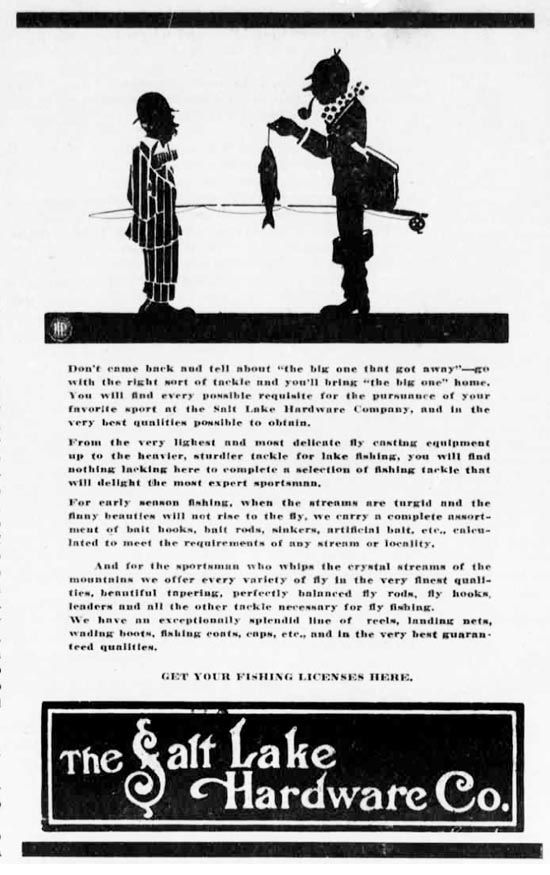
The Hauser brothers should have taken a lesson from the Salt Lake Hardware Company. The ad below, dated June 24, 1916 and run in the very Mormon-y Salt Lake newspaper Goodwin's Weekly, is a perfect newspaper ad. Well, it should be, considering the paper it was run in billed itself as "A thinking paper for thinking people."


What's not to like? A beautiful piece of "Silhouette" art. Again, a pair of sharply dressed anglers, a snappy fly rod and reel, and a pipe to lend a touch of elegance. "From the very lightest and most delicate fly casting equipment up to heavier, sturdier tackle for lake fishing…" Not much more needs to be said here.

More so than even Mr. Grant's ad (and certainly more than the Hauser brothers), THIS ad makes me want to go fishing. It makes me want to buy fishing tackle, also. And THAT'S what a good newspaper ad is supposed to do.

We'll jump into some more classic newspaper ads next week.

-- Finn

Finn Featherfurd is the pseudonym of a sad and lonely retired professor and newspaper columnist who has spent the better part of the past four decades (unsuccessfully) chasing fish in the Lower 48. A long-time collector of vintage fishing tackle of all kinds, he is currently fascinated by pre-1920 children's fishing reels (40 yards and smaller). When the spirit moves him, he will contribute occasional pieces and essays to the Fishing for History Blog. He can be reached at finnfeatherfurd@yahoo.com.