Thursday, September 18, 2008

Review of the Fall 2008 NFLCC Gazette

The fall NFLCC Gazette comes to us with some big news; Jim Fleming, after five years of stewardship, is stepping down as editor--which means there is now an opening for the position. It will be interesting to see who applies...


The issue itself has a number of interesting articles. The first is an interesting piece by Jim Hall of Gallatin, Tennessee called "The Birth of the Pflueger Surprise Minnow" and it covers the background and history of this Clarkson & Hummon patented bait.

Dan Basore informed us of the two new honorary members, Berkley Bedell and Lee Sisson. Both were extremely important men in the later half of twentieth century fishing history, Bedell for helping bring science into the fishing world, and Sisson for his work with Bagley as a lure designer and later for his designs for Heddon and his own company.

Eric Borgerding presented the second part of his great article on Tony Burmek. Congratulations to Eric for his nifty work in putting this piece together!

Blake Bach gives us some neat information on "Creek Chub--Peters Special" lures. The history of H.L. Peters was printed in the pages of The Gazette some time ago, so it was nice to add some additional history both to the background of this neat trade house and to Creek Chub.

A variety of shorter offerings round out the issue. Tom White gave us "America's Game Meets America's Sport" on the connection in 1957 between Heddon and Pabst; Gregg Stockey gives us "Bass Lures" on the joys of collecting lures with the word "bass" in them; Tim Mierzwa offered up a glowing review of Jeff Kieny's new book Patented Fish Hooks, Harnesses, and Bait-Holders; and Marc Dixon defines the word mint for us.

The NFLCC Gazette is edited by Jim Fleming. If you're not a member of the NFLCC--and really, I can't understand a rationale explanation why you wouldn't be--you can join by Clicking Here.

-- Dr. Todd

Wednesday, September 17, 2008

Dr. James A. Henshall, Fish Culturist, by Clyde Drury

I was recently asked to contribute a piece on Dr. James Henshall's career as a fish culturist to the outstanding new journal Eddies: Reflections on Fisheries Conservation, which I strongly suggest anyone with an interest in preserving our fishing history should subscribe to immediately.


In the course of researching this material, I wrote Clyde Drury, the premier Henshall authority in the world and editor of the recently released Autobiography of Dr. James Alexander Henshall, for his take on Henshall's work in this field. He sent me far more than I needed, and has kindly allowed me to reproduce a portion of his correspondence as it adds greatly to our knowledge of Henshall.

Dr. J.A. Henshall as a Fish Culturist

by Clyde E. Drury

In 1865 while working as a medical doctor in New York, Henshall began studying the scientific and life history of fishes as a means of rest and relaxation. His study of the writings of all the leading ichthyologists of the day served him well in the scientific section of his “Book of the Black Bass.” It was there that he established priority for the scientific names gives to the largemouth and smallmouth bass.

When he moved to Oconomowoc, Wisconsin he began to study the fish up close. He stocked a pond on the property with adult bass and studied their breeding, spawning, and feeding habits for several years. He also studied the bass in several other nearby lakes and another hatchery run by Colonel George Shears of Beaver Lake.

The months of February, March, and April, 1889, were spent by Henshall in making an ichthyologic exploration of the southern coast of Florida, together with the U.S. Fish Commission schooner Grampus.

During the months of January, February, and March, 1892, he was engaged in collecting a series of the salt-water fishes of Florida for use in preparing the exhibit of the U. S. Fish Commission at the World's Columbian Exposition, Chicago, 1893.

Some key dates in Henshall's fish culture career:

1886-1892 – secretary and then President of the Ohio Fish commission
1891-1892 – President of the American Fisheries Society
1897-1909 – for 12 years Superintendent, Bozeman Montana Hatchery, US Fish Commission
1909–1917 – Superintendent of Tupelo Mississippi Hatchery

Here is a brief list of works written by Henshall on the subject of fish culture:

Henshall, James A., Dr. "Contributions to the Ichthyology of Ohio: No. I." Journal of the Cincinnati Society of Natural History 11 (July-October 1888): 76-80.

Henshall, James A., Dr. "Contributions to the Ichthyology of Ohio: No. 2." Journal of the Cincinnati Society of Natural History 11 (January 1889): 122-126.

Henshall, James A., Dr. "On Some Peculiarities of the Ova of Fishes." Journal of the Cincinnati Society of Natural History 11 (July-October 1888): 81-85.

Henshall, James A., Dr. "Some Observations on Ohio Fishes." Journal of the Cincinnati Society of Natural History 12 (January 1890): 114-125.

Henshall, James A., Dr. - Report Upon A Collection Of Fishes Made In Southern Florida During 1889. 4to. Pages 371-389. 1891. U. S. Commission of Fish and Fisheries. Document 167. Washington DC. Extracted from the Bulletin Of The United States Fish Commission, Volume ix, For 1889.

Henshall, James A., Dr. - Notes On Fishes Collected In Florida In 1892. 8vo. 15 pages. 1894. U.S. Fish Commission Bulletin for 1894, Article 17. Softbound. Washington DC. Reprinted 1987.

Henshall, James A., Dr. - A Plea For The Development And Protec¬tion Of Florida Fish And Fisheries. Taken from Proceedings And Papers Of The National Fishery Congress held at Tampa Florida, January 19-24, 1898. Ex¬tracted from U. S. Fish Commission Bulletin for 1897. Article 8, pages 253 to 255.

Henshall, James A., Dr. - A List Of The Fishes Of Montana With Notes On The Game Fishes. 8vo. 12 pages. 1906. University of Montana. Missoula MT. A descriptive paragraph on Largemouth and Smallmouth Bass. Indicates that Bass had been planted in the western portion of the state where the waters were warmer. He also says “The colder waters of the eastern part of the state are totally unsuited to black bass; moreover, they should never be planted in ponds or streams containing trout.” Four pages are devoted to trout, and grayling with a short paragraph on the Rocky Mountain whitefish. Reprinted 1985.

Henshall, James A., Dr. - Culture Of The Montana Grayling. 4to. 7 pages. 1907. Fisheries Document #628. U. S. Dept. of Commerce and Labor. Washington DC. Softbound.


Many thanks to my friend Clyde for penning this brief piece, which along with my own biography of Henshall's fish culture work, should be a great start for anyone interested in reading more on his work in this field.

-- Dr. Todd

Tuesday, September 16, 2008

Voices from the Past: Indian Feather Merchant


If you ever thought outsourcing was just the scourge of the 21st century, guess again. Here is an article run in the 02 June 1971 Tri-City Herald describing how one American fly tier--Dennis Black--contracted with an Indian feather merchant to tie flies. It heralded a move that eventually saw most of the large-scale fly tying companies move overseas.

A feather merchant from India is in the United States, learning from a Roseburg businessman how to tempt and deceive.

Joga Rao sits daily in a cramped back room, learning the intricate art of tying flies — tiny lures resembling insects that tempt and deceive fish.

But what is an Indian feather merchant doing in the Umpqua Valley community of Roseburg and why does he want to learn to tie flies?

Dennis Black, who makes and sells nearly 200,000 flies a year in his factory-shop, traveled last summer to India and purchased some feathers — an intregal part of flies.

There he met Rao.

After a lengthy discussion of the fly tying business and some planning, Rao decided to spend four months in Roseburg, learning the business so he could establish his own fly tying factory.

It is the first visit to the United States by the 36-year-old Rao since he received his master's degree in business administration from the University of Cincinnati.

Although Rao has a degree in chemistry and "could probably have started making chemicals for a chemical company," he went into the feather business with his father. He describes it as "a profitable business, a good business."

Rao and his father sell mostly peacock and rooster feathers and most of the business is exporting them to fly tying shops around the world.

Peacock feathers are plentiful in India where it is the national bird, protected by the government. The peacock sheds its tail feathers, providing the source of most of Rao's material.

By producing flies, Rao will be making use of his own raw materials instead of exporting most of them.

And fly tying is also a profitable business. Black says his flies bring about 65 cents each on the retail market.

Rao, after only a month's practice, can turn out an expertly tied fly in just three minutes.

Rao says he will establish his factory in Katmandu, the capital of neighboring Nepal, because of India's restrictive import laws. He will need to import steel hooks from Norway and pieces of muskrat, beaver and raccoon fur from other countries.

With an anticipated annual production of 600,000 flies, Rao plans to export most of them to the United States where sportsmen are "more interested in sport fishing than anyone else in the world," Rao says.

Black will handle the marketing details in this country.

Rao says he expects the first flies from his factory to be ready next January.


-- Dr. Todd

Monday, September 15, 2008

News of the Week: 15 September 2008


NOTE: Dr. Todd is currently without power due to Hurricane Ike (no joke -- Category 1 Hurricane force winds leave 500,000 in Cincinnati without power...so I am filling in until Dr. T can get back up and rolling again.

How far would you go to catch a nice sailfish?


Groote Eylandt, that's where.


NASCAR crew chief having success as angler


Case Western Reserve Professor teaches freshmen the art of fly fishing

Musings on a carp fishing tournament: C.A.R.P. - An Idea Whose Time May Never Come

Aged angler overcomes 150-pounder


-- Marc T. Hanger

Friday, September 12, 2008

Friday Funhouse

The Friday Funhouse

Video of the Week


The Bloomington Brothers try to pay off their credit card bill by starting a fishing show...pretty much how every popular TV fishing host got started, I hear.


Things I Would Buy If I Could Afford Them


As I spent two days talking about the Shmoo, it is only fair that I feature one as a lead off hitter in the Funhouse this week.


This awesome Vom Hofe Restigouche 423 Salmon reel is the reelmaker at his height.


Although it doesn't have any paint, the H.C. Brush spoon is still an all-time classic lure.


Nothing nicer than a J.H. Mann marked spinner.


From the There Used to be a Museum Here Files: This awesome E.F. Payne fly rod used to be in the Granville Island Sportfishing Museum.


This nifty Heddon Punkinseed 9630 is a sweetheart.


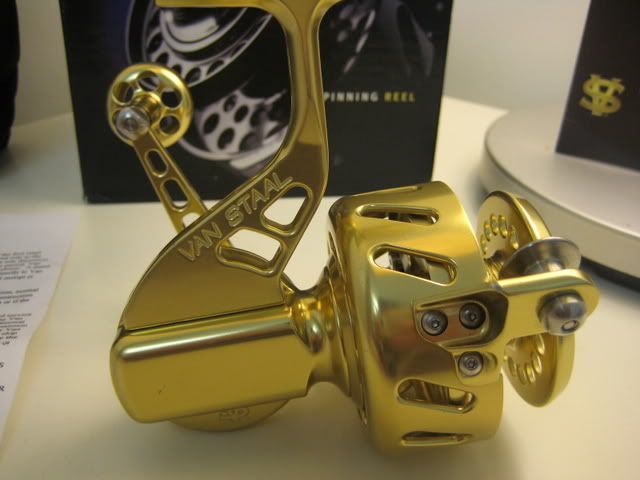
A Van Staal 150 spinning reel is a classic spinning reel.


This 1926 Elto Outboard Motor catalog and owner's manual has attracted a veritable host of bidders.


If you want to start a collection of Victorian metal baits, you could go a long way before finding a better starting point than this W.D. Chapman Allure.


The Allcock Cleopatra is a terrific English bait.


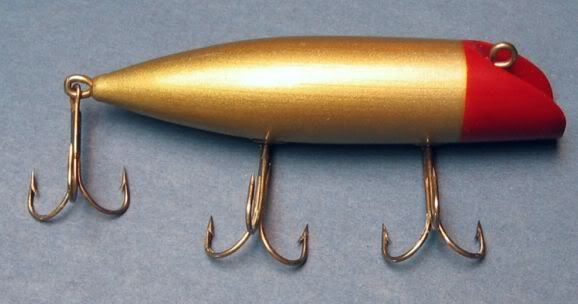
The South Bend Bass Oreno in Red Head/Gold does not appear every day.


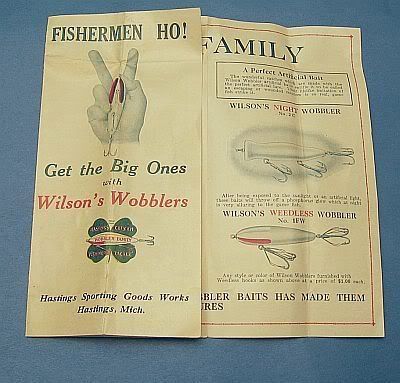
A 1916 Hasting Wilson Wobbler box paper has attracted lots of attention.


Finally, if you are looking for a great go-with, this is a classy Izaac Walton tobacco tin.


As always, have a safe weekend, and be good to each other--and yourself.

-- Dr. Todd

Thursday, September 11, 2008

The Shmoo, Part 2

The Shmoo Part 2

NOTE: Unless noted, All photos of Shmoo Lures and catalogs provided by Chris Labuz.

In upstate New York, Richard Balch, director of one of the largest tackle manufacturers in the country, got caught up in Shmoomania like everyone else. Unlike most, however, Balch had an idea, and that idea would morph into one of the neatest fishing lures of the post-World War II era: The Shmoo.

There has been some speculation over who actually manufactured the Shmoo--various sources state either the Shurkatch Company of New York or an unknown maker. We can conclusively put the rumors to rest. We get a great glimpse at the manufacturer of the "Shmoo" bait in an article in the Utica Daily Press dated 01 August 1950. Entitled "Salesman Attend 3-Day Meeting of Local Firm," it covered the annual meeting of the approximately 50 salesmen of the Horrocks-Ibbotson Company of Utica, New York. As the article declared:

The conference, featuring the presentation of the company's new lines, opened yesterday morning and will continue through tomorrow. The 1951 line, President Richard H. Balch said, include new split bamboo rods, tubular and solid fibre glass casting and fly rods, and improved models of fishing reels. The exhibit of the company's complete [line of manufactured] products includes for the first time the new Robatrola automatic trolling device and "Shmoo" bait plugs.

So we know that Balch--a very important figure in the history of American fishing tackle and the son-in-law and successor to Edward D. Ibbotson--and his company were both the manufacturers and sellers of the Shmoo Plug Bait. They also, by the way, purchased Shurkatch as well.

The Shmoo bait was a neat idea. Clearly, like all Shmoo products, H-I paid a royalty for use of the L'il Abner figures directly to Al Capp. Capp himself was one of the pioneers of licensing and merchandising for cartoon figures. In a successful $14 million lawsuit against King Features Syndicate in 1947, he wrested control over his creations and thus benefitted financially from its merchandising, unlike so many other less fortunate cartoonists.

The lure itself first appears in the 1950 Horrocks-Ibbotson catalog.


The Shmoo catalog cut. Apparently the lure was made in five colors.


The Shmoo dealer box came with six lures per box.

The Shmoo certainly has abundant collector appeal. The box is an outstanding pictorial two-piece cardboard item with the modern cellophane cut out window. Festooning the side are pictures drawn by Al Capp for the lure, including one of the Shmoo fishing, and another showing L'il Abner and a suitably tressed blonde declaring "The Shmoo Plug Bait kin ketch anythin' 'cept L'il Abner." This of course references L'il Abner's legendary ability to avoid the alter in Dogpatch, Kentucky.


The only problem with H-I's Shmoo Plug Bait is the timing. Certainly conceived in early 1949, when Shmoo mania swept America, the time table for producing a new lure was certainly a full year, which explains why the Shmoo hit the stores only in the spring of 1950. The problem is, this was almost two years from when the character was introduced, and the mania over the Shmoo had certainly waned by this point. Oversaturation and the fact that the Shmoo was conceived only as a short-term character (its final appearance was on 20 December 1948) meant that, like most fads, Shmoomania was short-lived.


An awesome collection of three H-I Shmoo Lures from Chris Labuz's collection.

The Shmoo was always a collectable bait, as is almost all Shmoo items, but particularly after the great Ted Williams Upper Deck commercial of 1992, prices for the Shmoo skyrocketed. It is, after all, one of the few examples of cross-over promotion between fishing lures and comics (but not the only--we'll profile another similar lure with a comic tie-in in the near future). It was introduced in 1950 and had disappeard by 1952 from the H-I catalogs.


Awesome dealer one-sheet display announcing the H-I Shmoo in 1950. Courtesy Gary Paschal.

My thanks to Chris Labuz for pushing me to write this piece, and for providing information on the endearing and classic Shmoo. Thanks also to Gary Paschal for sending the neat Shmoo one-sheet.

-- Dr. Todd

Wednesday, September 10, 2008

The Shmoo Part I

The Shmoo Part I:

Everything You Ever Wanted to Know About the Schmoo But Were Afraid to Ask

by Dr. Todd E.A. Larson
© 2008

------------------------------------------

On August 31, 1948, cartoonist Al Capp added a strange new character to his popular nationally syndicated cartoon L'il Abner, itself already nearly fifteen years old and enormously popular. An amorphous blob sometimes called a "bowling pin with legs," the Shmoo as it was called immediately became a national sensation.


One of the oddest characters in the history of an odd business, the Shmoo was basically a being created to serve man in all his needs. If a character was hungry, the Shmoo gladly killed itself so that the human master could eat. As a political editorial pointed out a year later (referenced later in the article):

[The Shmoo] is a remarkably amiable creation, the non-existent shmoo delights to serve humanity's wants. Versatile enough to give milk, eggs and butter, all packaged, when fried the shmoo tastes like chicken, when broiled it tastes like steak, when roasted it tastes like pork, and when baked it tastes like catfish.


A very early Shmoo cartoon by Al Capp, dated 10 September 1948. Note the baby Shmoo dies in ecstasy as soon as the character gets hungry.

The basic story of the Shmoo dominated the comic strip for several months; obviously, the benefits to mankind were unbelievable, but at what cost? This is the issue Capp explored in his comic. L'il Abner discovers the Valley of the Shmoon by accident, but when word of his discovery leaks out, it causes a massive economic panic as humans can use the Schmoo for almost any available need--from coat buttons to building materials. The Shmoo morphs into basically whatever humans need.

In a strange and deeply allegorical story line, the U.S. Government discovers L'il Abner's Shmoos and systematically sets out to exterminate them, literally sending out teams of Shmoo death squads to eliminate them as L'il Abner watches in helpless shock. The story line ends when it is discovered L'il Abner has saved a boy and a girl Shmoo (although why one of each sex is needed is unclear, as they are said to reproduce asexually) and they are last seen in company with their children returning to the hidden Valley of the Shmoon.

All of this was MASSIVELY popular, both as a commentary on the state of society, as well as a classic Utopian tale and an allegory of greed and corruption tarnishing all that is good and innocent in the world. As cartoonist Dennis Kitchen wrote in 2003:

After it came out both the left and the right attacked the shmoo. Communists thought he was making fun of socialism and Marxism. The right wing thought he was making fun of capitalism and the American way. Capp caught flak from both sides. For him it was an apolitical morality tale about human nature... I think [the shmoo] was one of those bursts of genius.

The Shmoo indeed spawned a media sensation. It was so popular that literally overnight merchandise bearing its picture and name came to dominate five-and-dime and department stores; everything from Shmoo ear muffs to Shmoo drinking glasses soon hit the market.

The Shmoo was so popular it even replaced Walt Disney's Mickey Mouse as the face of the children's savings bond for the U.S. Treasury in 1949. According to one article at the time, the Shmoo showed "thrift, loyalty, trust, duty, truth, and comment cents [that] add up to aid to his nation."

College students--who had flocked to Al Capp's cartoon as far back as the mid-1930s and who made his invented idea of a "Sadie Hawkins Dance" universally adopted--flocked to the Shmoo as well. One school--Bridgeport University--even launched the "American Society for the Advancement of the Shmoo" in early 1949.


But it wasn't just college kids who were enamored with Shmoomania. The Shmoo even made it into political parlance; in an editorial in The Winona Republican Herald, Gordon R. Closway used the Shmoo to describe what he considered the current state of American politics:

People who follow the comic strips, and it seems that most of us do, know the "shmoo." This remarkably beneficent and friendly little animal appears with Li'l Abner in the strip drawn by Al Capp.

A remarkably amiable creation, the non-existent shmoo delights to serve humanity's wants....Mr. Capp could have invented the idea of the shmoo from a study of political history. Indeed, he would not have needed to have looked into history, but only to have read the news of the times.

The Welfare State—in which government assumes responsibility for these various aspects of individual welfare—might well be called the Shmoo State.

The term would be apt if for no other reason than because "there ain't no such ani- mal." The shmoo exists on paper. The government that takes care of everything for everybody exists only in fancy, or only temporarily, simply because the thing cannot be done. There always comes a wreck.


In upstate New York, Richard Balch, director of one of the largest tackle manufacturers in the country, got caught up in Shmoomania like everyone else. Unlike most, however, Balch had an idea, and that idea would morph into one of the neatest fishing lures of the post-World War II era: The Shmoo.

(Tomorrow: the Shmoo Plug Bait in all its glory).

Tuesday, September 9, 2008

Voices from the Past: Charles Kent


It's been a fair while since we've featured any angling poetry. Wait no more, fellows of the internet angle, for her cometh a poem from the 1892 American Angler by Charles Kent entitled, fittingly, "Fishing."

Fishing

by Charles Kent

The anticipation,
The rapid pulsation,
The fear and the doubt,
That no luck is in store;
The tremendous throbbing,
While watching the bobbing,
Gay, trim little cork
As it drifts into shore.

Fingers are quivering,
Trembling or shivering,
If but for a second
It bobs out of sight:
With pride you are swelling,
For isn't it telling,
Ahead of your comrades,
You've at last got a bite.

Firs you are dubious,
Then are most curious
To find out the breed
Or the size of the thing;
Get nervous and shakey
And hot, cold and quakey,
Lest you fall to the shore,
The prize safely to bring.

You're hopefully wishing
That when you are fishing
Roam the carp and the perch,
Or the pugnacious bass;
You were told so, at least,
And are sure of a feast,
But lo! a small sunfish
You throw on the grass.

With feelings disgusting,
For being so trusting,
As to list to the lies
Of a bucolic lad;
Take a pull at your flask,
While you mentally ask
Old Nick to reserve him
A place with the bad.


-- Dr. Todd

Monday, September 8, 2008

UPDATE to News of the Week

OK, this is the first update I've ever done to news of the week, but I got emails from Joe Yates and Bill Bates that went together nicely. The first is the greatest fish picture ever:


Second, an article about an Asian Carp that nearly killed a 15-year old boy by smacking him in the jaw. Definitely in the running for story of the year.

And no, the carp wasn't dropped on him by an Osprey...

Thanks Joe and Bill for the links!

-- Dr. Todd

News of the Week: 08 September 2008


Bill Sonnett gets profiled for his antique tackle angling habits...All-Pro NFL player Matt Light makes fishing tackle furniture...the first review of the movie Bait Shop...mullets are on the move...bullheads work for stripers...a fishing club gets organized in Iraq...it takes 5 men 3 hours to land 700 pound sturgeon...man catches shark, in Lake Michigan?...a profile of master rodmaker Per Brandin...it must be THE NEWS OF THE WEEK!

The Big Lead: Our own beloved Bill Sonnett gets profiled by The Toledo Blade on the joys of fishing antique gear.


New England Patriots left tackle Matt Light constructs a fly-rod cabinet of wood for charity; makes John Elder jealous.


Wise bass fall for swimbaits. Wait, wouldn't that make them dumb bass?

From France: A weird article on light tackle fishing for trout.

D'Arcy Egan reviews the soon-to-be epic bomb movie Bait Shop.

The Edmond Historical Society has a display of Oklahoma fishing and tackle on exhibit.

The Mullets are cruising the beach for action...and no, we're not talking about spring break in Canada. Ironically, the article pictures a guy with a mullet. Go figure.


Speaking of Canucks, apparently they are buzzing over toothy critters.


An author previews a telemarketing late night TV fishing lure.

Bullheads are working for stripers...this headline is so much more awesome with an extra "P."

Christmas trees and fishing...or fishing Christmas trees. It's one or the other.

Night fishing made easy...like, when you use a light...

Ah, the august New York Times reports on the sport of the common man, angling.


The Kansas City Star reports on the fishing club that has sprung up in the Iraqi desert.

The Detroit Free Press profiles fly fishing legend Lefty Kreh.

Orvis and the Old Mill District team up to create an 18-station fly casting course.

It takes 5 Men to land a 700-pound sturgeon in B.C. I bet Bill Sonnett could have landed it with his Pflueger Supreme all by himself.

Michigan man claims to catch two-foot shark...in Lake Michigan.

The future of fishing?

A future I can get with: teaching kids how to fly fish.


Finishing With a Flourish: A profile of Per Brandin, master rod maker.


-- Dr. Todd

Saturday, September 6, 2008

The UNID Files #5: The Case of the Counterspinning Spinner

The UNID Files #5: The Case of the Counterspinning Spinner


Chris Diestel sends us another for the UNID files, and it is a real sweetheart. Here is what he has to say about it:

Total length from bend in hooks to eye at front is 4 1/4". Any and all help appreciated. Made of Brass and the body spins counter to the blade in front. Hooks are Japanned enamel.


Chris thinks this might be folk, but I think it is production and I think it may be one of the hundreds of unfound patented lures from the 1880s-1920s. It seems like it is just too well made be to be a one-off lure.

I sure hope someone out there can help Chris out!

-- Dr. Todd

Friday, September 5, 2008

Friday Funhouse

The Friday Funhouse

Video of the Week


The Art of Fly Fishing...or art and fly fishing...take your pick.


Things I Would Buy If I Could Afford Them


An incredible selection of five Chapman Electric lures starts off this week's selections. Unbelievable and museum quality. It would literally take you a lifetime to build a collection like this.


This is a great Fin-Nor Tycoon Gar Wood Jr. Spinning Reel, one of the classiest of its kind.


This Garrison 7 3/4' 209E fly rod reminds us (as if we needed a reminder) why Everett was a master rodmaker.


A Viking Frog in a box...is there a trend here?


There is a great selection of all-time classics up this week, starting with this Chippewa.


This Shakespeare Revolution is another of the all-time best.


This Surface Charmer qualifies as a classic, but it has a hellacious varnish overcoat.


If you haven't been paying attention, Fenwick Feralite rods have been going through the roof of late...


This mechanical spring loaded hook and gaff has the hook heads going crazy.


A Pflueger Nibalo float assortment is a great addition to any bobber collection.


Anytime a J.C. Conroy & Co. reel goes up, I'm all over it.


The Trenton Surface Doodler is the not-so-poor man's version of the Crazy Crawler.


This Falls City Confidence Minnow Bucket is a wonderful and classic example of this style of pail.


This bug swam across the pond--an Allcock Aquatic Spider in original tin.


This FIHE Telecast is one bizarre reel. Or sausage grinder. I can't tell...


This is a neat Orvis fly reel marked Manchester VT.


You don't find these Al Foss lures in cardboard boxes very often...


As always, this weekend be good to each other--and yourself.

-- Dr. Todd