Thursday, August 23, 2012

Thursday Review: The Colors of Bagley Web Site

There's a terrific new Bagley web site called The Colors of Bagley. It's run by Mike Metzler, and I think it is flat-out awesome.


As is well-known, I am very intrigued with the history of bass fishing, and in particular, bass fishing tackle. We are currently getting ready to launch a new book on bass fishing legend Bill Plummer. Of all the bass fishing tackle icons, I like Jim Bagley the best. The sheer fun of collecting Bagleys is hard to match anywhere -- from the most affordable to ultra rare baits, it offers something for everyone.

This site is divided into sections, but two are of the most interest to collectors. The Collections section shows some incredible displays Mike has put together on tackle ranging from Shiners and Pinfish to Shimano 201.

An important section is the Color Codes and Values which shows almost 450 different Bagley colors. When it comes to colors, it is among the most comprehensive web sites of this kind around. The pictures are clear and bright.

It also has a section for Site Links, Lures for Sale, and a Trading Post.

Overall, this is a web site you will want to bookmark. The link will be permanently available to the right.

-- Dr. Todd

Wednesday, August 22, 2012

A Visit to the Chubb Factory in 1883

I love vintage accounts of tackle factories, but they are so very, very rare. The following account by American Angler editor William C. Harris was run in the October 6, 1883 issue and was called “A Representative Factory: Rods, Mountings, Etc.” It gives an outstanding overview of the Vermont tackle factory of William C. Chubb, the legendary rod maker. It is one of the most detailed looks we have of an early American tackle factory.

A REPRESENTATIVE FACTORY-RODS, MOUNTINGS, ETC., ETC.

The village of Post Mills, in Vermont, is beautifully located in the county of Orange. Passing through the village is the Ompompanoosuc River, wherein we found black bass, pickerel (up to six pounds,) sun perch ("kivers") yellow perch (pounders,) and a fish called locally the rock dace, growing to the heft of one and a-half pounds. On this river is located the fishing rod manufactory of Thomas H. Chubb, Esq., who now runs the largest factory devoted to this specialty in the United States, and equal if not superior in extent to any similar establishment in Europe.

A recent visit to Post Mills gave us an opportunity to call on Mr. Chubb, with whom our readers have been long acquainted through our advertising columns. A brief summary of what we saw, and a hint or two of the points in the manufacture of anglers' goods given us by Mr. C., will doubtless interest every angling reader of our paper.

The factory is situated at the south end of the village, and occupies an area of three acres. The main factory is one hundred and twenty feet long, by thirty-two feet in breadth, and four stories in height, including the basement. In addition thereto is a board or sawmill, used in sawing lumber for the factory, which is about two acres in extent. The factory is run by water through a fifty-two inch turbine wheel, giving eighty horse-power; in addition thereto, is a thirty horse-power steam boiler, which is mainly used for heating and drying. The saw mill is at the south of Fairlee Lake, a lovely sheet of water three miles in length by one in width; this lake furnishes the water power for the saw mill and is used as a reservoir (an inexhaustible water power) for running the main factory. In the basement of the factory, an area of one hundred and twenty by thirty-two feet, are found the large turbine wheel and the
lumber storage room. In the L adjacent it is the boiler room.

On the first floor is the mill room, where the sawing and turning of every description, from the largest butt of a bass rod to the smallest lance fly-tip is done. On this floor there are five turning gauge lathes, saws, boring machines, planes, etc. Adjoining is the machine room, which contains engine lathes, shaper, drill press, hand lathes, a large seven foot iron planer, and one of Blake & Johnson's (Waterbury, Conn.) largest presses for striking up reel caps, plates and ferrules. A tool room for dies, pattents, etc. adjoins the machine room.

In this connection we note that Mr. Ohubb has in his permanent employ a competent draftsman and pattern maker, and that every tool, machine or pattern used in the factory has been made therein. In the L on the first floor is the drying room, where the lumber is placed to season for use in the factory.

On the second floor front is the office, twenty by seventeen feet in size, where, by the bye, we saw one of the finest elk heads in the country. It is fifty-four inches between prongs, of which there are fourteen. Several extraordinarily fine chromos of black bass and brook trout are on the walls; a five foot alligator from Texas (the native State of Mr. Chubb) adorns the large sample case, while a mounted but life-like horned owl sits over the desk of the proprietor. Adjoining the office is the winding room, where the rings are put on and the rods silk-wrapped. The next room opposite the office is the dressing or cloak room of the female employees. Then comes the braizing room, in which girls are employed in the manufacture of guides, ring tips, tops, and all the small braizing required in the making of trimmings for rods. Adjoining this is the room used for storage of completed work. The next apartment, sixty by thirty-two feet in size, on the second floor, is tile brass finishing and fitting room, which is the working room for ferrule fitting, general brass work and jointing of rods. Nineteen men are employed in this room. The room for reel making comes next, where special reels are only made for first-class retail trade. We were shown in this room, a nickel-plated click reel of sixty yards capacity, of perfect and substantial workmanship, which Mr. Chubb sells at retail for $1. He also supplies reel-makers with castings, blanks, screws, etc., for making reels. In the L on the second floor is the polishing room, in which all the brass work is buffed and polished preparatory to nickeling. The next room adjoining is devoted to the nickel-plating, in which we found Mr. Geo. R. Huson, whose father was an old gun-repairer and rod-maker from New York City. The brass foundry is next, where the brass castings are made. There is also a room used for the manufacture of cloth cases for rods, and bottoms for camp chairs.

On the third floor comes consecutively: 1st. The store room; in which is stored ferrules, finished wood stock, etc., etc. 2nd. The varnish room, which is used for varnishing the cheaper grades of rods by machinery. 3rd. The room for the manufacture of paper boxes and bags for the special use of the business and for sale to the trade. The machines used in this room were made to order especially for Mr. Chubb. 4th. The staining and filling room. 5th. The rubbing-down room, in which the rods are rubbed down and polished preparatory to a flowing coat of varnish,. 6th. The shellac room.

The factory is heated throughout by steam, and one hundred gas-burners are supplied by a generator located some thirty feet distant from the front end of the building. Mr. Chubb employs between sixty and seventy workmen, and supplies the leading tackle jobbing houses with rods, rod mountings, landing net frames, camp chairs, etc., etc. When passing through the first floor we were much interested in the machine for making split bamboo rods. It was invented by the proprietor, and is the perfection of fine automatic machinery. We saw the rough strips placed in the machine, and in a moment held in our hand a symmetrically shaped strip, six of which were wound with thread, and fitted without a break or irregularity into each other, thus forming a complete and perfect section of split bamboo rod, made almost in the twinkling of an eye. It is this wonderful machine that enables the amateur rod-maker to get his materials at a trifling cost. We learn that Mr. Chubb finishes a complete mounted split bamboo rod, either three-joint bass or fly-rod, ready for ringing and varnishing, for $7.50.

The proprietor of this celebrated establishment came to Vermont after the civil war, having lost hiss health during active service therein, and naturally drifted into a line of business congenial to his tastes. Being a life-long angler, he became perforce a rod-maker, and from a comparatively small beginning, Mr. Chubb has now the most complete rod-factory known to us, wherefrom the amateur angler can get everything he wants, from a minute piece of pinning wire to the heaviest piece of stock or fitting used in making a rod; but be it remembered that Mr. Chubb does not furnish finished rods for the retail trade.

Mr. Chubb is aided in his management by his brother, Mr. Wm. B. Chubb, of Texas, who has charge of the financial and correspondence departments of the business, which is growing rapidly in minutiae of detail and commercial value.


-- Dr. Todd

Tuesday, August 21, 2012

Voices from the Past: The Death of a Hook-Maker (1761)


Maybe it says something about my personality that I am always fascinated by the vintage crime reports of the eighteen and nineteenth century. Every now and then, a fishing tackle related blurb will catch my eye. Such is the case with a certain Mr. Souch, a fish hook maker from

The London Magazine for November 1761 published the following blurb about the incident.

Mr. Souch, a fish-hook maker, was stabbed by one Greenstreet, his journeyman, and died of the wounds he received. The murderer is in custody.

It leaves so much to the imagination. What prompted the violence? A journeyman was an apprentice who spent as long as 13 years (unpaid!) learning a trade. Perhaps Mr. Greenstreet was not being treated as he should have by Mr. Souch, the hook-maker.

All we know in the 250 years that have passed that on Wednesday, October 18, 1761, one hook maker stabbed another, and the rest is simply a mystery.

Some day I plan to write a fictional account of these events.

-- Dr. Todd

Monday, August 20, 2012

News of the Week: 20 August 2012


Don't have time to read 50+ fishing and tackle collecting blogs and web sites? Well, let us do it for you! Follow all of the latest news, articles, and stories on our Whitefishpress Twitter account! Hint: You don't need to be a member...just bookmark the Twitter Feed Page or click on latest links to the right!

THE MONDAY 10: The Ten Fishing Stories of the Week You Need to Know

The Big Lead: Well, color me blushing…yours truly, and Fishing for History, get profiled by Bernie Schultz on Bassmaster!

Big Wisconsin smallies.

Teenager battles six foot bull shark in South Carolina.


From military pilot to champion bass angler.

If you ain't fishing cane, you ain't fly fishing.

Kayak angler survives battle with a Great White.

An angler's diary along the Salmon Highway.

This weeks winner in the Field & Stream vintage tackle contest is the Borgen Weedless Spoon.

Celebrating the 20th anniversary of A River Runs Through It.

Finishing with a Flourish: Al Troth, pioneer fly tier, has passed away.


-- Dr. Todd

Sunday, August 19, 2012

1000 Words

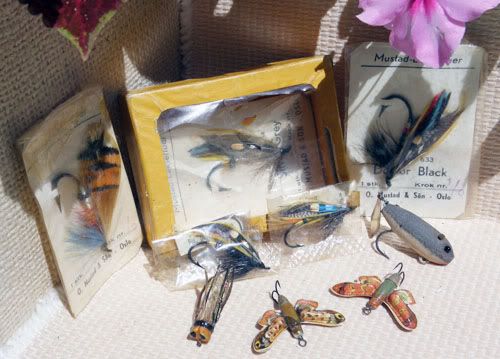
One of my favorite photos every year comes from Doug Bucha's Nilesfest display. This year is no exception. Doug's description this year:

Over the past twenty years the Niles Riverfest has brought in many fly fishing items.  This year was no exception.  These fly fishing items came from the tackle box of a long time, world traveled Atlantic Salmon fly fisherman by the way of Florida.  I find it interesting to note the variety of age and origin of these items.  From the Atlantic Salmon flies made in England and Norway  to the domestic South Bend Hop-Oreno, Heddon Flap-Tail Mouse, and the exquisite Colorado Moths.  This gentleman fisherman must have really gotten around over the years plus he must have enjoyed fishing for a variety of fish.


What a time capsule! Awesome photo, too. Thanks Doug!

-- Dr. Todd

Saturday, August 18, 2012

Deconstructing Old Ads: Those Plastic Spool Pflueger Reels (1947-1948)


Those Plastic Spooled Pflueger Reels

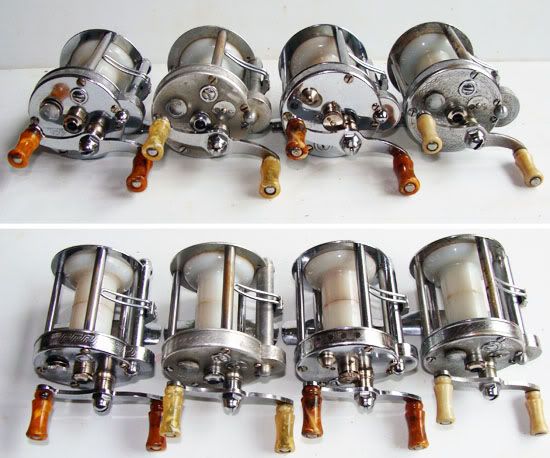
The first time I can remember seeing a Pflueger baitcasting reel with a white plastic spool was a Summit model at a garage sale about 35 years ago. My first thought was that this must have been a way to cheapen the cost of making a reel toward the end of its production run. Occasionally after that I would see Summits, Nobbys, Skilkasts, and Akrons with the plastic spool. I always passed on them as they seemed something less of a reel. I enjoy using older baitcasting reels and have tried to use the best quality reel produced during a model's lifetime and plastic spools didn't seem to fit this mold.
 
After I became familiar with the evolution of these reels and the changes they had gone through, it became obvious that the plastic spools did not occur at the end of their production run, but rather much earlier. No one seemed to know when, what or why these plastic spools existed and they were not shown or described in any Pflueger catalog.

As I was looking at a plastic spooled Summit in the box at a lure show, it occurred to me that almost all Pflueger reels have an inspection date stamped on the bottom of the box indicating when they left the factory. I turned the box over and saw a 1948 date. That was a start. In order to check the accuracy of that combination (box & plastic spooled reel) I began to check each and every one I saw. Over the next several years anytime one came up on eBay that looked like it probably was in the original box I would ask the seller for the date stamped on the bottom. The answer always came back sometime in 1948. I have seen one box that was dated the last day in November 1947.

Sometime later I ran across the following ads which show, but do not mention, the plastic spool. The ad for the Akron is from the  April 1948 issue of Outdoor Life and the SkilKast ad is from the March 1948 issue of Sports Afield.


The two obvious questions that fallow are: Why would Pflueger go to an all plastic spool? --- and why did they give up on it so quickly? There was a lively discussion about this topic some time back on the Old Reel Collector Association website. My own feeling is that it has more to do with the history of line than anything else. Pflueger had always used cork arbors on their baitcasting reels. Before World War II almost all braided casting lines were silk. A dry silk casting line has very little stretch in it and it must be removed from the reel and dried after each use or it will quickly mildew and rot. After World War II the new “wonder material” DuPont Nylon quickly took over the braided casting line market, if for no other reason than it did not need to be dried after each use and seemed impervious to decay. There was a problem with early braided Nylon line. It would stretch approximately one third of its length before breaking and one fourth of its length under even moderate tension. In addition to making it somewhat difficult to set the hook on a fish, it had the same effect as wrapping a long strand of rubber band on the spool. As each addition layer of line was wound onto the spool under tension, the ever increasing crushing force soon warped the soft cork arbor out of round and made casting uncomfortable at best. Plastic was a “modern” product that was viewed as the answer to many problems. (It was even used to stock shotguns at this time!) It seemed an obvious answer to this problem. It would not deform under pressure like cork. It was light and eliminated the need for an arbor as that was already part of the molded spool. Why did the plastic spool stick around such a short time? No one is sure. My best guess is that the public did not like the idea and the line companies by 1949 had made great strides in reducing the amount of stretch in Nylon casting lines. This is documented in several books. If interested, I particularly recommend the chapter on lines in John Alden Knight's 1949 book Black Bass. Also the permanent, molded arbor on the plastic spool reduced the line capacity of the spool. This would have been a big disadvantage in situations like Musky fishing where more than 50 yards of line would be prudent.

There is another possible factor. I do a lot of repair and casting with baitcasting reels of the pre-1960 period. I have made it a point to try several examples of Summits, Nobbys and Skilkasts with plastic spools. They cast moderately well but never quit as well as the same reels with aluminum spools. Surprisingly, most are also somewhat more noisy. Later, Pflueger did produce a snap-on, white plastic arbor which never seemed to replace the ever-present cork. I personally like the plastic Pflueger arbor but due to some apparent miscalculations in design the arbor pin never wants to line up correctly with the line tie hole in the spool. This may explain why the Pflueger plastic snap-on arbors are so hard to find.

Pflueger Akron, Nobby, Skilkast and Summit reels showing 1948 plastic spools.


-- Bill Sonnett

Friday, August 17, 2012

The Friday Funhouse

Video of the Week

Shark found floating in a lake in Alabama.

Visit NBCNews.com for breaking news, world news, and news about the economy

12 Things I Would Buy If Only I Could Afford It This Johnson Sa'bra is more evidence spin cast reels are on fire.
A nice selection of Winston Rod Co. catalogs is a nice find.
This Heddon P41 casting reel in the box with all the papers is a superb find.
This Bristol sign sure is pretty…
When's the last time you've seen an Ambassadeur TGC4000C narrow spool?
This 1891 Cummins Bobber is very rare.
Who wouldn't want a Heddon Black Sucker?
A Musky Chippewa is a superb lure.
A Winchester 5-hook minnow in the box will drive the Winchester collectors crazy.
Instant Collection Alert: Punkie Spooks.
A Shakespeare Whirlwind is a rare bait.
This Wilson 6-1 Wobbler is a great lure.

As always, have a great weekend -- and be good to each other, and yourself.

-- Dr. Todd

Thursday, August 16, 2012

The Shakespeare Carbo-Meter Part II

The Shakespeare Carbo-Meter Part II

I thought I'd give a bit more history on the Carbo-Meter. At the 1913 Detroit Auto Show, the Shakespeare Carbo-Meter was unveiled. The January 30, 1913 Motor World magazine was there, and described it as thus:

The accessory exhibits, though more than a third of the total number, occupy a small amount of space; nevertheless, there are several decidedly interesting new things shown that did not adorn the New York show lists. Chief of these is the Carbo-Meter, which is a carburetor of novel construction representing three years' study and work by William Shakespeare, Jr., the Kalamazoo (Mich.) manufacturer of "Honor Built" fishing tackle and other sporting goods.

William Shakespeare, Jr. himself even gave a presentation entitled "A New Form of Carbo-Meter" on March 6th, 1913 at the Michigan State University.

Shakespeare even spent a goodly amount of time promoting his new engine part. The magazine The Horseless Age reported on Dec. 30, 1914 that:

Wm. Shakespeare Jr. Co. will show the Carbo-Meter, a carburetor in which the centrally located combined throttle and air valve is the only moving part. The primary air inlet and gasoline nozzle are in the middle of this valve, and additional air is admitted around the periphery.

As late as 1917 (according to an Oct. 6, 1917 Automobile Topics article), Shakespeare was an active member of the Motors & Accessory Manufacturers association (M.A.M.) and gearing up to display at the fall New York Auto Show.

He was granted Patent #1,243,348 on Oct. 16, 1917 (filed on Dec. 12, 1914) for his Carbo-Meter. The patent was jointly granted to William Schmid and Shakespeare, and assigned to the Shakespeare Co. Schmid was one of Shakespeare's most brilliant engineers and responsible for at least a dozen of Shakespeare's fishing reel patents between 1912 and 1930.
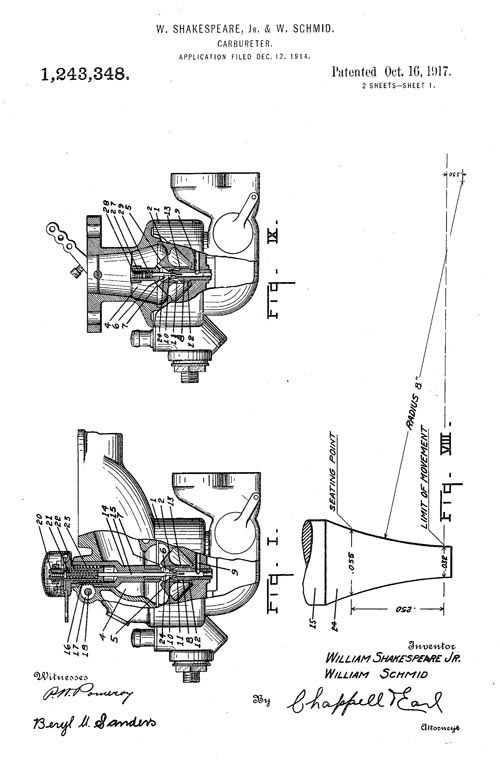

The timing could not have been worse to launch a new automobile enterprise. America's entry into the world war occurred right around the time the patent was granted for the Carbo-Meter, and it appears to have disappeared by 1920. Still, it is telling of the mechanical genius of Shakespeare (and Schmid) that they developed so much buzz in a car world literally awash in new developments.

-- Dr. Todd

ADDENDUM: I was just reading Eric Foster Jeska's (Wm. Shakespeare's grandson) history of Shakespeare, and he notes that one of the products that Shakespeare made during World War II was carburetors.

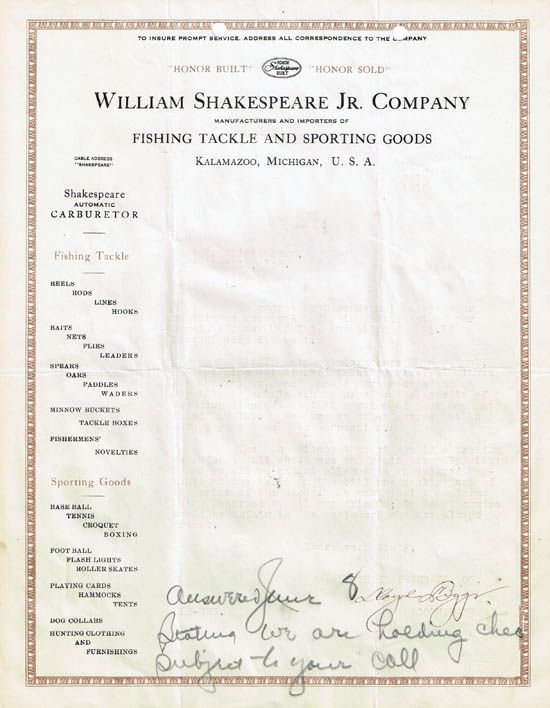
ADDENDUM II: Rich Ludwig sent in this incredibly cool 1910s era Shakespeare letterhead. Check out the Carburetor advertised on the top left. Also note the other goods they carried. What a diverse company! Thanks, Rich!

Shakespeare's Carbo-Meter Carburetor (1913)

Shakespeare's Carbo-Meter Carburetor

I've been brushing up on my Shakespeare history of late, and recently ran across some information I found amusing and interesting. Did you know that for a short time Shakespeare was in the automobile industry? The story of the Shakespeare Carbo-Meter is a fascinating one.

A lot of people forget what smart businessmen the Shakespeares were. Early on, they even took to selling items from other tackle manufacturers to supplement their growing reel, lure, and rod lines -- collectors are always surprised to discover in an early Shakespeare catalog tackle from Heddon, for example.

So it should come as no shock that Shakespeare since its earliest days always was interested in branching out from tackle. They would successfully do this during their history, including manufacturing bows and arrows and golf clubs, but one of their least talked about divisions dealt with auto parts. Here is an article from the May 3, 1913 Automobile Topics entitled "Vacuum Tendency Aids Vaporization." It details the new Shakespeare Carbo-Meter Carbureter. As a gear head (some of you know I run an car and engine history press called The Tachometer Press), I have to run this article in its entirety.

Vacuum Tendency Aids Vaporization: Shakespeare's Carbo-Meter Carbureter Has Throttle Below the Jet--Needle Interconnected with the Throttle-Temperature Dial.

Vaporization of gasoline, as of all liquids, is dependent both upon the atmospheric pressure at its surface and upon the temperature. Thus if a specimen of gasoline will boil at 150 degrees when subjected to atmospheric pressure, it will boil at less than 150 degrees if the pressure is reduced. The evaporation of the liquid at temperatures below the boiling point is influenced in exactly the same way.


One or two carbureters have been designed to take advantage of this "vacuum principle" as it is sometimes termed, while all carbureters naturally are more or less influenced by the vacuum or reduced pressure caused by the suction of the engine, although the main reliance of most of them for vaporization is upon the principle of exposing to the air as much surface of the gasoline as possible, by atomization and a thorough mingling of the currents of air and gasoline. Artificial heat also plays its part in some instruments.

In most carbureters the effect of lowering the pressure on the gasoline is small, being confined to the area immediately surrounding the jet or jets. The lowering of pressure is purposely concentrated here, in order to lift the gasoline into the large mixing chamber, where the breaking up process begun at the jet is continued at a pressure nearly approximating atmospheric. The difference in pressure between the jet area and the mixing chamber is especially great where auxiliary air valves are used, admitting air above the jet.

If the pressure in the mixing chamber could be kept equal to that at the jet, vaporization would be aided in proportion to the lessening of the pressure.

There are two ways of securing this effect, both having to do with the location of the throttle. This member may be placed either at the jet, or below it, instead of above, as in the usual construction. Auxiliary air valves admitting air into the mixing chamber are of course impossible if the effect of the jet or below-the-jet positions of the throttle is to be realized. One or two carbureters have been designed on this plan, and now comes another one. William Shakespeare, Jr., is marketing it. Shakespeare is located in Kalamazoo, Mich., and is well known to sportsmen as a maker of fishing tackle. He calls the carbureter the Carbo-Meter.

The cross section shows the construction of the instrument, which may be seen to have the throttle at the jet, and the mixing chamber above it. By this means the vacuum in the mixing chamber is kept practically the same as that at the jet, and full advantage of such vacuum as is created is thus utilized. It should be noted in the illustration that the throttle, besides regulating the amount of what might be called the main air, also regulates the amount of air passing immediately around the jet. This air enters at the bottom of a small cylinder surrounding the jet, and as the throttle is opened and closed the space for this air to pass through is increased or lessened by means of a shoulder on the cylinder varying its position with reference to the outside of the jet, which is cone shaped.

In addition to this, the needle of the jet itself is moved by the throttle so that just the right amount of fuel is admitted. It should be noted here that this needle, instead of being a plain cone, is curved according to a carefully plotted series of tests.

The mixing chamber, as may be seen, is water jacketed, thus assisting the vacuum in effecting vaporizing of the gasoline. Besides this, provision is made for taking warm air from around the exhaust manifold, there being two branches to the air intake, one for warm air and the other for air at the outside temperature. By means of a sleeve the amount of warm air admitted can be regulated, and a dash adjustment is provided for this. It takes the form of a dial graduated in degrees of temperature, with a pointer that is to be set at the approximate normal temperature of the day. The same dial is also graduated in like manner for a primer, the pointer on this operating the priming device, which consists of a by-pass from the float chamber to the mixing chamber. If necessary for starting or for power at slow speed, this primer may be opened until the desired effect is obtained. The carbureter takes advantage of all possible aids, including lowering of pressure in the mixing chamber, atomization, and application of heat.


I don't believe Shakespeare's foray into auto parts was a big success, but it is representative of the business acumen of William Shakespeare, Jr., and another reason to love Shakespeare history.

-- Dr. Todd

Wednesday, August 15, 2012

Help Us Right A (Fishing) Wrong

Help Us Right A (Fishing) Wrong

As mentioned yesterday, an angler who legally caught a world record fish is being denied his bonus due to a technicality. I join the voices of many -- including outdoor writer Dan Basore, B.A.S.S. owner Jerry McKinnis, and angling author Shane Andrews -- in seeking to right this wrong.

Take a minute to watch the following video, then click on through to the petition and Sign It.


-- Dr. Todd

New Book: John McDaniel's Fly Fishing the Harriman Ranch

Wow! After a LOT of hard work by the Whitefish Press team and the author, John McDaniel, we are happy to report that the new book on fly fishing the Railroad Ranch is shipping!


It's called Fly Fishing the Harriman Ranch of the Henry's Fork of the Snake River
Lessons Learned and Friends Made Sight Fishing to Selective Trout
and it is the most detailed look at this hallowed water ever published. John's been fishing the Ranch for 30 years and kept meticulous details. The book works as a history, as a guide to the Henry's Fork, and as a wonderful tale of one man's love of fly fishing.

It also has some of the greatest photography you'll ever see from pros like Bonnie Harrop and Bryan Gregson, among others.

You can read more about this book, which is available in hardcover trade edition and as a Limited Edition (with matching signed and numbered map) by Clicking Here.

-- Dr. Todd

Tuesday, August 14, 2012

Technicality Costs Angler $1 Million?

Here's a fascinating story courtesy of our friends over at The Rocky River. It's the story of how the Arkansas Department of Game of Fish is working hard to deny an angler a chance at a big bonus for his massive 68 pound striper. Read more about this by clicking here. It's well worth the read.


-- Dr. Todd

Monday, August 13, 2012

News of the Week: 13 August 2012


Don't have time to read 50+ fishing and tackle collecting blogs and web sites? Well, let us do it for you! Follow all of the latest news, articles, and stories on our Whitefishpress Twitter account! Hint: You don't need to be a member...just bookmark the Twitter Feed Page or click on latest links to the right!

THE MONDAY 10: The Ten Fishing Stories of the Week You Need to Know

The Big Lead: Gibby Gibson gets profiled!


Sometimes you just need a good rod repair man.

A 130 year old tackle store is closing…so the owner can go fishing.

A trip down (fishing) memory lane.

More on the death of Jim Hardy.

Angler gets pierced by stingray barb while fishing.

The weirdest lakes you'll want to try fishing.


Finishing with a Flourish: A neat profile of tackle collector James Sherman.

-- Dr. Todd

Saturday, August 11, 2012

Deconstructing Old Ads: Those Six Screw Pfluegers? (1941)


Those 6 screw Pfluegers ?

Most reel collectors these days have heard of the “4-screw Ambassadeurs” and the later “3-screw” models. Fred Ribb tells me this refers to the number of screws on the tail plate of these reels. I have been surprised the last few years how many experienced collectors do not know that at least some of the most common Pflueger baitcasting reels have an extra screw bringing the total to 6 on the face plate rather than the usual 5. This oversight has included some long-time Pflueger reel collectors.

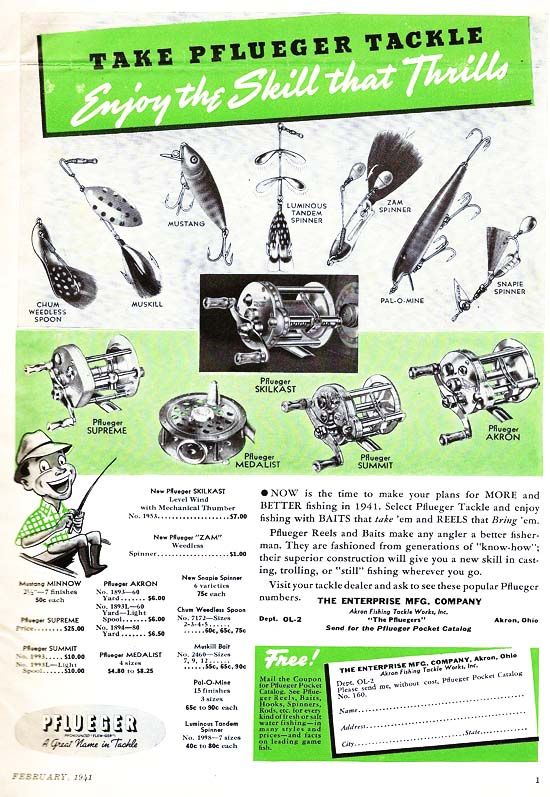
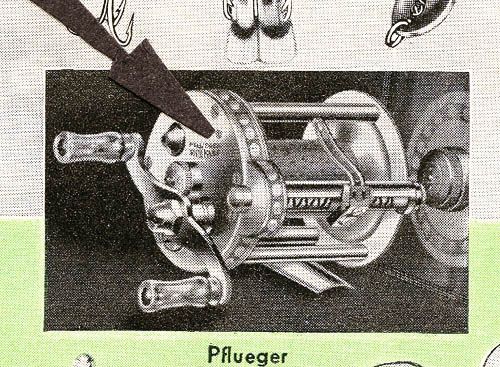
The first clue in this particular case is the 1941 ad for the “New Skilkast” reel shown here from the February 1941 issue of Outdoor Life. Careful observation of this ad will show that there is a small, extra screw at the 2 o'clock position on the reel's face plate. The second picture is a blowup of that portion of the ad with the black arrow pointing to the small extra screw.


Dis-assembly of a reel with this extra screw reveals that the screw serves no mechanical purpose at this location. It is in fact, an extra screw, meant as an emergency replacement for the small screw that holds the metal plate in place that retains the Pawl in the line guide. Pflueger's name for this plate is the “Half Nut Cover”.

One of the great aids in studying Pflueger reels is the fact that most have the date stamped on the bottom of the box as to when the reel was given its final inspection before leaving the factory. By looking at enough boxes one can get a good idea when certain changes took place. According to the inspection dates on reel boxes, this method of retaining the pawl in the line guide was new some time in 1940 on Pflueger's line of freshwater baitcasters such as the Akron, the Summit and the Nobby.

The idea of changing a pawl with this tiny screw while out in a boat seems to me to be a recipe for certain trouble. If you are like me and regularly drop this tiny screw while attempting to get it started, an extra screw sounds like a good idea. I will paraphrase a deceased friend here and say that I have been tinkering with baitcasting reels for about 50 years and have spent more than 40 of them on my hands and knees looking for the screw I just dropped.

Careful observation of reels and boxes has shown that the Nobby, the Akron, the Summit and the Skilkast all featured this extra screw in 1941. I have seen no evidence that the extra screw was not still featured on reels produced early in 1942. With the United States entry into World War II in December of 1941, the Federal Government mandated that production of fishing reels cease by July 1st 1942. Pflueger and others reel manufacturers quickly turned their efforts toward War production. When production of reels resumed at Pflueger in late 1945 that extra screw was no longer there and was never to reappear in the future.

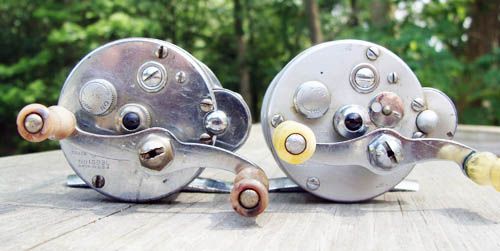
On the left a Pflueger model 1893L Akron and on the right a Pflueger model 1963 Nobby. Both show a small extra screw at approximately 2 o'clock on the face plate, immediately to the right of the extra pawl compartment. A short lived feature beginning in 1941.

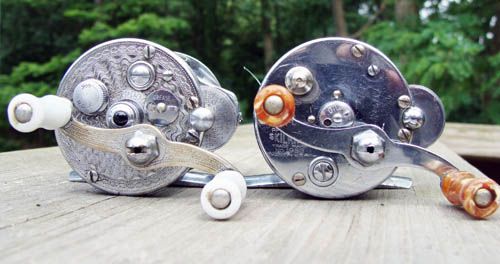
On the left a Pflueger model 1993L Summit with the extra screw at the at the 2 o'clock position. On the right the 1941 introductory version of the Pflueger model 1953 SkilKast which also has this extra “Half Nut Cover Screw.” This feature was gone when production resumed after World War II.

-- Bill Sonnett