Showing posts with label Shakespeare. Show all posts

Thursday, August 16, 2012

The Shakespeare Carbo-Meter Part II

The Shakespeare Carbo-Meter Part II

I thought I'd give a bit more history on the Carbo-Meter. At the 1913 Detroit Auto Show, the Shakespeare Carbo-Meter was unveiled. The January 30, 1913 Motor World magazine was there, and described it as thus:

The accessory exhibits, though more than a third of the total number, occupy a small amount of space; nevertheless, there are several decidedly interesting new things shown that did not adorn the New York show lists. Chief of these is the Carbo-Meter, which is a carburetor of novel construction representing three years' study and work by William Shakespeare, Jr., the Kalamazoo (Mich.) manufacturer of "Honor Built" fishing tackle and other sporting goods.

William Shakespeare, Jr. himself even gave a presentation entitled "A New Form of Carbo-Meter" on March 6th, 1913 at the Michigan State University.

Shakespeare even spent a goodly amount of time promoting his new engine part. The magazine The Horseless Age reported on Dec. 30, 1914 that:

Wm. Shakespeare Jr. Co. will show the Carbo-Meter, a carburetor in which the centrally located combined throttle and air valve is the only moving part. The primary air inlet and gasoline nozzle are in the middle of this valve, and additional air is admitted around the periphery.

As late as 1917 (according to an Oct. 6, 1917 Automobile Topics article), Shakespeare was an active member of the Motors & Accessory Manufacturers association (M.A.M.) and gearing up to display at the fall New York Auto Show.

He was granted Patent #1,243,348 on Oct. 16, 1917 (filed on Dec. 12, 1914) for his Carbo-Meter. The patent was jointly granted to William Schmid and Shakespeare, and assigned to the Shakespeare Co. Schmid was one of Shakespeare's most brilliant engineers and responsible for at least a dozen of Shakespeare's fishing reel patents between 1912 and 1930.
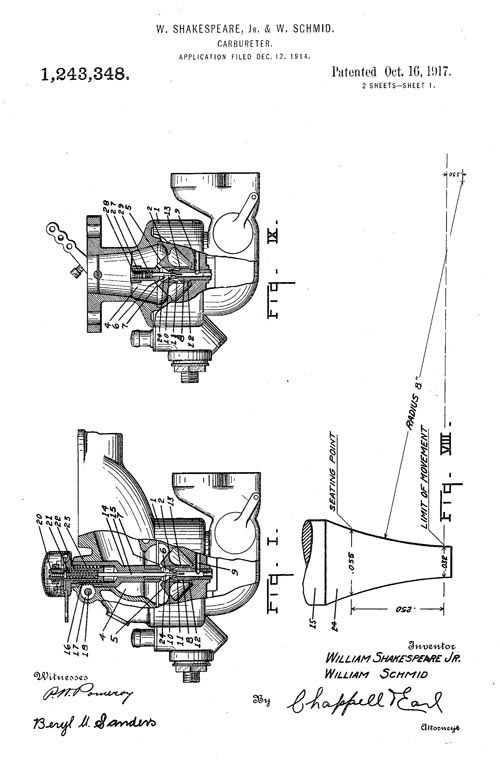

The timing could not have been worse to launch a new automobile enterprise. America's entry into the world war occurred right around the time the patent was granted for the Carbo-Meter, and it appears to have disappeared by 1920. Still, it is telling of the mechanical genius of Shakespeare (and Schmid) that they developed so much buzz in a car world literally awash in new developments.

-- Dr. Todd

ADDENDUM: I was just reading Eric Foster Jeska's (Wm. Shakespeare's grandson) history of Shakespeare, and he notes that one of the products that Shakespeare made during World War II was carburetors.

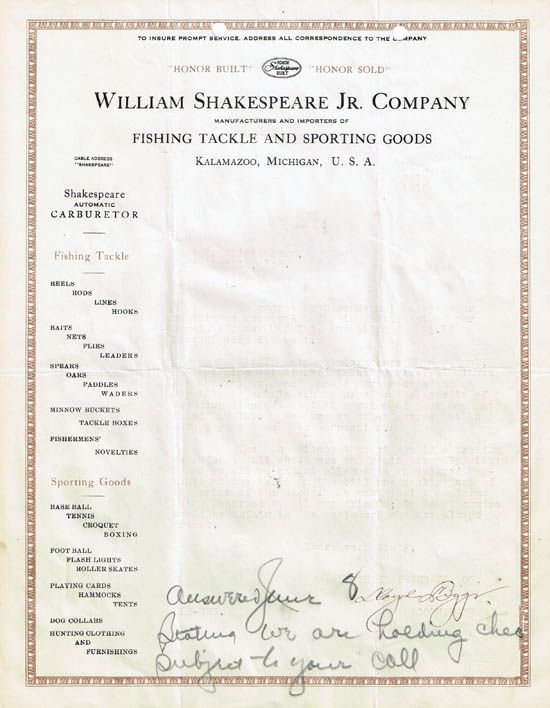
ADDENDUM II: Rich Ludwig sent in this incredibly cool 1910s era Shakespeare letterhead. Check out the Carburetor advertised on the top left. Also note the other goods they carried. What a diverse company! Thanks, Rich!

Shakespeare's Carbo-Meter Carburetor (1913)

Shakespeare's Carbo-Meter Carburetor

I've been brushing up on my Shakespeare history of late, and recently ran across some information I found amusing and interesting. Did you know that for a short time Shakespeare was in the automobile industry? The story of the Shakespeare Carbo-Meter is a fascinating one.

A lot of people forget what smart businessmen the Shakespeares were. Early on, they even took to selling items from other tackle manufacturers to supplement their growing reel, lure, and rod lines -- collectors are always surprised to discover in an early Shakespeare catalog tackle from Heddon, for example.

So it should come as no shock that Shakespeare since its earliest days always was interested in branching out from tackle. They would successfully do this during their history, including manufacturing bows and arrows and golf clubs, but one of their least talked about divisions dealt with auto parts. Here is an article from the May 3, 1913 Automobile Topics entitled "Vacuum Tendency Aids Vaporization." It details the new Shakespeare Carbo-Meter Carbureter. As a gear head (some of you know I run an car and engine history press called The Tachometer Press), I have to run this article in its entirety.

Vacuum Tendency Aids Vaporization: Shakespeare's Carbo-Meter Carbureter Has Throttle Below the Jet--Needle Interconnected with the Throttle-Temperature Dial.

Vaporization of gasoline, as of all liquids, is dependent both upon the atmospheric pressure at its surface and upon the temperature. Thus if a specimen of gasoline will boil at 150 degrees when subjected to atmospheric pressure, it will boil at less than 150 degrees if the pressure is reduced. The evaporation of the liquid at temperatures below the boiling point is influenced in exactly the same way.


One or two carbureters have been designed to take advantage of this "vacuum principle" as it is sometimes termed, while all carbureters naturally are more or less influenced by the vacuum or reduced pressure caused by the suction of the engine, although the main reliance of most of them for vaporization is upon the principle of exposing to the air as much surface of the gasoline as possible, by atomization and a thorough mingling of the currents of air and gasoline. Artificial heat also plays its part in some instruments.

In most carbureters the effect of lowering the pressure on the gasoline is small, being confined to the area immediately surrounding the jet or jets. The lowering of pressure is purposely concentrated here, in order to lift the gasoline into the large mixing chamber, where the breaking up process begun at the jet is continued at a pressure nearly approximating atmospheric. The difference in pressure between the jet area and the mixing chamber is especially great where auxiliary air valves are used, admitting air above the jet.

If the pressure in the mixing chamber could be kept equal to that at the jet, vaporization would be aided in proportion to the lessening of the pressure.

There are two ways of securing this effect, both having to do with the location of the throttle. This member may be placed either at the jet, or below it, instead of above, as in the usual construction. Auxiliary air valves admitting air into the mixing chamber are of course impossible if the effect of the jet or below-the-jet positions of the throttle is to be realized. One or two carbureters have been designed on this plan, and now comes another one. William Shakespeare, Jr., is marketing it. Shakespeare is located in Kalamazoo, Mich., and is well known to sportsmen as a maker of fishing tackle. He calls the carbureter the Carbo-Meter.

The cross section shows the construction of the instrument, which may be seen to have the throttle at the jet, and the mixing chamber above it. By this means the vacuum in the mixing chamber is kept practically the same as that at the jet, and full advantage of such vacuum as is created is thus utilized. It should be noted in the illustration that the throttle, besides regulating the amount of what might be called the main air, also regulates the amount of air passing immediately around the jet. This air enters at the bottom of a small cylinder surrounding the jet, and as the throttle is opened and closed the space for this air to pass through is increased or lessened by means of a shoulder on the cylinder varying its position with reference to the outside of the jet, which is cone shaped.

In addition to this, the needle of the jet itself is moved by the throttle so that just the right amount of fuel is admitted. It should be noted here that this needle, instead of being a plain cone, is curved according to a carefully plotted series of tests.

The mixing chamber, as may be seen, is water jacketed, thus assisting the vacuum in effecting vaporizing of the gasoline. Besides this, provision is made for taking warm air from around the exhaust manifold, there being two branches to the air intake, one for warm air and the other for air at the outside temperature. By means of a sleeve the amount of warm air admitted can be regulated, and a dash adjustment is provided for this. It takes the form of a dial graduated in degrees of temperature, with a pointer that is to be set at the approximate normal temperature of the day. The same dial is also graduated in like manner for a primer, the pointer on this operating the priming device, which consists of a by-pass from the float chamber to the mixing chamber. If necessary for starting or for power at slow speed, this primer may be opened until the desired effect is obtained. The carbureter takes advantage of all possible aids, including lowering of pressure in the mixing chamber, atomization, and application of heat.


I don't believe Shakespeare's foray into auto parts was a big success, but it is representative of the business acumen of William Shakespeare, Jr., and another reason to love Shakespeare history.

-- Dr. Todd

Saturday, May 30, 2009

Deconstructing Old Ads with Bill Sonnett


Deconstructing Old Ads with Bill Sonnett

Shakespearean Math

This is one of my all time favorite ads. It appeared in Recreation Magazine in April of 1901. Apparently William Shakespeare felt some of his clientele could not read all that well so this picture story/ math problem addressed some of those concerns. This also illustrates to the non-believer just how early the aluminum Revolution and Worden Bucktail Revolution came upon the scene. I wonder what a modern advertising agency executive would say today if presented with this ad for approval by one of his artists.


-- Bill Sonnett

Saturday, May 9, 2009

Deconstructing Old Ads with Bill Sonnett


Deconstructing Old Ads with Bill Sonnett

The Origins of the Shakespeare Minnow

At the behest of Dudley Murphy, I spent nine years researching an article for the NFLCC Magazine on the beginnings of Shakespeare in the wooden minnow business. This also necessitated thorough research into the history's of Fred Rhodes and his uncle Jay Rhodes and their wooden minnow inventions which eventually became the property of William Shakespeare. That article appeared in the December 1999 issue of the NFLCC Magazine. Only one question that nagged me for those nine years was not answered to everyone's satisfaction: Did the Kalamazoo Minnow (known to collectors as the "Kalamazoo String Minnow) actually have the hooks strung on string, or on wire as so many had been found in the field? I always felt having "restrung" three of them myself, that the wires were simply fisherman's solutions to what had shown itself to be a very difficult task. But without proof, I had to hedge in my article. Within a couple of months of the article's appearance my friend and very accomplished researcher Jerry Martin sent me this ad and the accompanying write up that he discovered in the May 1904 issue of Sports Afield. Needless to say the debate was settled one and for all.


-- Bill Sonnett