Tuesday, July 24, 2012

Voices from the Past: John W. Milam (1922)


Last week's piece on Kentucky reel history was well received, and at the request of Doug Carpenter, I'm publishing a second fascinating article detailing the history of the Kentucky reel. It's from History of Kentucky, Vol. 5 by William Elsey Connelley (AHS, 1922) and details the life of John W. Milam before going in to the history of the Meek and Milam firms.

John W. Milam, of Frankfort, is active head of the business originally established and developed by his father, the late Benjamin C. Milam. This firm, B. C. Milam & Son, are manufacturers of "The Milam," the original "Frankfort Kentucky" fishing reel, a perfected device probably known to every follower of the sport of fishing in America. These reels have been manufactured by the Milams for over eighty years. They have been awarded four international first prizes and medals: World's Fair, Chicago, Illinois, Fisheries Exposition, Bergen, Norway, World's Exposition, Paris, France, St. Louis Exposition, St. Louis, Missouri. They have been used by three presidents of the United States, Grover Cleveland, William McKinley and Theodore Roosevelt. Joseph Jefferson was also a great admirer of this reel, having four. A number of years ago a competing firm began manufacturing what they called the Frankfort Kentucky reel, and finally the Milam Company asked the courts for protection for their rights. The case was argued before Chancellor Shackelford Miller, later Chief Justice of the Kentucky Court of Appeals, who on November 2, 1901, rendered an opinion asking for an injunction in favor of the Milam Company. The evidence brought out during the trial and the decision of Judge Miller constitute an interesting history of this famous reel and of the business of B. C. Milam & Son.

Before taking up the facts brought out in this trial something should be said of the Milam family in general. The Milams are of Welsh descent. Moses Milam, grandfather of Benjamin C. Milam, came from Wales to this country and married Pattie Boyd, and their son, John Milam, was born in Virginia in 1780, and at an early date settled in Franklin County, Kentucky, where he owned and operated a large farm of 4oo acres. He died in Franklin County in 1843. John Milam married a Miss Bradley, who died in Franklin County.

Benjamin C. Milam was born in Franklin County, near the City of Frankfort July 1, 1821. He was a nephew of Col. R. Milam, of Alamo fame, he having captured the fort and delivered it to Travis, Crockett and others. Mr. Milam was also connected by blood relation to Richard M. Johnson, once vice president of the United States. When about sixteen years of age Benjamin C. Milam went to Frankfort, and from the evidence adduced at the time of the trial mentioned he soon became an apprentice with Jonathan Meek, a Frankfort jeweler. In 1839 Jonathan and B. F. Meek formed a partnership known as J. F. & B. F. Meek, with B. C. Milam associated with them. It was a watchmaker, Theodore Noel, who had made a fishing reel at Frankfort about 183o, and the manufacture of reels was an incidental part of the business of the firm of J. F. & B. F. Meek. B. C. Milam, not liking watchwork, took up the reel business and developed the multiplying reel to its present state of perfection, and devoted practically his entire life to that business. In 1848 B. C. Milam was taken into the firm, which became J. F. Meek & Company, Mr. Milam doing all the work of making reels. These reels were stamped "J- F. & B. F. Meek." In 1852 the firm failed and Jonathan Meek removed to Louisville, while on January 1, 1853, B. F. Meek and B. C. Milam formed a new firm as Meek & Milam, continuing the business of jewelers and reel making at the old stand on Main Street. Mr. Milam had entire charge of and did all the reel work on the second floor above the watchmaking and jewelry establishment. Their partnership agreement was to the effect that upon dissolution the reel making outfit was to go to Milam. By mutual consent the partnership was dissolved in 1855 and Mr. Milam continued at the head of the independent business on the second floor of the old quarters. During the partnership the reels were stamped "Meek & Milam," and after the dissolution the reels had the same stamp until 188o, a period of twentyseven years, though Meek had no interest in the business. During that time the Meek & Milam reel became famous not only throughout the United States but was known to the anglers of Europe. In 1882 B. F. Meek removed to Louisville and began making a reel, and in 1898 sold his business there to others who formed a corporation to continue the manufacturing of reels. Meek then returned to Frankfort.

The following quotation from the opinion of Judge Miller reveals the important points in the legal controversy and something further concerning the history of the business itself: "The plaintiffs, B. C. Milam & Son, now complain that the defendant corporation B. F. Meek & Son, with the design and purpose to get plaintiff's trade and to deceive the public is now and has since its purchase from Ben F. Meek in 1898, been manufacturing reels in Louisville, which it puts on the market advertised as the original 'Frankfort, Kentucky Reel' by reason, whereof, it is claimed the public are deceived into buying defendant's reels as the reels of plaintiffs' make. No one of the Meeks are interested in or employed by the defendant corporation B. F. Meek & Sons.

"Prior to 1882 the Meek & Milam Reel made in Frankfort by B. C. Milam, had become generally known in Kentucky as the Frankfort Reel and outside of the state as the Kentucky Reel or the Frankfort, Kentucky Reel, and was so advertised by Milam in 1882 and was so stamped by him in 1896. The descriptive term or phrase Frankfort, Kentucky Reel was first used by Milam. Furthermore B. F. Meek was never engaged in the manufacture of these reels at Frankfort after 1855, while Milam had been continuously in that business at the old stand, 318 Main Street,
from 1848 to the present time, a period of more than fifty years.

"The plaintiffs' reels have become famous during a period of nearly fifty years of exclusive manufacture at Frankfort, Kentucky—in fact they became so popular as to be generally known and subsequently advertised as the 'Frankfort, Kentucky Reel.' To allow the defendant corporation to reap the benefit of the plaintiffs' long and honorable course in business by indirectly naming or calling its reel made in Louisville and as the Frankfort Reel or the Frankfort, Kentucky Reel—something that Ben F. Meek, its assignor, never attempted or claimed—would be in violation of the broad and equitable rule of fair trade laid down in the many authorities above cited."

Benjamin C. Milam died at Frankfort in 19o4, several years after his controversy was decided. Besides his place as a manufacturer he was also a well known banker, having helped establish and for many years was president of the Deposit Bank of Frankfort. He was a veteran of the Mexican war, having served as captain of cavalry under Colonel Humphrey Marshall. He was a republican, was two terms a member of the city council, president of the council and mayor pro tem, and was affiliated with Hiram Lodge No. 4, A. F. and A. M., Frankfort Chapter No. 3, R. A. M., and Frankfort Commandery, K. T.

Benjamin C. Milam married Martha Shockley. She was born in Frankfort in 1826 and died in 1885. Her father, Thomas Shockley was born in Franklin County in 1783, spent his life as a farmer and died in Franklin County January 21, 185o. His parents were Benjamin and Sarah Shockley, early pioneers of Kentucky. Thomas Shockley married Ann Stephens, born! in December, 179o, and died November 23, 1876. She was a daughter of John and Martha (Faulkner) Stephens. John Stephens was one of the real pioneers of Kentucky. Born January 3o, 1763, he came to Kentucky from Orange County, Virginia, and settled in the County of Franklin. He served as a soldier in the Revolutionary war, took part in a number of Indian campaigns, and his was the first house burned by the savages in Kentucky during the period of early settlement. He was one of the garrison that defended Bryant's Station near Lexington when that place was besieged by Indians.

Benjamin C. Milam had two children, Annie and John W. The daughter, who died in October, 19oo, was the wife of Uberto Keenon, who died at Frankfort October 16, 192o. Mr. Keenon was for a number of years an official in the Deposit Bank of Frankfort.

John W. Milam, who continues the industry founded by his father, was born at Franklin July 12, 1859. He was educated in public schools and was prepared for college in the private school of J. W. Dodd, but at the age of seventeen left school to enter his father's manufacturing establishment, subsequently became a member of the firm B. C. Milam & Son, and for the past sixteen years has continued the business as his father's successor. The home of the firm now is at 222 West Main Street. Mr. Milam is also a director in the National Branch Bank of Kentucky at Frankfort and is president of the Frankfort Cemetery Company. He was a captain of several teams to prosecute war work and one of the generous Frankfort business men who responded to all calls upon purse and time for patriotic need. Mr. Milam is owner of much valuable city property, including five residences, is interested in a five acre tract within the city limits, and his own home is a modern place at 325 Shelby Street. Mr. Milam is a republican, was for two terms a member of the city council and one term city treasurer. He is treasurer of the First Presbyterian Church at Frankfort, is a past exalted ruler of Frankfort Lodge No. 53o of the Elks, and a member of the Knights of Pythias.

On September 12, 1888, at Hamilton, Ohio, Mr. Milam married Miss Mary Vander Veer, daughter of Henry and Sallie (Millikin) Vander Veer, now deceased, and a granddaughter of Thomas Millikin, one of the most noted lawyers in the State of Ohio. Her father was in the real estate business at Hamilton. Mr. Milam was seven years in military service, first as a private lieutenant, and was commissioned captain in 1883 of the State Militia.


-- Dr. Todd

Monday, July 23, 2012

News of the Week: 23 July 2012


Don't have time to read 50+ fishing and tackle collecting blogs and web sites? Well, let us do it for you! Follow all of the latest news, articles, and stories on our Whitefishpress Twitter account! Hint: You don't need to be a member...just bookmark the Twitter Feed Page or click on latest links to the right!

THE MONDAY 10: The Ten Fishing Stories of the Week You Need to Know

The Big Lead: Fort Wayne national tackle show gets a lot of great press!


British auto sports store begins offering fishing tackle.

Five piece brass band are hooked on fishing.


What kind of swivel do you need?

Ontario seeks anglers with free fishing week.

How to increase your fishing vocabulary.

Why Tyler Befus is not just an ordinary fly tier.

Pittsburgh State University professor teaches fly fishing.


The story behind Eagle Claw snelled hooks.


Finishing with a Flourish: Soccer star Ronaldo is a new convert to the angling fraternity.

-- Dr. Todd

Sunday, July 22, 2012

1000 Words

This week in 1000 words we recall the connection between baseball and fishing. This photo dating from the early 1960s shows the New York Yankee pitcher Ralph Terry (107-99 for his career) on the left, minor league pitcher Jim Marrujo (a native Cherokee who pitched 10 years of minor league ball) in the center, and on the right Don Wright, who's career dated back to Babe Ruth days. They are fishing the Margate River in Florida.


-- Dr. Todd

Saturday, July 21, 2012

Deconstructing Old Ads: Back-Lash Nite-Light (1953)


Back-Lash Nite-Light (1935)

Those who know me well and those who have read this column regularly, know that I love fishing for bass after dark. There is nothing quite like the smash of a big bass next to the boat after slowly retrieving a surface lure across starlit waters. Often one has the lake to themselves at this time and the opportunity is never better to catch a really big bass. Night sounds of various birds, animals, the dip of the oars as well as displays of "shooting stars" are all a part of what gives night fishing its charm. Unfortunately, there are also mosquitoes and the occasional backlash.

Not wanting to "put the fish down" by turning on a light, one learns to operate in the dark. Certain favorite lures are always in the same tackle box compartments so as to be easily located. The same with a pair of needle nose pliers and my pipe and tobacco (helps keep the mosquitoes at bay). I like a head lamp that is easily turned on at the last minute when one is about to stick their thumb into a bass' mouth that also contains treble hooks. Older "safety" style snaps on the end of the line help make lure changing easier when done by "feel" in the dark.

I really enjoy using vintage baitcasting equipment and lures. They double the pleasure of an "old time" night fishing trip. I enjoy the rush of a "lunker" as it takes line "under the thumb" with reel handles spinning in reverse. I have found braided nylon to be my favorite line for pre-1950 reels as it spools well, which is one of the keys to easy casting. Very little braided nylon line is manufactured these days but there is a lot of it around left over from its heyday and most of it has held up well against the ravages of time. The majority of braided nylon casting line is black with so-called "Camouflage" colors coming in second. When silk line was used before WWII the majority of it was also black. I use camouflage line with its alternating colors almost exclusively. This has nothing to do with any theory that the fish find it hard to see multi-colored line, but rather the frustrating experience of trying to untangle a backlash in black line on a dark night. Its hard enough when the line is made with short lengths of various colors.

Night fishing was far more poplar in earlier times and backlashes with that black silk casting line were common. Turning on a flashlight to untangle a backlash while night fishing has several downsides. It ruins one's night vision for a period, it tends to put any nearby fish down and worse of all it quickly draws a crowd of annoying insects. As a result of this last attraction, one learns not to hold a small flashlight in ones mouth while using both hands on the problem. LOL

No matter what the problem in fishing someone will come up with an invention to take care of it. The following advertisement is from the August 1935 issue of Field & Stream. It is for the "Back-Lash Nite-Light" made by the Boyd-Martin Mfg Co of Delphi, Indiana. Though the ad is fairly self-explanatory, I betting that this item was not a big seller and if it were seen today lying loose in the bottom of a tackle box very few would recognize it for what it is.


-- Bill Sonnett

Friday, July 20, 2012

Overheard At Fort Wayne Part II

Overheard At Fort Wayne Part II

"This is the NFLCC Nationals? Why are all the tables covered? And where are all the people?" (New Collector at 1st NFLCC Nationals, looking around the floor at 2:45 on Friday Afternoon)

"He has nineteen different Michigan Life-Likes? I can't even get a collection of nineteen Heddon spooks together."

"The longer he pauses before giving you a price, the less chance you're going to be able to afford it."

"I knew I did bad on that one. He couldn't get his money out quick enough."

COLLECTOR A: "If I had his money, I'd have a collection like that, too."
COLLECTOR B: "If you had his money, all you'd have is a bigger pile of s*it."

"It's nearly impossible to explain how great that reel collection is. There just isn't a frame of reference that makes sense for most people." (COLLECTOR A to COLLECTOR B, on the Best in Show Award winning display of Jim Schottenham)

"This is Fort Wayne, not New York City!" (Collector A to Collector B after getting the bill at a local bistro)

The Friday Funhouse

The Video of the Week

A cool video of Stu Apte fishing with the Citrus Queen ca. 1960.


12 Things I Would Buy If Only I Could Afford Them

This is a nifty Shur Strike Uncle Tom lure in the box.


A True Temper six pack of Speed Shads is a nice find.


A B.C. Milam No. 4 is a superb reel.


A Heddon "Macy's" casting rod is very rare.


Salmon guys are going crazy for the Harris Salmon plug.


A Goble Tulsa Wiggler is really neat.


This Moonlight Musky Pikaroon is my favorite lure on eBay this week.


The Everol 6/0 Graveglia is a huge reel.


A Heddon Musky Vamp is a huge bait.


A Heddon Tiger dealer display is a nifty find.


A Bagley DB3 in Rainbow will drive the Bagley guys crazy.


As always, have a great weekend -- and be good to each other, and yourself!

-- Dr. Todd

Thursday, July 19, 2012

SNEAK PEAK

SNEAK PEAK

What did I do my first day at NFLCC Nationals? Well, I did some room trading…had a great dinner with friends…saw a lot of great fishing tackle.

And, oh yes…I got a private tour of the 1931 J.M. Keeley Car and Tackle Trailer.

Wait…what?


Yes, your intrepid fishing historian made the 15 mile trek from Fort Wayne up to Auburn, Indiana, where we were given a private tour of the astounding J.M. Keeley owned Florida tackle wholesaler's incredible combo, which has even more incredibly survived down to the present!


My friend Steve Lumpkin and I (he took these photos) got to see this rig inside and out. Many thanks to Auctions America PR man Ian Webb (Winchester, Indiana in the house) and to president Donnie Gould for giving us a personal tour.

In my opinion, this is the most historic piece of American fishing tackle history to come to market…ever.

We'll be posting LOTS more info and photos, as well as some videos, over the course of the next couple weeks. But until then, we'll leave you with this:


It was an incredible day! Check out the photos from Auction America's web site if you want a preview of what's coming up…but I warn you. It's only the tip of the iceberg!

-- Dr. Todd

Wednesday, July 18, 2012

Overheard At Fort Wayne

Overheard in the hallways of the Fort Wayne Hilton:

-- "It's just not the same without Dick Streater" (Moose missed only his second Nationals since they began)

-- "You know that Creek Chub you thought about buying in Room XXX? The one with the crisp box? Well, I couldn't help myself. I bought it." (This was followed by a crestfallen look)

-- "I can't stand Bagleys." (Uttered by a guy with a room full of overpriced Heddons)

-- "Did you see this [Bagley] DB3 I got on the fifth floor?" (Collector A excitedly to Collectors B,C, & D in the hallway outside my room)

-- "He won't put that kind of money into something unless it shows a tiny bit of honest wear." (Seller A explaining to Seller B why a particular heavy hitter walked away from a screaming mint bait)

-- "I haven't seen a tough Millsite for sale in any of the rooms."

-- "Room #XXX has the best free food." (Collector A to Collector B, comparing the freebies)

-- "I asked the guy how much the lure was. He immediately launched into a story about it. Did you ever notice that any time a story precedes the price, you can't afford the bait?"

-- "I never go into a room if all I can see from the hallway are a pair of feet propped up on the bed."

-- "I remember a time when I thought $50 for a lure would be the end of tackle collecting."

-- Dr. Todd

Off To Fort Wayne!

I am off today for another NFLCC Nationals, in Fort Wayne, Indiana...

Look for some special updates over the next few days! Trust me, you'll want to stay tuned!

-- Dr. Todd

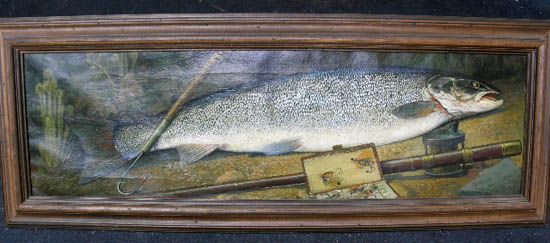
An Original Louis Rhead Painting

One of my all-time favorite writers was Louis John Rhead. Many people know Rhead from his books, and it's certainly not a revelation to many that he was also one of the notable painters of his day.

Below is a photo of an original painting sent in by Doug Bucha. Thanks, Doug! It's really beautiful. If anyone is interested in it, please contact Doug directly. He's in the NFLCC Directory.


-- Dr. Todd

Tuesday, July 17, 2012

Voices from the Past: B.F. Meek (1895)


The following article, dated 13 April 1895, was reprinted in The Frankfort Roundabout but was originally published the previous Sunday in The Louisville Courier Journal. It is the best description of the B.F. Meek reel history I've seen in a newspaper article. I don't recall if I have seen this article referenced before…

THE FISHING REEL

A Talk With the Veteran Maker, B. F. Meek.

NEVER SECURED A PATENT

Difficulties Under Which An Unexpected Order Was Filled

========

The Courier Journal of Sunday contained the following in regard to a former prominent citizen of Frankfort, which may prove of interest to many of his old friends here:

The fame of the Meek reel has spread to almost every part of the globe where the name of Old Isaak Walton himself is reverenced, and there is an interesting story connected with the first one that left the hands of Mr. B.F. Meek nearly sixty years ago.

"My brother and myself were then in the watch and jewelry business at Frankfort," says Mr. Meek. "One day Judge Brown, the father of John Mason Brown, came in to have a reel repaired. He was a great lover of angling, and a constant seeker after improvements in tackle. He was not satisfied with his reel, and so insisted upon our making one that we consented.

"For making the wheels a cutting engine was necessary, and there was only one cutting engine in Kentucky; it was at Danville, and had been brought over from England. My brother, J. F. Meek, who is now dead, went to Danville, cut the wheels, and we finished the reel with as much care as if it had been the finest piece of watch mechanism.

Judge Brown was delighted. He exhibited it to his friends, and requests became so persistent that we sent to Switzerland for tools, which could not be obtained in this country, and I devoted myself to reel making while my brother attended to the watch work. The greatest demand for reels then came from New Orleans, and a number of the orders were for England.

"Mr. B. C. Milam, who had worked in the jewelry trade, returned from Mexico about 1847, and learned the reel-making trade with me in Frankfort, where he is yet following this work. In 1852 my brother and I failed, sold out and he came to Louisville to work for Kendrick, the jeweler, while I went back to my old trade of watch-making until 1862, when I came here and resumed the making of reels. Owing to effects upon my nerves, it had become hard for me to handle the extremely delicate parts of a watch, but to this day I can make as good, yes, better, reel than I ever could. Before leaving Frankfort i was in partnership for a time with Mr. Milam, he making reels and I working on watches. Two of my sons, Sylvanus and Pitman C., have been working with me, but I fear that Pitman, who has been ill for months, will never be able to work again.

Mr. Meek was the first maker to jewel fishing reels. He uses carnelian because that is so hard to crush. Diamond, ruby, carnelian is the order he ranks stones as to resistance of crushing, but carnelian is his choice for reel work. Besides being a student of mechanical science and an expert workman, he has made the fishing reel a study in all of its parts and has designed improvements which many makers have eagerly adopted, for Mr. Meek never patented any one of his inventions, relying alone upon the excellence of his own manufacture. The care bestowed in their manufacture will appear when it is told that he and his three sons counted seven as the extreme number of fishing reels that they could complete in one month. The spiral gearing and provisions for retaining oil where most needed without permitting the oil to spread over and gum up the works are counted by Mr. Meek as his most important improvements.

For the spiral gearing he designed and had made, at a cost of $700, a complicated tool that is scarcely larger than a man's hat. By it the teeth of the wheels describe a section of a gentle curve and, furthermore, slant across the wheel so that when in use two teeth of the connecting wheels constantly have a bearing, one tooth on either edge of the wheel so that this continuing force exerts itself at all times on the very center of the rim of each wheel. The motion thus gained is as smooth as that of a leather belt over a pulley. For years, he says, he pondered and experimented before he hit upon an adjustment of all the parts so that the application of force and the smoothness of motion would be the same when making a cast as when reeling in the line. In the one case the pinion must lead the wheel, and in the other the wheel must lead the pinion.

After trying many metals Mr. Meek adopted German silver as the best for the body of the reel. At the request of the wealthy Mr. DePauw, of Indiana, he tried aluminum, but found that the steel screws would strip out the threads cut in the aluminum. Owing to its extremely light weight he thinks that this metal would be invaluable if a process could be discovered for hardening it.

Mr. Meek does not make exhibits of his reels at expositions and would never contract with firms to make exclusively for them. His prices, too, have been inflexible, the best terms offered being some years ago when he did about $7000 worth of work for a large Eastern house, giving a 10 percent discount of payment within days.

Many prominent names appear in the order book at Mr. Meek's workshop, 839 Seventh Street. One is for the reel which the Louisville Fishing Club presented to President Arthur and another is for the reel which Col. T.H. Sherley secured for President Cleveland. Among the local names will be found John E. Green, the Messrs. Dodd, George Avery, Judge R.H. Thompson, Dr. Preston Scott, John H. Weller, Col. Bennett H. Young, W.N. Haldeman, Dr. D.S. Reynolds, Dr. McMurtry, Arthur Peter, Jr., Rozel Weisinnger, G.M. Allison, C.F. Tatum, J.R.S. Brown, Emmett Logan, J.C. Burnett, B.F. Buckner, C.P. Atmore, and a host of others.

Mr. Meek is now in his seventy ninth year. He was born in Hoyle county, Ky., when it was called Mercer county, and delights to refer to himself as "a Salt river tiger." Strange to say he cares little for the angling sport, declaring that he did not have the patience to wait for bites, but until recent years he was an enthusiastic hunter and accounted a good shot in any company.


-- Dr. Todd

Monday, July 16, 2012

The News of the Week


Don't have time to read 50+ fishing and tackle collecting blogs and web sites? Well, let us do it for you! Follow all of the latest news, articles, and stories on our Whitefishpress Twitter account! Hint: You don't need to be a member...just bookmark the Twitter Feed Page or click on latest links to the right!

THE MONDAY 10: The Ten Fishing Stories of the Week You Need to Know

The Big Lead: The Chinese go to war against the piranha.

Reports on iCast are that it is booming, and Lew's is stealing the show.


Thieves in Tacoma steal $40,000 worth of fly tackle.


New tackle shop is opened by Cleveland radio DJ.

Massive game and tackle fair is cancelled in Britain with huge economic cost.


The World Series of Bass opens their door to all tournament anglers.


Shark steals woman's catch and causes her to swear a blue streak.


The Spirituality of Fly-Fishing.


Bamboo rod maker Pete Carboni strives for perfection.

Finishing with a Flourish: An old wooden boat brings back memories.

-- Dr. Todd

Sunday, July 15, 2012

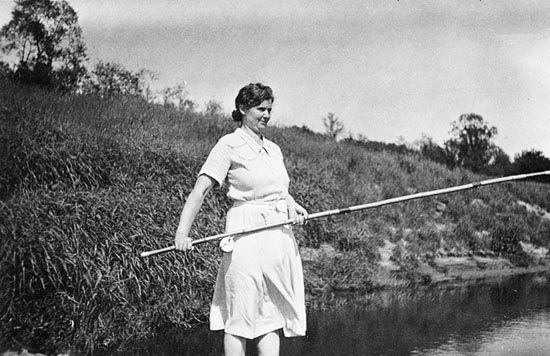
1000 Words

This 1930s photo of a woman salmon fishing is a favorite image of mine. There's just something about her look that means all business, and that the fish better beware.


-- Dr. Todd

Saturday, July 14, 2012

Deconstructing Old Ads: The Bon Net (1953)


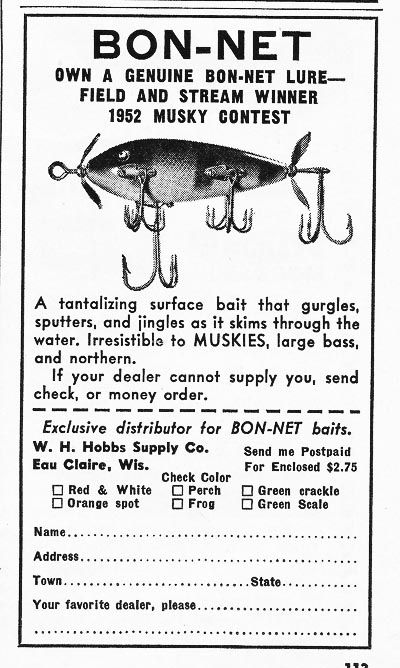
The BON-NET

The BON-NET lure, distributed by the W. H. Hobbs Supply Company of Eau Claire Wisconsin, is the subject of the following advertisement from the June 1953 issue of Field & Stream Magazine. This is not a lure that is seen much outside the State of Wisconsin and it is not often seen advertised in nationally distributed “Outdoor” magazines.

The BON-NET's resemblance to a 6-hook version of the Heddon #300 “Surfusser” is no accident. I learned many years ago that it was produced to satisfy the demands of Musky fishermen after Heddon discontinued the 6-hook “Surfusser”.


We learn from Dick Slade's Fishing Tackle of Wisconsin that only 12,000 of these baits were ever produced and that the Arnold Bait Company of Paw Paw, Michigan was contracted to produce it. As a regional bait, it is not surprising that not much advertising is seen in the “Big Three” magazines of the day (Field & Stream, Outdoor Life and Sports Afield). Being a popular Musky lure, it is even less surprising that few are found in good shape. Not only were they being used for the “fish of a thousand casts” but a Musky is pretty rough on any painted wooden lure and the Arnold Bait Company wasn't exactly known for their durable paint jobs. Another reason for the scarcity of BON-NET's might be the price tag. $2.75 was a lot to pay for a fishing lure in 1953 when the average wage in the united States was $4,700 a year!
 
Many States today have a limit on the number of hooks one can have on the end of the line. There is a current debate in several States as to the legality of the “Alabama” type rigs due to the number of hooks involved. It would be interesting to know in how many States the BON-NET, with its six treble hooks, would currently be legal to use.

As an aside, the cover painting on this June 1953 magazine was later used as the cover of the 1956 L. L. Bean Spring Catalog. It is currently being sold in a “re-interpreted” version with updated clothing and hair styles by L.L. Bean as a wall hanger. Needless to say I prefer the original. LOL


-- Bill Sonnett