Showing posts with label dixie carrol. Show all posts

Tuesday, March 3, 2015

Voices from the Past: Dixie Carrol on the Tuttle's Devil Bug


Over the next several months, I’m going to feature the fishing tackle writing of one of my all-time favorite writers, Dixie Carroll (Carroll Blaine Cook). These famed pieces of tackle were featured in his great book Fishing Tackle and Kits. They are fascinating write-ups of the tackle from a contemporary perspective. Below is Dixie’s write up on the Tuttle Devil Bug, one of fly fishing’s greatest inventions.\


TUTTLE'S DEVIL BUG - Made by O. C. Tuttle, Old Forge, N. Y. Along comes Tuttle with a little old bass bug that he has been hogging all to him self and a few friends for a few seasons and believe me it is a great little lure. It is made of hair in the natural colors, browns, grey and white, and what It looks like to the bass and trout I do not know but it looks more like a mouse than anything else or a large doodle bug whatever that is. The loose hairs on the back and the bunched tail have a lively move in the water and the game fish simply cannot let it get away from them. It is tied on a single hook and snelled with a good strong gut. For night-fishing it is a winner, it certainly gets the fish. Not only in casting is it good dope but in trolling it shines. Blow a little dry-fly oil on one of these Devil Bugs and let it float down around the boulder into the quiet spot behind and the rise you get will nearly throw you off your feet. I have one of these bugs that took 203 bass and 17 trout; the largest bass a 4 3/4 pounder and the largest speckled beauty an even two pounder. Made in a larger size this bug ought to interest the musky and I am going to have Tuttle tie one for try-out on that big ruffian of the underwater. The whites and greys in the smaller sizes make good trout lures, they have extended hair wings that give them the appearance of a white miller. These bugs are made strong and solid being wrapped with fine wire and will hold up for many a cast, in fact they are practically indestructible. A good lure, made right and of good material all the way through.


— Dr. Todd

Tuesday, February 17, 2015

Voices from the Past: Dixie Carroll on Hildebrandt (1919)


Over the next several months, I’m going to feature the fishing tackle writing of one of my all-time favorite writers, Dixie Carroll (Carroll Blaine Cook). These famed pieces of tackle were featured in his great book Fishing Tackle and Kits. They are fascinating write-ups of the tackle from a contemporary perspective. Below is Dixie’s write up on the Hildebrandt Spinner, an iconic lure if ever there was one.\


HILDEBRANDT SPINNERS
- Made by the John J. Hildebrandt Co., Logansport, Ind. As soon as a fellow talks of spinners in the fishing game, he just naturally thinks of Hildebrandt. These spinners of the famous Slim Eli, Standard and Idaho shapes have a name for spinning and sending a flashing invitation to the game fins that is irresistible to these husky tailkickers. I have used many of these spinners, both the singles and tandems and they have always merrily spun through the water, free and easy which is just what they are intended to do. A number of years ago I had the pleasure of meeting the originator of this line of spinning lures, John J. Hildebrandt, now passed to the Great Master of all waters. He was a keen angler, a true sportsman and a fine gentleman and his work on devising light- weight spinners for fly-fishing for bass as well u bait-casting for these bronze-backed warriors has been of great value to the fishing clan. These spinners are hand made and made right, just as good now and with as much care as when "Old John" Hildebrandt used to turn them out himself. The reversible hinge allows the spoon to reverse when playing a fish so that there will be no interference from weeds and rushes in retarding the playing of the fish. The Slim Eli style spinners spin very close to the shaft, the Standard style spins medium close and Idaho spins wide. I find the Standard shape best for ordinary fishing, the Idaho for roily waters and the Slim Eli for clear and fine waters. The tandem standard 3 size spinners is a great bass casting-bait and for the very bright day the black Slim Eli #3 1/2 is a crackerjack. Taken right through the deck, the entire line of Hildebrandt spinners are right in material and workmanship as well as being great game fish attractors.


— Dr. Todd

Tuesday, February 10, 2015

Voices from the Past: Dixie Carroll on Lowe Spoons (1919)


Over the next several months, I’m going to feature the fishing tackle writing of one of my all-time favorite writers, Dixie Carroll (Carroll Blaine Cook). These famed pieces of tackle were featured in his great book Fishing Tackle and Kits. They are fascinating write-ups of the tackle from a contemporary perspective. Below is Dixie’s write up on the Pflueger Lowe Star Spoon, one of the iconic metal baits.\


LOWE-STAR SPOON.- Made by the Enterprise Manufacturing Company, Akron, Ohio. This spoon is so swell looking that, honestly, fellows, you hate to throw it into the water, but, say, when those gold and silver sides start ·flashing down in the watery recesses it takes a mighty tame game fish to lie still and let it go revolving past without said game fish taking a walloping crack at it. And, believe me, the way the musky go for that shining- spoon makes your teeth rattle to think of it. I have one Lowe-Star Spoon, a No. 1-o, that is completely bent double from the hammering crack of a big old musky; he sure must have been most highly in- terested in that little old spoon to smash it like that. This spoon was a silver and gold on one side, and red enameled concave side with a feathered trebled hook trailing along behind, partly red and white feathers with a dash of peacock. It just made the pike and musky stand right up on their toes to get a chance at it, and this size and style is worth a place in any tackle-box. For bass-casting the silver and gold spoon of smaller size made an attractive lure used with minnows and pork-rind. These spoons are made strong and of good material, and they stand the rough work of trolling in snaggy and weedy waters. For the pike family- the musky, pike, and pickerel- they stand right out like a house afire and they get the fish.


— Dr. Todd

Wednesday, January 21, 2015

Voices from the Past: Hildebrandt's Night Bugs (1919)


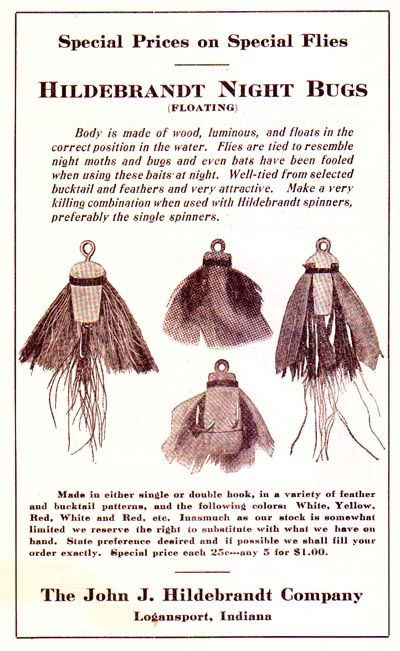
HILDEBRANDT NIGHT BUG AND BUCKTAIL SHINER.- Made by the John J . Hildebrandt Co., Logansport, Ind. These two new lures of the Hildebrandts are right in line with the new era in the fly game. The Night-Bug is tied to resemble a night moth and the yellow, brown and white combination with the luminous body makes a cracking good lure for night fly-fishing. This is a floating fly and used with a small aluminum spinner it makes a strong play for the bass at night and that is the time to get the big ones. The fly is well tied and has twin hooks working out of the under side of the body. The Bucktail Shiner is light enough for the fly-rod and still large enough to be attractive, and the move of the bucktail hair in the water makes a rather enticing lure for game fish. More and more the hair fly will be used and this bucktail minnow tied on a No. 1-0 sneck hook is a pleasing departure from the usual run of flies. This fly is a good lure for a dark day especially and I have found it successful for both bass and trout. Both these lures are well made and tied with the usual skill of the Hildebrandts and for the angler who delights in trying the 'new stuff, and wants to try it with the idea that it will help him land the big ones, these two flies can be recommended as good dope and worthy of the try on the next fishing trip.


Night Bug ad from 1920 courtesy Jim Jordan.


-- Dr. Todd

Tuesday, January 13, 2015

Voices from the Past: Dixie Carroll on the Shannon Twin Spinner


Over the next several months, I’m going to feature the fishing tackle writing of one of my all-time favorite writers, Dixie Carroll (Carroll Blaine Cook). These famed pieces of tackle were featured in his great book Fishing Tackle and Kits. They are fascinating write-ups of the tackle from a contemporary perspective. Below is Dixie’s write up on the Jamison Fly Rod Wiggler, one of the earliest true fly rod lures.

SHANNON TWIN SPINNER.- Made by the W. J. Jamison Co., 736 South California Avenue, Chicago, Ill. I take off my hat to the Shannon Twin Spinner, it is certainly a winner. On sight, the experienced fisherman will at once see its practicability and get it for his tackle box. The spoons are small and are attached onto swivels at the ends of piano wires which bend up from the eye of the hook, and the big winning point for the bait is that the spoons do their flashing spinning right above the point of the hook. Often a bass will strike at the spoons and on many lures the distance of the spoon from the hook makes it possible for many of the fish to be lost through not hooking them. Not so with the Shannon, the game fish that strikes the spoon strikes the hooks at the same time. This spinner comes either with a red fly or plain with a weight for keeping the bait right side up. The idea of putting the spoons above the hook was doped up by Jesse P. Shannon, a fisherman than whom there is no better, and a thoroughly practical fellow. I found this spinner entirely weedless, the wires upon which the spoons are swiveled and the whirling spoons them- selves acting as weed-guards, and the bait comes out of the thickest weeds without a trailing bunch of bait-hiding weeds. The bait without the fly makes a fine lure used with the frog, pork-rind or minnow and is just right for casting, while the weighted fly makes a small-mouth bait that gets the fish. I find that the spoons spin very well when the bait is reeled in slowly and also in trolling, they still wiggle around and shoot their flashes even at the slow speed of that style of fishing. Taking the bait all around, it is certainly right in every way, material, workmanship and the big point remains that it is a fish t~ getter and I feel sure the fellow who uses it will never be without it.


— Dr. Todd

Thursday, January 8, 2015

Voices from the Past: Dixie Carroll on Wilson Wobblers


Over the next several months, I’m going to feature the fishing tackle writing of one of my all-time favorite writers, Dixie Carroll (Carroll Blaine Cook). These famed pieces of tackle were featured in his great book Fishing Tackle and Kits. They are fascinating write-ups of the tackle from a contemporary perspective. Below is Dixie’s write up on the Jamison Fly Rod Wiggler, one of the earliest true fly rod lures.

Wilson Wobblers And Getsem Bait.— Made by the Hastings Sporting Goods Works, Hastings, Mich. The whole family of Wilson Wobblers are good baits but the one that stands out way ahead of the rest is the old reliable fluted wobbler. This little old bait has a record as a fish getter that will make the rest of the family wiggle some to beat it. It has the most natural travel through the water possible to obtain by whittling a chunk of red cedar and it darts in through the water in a smooth swing that resembles the live bait to a fare-you-well. I know of many old musky, husky to the weight of from 25 to 35 pounds, that have answered to the last call at the inviting wiggle of the white Wilson wobbler with red flutes. And bass, say old-timer, it makes 'em crazy to get at it. The cupped Wilson wobbler is a good surface bait for the shallows, it travels on the top and has a bit of an erratic crawl that attracts attention, while the winged wobbler dives to a depth of about four feet and is especially good for the warmer weather when the fish are down deep looking for a little cool spot. The Six-in-one wobbler has an adjustable visor that can be moved to regulate the diving depth and make the wobbler do anything from a surface crawl to as deep as a six foot underwater swim and the motion it takes is attractive to the game fins. Of the whole outfit, however, I personally stack my chips on the white, red fluted wobbler, I am never without it on the fishing waters. The Getsem bait is a weedless plug in imitation of a chunk of pork and it can be cast right into the middle of a bunch of weeds or lily pads and come out without bringing the weed bed with it. It is a weedless bait. It should be reeled slowly and make the strike quickly when the fish strikes and don't be afraid to give it a strong strike as the arrangement of the hooks to keep the bait weedless make this necessary. For the weedy places where the big ones hang out, the Getsem is a livewire winner. The whole Wilson family of Wobblers and the Getsem are A-1 in material and workmanship and they are good lures.


Wilson Six-in-One Wobbler.


Wilson Wobbler.


Wilson Getsem.


— Dr. Todd

Tuesday, December 30, 2014

Voices from the Past: Heddon's Baby Crab Wiggler (1920)


Over the next several months, I’m going to feature the fishing tackle writing of one of my all-time favorite writers, Dixie Carroll (Carroll Blaine Cook). These famed pieces of tackle were featured in his great book Fishing Tackle and Kits. They are fascinating write-ups of the tackle from a contemporary perspective. Below is Dixie’s write up on the Jamison Fly Rod Wiggler, one of the earliest true fly rod lures.

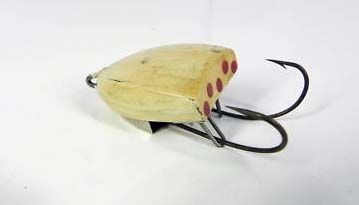
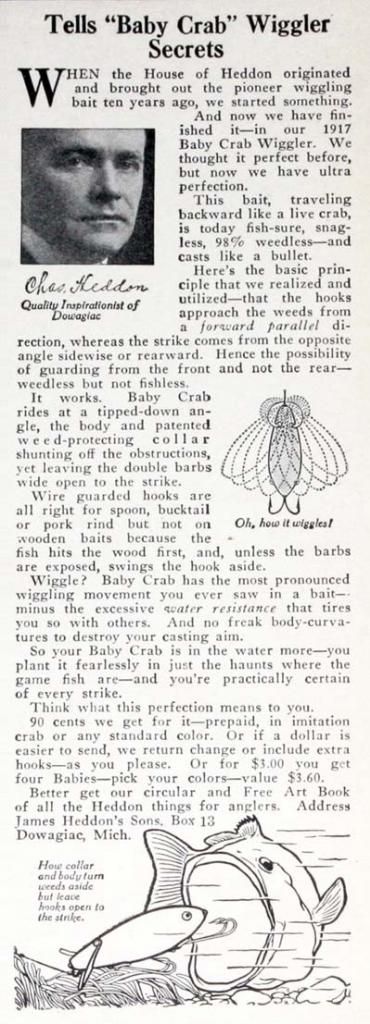
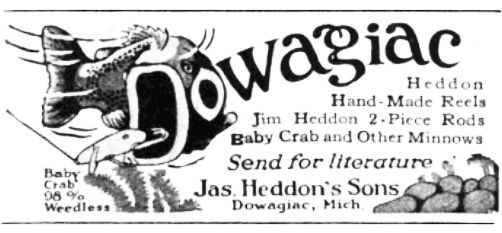
BABY CRAB WIGGLER.- Made by James Heddon's Sons, Dowagiac, Mich. When Heddons thought of imitating the little old crab, that succulent food of the enterprising bass and other game fish, they sure hit the bull-eye right plumb in the center. For a something different bait in the artificial line with a wiggle, dive and crawl of the crab tied up in its make-up the crab wiggler has been making the game fish strike in that swirling curve that almost takes the hair off the head as the game rascals drive into it. I have had very fine luck with the crab wiggler finished in the natural crab color, especially for bass and big wall-eye pike and the smaller baby crab wiggler is a wonderfully good lure for stream bait-casting for small-mouth bass. It is a floater and sure has a great wiggling crawl in the water. I had the best results by working the crab wiggler through a series of short jerks of the rod, that is by giving the tip of the rod a slight jerk, then making a couple turns on the reel handle followed by another slight jerking movement and so on until finally reeled in. About the second jerk, which gives the crab wiggler a sort of backward, darting crawl like the real crab, some old " he-bass" generally gave it a crack and the fun was on. Like all of the famous line of Heddon's Dowagiac baits, the crab wiggler is made right both in material and workmanship. The enamel finish of the bait is excellent and it stands up under mighty rough usage without cracking or chipping. The new scale finish, underlaid with red and with a golden tint to the side scales is a rattling attractive lure any time, while the white finish I have found particularly good for night and moonlight-fishing as well as on a cloudy or dark day. The natural finish crab color makes a 100% winner for fall casting when the crabs have become a bit scarce, although this finish I have found good all through the season. The crab wiggler is a worthwhile artificial in any kit.


Classic Green Crackleback baby crab wiggler.


Baby crab wiggler in downward leaping bass box with papers.


1917 ad for baby crab wiggler.


— Dr. Todd

Tuesday, December 16, 2014

Voices from the Past: Dixie Carroll (1919)


Over the next several months, I’m going to feature the fishing tackle writing of one of my all-time favorite writers, Dixie Carroll (Carroll Blaine Cook). These famed pieces of tackle were featured in his great book Fishing Tackle and Kits. They are fascinating write-ups of the tackle from a contemporary perspective. Below is Dixie’s write up on the Jamison Fly Rod Wiggler, one of the earliest true fly rod lures.

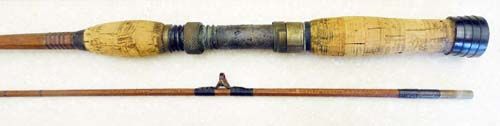
HEDDON's DOWAGIAC CASTING RODS.- Made by James Heddon's Sons, Dowagiac, Mich. The Heddon's split-bamboo bait-casting rod is a mighty fine one and made right all the way through and at the same time you can get it in price from four dollars up to twenty-five and a good rod that does not stagger your bank roll. Even from the lowest priced ones up you get a good rod and the topnotcher is a winner. I have used these rods from the old one piecer up to the No. 15 and they all work well. The bamboo is selected, the ferrules of German sil- ver, shouldered, hand welt and satin finish while the guides are agate and hardened steel. The construction of these rods is on the one-piece demountable style and that gives you a long tip and short butt; this style allows free whip to the tip giving the bam- boo a chance to bend with all its natural resiliency, throwing the bait with practically no strain on the wrist or arm. They are full of action, yet strong and sturdy and a tool that you can handle with pride on any lake or stream. They look and act the part of a thorobred. The fact that the ferrule is set well below the center of the rod, down towards the butt eliminates the chance of breakage at the ferrule as the bend of the rod centers well above the ferrule. Care in selection of bamboo, thoroughly seasoned, and then care and skill in manufacture as well as the Heddon name behind the rod as a guarantee for workmanship and material means that the Heddon rods are right in every way.


1910 Heddon rod ad.


A Heddon baitcasting rod ca. 1920.


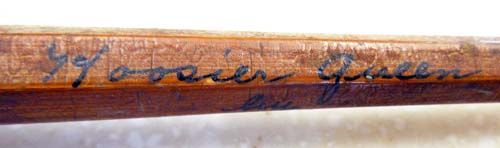
The “Hoosier Queen" by Heddon.


A 1921 Heddon rod ad.


— Dr. Todd

Tuesday, December 9, 2014

Voices from the Past: Dixie Carroll on the Jamison Fly Rod Wiggler


Over the next several months, I’m going to feature the fishing tackle writing of one of my all-time favorite writers, Dixie Carroll (Carroll Blaine Cook). These famed pieces of tackle were featured in his great book Fishing Tackle and Kits. They are fascinating write-ups of the tackle from a contemporary perspective. Below is Dixie’s write up on the Jamison Fly Rod Wiggler, one of the earliest true fly rod lures.

Fly Rod Wiggler.— Made by the W. J. Jamison Co. 736 So. California Ave., Chicago, 111. Along comes Jamison with the very, very latest, the Fly Rod Wiggler, a nice little minnow shaped wooden bait that looks so nice that you feel like wearing it for a watch charm. A little fellow 13/4 to 2 1/8 inches long that don't even press down a pair of postage scales enough to hardly pull the indicator down below the starting line. And say the way the two advance models of this bait made the small-mouth bass fighting mad to get to them last Fall was a caution; large trout are also very partial to it. With a fly rod just a bit stiffer than the very light trout rods say a five to six or seven ounce rod, they cast free and easy with just a trifle more pull than a fly, in fact they cast and lift easier than a large bass fly or a small spinner. They come in varied colors and are fitted with one double hook. When you use it in the weeds, turn the hook points up and let 'em stay down when casting clean water. It wiggles along twelve to fifteen inches below the surface but it is a floater and can be used for surface fishing by retrieving it slower. Now that bass and pickerel fishing with the fly rod is developing more and more each season, this lure should be a mighty popular bait as it is undoubtedly an interest creator among the bass and picks. It looks and acts like a minnow and with a small weight ahead of it works fine on the ordinary bait-casting rod. Also great for deep trolling for wall-eyed pike, land locked salmon, etc. It is made just as strong and perfect as any of the rest of Jamison's goods and more you could not say for a lure.


Courtesy of Lang’s Auctions.


Ad from the May 1921 Forest & Stream


— Dr. Todd

Tuesday, December 2, 2014

Voices from the Past: Dixie Carroll on the Pflueger Redifor Baitcaster (1919)


Starting this week and continuing for the next several months, I’m going to feature the fishing tackle writing of one of my all-time favorite writers, Dixie Carroll (Carroll Blaine Cook). These famed pieces of tackle were featured in his great book Fishing Tackle and Kits. They are fascinating write-ups of the tackle from a contemporary perspective. Below is Dixie’s write up on the Pflueger Redifor baitcaster, a reel so nice it was made by two companies.

PFLUEGER-REDIFOR ANTI-BACKLASH REEL


Pflueger-redifor Anti-backlash Reel.— Made by the Enterprise Mfg. Co. Akron, Ohio. Well, fellows, you lads who have a hankering to get into that great little old sport of tossing the plug, spinner and pork-rind, minnow or frog to the big chief of the weed beds, via the short casting rod and haven't the time to learn the art of thumbing the line, Cheer up 1 You can do it with the PfluegerRedifor A-B-L. reel and in a half an hour or so. Of course, it takes a little more time than that to get accuracy and distance, but you can make a mighty big start without any trouble in a half an hour anyway. Just f'rinstance. Two seasons ago I took a youngster up north to learn the game, gave him my Pflueger-Redifor A-B-L., told him about it and in an hour he had three bass, by evening he was quite good at casting and two days later after fishing all day with him, my old guide thought he had been casting for two or three years. It does the work. It makes backlashes a darned hard thing to produce with it and it is a boon to the fellow who wishes to learn, but figures that he hasn't got the time to dope out the thumbing control and the mystery of backlashes. It is a wonder worker, automatic in action without anything to get out of order, all you have to do is cast. The anti-back-lash end is controlled by centrifugal thumbers on the left flange of the spool. The generated spiral toothed gears with which this reel is fitted run longer and smoother than the ordinary spur toothed gear. The hardened steel pinions run in phosphor bronze bushed bearings and ride on agate jeweled cups. End play in the spool is controlled by adjustable tension oil cups and the reel is fitted with a click and drag. The dull satin finish of the German silver is a winner and the low spool, long barrel design is ideal. It is a thoroughbred. The cast is not retarded by the thumbers, they do not act on the end plate until the lure slows up the pull on the line and that is when you want them to work. For night-fishing it is a dandy tool. It certainly is death on backlashes. Material and workmanship are of the best right through the entire reel and it is a fine high class tool at a moderate price.


Early Pflueger Redifors had the 1914 patent date.


— Dr. Todd

Tuesday, November 25, 2014

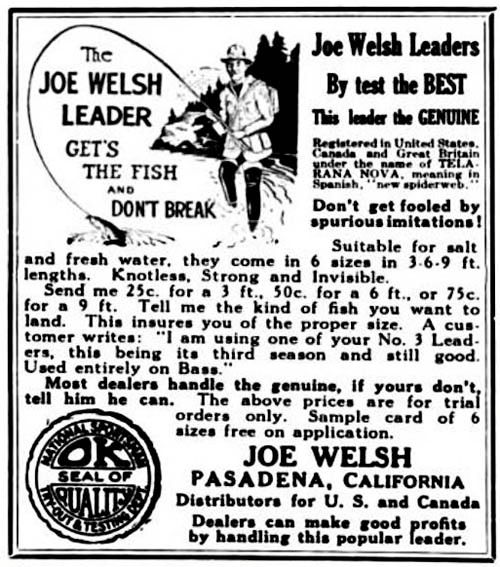
Voices from the Past: Dixie Carroll on the Joe Welsh Telaranova Leader (1919)


Starting this week and continuing for the next several months, I’m going to feature the fishing tackle writing of one of my all-time favorite writers, Dixie Carroll (Carroll Blaine Cook). These famed pieces of tackle were featured in his great book Fishing Tackle and Kits. They are fascinating write-ups of the tackle from a contemporary perspective. Below is Dixie’s write up on the Joe Welsh "Telarana Nova" leaders. Telarana Nova is Spanish for "new spiderweb," as these were made from Spanish silk gut. As seen in the picture below, the name was retained in the post-war era with Nylon leaders.

TELARANA NOVA LEADERS

Telarana Nova Leaders.— Imported by Joe Welsh, Pasadena, Calif. The Joe Welsh Telarana Nova Leaders are wonders in the leader line. They are made of one length, without a splice or knot in it, and any fisherman knows the value of this feature alone in a leader. They are quality goods and wear till the cows come home; they carry more strength in their make-up than one would expect in a leader and you never have to worry about leader troubles when using them. Besides the strength and durability of these leaders, they have a color that blends in with the water and are practically invisible; they throw no reflections whatever and seem to blend in with the water in such a way that they cannot be seen at all. I have one of these leaders that has been used two years and it has not shown up any weakness, fraying or bad spots; it should be good for another season or the openers anyway. They come in sizes for most any kind of fresh and salt water fishing and can be had up to nine feet in length without a knot. When you figure that you can use a Telarana Nova Leader all season you gotta admit that it is some leader. Without a doubt this leader is the greatest development in the leader line since old Daddy Walton was in the game. When the water is crystal clear and the light brilliant and you have tried the ordinary gut leaders, throwing their reflection like a bright streak in the water, just tie on a Telarana Nova Leader and note the results in the creel. For their strength, the fact that they are knotless and that they are practically invisible in the water these leaders are recommended as being right and they should be carried by every fly-fisherman.


Joe Welsh Telarana Nova leader.


Later nylon Welsh Telarana Nova leaders.


1921 American Angler ad for Telarana Nova leaders. Note the National Sportsman seal used by tackle articles approved by Dixie Carroll.


Joe Welsh photo ad from 1918.


-- Dr. Todd

Tuesday, November 18, 2014

Voices from the Past: Dixie Carroll on the Pflueger Supreme (1919)


Starting this week and continuing for the next several months, I’m going to feature the fishing tackle writing of one of my all-time favorite writers, Dixie Carroll (Carroll Blaine Cook). These famed pieces of tackle were featured in his great book Fishing Tackle and Kits. They are fascinating write-ups of the tackle from a contemporary perspective. Below is Dixie’s pre-amble followed by the first installment on the Douglass Patent Pflueger Supreme.

THE FOLLOWING ARTICLES HAVE BEEN TESTED AND TRIED-OUT UNDER RIGID CONDITIONS AND THEY CARRY MY UNQUALIFIED APPROVAL

During the past few years as editor of the National Sportsman Magazine, fishing editor of the old Chicago Herald, the Chicago Daily News, and author of a series of articles on fishing, hunting and the outdoors for over fifty of the leading daily newspapers of the country I have had thousands of requests from sportsmen asking for my opinion on this or that in the tackle line, or what I thought of this particular piece of kit, or would you carry this line of food in your dufile bag on a two-weeks' canoe trip. Although having fished from the bent-pin stage up to now and toted a rifle or shotgun from as far back as I can remember, there were many lines of goods that I had not used, therefore was not familiar with them and could not give an honest opinion on their value in the woods or along the waters.

To be both square with my readers and fair to the maker of a particular piece of kit about which query had been made and with which I had no experience or knowledge as to its material, workmanship or adaptability for the outer's use, I instituted in the National Sportsman a Tryout and Testing Department, giving the maker of any piece of outdoors outfit the privilege of submitting his goods, same to be put through whatever paces I wished to give it during the work-out, my report to be published, and from which I could base a definite and worth-while reply to a reader.

During the past year and a half I have tried out and tested 364 pieces of kit; of these I have favorably passed on and reported 168 as being in my judgment high class in material and first class in workmanship, and worthy of a place in any sportsman's outfit. On others I have reported either conditions that could be corrected, or that certain stuff was not of a grade or value enough to receive a favorable report.

Following is a selection of reports that have been made on goods that have been submitted by the maker, without any strings tied to them, and upon which I have passed as being right and of value to a sportsman who prides himself on having a kit that he can show to a pal and feel that it will stand the gaff in camp, on the trail or waters. These goods were all given a thorough workout under far more rigid conditions than they could ever receive with ordinary usage, some of the tests extending over a period of six months to a year before being completed, and it is a pleasure to me to place my unqualified endorsement upon them. The trying out of these different pieces of kit, under varying conditions, has been one of the most interesting and instructive things that I have ever handled, and if the outer derives any value from the many hours devoted to the work I will feel that the effort has been rightly placed and that the work has accomplished even more than the good that was originally intended.

PFLUEGER-SUPREME CASTING REEL


The Douglass Patent Pflueger Supreme Casting Reel


Pflueger-Supreme Casting Reel. — Made by the Enterprise Mfg. Co., Akron, Ohio. For a reel that minimizes backlashes to zero and makes a clever caster out of an amateur in a day's casting, the Pflueger-Supreme reel which is combination levelwinder, anti-backlash, freespooler, certainly is a tool that takes all the work out of casting and adds pleasure to the sport. No more cussin' from tangled lines nor tired fingers from guiding the line evenly on the spool. The level-winding part of the reel remains stationary when casting, thus avoiding the frictional wear on the line and on the level winding part of the reel. As you start reeling in, the line is picked up by the carrier and laid on the spool as evenly as the thread on a new spool. The level winder is encased, which makes it dirt, sand and water proof and the carrier only works while the line is being reeled in. The gears which are generated spiral toothed are always in mesh which makes it impossible to strip them, the clutch taking hold automatically when the line is reeled in. The automatic thumbers set on the inside of the end plate make the reel anti-backlash; as the tension of the bait diminishes, these thumbers slow down the spool and as the bait drops on the water the spool stops. A mighty handy part of the reel is the adjusting screw with a dial regulator on the end plate by which the tension of the thumbers can be regulated to the weight of the lure. A complete twist of this dial and the reel is a free-spool, level-winder for the fellow who wishes to thumb the reel without the help of the automatic thumbers. The reel is finished in the dull satin silver which throws no flashing signals to the waiting fish. It is built right and of fine material and will last a fisherman a lifetime. For night-fishing, when the big ones are out, it is a wonder worker. The Pflueger-Supreme reel carries the usual guarantee of the Enterprise Mfg. Co. as to quality and service.

-- Dr. Todd

Tuesday, January 8, 2013

Voices from the Past: Night Casting Tackle by Dixie Carroll (1918)


Wild Bill Sonnett and myself share a lot of things in common. Among other things, we both like fishing vintage gear, we like to fish that gear topwater, and we like Dixie Carroll, the great outdoor writer. So when I ran across this column from the La Cross Tribune and Leader-Press dated June 02, 1918, Wild Bill was the first person I thought of. Dixie's article is entitled "Night Casting Tackle" and he relates a story of how a bass leaped out of the water to hit a lure dangling from a tree. I have a similar story; one night several years back I was casting over a brush pile from my dock in Northern Wisconsin on a nearly full moon night. I decided to take a break and laid the rod in the back of the boat tethered to the dock, with the jitterbug dangling a foot above the water. Imagine my surprise when less than a minute after doing so, a twelve inch bass leaped out of the water and hooked itself on the back treble of the hanging lure!

Night Casting Tackle

by Dixie Carroll

There are two kinds of night-casting, either of which are sure-fire winners. Moonlight night and the simon-pure black night, both good fishing-time with a winning kick to the inky black affair as the real thrill producer. For moonlight-casting you can let your canoe slide along the outer edges of most any bay or cove and cast into the shore and cover considerable water, but for the black night, with just the stars burning out here and there, you must select your fishing waters during the day and study them well, because your casting is going to be a bit of judgment in your part without any helpers along the side lines to give you distance and locations.
For night-casting a great deal depends upon the tackle, and it would be simply playing tag with fate to use a nifty bamboo for the sport: at times you must give the butt and do a bit of pumping, and who wants to subject a pet split-bamboo to such rough usage? Make the rod a steel one that has plenty of backbone and stiffness. Long casts are not at all necessary, and a good stiff steel rod will tickle a fighting bass behind the gills with more success than any other kind, and do the job without suffering any during the operation. Should you by any species of luck hook a pike, or, great guns!—a musky, there is quite a bit of satisfaction out there in the black darkness to have your paws wrapped around a good stiff old steel rod, and get the lay right, old-timer, you'll need all the help a good strong rod can give you to bring a life-sized roughneck to gaff when you cannot tell whether he's coming to you or making a drive for the far end of the lake.

In the matter of reels it is a choice between the anti-back-lash or the level winders, unless, of course, you feel like doing a bit of knitting and cussing in the great old handicap of backlashes. Between the self-thumbing reel and the level-winder there is not much choice, as they both are the real stuff for the night game. The ideal reel, however, for night-casting is the tool that combines both of these features, and two reels in this class that stand out like "four of a kind" are the Beetzel and the Pflueger Supreme. Either of these reels makes night-casting a pleasant occupation. The South Bend Anti-back-lash and the Pflueger Redifor Anti-back-lash are good workers in the self-thumbing line and the Shakespeare levelwinder is an excellent tool for night use.

The fifteen-pound test line is plenty strong enough and the soft-braided No. 6 silk casting-line used for general casting is about right, although a line testing at twenty to twenty-five pounds is not amiss if you are fishing in waters inhabited by the big fellows. And just chalk this up on the scoreboard, the big fellows are great night feeders. This is especially so in the warm summer nights, at which time some of the largest fish are brought to gaff.

As to the plugs for this end of the game, your selection should be entirely of the surface and semi-surface variety, as the underwater lures are taboo, they have too much of an inclination to slip down to the bottom and lovingly cling to any old thing they can hook onto. And then, again, why use an under-water plug when the fish are all flopping around on the surface? For the real dark nights, the all-white lures are the best, and particularly those coated with the luminous enamel which glows like the dampened head of an old-style parlor match. Let a couple of these luminous plugs lie out in the sunlight for a short time, or expose them to the glow of your camp light before paddling out to your fishing-waters, and the plow they shoot off in the darkness will make any bass curious enough to give them a wallop. Not only do they help the bass to become interested but you can see them yourself at considerable distance and keep in touch with your lure as it wobbles in through the black.

That these luminous plugs are the real stuff was shown to me quite vividly last season when on a little night-casting jaunt, I threw a walloping cast over towards a fairly loud splash and succeeded in twining my line around the limb of a windfall that stuck up out of the water, the plug dancing in the air about six inches from the surface of the water. This wiggling plug was too much for an overzealous bass; it sort of got his scales all ruffled up, and he up and strikes that plug in the air, succeeding in hooking himself. He sure cut up a bunch of tricks, half in the water and the rest up in the air. He kicked up such a rough-house that another bass joined him in the fight for the shining plug. I find, also, in the plug line, that the surface bait which kicks up a little riffle as it reels in makes an added attraction, although most of the strikes are made by the fish as the plug hits the water, or vary soon after the splash.

In fact, a good-sized splash when the lure strikes the water helps show 'em the way, and how easy it is to locate the bait. A mighty good plan is to either use all weedless hooks on your plugs or to substitute the trebled books with the twin hooks which ride points up. In this way you will avoid a lot of trouble, especially if the waters you fish are weedy or full of snags. Of course you may not hook all your fish, but you will not haul in a mess of weeds every shot, and who ever had a fish strike a lure when it was burled in a litter of straggling weeds?

-- Dr. Todd

Tuesday, April 26, 2011

Voices from the Past: Dixie Carroll (1919)


We've had occasion to feature one of my favorite outdoor writers, Carroll Blaine Cook (a.k.a. Dixie Carroll) numerous times on the blog. Today, we take a piece from his syndicated columns that made it into his book Fishing, Tackle and Kits (1919). It features an entertaining and interesting short history of the casting spoon, and is well worth knowing.

HAIL TO THE SPOON
Dixie Carroll

Way back when you and I and most of the gang were kicking around in knee panties and just breaking out of the kilts, our dads who answered to the rollicking call of the lakes and streams were teasing the game fins into striking with the spoon. And many a big fish has answered to the tantalizing flash of the spoon as it glided, darted or revolved on its way through the water.

Most of the spoons of the early days were of the wobbling, darting class; this was just a bit before the advent of the more modern idea of spooning, the revolving type which is so popular today and justly so because these twirling beauties certainly attract fish. However, the old-time darters were standbys in their day, and many game-fish have made their last strike at them. The Old Lobb, shaped a trifle longer than the bowl of an ordinary teaspoon; the Onondaga, a slim-shaped spoon that darted and revolved at will or as the speed of its movement was increased in the water; and the Oneida, a fat-shaped spoon that had an erratic dart which followed no set route or schedule — all were pets and fish-getters.

Many of the old-timers still swear by these old patterns, but a glance in their tackle-box will generally show up a couple of the modern beauties either fluted, hammered, or plain. The old wobbling, darting spoons have a place in any tackle-box and are great little flashers of light as they dart from side to side. This makes them very attractive to the curious fish, especially the pike, pickerel and musky, as they lie in wait for the passing small fish upon which they gorge their tummies. The larger fish are particularly subject to the fascinating glide of the spoon and strike it with a wallop that often bends it double.

One of the earliest spoons of the darting type was the Buel spoon, following closely the shape of the bowl of the teaspoon, in fact it is claimed that young Buel, while washing his dishes at camp one day, accidentally let a silver teaspoon drop into the water, and as it glided down towards the bottom an overzealous lake trout, that could not resist the scintillating flashes of light reflected from the spoon, made a dart as it and cracked his teeth in the effort. Being of an inventive turn of mind, the youngster filed the handle off the spoon, drilled a hole in one end, to which he attached his line, and in the other end he drilled another hole and eyed in a long-shanked hook. This simple arrangement caught many fish, and for years was the model from which other spoons of the early days were patterned.

A little later, out in the West, an old-time fisherman of Delevan lake, puttering around his cabin, doped up the Delevan spoon by hammering a halfdollar piece into a concave shape with a sort of nicked tail at one end and an eyed ring on the other side. This old sport of the southern Wisconsin lake region eyed on two long-shanked hooks and, as minnows and shiners were the accepted bait for bass at that time, he hooked a minnow on each of the hooks. Trolling out into the lake to go to his usual fishing-grounds, he was kept busy hauling in the bass and putting on new bait. The fishing with the new spoon was so good that he did not find it necessary to keep on going until he hit his old spots, and when he flashed his string on the unsuspecting public and then flashed the new lure on the fishing fans he had to cut out fishing himself and hammer out these new spoons for the boys of other days. This was the beginning of the famous old Delevan spoon that has a wonderful string of fish to its credit.

A few years later, over on the fine old St. Lawrence river, G. M. Skinner put a real up-kick into the spoon game when he decided that the spoon which revolved regularly in one direction was what the big fins were really looking for. And to give the spoon this steady revolving movement, G. M. slipped a few flutes on an oval-shaped brass spoon and on the first tryout he hooked up with a walloping big musky that snapped his teeth shut with such force on the strike that Skinner knew he had made a ten-strike with the new lure and that he had something that would make the real old grand-daddy of the tribe sit up on his tail and take notice. The flutes not only added to the movement of the spoon, but also broke up the flash of light from its surface so that it shot through the water in a dozen different shafts, penetrating the watery recesses in a coaxing way that could not be resisted.

Up to this time most of the spoons were of large size, when along comes John Hildebrandt, one of the best-known old-time fly-casters of Indiana, with an idea that something ought to be done for the flyfisherman, to add a bit of attractiveness to the fly which a lot of bass were passing up, probably because they were nearsighted and could not see it. Anyway, " Big John," as he was lovingly termed by his angling pals, came through with an idea that helped make the spoon the attractive bait it is. He reduced the size of the spoon greatly, in fact his first spoon was made from a hammered dime and a bent hairpin. One trial with this little spoon and Big John found that the whirling spoon gave an added bit of motion to the fly and also the flash of light seemed to be just what the big fellows were waiting for. The boys of the present day can thank John Hildebrandt for pulling down the size of the spoon which added it to the casting end of the game, where it is just as effective as it ever has been in the trolling end.

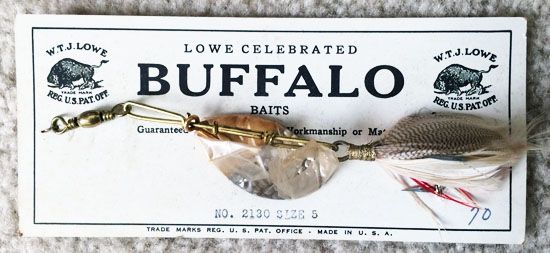
It took the late W. T. J. Lowe of Buffalo to fancy up the spoon in gold and silver, and the famous Star and Buffalo spoons finished in these metals in beaded or plain styles have made a place in spoon line that is second to none. While on a trip for musky a few years ago I had a very accommodating guide whom I wished to remember for his many kindnesses during the trip, so I sent him a couple of the Lowe Star spoons as a little friendly token. Two seasons later, while in the same locality, I met this old guide of former years and was surprised to find him wearing one of the Lowe spoons as a watch charm. He just couldn't toss that gold and silver beauty into the water for ordinary fishing, it looked so darned fine, he said, that he was going to make a musky hop clean out of the water to take it off his watch chain if it came to a showdown.

An interesting bit of information regarding the early use of the spoon hook and artificial bait to coax the finny tribe out of the deep was brought to my attention some time ago by Harry R. Phillips, a well-known and popular angler. It is in regard to a quotation from a book, "A Voyage to the Pacific Ocean for Making Discoveries in the Northern Hemisphere," written by Capt. James Cook and Capt. James King about the voyages of Captain Cook from 1776 to 1780. The quotation is in regard to the fishing game in the Sandwich islands, and from the dope, those old-timers must have been some fishermen with their hand-made tackle. So that everyone gets a fair chance at the credit for introducing the spoon hook in the sport 'of fishing, I quote the paragraph from this old book published in 1796:

"Their fishing hooks are of various sizes and figures; but those which are principally made use of are about two or three inches in length and are formed in the shape of a small fish, serving as a bait, with a bunch of feathers fastened to the head or tail. They make these hooks of bone, mother of pearl or wood, pointed and barbed with little bones or tortoise shell. Those with which they fish for sharks are very large, being generally of the length of six or eight inches. Considering the materials of which these hooks are composed, their neatness and strength are amazing; and indeed, upon trial we found them superior to our own."

Like all fishermen, it is a ten-to-one shot that the boys of the crew bought up the entire supply of this new-style bait before they left the islands.

The spoon is a very effective bait and can be used with no other adornment than that which the maker has endowed it, or it will be found an added attractiveness when used with any of the natural foods of the game fishes, or the artificial substitutes. The glittering, flashing whirl of the modern spoon in front of a minnow, frog, pork rind or chunk is something that awakens the curiosity or anger of most any of the game boys.

-- Dr. Todd

Tuesday, June 10, 2008

Voices from the Past: Dixie Carroll


Those who have read this blog for awhile know that one of my favorite writers is Dixie Carroll. This article is enjoyable for a number of reasons, not the least of which is that it helps explain why half the lures in any vintage tackle box are red head/white body models. This is one of his early syndicated columns dating from July 1916.


Wobblers, Wigglers and Such
My Dear Buck: They are with us by. the hundreds, and even thousands, the various-shaped wooden plugs, painted in every color in the deck and then a few extra cubist daubs thrown in for luck. And here's the funny part, old chap, they all seem to get the fish, more or less, according to the expertness of the manipulator of the rod.

Although the majority of the artificial baits do not resemble any natural bait, that is, not that you could notice without first having read their pedigrees, through some inexplainable reason the fish strike them, and as they generally have hooks galore, even the beginner has no difficulty in hooking his fish; fact is, many times the fish hooks itself. Of course you'll have to jot this down in your dream-book, "Hookin' 'em doesn't always mean landin' 'em."

What Makes 'Em Do It
Probably when a highly cultured bass sees one of these gloriously decorated affairs splash in his home grounds he up and makes a dash at it in anger at the rough-neck intrusion of the queer-looking object, or perhaps strikes it in pure cussedness ; egged on by the wonderful movements of the little demon in its wobble back home to the caster.

How they ever dug the big bunch out of the woodpile and got away it is the eighth wonder of the world. More power to ‘em. What would a fellow do if he couldn’t browse around among a bunch of new ones and select a few to take along on each trip and try them out on the unsuspecting fish. Every time you get a new selection you have a sneaking idea that you have perhaps al last found the “killer” you are always on the lookout for.

You can get them shaped like a minnow or fashioned after a chunk of pork and they are sometimes armed with a spinner fore and aft, while in the last few years plugs resembling nothing in particular have been put temptingly before the eyes of the fishermen and touted as one of the best of the season. Some of them don’t look like fish feed, but they have a little groove, flute or curve that makes them fo a Turkish dance through the water that even an oldtime “he bass” falls for.

You Never Can Tell
You never know what you can do with one of these dippy, diving, wobbling wonders ‘till you try it and then all the advance dope and traditions of that particular bait may go to smash in one afternoon’s fishing and new victories in an entirely different line of fishing be pegged up to its credit.

To illustrate the point, old man, at the opening of the season I took a flyer at bass. It had been cold and rainy, with high waters, and the bass were quiet an far-offish. My tackle box was decked out with a collection of lures guaranteed to make any bass nervous, jealous, or fighting mad. The bass sure were off their feed, both in color and shape. Nothing seemed to coax them out of the wet. I snapped on a South Bend Bass-oreno bait, all white with a red head, and tried that as an enticer. Nothing doing with the bass, but I had as nice a piece of wall-eyed pike fishing as a fellow could find anywhere. Almost every cast brought a strike, and in the afternoon’s casting this little old bass lure hooked 32 wall-eyed pike, all of which were thrown back in the drink except the larger ones and that left a stringer with the limit and none below two pounds, topped with a six and a half pounder. My fishing pal and guide had the same luck with a white Wilson Wobbler with red flutes, by which he swears like a pagan. They were sure off the bass but on the pike.

The Colors They Like
As to colors, the prefernce seems to be with the white body and red head, followed by all red, all yellow, green back with white belly and rainbow, but what they take one day may be passed without a squint the next. However, with the above colors in your tackle outfit you probably can please them any day.

The luminous-painted plug, which if exposed to daylight or artificial light, glows like the dampened head of a match, makes an excellent bait for after sundown or moonlight casting. The fact that these baits float when in the water and not in motion makes then an idea lure for the beginner, especially when he puts in a session with a little old backlash. He knows his bait is floating instead of snagging, which was the habit of the “daddy” of this kind of plug, the old underwater sinker that found more snags and hook holds than a fellow thought could exist in well-regulated fishing waters.

Lures That Make ‘Em Strike
For a selection of lively artificials, the Jamison Coaxer, which is a cross between a chunk of pork and a humming bird, makes a good one to start with; the Heddon's Baby Crab Wigler gives all the moves of a crawfish going home to its mother and that sure is pie for the bass. The Wilson Fluted Wobbler, South Bend Bass-oreno and Rush Tango Minnow, all with white body and red heads, give you a bunch or dives, dips and and crawls that is hard, to beat. The Pfluegcr-Surprise minnow, Apex Bull-nose and the Jim Dandy plug have the motion of a crippled minnow, easy feed for a hungry fish.

With these baits in your tackle box, and any others that tickle your fancy, you ought to be able to slip one over on the unsuspecting fish, and at the same time have a lot of fun watching them do their dance in the water.


-- Dr. Todd

Wednesday, December 5, 2007

Voices from the Past: Dixie Carrol


Part II of the article on Browns and Rainbows.

The rainbow trout, like the brown, feels entirely at home in the warmer waters of the stream that have been passed up by the brook trout, and he dotes on minnows and the insects he can forage from the surface. To him a grasshopper is a dainty morsel and many of the big ones have been tricked into the creel by the wise angler who hooks on a lively hopper and casts it the same as a feathery fly, letting it float with the current in a natural manner and not trying to open it up with a bunch of jerks in an effort to fool the wise fellow.

The rainbow carries more speed in his make-up than the brown trout, making a faster fight in every way,| fact is his battle with the fly resembles the fight of the native brook trout far more than that of the brown boys. About the first thing he does when hooked is to go up into the air, both figuratively and literally speaking, and his leap is a thing of beauty, way up out of the water generally, and at this point of the game many of them depart to other waters having passed up the fly on the way.

The rainbow is a voracious fish and speedier to accept an invitation to strike than either the brown or native trout, whether you offer him the fly, minnow, spinner or the small rubber artificial minnows. While early in the season the worm, scorned by many fishermen as the "garden bunk," makes 'em sit up on their tail and take notice although later the flies and minnows are the most attractive lures. The fellow who usually howls with horror when you mention worms in the same breath with trout, is generally the cherub who sneaks out alone with a nice bait-can full of the wrigglers and proceeds to play a little solitaire on the stream. In the early season the worm with the usual light trouting tackle is no kid's bait for trout, many a sure enough fisherman finds it necessary to play the game with his utmost skill and knowledge of the trout to coax 'em into the creel even on worms.

In a selection of flies for the rainbow and brown trouts, the usual flies used for the native brook are effective, playing up strong on the hackles, making it a point to include a March Brown and a McGinty. The tackle for the big fellows can he a bit stronger than that for the brook trout, and still be in the light tackle class, say a ten foot, six ounce fly-rod and strong leader for the the fight with the husky boys in the swift waters, or the old granddaddy of the deep pool.


-- Dr. Todd

Tuesday, December 4, 2007

Voices from the Past: Dixie Carrol


Dixie Carrol was always one of my favorite writers. Today and tomorrow I'll profile a two-part article in which Dixie opines on the nature of the Brown vs. Rainbow Trout. This article dates from 1918.

Browns & Rainbows

by Dixie Carrol

My Dear Buck:

When It comes to trouting, oldtimer, the little old native brook trout holds a warmer place in the heart of the average fly tosser than either the rainbow or brown, but as a general thing these last named fins grow to a huskier size than the brook trout, and with the added weight and the regular trout instinct they put up as fancy a fight as any angler could wish for. And they have one little trick that the brook trout seldom, if ever, pulls, and that is the leaping out of the water on a slack line, just about the same kind of a leap as the bass and particularly the brown trout pulls the same all-bo y shake of the bronzebacker. For that one little old trick we gotta give 'em credit; it's the snappy, unexpected leap out of the water that puts the pep into the sport and makes the fisherman keep his mind, eye and hands in the game.

The brown trout is a harder fish than the brook trout and for that reason has been stocked in streams that have become too sluggish and warm for the brook. This change in temperature of the waters is due to the cutting out of timber and in many streams the waters have warmed up to such an extent that the native trout have passed to the happy fishing waters. Many streams of this character, if stocked with the brown brothers, would in a short time make fishing in them, sport of the highest class. The brown trout is a killer and the fact that he has been planted in streams in which the native brook trout held domain, and then routed this little sport out of his home waters, has in a way given him a bad name with some of the frat., but plant him in waters that have been deserted by the brook and you will be surprised at his rapid growth and the amount of kick he develops in his tail in a few years. He tacks on weight like an off-season ball player, running up a score of about a pound a year, which sizes him up well in a short time.

While the larger brown boys are generally found in the deeper water and the pools, which is often the hiding place of the large brook trout, the smaller fins of the tribe weighing around the one to three pound limit are found in the swifter and more broken waters, especially in the waters cut up by rocks and boulders. In this white water he is nearly always found on the upper side of the boulders, keenly on the lookout for the food as it comes down stream.

Alfhough the brown trout is not as speedy in his fight as the native brook trout, he takes to the artificial fly with a dive that sure has some punch, and it is often unnecessary to strike him for the simple reason that he has hooked himself in his energetic wallop at the feathery fancy tossed to him. And when he is hooked, old scout, he puts up a fight right up to the net, and then some. He makes a long, steady fight, and often when brought to net will start out on another round just when you think you have him "headin' in."

On water that is not too broken or swift give him a tryout with the dry fly, especially in fishing the pools and deeper water. In the fast white water the wet-fly fishing will be found more effective, in fact it is almost impossible to really fish an entirely dry fly on such waters, and you'll save time and cussin' by starting in with the wet riggin'.


-- Dr. Todd

Wednesday, August 1, 2007

Voices from the Past: Dixie Carrol


Dixie Carrol was a prominent outdoor writer circa 1910-1950. For many years his "Rod and Reel" column was syndicated to newspapers across the nation, and he was the author of a number of important works. The following selection from 1917 deals with the hair fly, a relatively new introduction that was becoming popular. Dixie interviewed Ed Wyman, an influential fly tier of the era, and his opinions on the hair fly are carried in this interview. Dixie often used the faux "letter" as a trope for his columns.

About the Hair Fly

by

Dixie Carrol


My Dear Buck,

Your fly book. old man, is dolled up with as nice a collection of feathered hooks as one would meet in many a day's fishing. and the colors range from the black gnat to the gaudy fancies that at times are the only thing in the fly line which seem to interest the game fish. But I see at a a glance that you have overlooked a fly that sure has a littie wiggle of its own and that is the hair fly. This fly, oldtimer. is an affair that will tease more fish into striking than most any one pattern, and there is a surprise in store for the angler who has never used it. The hairs have a nervous twitch in the water that resembles the movement of a struggling insect. and when tied in combination with the feathers they make a fly that speaks for itself as soon as it is casted by an expert fly fisherman, and besides that it has a call to the fish which they cannot resist.

Talked it Over With Ed.

Last week I “sat-in” at a fly fest with Edward Wyman of St. Louis of the show me state, and Ed certainly did show me as nifty a bunch of hair flies as I ever hope to see. Wyman is a fly-caster of the finest, a regular sure-enough sportsman and probably the cleverest fly-tier in the game, and a few words from such an authority on an angle of the kit that he has feathered is a bit of info that is worth pasting in the scrapbook. Here's a bit from Ed on the flies and fly casting:

Fly-casting is not difficult and can be learned in a surprisingly short time under the instructions of a competent mentor. With this newly acquired skill you have before you an immensely broadened field of enjoyment. In the early days the old English gentleman, as a rule, tied his old flies for trout and salmon fishing, or had them tied at the streamside by his gillie. This worthy would scan the sky and appearance of the water, take note of the weather and direction of the wind, and thus, after scrathing himself, crossing his fingers and getting a hunch, would soon make on the spot he [a fly] deemed suitable for his master's use.

Fly Tying as an Art

The tying of the salmon flies is a cult in England and Scotland, where for generations certain families have followed this beautiful art. One must confess an inherent skepticism, not consistent with his lineage, of the entire desirability of the patterns of flies blindly adored by past generations, and the lack of durability of many of those now sold is most exasperating. To be on a stream with but one fly of a pattern that is a killer at that particular time and to have that fly work apart and dissemble is certainly the height of misfortune. True, new types are being produced, some of them handsome enough and attractive to the eye of the novice, but few of them made to stand much real use.

The first requisite in an artificial fly is killing quality, then it should cast well and be thoroughly well made of fine and suitable materials. Much of the joy that comes to the angler is through the discussion and selection of his tackle; of course the fly is the most important item, then the line, and then the rod, equally, of course; the rod is of first importance, and then the line, and then the fly. The vicious circle; you can play both ends against the middle and the middle against both ends and never lose. Look well to your leaders. The reel needs be one with a fairly large spindle to accommodate the bulk of the enameled line. And the rod, one made in this country will do very well, indeed a really good one is as rare as a fine fiddle and should last as long, and will, if treated right. The fine rod is a joy forever and the best is the cheapest, which is true of all tackle.

The Fly of the Future

As has been said in the development of fly-tying as a business, it may be an art and a fine art at that. The fly of the future will undoubtedly be of hair and hair combined with feathers, These flies have been found wonderfully efficient, met every requirement, and may be made in many forms, embracing an infinite variety of shades and colors and varying from the finest of trout flies to those for pike and muskellunge. Royal sport may be had casting for muskellunge with one of these flies. A grilse or salmon rod may be utilized or a regular bait casting rod. A seven-ounce, nine-foot fly rod is a rather sporty proposition, too, in this musky game.

Those who have never seen really fine hair flies can hardly imagine their remarkable appearance and action in the water: When skillfully tied they are the most killing flies, for all fish [are] taken. They seem alive and give off glints of color and produce an effect that must be seen to be understood. Fly-casters can now try something new with confidence and to their advantage, while bait-casters who have had none too much done for them by commercial fly-tiers, will find the long-sought lures adaptable to the heaviest an well as to the lightest form of bait-casting. The hair fly responds as no other type of fly can to the manipulations of the rod and line and much depends on how--after being delivered properly--a dry fly is controlled In the water. The hair fly also makes a very fine dry fly, the hairs having a spidery twitch on the surface.

I have known 50 heavy bass to be taken by one of thse hair flies in five hours, those over the limit thrown back uninjured, of course, the fly being good for many more, owing to its durability. Even greater records have been made with a single fly in use from season to season. Them files have been called the "Artificial Flies Par-excellence" and have been praised unstintedly by all anglers who have seen and used them.


Not bad at all, old man, for a bit of info from the father of the hair idea in flies, and before you hit the stream this season take a look-see at the hairy twitchers which sure awaken an interest la the big fellows.


The influence of Ed Wyman can be seen in such modern hair flies as this saltwater pattern.


-- Dr. Todd