Showing posts with label American Snells. Show all posts

Wednesday, November 19, 2014

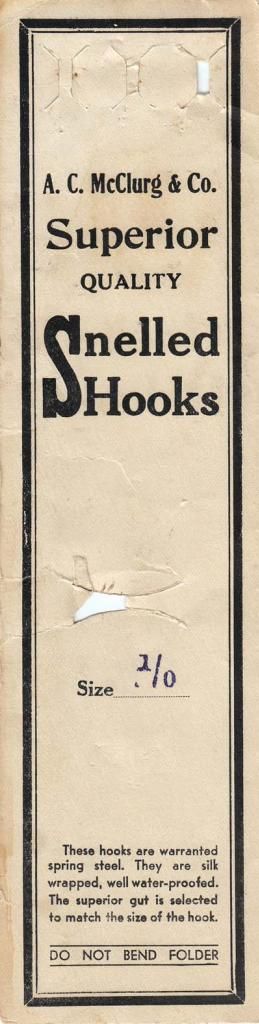
The American Snell Part VIII: A.C. McClurg & Co. Superior Snells


We wrote up the history of A.C. McClurg back in the “52 for 52” days, when we covered the history of 52 trade houses in one year.

General Alexander Caldwell McClurg was a Civil War veteran who became a legend in the book business, being one of the largest book publishers and distribution houses in America. Best known for publishing Edgar Rice Burroughs’ Tarzan books, in the 1919 Sporting Goods Dealer the company was listed as a sporting goods jobber, implying they were in the tackle business a generation before I had previously thought they were.


This would explain why bamboo fly rods marked “McClurg's Challenger” have been found; they are Union Hardware products, a pre-World War II manufacturer of note that never got back into the business after Word War II.

These are ca. 1950 McClurg & Co. snells from the 1930s, likely manufactured for them by Pequea (who utilized that sylized “S” on many snells they made for other companies). They are fairly hard to find.

— Dr. Todd

Wednesday, March 26, 2014

The American Snell Part VII: Buhl & Sons' Guardian Brand


The Buhl Brothers were legendary figures in Detroit's long and interesting history. The founders of Buhl & Dacharme in 1855, the company became a titan in the wholesale hardware word. It eventually became koan as Buhl, Sons & Co. in 1880, and was located after 1925 in the art deco Buhl Building in downtown Detrot.

The firm sold a ton of fishing tackle, the majority under two different names -- Wolverine and Guardian. You can find a lot of tackle from this firm, ranging from Shur Strike lures in Guardian Boxes to Wolverine brand line spools.


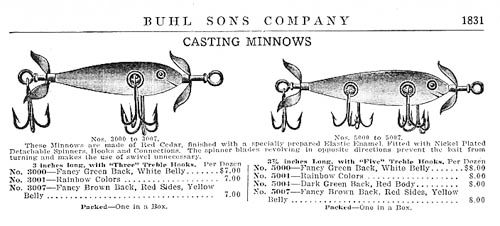
1918 Buhl Catalog trade minnows.


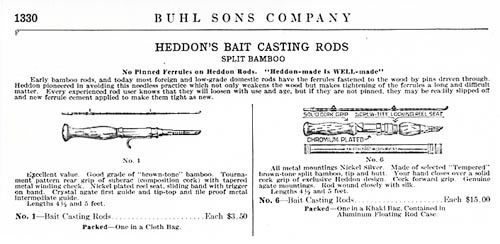
1930 Buhl Catalog Heddon rods.


Snells from Buhl are tough to find, and even harder to find in good condition. Below is a snell I picked up recently; note it is missing the bottom part. I own a half dozen of these snells, and every single one has fallen apart due to enormously acidic paper. Very few other snell packets I own have this problem to this degree. Maybe Buhl got a batch of bad paper in their orders. I only own one complete Guardian snell packet.


They are fun to add to a collection of Michigan or Shur Strike lures. To learn more about Buhl, Sons & Co., see my article "Algonacs and Tashmoos: The Reels of Buhl Sons Co. of Detroit" in the September 2009 Reel News.
-- Dr. Todd

Wednesday, February 12, 2014

The American Snelled Hook, Part VI: A Lazy Ike Snell


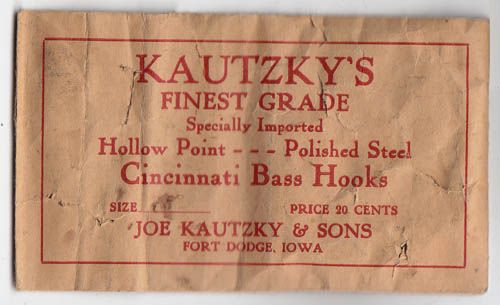
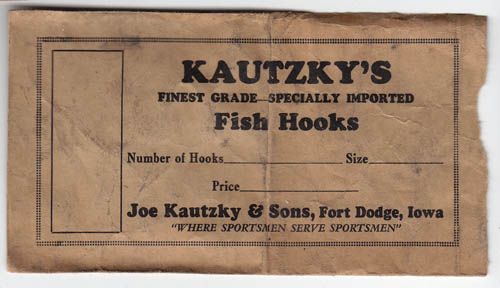
Joseph Kautzky, the namesake of the famed Lazy Ike, was a gunsmith by trade. Based out of Fort Dodge, Iowa, sometime around 1920 the company became known as Joe Kautzky & Sons and began to expand into the general sporting goods field. Below are two hook packets dating to before World War II featuring the Kautzky name and logo, "where sportsmen serve sportsmen."


These packets would have been sold around the time (1938) that Newel Daniels began to hand carve wooden lures which were sold through the Kautzky shop. This would, of course, become the Lazy Ike, and after 1945 when it began to be made out of plastic, the lure would come to dominate all the free time of the Kautzky family had and the sporting goods, and snelled hooks and hook packets, disappeared into history.

They are a nice reminder that before the Lazy Ike, Joseph Kautzky sold a full line of tackle.

-- Dr. Todd

Wednesday, December 18, 2013

The American Snelled Hook, Part V: A Dave Cook Special


Dave Cook, who we've written about before, was an interesting guy. Not only was he a good friend, but he was a shrewd marketer as well.

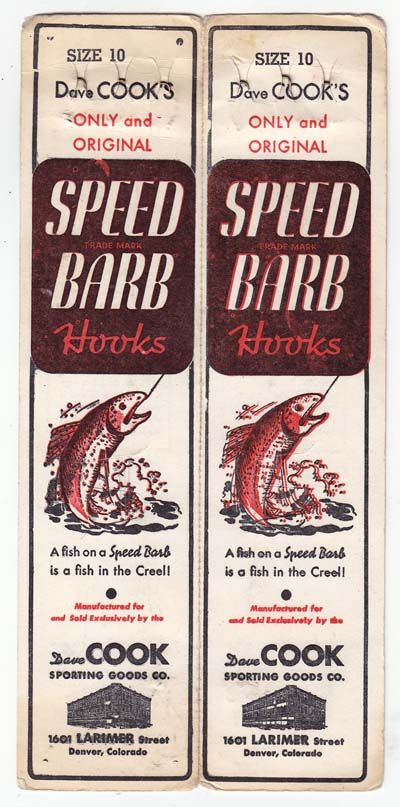
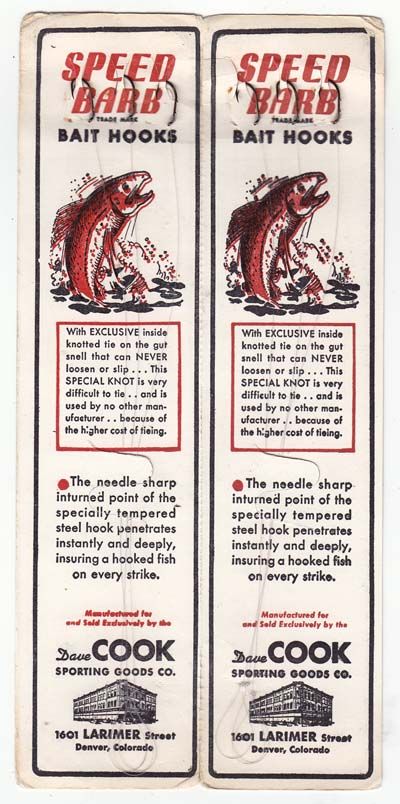
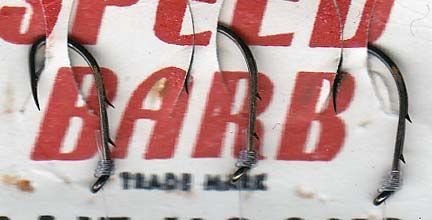
Take for example our snelled hook under the microscope this week -- Dave Cook's trademarked "Speed Barb" hooks. He spent a lot of time and effort branding these hooks, declaring them to use an exclusive "special knot [which] is very difficult to tie … and is used by no other manufacturer .. because of the high cost of tieing." Cook also declared them to be "manufactured for and sold exclusively by the Dave Cook Sporting Goods Co."


It was all a great bit of obfuscation, for the Dave Cook "Speed Barb" was nothing other than an Eagle Claw Bait Holder hook, made so famous across town from Dave Cook's headquarters.


I don't often find Eagle Claw trade snells, so perhaps their close proximity allowed Cook to market his Speed Barb hooks when others had to sell the Eagle Claw brand. Anyway, it's a nice story and another feather in the cap of Dave Cook.

-- Dr. Todd

Wednesday, December 4, 2013

The American Snelled Hook, Part 4: Eppinger--A Tackle Maker and Dealer


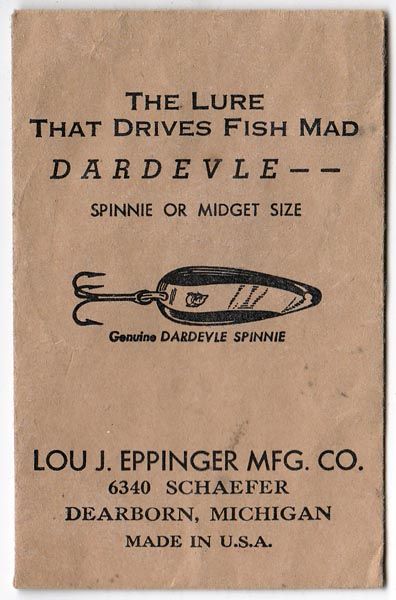
Lou J. Eppinger is justly famous as one of the most important tackle makers in American fishing history. The inventor of the Daredevle casting spoon and a host of similar metal baits, his lures are so omnipresent in the fisherman's tackle box that it is easy to forget that for the first three decades of his career, Eppinger concurrently ran a tackle and taxidermy shop in Detroit under his own name. His early catalogs, in fact, are filled with tackle from many other manufacturers, in addition to his own wares, meaning he was a manufacturer and trade house as well.

Eppinger's was the place for Michigan sports to buy their tackle, and perhaps meet the man himself, in the 1910-1940 era. Not only was his presence everywhere in the shop, but he always hired the best staff. It was Lou Eppinger, for example, who hired a brilliant young taxidermist named Paul H. Young to come work for him, setting in motion the career of one of the greatest bamboo rod makers of all-time.

Today's snell is a nifty small hook envelope (2.25" x 3.5") that came with a dozen #12 trout hooks in it. It's a cool hook envelope and a reminder that even in the 1930s, when this envelope was sold, you could walk up to Eppinger's at 6340 Schaefer in Detroit and buy your fishing tackle.


-- Dr. Todd

Wednesday, November 13, 2013

The American Snelled Hook, Part III: Wright & McGill's Eagle Claw Snells


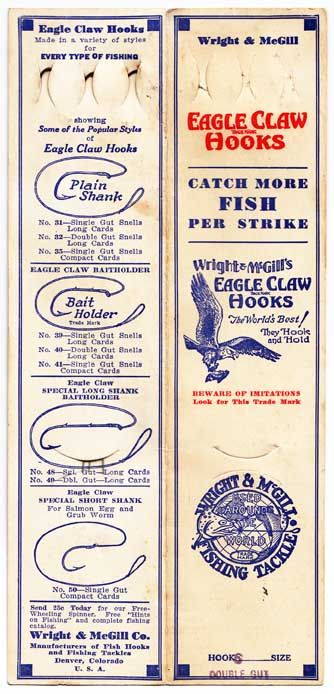
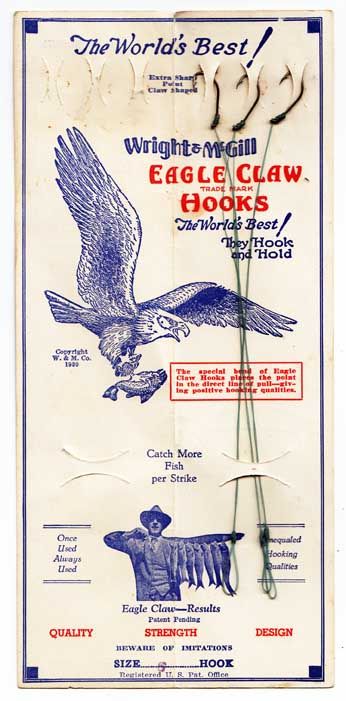
The most recognizable snelled hook packet in the world is the Wright & McGill "Eagle Claw" snell. There are over 100 different varieties of this snell, and it can be really difficult to date these, but there are a few tricks which I'll share with you over the coming months.

Take the snelled packet below. It has the circular Eagle Claw logo, which dates it to the 1930s. On the backside you'll note the 1930 copyright, which is a bad way to date snells as they used this for decades. More telling is the "Patent Pending" mark on the back side of the packet. This would not be in reference to the hooks, but to the name itself.

Stanley M. Wright and Andrew D. McGill founded this great tackle concern in 1925. Their first patent dealt with a tied fly (1928) but it was with fish hooks that the firm would make their name. They first registered the name "Eagle Claw" in 1938, and it would become one of over 60 trademarks the firm owned over the years.

Because of this (and the mono snells) I believe the snells below date to the late 1940s.


-- Dr. Todd

Thursday, November 7, 2013

The American Snelled Hook, Part II: A Michigan Fly Shop (Bob's Fly Tying Shop)


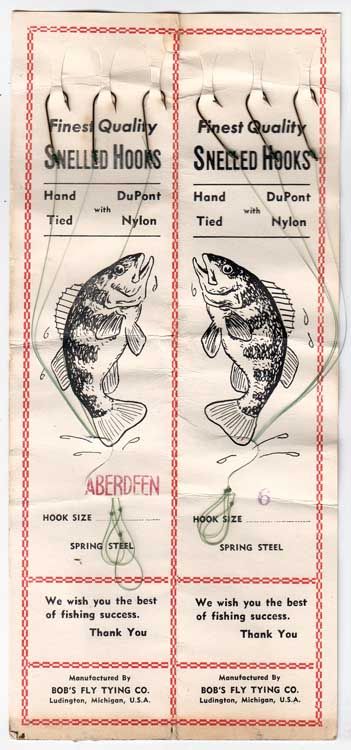
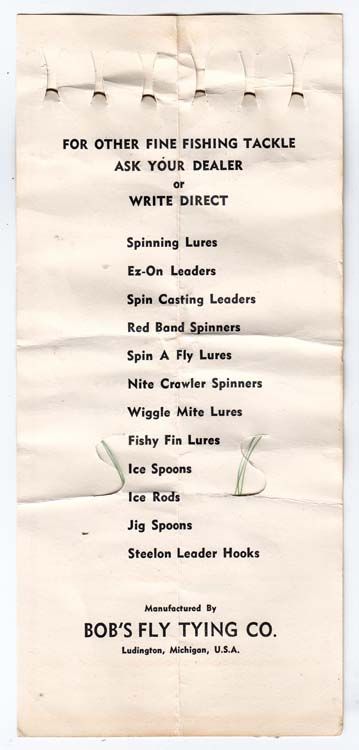
Bob's Fly Tying Shop was founded by Bob Lauterwasser in the wake of World War II in Ludington, Michigan. Mostly known today for having sold some very nice ice spearing decoys they sold a lot of items they manufactured as seen by the back of the snell packet below.

There isn't a ton of information on this store, but it is known they were in business for about a decade. The Ludington Daily News reported on September 4, 1948 that "When talking to Bob Lauterwasser, proprietor of Bob's Fly Tying Shop on West Ludington avenue, we were curious to kno what his reaction was when the next-door fire threatened to cook his goose. We learned that Bob had been as uneasy as an umpire in a bottle factory during the time of the fire, but he admitted the thing that worried him most was getting some 300,000 fish hooks out of stock. Good fish hooks are hard to find and he didn't want to be hooked with a loss that big. The imported hooks had been accumulated over a considerable period of time and Bob uses thousands of them in his wholesale fly and hook business.

It's a cool shop that likely bought a Herter's snelling machine and tied their own snells in the back. This makes small mom-and-pop snell packets like this rare, and nifty collectables.


-- Dr. Todd

Wednesday, October 23, 2013

The American Snelled Hook, Part I: A Triple Threat (Pequea - Roberts - Hartmann)


Beginning this week, I'm going to start a new series detailing snelled hook envelopes -- one of my favorite collectables. I'll feature a variety of different styles and kinds of snells, and hopefully give the reader an idea on how great a variety there are of these neat pieces of fishing tackle history.

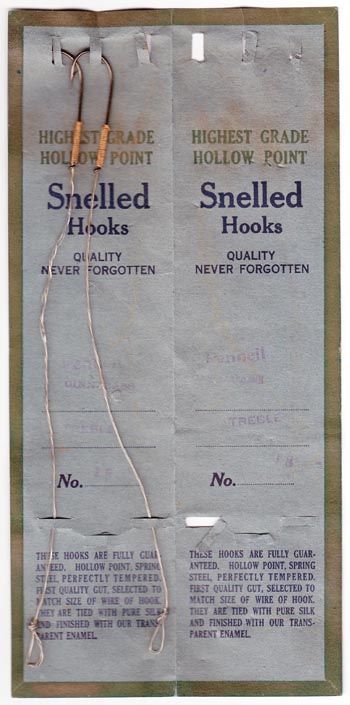
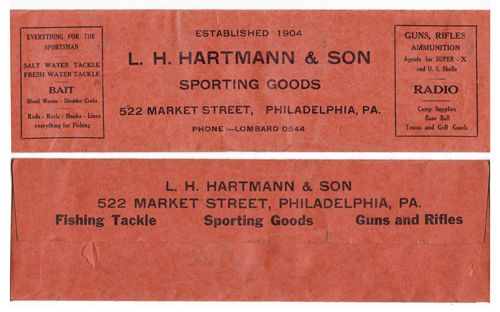


We'll begin with the Gold Medal Standard Bearer of snelled hooks -- the "Triple Branded" packet with the original store envelope. "Triple Branded" means a snell that we know the manufacturer, wholesaler, and retailer for--in this case a Pequea Works snell manufactured for W.F. Roberts Co. and then sold to L.H. Hartmann & Son ca. 1920.

Tracking the history of such snells offer great insight into the tackle trade of any given era.

Let's start with the manufacturer. Due to the style of the card, we know this snelled hook packet originated with the great Pequea Works of Strasburg, Penn. They were responsible for the majority of American snells in the first half of the century. Presided over by the great scoundrel of the tackle industry, Harry Kaufman (profiled by J.K. Garrett and L.P. Brooks in an on-going series on this blog), they manufactured the snells for most East Coast wholesalers of the day, ranging from Ed. K. Tryon to Supplee-Biddle Hardware to W.F. Roberts Co.
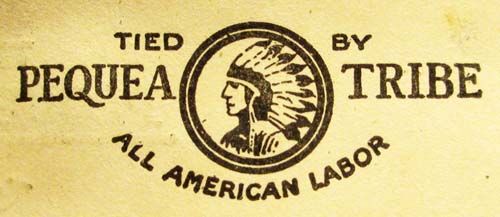


The famous "Pequea Tribe" logo was used beginning around 1920 for some wholesale snells, to indicate quality, and also on their own brand name as they began to sell direct.


With this particular snelled hook packet, Pequea manufactured them in large quantities and then wholesaled them to W.F. Roberts Co. of Washington, D.C. -- who acted as a jobber, distributing such goods to a number of stores, including (as we can tell from the label) Hartmann's Sporting Goods of Philadelphia.

Roberts Co. has an interesting history. William F. Roberts founded a Washington, D.C. based publisher responsible for many books in the period 1890-1940, including one of the earliest guides to raising Japanese Koi in 1909 (H.M. Smith's Japanese Goldfish, Their Varieties, and Cultivation).

At some point around 1910, like other companies of this kind (including Chicago's A.C. McClurg, another publisher) it expanded into general sporting goods wholesaling for a short period. As Roberts told the trade journal Printing Trade News in the April 7, 1914 issue, "Our photo goods and sports goods departments are now installed in 1411 New York avenue…" They were at it for a while; the publication Who's Who in the Nation's Capital for 1921 lists William F. Roberts as president of the "W.F. Roberts Co., engraving, printing, and sporting goods, 1514 H St."


The W.F. Roberts Co. used this stylized "R" logo on the copyright page of books they published.


Servicing a large number of independent retailers, the Roberts Co. jobbed their "R Special Brand" snells to an established sporting goods house in Philadelphia named L.H. Hartmann & Son, who branded the snell with a sticker. You might ask why Hartmann did not get their tackle from the nearby heavyweight wholesaler Ed. K. Tryon; I think it may have been because Roberts offered both radio and tackle, two major departments for Hartmann ca. 1920.
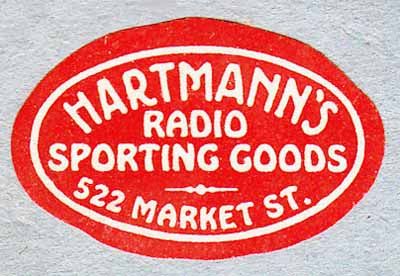


This sticker was used to brand the snelled packet for Hartmann.


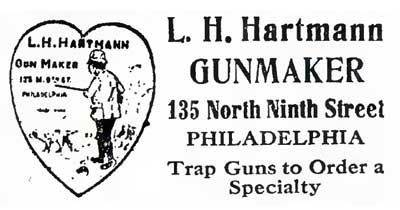
L.H. Hartmann & Son was founded in 1904 by Louis H. Hartmann, the former gunsmith for the sporting goods house of Nelson & Mattson and erstwhile instructor at the Royal Shooting School in Sandau, Germany. He was a crack shot and something of a local icon in the shooting community. He was a sufficiently known national figure on the subject that an article in The Minneapolis Journal dated Nov. 21, 1901 featured an interview with Hartmann, who disputed the claim of local gunsmith P.J. Kennedy (of Kennedy Bros. Arms of St. Paul) that high power sporting rifles were inherently dangerous. Later, the journal Sporting Life wrote on February 21, 1914 that "L.H. Hartmann, the veteran gunmaker, who is secretary of the Scheutzen Park Gun Club, of Philadelphia, Pa., is being highly praised by local shooters for his work in building up trap shooting in that organization." Below is an advertisement for Hartmann dated March 7, 1914 and also from the Sporting Life magazine.


Hartmann also advertised in the 1919 Yearbook of the Ocean City Fishing Club:
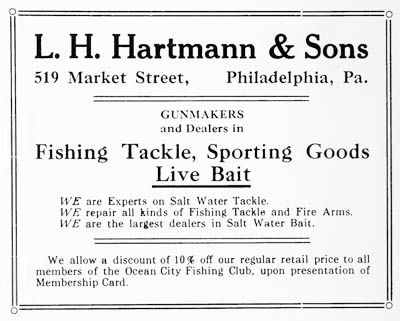


Note that the firm claimed expertise in salt water tackle, offered repair of tackle, and trafficked in live bait (and even offered 10% discount to Ocean City Fishing Club members).

The angler who purchased these snells was given a really cool L.H. Hartmann & Sons envelope to put them in, which is just frosting on top of the cake for this particular snell. An original snell, with triple provenance, in the original retailer envelope? The only thing missing is the receipt.

I can't promise that all snells have a history as detailed as this, but we'll try and feature some of the neater ones over the coming months.

-- Dr. Todd