Showing posts with label Abu. Show all posts
Showing posts with label Abu. Show all posts
Wednesday, June 19, 2013


Thursday, July 23, 2009
Journey to the Center of an Obsession: My ABU Tour, Part II by Espen Olav Sjaastad
Today we get the second and final part of Espen's beautiful article on ABU. A tremendous thank you goes out to Espen and the whole ABU gang. What a great story! I can't wait for the book...
Journey to the Center of an Obsession, Part 2
by Espen Olav Sjaastad
© 2009 Espen Olav Sjaastad. All right reserved.
We meet Jan Sjöblom, plant manager, in his office. As expected, he exhibits more than a marginal interest in fishing reels. He is open-minded and accessible and supplies us with some valuable bits of information about the reels we are researching. We also learn that ABU is weathering the hostile economic climate quite well. The Ambassadeur has been winning market shares of late, to some extent offsetting the effects of a shrinking market, and sales in Sweden have increased. I look past Sjöblom and recognize some seductive, familiar curves in an unfamiliar costume, a prototype 2501CDL with gold-plated frame and red sideplates. Our licence to shoot is still good, so I wipe some drool from the corner of my mouth and reach for my camera.

Plant Manager Jan Sjöblom
This enormous building is divided into four floors which, in descending order, contain offices, assembly, machining, and surface treatment. In assembly, the work stations look a bit like those in a collector’s basement, except that the tools are better. ABU’s finest reels – the small Ambassadeurs and the Mörrums – are still assembled by hand. There is also a production line where the fully automated assembly of the C3s and and C4s and other models takes place. There’s plenty of activity in machining, too. Some parts are now made in Eastern Europe and Asia. Others, like the frames and spools and gears, are machined here at the factory from brass and aluminum rods and sheets. One more trip in the elevator and we’ve reached the ground floor, where anodizing and plating takes place. I follow Karl-Eric through the factory in a half-daze, too mesmerized by machines and colors and bins full of parts to take the pictures I had planned.
Later that day, I’m thrilled when Karl-Eric gives me a Norwegian edition of the ABU 75th anniversary poster, a poster of some note among ABU fans. He mentions, offhand, that the Norwegian posters came from the printer with a number of spelling mistakes and were all destroyed. He thinks. This was one he saved from the scrap heap, it might be the only existing Norwegian specimen. He thinks. I’m a collector, so back at Lotta’s I spend the rest of the evening in a feverish hunt for those magical typos that would support his theory. Collectors are mad.
Thursday morning at Lotta’s. Across the street is a row of apartment buildings just like the one in which I’m staying. Under new ownership, the Halda watch factory would recover from its 1920 collapse and would, at its peak, employ 1300 workers. ABU, around 1980, employed 700. Halda shut down for the last time in 1989, while ABU now employs about 100. All those workers gone, and many of them lived across the street. The buildings fell into disrepair and were marked for condemnation, but some of my compatriots caught wind of this, picked up the apartments for a song and half a dance, and restored them to summer home status. More followed and a Norwegian colony gradually formed.
July is the big vacation month, but some Norwegian migrants are already here. Gathering outside in the parking lot, stretching, yawning, wondering how to spend another perfect day. They look happy enough. Stereotypically, Danes are Scandinavia’s tropical tribe, fun-loving and friendly. Norwegians go to Denmark for a beer and a laugh. But Sweden feels more like home. The landscape is familiar, the spoken language more accessible. And Swedes radiate something more temperate, not a heatwave but a mild summer breeze, easier on our frozen Norwegian souls.
ABU’s reputation in Scandinavia owes a lot to its service policy. In Oslo, I never had to worry about parts. Regardless of model, they always had what I needed. And in the good old days, if you sent an Ambassadeur for service and it was sufficiently trashed, ABU would simply send a brand new one in return. Unfortunately, the Oslo inventory of parts was recently shipped back to Svängsta. More worryingly, a couple of years ago, ABU stopped producing spare parts for the classic reels from the ‘50s, ‘60s, and ‘70s. They still have the tooling in Svängsta but tooling won’t help if the knowledge of how to use it is lost. Prices in the online market for parts may soon explode.
The ABU Service Department is located in a long, single-storey building behind the factory. Karl-Eric says hallo to a number of old colleagues before we sit down with his namesake, Håkan Svensson (no relation), to talk about small Ambassadeurs, the 1500C and 2500C models and their closest relatives. Of the classic models, the small ones and the 7000 are apparently those that generate fewest problems and complaints. Håkan explains that there are issues associated with some permutations of the small ones too, but that’s another story for another time.

Håkan Svensson services a reel
We sit down for coffee, where we are joined by Jan Svensson (no relation). Jan has brought some old factory catalogs and schematics. We discuss past changes to small Ambassadeurs for a while. It’s Thursday afternoon. Outside the sun is shining. Just down the road, people are swimming or catching fish. In America, a few dozen incurable reel addicts are preparing for a guided tour of the IGFA Museum. Somewhere in this world, people are making money, making love. And here I am, in the ABU Service Department, listening to three unrelated Svenssons lamenting the march of time and cursing the inventor of jerk bait techniques. There is no place on earth I would rather be.

Part of the assembly crew
On a day when the wind is just right – or just wrong, depending on your perspective – you can hear the blasts from the open-air concerts at the Sweden Rock Festival all the way to Svängsta. Most of the bands are Swedish, and many of those bands have banded together to form an organization called “Ge fan i våra vatten.” This is untranslatable, which is just as well, since expletives are involved. But the general purpose of the organization is conservation of Swedish waters and the fish stocks they hold. In support of this initiative, ABU recently unvailed a reel in loud greens with the organization’s suggestive logo anodized into the tailplate, the Ambassadeur 5601C Raw. A percentage of receipts goes to conservation. A marriage of two desirable trends: the increasingly cool image that recreational fishing enjoys among Scandinavian rockers, and the growing realization among tackle makers that if there are no fish, there is no reason to buy tackle.
After leaving the Service Department, we visit with Els-Marie Svensson (no relation), who works with product development at ABU. A few of the rock & roll reels are scattered around her office. Els-Marie educates us on some of the finer points of Ambassadeur foot numbers, then shows us another rock & roll reel in black and aubergine. She calls it the Harley-Davidson reel. Still later, we talk to Arne Johansson. Arne is another retired ABU reelmaker, and he willingly shares his memories of the small Ambassadeurs. Then he and Karl-Eric get into old stories from their ABU days, the crazy things that seem to have happened on a regular basis. They talk about getting the old gang together, revisiting the past, using this as a foundation for a book or a video. Amen.
Lennart Borgström has said that it’s always either up or down, you never stand still. Many collectors believe that his leaving ABU not only marked the end of a long ascent and the beginning of a long descent but actually precipitated these. Karl-Eric thinks Lennart Borgstöm did the right thing – Borgström would not have been a happy man at ABU today, not within any plausible counterfactual scenario. The rise of ABU was a small miracle, but things change. Tax policies, cost levels, competitors, tastes. Perhaps it’s equally miraculous that, despite it all, Ambassadeurs are still being made right here in Svängsta.

Support a good cause - look for this logo when buying your next reel
Thursday evening, I go for dinner with Karl-Eric and his wife Mona to a restaurant in Karlshamn. They advise me to take a different route back to Oslo the next day, through the heartlands of Sweden, places I have never been. It may take a little longer, they say, but it’s worth it. I’m thinking I might get lost, it’s something I’m good at, especiallly when I’m daydreaming about reels. But then I figure if I just keep going north for a few hours, then hang a left, I’m bound to reach Norway sooner or later. Devoted pilgrims always find their way home.
If you collect small Ambassadeurs and have stories or pictures that you are willing to share, or if you would simply like to discuss these reels, feel free to contact Espen at espen.sjaastad@umb.no -- and look here for information on the book, as I'll post it as soon as I hear anything!
-- Dr. Todd
Journey to the Center of an Obsession, Part 2
by Espen Olav Sjaastad
© 2009 Espen Olav Sjaastad. All right reserved.
We meet Jan Sjöblom, plant manager, in his office. As expected, he exhibits more than a marginal interest in fishing reels. He is open-minded and accessible and supplies us with some valuable bits of information about the reels we are researching. We also learn that ABU is weathering the hostile economic climate quite well. The Ambassadeur has been winning market shares of late, to some extent offsetting the effects of a shrinking market, and sales in Sweden have increased. I look past Sjöblom and recognize some seductive, familiar curves in an unfamiliar costume, a prototype 2501CDL with gold-plated frame and red sideplates. Our licence to shoot is still good, so I wipe some drool from the corner of my mouth and reach for my camera.
This enormous building is divided into four floors which, in descending order, contain offices, assembly, machining, and surface treatment. In assembly, the work stations look a bit like those in a collector’s basement, except that the tools are better. ABU’s finest reels – the small Ambassadeurs and the Mörrums – are still assembled by hand. There is also a production line where the fully automated assembly of the C3s and and C4s and other models takes place. There’s plenty of activity in machining, too. Some parts are now made in Eastern Europe and Asia. Others, like the frames and spools and gears, are machined here at the factory from brass and aluminum rods and sheets. One more trip in the elevator and we’ve reached the ground floor, where anodizing and plating takes place. I follow Karl-Eric through the factory in a half-daze, too mesmerized by machines and colors and bins full of parts to take the pictures I had planned.
Later that day, I’m thrilled when Karl-Eric gives me a Norwegian edition of the ABU 75th anniversary poster, a poster of some note among ABU fans. He mentions, offhand, that the Norwegian posters came from the printer with a number of spelling mistakes and were all destroyed. He thinks. This was one he saved from the scrap heap, it might be the only existing Norwegian specimen. He thinks. I’m a collector, so back at Lotta’s I spend the rest of the evening in a feverish hunt for those magical typos that would support his theory. Collectors are mad.
Thursday morning at Lotta’s. Across the street is a row of apartment buildings just like the one in which I’m staying. Under new ownership, the Halda watch factory would recover from its 1920 collapse and would, at its peak, employ 1300 workers. ABU, around 1980, employed 700. Halda shut down for the last time in 1989, while ABU now employs about 100. All those workers gone, and many of them lived across the street. The buildings fell into disrepair and were marked for condemnation, but some of my compatriots caught wind of this, picked up the apartments for a song and half a dance, and restored them to summer home status. More followed and a Norwegian colony gradually formed.
July is the big vacation month, but some Norwegian migrants are already here. Gathering outside in the parking lot, stretching, yawning, wondering how to spend another perfect day. They look happy enough. Stereotypically, Danes are Scandinavia’s tropical tribe, fun-loving and friendly. Norwegians go to Denmark for a beer and a laugh. But Sweden feels more like home. The landscape is familiar, the spoken language more accessible. And Swedes radiate something more temperate, not a heatwave but a mild summer breeze, easier on our frozen Norwegian souls.
ABU’s reputation in Scandinavia owes a lot to its service policy. In Oslo, I never had to worry about parts. Regardless of model, they always had what I needed. And in the good old days, if you sent an Ambassadeur for service and it was sufficiently trashed, ABU would simply send a brand new one in return. Unfortunately, the Oslo inventory of parts was recently shipped back to Svängsta. More worryingly, a couple of years ago, ABU stopped producing spare parts for the classic reels from the ‘50s, ‘60s, and ‘70s. They still have the tooling in Svängsta but tooling won’t help if the knowledge of how to use it is lost. Prices in the online market for parts may soon explode.
The ABU Service Department is located in a long, single-storey building behind the factory. Karl-Eric says hallo to a number of old colleagues before we sit down with his namesake, Håkan Svensson (no relation), to talk about small Ambassadeurs, the 1500C and 2500C models and their closest relatives. Of the classic models, the small ones and the 7000 are apparently those that generate fewest problems and complaints. Håkan explains that there are issues associated with some permutations of the small ones too, but that’s another story for another time.
We sit down for coffee, where we are joined by Jan Svensson (no relation). Jan has brought some old factory catalogs and schematics. We discuss past changes to small Ambassadeurs for a while. It’s Thursday afternoon. Outside the sun is shining. Just down the road, people are swimming or catching fish. In America, a few dozen incurable reel addicts are preparing for a guided tour of the IGFA Museum. Somewhere in this world, people are making money, making love. And here I am, in the ABU Service Department, listening to three unrelated Svenssons lamenting the march of time and cursing the inventor of jerk bait techniques. There is no place on earth I would rather be.
On a day when the wind is just right – or just wrong, depending on your perspective – you can hear the blasts from the open-air concerts at the Sweden Rock Festival all the way to Svängsta. Most of the bands are Swedish, and many of those bands have banded together to form an organization called “Ge fan i våra vatten.” This is untranslatable, which is just as well, since expletives are involved. But the general purpose of the organization is conservation of Swedish waters and the fish stocks they hold. In support of this initiative, ABU recently unvailed a reel in loud greens with the organization’s suggestive logo anodized into the tailplate, the Ambassadeur 5601C Raw. A percentage of receipts goes to conservation. A marriage of two desirable trends: the increasingly cool image that recreational fishing enjoys among Scandinavian rockers, and the growing realization among tackle makers that if there are no fish, there is no reason to buy tackle.
After leaving the Service Department, we visit with Els-Marie Svensson (no relation), who works with product development at ABU. A few of the rock & roll reels are scattered around her office. Els-Marie educates us on some of the finer points of Ambassadeur foot numbers, then shows us another rock & roll reel in black and aubergine. She calls it the Harley-Davidson reel. Still later, we talk to Arne Johansson. Arne is another retired ABU reelmaker, and he willingly shares his memories of the small Ambassadeurs. Then he and Karl-Eric get into old stories from their ABU days, the crazy things that seem to have happened on a regular basis. They talk about getting the old gang together, revisiting the past, using this as a foundation for a book or a video. Amen.
Lennart Borgström has said that it’s always either up or down, you never stand still. Many collectors believe that his leaving ABU not only marked the end of a long ascent and the beginning of a long descent but actually precipitated these. Karl-Eric thinks Lennart Borgstöm did the right thing – Borgström would not have been a happy man at ABU today, not within any plausible counterfactual scenario. The rise of ABU was a small miracle, but things change. Tax policies, cost levels, competitors, tastes. Perhaps it’s equally miraculous that, despite it all, Ambassadeurs are still being made right here in Svängsta.
Thursday evening, I go for dinner with Karl-Eric and his wife Mona to a restaurant in Karlshamn. They advise me to take a different route back to Oslo the next day, through the heartlands of Sweden, places I have never been. It may take a little longer, they say, but it’s worth it. I’m thinking I might get lost, it’s something I’m good at, especiallly when I’m daydreaming about reels. But then I figure if I just keep going north for a few hours, then hang a left, I’m bound to reach Norway sooner or later. Devoted pilgrims always find their way home.
If you collect small Ambassadeurs and have stories or pictures that you are willing to share, or if you would simply like to discuss these reels, feel free to contact Espen at espen.sjaastad@umb.no -- and look here for information on the book, as I'll post it as soon as I hear anything!
-- Dr. Todd
Wednesday, July 22, 2009
Journey to the Center of an Obsession: My ABU Tour, Part I by Espen Olav Sjaastad
Today and tomorrow, we are absolutely delighted to offer you a glimpse into the world of ABU, written by our Scandinavian friend Espen Olav Sjaastad. Espen--a dedicated collector and historian--gives us unique insight into both ABU history and the state of reelmaking today. We should ALL thank Espen for this delightful and brilliant essay. He is co-authoring a new book on ABU small baitcasters, my favorite reels maybe ever, which will be one of the most anticipated offerings in the coming year. Enjoy!
Journey to the Center of an Obsession, Part 1
by Espen Olav Sjaastad
© 2009 Espen Olav Sjaastad. All right reserved.
The E6, or European Route Six, is a Scandinavian artery. It starts at the southern tip of Sweden and ends at the northern tip of Norway. Or is it the other way around? Monday, June 1, a sunny Oslo morning, I pack my bags and head south. At the border, I show my reels to Swedish customs, just in case their Norwegian counterparts try to charge me VAT on my way back. I skirt Gothenburg, Falkenberg, Halmstad, catching an occasional glimpse of the Swedish west coast. Boats and lighthouses and a million small islands. Get your kicks on Route Six? Not likely. I get my kicks in mysterious ways, so just north of Helsingborg I turn east.
International news. The radio is blaring about this Swede who upset Rafael Nadal in the French Open. After about an hour of this, they mention the collapse of General Motors, 240,000 workers facing an uncertain future. I reach the Swedish east coast at Pukavik. Another good-looking coastline, with larger formations and more vegetation. They’re raising tents for the Sweden Rock Festival, where bands like Heaven & Hell and Twisted Sister are expected. Almost there. I turn north before I reach Karlshamn, pass through the small town of Mörrum, drive another eight kilometeres or so, and there it is, the even smaller town of Svängsta with the great big factory where they made all those fishing reels that I love.
It’s early evening. I check into Lotta’s. You won’t get any breakfast at Lotta’s but you’ll get a bed and free Internet in your room. I get my room keys and make a phone call to Karl-Eric Svensson, also known as “Svängstakalle” among Swedish collectors.

Karl-Eric Svensson prepares to stamp a number on a foot
Karl-Eric started working on the ABU factory floor in 1957. Before retiring in 2003, he had held almost every imaginable position within the firm. Karl-Eric and I are planning a book about small Ambassadeurs, the reason for my visit. For the next three days, I have the privilege of being guided through the ABU legacy by a true veteran and expert.
Tuesday morning, we meet outside the ABU museum and the curator, Henning Karlsson, lets us in. ABU owes its existence to the collapse of the Halda watch factory in 1920. Carl August Borgström, suddenly unemployed, started his own watch-making business in a small wooden building a stone’s throw away from the Halda factory. That’s where the ABU museum is now.
From the ceiling hangs an old photo of the workshop as it appeared in 1939, just before Göte Borgström, Carl August’s son, decided to make the transition to fishing reels. The interior displayed in the photo has been meticulously reconstructed in the museum itself. But the photo also shows the workers. And there, in a far corner of the room, is the thirteen-year-old Karlsson at work at his machine.
The museum also contains a couple of reels of more than passing interest to Karl-Eric and me. Karlsson unlocks the displays and gives us a licence to shoot. I take a few snaps, the anti-shake on my camera working overtime.

A rare, early Ambassadeur 1500CDL
Sightseeing is next. ABU nostalgia is scattered like spare parts all around this neighborhood. At Lotta’s, a life-size cardboard cutout of the bikini-clad ABU girl greets me just inside the entrance. Walk into a restaurant or hotel in Svängsta or Mörrum and you’re as likely as not to find a couple of glass cabinets full of old reels. Residential streets are named after brands of fishing tackle.
In Mörrum, next to Kungsforsen (the King’s Falls), is the House of Salmon and the Royal Salmon Fishery. You can buy your fishing licence here or simply enjoy the view. There’s also a weighing station, a restaurant, and an exhibit. The latter contains a vast number of Ambassadeurs, of course, but also some good Hardy Perfects, a wall full of lures from around the world, and a few enormous, wall-mounted salmon.

The old ABU watch factory, now the ABU Museum
Further down the river, a flyfisher is just about to take a break. He’s German, has been here a few days, but has had no luck. We talk for a while, before he asks why I’m staring so intently at his reel. Instead of trying to explain to the man that this is simply one of my bad habits, I ask him whether the reel is any good. Yes, yes. It’s a German reel, a Vosseler. A modern, large-arbor salmon reel. It looks to be of decent quality.

The Mörrum River
Another of my bad habits is the wanton purchase of reels. There are twice as many specialist tackle dealers in this little town as in my hometown of Oslo, Capital of Norway. In one of them, Bringséns Sportfiske, Mr. Bringsén even makes his own brand of reels, including “the only antireverse fly reel that truly works.” In another, I almost buy a tiny Loop trout reel, a model no longer produced that is hard to find outside Sweden. Somehow, though, the reflexive grab towards my credit card fails to materialize, probably because I’m subconsciously afraid of offending Karl-Eric by buying a non-ABU reel.
Our final stop this day is Ekebergstugan, a timber cottage imported from Finland that sits on a hill above the Mörrum River. Karl-Eric still patrols the ABU beats and possesses keys that will open most doors. This is where the King of Sweden came to fish and recreate in 1976 as a guest of Lennart Borgström, son of Göte and third in the line of ABU owners. The King brought his uncle, Prince Bertil, and a friend, President Uhro Kekkonen of Finland. He also brought his fiancée, the lovely Silvia, who is now Queen.
Karl-Eric and I sit down at the royal table, unpack pizza and beer. We talk about collecting and collectors. There’s a Scandinavian club for reel collectors, Samlarklubben Rullen, mostly populated by Swedes. Karl-Eric has organized a couple of get-togethers in Svängsta in the past, it’s a popular venue because you are still likely to find rare ABU tackle that hasn’t yet reached collectors. He knows of only one other dedicated collector among the employees and ex-employees at ABU, but there are plenty of old reels and lures among them. Walk-ins can still produce a number of gems if a meet is held in a public place and properly advertized.
We walk down a flight of stairs to the basement. President Kekkonen’s old bedroom has portraits on the wall but no signs of luxury. Kekkonen was a tough guy, a hunter and fisher with a legendary capacity for something called Koskenkorva. In the hallway, crates of empty bottles are stacked along a wall but none of those bottles ever contained Finnish vodka. ABU clients occasionally still come here to fish, but there haven’t been any Finnish presidents for a while. No kings or queens either.
Outside, the grass is long and the fishing piers lie unmounted and unused along the banks of the river. In the 1960s and 1970s, a dozen employees were charged with upkeep of the ABU stretches, but those jobs were cut along with other costs during the last 30 years. The piers don’t matter right now, the salmon and the sea trout won’t reach this far in June. An upstream dam is rationing the water, saving it for another time of year when electricity prices are higher, so the fish are stuck below the falls further down.
At the age of 14, on a fishing trip to the western fjords of Norway, I picked up an ABU catalog at a local tackle dealer. The compact beauty of the multipliers caught my attention, and those images stayed with me through the winter. Somewhere in my brain, the seeds of an obsession – acquisitive, probably unhealthy – were germinating. For my 15th birthday, after a campaign of threats and pleas, my parents gave me my first Ambassadeur, a 6600C with black sideplates and red thumbar. Backlashes were surely a feature of the early days, but they have disappeared from memory. What I remember, mostly, is casting twice as far as my non-Ambassadeur-owning friends. I did not catch more fish than them (I still don’t), but I had the finest reel (I still do).
I don’t have reels as fine as those that Karl-Eric displays in his tackle room, however. If you are an ABU collector and could pick a career, his would have to come pretty close to the top of the list. We spend Wednesday morning examining, discussing, and photographing reels. The perfect vacation.
Wednesday afternoon, it’s time to visit the factory. We park the car, walk up to the entrance, and take the external elevator to the top floor. Karl-Eric presses a button and someone inside presses a buzzer. We enter. As it’s my first time, I’m feeling I should have made more of this moment, but animal sacrifices or other elaborate rituals might not go down so well with management. Instead, I spend some time admiring the reels displayed in the lobby.

The ABU factory entrance
Tomorrow: Part 2
Journey to the Center of an Obsession, Part 1
by Espen Olav Sjaastad
© 2009 Espen Olav Sjaastad. All right reserved.
The E6, or European Route Six, is a Scandinavian artery. It starts at the southern tip of Sweden and ends at the northern tip of Norway. Or is it the other way around? Monday, June 1, a sunny Oslo morning, I pack my bags and head south. At the border, I show my reels to Swedish customs, just in case their Norwegian counterparts try to charge me VAT on my way back. I skirt Gothenburg, Falkenberg, Halmstad, catching an occasional glimpse of the Swedish west coast. Boats and lighthouses and a million small islands. Get your kicks on Route Six? Not likely. I get my kicks in mysterious ways, so just north of Helsingborg I turn east.
International news. The radio is blaring about this Swede who upset Rafael Nadal in the French Open. After about an hour of this, they mention the collapse of General Motors, 240,000 workers facing an uncertain future. I reach the Swedish east coast at Pukavik. Another good-looking coastline, with larger formations and more vegetation. They’re raising tents for the Sweden Rock Festival, where bands like Heaven & Hell and Twisted Sister are expected. Almost there. I turn north before I reach Karlshamn, pass through the small town of Mörrum, drive another eight kilometeres or so, and there it is, the even smaller town of Svängsta with the great big factory where they made all those fishing reels that I love.
It’s early evening. I check into Lotta’s. You won’t get any breakfast at Lotta’s but you’ll get a bed and free Internet in your room. I get my room keys and make a phone call to Karl-Eric Svensson, also known as “Svängstakalle” among Swedish collectors.
Karl-Eric started working on the ABU factory floor in 1957. Before retiring in 2003, he had held almost every imaginable position within the firm. Karl-Eric and I are planning a book about small Ambassadeurs, the reason for my visit. For the next three days, I have the privilege of being guided through the ABU legacy by a true veteran and expert.
Tuesday morning, we meet outside the ABU museum and the curator, Henning Karlsson, lets us in. ABU owes its existence to the collapse of the Halda watch factory in 1920. Carl August Borgström, suddenly unemployed, started his own watch-making business in a small wooden building a stone’s throw away from the Halda factory. That’s where the ABU museum is now.
From the ceiling hangs an old photo of the workshop as it appeared in 1939, just before Göte Borgström, Carl August’s son, decided to make the transition to fishing reels. The interior displayed in the photo has been meticulously reconstructed in the museum itself. But the photo also shows the workers. And there, in a far corner of the room, is the thirteen-year-old Karlsson at work at his machine.
The museum also contains a couple of reels of more than passing interest to Karl-Eric and me. Karlsson unlocks the displays and gives us a licence to shoot. I take a few snaps, the anti-shake on my camera working overtime.
Sightseeing is next. ABU nostalgia is scattered like spare parts all around this neighborhood. At Lotta’s, a life-size cardboard cutout of the bikini-clad ABU girl greets me just inside the entrance. Walk into a restaurant or hotel in Svängsta or Mörrum and you’re as likely as not to find a couple of glass cabinets full of old reels. Residential streets are named after brands of fishing tackle.
In Mörrum, next to Kungsforsen (the King’s Falls), is the House of Salmon and the Royal Salmon Fishery. You can buy your fishing licence here or simply enjoy the view. There’s also a weighing station, a restaurant, and an exhibit. The latter contains a vast number of Ambassadeurs, of course, but also some good Hardy Perfects, a wall full of lures from around the world, and a few enormous, wall-mounted salmon.
Further down the river, a flyfisher is just about to take a break. He’s German, has been here a few days, but has had no luck. We talk for a while, before he asks why I’m staring so intently at his reel. Instead of trying to explain to the man that this is simply one of my bad habits, I ask him whether the reel is any good. Yes, yes. It’s a German reel, a Vosseler. A modern, large-arbor salmon reel. It looks to be of decent quality.
Another of my bad habits is the wanton purchase of reels. There are twice as many specialist tackle dealers in this little town as in my hometown of Oslo, Capital of Norway. In one of them, Bringséns Sportfiske, Mr. Bringsén even makes his own brand of reels, including “the only antireverse fly reel that truly works.” In another, I almost buy a tiny Loop trout reel, a model no longer produced that is hard to find outside Sweden. Somehow, though, the reflexive grab towards my credit card fails to materialize, probably because I’m subconsciously afraid of offending Karl-Eric by buying a non-ABU reel.
Our final stop this day is Ekebergstugan, a timber cottage imported from Finland that sits on a hill above the Mörrum River. Karl-Eric still patrols the ABU beats and possesses keys that will open most doors. This is where the King of Sweden came to fish and recreate in 1976 as a guest of Lennart Borgström, son of Göte and third in the line of ABU owners. The King brought his uncle, Prince Bertil, and a friend, President Uhro Kekkonen of Finland. He also brought his fiancée, the lovely Silvia, who is now Queen.
Karl-Eric and I sit down at the royal table, unpack pizza and beer. We talk about collecting and collectors. There’s a Scandinavian club for reel collectors, Samlarklubben Rullen, mostly populated by Swedes. Karl-Eric has organized a couple of get-togethers in Svängsta in the past, it’s a popular venue because you are still likely to find rare ABU tackle that hasn’t yet reached collectors. He knows of only one other dedicated collector among the employees and ex-employees at ABU, but there are plenty of old reels and lures among them. Walk-ins can still produce a number of gems if a meet is held in a public place and properly advertized.
We walk down a flight of stairs to the basement. President Kekkonen’s old bedroom has portraits on the wall but no signs of luxury. Kekkonen was a tough guy, a hunter and fisher with a legendary capacity for something called Koskenkorva. In the hallway, crates of empty bottles are stacked along a wall but none of those bottles ever contained Finnish vodka. ABU clients occasionally still come here to fish, but there haven’t been any Finnish presidents for a while. No kings or queens either.
Outside, the grass is long and the fishing piers lie unmounted and unused along the banks of the river. In the 1960s and 1970s, a dozen employees were charged with upkeep of the ABU stretches, but those jobs were cut along with other costs during the last 30 years. The piers don’t matter right now, the salmon and the sea trout won’t reach this far in June. An upstream dam is rationing the water, saving it for another time of year when electricity prices are higher, so the fish are stuck below the falls further down.
At the age of 14, on a fishing trip to the western fjords of Norway, I picked up an ABU catalog at a local tackle dealer. The compact beauty of the multipliers caught my attention, and those images stayed with me through the winter. Somewhere in my brain, the seeds of an obsession – acquisitive, probably unhealthy – were germinating. For my 15th birthday, after a campaign of threats and pleas, my parents gave me my first Ambassadeur, a 6600C with black sideplates and red thumbar. Backlashes were surely a feature of the early days, but they have disappeared from memory. What I remember, mostly, is casting twice as far as my non-Ambassadeur-owning friends. I did not catch more fish than them (I still don’t), but I had the finest reel (I still do).
I don’t have reels as fine as those that Karl-Eric displays in his tackle room, however. If you are an ABU collector and could pick a career, his would have to come pretty close to the top of the list. We spend Wednesday morning examining, discussing, and photographing reels. The perfect vacation.
Wednesday afternoon, it’s time to visit the factory. We park the car, walk up to the entrance, and take the external elevator to the top floor. Karl-Eric presses a button and someone inside presses a buzzer. We enter. As it’s my first time, I’m feeling I should have made more of this moment, but animal sacrifices or other elaborate rituals might not go down so well with management. Instead, I spend some time admiring the reels displayed in the lobby.
Tomorrow: Part 2
Thursday, June 18, 2009
Thursday Review: ABU & Garcia--What Happened? By Len Borgstrom
Thursday Review: Abu and Garcia: What Happened? By Len Borgstrom

As the newest inductees to the Freshwater Fishing Hall of Fame have recently been announced, and include one Lennart Borgstrom, long-time president of ABU-Garcia, I was reminded I was remiss in my duties to review his fine book, which was put into English translation about two years ago.
ABU and Garcia: What Happened? is not your typical fishing tackle book. No, this is not the book to buy if you want to ID various models of ABU reels or lures. In fact, Len tries very hard NOT to spend too much time discussing the technical developments of tackle.
What the book is about, however, is how the fishing tackle trade works, both in America and internationally. From this perspective, Borgstrom is perhaps the most qualified individual around to discuss the subject at hand. He tells a very personal story about the origins, development, growth and set-backs of the famed ABU company of Svängsta, Sweden, which went from making pocket watches and taximeters to dominating the casting reel market.
This book has much to offer anyone interested in fishing history. As it by definition spends much time discussing the many partners ABU had in its past, the book is as much about Mitchell, Zebco, Garcia and other firms as it is about ABU. While it does discuss the high points of ABU history--such as the development of the Ambassadeur reel--it always puts them into perspective in the overall fishing tackle scene.
There are many revelations in this book, such as how the price of the Ambassadeur--which should have sold at $44.95 retail--was kept at $19.95 because so many big companies used it as a loss leader to attract customers that no one could thus afford to sell it at actual retail price. Few American retailers ever made any money selling Ambassadeur reels in the 1950s and 1960s.
Much of the book is couched in terms of the Swedish government's oppressive tax schedule, which makes entrepreneurship very difficult. Borgstrom has some definite ideas on the effectiveness of this program, and is not shy in giving his opinion on how it effected the overall development of Swedish business.
This is certainly a must read book. Unfortunately, I'm not sure where (or if) the book is still available. For a time, Bass Pro Shops carried the title but it no longer shows up on their web site. Perhaps it is out of print, which would be a tremendous shame as it deserves a wide readership. If you have to beg, borrow, or steal--get a copy of this book.
-- Dr. Todd
As the newest inductees to the Freshwater Fishing Hall of Fame have recently been announced, and include one Lennart Borgstrom, long-time president of ABU-Garcia, I was reminded I was remiss in my duties to review his fine book, which was put into English translation about two years ago.
ABU and Garcia: What Happened? is not your typical fishing tackle book. No, this is not the book to buy if you want to ID various models of ABU reels or lures. In fact, Len tries very hard NOT to spend too much time discussing the technical developments of tackle.
What the book is about, however, is how the fishing tackle trade works, both in America and internationally. From this perspective, Borgstrom is perhaps the most qualified individual around to discuss the subject at hand. He tells a very personal story about the origins, development, growth and set-backs of the famed ABU company of Svängsta, Sweden, which went from making pocket watches and taximeters to dominating the casting reel market.
This book has much to offer anyone interested in fishing history. As it by definition spends much time discussing the many partners ABU had in its past, the book is as much about Mitchell, Zebco, Garcia and other firms as it is about ABU. While it does discuss the high points of ABU history--such as the development of the Ambassadeur reel--it always puts them into perspective in the overall fishing tackle scene.
There are many revelations in this book, such as how the price of the Ambassadeur--which should have sold at $44.95 retail--was kept at $19.95 because so many big companies used it as a loss leader to attract customers that no one could thus afford to sell it at actual retail price. Few American retailers ever made any money selling Ambassadeur reels in the 1950s and 1960s.
Much of the book is couched in terms of the Swedish government's oppressive tax schedule, which makes entrepreneurship very difficult. Borgstrom has some definite ideas on the effectiveness of this program, and is not shy in giving his opinion on how it effected the overall development of Swedish business.
This is certainly a must read book. Unfortunately, I'm not sure where (or if) the book is still available. For a time, Bass Pro Shops carried the title but it no longer shows up on their web site. Perhaps it is out of print, which would be a tremendous shame as it deserves a wide readership. If you have to beg, borrow, or steal--get a copy of this book.
-- Dr. Todd
Wednesday, April 22, 2009
Three Awesome 1956 ABU Garcia/Mitchell Films!
Today we have a real treat, courtesy of fishing historian Wallace Carney. Wallace has come across some rare and really important historic fishing and tackle related films from the 1950s, and he's graciously allowed us to post them here on the blog as part of a joint effort between The Mitchell Museum, Wayne Real's ABU site, and our very own Fishing for History Blog.
The first one is a 1956 ABU Garcia film featuring Johnny Dieckman, a world champion fly caster. This is a really, really neat one and we should all thank Wallace for sharing this with us.
I can't believe how elegant a caster Dieckman was.
The second film is also of Dieckman demonstrating ABU Ambassadeur fishing tackle in a baitcasting demonstration. Pretty awesome photography of some classic gear!
The final of the three films is a great featurette on the Mitchell spinning reel, showing Dieckman in action once again with these wonderful angling tools. I just love how the reel comes together again at the beginning of the film!
Wallace has spent hundreds of hours converting these to digital format so he can share them with us. He has a comprehensive web site at The Mitchell Museum which is also linked to the right on my blog; he has also just started a forum on Mitchell history called Mitchell Mates which can be accessed by Clicking Here. I strongly suggest you bookmark them as these three films are just the tip of the iceberg!
-- Dr. Todd
The first one is a 1956 ABU Garcia film featuring Johnny Dieckman, a world champion fly caster. This is a really, really neat one and we should all thank Wallace for sharing this with us.
I can't believe how elegant a caster Dieckman was.
The second film is also of Dieckman demonstrating ABU Ambassadeur fishing tackle in a baitcasting demonstration. Pretty awesome photography of some classic gear!
The final of the three films is a great featurette on the Mitchell spinning reel, showing Dieckman in action once again with these wonderful angling tools. I just love how the reel comes together again at the beginning of the film!
Wallace has spent hundreds of hours converting these to digital format so he can share them with us. He has a comprehensive web site at The Mitchell Museum which is also linked to the right on my blog; he has also just started a forum on Mitchell history called Mitchell Mates which can be accessed by Clicking Here. I strongly suggest you bookmark them as these three films are just the tip of the iceberg!
-- Dr. Todd
Wednesday, January 28, 2009
Abu Art, by Wayne Real
We are honored this week to have a great article by my friend Wayne Real from Australia on ABU artwork. It's a nifty piece and we should all thank Wayne for sharing with us!
ABU ART
by Wayne Real

My all time favourite image from ABU, Napp och Nytt was produced for the 1956 catalog and evokes in me, many happy childhood fishing moments. I certainly didn't have a fine Record casting reel like this lucky boy, but for kids it was not the technology being employed, rather grasping the freedom, excitement and opportunity of the moment!
May kids worldwide continue always to experience these joys!


After some discussion with Len Borgstom, (quotes below) I have learned a lot more about the working environment of A.B.Urfabriken in Svangsta.
So you can see ABU's appreciation for fine art was present from the beginning and continues to this day.
Art was not merely created on paper with pen and ink or watercolours or photographs, it was also cast in bronze as small limited edition objects d'art to be won in fishing competitions as well as massive corporate casting, some of which Len Borgstrom has kindly invited us into his home to share with us here.

The Marlin, typical universal exaggerating fisherman and School of Salmon
I was well aware of the consideration of aesthetics by the company to produce such beautiful products but it seems the employees were immersed in fine art even when relaxing at lunch time.
Len noted: "As I have mentioned in my book, we also had an active Art Club at ABU. We invited known Swedish artists to hang their art in the ABU cafeteria so that every employee got a chance to constantly be exposed to fine art."
We all remember the beautiful Jubilee year in 1971 when the covers of Napp och Nytt /Tight Lines changed from the traditional photographic fishing images to artistic paintings. Unfortunately this approach lasted for 10 years only.

Len continued: The covers of Napp och Nytt were created by well known artists. We got tired of doing what everybody else did – having products or some fisherman holding a fish on the cover. I have mentioned this in my book. We started with that idea 1971 with a famous illustrator Ib Thaning , Denmark. 1972 Gunnar Brusewitz, Sweden I forgot who made 1973, 1974 Harald Wiberg, Sweden, 1975 with Tom Sayers and Huckleberry Finn, by Per Åhlin (this artist also made animated movies). 1976 was an American artist (Scott), 1977 Ralph Judell, Sweden. 1978 the name of the Swedish artist was Arenhill. 1979 an artist from Checkoslovakia, 1980 a Danish well known artist Mads Stage, I do not know who made the leaping salmon 1981, but I would think that Bengt Olofsson would know. As you know, I left for the US 1978 and the last picture that I picked was Mads Stage"

ABU was also responsible for furthering the artistic careers of several of its employees.
"Two employees ended up being full time sculptors. One of them (Hjalmar Ekberg) made the four piece relief showing the history of fishing, hanging in the entrance stairways to the main factory in Svangsta. The other artist (Johnny Martinsson) made the relief showing my father located outside the same factory."
Hopefully more to follow....

Some ABU Line Art from their catalogs.

An early ABU Photograph.
(© 2009 Wayne Real)
Thanks Wayne! Of course, my favorite piece of ABU art would have to be this one...For those who haven't visited, go to Wayne's Abu Web Site!
-- Dr. Todd
ABU ART
by Wayne Real
My all time favourite image from ABU, Napp och Nytt was produced for the 1956 catalog and evokes in me, many happy childhood fishing moments. I certainly didn't have a fine Record casting reel like this lucky boy, but for kids it was not the technology being employed, rather grasping the freedom, excitement and opportunity of the moment!
May kids worldwide continue always to experience these joys!
After some discussion with Len Borgstom, (quotes below) I have learned a lot more about the working environment of A.B.Urfabriken in Svangsta.
So you can see ABU's appreciation for fine art was present from the beginning and continues to this day.
Art was not merely created on paper with pen and ink or watercolours or photographs, it was also cast in bronze as small limited edition objects d'art to be won in fishing competitions as well as massive corporate casting, some of which Len Borgstrom has kindly invited us into his home to share with us here.
I was well aware of the consideration of aesthetics by the company to produce such beautiful products but it seems the employees were immersed in fine art even when relaxing at lunch time.
Len noted: "As I have mentioned in my book, we also had an active Art Club at ABU. We invited known Swedish artists to hang their art in the ABU cafeteria so that every employee got a chance to constantly be exposed to fine art."
We all remember the beautiful Jubilee year in 1971 when the covers of Napp och Nytt /Tight Lines changed from the traditional photographic fishing images to artistic paintings. Unfortunately this approach lasted for 10 years only.
Len continued: The covers of Napp och Nytt were created by well known artists. We got tired of doing what everybody else did – having products or some fisherman holding a fish on the cover. I have mentioned this in my book. We started with that idea 1971 with a famous illustrator Ib Thaning , Denmark. 1972 Gunnar Brusewitz, Sweden I forgot who made 1973, 1974 Harald Wiberg, Sweden, 1975 with Tom Sayers and Huckleberry Finn, by Per Åhlin (this artist also made animated movies). 1976 was an American artist (Scott), 1977 Ralph Judell, Sweden. 1978 the name of the Swedish artist was Arenhill. 1979 an artist from Checkoslovakia, 1980 a Danish well known artist Mads Stage, I do not know who made the leaping salmon 1981, but I would think that Bengt Olofsson would know. As you know, I left for the US 1978 and the last picture that I picked was Mads Stage"
ABU was also responsible for furthering the artistic careers of several of its employees.
"Two employees ended up being full time sculptors. One of them (Hjalmar Ekberg) made the four piece relief showing the history of fishing, hanging in the entrance stairways to the main factory in Svangsta. The other artist (Johnny Martinsson) made the relief showing my father located outside the same factory."
Hopefully more to follow....
(© 2009 Wayne Real)
Thanks Wayne! Of course, my favorite piece of ABU art would have to be this one...For those who haven't visited, go to Wayne's Abu Web Site!

-- Dr. Todd
Wednesday, August 20, 2008
The Colgate Compound: The Strange Connection between Toothpaste and Ambassadeur Reels
The Colgate Compound:
The Strange Connection between Toothpaste and Ambassadeur Reels
About ten years ago I got a call from a friend of mine who had just purchased a vintage Ambassadeur casting reel. These Swedish-made beauties need no introduction, as they are among the most famous—if not the most famous—casting reels in all of fishing history. Their wide-spread acceptance in the 1950s saved American bait casting at a time when the spinning reel threatened to make its casting rival a relic of the past. My friend’s initial excitement over his find was somewhat tempered by the fact that the reel’s operation was intensely sluggish, a fact easily attributed to the mounds of a grey/whiteish gunk he found on the inner gears when he cracked open the Ambassadeur to find out what was wrong. The whiteish gunk—dried from years of dessication—felt remarkably like…dried toothpaste?

That couldn’t be. Who would use toothpaste as a lubricant, especially on a high-end ABU reel? I was as perplexed as my friend was, although he was adamant that if it wasn’t toothpaste he was damned if he knew what else it might be. That is where the matter rested until almost a decade later I purchased a tackle box at an estate sale. At home I eagerly dug out the lures, spoons, and spinners and set them aside, then grudgingly picked through the bottom of the box, separating out the band-aid boxes, rusty hooks, and assorted ephemera. I picked up an incomplete newspaper article clipping, moldy and water-damaged, and was about to throw it out without bothering to look at it when a headline caught me eye. It read “It’s No Joke, Toothpaste Has Bass Casters Reeling in Glee.” As I read the surviving portion of the article, I smiled because I now knew the answer to my friend’s nearly decade old conundrum.
The article gave no sign as to date or place of publication, but the author was the noted outdoor writer C. Boyd Pfeiffer, probably best known for the classic do-it-yourself fisherman’s bible Tackle Craft. Only half the article survived the ravages of tackle-box life, so I put it on my ever-growing list of things to do to try and track down the full article. I knew Pfeiffer wrote for every major sporting journal, but was also a columnist for The Washington Post. A few months back while searching through the back issues of The Post for something totally unrelated I stumbled across the complete text, and now I can conclusively put to rest why you may find toothpaste on the inner gear workings of your Ambassadeur reel.
“Mother never told you about Ultrabrite,” Pfeiffer began in the article dated 18 September 1973, “at least when it comes to polishing your bass casting reel to a slick smoothness undreamed of by the manufacturer.” Using toothpaste as a gear polishing compound was an idea developed in the early 1950s by Texas native Gene Bullard, a Dallas custom rod builder and fisherman who turned to toothpaste when valve grinding compound failed. The theory was that the abrasive components in over-the-counter toothpastes would, through an arduous process, eventually polish the inner gear teeth to a point where performance would be extraordinary and the Ambassadeur would “cast farther, more accurately, and…will not backlash.” The last claim was based on the dubious idea that “minute spurs and uneven surfaces of machined reel parts cause the reel to slow and jerk, causing the backlash in the first place.”

The process of actually polishing the gears began with packing the side plates with a mixture of 50-50 grease and toothpaste (Colgate and Ipana being Bullard’s first choices), the grease acting as a suspending agent. Then the intrepid fisherman would continuously turn the handle anywhere from eight to twenty hours, either by hand or by hooking it up to a small motor turning at 100 rpm. The mixture was to be reapplied on occasion to the pawl and worm gears so that these parts would be polished as well. Once the polishing was done, the Ambassadeur was opened, stripped of the mixture, lubed and oiled and ready for work.
The toothpaste technique was “kept for all these years within the borders of Texas,” and publicized nationally by Pfeiffer’s article. How many Ambassadeur reels received the Colgate Treatment is unknown, but it is an interesting (albeit trivial) chapter in the history of this great reel, and exemplary of the ingenuity of the American fisherman. As for my friend’s Ambassadeur 5000, it would appear the original owner read the Pfeiffer article, got excited about fixing up his reel, squirted a tube of toothpaste inside the gear plate and started cranking. Before long, he apparently tired of this tedious task, set aside the reel, and forgot about it. More than twenty years later my friend soaked the gears to remove the crud, cleaned, oiled, and lubed the reel, and took it out fishing. He claims that it does indeed work like a dream (although it still backlashes), so maybe there is something to the Colgate Compound after all!
-- Dr. Todd
The Strange Connection between Toothpaste and Ambassadeur Reels
About ten years ago I got a call from a friend of mine who had just purchased a vintage Ambassadeur casting reel. These Swedish-made beauties need no introduction, as they are among the most famous—if not the most famous—casting reels in all of fishing history. Their wide-spread acceptance in the 1950s saved American bait casting at a time when the spinning reel threatened to make its casting rival a relic of the past. My friend’s initial excitement over his find was somewhat tempered by the fact that the reel’s operation was intensely sluggish, a fact easily attributed to the mounds of a grey/whiteish gunk he found on the inner gears when he cracked open the Ambassadeur to find out what was wrong. The whiteish gunk—dried from years of dessication—felt remarkably like…dried toothpaste?
That couldn’t be. Who would use toothpaste as a lubricant, especially on a high-end ABU reel? I was as perplexed as my friend was, although he was adamant that if it wasn’t toothpaste he was damned if he knew what else it might be. That is where the matter rested until almost a decade later I purchased a tackle box at an estate sale. At home I eagerly dug out the lures, spoons, and spinners and set them aside, then grudgingly picked through the bottom of the box, separating out the band-aid boxes, rusty hooks, and assorted ephemera. I picked up an incomplete newspaper article clipping, moldy and water-damaged, and was about to throw it out without bothering to look at it when a headline caught me eye. It read “It’s No Joke, Toothpaste Has Bass Casters Reeling in Glee.” As I read the surviving portion of the article, I smiled because I now knew the answer to my friend’s nearly decade old conundrum.
The article gave no sign as to date or place of publication, but the author was the noted outdoor writer C. Boyd Pfeiffer, probably best known for the classic do-it-yourself fisherman’s bible Tackle Craft. Only half the article survived the ravages of tackle-box life, so I put it on my ever-growing list of things to do to try and track down the full article. I knew Pfeiffer wrote for every major sporting journal, but was also a columnist for The Washington Post. A few months back while searching through the back issues of The Post for something totally unrelated I stumbled across the complete text, and now I can conclusively put to rest why you may find toothpaste on the inner gear workings of your Ambassadeur reel.
“Mother never told you about Ultrabrite,” Pfeiffer began in the article dated 18 September 1973, “at least when it comes to polishing your bass casting reel to a slick smoothness undreamed of by the manufacturer.” Using toothpaste as a gear polishing compound was an idea developed in the early 1950s by Texas native Gene Bullard, a Dallas custom rod builder and fisherman who turned to toothpaste when valve grinding compound failed. The theory was that the abrasive components in over-the-counter toothpastes would, through an arduous process, eventually polish the inner gear teeth to a point where performance would be extraordinary and the Ambassadeur would “cast farther, more accurately, and…will not backlash.” The last claim was based on the dubious idea that “minute spurs and uneven surfaces of machined reel parts cause the reel to slow and jerk, causing the backlash in the first place.”
The process of actually polishing the gears began with packing the side plates with a mixture of 50-50 grease and toothpaste (Colgate and Ipana being Bullard’s first choices), the grease acting as a suspending agent. Then the intrepid fisherman would continuously turn the handle anywhere from eight to twenty hours, either by hand or by hooking it up to a small motor turning at 100 rpm. The mixture was to be reapplied on occasion to the pawl and worm gears so that these parts would be polished as well. Once the polishing was done, the Ambassadeur was opened, stripped of the mixture, lubed and oiled and ready for work.
The toothpaste technique was “kept for all these years within the borders of Texas,” and publicized nationally by Pfeiffer’s article. How many Ambassadeur reels received the Colgate Treatment is unknown, but it is an interesting (albeit trivial) chapter in the history of this great reel, and exemplary of the ingenuity of the American fisherman. As for my friend’s Ambassadeur 5000, it would appear the original owner read the Pfeiffer article, got excited about fixing up his reel, squirted a tube of toothpaste inside the gear plate and started cranking. Before long, he apparently tired of this tedious task, set aside the reel, and forgot about it. More than twenty years later my friend soaked the gears to remove the crud, cleaned, oiled, and lubed the reel, and took it out fishing. He claims that it does indeed work like a dream (although it still backlashes), so maybe there is something to the Colgate Compound after all!
-- Dr. Todd
Thursday, June 5, 2008
Thursday Review: Wayne Real's Ambassadeur Site
The first casting reel I ever owned was an original Ambassadeur 5000 my father bought not long after he returned from Korea. He had always been a Shakespeare fan--he had owned a number of Marhoffs which he still feels is a superior reel to the Pflueger Supreme. But the second he casted with an Ambassadeur, that was it. I don't think he has used another brand of casting reel since. He has, of course, continually upgraded the Ambassadeurs but the 6000C he has used for decades is still as serviceable of a reel as it was when he first bought it, and it still gets used every year too.

It is this kind of devout loyalty that helps us understand why there are so many people who collect Ambassadeur reels. Of all the many web sites out there, perhaps the most detailed and impressive is Australian Wayne Real's "Real's Reels" site, devoted to the world of the Ambassadeur Reel.
Wayne--the Ambassadeur of Abu--has fished these reels for over three decades and has put together an unbelievable wealth of information on all aspects of ABU, from the great reels to the history to the lures to the obscure. Pretty much everything you'd ever want to know about ABU and Ambassadeur can be found in its myriad of pages.
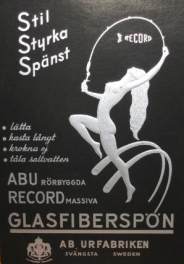
I have been visiting the site for a couple of years, and among my favorite things are the ABU advertising. The catalog inserts are also very cool (and rare) and offer a great glimpse at the history of this firm.
Rare ABU sign from Wayne's web site
If you are interested in ABU's this is a must have, and if you aren't than you will find out quickly why there are so many ABUholics out there. Stop in and spend an hour; you won't regret it.
-- Dr. Todd
It is this kind of devout loyalty that helps us understand why there are so many people who collect Ambassadeur reels. Of all the many web sites out there, perhaps the most detailed and impressive is Australian Wayne Real's "Real's Reels" site, devoted to the world of the Ambassadeur Reel.
Wayne--the Ambassadeur of Abu--has fished these reels for over three decades and has put together an unbelievable wealth of information on all aspects of ABU, from the great reels to the history to the lures to the obscure. Pretty much everything you'd ever want to know about ABU and Ambassadeur can be found in its myriad of pages.
I have been visiting the site for a couple of years, and among my favorite things are the ABU advertising. The catalog inserts are also very cool (and rare) and offer a great glimpse at the history of this firm.
If you are interested in ABU's this is a must have, and if you aren't than you will find out quickly why there are so many ABUholics out there. Stop in and spend an hour; you won't regret it.
-- Dr. Todd
Thursday, January 17, 2008
A Review of Marco Malavasi's Abu Spinning Reels of Sweden
Every great while a book comes out that sets the standard for others to emulate. Marco Malavasi's The Reelstown Guide to Abu Spinning Reels of Sweden: A Collector's Guide is just such a revelation. What Robert A. Miller did for baitcasting reels with his History of the Pflueger Supreme Casting Reel, 1916-1982, Malavasi has done for spinning reels. His work is thorough, authoritative, and above all else interesting.

The author explains in great detail the evolution of the ever-popular Abu spinning reels from their rather humble beginnings (not in Sweden I might add) to their glory days of the 1960s and 1970s to the final American and Japanese Abus. Over 200 different reels are discussed and broken down in an abundance of images. patent drawings, and documents (over 600 images, many in full color).
Of great interest is the author's ability to trace the threads of Abu history across the globe, from America to Switzerland to Japan to Germany. Abu spinning reel fans will delight at the detailed history of Sportex, the German trade house that sold branded Abu reels that for many years have puzzled collectors. Additional history on Zangi in Italy will help illuminate other previously murky areas of Abu history.
An interesting history of Abu prefaces the main body of the work, which takes us from the first models through the Cardinal era to the Zebco period and even touches on a few Japanese models at the very end. Everything from the rarest prototype to the most common models are treated with equal care by the author. Collectors will delight at the photos of cut-away promotional models, tournament casting reels, boxes, exploded drawings, and multiple shots of various reels.
The book is a 356-page trade paperback (5.5" x 8.5") and is full color throughout, something that without doubt influenced the price of the book ($80.00). Although the author is Italian, the work is written in English, and despite the author's declaration at the beginning "I'm not a perfect English speaker and often you'll find errors in my use of this language." I will attest that I have read every single word of this book and not one time was it ever unclear what the author was trying to say. As someone who grades several hundred college papers every year, I can say without reservation Malavasi's written English skills are better than many of my incoming freshman students.
This book is limited to 260 copies, and as I purchased this book over a month ago with a number in the high 100s, I would surmise only a couple of dozen are left for sale. I don't know if there is a web site, but if you are interested in spinning reels in the least, you simply cannot miss this book. Track it down. I strongly believe in a few years, those few used copies of this work that may make it to market will cost you several hundred dollars or more. It is a fascinating read and a great contribution to fishing history.
-- Dr. Todd
Subscribe to:
Posts (Atom)