Sunday, January 17, 2010

1000 Words

1000 Words


The attached photo is one of my favorites. The inscription on the back simply says "Eugene Fox -- Long Lake." There must be a thousand "Long Lakes" but Eugene was having a good day on one of them, those many years ago around the turn of the last century.  One of the few photos I've seen this old actually taken from in the boat. My bet is this lake is now surrounded by cottages and submerged in the sounds of Jet Skis. Very sad.
 
-- Bill Sonnett

Saturday, January 16, 2010

Deconstructing Old Ads with Bill Sonnett


The South Bend Wobbler 1915


The July 1915 issue Outer's Book featured this ad which was widely published at the time. It is shown here along with an entry from the 1915 South Bend Catalogue. It illustrates the "South Bend Wobbler". South Bend was a small company at the time trying desperately to "make a go of it". The Anti Backlash reel made for them by Shakespeare was one of their few success storys. With the introduction of this new bait, I think they knew they were on to something that could compete with the many "Wobblers" that had supplanted the underwater minnow as the lure of choice over the preceding two years. I don't think that they suspected that it would become a candidate for the biggest selling lure of the 20th century and a lure that is still being produced 95 years later! With all that success came a new name in 1916. One that would be familiar to all bass fishermen of several generations: the BassOreno. It was the envy of other lure companies and they produced lures specifically meant to capitalize on the BassOreno's success. In a letter in the Heddon Museum, Charles Heddon waxed that fishermen were so fickled that the sale of any new lure faded after a few years and that what the Heddon Company needed was a lure like South Bend's BassOreno that had steady sales year after year.

-- Bill Sonnett

Friday, January 15, 2010

Friday Funhouse

Video of the Week

In honor of the upcoming Winter Olympics, I present my sister's nephew Chris Plys from my hometown of Duluth, MN, a member of the U.S. Olympic Curling Team who was featured recently in this piece with Stephen Colbert on the great Colbert Report TV show.

The Colbert ReportMon - Thurs 11:30pm / 10:30c
Skate Expectations - Curling Team Tryouts - Colbert vs. Shuster
www.colbertnation.com
Colbert Report Full EpisodesPolitical HumorEconomy


Things I Would Buy If I Could Only Afford Them
You don't see these South Bend Strong-Oreno spools very often.


Holy Moly is this an AWESOME K&K Picture Box!!


This is a great S.W. Evans & Sons Eagle Claw.


This 7.5' Payne is a pretty exciting rod.


This Creek Chub Beetle in an uncatalogued color is a dream for the CCBC collector.


This is a gorgeous Pflueger 6/0 Atlapac.


Instant Collection Alert: A set of five nice Punkinseeds.


This Heddon 150 in Green Crackleback is a terrific bait.


These Joe Coxe L.A. saltwater reels are some of the nicest big game models ever made.


No one made more popular decoys than Oscar Peterson.


Wow. This Oliver & Gruber Glowwurm has reached astronomical prices.


I love mortised Thomas Chubb rods.


Who doesn't like a Toad van Houten lip?


My brother swears the Al Foss #3-25 is the greatest tournament casting reel ever.


A Pflueger Palomine in Scramble Finish is a work of art.


The Red & White Luny Frog (closed legs) is pretty much the holy grail of Luny Frogs.


I like these Everol reels a lot.


Wow. This is one of the great trade minnows ever.


As always, have a great weekedn, and be good to each other, and yourself.

-- Dr. Todd

Thursday, January 14, 2010

I'm With Coco

Thursday Review: The Reel News January 2010

Thursday Review: The Reel News January 2010

A bit late but always welcome is The Reel News, the official publication of the Old Reel Collector's Association. This issue is Vol. XX, No. 1 (January 2010) and contains some great articles.

Florida's Bill Stuart gives us the lovely "Thumbs Up for Thumb Reels" which detail the great thumb reels he had on display at the last ORCA National in Dania Beach, Florida. A great article.

The great Steve Vernon gives us "Spiral Cam Level Winds," the 14th installment in his great "Roots o' Reels" series. This one covers Spiral Winds, Smooth Casters, and others that used then oscillating spool method of level winding.

Ed Scharf weighs in with "Mitchell Salt Water Reels" which covers these ever popular larger Mitchell models.

My own contribution this month was "The Bullard & Gormley Co." that covered the trade reels of this fabulous Chicago firm. It's one of my favorite of the articles that I've written across the past five years. I also sent in a short article "Clayton Hoyle of Martha's Vineyard: Inventor of the Wood Casting Reel?" that is also reproduced directly below.

Ben Wright gives us "How Times Have Changed" in his "Spinning Lines" column that updates the Van Staal spinning reels.

Bob Miller's always anticipated "Pflueger Pfacts" column gives us a much needed bibliography on Pflueger reels, detailing the many articles on the subject that have been covered.

Dick Braun, our resident Zebco guru, sent in "A Zebco 202: Who Cares?" and lets us know in great detail why we should care very much about this, and all Zebco reels.

Jim Madden gives us another great "South Bend Bits" column on the subject of the South bend #350, their version of the Supreme.

Col. Milton's reel fix this month is the Model No. 350 Master Reel Model 1. We should all thank the Colonel for his contributions!

Ed Slane's always anticipated "Footprints in the Sand" remembers our great friend Harvey Garrison.

Stu Lawson's "More Reel Stuff" covers the ins and outs of the Kelso show.

Howard Coleman gives us a review of the latest Lang's auction.

Finally, John Elder wrote "A Look Inside an A.J. Stead Reel" that takes apart one of the saltwater monsters from this California reelsmith. A wonderful article from the learned Dr. Elder.

All in all it was an awesome and information-packed issue. Tremendous stuff, folks. If you are not an ORCA member--and why aren't you?--you can join in the fun by Clicking Here. The Reel News is ably edited by Richard K. Lodge.

-- Dr. Todd

Wednesday, January 13, 2010

Clayton Hoyle of Martha’s Vineyard: Inventor of the Wood Surf Casting Reel?

Clayton Hoyle of Martha’s Vineyard:

Inventor of the Wood Surf Casting Reel?

by Dr. Todd E.A. Larson

© 2010 By the Author


--------------------------------


While doing some research on a completely unrelated subject, I came across an interesting article in the 21 October 1966 Washington Post that I thought might be of interest to saltwater fishermen and collectors, and in particular that strange breed known as the surf caster. Written by LeRoy Whitman and entitled “Hoyle’s Wood Reel Eased Surfcasting,” it profiled perhaps the least famous reel maker in modern memory: Clayton Hoyle of Martha’s Vineyard, Massachusetts.

Martha’s Vineyard is of course famous as being the playground of the rich and famous, but as an island with 6000 year-round inhabitants at the time was also a hotbed of saltwater fishing, with an emphasis on surf casting. As Whitman declared, “Mr. Hoyle is esteemed as the man who made the first big advance in salt water angling. Back in 1907 Clayt. Hoyle revolutionized surf fishing by building the first salt water reel the islanders had ever seen. It was made of wood, built like a windless and had a leather tab on its side as a friction drag—but it worked.” What the article was describing was in essence the popular wooden “Good Luck” reel made by Meisselbach, Yale Metal Products, and more recently by Peetz. Was Hoyle the inventor of this reel?


Not likely. “Good Luck” reels, as Phil White shows in his outstanding Meisselbach research, were a staple even in the nineteenth century. Yet clearly Hoyle invented some kind of reel that, at least within his small community, engendered a kind of lasting fame. This is probably because surf fishing at the turn of the twentieth century was a laborious affair known as “drail casting.” A fisherman would start out with 16-strand 50 pound test line, soaked in water and tied taught between trees to dry out. Surf casters would then tie one end of the line to a broom stick drilled into the sand, lay out the line on the beach, and attach a seven and a half inch lead jig or “drail” to the other end. Whitman wrote “the drail caster’s art consisted of swinging the lure in a circle and timing its release so that it soared out to sea carrying his line behind it.” Then the fisherman would work the drail by hand until a fish bit or it was hauled in, to be tossed out again.

Clayton Hoyle decided there had to be a better way to fish from the shore. Tired of having large stripers pull him into the drink, he built a reel in his shop that was “single action and had no multiplying gears, but with a stout rod it enabled the surf fisherman to haul in a big fish…” Further, it allowed for lighter line (35 pound test) and more importantly, far more casts per hour. Apparently, it became popular among fisherman on Martha’s Vineyard.

Whitman did note that “his wasn’t the first saltwater reel…Charles von Hoff [sic] had made one in New York. But Hoyle’s wooden one proved very popular. In fact, a New York firm subsequently came out with one designed along the same lines as Hoyle’s but made of mahogany and equipped with ball bearings.” This was without doubt the Meisselbach/Yale Metal Works wooden reels offered in the 1920s and 1930s, although the casual reader might have wondered about the spelling of Edward Vom Hofe.

Clayton Hoyle remained active in the fishing tackle trade his whole life, running a tackle shop in Oak Bluff’s on the island where he made surf rods, repaired reels, and of course sold his Hoyle surfcaster. Was Hoyle the inventor of the wooden surf reel? Absolutely not. It would be fascinating, however, to examine a Hoyle surf casting reel to see what (if anything) differentiated it from a number of its far better known competitors. Whether it was truly original or just another take on an old idea, we can thank LeRoy Whitman of The Washington Post for bringing to light information on at least one small east coast reel maker.
Has anyone ever seen a wooden reel marked Clayton Hoyle?

NOTE: This article appeared in the January 2010 edition of ORCA's Reel News.

-- Dr. Todd

Tuesday, January 12, 2010

Voices from the Past: Edward Chalmers, Reel-Maker-Turned-Miner


I ran across this bizarre article in the 30 April 1954 Charlestown Gazette about a reelmaker named Edward Chalmers of Glenville, CT, who claimed to find a uranium mine on government land. Reelmakers are an odd lot but this gentleman has to be the only one to ever stake claim to a uranium mine. Anyone know what kind of fishing reel Chalmers made?

Uranium Claim Staked On New York State Land

ALBANY, N. Y., April 29 — (INS) — An amateur prospector from Connecticut has staked a claim to New York State-owned lands which he believes are heavy with uranium deposits.

If the claim of a uranium find is borne out, it would be the first major source of uranium yet discovered in the Eastern United States.

The prospector. Edward Chalmers, of Glenville, Conn., filed 34 claims for 1,360 acres of the son Highlands, near Peekskill and about 35 miles north of New York City. The site is that of Camp Smith, used by the New York National Guard.

Chalmers, 44, is a machinist and fishing reel manufacturer, and his find was first reported by the Albany Times-Union.

Until the depth of the reported deposit is determined, its commercial feasibility will remain unknown. But Chalmers believes it could develop into a major source of uranium, a key element in production of atomic weapons.

Chalmers' Geiger counter reportedly recorded .064 per cent of equivalent uranium in the ore-bearing rock. This was said be higher than in that of deposits in the Colorado Plateau, where most of this country's uranium is mined.

Arthur J. McLoughlin, secretary of the State Land Office in Albany, confirmed the claims were filed with his office.

The State Land Board will hold hearings in New York City next Tuesday to decide whether Chalmers can make depth drillings.

Chalmers, reported "out-of-town," filed his first six notices of discovery on Sept. 25, 1953. On last Jan. 22, he filed 28 more notices, which amount to staking a claim.

Papers filed state he has "discovered a mine or deposit of uranium or component parts of derivation thereof."

Chalmers' attorney, George Hurlburr, of Greenwich, Conn., declared further information would have to await decision by the land board.


-- Dr. Todd

Monday, January 11, 2010

News of the Week: 11 January 2010


A new world record bass...the MIlwaukee show gets more press...safety first on the ice...prize tackle box stolen from 14 year old...Bass Pro buys Minnesota marine chain...a UK program breaking racial barriers...the pelagic plague...bassin' from the bog in Rhode Island..."rolling meat" method...the war on iced fishing rods...Zebco Sports Europe celebrates an anniversary...North Carolinian rebuilding used tackle...'Bama cheerleader is quite the angler...it must be THE NEWS OF THE WEEK!

The Big Lead: What else? The World Record Bass is officially a tie.


The Milwaukee NFLCC show gets another bump.

One writer declares there is a fine line between clutter and collectible.

Safety first when it comes to ice fishing.

Idiot lowlifes steal 14-year old boy's prize tackle box.


Bass Pro Shops buys Crystal-Pierz Marine stores.

Down below there are plenty of quality fish to be caught.


Tragic angling death splits family apart.

One U.K. program is breaking racial barriers.


A tackle shop's return is like starting over.


In Malaysia, one man has rod, will travel.


Fly Rod & Reel's Ted Williams weighs in on the pelagic plague.


Oklahoma City's Lucky Lure's Tackle is burgled.

In Rhode Island, they are bassin' from a bog.


An Irish fisherwoman has broken an IGFA world record.

This lad has great success with the "rolling meat" method.


Field & Stream's John Merwin opines on the war on iced fishing rods.


Zebco Sports Europe celebrates its 150th anniversary (really) with the Browning Z9 rod.


This North Carolina surf casting instructor is rebuilding old and used tackle.


Finishing With a Flourish: While Alabama fans revel in a National Championship, one Crimson Tide cheerleader would rather be fishing.


-- Dr. Todd

Sunday, January 10, 2010

A Thousand Words with Warren Platt

Thousand Words with Warren Platt

Two photos of six men and women on what looks like a Sunday outing. All smiles from everyone except for the two in the background of the lake. What perfect timing from the photographer! The women's hats are to die for!


-- Warren Platt

Saturday, January 9, 2010

Deconstructing Old Ads with Bill Sonnett


The Wise Sportsman Jim Dandy


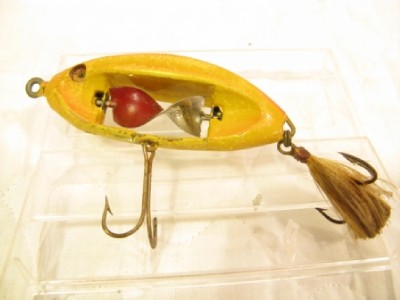
The Wise Sportsman Company introduced the "Jim Dandy" in 1915 after acquiring the rights from the inventor Henry Schillinger of Paw Paw Michigan. If you look at this ad from the August 1915 issue of Outers Book, you will notice that the face of the plug is hollowed out completely to the front edges of the bait. The following year the face of the bait had changed as illustrated in the 1916 advertisement show here. The patent drawing illustrates a bait that is much more like the 1915 illustration. My guess is that when mass production began it proved just too expensive and time consuming to hollow out the entire asymmetrical face of the lure. Shown here in the photo is an example of each style. In my experience, 1915 examples are much harder to find than the moderately common models that follow. I'm not sure when it happened but the Wise Sportsman Company sold the rights to this lure to Shakespeare. Shakespeare examples are very tough to find and do not have the unique wire hook holders that are always seen on earlier models. Every Shakespeare example of this bait I have ever seen with one exception was painted black with a bit of white and red trim. The bait was obviously not a success for Shakespeare and as they then owned the rights to the name "Jim Dandy" they went on to use it for an entire line of their less expensive baits.


-- Bill Sonnett

Friday, January 8, 2010

BREAKING NEWS: It's Official--The Kurita Bass Ties George Perry

Well, the long wait is over -- the Kurita bass is officially a World Record, officially tying George Perry's record of 22 pounds 4 ounces. ESPN weighs in here .


Photo Courtesy of IGFA.org.

Here's the official IGFA Press Release:

It’s official; largemouth bass caught in Japan ties IGFA All-Tackle World Record

Freshwater fishing’s “Holy Grail” now has dual holders; 22 lb 4 oz bass caught by Japan’s Manabu Kurita matches IGFA record held for 77 years by Georgia’s George Perry

DANIA BEACH, Fla. USA, (January 8, 2010) --- After nearly six months of waiting, Japan’s Manabu Kurita is taking his place along side Georgia, USA angler George Perry in the International Game Fish Association’s (IGFA) World Record Games Fishes book as dual holders of the All-Tackle record for largemouth bass each weighing 22 lb 4 oz and caught 77 years apart.

Today the IGFA approved Kurita’s application for the fish caught from Japan’s largest lake on July 2, 2009. The 70-year old non-profit fisheries conservation, education and record-keeping body, received Kurita’s application and documentation on Sept. 19, 2009. The largemouth bass (Micropterus salmoides), was caught from Lake Biwa which is an ancient reservoir northeast of Kyoto.

Kurita, 32, of Aichi, Japan, was fishing Biwa that July day using a Deps Sidewinder rod and a Shimano Antares DC7LV reel loaded with 25 lb Toray line when he pitched his bait, a live bluegill, next to a bridge piling. It was Kurita’s first cast to the piling where he had seen a big bass swimming. He only twitched the bait a couple of times before he got bit. After a short, three minute fight he had the fish in the boat.

Kurita was quoted as saying “I knew it was big, but I didn’t know it was that big.”

But big it was. Using certified scales, his fish weighed in at 10.12 kg or 22 lb 4 oz. When measured, the fish had a fork length of 27.2 inches and a girth of 26.7 inches. The IGFA only has line classes up to 20 lb for largemouth bass, so Kurita had no chance at a line class record as well.

IGFA rules for fish caught outside the U.S. allows anglers 90 days to submit their applications from the date of their catch. The documentation was received through the IGFA’s sister association the Japan Game Fish Association (JGFA). IGFA conservation director Jason Schratwieser said Kurita’s application was meticulously documented with the necessary photos and video.

Kurita’s fish ties the current record held for over 77 years by Perry who caught his bass on Georgia’s Montgomery Lake, June 2, 1932, near Jacksonville, Georgia. That 22 lb 4 oz behemoth won Field and Stream Magazine’s big fish contest and 46 years later, when the IGFA took over freshwater records from Field and Stream, it became the All-Tackle record now one of over 1,100 fresh and saltwater species the IGFA monitors.

IGFA All-Tackle records are now free for viewing by the public at igfa.org. Kurita’s name is now on the IGFA Web site with that of Perry’s and will appear in the 2011 edition of the World Record Games Fishes book…. unless that record is broken this year.

The IGFA announced the decision at its headquarters with a live video feed carried on Bassmaster.com, one of the most popular fishing Web sites in the world and the official site of the Bass Anglers Sportsman Society (BASS).

In North America the largemouth bass, and especially the All-Tackle record, is considered by millions of anglers as the “holy grail” of freshwater fish because of its popularity and the longevity of Perry’s record. That fish undoubtedly helped to spawn a billion dollar industry that today makes up a significant part of the sport of recreational fishing.

Schratwieser said, “The moment Kurita weighed his fish, word spread like wildfire. We knew this would be significant so we immediately contacted the JGFA for more information. Established in 1979, and JGFA compiles and translates all record applications of fish caught in Japan before forwarding to the IGFA.

“It works out well because they not only translate applications but can also contact the angler if more documentation is needed.”

It turned into a lengthy process
“Since the IGFA requires three months from the time of capture before a record can be approved, the official word would have to wait until October 2,” said Schratwieser.

“However, almost right away rumors began to circulate that Kurita may have caught his fish in a ‘no-fishing zone’. In response, the IGFA immediately corresponded with the JGFA to speak with the angler about this issue and to gather information regarding the legality of fishing where Kurita caught his bass. Official word came back that the location of the catch was not a no-fishing zone, but was an area where anchoring or stopping was prohibited. This spurred more correspondence with the JGFA and the angler, including affidavits asking the angler if he stopped his boat at anytime. Again, the testimony and affidavits that came back indicated that the Kurita did not violate any laws and that his catch was indeed legitimate.”

It didn’t end there.

A considerable amount of time and correspondence was to continue between the IGFA, JGFA and Kurita, a primary reason it took so long to come to a decision.

During this time, the IGFA was also besieged with letters and emails from the bass fishing community, said Schratwieser.
“Many were incredulous that the All-Tackle record could be tied from a fish in Japan. Others beseeched the IGFA to approve the record and give Kurita the credit he deserves. Still others wanted to know why the entire process was taking so long. It soon became clear to the IGFA staff that this would be a contentious issue no matter if the record were approved or rejected.

“The IGFA was also sensitive to this particular record because in past years there have been several attempts to sue us over largemouth bass record claims. Although none of these claims have been successful, they have resulted in considerable legal fees for the IGFA,” he said.

In the end, the IGFA staff concluded it would be both in the best interest of the IGFA and that of Kurita if he submitted to a polygraph analysis. The IGFA reserves the right to employ polygraph analyses to any record application, and this is explicitly stated in the affidavit section of the world record application form.

Again, more correspondence was issued to the JGFA to request that Kurita take a polygraph test.

He immediately agreed.

On December 15, Kurita was examined by a professional polygraph analyst in Japan. The many questions he was given included if he was truthful about the information reported on the application form and if his boat ever came to a complete stop while fighting his fish.

The results from the polygraph concluded that Manabu Kurita answered the questions honestly and that the catch was legitimate.

George Perry’s 77 year old record was officially tied.

Due diligence pays off
“Six months may seem like a lot of time to determine if a fish ties a record,” said Schratwieser. “Hopefully, people now understand the amount of due diligence the IGFA conducted on this record. Although we treat all records with equal rigor, the All-Tackle largemouth bass record is nothing less than iconic and the bass angling community deserved nothing less.”

Schratwieser added, “The IGFA wishes to applaud Kurita on his outstanding catch and would also like to commend him on his patience and candor during the entire review process. We would also like to thank the JGFA for their diligence and tireless assistance in corresponding with Kurita and fisheries officials.”

Biology and bass across the globe; where will the next record come from?
Largemouth bass have also been introduced in many countries but in Japan fisheries officials consider it an invasive species. In addition, because bass are not native and are stocked in Japan, many speculated that the big bass was a sterile triploid. However when biologists in Japan examined the ova of the big female, Schratwieser said they concluded that the fish was not triploid.

For over 77 years the record stood as bass fanatics theorized when and where the record would be broken. Over the years there have been rumors and unsubstantiated reports of bass that could have tied or eclipsed Perry’s record, but nothing ever passed IGFA criteria. Some anglers did come close, however.

Schratwieser said the closest came in 1991, when Robert Crupi caught a 22 lb bass in Lake Dixon, California USA, that still reigns as the 16 lb line class record and the third heaviest approved bass record in IGFA history.

“Most people thought that the next All-Tackle record would come from California. Until Kurita’s tie the seven heaviest bass records behind Perry’s came from California lakes. Although not native to California, it appears transplanted bass have adapted quite well to the deep, clear lakes and reservoirs and the abundant trout forage found in some of them.

“Little did people know that introduced bass grew big in places besides California, and that there are true monsters swimming on the other side of the world in Japan.”

-- Dr. Todd

Friday Funhouse

The Friday Funhouse

Video of the Week

The Largest catch-and-release in history.


Things I Would Buy If Only I Could Afford Them
Another Perfect Hardy fly reel.


This Ambassadeur 5000C De Luxe is about the pinnacle of casting reel perfection.


Leonard Duracanes are not my cup of tea, but some people love 'em.


I love the Wee Dee but how do you display it with those pokey wires?


The Charles Ritz Parabolic has that touch of old world class.


A Chapman & Son Water Nymph is a very, very rare metal bait.


Shimano Twinpower, ACTIVATE!


Heddon Head-On Basser in Blue Scale is scarce as hen's teeth.


This Palomine from Pflueger has attracted a ton of interest.


I'm a sucker for the Howe's Vacuum Bait in the box.


A charming Charmer.


My all-time favorite bait: the Immell Chippewa.


This Dowagiac Basser is also a rare Heddon bait.


It must be Heddon week as this Sienna 150 is a super bait.


This Heddon Fly Rod Runtie is super hard to find in wood.


I've never seen this Police 911 Ambassadeur before.


It must be ABU week too, as this ABU 3000 is another scarce model.


A wooden CCBC Deepster in frog? Yes, please.


As always, have a great weekend, and be good to each other, and yourself.

-- Dr. Todd