Friday, August 10, 2012

The Friday Funhouse

The Video of the Week

My friend Dick Braun sends in this incredible documentary done by his local PBS station on the history of Tarpon fishing. It is WELL worth the time spent watching it!

Watch Silver King on PBS. See more from WGCU Presents.

12 Things I Would Buy If Only i Could Afford Them This is a rare dealer box of Pflueger Wizard fly rod lures.
A lot of seven tied flies from legend Gary Howells is a nifty find.
This Julius vom Hofe fly reel is spectacular.
This is a pretty cool Pflueger gem clip underwater minnow.
You never see a Charlie Wheeler fly rod for sale.
A Vom Hofe Commander Ross #722 is a superb and rare saltwater reel.
A 1910 Bristol Steel fishing rod catalog is a wonderful find.
This Ideal float display will make a bobber collector very happy.
This Bogdan salmon reel is a work of art.
This is a nice Sears Ted Williams reel in the box.
This Wiltom Glass Minnow Tube is pretty spectacular.
This is a super rare phantom on the card.

As always, have a great weekend, and be kind to each other, and yourself.

-- Dr. Todd

Thursday, August 9, 2012

Hibbo Scores, We Riot

As a dedicated Everton fan since the early 1990s, this post will only mean something to my friends in the U.K. -- but damn if Hibbo didn't score in his own testimonial.

So, as promised, when Hibbo scores, we riot!


-- Dr. Todd the Toffee

Videos of the 1931 Keeley Fishing Tackle Trailer Rig

Video of the 1931 Keeley Fishing Tackle Trailer Rig

Yesterday, we gave you some photos -- historical and current -- of this incredible rig. But you have to see it in video to understand how truly cool it is. Here's a 360 degree tour of the car and trailer's external.


Donnie Gould, the president of Auctions America, was kind enough to answer a few questions about this incredible combo for us. It is well worth a listen.


Many thanks to Donnie and the team at Auctions America in Auburn, Indiana for taking this out of storage and allowing us access to it.

This rig goes to auction on Labor Day weekend, so we'll be watching very carefully to see what it goes for. Remember to check out the 1931 J.M. Keeley Car and Tackle Trailer photos on the Auctions America web site!

-- Dr. Todd

Wednesday, August 8, 2012

1931 J.M. Keeley Car and Tackle Trailer

1931 J.M. Keeley Car and Tackle Trailer

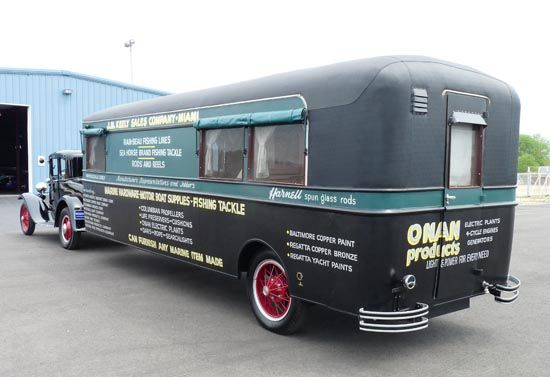
As promised in a previous post, I said I would give everyone a better look at the incredible J.M. Keeley fishing tackle car and trailer. Here is a photographic tour of the outside and inside of the trailer and car, courtesy of Donnie Gould and his incredible team at Auctions America in Auburn, Indiana. Donnie pulled out the car and trailer from the auction building and gave us a private tour, and it was as awe-inspiring as you can imagine!
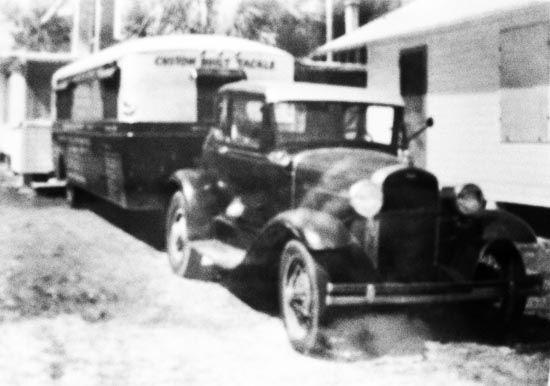
The rig as it appeared in the early 1930s.
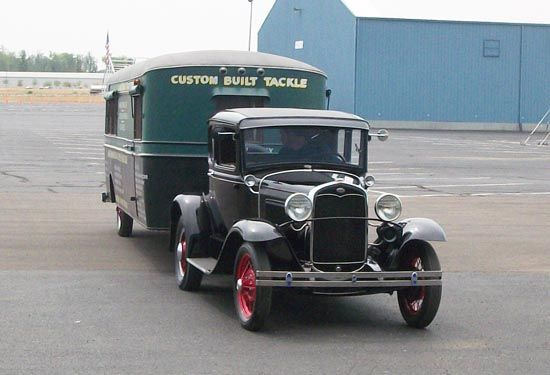
The rig as it appears today, fully restored.

Seeing the Keeley trailer in person is just awesome. I cant imagine a cooler tackle-related item in history. The restoration was just amazing.

Close up of the custom-built 1931 Ford car.
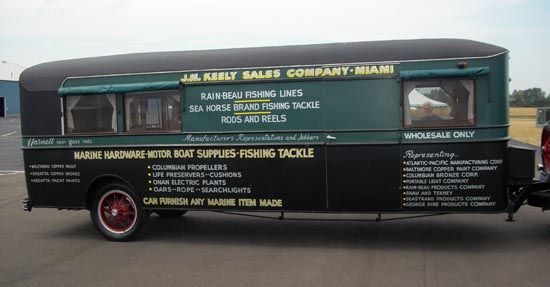
Nice side shot of the trailer.

A photo of the other side.

The inside of the trailer has been restored, but was full of the original tackle items awaiting the new owner to put in what they desired. Here are a few internal shots showing how cool (and how customized) this trailer was.
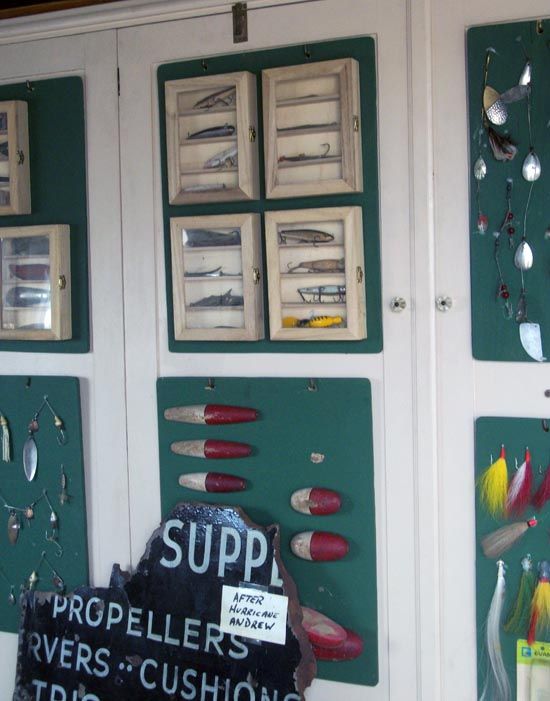
The walls are full of tackle displays for prospective buyers, including the neat H-I bobber and L&S baits display.
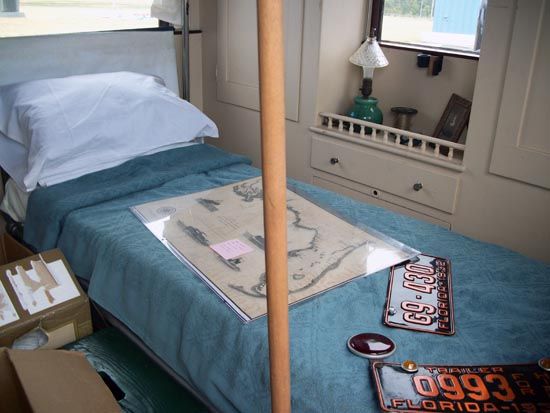
J.M. Keeley had a bed put in so he could sleep while on the road.
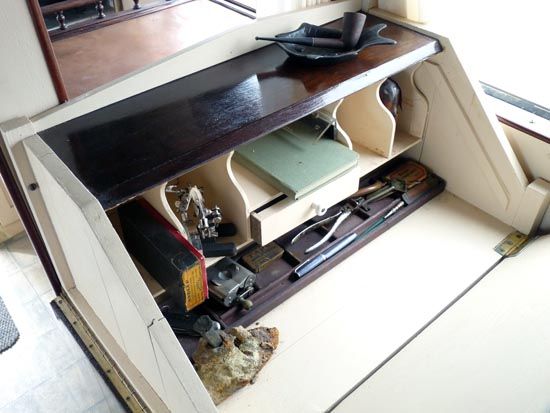
The trailer had a kitchen, dining room, and even a fly tying bench and table.
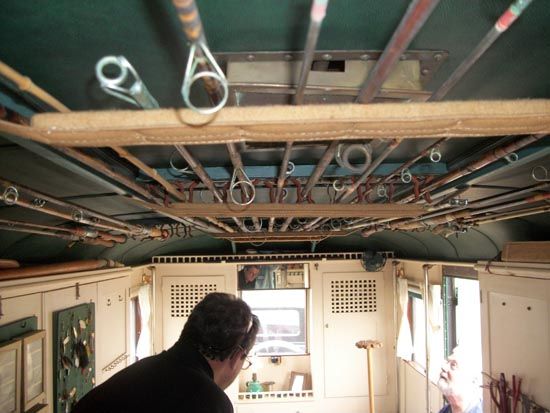
Even the ceiling was converted to hold fishing rods.

The restoration of this car and trailer was a truly daunting project. Below are a couple of "before" photos. The combination was found in the Florida Keys, and looked like this when it was discovered:
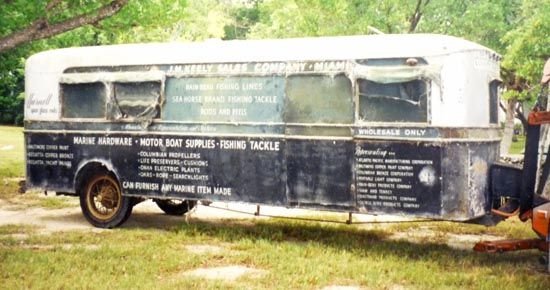
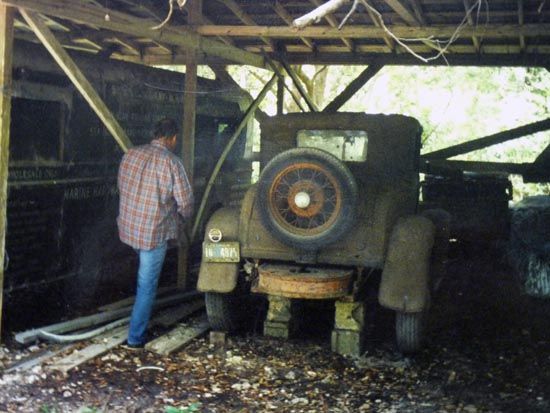
J.M. Keeley himself was a prominent tackle and marine products representative based out of 2380 NW 23rd Street in Miami, Florida.
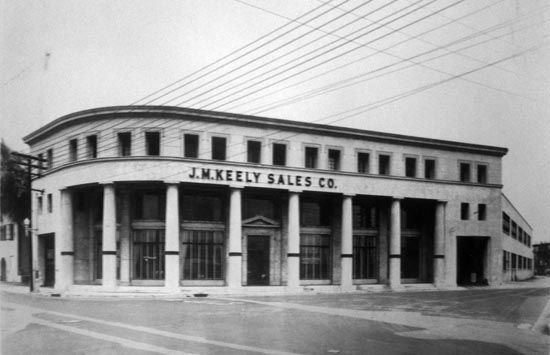
The Keeley building was used as a showcase for their product line.
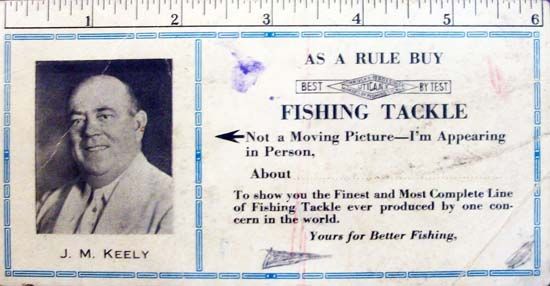
Keeley himself promoted his company through such things as this Horrocks-Ibbotson ink blotter and ruler.

It was an incredible experience seeing this in all its glory, and my thanks go out to Donnie and Auctions America for letting us get a look at it.

Our final view of this incredible combination.

Tune in tomorrow where we'll post a couple of videos you'll definitely want to see.

Check out the auction photos for the 1931 J.M. Keeley Car and Tackle Trailer yourself!

-- Dr. Todd

Tuesday, August 7, 2012

Voices from the Past: Fish Hooks of Many Kinds (1903)


The following article, published originally in the Scientific American Supplement (28 November 1903) is as good an overview of the process of hook making as you're likely to find. It really is well done. It is called "Fish Hooks of Many Kinds."

At a recent meeting of the Anglers‘ Association of Onondaga, George Barnes Wood, of Syracuse, read a paper on “Fish Hooks." Among other things he said:

Primeval man hooked and caught fish by the aid of numerous devices, the most important of which were gorges made of bronze or stone. The latter consisted of pieces of stone about an inch in length with a groove in the middle for a line. One of these gorges, a relic of the Stone Age, has been discovered in France and is about eight thousand years old. When swallowed by the fish, it turned across the fish's gullet and held it secure.

After stone, bronze was used. and then bone. The early Indians used bone, thorns and antlers, and later improvised hooks made from hand forged nails.

The saying of Amos in the Old Testament established the fact that fish hooks have been used nearly 2,700 years. lie says, "The days shall come upon you, that he will take you away with hooks, and your posterity with fish hooks." (Amos iv., 2.)

It has been stated that the best quality of hooks are made in this country and that the imported hooks are inferior in temper and durability. The facts are simply reversed. There has been but one factory in the United States that ever made the attempt to compete with the imported hooks, and it gained a fine reputation for turning out hooks which were compared to pin hooks, with the exception of their having a barb.

The reason why Americans do not manufacture as good hooks as those imported is the same as why we cannot make needles. We lack the experience in tempering, and, until recent years, have been unable to make steel to compare with that of England, Germany, and France.
There are over two hundred different sorts of hooks. each having from twenty to thirty sizes, among which may be mentioned:

Eyed, Flatted, Ringed, Tapered, Turndown eye. Knobbed, Spiral eye, Kirby, Limerick, Kendall, Sneck bent, Pennell turndown eye, Cholmondeley Pennell, Gravitation cod, Double brazed, Double black or japanned, Double brazed live bait, Lip hooks, Mansen treble, Double reversed Limerick, Round bent sea hooks, Harwich sea hooks, Exeter, Shark, Carlisle, Cincinnati bass, New York bass, New York trout. Perfect trout, Perfect bass, Halibut, Mackerel, Dog, Roach, Hake, Mackensie, Baiting hook, Central draught, Indiana bass, Kensey, Blackfish, Sheepshead, Whiting, Virginia, Chestertown, 0’Shaughnessy, Aberdeen, Sproat, Bayonet point, Spear point, Hollow point, Needle point, Double, Treble, Quadruple, Double safety pin, Norway, Yankee, Pothook, Weedless, Sockdolager, Automatic, Round bend, Pennsylvania, Salmon, Crystal.

Yankee inventions on fish hooks have been numerous, but little attention has been given to efforts to change the shape. I have examined the United States Patent Office reports and find 119 patents were granted on fish hooks from the year 1872 to 1903, an average of about four each year. The banner year was in 1899, their being fourteen patents issued. Nearly all patents have been on the principle of the “snap-and-catch’em" order, none of which appeals to the true angler.

The Kirby is the oldest steel hook made in England. its name is derived from its inventor, a Mr. Kirby, of London. Samuel Allcock, of Redditch, England, writes me that he remembers the appearance of the Kirby hook sixty-five years ago. This hook has a curve in the body, is commonly called a bent hook and does not lie fiat on a level surface.

The Limerick follows next in order. It is a straight hook and lies flat on the level. The bend is more acute and the barb a trifle longer than on the Kirby hook. it was made in Limerick, Ireland; hence its name.

Shortly after it came out, a Mr. Philips, of Dublin, Ireland, made a slight alteration of the point. instead of a straight point, he causedthe point to stand out; he also made it not quite so long, hence the name "Dublin Limerick.” His claim was that upon striking the fish it was more sure of hooking him.

The Kendall hook was first made in Kendall, England, whence its name. It has an almost square bottom and is bent like the Kirby, the shank being about the same length.

Carlisle hooks were first made at Carlisle, England. They have a round bend and lie fiat. Later they were manufactured at Kirby and given a bend and were termed “Carlisle Kirby," which shape is mostly used in this country and called Carlisle.

Barbless hooks have been used by the Japanese for centuries. They are much used by fish breeders in order to avoid injuring the fish when taken from the water to be stripped of spawn and milt for the hatchery.

When Seth Green was in charge of the New York State Fish Hatchery at Caledonia, he made the assertion that more fish could be caught and saved by barbless hooks than any other. He gave me a few to try and taught me how to make them, which was by using the best steel needles. First we annealed them and then bent them around a form which was like a Carlisle, only the point was a trifle higher.

I made over one hundred, which were distributed among my angling friends as an experiment. The results were the same. On small trout, which could be quickly landed, it worked admirably, but for bass, pike, and pickerel it was a failure, as the reports showed a loss of six per cent of fish hooked.

H. Cholmondeley-Pennell. of London, was formerly inspector of Sea Fisheries of England. The eyed trout hook was perfected by him in 1885, and, strange to say, it is almost a new hook to the angling fraternity in the United States.

It is used extensively in England, especially for flies, as they are much easier to carry and with little practice are quickly changed from one kind to ,another on the leader. i consider the draft better than any other kind. The Limerick style combines the three great requisites of penetration, holding power. and flotation, or the general contour of the shank.

Double hooks originated centuries ago. They are said to have been used before the single hook. Many millions of double hooks are now utilized in this country for the manufacture of spoon baits. gangs, and inventions to represent fish.

More than a century has passed since any attempt has been made to improve the eye. One manufacturer has lately been granted a patent on double interchangeable hooks. The shank is arranged like a safety pin. its advantages are: It can be attached and detached iii a second; it can be made in single or treble hook as well.

The sproat hook is undoubtedly one of the best known and most universally used hooks throughout the United States. It has been termed by some the hogback, as it has that appearance when laid on its point.

It has gained a world-Wide reputation on account of its admirable form, having a beautiful curve, and penetrating power is very near correct because the pull is nearly in the direction of the point. it also has the advantage of being less liable to break than any other on account of its general construction, together with the size of the wire used.

The wire used in hook making is the best English cast steel, which must be first quality—otherwise it will not temper properly—the gage or size varying according to the requirements of the hook to be made.

First—The operator takes a part of a coil of wire in his hand and places the ends in a gage, and the correct length being arrived at, he quickly and sharply cuts them into lengths with a large pair of shears.

Second—Bearding. A number of wires thus prepared are arranged on a plane surface, with their right-hand ends against an upright. The barb, or beard, is then cut by means of a hollow-ground knife which, being pressed forward and deftly turned by the hand of the workman, opens the barb to the required angle, great care having to be exercised in this operation to avoid cutting too deep or opening too wide, or the barb breaks when used.

Third—Filing. The points are now carefully filed. Using a pair of tongs made specially to hold the wire and rapidly turning the same a point is filed on instantly, forming either what is termed a hollow, Kirby, or Dublin point. All best hooks are filed this way by hand, thus giving to the point three or four knifelike cutting edges, enabling it to penetrate much more quickly than the less expensive needle pointed hook.

Fourth—Bending. It is now necessary to give the hook its form, and for this purpose the workman holds a mold fashioned like the pot hook of our copybooks, mounted on a wooden handle. With one deft movement the beard is hooked around the shorter end. and a quick turn brings the shank straight with the shank of the mold.

Fifth—By the aid of an ingenious machine, or hammer, the end of the shank is either ringed, flatted or marked. if intended for salmon or trout flies it is filed to a delicate point, or knobbed.

Sixth—Process six is most important, and is that of the hardening of the hitherto soft steel hook. This is carried on in a specially constructed building, and consists in placing the hooks in a white-heat furnace, watched by an experienced workman, who withdraws them on seeing them attain a certain appearance, and plunges them into a vat of oil. This converts the temper of the hitherto soft hook into a highly brittle condition. Mere description cannot do justice to this stage of hook manufacture.

Seventh--Tempering. The hooks are then taken from the oil, mixed with heated sand, and placed in an iron pan over a fire, sand and hooks being kept in constant motion. Ever and anon, a hook is picked out and tested, and as soon as one lot is deemed sufficiently tempered it is passed to one side and another takes it place.

Of course the experience of the operator dictates the finish of each parcel, and the man is always selected from those of the highest capabilities. The heat required for each size and style of hook varies, and there is all the difference between a hook too hard or too soft.

In the former case, immediately it is struck against the hard jaw of a fish it breaks, either going at the bend or the point. Nothing is more irritating to the fisherman than to find the fish pricked and gone, and the point also minus, and this not discovered possibility till he has hit, and, as he thinks, by some fault of his own, missed the rising fish.

Eighth--Scouring. For this purpose the hooks are placed with water, etc. in oblong barrels, which are kept in motion by steam power from one to two days, thus removing all scale and leaving the hooks ready for the ninth process of polishing.

Ninth--Polishing is performed in two ways. The hooks are placed in an oblong bag, with sawdust, and are rapidly shaken from end to end, until they become quite bright. The other way is to place them in barrels, moving more or less rapidly round on their bases, inclined at an angle of 85 degrees from the perpendicular. It is found that this inclination has a greater more certain effect toward the end in view than an upright or horizontal position would have,

Tenfth——Consists in the application or various methods of protecting the hooks from the corrosive action of water. Japanning—that is, giving the hooks several coats of a specially prepared black Japan; tinning or coating them with tin; rust-proofing, browning, bluing, and coloring them red for worm fishing, or blue, green, yellow, etc., for fly dressing.

One factory alone in England turns out an average of 7,000,000 fish hooks a week.

Nearly all the best known hooks are numbered alike, starting with a hook which measures about 7-16 inch from the point across to the shank and in called No, 1. From that, hooks down to the smallest in common use, No. 15, although one hook is made as small as No. 20, which is 3-16 inch. The larger sizes start from No. 1 and run up in naughts to No. 10-0 and even 14-0, the larger sizes being used for salt water fishing.

Cincinnati bass hooks have independent numbers starting with No. 30, the smallest of which measures 1/4 of an inch and going up to No. 16, which is 13-16 of an inch. Number 24 corresponds with No. 1 in ordinary styles.

The Kinsey is also oddly numbered, ranging from No. 24, the smallest, up to No. 6, the largest. No. 16 corresponds with No. 1 of the common hooks.


-- Dr. Todd

Monday, August 6, 2012

News of the Week: 06 August 2012


Don't have time to read 50+ fishing and tackle collecting blogs and web sites? Well, let us do it for you! Follow all of the latest news, articles, and stories on our Whitefishpress Twitter account! Hint: You don't need to be a member...just bookmark the Twitter Feed Page or click on latest links to the right!

THE MONDAY 10: The Ten Fishing Stories of the Week You Need to Know

The Big Lead: Jim Hardy of the famed firm has passed away.

Tony Floor's tackle box is dedicated to salmon.

Ohio's record fish list is updated.

The Hardy Cup at the Catskill Museum.

Doing the Jitterbug after dark.

What do fly fisherman think of Eric Sharp's new lure?

Thomas & Thomas on win that fly rod.

Lake closed after fisherman catches clump of human hair.

Dry Flies are doing the business.

Finishing with a Flourish: Bernie Schultz profiles the great Glen Lau.


-- Dr. Todd

Saturday, August 4, 2012

Deconstructing Old Ads: The Long Island Manufacturing Company's Flasher Lures (1934)


The Long Island Manufacturing Company's Flasher Lures

The first time I saw a “Long Island Flasher” lure was at a NFLCC lure show about 25 years ago. As I recall, it looked a little like a Heddon Vamp and was painted with a cream colored body and a blue head. The paint had a pearlescent luster that was extremely attractive. There was no one at the show who had any idea what the lure was or who had made it. The most memorable thing about the bait was the strange and beautiful paint job.

I had seen a similar pearlescent effect on a Shakespeare Jr Swimming Mouse that I had purchased in 1957. It caught countless Bass over the years. That pearlescent paint always looked great in the water and I attributed much of the lure's success to the plug's finish. As the years rolled by I was always hopeful that I could find another Shakespeare Mouse in the same color as a “back-up” in case I lost the one I had. This was before the NFLCC and lure shows brought forth an endless supply of old baits to fish with. My solution at the time was to attempt to turn out some “swimming mice” bodies on a lathe from white cedar. Lets just say that no two ever turned out exactly the same, but most swam well, all be it at vastly different depths. What I really wanted was to duplicate that pearlescent finish that had been so successful to begin with. At that time I was doing a lot of bird taxidermy and some fish taxidermy. A taxidermy supplier sold a base coat for fish mounts that was made with powdered fish scales. I had purchased some but never used it. I painted one of my homemade mice with it and it produced a nice pearlescent effect, though somewhat whiter that my original Shakespeare bait. That homemade bait caught fish like crazy. After a year or two it started to change color and take on a pinkish hue eventually becoming a flesh color. Though it has darkened over the last thirty plus years it still maintains some of the pearlescent effect.

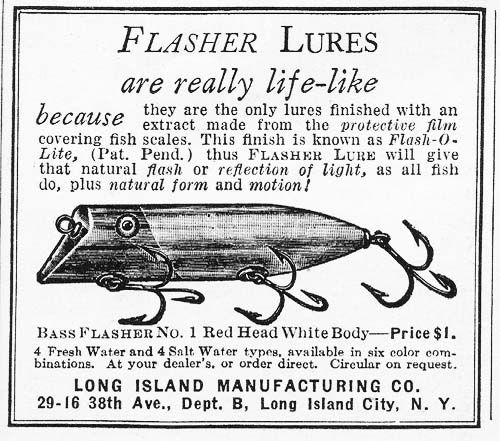
A few weeks ago, I ran across the first advertisement for a “Flasher Lure” I have ever seen. It is in the May 1934 issue of Field & Stream. I was delighted to see that it contained the “secret” of that pearlescent paint job. The lure was “finished with an extract made from the protective film covering fish scales”. I don't think they are talking about the slimy coating on the outside of a fish, but rather something off the surface of the scales themselves. Playing off the somewhat recent popularity of the battery operated flashlight the finish was called “Flash-O-Lite”.


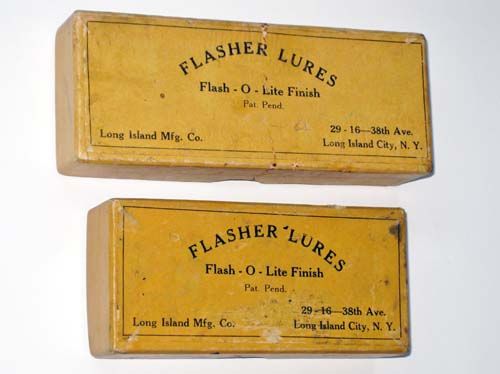
It is generally agreed among those who collect them, that this ad represents the approximate time when the Long Island Manufacturing Co started to sell its line of “Flasher” lures. There is not much advertising to be found and the collectors I spoke to all feel that they did not remain in production past the beginning of World War II. The pictures of “Flasher” lures shown here were provided by Gary Deppe to who I am very grateful for all his help. Enjoy some of these beautiful lures compliments of Gary.


-- Bill Sonnett

Friday, August 3, 2012

The Friday Funhouse

Video of the Week

Holy Jumping Makos, Batman!


SPECIAL BIG LEAD: Own A Piece of Dan Basore?

Need your Basore fix but Dan's too busy tracking down a van full of tackle? Now you, too, can buy a piece of Dan Basore.


12 Things I Would Buy If Only I Could Afford Them

A Musky Chippewa is nothing to sneeze at…

Any Moonlight Pikaroon in the box is a great find.

A Bert Quimby tied fly is attracting a huge amount of interest.

Who wouldn't like this Shakespeare "Pig" Glass Minnow Trap?

You don't see many Vance Waters lures in boxes.

This Blue Shore Minnow River Runt Spook is one of my all-time favorite colors.

The Bronson Invaders keep rising in price.

A 1931 Creek Chub catalog is a thing of beauty.

This is one cool Heddon vamp.


The most bizarre lure ever made? The Turner Spider.

This Woods underwater Expert is a great find.


Don't know who made this but it is really cool.


As always, have a great weekend -- and be nice to each other and yourself.

-- Dr. Todd

Thursday, August 2, 2012

August 19: Sporting Collectibles Auction in Cadillac, MI

Gary Miller sent in this reminder and I thought I'd repost it here.

Just a note to remind everyone that Auctioneers, Inc. (formerly Century Asset Management, Inc.) will be holding their annual Sporting Collectibles Auction in Cadillac, Michigan on August 19, 2012.  All pertinent auction details including a downloadable and searchable auction catalog and brochure are now posted on the auctioneer's website (http://www.centuryassets.com/) under the heading, "August 19, 2012 – Sporting Collectibles, Cadillac, MI".

This years offerings include 15 Oscar Peterson items including one plaque, fish decoys by George Aho, Sonny Bashore, Bear Creek, Floyd Bruce, Mark Bruning, Larry Compoe, Virgil Curtis, Cal Deming, Carl Christiansen, A. J. Downey, Jack Eddy, William Faue, Isaac Goulette, Louie Hill, Lorry Huested, Tony Hughes, Fridolf Hummelgard, Karl Johnson, Mike Maxson, Jay McEvers, Bob Miller, Dennis Nelson, Jim Nelson, Leonard Nelson, Floyd Osga, John Panula, Martin Pestrue, Ernie Peterson, Kimberley Richards, Tom Richards, Tom Singleton, James Stangland, Bud Stewart, Hugh Stewart, Duane Sosseur, Nick Torella, Al Williams, Carl Zenner

For additional high resolution views of specific fish decoys you may contact me directly at garylmiller@mac.com


-- Dr. Todd

Wednesday, August 1, 2012

NFLCC Nationals Reconsidered: A Recap

Last week we had a vigorous and honest discussion about the state of the NFLCC Nationals. In the interest of preserving, and furthering, this discussion, I have excerpted the many posts from Joe's Board as well as anonymously editing some of the many emails sent to me on the subject matter.

I hope the powers that be -- and anyone interested in the future of our hobby and the NFLCC -- will take time to read and comment on this, and offer up a solution.

If someone could email this note to the appropriate NFLCC authorities, I would appreciate it. I would like the people in a position to make decisions to have this information at their disposal. They can then do with it as they please.

To download the 36 page document in PDF form, please Click Here

My thanks to everyone who kept this dialogue civil and interesting.

-- Dr. Todd

BREAKING NEWS: New Book on French Reels Published

My friend Ben Wright emailed me to let me know the good news; a new book on French fishing reels has been published!

It is written by French fishing tackle authority Bernard Caminade and is called IDENTIFICATION ET COTE DES MOULINETS FRANCAIS, or in English, The Identification and Value Guide to French Reels. The price (including USA shipping) is 20 Euros and payment (and questions) can be sent to:

desmotsdauteur@yahoo.fr

Ben considers Bernard one of the leading lights in the fishing tackle world, and I'll hopefully run a review of his new book up on the blog in a short while!

-- Dr. Todd