Showing posts with label pflueger. Show all posts

Thursday, November 20, 2014

A Rare Pflueger Dealer Display


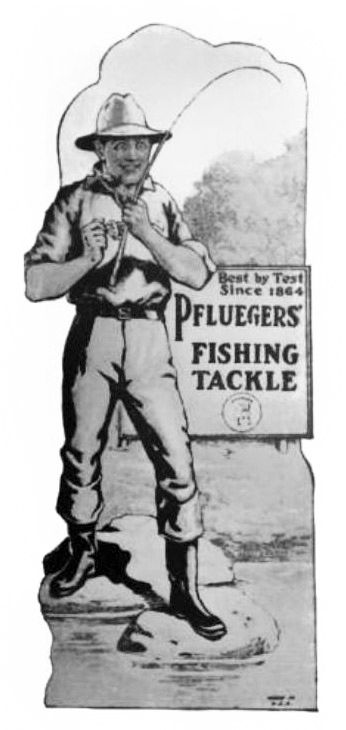
I was looking up other things recently and ran across this blurb in the June 1922 Hardware World magazine. It was above an article entitled “Dealer Cooperation” and showed what has to be one of the toughest Pflueger advertising pieces to find. The copy read:

The Enterprise Mfg. Co. of Akron, Ohio are offering to send to dealers, prepaid, a three-piece window display in color on heavy lithographic board, with double easels and complete instructions for setting up, as a means of helping to increase their sales and extend their trade on Pflueger’s fishing tackle.

These three display pieces consist of the fishermen as shown above a leaping bass and water, a counter pamphlet container. It is sure to attract attention at this season. They claim to be the oldest and largest manufacturers of fishing tackle in the United States making a complete line of everything the fisherman needs. They will be glad to send their catalog, No. 37, of some 400 pages of interesting and valuable information to any of our readers who have not received a copy.


I imagine this display was at least six feet tall, and I bet it had gorgeous colors! It’s a superb piece.

So … has anyone seen this dealer display?

— Dr. Todd

Tuesday, December 13, 2011

Voices from the Past: E.A. Pflueger (1918)


The following article on the origins of the Wooden Minnow appeared in my book Pflueger Profiles. I had found it in a 1924 edition of the League of Ohio Sportsman magazine, but wondered where the original had come from. Wonder no more. The original article was published in the May 1918 Hardware Review magazine, in response to Stimson's article in the American Angler on the same subject.

THE ORIGIN AND EVOLUTION OF THE WOODEN MINNOW

By E. A. Pflueger, Enterprise Mfg. Co.

As there seems to be some agitation on at the present time on the part of sporting writers in showing up relics of the past in the fishing tackle line, especially as regards wood minnows or plug baits, the Enterprise Mfg. Company has prepared the following for the enlightenment of all interested in this subject.

We made our first plug bait in the year 1881 in the form of a hollow glass minnow, mounted with single and treble hooks at tail and spinner at head. This was heavy enough to cast properly and the minnow being filled with a mirror substance also our "Luminous" material, made it very attractive and a good seller.

Following the Glass Minnow, we made other casting baits, all of which could be termed plug baits in the following order: Rubber Minnows, Phantom Minnows, Devon Minnows, Pearl Minnows, Metal Minnows. In the year 1883 we put out the Comstock Wood Minnow, the body being made of wood with glass eyes and spinners mounted upon the side instead of at the head and tail, according to prudent methods.

In the year 1898 we were the first to place on the market a wood minnow of the present day structure, and have been continuously manufacturing wood minnows and other forms of wooden baits ever since.

Our variety of baits and fishing tackle general to-day is by far the largest in volume and number turned out by any factory in the United States.


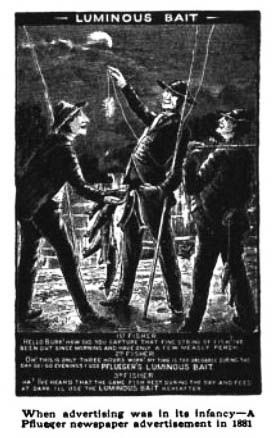
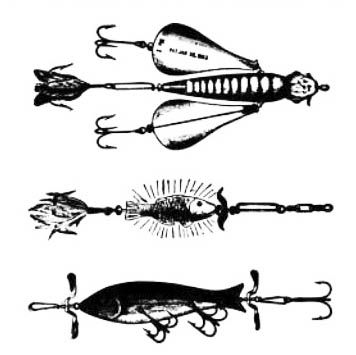
The best thing about the original was the two accompanying images--one I'd seen before (of the three Pflueger lures) but I'd not seen this version of the newspaper ad.


-- Dr. Todd

Wednesday, March 2, 2011

Pflueger 1905 Art Print Give-Away (Part II)

Last week, we featured a neat post on Pflueger 1905 Art Print Give-Away. At the end, I mentioned I would LOVE to see what this image looked like in color.


Now, thanks to Canadian collector Merrick Burr, we have an opportunity to see it in full color! Merrick writes:

This print was reproduced by A.L. & W. (Toronto) and used as the cover art for the 1928 catalog. They then made it into a lure box design for their inhouse made lures. I can not give you exact dates for the use as a lure box. I assume it started in 1928 until ????. ALW sold many Pflueger lures and I believe Pfluegar made most of the early metal lures marked ALW.


Wow. Thanks, Merrick! That print is even more beautiful than I would have thought. I find many things fascinating about this, but first and foremost is that it was still being used 23 years (and for years after on lure boxes) it was originated as a give-away. How incredible. Second, it is amazing how they "added" fishermen and a boat to the catalog cover. I wouldn't have thought to notice, but once you know what the original looks like, they stick out like a sore thumb.

The image is timeless and now you know what it looks like in color, thanks to Merrick Burr!

-- Dr. Todd

UPDATE:

Tom Penniston writes:

Pflueger did a tin litho full color sign in 1905 based on that print as well.  There is one in Arlan Carter’s book I believe in full color.  They are scarce, but there is a small handful around, there is one pristine one that showed up at an auction in Northern WI some years back.  Check Arlan’s 19th Century lure book, I’m almost positive he has one in there, but if not, email him, he has it as a center piece in one of his Pflueger metal cases.

I looked in Arlan's book but couldn't find it in the Pflueger section, but I do recall seeing it in his display. Thanks for the update, Tom!

Wednesday, February 23, 2011

Pflueger's 1905 Art Print Giveaway

Pflueger's 1905 Art Print Giveaway

In the April 1905 Western Field, Pflueger inaugurated a novel give away program that might help us to identify a number of sporting prints that have been floating around for years. In an article entiled "AN ENTERPRISING PROPOSITION," the magazine wrote:

Western Field is in receipt of one of the metal signs and window transparencies gotten out In eight colors by the Enterprise Manufacturing Company of Akron, 0. for display by dealers who handle their goods.

Both the embossed signs and the transparencies measure 10 by 14 inches. The Illustration herewith gives an idea of the subject, though it can not adequately reproduce the beauty of the colored original.

Both the signs and the transparencies are so handsomely gotten up that they are an ornament to the handsomest sporting goods establishment, and are bound to attract favorable attention wherever seen by anglers.

The Enterprise Manufacturing Company. however, have not stopped at this. They have, In addition, issued a set of certificates which, when signed by both the dealer and his customer, certifying that the customer has purchased $1.00 worth of Pflueger's goods from the dealer's store and mailed to the Enterprise Manufacturing Company, together with 4 cents in stamps to cover postage, entitles the customer to an eight-color picture of the subject illustrated below, measuring 10 by 14 Inches, but entirely free from advertising matter of any kind.

This picture is a work of art particularly appropriate for any sportsman's den and the liberal policy of the Enterprise Manufacturing Company in presenting it to their patrons is bound to greatly help the retailers In Increasing sales.

Realizing that there will be a great demand for these pictures during the coming season, the Enterprise Manufacturing Company positively state that not more than one picture will be sent to the same person, no matter what the amount of his purchase may be.

The metal signs. window transparencies. and certificates will be sent to any dealer In fishing tackle addressing the Enterprise Manufacturing Company and mentioning "Sporting Goods" in his request.


I encourage everyone to commit the above print to memory. I know I've seen it before, and did not know it was an Enterprise Manufacturing print. In fact, I am positive I saw this for sale at a recent tackle show.

I recall they were beautiful and I wish I had bought them! Does anyone own one of these prints?

-- Dr. Todd

Tuesday, February 22, 2011

Voices from the Past: Pflueger Courts the Local Druggist (1906)


Today and tomorrow, we will be relating some small pieces of Pflueger history. Today, we look at how Pflueger worked to court the humblest of tackle merchants -- the small town druggist. In this fascinating article from the March 1906 issue of National Druggist magazine, a very verbose editor for this trade publication extolls the plus side of stocking Pflueger's cheapest line of tackle -- the "O" line.

Fishing Tackle a Profitable Side Line

As quality is the keystone of satisfaction, so is satisfaction the keystone of increased patronage, and the dealer who makes the former his rule finds the latter a constant quantity. Experience has taught the druggist that fishing paraphernalia is not an exception, and that the connoisseur no more than the humblest follower of Isaac Walton knows and appreciates quality and "sticks to" and indulges deep-seated affection for the dealer who shares his enthusiasm and supplies his wants in that particular. The Enterprise Manufacturing Co. of Akron, O. has shown the druggiest how fishing goods can be converted into a handsome revenue, accessory to the drug business, and the quality of their goods has "clinched" the patronage of customers who has used them, from the very start. The immense plant of the Enterprise Manufacturing Co. produces a variety of goods that is nowhere equalled. Their factory has been owned and operated by the Pfluegers for twenty-five years, and enjoys the proud distinction of being the best-equipped and most extensive plant in the country for the manufacture of fishing tackle.

Fishing reels of all kinds and qualities are made for fresh and salt water -- of brass, nickel and hard rubber. Fish hooks, that until recent years were purchased largely in Europe, are now made with improved machinery, and acknowledged much superior in quality to the goods heretofore imported from abroad, resulting in an immense export trade along those lines. Spoons, baits and spinners, flies, leaders, and sneers, phantom minnows, lead sinkers, rubber baits and insects, fishing floats, and a multitude of other goods, all bear the imprint of quality and skillful manufacture, and each and every article goes out of the factory a symbol of perfection. Beginning with their cheapest line, No. 0, being all complete with float, hook, sinker, etc., retailing at 5, 10, 15, and 25 cents, respectively. It is possible to get anything in this line the trade may want, including twisted cotton line, braided cotton and braided linen, cable silk, plain and water-proof. These goods are put up in an especially attractive manner and have proven banner sellers with the drugstore trade.

Briefly told, the goods of the Enterprise Manufacturing Co., of which their new catalogue, No. F 24, lists several thousand of items, are an exemplification of perfect mastery of the business, and reflect great credit upon the makers, whose skillfulness and earnestness to excel has attained that degree of excellence in quality that warrants and deserves the name by which they are so favorably known in the trade. The Enterprise Manufacturing Co. will send their large new catalogue, No. F 24, prepaid, to any druggist desiring their name.


Pflueger didn't get to be the biggest by only courting huge merchants. With tens of thousands of druggists across the country, the majority of them stocking fishing tackle (and a good many of them getting tackle from Pflueger), this was a profitable market for Enterprise to get in to.

-- Dr. Todd

Wednesday, January 6, 2010

Getting Pflueger History Wrong

Getting Pflueger History Wrong

As I'm always keen on Pflueger history, I want to share with you an article sent to me by Gary Miller and run in the June 1932 Hunter-Trader-Trapper magazine. It covers Pflueger history, as seen from the corporate eyes of Enterprise Manufacturing Company. It is also an example of how companies often spin their own history until it no longer represents a factual account.

Entitled News Story Reveals Progress of Pflueger Tackle" it is reprinted, with my commentary, in its entirety here (original text in italics):

An interesting story of the birth and development of Pflueger tackle was printed recently in the Akron (O.) Times under the caption, "Biggest Fishing Tackle Plant Founded in Akron Farm House."

The 1920s and 1930s were very big years for Pflueger, and they were keen on trumping their own history. They even began backdating the founding of the company to 1864, which was most definitely not when Pflueger tackle got its start. It was founded in 1881; 1864 was the founding date of the American Fish Hook Company, which Pflueger bought in 1899.

"Back in 1864," says the author, "when most of what is now Akron was farm land, there stood on the hill overlooking the canal a rambling, old farm house. It was the home of E.F. Pflueger--a dreamer, a student, a reader. Fish interested him. He found that they would leap to the lure of a luminous bait. This gave him an idea--he would make luminous bait out of glass with a phosphorescent filling."

Of course, this took place in 1880 or 1881, not 1864. Pflueger did, however, pioneer the use of phosphorescents, but they were originally used on horse tack (saddles, etc.). The (corporate shill) author continues:

"It was a good idea but hard to sell. Years passed but the Pflueger factory in the farm house wasn't really prosperous until later. The Pflueger boys began to grow up and the three of them--E.A., Charlie and Joe--entered the business. E.A. was secretary and treasurer but became president upon the death of his father. The late Joseph Pflueger, who was regarded as one of America's best loved sportsmen and familiarly known as "Uncle Joe," was vice president. Charles T., who entered the company later, has succeeded Uncle Joe as production chief."

Again, as the author had to account why Pflueger lures were not being sold until 1881 (the real founding date) and not 1864, the "farm house" idea seemed to account for it. The truth is that Pflueger was a big success from the beginning, launching national ads as early as 1883 and putting up a big factory in 1887 (which promptly burnt to the ground in 1891, as chronicled in my book Pflueger Profiles). The text also skips the nasty family split that led E.A. to go off and found his own company in 1905 -- the E.A. Pflueger Company -- just down the street from the Enterprise Manufacturing Co. They would not heal this rift until 1913.

The business outgrew the farm house and the Enterprise Manufacturing Company now requires two factory buildings, one devoted to the making of fish hooks. Fish hooks are a basic product, but there are 4,999 other Enterprise products. There are rods of steel, of bamboo, rods of many shapes and dimensions and weights. There are reels that are build with the precision of a wrist watch, with jewel mounted shafts and a polish like milady's gewgaw. And there are lures by the thousands, and lines.

Well, now we can see Pflueger had two factories. Concealed is that one of these was E.A. Pflueger's factory from the split, which after 1913 began to absorb the other branches of Pflueger's manufacturing as it was a more modern, state-of-the-art factory. The fish hooks were left to be manufactured in the old factory.

The Pfluegers remain the 'works' as Enterprise. E.A. and C.T. are still active, and J.S. and William S., son of E.A., are, respectively, treasurer and sales manager. The latter also is assistant treasurer. L.W. Griffith is secretary and advertising manager and L.C. Dibble is assistant secretary.

All in all, this is an interesting if historically inaccurate portrayal of Pflueger history. It is what happens when reporters allow corporations to write their own history in print, as without doubt this copy was (barely) rewritten from the information contained in other Pflueger ads, catalogs, and press releases -- all of it inaccurate.

It just goes to show you can't trust everything you read! Especially when it comes to Pflueger history.

-- Dr. Todd

Wednesday, December 16, 2009

Pflueger's Egg Beaded Bait by Jerald Jolly

Today we get the pleasure of a massively detailed article on Pflueger by Jerry Jolly. For those don't know, Jerry is the author of Pflueger Fishing Lure & Misc. Tackle Patents, which would make an awesome Christmas gift...We thank him for allowing us to publish this on the blog!

PFLUEGER’S EGG BEADED BAIT

by Jerald Jolly

I consider the Egg Beaded Bait made by the Enterprise Manufacturing Co. (Pflueger) one of the favorite parts of my collection. It was made for casting, trolling, or however one wanted to use it. The bait has a unique configuration and does not cost an arm or a leg to collect. When many collectors see an Egg Beaded Bait or put one up for sale, they immediately think it is around 100 years old. That is not the case. While the bait was first made in the late 1880s or early 1890s not all of them are that old. According to the catalogs and catalog copies I have the Egg Beaded Bait was shown in Enterprise Manufacturing Co. catalogs thru the 1941 copyright catalog.

Several early patents granted to Pfluegers pertain to the Egg Beaded Bait. The following is a list of the patents, their issue date, and what they pertained to.

…..Patent No. 272,317, Granted Feb. 13, 1883 – Dealt with the three types of artificial metal baits (the minnow, the devon or angel, and the spinner) as well as the application of a luminous coating to the bait.

…..Patent No. 432,436, Granted July 15, 1890 – Dealt with the addition of a picture or representation of some insect or animal suitable for bait to a metal spoon bait. This patent was not listed with the bait in the catalogs; however, some of the Egg Beaded Baits do have the pictures or representations on them.

…..Patent No. 468,361, Granted Feb. 9, 1892, -- Dealt with the addition of brightly colored flakes to the luminous or reflective paint on the back of a metal spoon bait.

…..Patent No. 480,132, Granted Aug. 2, 1892 – Dealt with the use of a thin piece of metal (hinge lug) to attach the blade of a metal spoon bait to the shaft.

…..Patent No. 564,839, Granted July 28, 1896 – Dealt with the addition of a primer used under the luminous paint on metal or flexible baits to help prevent the luminous paint from flaky off the bait.

There are many ways to assign an approximate date to the Egg Beaded Bait but you need to know what to look for when examining the bait. This article will take you thru the changes in the Egg Beaded Bait according to the information I have available in the form of Enterprise Catalogs and copies of portions of Enterprise Catalogs. I will give a brief description of the bait and/or changes in the bait along with a photo or photos for illustration.

The first catalog we will look at is the 1897 F-25 catalog. This catalog shows that the Egg Beaded Bait came in both the Kidney and Egg Shapes. The Kidney came in 7 sizes (1-7) and the Egg came in 8 sixes (1-8) and both came in both Luminous and Non-Luminous (red paint). The photo to the left is from the 1897 catalog and shows that both shapes had a box swivel and a small glass bead above the blade. There were also many different hammered designs for the blades and the blade was attached with the reversible hinge lug. The catalog goes on to state that the Special Feature for this bait was the GIMP SHAFT which was flexible and easy to cast and would not allow the hook to cock back like a stiff shaft would. These baits were marked PFLUEGER AKRON O on the convex side of the blade.


The 1906 Catalog had different pages for both the Kidney Shaped and Egg Shaped Egg Beaded Bait. The photos to the left were taken from the 1906 catalog. The top photo is of the Kidney bait and the bottom photo is of the Egg Shaped bait. As you can see both baits continue to be seen with the box swivel and the small glass bead above the blade with the blade being attached with the patented reversible hinge lug. The beads below the blade are simply referred to as a string of brilliant colored beads. The baits still have the flexible GIMP SHAFT and come in Luminous and Non-Luminous (Red Paint) Quality and Non-Luminous (Red Paint) Favorite Quality with the paint being on the concave side. The Kidney Shaped bait came in 9 sizes (1-7 with a 2 ½ and 5 ½). The Egg Shaped bait came in 12 sizes (0-9 with a 1 ½. 2 ½, and 3 ½). It also reads in the catalog that the Premium Quality baits come in either Nickel, Brass, or Copper finish with the Favorite Quality coming in either Nickel or Brass but Copper could be ordered for the price of 50 cents per gross. It goes on to state that unless specified the bait would come in Nickel Finish and either plain or embossed blades should be specified when ordering. The Luminous Premium Quality baits come sewn on a Bronze Printed Card and the Non-Luminous Premium and Favorite Quality baits came wrapped in tissue paper. They could also be sewn on a card for the extra cost of 50 cents per gross. These baits were also marked PFLUEGER AKRON O. This catalog also states that the Old Style Lug can be ordered at no extra charge.


The next entry I have is a copy of page 212 from the 1916 Pflueger Catalog. The photo on the left was taken from that page. As you can see there have been some changes made. For one thing, there is a barrel swivel in place of the box swivel and there is no longer a small glass bead on the shaft above the blade. The blade is still attached with the patented reversible hinge lug; however, it is no longer on a Gimp Shaft but on a flexible
Cable Bronze Wire Shaft. Also, there was no mention of a Kidney Shaped Egg Beaded Bait. The catalog also specifies that there is an assortment of brilliant colored Ivory Beads strung on the shaft. The patent numbers 272317-468361-480132-564839 are also shown on the page. It also goes on to state that the blades are furnished in hammered metal which is Polished Nickel on the Convex side. The bait came Luminous Concave and Red Concave in 8 sizes (1-8) with sizes 1, 2, 7, and 8 being special order sizes only. They were sewed one on a card and once card in a fancy card box. Six boxes in a fancy carton. The bottom of the page mentions PFLUEGER BULL DOG Brand Goods. The photo immediately to the left is a close up of the above photo from the 1916 catalog. Notice the reversible hinge lug. Instead of being a thin piece of metal it appears to be the reversible hinge lug that looks like a circle of metal bent around the shaft of the bait with the blade mounted on it. The photo also shows the Bull Dog Trade Mark marking; however, I am not so sure that is correct as will be seen in the 1919 Catalog entry coming up next. The hook on the bait is Polished Nickel adorned with an assortment of fancy water fowl feathers.


The photo below is from a copy of page 68 from the 1919 Enterprise Catalog. Once again there is no sign of a box swivel or the small glass bead above the blade and appears to be the same photo seen in the 1916 catalog. The four Patent numbers 272317-468361-480132-564839 are present as is the Trade Mark we are accustomed to seeing with a Pflueger metal bait from this era. If you look very closely you can see the other Bull Dog Trademark at the apex of the blade which can be seen in the close up of the 1916 catalog photo. Once again, the catalog states that the blade is hammered metal attached to a flexible Cable Bronze Wife shaft with the patented reversible hinge lug. The bait only comes as the Pflueger Luminous Egg Beaded Bait No. 191 in 4 sizes (3-6). It has a bright Nickel plated hook that is adorned with a liberal assortment of fancy water fowl feathers and the shaft is provided with the new idea of “Slip Loop” which will permit quick changing of hooks. They came sewed one on a card and once card in a fancy card box.


The photo below is from the copyright 1924 Enterprise Catalog page 91. Once again several changes have been noted. In this catalog, it states that the blades are made of Hammered Spring Brass with an Old Style Lug firmly soldered to the same. The blades are shaped to spin freely and close to the shaft which is made of Cable Bronze Wire. There is an assortment of brilliant colored Ivory Beads strung on the shaft which are a great fish attractor. The several lower beads slip over a Piano Wire Hook Connection (see photo) that allows for quick and easy hook changing. The hook is plated with Polished Nickel and adorned with an assortment of water fowl feathers. For the first time a Brass Barrel Swivel is noted. This bait came in 8 sizes (1-8), with 7 and 8 being special order only, in Polished Nickel Convex-Luminous Concave (No. 191) and Polished Nickel Convex-Red Concave (No. 195). They are on fine printed cards and PFLUEGER BULL DOG Brands are mentioned. Only 3 patents appear (272317-468361-564839) since Old Style Lug is used.


The photo below is from Enterprise Pocket Catalog 145 Copyright 1925 page 82. All the information for this bait is the same as for the bait in the 1924 Catalog except for the following small differences. There is no mention as to what type of finish is on the hook and whether or not it has water fowl feathers, the bait only comes in 6 sizes (1-6), and, for the first time, No. 191 is said to have Luminous Enamel Concave. Since the Old Style Lug is used there are only 3 patents listed (272317-468361-564-839). No other changes or any markings are noted.


The photo below is from the Enterprise Pocket Catalog 146 Copyright 1926 page 85. There are no changes from the 1925 Catalog and Luminous Enamel Concave is use again with the bait coming in 6 sizes (1-6).


The photo below is from the Enterprise Pocket Catalog 148 Copyright 1928. All of the information is the same except that the bait only comes in 5 sizes (2-6). It has the same 3 patents and comes in the same 6 sizes with Luminous Enamel being used again also.


The photo below is from Enterprise Trade Catalog No. 49 Copyright 1929. In this catalog the bait still uses the Cable Bronze Wire shaft, brilliant colored Ivory Beads, Old Style Lug, and Hammered Spring Brass Blades. The bait comes in 5 sizes (2-6) and No. 191 still has Luminous Enamel Concave and it came in both Luminous and Red Paint. The only difference noted is the use of bright Tin Plated Treble Hooks with assorted water fowl feathers. The bait also has Brass Barrel Swivels. The same 3 patents are listed since the Old Style Lug is used.


The Copyright 1931 Pflueger Pocket Catalog No. 151 contained and Egg Beaded Bait with some changes (photo to left). The bait still had a blade made of Hammered Brass with the Old Style Lug on a shaft made of Cable Bronze wire. There was still a string of brilliant colored Ivory beads and a Piano Wire Hook Connection as shown in the photo. The same 3 patents are listed but there is no designation as to the type of hook or how it is adorned. The biggest change is the addition of a Sleeve on the shaft that the Old Style Lug rides on to reduce wear on the shaft. This year only the No. 191 Luminous bait was offered in 5 sizes (2-6) and it had Luminous Enamel.


In Trade Catalog No. 53, Copyright 1932, The bait remained the same as was shown in the 1931 Copyright Pocket Catalog. It came as No. 191, Polished Nickel Convex-Luminous Enamel Concave in 5 sizes (2-6). Everything else was the same. One interesting fact is that the Patent Numbers are no longer listed, only Trade Marks Reg. U. S. Pat. Office, which was noted on the other listings also.


The photo below is from the Copyright 1940 Trade Catalog No. 61. They must not have had much room in the catalog as the listing was very short. It says it is a dependable trolling bait that has stood the test of time and is still vedry popular. Improved sleeve construction prevents fraying of cable bronze wire shaft. Spoon is polished Nickel Convex, Luminous Enamel Concave. It then list No. 191. The only difference is that the hook is attached with a Heavy Split Ring. No patents are listed here either.


I found information from the 1895 Catalog in which the Egg Beaded Bait was listed as coming in 8 sizes (1-8) in the Hammered Finish that resembles a pine cone. It has the small red bead above the blade, and box swivel, and the blade is attached with the Reversible Hinge Lug. No photo is available for this bait.

A special thanks to Lindy Egan who provided me with information that the Egg Beaded Bait did not appear in any of the Pocket Catalogs 1934 thru 1941. I have the Trade Catalog 59 Copyright 1938 and the bait is not in that catalog either.

From its inception the Pflueger Egg Beaded Bait went thru many subtle changes. The changes pointed out in this document will help everyone more accurately date the Egg Beaded Bait in the future and help with assigning a value to it. Since there are some catalogs not included herein there is the possibility that other changes could also have been made. This document is most likely not all inclusive and is only meant to be a guide and reference as far as the information contained herein.

The following 4 Baits are from my collection. The photos and description will point out how I dated them using the information contained in this document.


I think the bait in the 3 photos below was made between 1916 and 1919 and possibly as late as the early 1920s since the Old Style Lug is shown in the 1924 Catalog. This could have been a transitional bait where they had box swivels left over and used them or they had the shaft with the swivel attached which they were trying to deplete from their inventory. Notice it has the box swivel and the blade has the Old Style Lug. The red concave side was being made during that time frame. Notice in the photo on the right that the shaft was bent back over itself and then secured with a wrapping of red thread and then covered with a lacquer or shellac coating. The 1919 Catalog stated that they introduced the new idea of Slip Loop once again suggesting that they were depleting the stock of something.


The 3 photos below show a bait that I have dated between 1919 and 1924. The barrel swivel, Old Style Lug, and Slip Loop (right photo) date it 1919 or later but the luminous paint does not appear to be Luminous Enamel which was introduced in the 1925 Catalog.


The bait in the 2 photos below is the oldest Egg Beaded Bait I have. I dated this bait between 1897-1906. The baits in that time frame had the box swivel, the red bead above the blade, the reversible hinge lug, and is marked Pflueger, Akron O. I did not date it earlier since it did not have the Pine Cone type hammered finish.


In the Catalogs this bait is called the Pflueger Egg Beaded Bait, the Pflueger Luminous Beaded Bait, and the Pflueger Beaded Egg Bait. No matter what you may prefer to call it, I think it is one of the really nice Pflueger Collectibles even though it is not considered “High End”.

Copyright 2010 Triple J Tackle, All Rights Reserved.
Wednesday, June 3, 2009

A Snippet of Early Redifor History

A Snippet of Early Redifor History

One of the nice things about early magazines--like the 1908 Field & Stream from which the information in this short article came from--is that when they profiled new tackle, they gave real detail.

Take for example the new attachments for 1908 made by the Redifor Rod & Reel Company of Warren, Ohio. Makers of outstanding quality baitcasters (and soon to be gobbled up by Pflueger of Akron, Ohio), they also produced a really neat Flegel thumbing device. As the article declared:

Appreciating the need of the unskilled for a reel that does not have to be "thumbed," and with which an amateur can cast comfortably without keeping in practice, they have adopted the wonderfully simple thumbing device brought out by Benj. F. Flegel last fall, and have taken Mr. Flegel into the Redifor Company as its secretary.

The first image shows a reel with the Flegel thumber, the second is an image of the spool with the thumber installed. What a simple device!


The article continued:

The thumbing devide is entirely out of sight and reach, and is so simple--there being no springs--that it cannot get out of (or)der and requires no adjustment whatever. The thumber takes care of the outgoing line absolutely, so one can cast and take the thumb off entirely.

This was not the only development:

For the incoming line the same company is putting out a spooler or level winder...that can be attached to the Redifor reel, or to any other reel, in a minute. In operation the motion of the cast throws the spooler forward as shown in the last cut. The line passing through the bail touches nothing, produces no friction, and does not shorten the cast. WHen ready for winding in the spooler is thrown up toward the reel, and the line running over the trolley, which is cannot possibly "jump," causes it to travel to and fro and lay the line evenly on the spool.


The article noted that Redifor bought the basic patent of Hon. S.L. Bean covering all thumbing devices attached to the spool of a bait casting reel, "and therefore insist that no reel of this type can legally be bought from, nor be made by, any one else."

Some great information on one of the early reel makers of the mass production era! By 1920 (for many long before this date), most magazines stopped doing such detailed analysis. What a shame.

-- Dr. Todd

Friday, August 31, 2007

Update on New Pflueger Book

Good news for Pflueger Pfanatics! The long awaited tome The Pflueger Heritage, by Wayne Ruby, is now shipping! We were first to review this book (for those who missed it the review is available here).


Wayne emailed me and said that the only place you can get a SIGNED copy is directly from him. The cost will be $39.00 plus $7.50 shipping and handling, and can be ordered directly from Wayne at pfluegerheritage@yahoo.com.

This is a fine book that any casual (or advanced) Pflueger collector will want for their library.

-- Dr. Todd