Showing posts with label Voices for the Past. Show all posts

Tuesday, February 17, 2015

Voices from the Past: Dixie Carroll on Hildebrandt (1919)


Over the next several months, I’m going to feature the fishing tackle writing of one of my all-time favorite writers, Dixie Carroll (Carroll Blaine Cook). These famed pieces of tackle were featured in his great book Fishing Tackle and Kits. They are fascinating write-ups of the tackle from a contemporary perspective. Below is Dixie’s write up on the Hildebrandt Spinner, an iconic lure if ever there was one.\


HILDEBRANDT SPINNERS
- Made by the John J. Hildebrandt Co., Logansport, Ind. As soon as a fellow talks of spinners in the fishing game, he just naturally thinks of Hildebrandt. These spinners of the famous Slim Eli, Standard and Idaho shapes have a name for spinning and sending a flashing invitation to the game fins that is irresistible to these husky tailkickers. I have used many of these spinners, both the singles and tandems and they have always merrily spun through the water, free and easy which is just what they are intended to do. A number of years ago I had the pleasure of meeting the originator of this line of spinning lures, John J. Hildebrandt, now passed to the Great Master of all waters. He was a keen angler, a true sportsman and a fine gentleman and his work on devising light- weight spinners for fly-fishing for bass as well u bait-casting for these bronze-backed warriors has been of great value to the fishing clan. These spinners are hand made and made right, just as good now and with as much care as when "Old John" Hildebrandt used to turn them out himself. The reversible hinge allows the spoon to reverse when playing a fish so that there will be no interference from weeds and rushes in retarding the playing of the fish. The Slim Eli style spinners spin very close to the shaft, the Standard style spins medium close and Idaho spins wide. I find the Standard shape best for ordinary fishing, the Idaho for roily waters and the Slim Eli for clear and fine waters. The tandem standard 3 size spinners is a great bass casting-bait and for the very bright day the black Slim Eli #3 1/2 is a crackerjack. Taken right through the deck, the entire line of Hildebrandt spinners are right in material and workmanship as well as being great game fish attractors.


— Dr. Todd

Tuesday, February 10, 2015

Voices from the Past: Dixie Carroll on Lowe Spoons (1919)


Over the next several months, I’m going to feature the fishing tackle writing of one of my all-time favorite writers, Dixie Carroll (Carroll Blaine Cook). These famed pieces of tackle were featured in his great book Fishing Tackle and Kits. They are fascinating write-ups of the tackle from a contemporary perspective. Below is Dixie’s write up on the Pflueger Lowe Star Spoon, one of the iconic metal baits.\


LOWE-STAR SPOON.- Made by the Enterprise Manufacturing Company, Akron, Ohio. This spoon is so swell looking that, honestly, fellows, you hate to throw it into the water, but, say, when those gold and silver sides start ·flashing down in the watery recesses it takes a mighty tame game fish to lie still and let it go revolving past without said game fish taking a walloping crack at it. And, believe me, the way the musky go for that shining- spoon makes your teeth rattle to think of it. I have one Lowe-Star Spoon, a No. 1-o, that is completely bent double from the hammering crack of a big old musky; he sure must have been most highly in- terested in that little old spoon to smash it like that. This spoon was a silver and gold on one side, and red enameled concave side with a feathered trebled hook trailing along behind, partly red and white feathers with a dash of peacock. It just made the pike and musky stand right up on their toes to get a chance at it, and this size and style is worth a place in any tackle-box. For bass-casting the silver and gold spoon of smaller size made an attractive lure used with minnows and pork-rind. These spoons are made strong and of good material, and they stand the rough work of trolling in snaggy and weedy waters. For the pike family- the musky, pike, and pickerel- they stand right out like a house afire and they get the fish.


— Dr. Todd

Tuesday, January 27, 2015

Voices from the Past: Dixie Carroll on the Pflueger Surprise Minnow (1919)


Over the next several months, I’m going to feature the fishing tackle writing of one of my all-time favorite writers, Dixie Carroll (Carroll Blaine Cook). These famed pieces of tackle were featured in his great book Fishing Tackle and Kits. They are fascinating write-ups of the tackle from a contemporary perspective. Below is Dixie’s write up on the Jamison Fly Rod Wiggler, one of the earliest true fly rod lures.\


PFLUEGER-SURPRISE MINNOW.- Made by the Enterprise Mfg. Co., Akron, 0 . Here is an excel- lent artificial minnow, and it is a natural fellow at the same time, it does not need a bunch of metal adornments to make it do a wiggling darting dive and the swim of a live minnow. It is of red cedar, the best all-round wood for making an artificial and it is finished in all the popular color designs with a crackerjack waterproof porcelain enamel that stands up under any kind of casting without -cracking or chipping. It is of minnow shape and what makes it do the wonderful lively swim under the water is the mouth-shaped cut or groove on the front under- side, and right where the mouth ought to be anyway. It is a very effective lure, of the semi-surface class, riding about ten to fifteen inches under water when reeled in at the ordinary fishing speed and it goes deeper if speeded up, floating when you happen to stop to untangle a backlash. A few seasons.ago I had one of these minnows along up north for a workout, it was cold and snow flurries made casting a bit of rough work. For two days the game ones had been off the strike, the pal and I had thrown them everything in the outfit without much success. I had loaned my pal the one Pflueger-Surprise minnow, a perch colored affair and that afternoon he landed a five pound fifteen ounce small-mouth bass and five others that just tipped the scale a tremble below fifteen pounds, all with this Surprise Minnow. It seemed the big ones could not keep away from it. My own string was not large enough or heavy enough· to mention that day. After a lot of coaxing, and then actually stealing this plug away from the pal, I had quite a nice bit of sport with it. It is still in my outfit a trifle battered and dinted from two years' use, but it still gets the fish when it is hard to interest them in hitting the lure. For its natural minnow-like movement in the water, the fine finish and good workmanship I commend it to the bait- caster as a rattling good lure.


Tuesday, December 9, 2014

Voices from the Past: Dixie Carroll on the Jamison Fly Rod Wiggler


Over the next several months, I’m going to feature the fishing tackle writing of one of my all-time favorite writers, Dixie Carroll (Carroll Blaine Cook). These famed pieces of tackle were featured in his great book Fishing Tackle and Kits. They are fascinating write-ups of the tackle from a contemporary perspective. Below is Dixie’s write up on the Jamison Fly Rod Wiggler, one of the earliest true fly rod lures.

Fly Rod Wiggler.— Made by the W. J. Jamison Co. 736 So. California Ave., Chicago, 111. Along comes Jamison with the very, very latest, the Fly Rod Wiggler, a nice little minnow shaped wooden bait that looks so nice that you feel like wearing it for a watch charm. A little fellow 13/4 to 2 1/8 inches long that don't even press down a pair of postage scales enough to hardly pull the indicator down below the starting line. And say the way the two advance models of this bait made the small-mouth bass fighting mad to get to them last Fall was a caution; large trout are also very partial to it. With a fly rod just a bit stiffer than the very light trout rods say a five to six or seven ounce rod, they cast free and easy with just a trifle more pull than a fly, in fact they cast and lift easier than a large bass fly or a small spinner. They come in varied colors and are fitted with one double hook. When you use it in the weeds, turn the hook points up and let 'em stay down when casting clean water. It wiggles along twelve to fifteen inches below the surface but it is a floater and can be used for surface fishing by retrieving it slower. Now that bass and pickerel fishing with the fly rod is developing more and more each season, this lure should be a mighty popular bait as it is undoubtedly an interest creator among the bass and picks. It looks and acts like a minnow and with a small weight ahead of it works fine on the ordinary bait-casting rod. Also great for deep trolling for wall-eyed pike, land locked salmon, etc. It is made just as strong and perfect as any of the rest of Jamison's goods and more you could not say for a lure.


Courtesy of Lang’s Auctions.


Ad from the May 1921 Forest & Stream


— Dr. Todd

Tuesday, December 2, 2014

Voices from the Past: Dixie Carroll on the Pflueger Redifor Baitcaster (1919)


Starting this week and continuing for the next several months, I’m going to feature the fishing tackle writing of one of my all-time favorite writers, Dixie Carroll (Carroll Blaine Cook). These famed pieces of tackle were featured in his great book Fishing Tackle and Kits. They are fascinating write-ups of the tackle from a contemporary perspective. Below is Dixie’s write up on the Pflueger Redifor baitcaster, a reel so nice it was made by two companies.

PFLUEGER-REDIFOR ANTI-BACKLASH REEL


Pflueger-redifor Anti-backlash Reel.— Made by the Enterprise Mfg. Co. Akron, Ohio. Well, fellows, you lads who have a hankering to get into that great little old sport of tossing the plug, spinner and pork-rind, minnow or frog to the big chief of the weed beds, via the short casting rod and haven't the time to learn the art of thumbing the line, Cheer up 1 You can do it with the PfluegerRedifor A-B-L. reel and in a half an hour or so. Of course, it takes a little more time than that to get accuracy and distance, but you can make a mighty big start without any trouble in a half an hour anyway. Just f'rinstance. Two seasons ago I took a youngster up north to learn the game, gave him my Pflueger-Redifor A-B-L., told him about it and in an hour he had three bass, by evening he was quite good at casting and two days later after fishing all day with him, my old guide thought he had been casting for two or three years. It does the work. It makes backlashes a darned hard thing to produce with it and it is a boon to the fellow who wishes to learn, but figures that he hasn't got the time to dope out the thumbing control and the mystery of backlashes. It is a wonder worker, automatic in action without anything to get out of order, all you have to do is cast. The anti-back-lash end is controlled by centrifugal thumbers on the left flange of the spool. The generated spiral toothed gears with which this reel is fitted run longer and smoother than the ordinary spur toothed gear. The hardened steel pinions run in phosphor bronze bushed bearings and ride on agate jeweled cups. End play in the spool is controlled by adjustable tension oil cups and the reel is fitted with a click and drag. The dull satin finish of the German silver is a winner and the low spool, long barrel design is ideal. It is a thoroughbred. The cast is not retarded by the thumbers, they do not act on the end plate until the lure slows up the pull on the line and that is when you want them to work. For night-fishing it is a dandy tool. It certainly is death on backlashes. Material and workmanship are of the best right through the entire reel and it is a fine high class tool at a moderate price.


Early Pflueger Redifors had the 1914 patent date.


— Dr. Todd

Tuesday, November 25, 2014

Voices from the Past: Dixie Carroll on the Joe Welsh Telaranova Leader (1919)


Starting this week and continuing for the next several months, I’m going to feature the fishing tackle writing of one of my all-time favorite writers, Dixie Carroll (Carroll Blaine Cook). These famed pieces of tackle were featured in his great book Fishing Tackle and Kits. They are fascinating write-ups of the tackle from a contemporary perspective. Below is Dixie’s write up on the Joe Welsh "Telarana Nova" leaders. Telarana Nova is Spanish for "new spiderweb," as these were made from Spanish silk gut. As seen in the picture below, the name was retained in the post-war era with Nylon leaders.

TELARANA NOVA LEADERS

Telarana Nova Leaders.— Imported by Joe Welsh, Pasadena, Calif. The Joe Welsh Telarana Nova Leaders are wonders in the leader line. They are made of one length, without a splice or knot in it, and any fisherman knows the value of this feature alone in a leader. They are quality goods and wear till the cows come home; they carry more strength in their make-up than one would expect in a leader and you never have to worry about leader troubles when using them. Besides the strength and durability of these leaders, they have a color that blends in with the water and are practically invisible; they throw no reflections whatever and seem to blend in with the water in such a way that they cannot be seen at all. I have one of these leaders that has been used two years and it has not shown up any weakness, fraying or bad spots; it should be good for another season or the openers anyway. They come in sizes for most any kind of fresh and salt water fishing and can be had up to nine feet in length without a knot. When you figure that you can use a Telarana Nova Leader all season you gotta admit that it is some leader. Without a doubt this leader is the greatest development in the leader line since old Daddy Walton was in the game. When the water is crystal clear and the light brilliant and you have tried the ordinary gut leaders, throwing their reflection like a bright streak in the water, just tie on a Telarana Nova Leader and note the results in the creel. For their strength, the fact that they are knotless and that they are practically invisible in the water these leaders are recommended as being right and they should be carried by every fly-fisherman.


Joe Welsh Telarana Nova leader.


Later nylon Welsh Telarana Nova leaders.


1921 American Angler ad for Telarana Nova leaders. Note the National Sportsman seal used by tackle articles approved by Dixie Carroll.


Joe Welsh photo ad from 1918.


-- Dr. Todd

Wednesday, October 15, 2014

Voices from the Past: Musky Fishing in Clayton, New York (1860)


Gary Miller sent in this blurb to me some time ago and I am just now getting around to posting it. It’s from the July 31, 1860 New York Times, back when the Gray Lady was just one of a couple dozen daily papers in NYC. It features a lovely account of musky fishing in Clayton in the days of Gardiner Mills Skinner.

This fishing is peculiar in its character. Your landlord engages your guide, with boat and tackle, for one dollar and a half a day, to serve you from dawn to dark if you wish to fish as early and as late. Two rods, supported entirely by the boat, one reaching out upon one side, and the other upon the other, with lines attached about 100 feet long, with spoons or decoys, and a drag-line from the stern about 150 feet in length, comprises the tackle. A seat is provided for the sportsman, which is generally a cushioned chair in the stern-sheets of the boat, and he sits face to the guide. In this luxurious and easy position he can amuse himself when the fish are not active in smoking, reading, viewing and admiring the quiet scenery of the beautiful islands surrounded by the crystal waters, or, if he so inclines, can sleep, relying upon his guide to wake him when he has a strike. The guide rows you over the best ground, if you are not personally acquainted with it, and the most uninitiated are enabled to tell when a fish seizes the decoy. Then hand over hand with the line, slowly, till Mr. Fish makes his appearance near the boat, and the great skill is in landing him safely. A large one requires the gaff; a smaller one is seized just back of the head with the hand, and a smaller one still is jerked in unceremoniously. A good day's sport gives so many that at night a true sportsman feels ashamed to look upon such murder.

The muskallonge vary in weight from 15 to 65 pounds; the pickerel from 2 to 20 pounds; the black bass from one to four pounds. It is not uncommon to see little boys and girls in skiffs rowing about the river trolling. One day last week a small lad was thus engaged in the bay near the vessels lying at the wharf, when he "fastened" (a local term) to a muskallonge. Being alone in the boat, with no implements to secure him or kill him, and the fish being about as heavy as the boy, it was a fair and for a long time seemed to be a very doubtfully-resulting fight. The lad, however, had the advantage; for while the fish was being weakened by the struggle, the boy held his own. The boat swayed round and round as the muskallonge struck out right and left, till at last the lad succeeded in getting Mr. Muskallonge's head over the gunwale, and by one sudden convulsion of the fish in he came with the boat. And now the reader may suppose the fight was ended. Not so: for it had but just begun, for the boats sit low upon the water, and these fish, averaging about five feet in length, will go overboard, if not prevented, quicker than they come in. The little fellow let go the line, and seized Mr. Muskallonge around the body, and a rough and tumble scuffle ensued upon the bottom of the boat, the fish being first uppermost and then the boy; but he held on, and hollowed stoutly for help, when one of the guides, seeing his condition, shot out with his boat from the shore, and towed in the contending parties. But the little fellow never relinquished his hold till the club was applied to the muskallonge's head, when it was ascertained the fish weighed 48 1/8 pounds. Mr. JOHNSON, the proprietor of the Walton House, sent the fish to the proprietor of the Everett House, in New-York.

-- Dr. Todd

Tuesday, October 7, 2014

Voices from the Past: Concerning Angling in Scotland (1882)


The following passage is from Robert Hall’s The Highland Sportsman, a classic Victorian work on fishing and hunting in Scotland. Note that 1800 pounds sterling in 1882 is the equivalent of nearly $4 million today. That’s a huge investment to secure some salmon angling!

CONCERNING ANGLING.


Good salmon-fishing nowadays is almost as expensive a luxury as deer-stalking, and is quite as eagerly sought after and harder to get. For some favourite stretches of the rivers Tay, Tweed, Dee, and Spey fabulous prices are willingly paid, and the six beats into which the river Lochy and its tributary, the Spean, is divided, generally fetches £1800 a-year, being about £160 a mile. The Thurso is also a very highly-priced river, and so is the Naver. Of late years, however, the quality of the sport has fallen off very considerably, and an ugly fungus disease has become epidemic in some rivers, and threatens to spread itself everywhere if piscatory scientists do not discover the cause and, what is better, the remedy.

It is a good rule in fly-fishing never to remain very long at one particular spot. When you have the water, take the best streams and fish them carefully, but as quickly as you can.

The best and pleasantest, and indeed the only efficient, mode is to fish down river, no matter what may be said by many fishermen against it.

A salmon will rise again and again at the fly after it has once missed it, provided it is not pricked by the hook; but trout seldom do so. It is better therefore, when fishing for the latter, and a big fellow rises and misses your fly, to allow it a little time to regain its former position before casting again.

When the salmon takes a fly, the angler must immediately give it line, and bear particularly in mind that the slightest degree of rashness at this moment will lose the fish. It is only by giving it gentle tugs and letting it feel the weight and pressure of the rod and line that you can make it rush about until its strength is exhausted.


— Dr. Todd

Thursday, September 4, 2014

Voices from the Past: China's Most Famous Fisherman (1887)


I ran across this article many years ago, and due to my new laptop dying and forcing me to use my old one which I haven't touched in two years, I found it. Happy accident. It was published in The Youth's Companion on July 21, 1887 and details China's most famous angler. I love this piece.

A Famous Fisherman

The profession of a hook-and-line fisherman is not greatly honored in this country. That is to say, while angling is esteemed as a diversion, it is not greatly honored or sought after as a career.

In China the case is different. The hook-and-line fisherman is an object of general consideration, and is regarded, from the very fact that he is an angler, as a person of unusual discrimination, as a philosopher, and a wise man.

Many Chinamen become professors, literary men, diplomatists even, after a preliminary period spent in nothing but angling. Moreover, whereas in this part of the world public men, after a career honorably spent in the service of the State, often choose to retire to the country, and become farmers, the great Chinese mandarins who have made their reputation and fortune take up their hook and line, and go to angling the rest of their lives.

The most famous fisherman of China was the illustrious Yen-Tsen-Ling. He loved his fishing rod so dearly that he declined all the honors that the Emperor Kwang-Yoo sought to heap upon him.

The Emperor, in order to tempt him from his fishing grounds on the River Foo-Thoon, where he had obtained a reputation for wisdom, continued to offer him greater and greater offices, and richer and richer prizes.

But Yen-Tsen-Ling stuck to his fishing rod. He was dressed in a simple sheep-skin garment, lived upon the fish he himself caught, frying them over a fire of dry bamboo sticks, and eating them with a little rice, served on the green leaves of the nenuphar tree.

After his death, a magnificent temple was reared to him on the banks of the Foo-Thoon. His portrayer, life-size, and framed in a beautiful ode to him, which is one of the most brilliant of the Chinese classics, is still preserved in this temple.

-- Dr. Todd

Tuesday, August 12, 2014

Voices from the Past: To Polish Spinners (1921)


I always thought the Outdoor Recreation family of magazines is underrated; not only did they have great writers, but they also had many neat little articles on tips for anglers. Here's one from the May 1921 issue I never thought of but it actually works.

To Polish Spinners

by M. Welch

If you ever need an emergency polish for spinners or other metal articles, use an ordinary pencil eraser – the Faber red-rubber erasers are what I use, but any rubber eraser would probably work as well. Rubbing the metal with the eraser will give it a nice polish. It does nicely to clean spinners, rod ferrules, etc. Do not leave the eraser in the same tray with your spinners, as the rubber will ruth black if it remains in contact with the metal for a long time.

I wonder if this is why I find a lot of small pencils with erasers in tackles boxes from this era?

-- Dr. Todd

Tuesday, July 22, 2014

Voices from the Past: A Bait that Kills (1917)


Not long ago I heard a discussion between a couple of collectors about why some of the older baits they found had red thread tied to their treble hooks. The following article, from the September 1917 Forest & Stream, details why this became a popular trend.

A Bait That Kills

A couple of trailing streamers of red flannel will accomplish wonders at times, if inserted on the hook. Often big clumsy bits of this cloth look queer on the spoonhook lure, and yet they work wonders in attracting pike. The addition of this red flannel is often the means of contriving a capture when other methods have failed. See that they stream in the water: when they produce an undulating motion they are the most attractive.

It is said that red acts on preying fishes much as it does when flashed in front of an angry bull. This is the reason why so much red is used on artificial minnows, bucktails, etc. And no doubt it fulfills a purpose, for red seems to be without any doubt a winning coloration in the eyes of the fish.

As for the strips of flannel attached to the spoonhook, I think it is chiefly the undulating motion and apparent animation that creates in the water that arouses the fish to strike. This I have proven by using white cloth strips with good success.

You will, likewise, have agreeable luck if you attach a pair of small red trailers to your plebeian pork rind lure; some use red yarn. These threads have a peculiar motion in the water that arouses curiosity in the fish and adds animation to the lure.

In using pork rind lures it is a singu larly good idea to have a spinner up ahead of the rind. Hooks with these spinners already attached are to be had in many forms on the market. The glitter and the pork rind form a double attraction. My best results have been had with the spinner in collaboration with the rind.

It is wrong to believe that the larger the lure the more attractive it is. Rather it can be said that the smaller, lighter lure has many points to its favor that the large lure has not. This has been evidenced in the smaller artificial minnows that are being put out by all the manufacturers. In fact I have come to believe firmly that a too large artificial rather frightens than causes a bass to be attracted to it to strike. This may be said to be especially true where the waters are very clear. I do admit there is a place for the large artificials, and that is where the waters are murky, or not out and out clear, or when the day is cloudy. But when the day is sunshiny and the waters are clear I would, on all counts, recommend for use the smaller sized minnow. Also in murky water, as after a rain, the pure white minnow is best seen, and the drabcolored minnows will not be seen.

The best minnow that the bass fishermen in the south can use is the white colored one, since much of the water in the south is not too clear.

-- Dr. Todd

Tuesday, June 3, 2014

Voices from the Past: Irving A. Cohen (1948)


Today in Voices from the Past we're going to feature a classic outdoor writer from the middle part of the 20th century. His name was Irving A. Cohen and for years he wrote the "Nimrod and Angler" column for The Charleston Daily Mail in West Virginia. Cohen also had a radio and later television show of the same name on WGKV in the 1950s, and wrote for magazines like Wonderful West Virginia. Writers like Cohen got local renown but little national notoriety; it's a shame because he's a fine writer, as seen in this column from April 4, 1948.


THIS trout fishing bug is a peculiar thing. Once bitten, the angler is immune to serious consideration of almost any other form of angling. Even the capture of a lordly merlin or a smashing tuna becomes but an incident in a career dedicated to the casting of the little fuzzy-wuzzies for fish which in many cases do not exceed in size the bait for other fish.

Let's take the brook trout. Many anglers admit that there are many other species who wage a gamer battle than the brookie, but they would rather fish for brook trout than for any other fish. This is evidence that their greatest enjoyment Is not inspired by the battle for what comparison is there between a half-pound or even a two-pound brook to that of a ten-pound bluefish, sailfish or a muskie?

The charm of trout fishing does not lie in the struggle of the fish after it is hooked, the art of casting and luring the fish provides keen enjoyment, but probably most trout fishermen derive their greatest pleasure from the environment. Just mention the Cherry River, Laurel, Greenbrier, or Hills Creek or the north fork of the Potomac to any angler familiar with these waters, watch his face light up!

After all,where can one find more beauty than along a trout stream, a stream flowing through wooded country alternating foaming rapids with calm pools and perhaps a waterfall?


THIS YEAR the siege Is starting early. Our telephone keeps buzzing with the query, "Where can I fish within a few miles of here, and can you guarantee us that we will be sure of getting our limit of nice big trout?"

If we knew of such a stream, the secret of its location would make the atom bomb security look like an electric sign. If there was such a stream and we made its location public, how long do you suppose that the few trout stocked in that stream would remain? A few years ago a friend of ours in an experimental mood and on a wager, told several anglers of a stream in Pocahontas county that was "literally full of legal sized rainbow trout." His own research had convinced him that there was not a trout in the stream. The next day he counted 20 cars in that vicinity.

Most of the trout streams we are told have been stocked to a greater or lesser degree, but no stream can withstand concentrated fishing pressure. Approximately 225,000 trout for all Went Virginia streams does not go far, especially if there are about 100,000 anglers during the trout season.

-- Dr. Todd

Tuesday, May 20, 2014

Voices from the Past: A Short Treatise on Conservation (1918)


Sometimes we think that conservation is a modern construct; the truth of the matter, however, is that there were clarion voices in the past concerning over fishing and pollution of our waters. Larry St. John, the fishing columnist for The Chicago Tribune in the 1910s, was one such voice. In his many fishing columns and his book Practical Bait Casting (1918), St. John lamented the sorry state of the American waters. Here is a section from his book illustrating the problem.

When the white man first settled in what is now the United States, the lakes and streams teemed with game fishes of all kinds. For example, up until 1840 trout were plentiful in the Chagrin River, a few miles east of Cleveland, Ohio, and other near-by streams, while to-day there is only one trout stream in the whole state of Ohio, and that an artificially stocked one, the property of a fishing club. In the Elkhorn and other streams of Kentucky, muskellunge and immense pike-perch were common, but these streams know them no more. In practically every lake and stream in the Great Lakes region, black bass were plentiful; now there are hundreds of waters where the black bass is either unknown or very rare unless artificially stocked. What is the reason?

Several causes. Civilization and the consequent, although unnecessary, pollution of water is one; the hoggishness of man is another. Most fishermen, commercial as well as sporting, look upon our State and Fish Commissions,, as a police force to enforce more or less obnoxious laws that are, according to their viewpoint, designed solely to interfere with fishing. As a matter of fact, the enforcement of laws is only incidental; the real purpose of a State commission is to conserve for both present and future generations, the fish and game resources of the state. Due to the shortsightedness of the people most interested, game and fish laws and their enforcement are necessary. In the language of one of the comic newspaper characters: "Them is harsh words," but the situation, to one who has studied the facts, demands harshness.

-- Dr. Todd

Tuesday, March 25, 2014

Voices from the Past: What is the Finest Fishing Lure in the World? (1922)


The following question was sent in to the fishing editor of Field & Stream in May 1922. It is an eternal one, in which the editor (Ladd Plumley) did a fine job of answering the question. Using the criteria below, I put the question to you: what is the best fishing lure in the world?

Editor, Field and Stream

"What is the finest fish lure in the world?"

-- S.J. Kelsey

ANS: Mr. Kelsey's question is certainly a very interesting one, and we are obliged to him for it. It is some question, all right! "What is the finest fishing lure in the world?"

Fishermen of different kinds have, of course, very different ideas as to tackle and lures. The sea and coast fisherman could not agree with his inland brother as to tackle or bait. If, however, we limit the question Mr. Kelsey asks to inland water fishing we can make it more simple, and perhaps arrive at an answer—that is for inland waters.

My own opinion is that the most productive lure in the world, the lure that in the past has caught the most fish of inland waters, if by lure we admit bait, is the ancient and always with us good old garden squirmer. Of course, if we do not admit bait to the class of lures. but regard all lures as artificial copies of living or dead things, then the question becomes still more narrow.

Anyhow, the question is not what is the most productive lure, but what is the finest of all lures?

Now for myself I consider fly fishing the finest kind of fishing for inland fish in the world. A personal opinion and that only. And, again as a personal opinion, I believe that there is one artificial fly which of the records of all artificial flies whatever stands at the very top. That fly is the Coachman—Royal and plain patterns.

Hence, and I speak for in personal opinion, as fly fishing, at least for inland waters, is the finest fishing in the world, and as the Coachman has made its record as the finest artificial fly in the world, the Coachman is the finest lure in the world.

But FIELD AND STREAM will be glad to hear the personal opinions of its readers as to this interesting question--What in their individual opinion is the finest fish lure in the world?

— FISHING EDITOR.

Tuesday, February 18, 2014

Voices from the Past: Outdoor Life's Square Deal (1918)


There was a time, in the period 1910 to around 1925, that the leading sporting journals in America fell over themselves trying to promote the latest and greatest fishing fad, even if that fad itself did little to help the angler catch fish. Some of the greatest writers of the era took part in this; they would receive free lures, rods, and reels and then write about them in the magazine. Dixie Carroll, Larry St. John, Sheridan R. Jones, and others all took part in this game (which, if my email inbox is any example, still goes on as I am constantly bombarded by companies who want me to imbed links to their wares in my bog articles).

This is why the article below, from the May 1918 issue of Outdoor Life, is so refreshing. In it, the magazine calls shenanigans on the idea that space would be devoted to shilling goods for companies. I wonder if this "shot across the bow" forced the other magazines to follow suit, for by the mid-1930s a fishing writer could hardly mention the tackle they were using by name in an article.


The Square Deal

OUTDOOR LIFE has always stood for the Square Deal. It has been fooled, just like each one of us has, at times; and when something has “been slipped over" on us in the 'shape of an erroneous account of a. gun's merits, an extravagant statement of what a certain fishing lure has done, or a delusive story of a guide or a hunting country, then, more than ever, have we realized the grave responsibilities that rest with the sporting magazine publisher. For if he publish such misleading matter (which generally comes from a writer who has received a gun from the manufacturer free on condition that he boost it in the press, a piece of fishing tackle on the same consideration, a hunting trip to be paid for in publicity, or some other article or service in exchange for his literary influence) the publisher is a direct accomplice—not always wilfully, of course — of the author of the story who would dishonor the publication he writes for merely to pay off a personal debt to his gun maker, guide, etc.

We believe in the praise of the really praiseworthy by the traditional Sir Hubert — but the parasite imitators must go, and to this end we have decided, in the mutual interests of our patrons and reader — in the furtherance of the Square Deal, in short — on a censor policy as drastic and far reaching as that of Uncle Sam in his dealings with those whose actions are open to reasonable suspicion. The indefensible and pernicious abuse of publicity from which we have suffered in common with all other publishers is, at least in our case, going to be eliminated, cost what it may.

The keystone of OUTDOOR LIFE'S foundation is the Square Deal to everybody and it is going to be kept conscientiously clean. As before stated, we believe in giving praise where praise is due—and conversely, we believe in conservative criticism of actual short-comings. But exaggerations of either will find no place in our pages. Truth needs no embellishment and tolerates no suppression or modulation. So perfectly demonstrable facts alone will be admitted to our columns. As a radical departure from obtaining and universal custom this may work some apparent hardships on advertisers — and some very discouraging ones on the irresponsible space filling writers — but what you see hereafter in OUTDOOR LIFE you may believe without hesitation. For it will be true!

To that end we shall hereafter decline to publish any reading matter wholly devoted to the laudatory description of any outing accessory, commodity or service. Our paid advertising space is the proper and legitimate vehicle to carry that. Reading matter (wherein merely incidental reference to the things above mentioned will be permitted, subject to editorial limitation) will not contain any names or addresses of manufacturers, owners or vendors, except where such information is given in answer to a question asked, or where such manufacturer's or owner's name is linked with, or forms a part of the name of the article. It will be our pleasure to impart such information on special request by private letter or in our “Answers to Correspondents" department. we reserving the right to express therein our personal views, confining same strictly to answers of direct questions asked. Conservative praise or censure of a guide or hunting country will be permitted in authors' articles descriptive of an actual outing, subject always to editorial revision.

Our position and policy are clear. We play no favorites and will countenance no menace to the purity — and incidentally the quantity — of our reading pages, feeling confident of our ability to give our advertising patrons full quid pro quo in their legitimate department. In this we are assured of the full and cordial co-operation of all dependable users of publicity, and we are even more assured of the spontaneous approbation of our readers who will acclaim our efforts to give them a cleaner, better and more powerful reflex of their pleasures afield and astream—one fearless, unbiased and dependable in all things as becomes an exponent of the clean, pure and invigorating life outdoors.

Entirely too much good money and too much valuable time has been wasted in following up the recommendations of the mercenary trade spongers as to good guns. rods, fishing and hunting locations, etc. We are going to put an end to this insofar as we can. Outdoor Life will be a medium of information, not misinformation peddled out by donation hucksters for the undoing of the overtrustful. The great guild of real sportsmen, knowing itself to be honest and clean in action and statement, has heretofore taken entirely too much on trust. We aim to remedy this by presenting to our friends only that which is worthy of their trust. 0f the outcome we have no manner of doubt. American sportsmen are a discriminating class and demand the best of everything, getting it always ultimately. We aim to give them that, and will confidently abide by their verdict.

The Square Deal for ours—and theirs.

-- Dr. Todd

Tuesday, January 14, 2014

Voices from the Past: O.W. Smith on "Freak Winches" (1920)


If you've ever wondered how some of the odder reels were received in their day, well, Onnie Warren Smith (O.W. Smith) can help you understand that if a reel looks weird, it probably had a weird reception. In his great book Casting Tackle and Methods (1920), Smith wrote up a section he charmingly called "Freak Winches" about a number of such reels. Today, these reels have great collector value, but at the time, they were seen as the same kind of oddity as they are today.

FREAK WINCHES

I have already referred to what I may term "freak reels," a great many of which were still-born or lived a short life though there is still any number upon the market. After all, the angling fraternity is somewhat conservative; it will not stand for a too radical innovation. A change must come gradually if it is to be adopted. There may be good points about a freak reel, but because it is a freak it will stand little show of even a fair try-out. I, Philistine though I am, do not care for a reel too different. Naturally in writing of these odd reels from my collection I will refrain from commenting upon their merits and demerits to any great extent, leaving the reader to determine in his own mind their respective value.

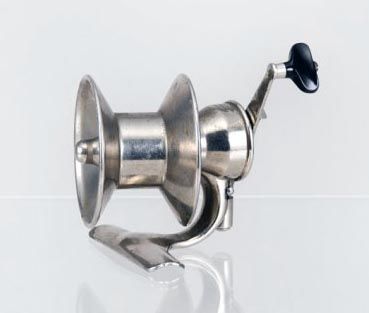
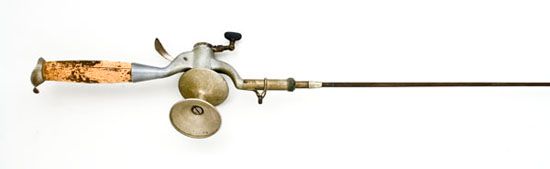
The "Gyratory Reel" was brought to my home by a traveling representative of a certain hardware house, a "special" he was then pushing. We tried it out on the street to the great amusement of a crowd that soon gathered and they were not all fishermen either. The name—"Gyratory"—gives a very good idea of the winch, referring to the eccentric action of the spool,wobbling from left to right like a lodge goat, with each revolution, laying the line from end to end of the spool. A lever frees the spool from the crank-shaft so that it is a "freespool." It will be noticed that it is built in the handle of the rod, is a part of the rod. The crank is of peculiar shape. All in all, I consider it one of the strangest creations ever produced for winding a line or casting. However, it certainly will handle a line in a manner to surprise the doubting Thomases, but a man would need to be possessed of more than a little courage to take the arrangement out in company on a bass-lake. Yet it may become popular.


Gyratory reel. (Two Images Courtesy of Lang's Auctions).


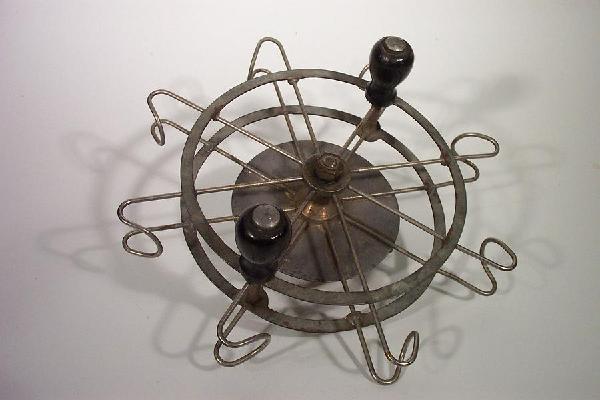
Another odd bass reel which came into my possession a few years ago, was the "Kenward Special," though there is nothing radically strange about it save the arrangement for thumbing. It is somewhat like the well-known single actions—"Experts"— which are so popular with trout-fly-fishermen, only much larger, being something like seven inches in diameter, a single revolution of the spool retrieving nearly two feet of line. The handle is simply two knobs fastened directly to the reel-head. At the base of the reel is a concave surface provided for the thumb, the idea being to facilitate thumbing. Though I tried out the reel somewhat at length I never succeeded in getting the hang of it, the side weight tipping the rod over in spite of my best efforts. I have always been sorry that I let those two reels get out of my collection and would be very glad indeed to replace them.


The Patented Kenward Special courtesy of Jim Schottenham's great Side-Mount Reel Site.


One sometimes sees listed, I never happened to see them in actual use, reels built in the rod handle. The innovation seems too great for the average fisherman; though one can easily discover certain advantages that such an arrangement would have, it would also have several disadvantages. The spooling of the line properly might be something of a problem, while, if not of the take-down style, a backlash would be quite difficult of solution; upon the other hand, the weight of the reel is in the center and the rod will not turn in the hand. (Parenthetically, I have often thought that without the off-set handle, same attached directly to the reel plate as in single action reels, one would have a perfect winch for trout bait fishing along brushy creeks, nothing to catch in the brush, one could even drag the rod after him without fear of entanglement.)


William Demmer's possible prototype Hurd Supercaster.

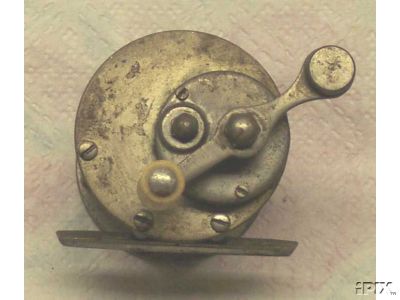
Some two years ago I received a sample "Thumezy" reel, a surprising bit of machinery. Made of German silver, put together in a workmanlike manner, it is a reel apparently built for a lifetime. The inventive genius who produced the "Thumezy" must have sat up nights thinking out the various things his winch will accomplish. Just to enumerate: the metal thumb-stall thumbs the spool, the thumb is not worn by contact with the line, and by pressing down to the lowest possible point, the spool is automatically freed from the winding gear, becomes free, so for casting it is a free-spool; to wind in, the operator but presses in on the handle which instantly connects the spool with the gear; slide on the click on the rear plate and advance the thumb-stall notch by notch—6 of them—the tension is increased with each, at the seventh the click, is thrown off, the spool becomes free once more; remove the two thumb-screws at either end, which takes the place of oil-caps, and the reel falls apart. I do not know that I have enumerated all the special features possessed by this winch, but surely I have mentioned enough to convince you that the "Thumezy" is "different" alright; however, it should not be called a "freak" for it is a practical reel.


The Benjamin Thumezy.


The "Stockford" is not a radical innovation and in nowise a freak though it appears odd. The gear is enclosed in a small gear-box attached to the outside of the head-plate, small, inconspicuous and light. The striking original feature is the lack of pillars; the ordinary reel has three above the reel-plate, the "Stockford" has but one, and that low down in the rear. The spool being open, in case of even a superlatively bad back-lash, it would not be necessary to take the reel apart, the operator can get at the line with ease. Do not imagine that because of few pillars the frame is weak and wobbly; it is unusually firm and rigid. By the way, the open frame and gear box is used to some extent by other makers; the former is a great convenience, while the latter reduces the weight of the reel.


The Stockford Reel.


To continue discussing the various patterns which from time to time have-come from original makers, would be a pleasure, but we have mentioned a sufficient number to prove that there is a reel for the lover of the unusual, and wide awake inventors are racking if not wrecking their brains to produce something different. Any day, perhaps, some angling, tool-wise Walton will invent a casting reel that will revolutionize the sport, who knows? However, I am free to admit that I am a conservative of the conservatives. I do not ask my reel to do all the work. I desire to do the major part of it myself. I prefer the simple un-everything reel. Just the same, there is no greater treat in store for the lover of bass tackle than to stand before a well filled reel cabinet, displaying the various orthodox and heterodox winches that have been produced; undoubtedly many of them spell tragedy for some inventor.


-- Dr. Todd

Tuesday, December 17, 2013

Voices from the Past: William Carpenter on Trolling (1848)


William Carpenter's The Angler's Assistant was an important, if often overlooked, early Victorian fishing treatise. Published in 1848, it gave a classic definition of the art of trolling, which is reproduced here:

Anglers divide trolling into three kinds: sinking and roving with live bait—trolling with gorge and snap hooks, and dead bait—and spinning, in which the fish with which the hook is baited, whether real or artificial, is given a revolving motion.

The fish to be taken by trolling are salmon, trout, pike, and perch.

Trolling is much esteemed, especially in the vicinity of London, and is practised when other modes of fishing are useless.

For trolling, properly so called—that is, with a gorge bait—the rod should be long and stout. A wellseasoned bamboo-cane, from fourteen to sixteen feet in length, is the best you can have; but in the absence of this, take the next best within reach. If you have a winch on the rod, there should be a ring on each of its joints; but if a thumb-winder is used, which some prefer, a large ring at the top of the rod, or at most two or three up it, will be ample. The rings must be large and strong, however, and the top one, two or three times the size of the rest. Trolling is sometimes practised, and not unsuccessfully, with a hedge stick, having a forked top, the line passing from the thumb-winder over the fork of the stick, which thus forms the top of the rod.

The trolling-line should be of silk, or of silk and hair; the former, however, is preferable. The length should be from fifty to sixty yards, and it should be seasoned, or dressed, by being put through cold-drawn linseed-oil, and then drawn through a piece of flannel or woollen cloth, held in the hand, after which it should be hung up for a few days in the air. The bottom line should be made of fine gimp, if for pike; or of the best gut, if for trout, about a yard and a half long, with a box swivel attached to it, about a yard distant from the hook, so that the bait may turn freely.

The gorge hook for a pike is formed of two single eel hooks, fastened back to back, to two or three inches of twisted brass wire, the end of which is formed into a loop, to be attached to the gimp or gut line, before described. Instead of using shot, as in other cases, the shank of the hook and part of the twisted wire are to be neatly covered with lead, taking care that it does not pass so far over the hook as that the jack, if he put his teeth through the bait-fish, will come in contact with the lead, as this would probably induce him to drop the bait and be off.


-- Dr. Todd

Tuesday, December 3, 2013

Voices from the Past: Reuben Wood (1885)


The following blurb, from the June 25, 1885 issue of Forest & Stream, remembers one of the great fly casters and tackle dealers of the middle part of the ninetieth century--Reuben Wood of Syracuse, New York. A massively popular sort, this little remembrance was written by his friend, and poet, Isaac McClellan.

Reuben Wood -- In speaking of the exploit of Mr. W. H. Wood in killing a tarpon, as recorded in FOREST AND STREAM, "McClellan," in Land and Water, says of the late Reuben Wood:

"I wonder, by-the-bye, whether 'the tarpon slayer' is any relation to that dear old American angler and prince of fly casters, Reuben Wood, who was with us through the time of our Fisheries Exhibition. It seems only yesterday since he slept under the very roof which now shelters my own bend from n splendid, and most May-like, shower of hailstones. And now, alas! he sleeps under the green, mossy turf, whose every blade of glass be loved with the sweet simplicity of a guileless heart. It is no exaggeration to say that every Englishman who had the pleasure and honor to know 'Uncle Rube' loved him alike for his simplicity of nature, envied him good-naturedly for his wonderful skill with the fly-rod, and honored and respected him for his sterling qualities as a sportsman.

Poor mortals die, and make no sign,

But Nature still its life renews;

Spring woods, spring fields with glories shine,

Spring blushes Nature's face suffuse."

-- Dr. Todd

Tuesday, October 29, 2013

Voices from the Past: Musky Fishing in the St. Lawrence (1884)


The following article on musky fishing appeared in the July 5, 1884 issue of The Daily Evening Traveller, and features a nice description of musky fishing in the St. Lawrence River.

THE MUSKALLONGE.

Habits of the King of the St. Lawrence -- How He Is Fished For

A correspondent of The New York Times, who has been fishing in the" Upper St. Lawrence river, writes:

The muskallonge has been known to grow to the length of six feet, and to weigh 80 pounds. Those of the St. Lawrence never attain that size, so far as is known, but in the lakes of Miehiganja "six-footer" is not uncommon. The waters of the Upper Mississippi also abound in muskallonge of the larger size. A forty-pounder is no rarity in St. Lawrence waters.

The angler who has never hooked a muskallonge, especially a large one, does not know what exciting sport with the rod is. The muskalionge is the Goliath of the pike family, and his great size, strength and endurance, and his tactics when hooked entitle him to the position of monarch of game fishes. He is built for swiftness and for offensive warfare. He is called to defend himself against no other freshwater fish that swims, but he is the natural enemy of all, being literally, as Halleck has called him, "a fierce and dauntless marauder." Anglers who are expert in both salmon and muskallonge fishing do not hesitate to say that the latter is much the more cunning and determined in the methods he adopts to escape the hook. Quick as the salmon is, and as sudden in his turnings and whirlings and leaping in manoeuvering to break the angler's hold, the muakallonge is still quicker.

The muskallonge is a panther in cunning and ferocity and as ravenous as a wolf. He lays in wait for prey in the weeds along the shore and in places where instinct teaches him that other fishes on which he feeds pass to and fro or congregate. He feeds on his own kind as readily as on other species, for, like all the pike family, his appetite is cannibalistic as well as insatiable. A favorite lurking place of the muskallonge is in narrow channels connecting wider portions of a river or parts of a lake. He catches the fish that pass to and fro In the confines of the channel at a great disadvantage, and, dashing from his hiding-place like a thunderbolt, seize3 his prey with greater ease and certainty. When lying in wait the muskallonge is as motionless as a rock. There is no more evidence of life about him, save an almost imperceptible and cautious working of the gills and a gentle movement of a fin now and then, than there is about the log by the side of which be may be lying. But the instant a pike or a bass or any living thing that will make a toothsome mouthful for him passes within sight the motionless object darts with the velocity of a cannon-ball from its hiding-place, and what it aimed to seize it seldom fails to strike.

The greed and pugnacity of the pike family is proverbial, a pike a foot long having no hesitancy in attacking a fish of a less bellicose species three times its size, and the greed and courage of the muskallonge are In proportions to its dimensions. A local St. Lawrence river angler relates how he was fishing for muskallonge by "skittering" a minnow in Goose Bay. This is a favorite method of angling for this fish, and is the familiar old-fashioned style of pickerel fishing on the small ponds of this and other States, except that the minnow used is much larger, and the tackle proportioned to the powerful game it is expected to kill, and the still more important exception that the rod is long, slender and elastic to make the sport more enjoyable and scientific. As the minnow was being skittered along on the edge of a weedy spot, it was seized by a small muskallonge, which was booked. The fisherman had drawn the fish within rive feet of the boat, when suddenly it was seized by one many times larger, which rushed to the top of the water, and bore the smaller one away under the very noses of the occupants of the boat. The large muskallonge rushed back ratio deep water, and soon gorged its victim. Aider a long fight it was landed in the boat. The small fish was in its throat, and the minnow was in the throat of the smaller fish, which weighed over five pounds. The big mukallonge was a 2O-pounder.

Trolling and skittering are the best methods for catching muskallonge, Still-fishing is not attended with good results, as the large fish are but seldom caught in that way. It is illegal to spear or net the muskallonge, but it is its own protection generally against both the spear and the net, its cunning and agility being almost invariably a match for the skill of those who bring the illegal methods against it. The man who succeeds in spearing a muskallonge has earned the prize, no matter if it be gained by a barbarous practice. It is related by a well-known angler for muskallonge that in a pool where a number of these fish of the largest size were known to lurk, some fishermen determined to draw a seine, as all efforts to catch any of the fish by legitimate means bad failed. The seine was drawn through this pool time and time again, but not a muskallonge was taken. The angler who relates the incident took bis position in a boat, and, holding by one of the buoys of the seine, was drawn after it over the surface for the purpose of investigating how the fish managed to elude the net. Lying with his face close to the water, he says, be could see the fish on the bottom plainly, and as the net approached them they ploughed their wedge-shaped heads in the sand and made a passage under the seine along the bottom of the pool.

Much depends on the skill and dexterity of the man at the oars in successfully landing a muskallonge, if the fish is a big one. The writer had a guide who seemed to attach more importance to recounting past exploits of his own in killing muskallonge than he did to furthering the present efforts of his employer In the same line, and the latter bad the pleasure of losing the only fish he hooked in the day's fishing he was enabled to enjoy—a muskallonge that would have tipped the beam at 25 pounds at least. He' jumped several times from the water at least 10 feet clear and shook his head in furious efforts to release himself from the hook, while his eyes glared like a tiger's. He was reeled nearly within reach of the gaffhook, when the man at the oara had his attention attracted to something else. The boat swayed round. The line slackened, and the infuriated fish turned like a flash and dartod down stream. There was an instant s slowing up in his speed as the line was again drawn taut, and then he went on, leaving the angler a semicircular piece of his jaw as a memento of the day.

But a few days have now to elapse before the opening of the trout fishing season on Long Island, N.Y. Rods have been looked over and got in readiness, and the merits of the split bamboo seven-ounce thoroughly canvassed. Artificial flies by hundreds are taken out of their hybernating camphor and aired, and especially the members of the South Side Sportman's club are hoping for a good day on the first of April when the game beauties will be brought to. basket by the hundreds.

-- Dr. Todd

Tuesday, October 22, 2013

Voices from the Past: The Sucker in the Cypress (1903)


A remarkable story comes from the New Orleans Times-Democrat printed in May 1903 about a fish that lived in a tree. I present to you the story of The Sucker in the Cypress.

A Sucker in a Cypress.

A Story comes from Jeanerette, La., where about thirty pounds of fish were recently sawed out of the heart of a cypress log. The other day when the larger end of an immense cypress log was being passed under the saw of the mill of the Jeanerette Cypress Lumber Company, one of the millmen made the discovery that in a hollow of the log was some substance that was evidently extraordinary. His examination acquainted him with the fact that a large fish had been sawed up with the log. The log was one that had been cut about the usual distance from the ground, but which had a hollow on one side above where it had been cut. The hollow space opened out in a hole of a few inches in diameter on the side of the tree. The hollow space itself, however, was of ample dimensions. Occupying a great proportion of the space were the sawed remains of a large sucker, probably a "choupique," estimated to have weighed at least thirty pounds. The explanation that has been offered for the lodgment of the fish in so unexpected a place was that in high water when the hole in the side of the tree was below the surface of the water, a small fish got through the hole into the hollow. The fish failed to swim out of the hole before the water fell. Enough water remained in the hole at all times to permit the fish to live, and it "waxed fat" in its peculiar abode, and at least remained fresh, if not alive, when the log was being rafted and when it was run into the mill.

--Dr. Todd