Showing posts with label bamboo fly rod. Show all posts

Tuesday, December 21, 2010

Voices from the Past: World's Smallest Fly Rod? (1890)


Well, here at the Fishing for History Blog we are fascinated by extremes. Here we have what was touted at the time as the smallest fly rod in the world, a three feet model made in Japan -- and which came with a barbless fly. The article was run in The New York Sun in July, 1890. While not as small as the novelty fly rod we wrote about last year, it is still a small fly rod and reminds me of the bantam rod made by modern maker Chris Lantzy. I believe the shop referenced was Thomas J. Conroy's. Here's the blurb in full:

In the window of a fishing tackle store in Fulton street is displayed a fly rod three feet long, and tapering from the thickness of a lady's pencil at the butt to the size of a pin at the tip. It is made of Japanese bamboo with a tip of whalebone. There are three joints in the rod. The line of the length of the rod is of fine gut. At the end of it dangles a tiny yellow fly, concealing a barbless hook. The rod was made in Japan, and is a specimen of those in use there in the capture of minnows, which are regarded as a delicacy by the natives.

-- Dr. Todd

Wednesday, December 1, 2010

Don Robb, Pennsylvania's Cantankerous Old Rod Maker

I'm sick so I'm putting up some stuff I've been meaning to run for a few months. Here's an article about Don Robb, a rodmaker from Pennsylvania who was making split cane rods in Ligonier, Pennsylvania before World War II and was still at it in 1981 when this short article came out. I love how grizzled he seems in this interview. And, I'd not heard much about how the Japanese invasion affected the Tonkin cane crop. Anyone with any info on that? The article was an unattributed wire report from the A.P. dated May 31, 1981.

FLY ROD MAKER LEARNED TO BEND WITH THE TIMES

LIGONIER. Pa. (AP) — World War II messed up the fly rod business for Don Robb, who was making magnificent fishing gear before the Japanese overran China.

"I haven't made a bamboo rod for a long time. They're not worth messing with," said Robb. "The best bamboo came from pre-war China. Kwangsi and Kwangtung provinces. The Japanese ruined things when they overran the place in 1936."

But Robb, who gives his age as "75 plus," has learned to bend with the times. His tackle shop is crowded with meticulously crafted fly rods and home-spun philosophy.

In a recent interview, he talked while he worked. Spring and the opening of Pennsylvania's trout season had brought a flood of orders. "I'm always three or four months behind, which keeps me busy during the winter. But at a time like this, my! Everyone has the fever. Some of them, why you'd swear they weren't going to survive." he said.

He took a new rod outside and talked as he cast with different reels to find the best weight line for the rod. "Fly fishing is different than bait casting or spin casting in that there, all the weight is on the end of your tine. Here, you depend on the weight of the line itself"

He handed over the twitching, black graphite rod. It seemed to have a life of its own. The price? "One hundred and five bucks. That's rod, reel, line, reel bag and rod case."

Is that a bargain?

"Yep."

Are the high-priced rods worth it?

"Nope."

What type rods are the best?

"Just whatever suits you."

Back inside, he worked surrounded by racks of lures, line and hooks, stacks of material for making flies — among them marabou, english grouse, emu and ostrich plumes. Bundles of graphite rod blanks stood in racks on the floor like sheaths of dry grass.

A hand-lettered sign warned those who entered: "No lookers. There is no time to spare for just lookers."

His spare time is very limited; not so his reputation.

"I've had rods (ordered) in 40 states, four provinces in Canada, two each in England. Ireland. Scotland and Wales and two countries in South America." Robb said. "You see my rods get a little more traveling than I do."

His clientele, however, is not large. For some families. Robb is making and repairing rods for the third generation of anglers. Would-be customers are routinely turned away.

"I don't want any publicity," he said. "I got more work than I can do already."

Robb works mostly with graphite, sometimes with fiberglass, but not with bamboo. The reason, he said, is a lack of good bamboo. Among the areas conquered by the Japanese in the 1930s was a 25-square-mile patch in China believed to be the world's only source of Tonkin cane. Of more than 1,000 species of bamboo, it is coveted above all others for making fly rods. Rod makers have scoured the world in vain trying to find another source.

Modern China resumed exporting Tonkin cane, but the quality of the crop hasn't been the same.


-- Dr. Todd

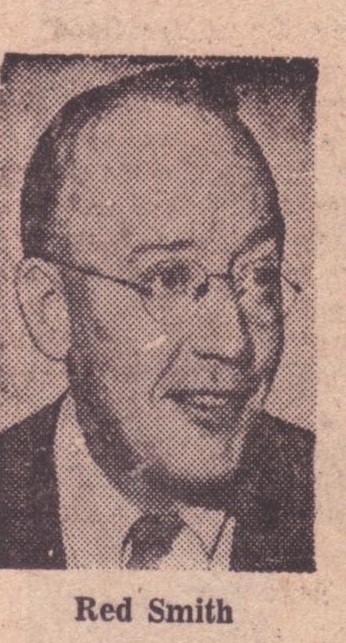
Red Smith and the Fish Pole Factory

I recently posted a blurb from Red Smith about Jim Payne's secret oven that the local women loved to bake beans in because it was the perfect temperature. I received several emails asking where this came from, so I decided to post the article in its entirety. It came from a 1969 syndicated article. For those who don't know Red Smith, he was one of the all-time greatest sports writers. If you've never read him before, you are in for a treat.


The Fishpole Factory

by RED SMITH

MANCHESTER, Vt . The sign on the white frame building reads, "C.T. Orvis Co., Fishing Tackle," and this is where it started 113 years ago when Charles Orvis—"a feisty little man with a Vandyke beard," said Dick Finlay—set out to help men prove themselves smarter than trout. They're still trying.

Dick Finlay, vice president, was conducting visitors through one of the few plants left in the world where artisans still work at the "ticklish business of building fine flyrods. A visitor can see it all in about 45 minutes, but it takes a stick of Tonkin cane six weeks to go through the 20 pairs of hands that will convert it into an instrument for presenting a fly at the head of a riffle.

Tonkin cane, the only bamboo suitable for quality rods, comes from a tiny mountain area in Communist China, which means it hasn't been shipped directly to the United States in years. It used to arrive in rattan-wrapped bundles of 100 sticks, one-third of which would be discarded for various defects before the remainder went into a bin in the basement here.

There's still a supply in the bin, all imported before the Korean conflict, and in an adjacent bin is newer stuff that was shipped from China to Europe and split into triangular strips there. That work made it a European product that could be legally brought to the United States.

Six Old Drunks

A woman seated near the bins was running halved sticks through a gas flame to dry them out. She heard Finlay explain that even though the bamboo had been aged for many years it still retained moisture, and she lifted a stick to show how the heat was bringing out bubbles of sap.

At a power saw a few steps away a man was splitting the dried cane into triangular strips about a quarter-inch thick. They came off long and limber but, the sawyer said, "They're like old drunks; six of 'em together hold each other up."

From the saw the strips go to a milling machine designed by Wes Jordan when he was with the South Bend Bait Co. before he became Orvis's foreman. When South Bend stopped making bamboo rods, Jordan went out and found his machine in the basement. It is a 12-foot tangle of cams and cogs and gears and gadgets and grommets and gismos that would give Rube Goldberg the vapors; it even has little wheels with tires made of rubber from surgical bandages.

Next is a machine called a flatbed miller that shaves the bamboo down to size within 1/1000th of an inch of specification. The machine has a bed of rock maple that swells on a rainy weekend and must be returned on Monday. Thus refined, six strips are fitted together to make a rod section, bathed in a phenolic resin glue that can't be removed from anything, and tied with shoemaker's thread on a machine that makes a spiral binding from left to right, then back from right to left.

Hot Dogs and Beans

Now the cane goes into the ovens for heat-tempering. Jim Payne, the great rod maker of Highland Mills, N.Y., never would reveal the temperature or time for cooking his bamboo but Highland Mills housewives always brought their bean pots around because his oven was exactly right for baking beans. "We've got a small oven upstairs," Dick Finlay said, "that we use for hot dogs sometimes."

After cooking, when the bindings have been removed and all excess glue filed off, the rod sections are impregnated by Wes Jordan's secret formula. This consists of a week-long bath in a mixture of water and phenolic resin that makes the bamboo diamond-hard.

Then it's back in the oven and on to a shop where everything is put together. All metal parts—the locking reel seat, the ferrules, and guides—are made here in the machine shop. Walnut dowels are shaped for the base of the reel seat, cork handles are fashioned and pulp removed from the pores with a jackknife.

The rod is given a final straightening over dry heat; it is sanded down and down and down with finer and finer paper; the butt, tip guide and ferrules are fitted and the ferrules are buffed to a high shine, then darkened and dulled by oxidization. (Thus do umpires rub a mud from New Jersey's Rancocas Creek on new baseballs to remove the factory gloss.)

No Shakes

Abstemious ladies innocent of the morning-after shakes apply silk windings which fasten on the chromium-treated guides of stainless steel and four coats of spar varnish glue the windings tight.

"Don't you ever overlap just one turn with that thread?" a visitor asked a lady twirling a rod tip between practiced fingers.

"Once in a while," she said.

"Like around four p.m. Friday after a hard week?"

The lady shrugged. "We all have our bad days."

No fisherman lie, the visitor shuddered. "All this work to kill a fish," he said. "Wouldn't dynamite be quicker?"

-- Dr. Todd

Wednesday, November 11, 2009

An 1880s German Split Bamboo Fly Rod!

Six months ago I wrote about the (possible) German origins of the split bamboo fly rod.

While I don't believe the split cane rod was first built in Deutschland, it is indisputable that Germany had some talented early rodsmiths. One of the rodmakers mentioned in Wilhelm Bischoff's Anleitung zur Argel-Fischerei, or Introduction to Rod Fishing (1882) was H. Hildebrand.

Now, thanks to our German friend Frank Luchsinger, we get the very rare treat of seeing a true 1880s German made split bamboo fly rod. It is a 3 piece, two tip rod and it is a real beauty. It is marked "H. Hildebrand, Muenchen" on the butt. Of course, that is the German spelling of Munich.

Frank writes:

I hope you enjoy these pictures. Any attempt to find more information on H. Hildebrand is difficult, it seems that you would have to visit Munich and physically go through Church, City, and regional records.

Indeed. Perhaps an enterprising German historian will undertake just such a project! In the meantime, enjoy a rare treat:


Full shot of the rod and its canvas sack.


Marked "H. Hildebrand, Muenchen" on the butt.


Close-up of the ferrules.


Close-up of the reel seat.


Close-up of the tips.

Thanks so much to Frank Luchsinger for sharing this with me and with all of us. What an amazing rod!

UPDATE: Frank writes: "Bottom 37", Mid 36", tip 35" Total put together 103" Weight is not stated but its heavy, probably a salmon rod."

-- Dr. Todd

Wednesday, July 29, 2009

John Conroy's Groundbreaking 1840 Rod

John Conroy's Groundbreaking 1840 Rod

A recent thread on The Classic Fly Rod Forum on the subject of the Porter General Rod got me thinking about groundbreaking events in the history of rodmaking. Certainly the Porter General--the rod designed by Spirit of the Times editor William Trotter Porter in the late 1840s--was just such a watershed moment. But there were others, that pre-dated it.

One such development in 1840 sent the ebullient editor Porter into a veritable apoplectic fit. The great rod and reelmaker John Conroy of 52 Fulton Street in New York City made a rod for Porter that was such a leap forward that the editor wrote a feature article on it in his journal, dated 09 May 1840. Entitled "Trout and Bass Rods" it began:

Mr. Conroy...has just presented us with the most splendid rod we ever beheld, and if we do not send him a thirty pound salmon caught with it before the month of June is over, it will be because there is not a sockdollager of that weight in Lake Pleasant.

What kind of rod was it? According to Porter, Conroy built it on an "improved plan." This improved plan was described in maddeningly short detail:

It has double hand-joints with rings on each for a reel, and the joints are so contrived that a rod may be put together for fly, brook or bass fishing. It has been on exhibition during the week at our office, where we shall be happy to show it to any of our piscatorial friends. The tips and sockets of every joint are German silver, and the materials of the very best description. As a piece of workmanship nothing of the kind we ever saw at the annual Fair of the American or the Mechanics' Institute is comparable with it.

Porter declared that he owned two rods by rival New York rodmaker John Lentner, three English-made rods, and but was "confident that this chef d'ouevre of Conroy's is so superior to either..."

Porter was a huge proponent of Conroy, and constantly pumped him up in print. As he noted:

There is not in the Union, probably, so extensive an assortment of fishing-tackle, and we know from ten years' experience that at no establishment in town can a spring supply be had in at so little expense. Conroy's German Silver Reels are the best we ever used, and his assortment of imported and domestic trout and salmon Flied is complete to the last degree. Lines, hooks, and rods of all kinds, and indeed all the paraphernalia for brook, pond, or salt-water fishing, he has an infinite variety. Ever obliging and attentive to his business, and never selling a poor article at any price, we conceive him eminently worthy of patronage, and therefore commend him to the attention of the disciples of old Izaak Walton generally, and of the readers of the Spirit in particular.

The article is a neat bit of information about one of the earliest--and arguably the most important--tackle maker in America, John Conroy. However, if the rod was so revolutionary, why did Porter feel the need to invent his own rod a few years later? Or did he borrow from Conroy's 1840 rod in making his Porter General? If so, how much?

It's unlikely we'll ever get an answer.

-- Dr. Todd

Wednesday, May 13, 2009

The German Origins of the Split Bamboo Rod. Wait. What?

The German Origins of the Split Bamboo Rod...Wait. What?

by Dr. Todd E.A. Larson

The origins of the split bamboo rod has preoccupied a number of writers, beginning with Dr. James Alexander Henshall. There have been many theories posited, from the split cane rod originating with the Ancient Chinese to the British to America's own Solon Phillippe. However, a nifty article from an 1884 edition of The American Angler brought up an interesting theory I've not seen debated before: the German origins of the split bamboo rod. Wait...what?

The impetus for the article was the revised edition of Wilhelm Bischoff's Anleitung zur Argel-Fischerei, or Introduction to Rod Fishing (Munich, 1882; first edition 1859). It quoted the book (translated by the author) as follows:

The best materials for rods are hickory, lancewood, greenheart, ash and split-bamboo, the latter especially for fly rods...hexagonal fly-rods of split-bamboo made by H. Hildebrand in Munich, (an idea which had already been carried out by Mr. Thoma, adjunct of the Royal Administration of Mines and Salt Works, and a member of the Bavarian Fishing Association, who died a number of years ago, and for whom the honor of having originated the notion may justly be claimed), are well worthy of the attention of all lovers of the sport, although our experience with them is as yet very limited.


Cut from the 1859 first edition of Bischoff's book.

Of course, knowing when Mr. Thoma had died would give us a lot better chronology when it came to fitting the first German split cane rods into a proper chronology.

The anonymous author left us with another interesting tidbit:

It was my good fortune recently to hear from Mr. William Mitchell a description of a Japanese or Chinese split-bamboo rod which he had seen; so that after all, we may be indebted to our brethren of the Flowery Kingdom for this valuable invention, as we are for that of the mariner's compass, gunpowder, and other valuable articles, as is usually admitted.

He also felt Bischoff was a gentleman of high character that was not known to conflate facts.

So...does anyone know how to do any German genealogical research?

-- Dr. Todd

Tuesday, April 28, 2009

Voices from the Past: World's Smallest Fly Rod? (1930)


Today we feature an article from a 1930 Sporting Goods Dealer outlining what has to be the smallest functioning fly rod in existence. Anyone know any Spokane, Washington rodmakers who might have made this???

Tiny Fly Rod Is Only 15 Inches High

What is believed to be the tiniest dry fly rod ever built, total weight 1/16 of an ounce, was presented to Dr. W.L. Von Nashmen, a Spokane (Wash.) sportsman, as a recent Izaak Walton League meeting in that city. Dr. Von Nahmen had been complaining that he could not purchase a rod light enough to suit his fancy.


The rod, with its case (shown beside a pencil for comparison), when "strung up," has a length of 15 inches. A single action reel is a part of this unique fishing outfit, the reel having both a drag and click and capacity of 25 yards of line. A No. 24 fly and its leader are shown in their receptacle in the case. The rod windings were put on with the aid of a magnifying glass and tungsten steel guides were used. The rod was presented to Dr. Von Nahmen by Wynn Coultas, also of Spokane.


-- Dr. Todd

Wednesday, December 3, 2008

The Abbey & Imbrie 1876 Presentation Rod, Part II

The Abbey & Imbrie 1876 Presentation Rod, Part II

by Dr. Todd E.A. Larson

I have previously written about the debate over the 1876 Leonard presentation rod made for the 1876 Philadelphia Centennial (see page 167). It is my personal opinion that the 1876 and the 1893 rods are different rods all together, and that the only surviving rod is the so-called 1893 Columbian Exposition model (made as one of five matching rods for the 1887 Queen Victoria Jubilee in London) and erroneously called the Philadelphia Centennial rod.

I recently uncovered an interesting article that very well may add fuel to the fire over what exact rod we are talking about. In an article dated 16 March 1890, The New York Times declared:

The old two-thousand dollar rod which was made for exhibition at the London Exposition is now being made over at Abbey & Imbriess [sic]. New wood is being fitted to the old mountings. These are of solid gold, as well as the rings, which are tied on with gold thread. The gold reel that accompanies the rod cost $600. There is a big topaz set in the butt and even the plugs are adorned with precious stones. All the gold work is engraved and chased. It is not likely that another rod like it will ever be made, for while beautiful to look at its usefulness on the stream is questionable.

The rod is clearly denoted as having been made for the London Exposition of 1887, and not the Philadelphia Exposition of 1876. But also note that this 1887 rod is being remade with “new wood” implying it would now be a totally different rod than the other four sisters made with it in 1887. Who did this work is a matter of speculation, but keep in mind it was being rebuilt a full three years before the Chicago Exposition!

This information is also in accordance with Hubert Howe Bancroft’s The Book of The Fair (1893), referenced by rod historian Charlie Fleischmann in the aforementioned Clark’s board thread.

Bancroft wrote: “Among the collection of rods is one valued at $2,000, manufactured by the New York firm of Abbey & Imbrie for the Queen’s Jubilee Exposition, as a specimen of the most finished workmanship. It is mounted in gold, engraved with designs of artistic merit, in it butt a topaz which cost $1,200, and its reel of solid gold, with handle of agate.” Note again the reference to the London exposition.

As reported by Cliff Netherton in his History of the Sport of Casting, the rod was written up by an American correspondent in Britain’s The Fishing Gazette as: “a beautifully gold-mounted rod and reel, a large topaz bejeweling the end of the rod. Two sister rods, it is said, have been sold to England.” This further supports the multiple rods referenced in the earlier Hemenway article.

The smoking gun, however, comes in the form of the U.S. United States Commission of Fish and Fisheries Report of The Commissioner for the Year Ending June 30, 1894, which declared in its catalog:

Messrs. Abbey & Imbrie, New York City, lent for exhibition many of the finest types of rods used by anglers, including the celebrated Queen’s Jubilee gold-mounted and jeweled fly rod, which was valued at $2000, and was accompanied by an engraved gold reel.

So we now have five independent sources all leading us to the conclusion that this was not the Philadelphia Centennial rod, but a new rod known as the Queen’s Jubilee rod manufactured in 1887, and rebuilt in 1890. This is likely the rod passed off later as the Philadelphia Centennial rod.

This is the rod, then, that was shown in 1900 at the Paris Exhibition and written up in the 26 March 1900 Brooklyn Daily Eagle:

A special feature is a split bamboo fly rod, mounted with solid gold ferrules, guide rings and a reel seat. The butt of the rod is set with a large topaz, as are also the plugs which fit in the ferrules when the rod is disjointed. The mountings of this rod are beautifully engraved with fishing scenes, and with the rod there is a solid gold reel likewise artistically engraved. The value of this rod is $2000.

It is beginning of a long trail left by what would eventually become known as the $2000 fly rod.

The Columbia Exposition (Queen’s Jubilee) rod would next have been displayed by Abbey & Imbrie at the Buffalo Pan-American Exposition held in Buffalo, New York in 1901 (best known for being the place where President William McKinley was assassinated). A photograph of this exhibition was reprinted in both the U.S. House of Representative’s Congressional Record (1901) and in the U.S. Commission of Fish And Fisheries Commissioner’s Report for the Year Ending June 30, 1901 (both available for free on-line). It is described as a “best eight section round split bamboo fly rod, gold mounted with engraved ferules and reel seat. Butt and ferule plugs set with topaz. Solid gold engraved reel, single-action with click.”


Abbey & Imbrie’s awesome 1901 tackle display.

Of interest is that the 1901 Buffalo Exposition rod is an eight-section rod, a style that Hiram Leonard certainly did not prefer to work in, and something seemingly at odds with what we know about his 1876 Centennial rod. All of this is more evidence that this rod is NOT the same as the 1876 rod, and maybe not even the same rod as the original 1887 Queen’s Jubilee rods, having been rebuilt in 1890.

What does this all mean? I believe there are now actually THREE rods (or families of rods) referred to as the 1876 Leonard Exposition Rod. The first is the actual Leonard-made rod exhibited at the Philadelphia Exposition of 1876, and whose whereabouts are unknown. The second is a matching set of five presentation rods made for the Queen Victoria Jubilee and Exhibition of 1887, four of which were sold in England and one that was to remain as property of the Abbey & Imbrie firm. This was the rod completely remade in 1890 for the Columbian Exhibition of 1893, and the one that served as the focal point of the Abbey & Imbrie traveling exhibit for the next three decades. It is also the rod misidentified as the Philadelphia Centennial rod.

Where did this rod end up? I have some tantalizing clues tracking it up to the 1950s, but you’ll have to wait for a later article for this part of the story.

-- Dr. Todd

Thursday, October 30, 2008

Thursday Review: My New Book Forgotten Fly Rods

Thursday Review: My New Book Forgotten Fly Rods

This is not a review as much as it is a short blurb about the release of my latest book, Forgotten Fly Rods: Overlooked and Underappreciated American Fishing Rod Makers which just arrived this Monday. It is a book I really, really enjoyed working on and it I think it is a very informative work and a good read, too. It takes a sort of radical approach, in that the book is more about the rodmakers and their craft than a dissection of the rods itself. It is a nice hardcover with dust jacket and is limited to just 150 copies. It would make a great gift and I think will hold its value awfully well, as all bamboo rod hardcover books do.


ABOUT THE BOOK

We know a good deal about many of the major American rod makers, ranging from Hiram Leonard to Eustis W. Edwards to Lyle Dickerson. But high end fly rod makers like these are just the tip (and a glorious one at that) of the iceberg. From the earliest days of American rod making in the 1830s to the immediate post-World War II era, hundreds if not thousands of men made their living in part or in whole as rod makers. We have documented histories of less than 10% of them. This book is an effort to resurrect the stories of rod makers that span the range of American fishing tackle history, from the beginnings to the 1960s.

Meticulously researched and documented, Forgotten Fly Rods brings to light a number of heretofore unknown rodsmiths including Morgan L. Marshall, Clarence Huntley, Nathan Harrington, Amasa Ward, George Miner, and Andrew Kull. It offers, for the first time, detailed histories of a number of rodsmiths whose stories have been misrepresented or incomplete, such as Will H. Cruttenden, George Morgan, Alonzo Fowler, and Roy F.B. Shaver. And it offers new interpretations and information on known rod makers, including Benjamin Welch, John Conroy, and Thaddeus Norris.

The story of the American fishing rod is much more than just split bamboo, and it goes far beyond just high end fly rods. The stories of these overlooked and underappreciated American rod makers will help us to better understand and appreciate the origins and development of the American fishing rod, and as such should prove of interest to fishing historians, rod collectors, and any anglers inquisitive about how the rod in their hands came into being.

192 Pages + 135 B&W Images + 332 Endnotes + 13 rodmakers = 1 great story of forgotten rods and their makers.

Forgotten Fly Rods is available by Clicking Here or sending $54.95 (for U.S. orders only) to: The Whitefish Press, 4240 Minmor Drive, Cincinnati, OH 45217.

-- Dr. Todd

Thursday, July 31, 2008

The Mystery of Abbey & Imbrie's Jubilee Rod

The Mystery of Abbey & Imbrie's Jubilee Rod

Noted fly rod historian Tom Kerr posted some interesting and important information about a great Abbey & Imbrie presentation rod over on Clark's Classic Fly Rod Forum that is well worth reading, as is all of Tom's research.

The problem is, I don't believe the 1876 A&I Philadelphia Exposition rod referenced was the same one displayed at the 1893 Columbian World's Fair in Chicago. What evidence do I have to support this theory? Well, first hand actually. Emerson Hough, the famed Chicago novelist and dedicated outdoor writer for Forest & Stream wrote many detailed briefs from the heart of expo, and knew intimately all of the men involved. He filed this fascinating brief in Forest & Stream on 25 May 1893, right before the exposition opening:

Mr. G.C. Hemenway, representing the well-known house of Abbey & Imbrie, was the other afternoon looking with interest at the work of installing the Abbey & Imbrie display of fine rods, the queen bee of which is a magnificent production known as the ‘Jubilee Rod.’ The rod is one of five made by Abbey & Imbrie for display in the Queen’s jubilee exposition in London. The other four were sold in London at $2,000 each, and brought the American house $75,000 trade besides. This rod now in Chicago is the equal of the others in all respects. It is a perfectly-made split-bamboo, faultless and ornamental to an unsurpassable degree. Even the ferrule plugs are exquisitely engraved. The precious metals only are used in the trimmings and fittings, the grip being of pure gold, richly and deeply chased. The butt of the rod contains a cut topaz the size of a pigeon egg and worth alone $1,200.

The "Queen's Jubilee" was Queen Victoria's Golden Jubilee held 20 and 21 June 1887 to celebrate the 50th anniversary of her coronation. Yet Tom Kerr's awesome poster, printed (I believe) in the 1920s to celebrate A&I own centenary, references what certainly sounds like the Queen's Jubilee rod and NOT the 1876 Centennial version. After all, when this brief was published, the Queen's Jubilee was only six year prior, and although memories are short, that is a very short time to forget when a rod you are in charge of was made.


A catalog cut from the 1928 A&I catalog of the rod and reel.

My belief is that the 1893 Chicago World's Fair A&I rod is the same pictured in the poster and erroneously called the 1876 Philadelphia Exposition rod. It is one of five made and if you want one, you have an 80% better chance of finding it in Britain than you do here in America. By the way, a $2000 rod in 1887 is equivalent to a $45,000 rod today. And it may seem like a lot of work to have made up such rods, but the blurb mentions it resulted in $75,000 in trade, or about $1.7 million in today's terms. Not a bad move by A&I!

As for what ever happened to the original 1876 Philadelphia Exposition rod...that is anyone's guess.

-- Dr. Todd

Tuesday, May 20, 2008

The First Fairy Wand?

The First Fairy Wand?

I am a nut for the small fly rods, referred to as Fairy Wands by many. Lots of speculation floats around the rod community about who made the first short sticks--Fairy Wands around 7 to 7 1/2 feet long. Of course they became popular for the first time in the 1920s, so one can imagine my surprise when I saw this notice in the November 1892 American Angler for the following rod:

For sale: unique rod. The lightest and shortest fly rod made. It is a split bamboo and only seven feet in length, and weighs three ounces; designed for small stream work when open and brush fishing alternate. It will cast forty to fifty feet with ease, and, owing to length, has sufficient backbone to kill a three-pound trout. By chance I have two of these rods, and will sell one, for want of use, at $7.50; cost $15 at first hands. Can be seen at office of AMERICAN ANGLER. Address J. W. H., care of this magazine.

I believe the gentleman selling the rod was J.W. Hoxie of Rhode Island, who ran a large trout farm and advertised in the magazine regularly. But the question still remains: who was making 7 foot, three ounce split bamboo rods in 1892? Any speculation? By the way, it is the equivalent of a $350 rod in today's monetary terms. Regardless, it is neat to know that a few people saw the merits in the Fairy Wand long before they became popular.

-- Dr. Todd

Thursday, February 21, 2008

Review: Fishnbanjos Slice of Fly Rod Life

Review: Fishnbanjos Slice of Fly Rod Life

Sante Giuliani is a well-known name in the bamboo fly rod community, but his web site Fishinbanjos Slice of Life in Cyberspace is not as well known outside of fly fishing communities. And that's a shame, as it is a site of broad interest and utility to the fishing community in general. Fishinbanjo, by the way, is Sante's username on the famed Clark's Classic Fly Rod Board linked to the right.

There are really three sections to Sante's web site. The first is the incredible wealth of data available to rod builders. These links and archives contain the transcripts from the old Cracker Barrel web site of the late Dick Spurr of which Giuliani was such an integral part. No question this is one of the more important places for budding bamboo rodmakers to get inspiration and information.

The second part of the web site deals with those, like myself, primarily interested in fishing history. There is a lot of great historical information on the web site, including a downloadable copy of E.C. Powell's Mechanics of Fly Casting and a great article on Syracuse rodmaker Dan Brenan. There is also a useful Orvis rod production database.

The third part is where I think this site could get a lot more use by non-bamboo fly rod collectors. How often have I seen someone post on Joe's about a particular model bamboo fly rod? At least two-three times per week. Well, these folks would do well to bookmark this site, as it has a "Vintage Tackle Makers Information plus Value and Profile Guide" available that gives you current value to hundreds of models of bamboo rods from most of the major makers, ranging from Montague, Heddon and South Bend to Uslan, Dickerson, and Cross. A must for anyone who comes across a nice rod and wants an idea of its value.

Overall, this is one of those sites you'll definitely want to visit on a regular basis. I've posted a link to this site on the right. And who knows? You may just catch bamboo fever and start planning your own fly rod...

-- Dr. Todd

Thursday, October 25, 2007

Alonzo H. Fowler: Forgotten Pioneer of the Bamboo Fly Rod, Part II

Alonzo H. Fowler:

Forgotten Pioneer of the Bamboo Fly Rod, Part II

By Dr. Todd E.A. Larson

Copyright 2007, all rights reserved.


As tournament casting was the premier way to advertise a fine bamboo fly rod in the 1870s, the 1876 tournament was shaping up to be a particularly hotly contested struggle. John McHarg, and perhaps more than a few other rod makers, must have been keenly interested in breaking Fowler’s iron grip on first prize in the fly casting tournament. Particularly galling to McHarg would have been the fact that first prize in the competition was an intricately engraved split bamboo fly rod made by none other than Dr. Alonzo H. Fowler. As The Rochester Express noted in the days leading up to the tournament, “We learn that among other crack linesmen the veteran Rube Wood, of Syracuse, who has borne off the blue ribbon the past three conventions, is determined for one to add the Fowler rod to his list of prizes won, and it is also said that Monroe Green will try his prettiest to secure it for future use in luring the wary denizens of Caledonia Creek.” As an aside, Monroe’s brother Seth Green was barred from entry for being a “professional,” meaning he kept winning every event he entered.

When the fly casting tournament was held on the banks of the Genesee River in May 1876, only three casters took part, less than a third of the normal turn out. What explains the paucity of fly casters? Perhaps the fact that Dr. Alonzo H. Fowler was appointed to judge the competition had something to do with McHarg’s (and others) withdrawal. The contest was won, not surprisingly, by Wood, who in an ironic twist utilized a Fowler rod to win the first prize presentation rod made by…Alonzo Fowler. As Forest & Stream commented, “The first prize was a very handsome split bamboo fly-rod, made and presented by Dr. Fowler, and it is worthy of note that the prize has been won for three consecutive years by one of Dr. Fowler’s rods.” One can almost hear John B. McHarg’s teeth gritting through the fog of time.

The following year, to put the final dig into the Fowler-McHarg feud, Dr. Fowler decided to enter the fly-casting tournament himself. At the 1877 New York State Meet in Syracuse, Fowler took fourth in the open competition, losing the first prize of a “silver mounted rod by McHarg & Co. valued at $75” to Reuben Wood. It is certain that Dr. Fowler must have felt a tinge of disappointment at not winning, seeing as how McHarg would personally have had to present him with the winning prize. Fowler did win the second competition (open to those who had never won a prize) with the longest cast of the tournament, 75 feet (three feet longer than Wood’s winning cast in the open division). Fowler’s first prize was a special $75 rod made by Hoskins & Waring of Oswego, New York. Since Wood used a Fowler to win the prize, his rods had won first prize five years running, and both categories in 1876.

Flush off this success, for the first time Fowler began to advertise his rods on a national scale, beginning in April 1877 in Forest & Stream. The ads carried the masthead “CARD.” the meaning of which the author regretfully admits is lost on him. The secondary masthead read “Dr. Fowler’s Celebrated Six-Strip Bamboo Fly-Rods.” Interestingly, the text declared that all Fowler rods were “finished without cutting away the enamel” and he claimed them to be “the strongest and handsomest rods in the world.” These ads ran for three consecutive months. Also of interest is the fact he was producing a circular (catalog) which implied selling by post.


Fowler reels were still being sold, and a 13 September 1877 article in Forest & Stream still recommended “Doctor Fowler’s hard rubber reel…weighing only one ounce for a trout rod…[and is] all that can be asked for ease and perfection of work.” None of the Fowler rod ads, however, make mention of the Gem Reel. According to Martin Keane, the few Fowler rods from this period that have come to market are stamped “A.H. Fowler” in a semi-circle on the reel seat

Perhaps it was because of this success that Dr. Fowler, who around this time opened a new dental practice, was forced to take on a partner by the name of Samuel Tisdel. Tisdel was a close friend of Fowler’s and a fellow officer in local conservation clubs. Beginning in the Spring of 1878, advertisements began to appear with a Fowler & Tisdel, Ithaca, New York address. The first ad the author has been able to find for this new firm dates from 28 March 1878 under the header “Split Bamboo Rods: The Original Hexagonal Rods.” The ad copy read “The superiority of the Fowler Rod, AS IT IS NOW MADE, is beyond comparison with any of the imitations offered by parties in the trade.” Fowler listed John W. Hutchinson (81 Chambers Street) as his New York agent, and still sold them by mail from his Ithaca address. This ad ran until the end of May 1878. It is also the last advertisement for Fowler fishing tackle of any kind the author has uncovered.


Martin Keane in Classic Rods and Rodmakers declared that Fowler actively made rods until “at least the mid-1890s.” He goes on to write that “specimens I have seen dated after 1885 had simple ferrules (without spikes) and stained dark-tone bamboo shafts. This meticulous finishing and good looks may have been the reason C.M. Clinton chose Fowler to build a special gold-plated rod to mount the doughnut shaped reel he invented. The reel was gold plated, and inscribed for presentation to D.F. Van Vleet of Ithaca, New York, in 1891. Housed in a walking cane case with presentation engraved cap of nickel-plated finish, it is indeed a stunning honorarium.”

It is almost certain that Keane’s dates are off; much research has been published since the pioneering Classic Rods and Rodmakers first came out and it is evident the work has a number of mistakes like this (for example, Keane was off by almost fifteen years on the purchase of Chubb by Montague City). The chances that Fowler was still making commercial rods by the mid-1880s while conducting a thriving dental practice are slim (he was listed as a dentist in numerous directories at this time), and it would appear that Fowler exited the tackle trade no later than 1885, and likely as early as 1880.

So how does one explain the Van Vleet presentation rod, and a few other highly intricate Fowler rods that may (or may not) date from the post-1880 era? It is likely the good doctor continued to make presentation rods for close friends and special occasions. De Forest van Vleet was a prominent Ithaca attorney and Democratic Party member who was named the U.S. Civil Service Commissioner. It is likely that the impetus behind his princely gift was his good friend and fellow Democratic Party officer Dr. Alonzo Fowler and not Charles M. Clinton, who made the gold-plated reel. Remember, Fowler had made gold-plated presentation rods as early as 1875. There was clearly some connection between Fowler and Clinton as well, as evidenced by Clinton’s patented reel which is pretty much a nickel-silver version of Fowler’s hard rubber Gem Reel.

Regardless of whether he was still making a few rods, tracking Alonzo Fowler after 1878 has proven to be a difficult task; in 1880, he was named the referee of the New York State Meet’s fly casting tournament in Seneca Falls. Per his usual generosity, Dr. Fowler made up a special rod to be given as a prize, which in the words of The Syracuse Daily Courier was “a handsome eight-strip bamboo fly rod, elegantly gold-mounted, with reel to match.” Note again the gold plating; the rod was valued at $65. Remember also in 1875, by his own admission, he was making solely six-strip bamboo rods, so the Fowler eight-strip rods clearly are a later product.

This is the last reference to Dr. Fowler concerning fishing rods the author has found, but not the last time he was mentioned by the press. For example, his stature had reached the point that The Utica Daily Democrat of 30 June 1884 reported that “Dr. A.H. Fowler was so unfortunate as to fall from a hammock, on the lakeside yesterday, and sustained several bruises.” Several notices commented on the fact that Dr. Fowler was a prominent New York Democrat, and that he was named President of the Game and Fish Protective Association of Tompkins County in 1890, the same year that his wife died.

In 1899, The Union Springs Advertiser declared that “Dr. Fowler, Ithaca’s popular dentist, visited Union Springs one day last week and lest he should forget the art of fly casting, he devoted about two hours to the finny tribe, and as a result took twenty-one fine black bass, weighing from 1 ½ to 4 ½ pounds each. The doctor was entertained at the Cottage House.” Clearly, the good doctor still knew how to handle a rod, even in his mid-70s. His fishing fame also lived on in the form of a dry fly named The Dr. Fowler; Dr. James Henshall in Book of the Black Bass (1881) described it as “Body, white; tail, scarlet; hackle, scarlet and white; wings, red ibis and white.”

The final notice came in the form of his obituary, which for someone so prominent, was surprisingly brief. He died at his home in Ithaca on 05 June 1903 in “the seventy-ninth year of his age.” In the two obituaries the author viewed, no notice was made of his contributions to fishing history. His ingenious legacy did live on in his son Fred Clarkson Fowler, a talented machinist who made instruments for the Cornell University Physics Department. When Fred Fowler died in 1915, the Cornell Alumni News noted “He was an Ithaca boy, the son of the late Dr. A.H. Fowler, a dentist, from whom he seems to have inherited his remarkable mechanical skill.”

Today, if Dr. Alonzo H. Fowler is remembered, it is for the pretty rubber reels he patented and had made under his name. But he made a significant contribution during the Golden Age of Bamboo Fly Rods, and in fact his rods were so good they were chosen (above Leonard, McHarg, and others) by some of the greatest tournament casters of all time. His rods are rare and of exceptional quality, and as such Fowler should be afforded a more august space in the pantheon of the bamboo fly rod gods.

POSTSCRIPT:

Anyone interested in purchasing a piece of Fowler fishing tackle, Lang's is selling this gorgeous Gem Reel in their upcoming auction.


One of the finest Fowler reels to come to market in some time.


-- Dr. Todd

Wednesday, October 24, 2007

Alonzo H. Fowler: Forgotten Pioneer of the Bamboo Fly Rod, Part I

Today and tomorrow, I am happy to share with everyone an article I have been working on in bits and pieces for the past seven years. It deals with a forgotten pioneer of the split bamboo fly rod, and will hopefully be the first of over forty such profiles of rodmakers I have been working on for over a decade. I hope everyone enjoys this piece, as I think it is important to give credit where it is due, and certainly Dr. Alonzo H. Fowler deserves reckoning as a pioneer of the split bamboo fly rod. Anyone requiring citations drop me a note, and I welcome any and all comments.
Alonzo H. Fowler:

Forgotten Pioneer of the Bamboo Fly Rod

By Dr. Todd E.A. Larson

Copyright 2007, all rights reserved.

Dr. Alonzo H. Fowler, if he is remembered at all today, is usually associated with the fascinating hard rubber reel he patented in 1872 known as The Gem. Indeed, early Fowler reels are some of the most coveted items of nineteenth century fishing tackle, bringing in excess of four figures for an example in decent condition (one once sold at auction for $14,000). However, although Fowler was important in the history of reel design, he was also a critical link in the history of the bamboo fly rod in America, being one of the earliest manufacturers of six-strip split bamboo rods. While this study does not pretend in any way to be definitive, it should serve as a start.

Although we know that Fowler was born in 1825, much of his early life is a mystery. Several articles refer to him as Colonel Fowler, implying a stint of military service, but where and when is not yet known. Although the first impulse is to place Fowler in the Civil War, he would have been 23 when the Mexican-American War broke out, and of course it is possible he fought in both conflicts.

What is known is that he became a dentist who practiced his craft in Ithaca, New York. Indeed, he was almost always referred to as Dr. A.H. Fowler. He set up a thriving practice in the pre-Civil War era, and was a dentist of national note; a testimonial from Dr. Fowler was run with an ad by the makers of Johnson & Lund Improved Artificial Teeth in the Dental Times Quarterly (1864) that read: “Gentleman, I take pleasure in adding my certificate in favor of your teeth. They are without fault. Dr. A.H. Fowler, Ithica, [sp] New York.” For reasons that remain unknown, Dr. Fowler sold his dental practice to Dr. George W. Melotte in 1866.

In addition to being a popular dentist, we also know that Fowler was a sportsman of great renown, and that he used his fame to build up a fishing tackle firm beginning in 1870, and perhaps a bit earlier. While his contributions to reel making have been covered by such authorities as Steven K. Vernon and Jim Schottenham, his place in fly fishing history has been virtually ignored, reduced to a few paragraphs of information in Martin Keane’s Classic Rods and Rodmakers, some of it misleading. What follows is an attempt to set the record straight on Alonzo H. Fowler, dentist and tackle maker.

Fowler was clearly one of the earliest and most talented American rodsmiths. No less an authority on the subject as Dr. James Alexander Henshall, pioneer American fishing historian and father of bass fishing in America, declared in Book of the Black Bass (1881) that Fowler was the second American to make a six-strip bamboo rod: “About 1870, Mr. H.L. Leonard, of Bangor, Maine, began making the six-strip bamboo rod, and Dr. A.H. Fowler soon followed him.” Certainly Henshall’s American-slanted bamboo fly rod history has come in for criticism by such modern scholars as Mary Kefover Kelly and others, but no matter how it is reckoned, Fowler was truly one of the earliest pioneers of the American split bamboo fly rod.

It is likely that he began his foray into the fishing tackle field around 1870, for on 18 June 1872, Fowler received Patent #128,137 for an improved fishing reel made from hard rubber. As the patent papers noted, “The reel is simple in construction, light and durable, and finished in appearance. The hard rubber is non-corrosive and peculiarly adapted for this purpose.” Jim Schottenham’s wonderful web site has a full reckoning of these reels (with photos) in their various permutations, so other than as a part of his overall tackle history, this article will concentrate on Fowler’s rodmaking and leave the nuances to these wonderful reels to the experts.


Still, the reel patent offers some interesting insight into Fowler’s work. Since patents at the time could take over a year to be granted, certainly Fowler was working on the rubber reel in mid-1871 (and perhaps earlier). From what Dr. Henshall noted, and from the patent information, we can be fairly certain that Fowler was also tinkering with fishing rods during this time. Interestingly, the 20 February 1873 Syracuse Daily Courier reported that “Dr. A.H. Fowler of [Batavia] is preparing a very handsome fly reel as a premium for fly throwing. It is composed of vulcanized India rubber, superbly mounted, and will be a beautiful specimen of the rubber reels patented and being manufactured for Dr. Fowler.” Note the wording says that Dr. Fowler had the reels made for him, but who made these reels per Fowler’s specifications has not been ascertained to date.

The first notice the author has found concerning Fowler rods comes from The Batavia Times of 14 April 1873 and reads:

Dr. A.H. Fowler has just finished the fly rod made to order of the Batavia Sportsmen Club, to be offered as a prize for fly throwing at the State shoot next month. It is a model of beauty and workmanship, and is the handsomest rod we have ever handled or seen. It is three jointed, composed of six-strip bamboo, silver-mounted, about eleven feet in length, and weighs only nine ounces, with one of the Doctor’s patent vulcanized rubber silver-mounted reels.

Additionally, as the Auburn Courier & Republic reported on 09 June 1873, Fowler donated several other reels as prizes at the New York State Sportsmen’s Association held at Batavia.

By this time, Fowler’s reputation in upstate New York had been cemented, and as he began to advertise nationally, his fame spread. The first national advertisement the author could find is dated 05 February 1873 in Forest & Stream, and several key pieces of information are contained in it. First, Fowler declared the reel was “the latest contribution to the angler’s outfit [and] has now been before the public for one year.” It is obvious Fowler was selling Gem Reels before his patent was issued in June 1872. The second point of interest is that Andrew Clerk Co., which would become Abbey & Imbrie in 1875, were sole agents for Fowler’s reel at this time. Finally, Fowler used testimonials from Seth Green, father of fish culture in America, and Robert B. Roosevelt, noted sportsman and uncle of Teddy Roosevelt, in his ad.


Initial reactions to the Fowler hard rubber reel were mixed. Forest & Stream opined in the same issue as the inaugural advertisement:

Dr. Fowler, of Syracuse, has placed anglers under obligations by giving them a newly invented reel, made of hard rubber, which for the simple quality of lightness makes it a great desideratum. It has been difficult to combine this requisite with the strength necessary to support the sometimes complicated machinery of the reel, and all anglers who use the finest tackle will appreciate Fowler’s improvement. There are other new features in his patent which are worthy of attention. Andrew Clerk, of Maiden Lane, is the sole agent for their sale.

Yet a few months later, editor Charles Hallock wrote in answer to the query of whether Fowler’s reels were suitable for bass, and whether he recommended them, that “We prefer a nickel reel ourselves, but we never fish with less than a two ounce reel, and Fowler’s weighs only an ounce. Different angler’s have different opinions.”

Perhaps the favorable notices from his friend Seth Green caused him to have a change of heart, for Hallock wrote on 16 July 1874, “Last week we tested for the first time the qualities of Fowler’s rubber reel, and found it worked to our complete satisfaction. Its lightness is charming. We noticed two of these reels in use by experts at the Fly Casting Trial at Oswego.” He later responded to another writer’s query by noting that the “Price of Fowler’s Hard Rubber Reel is $3.50 [40 yard] to $4.50 [100 yard], according to size, [and his] rods from $3.50 upwards, according to quality. Can get a good one for $15.00.” It might comes as a bit of a surprise to some reel collectors to find The Gem was apparently made in four sizes (40-60-80-100 yard).

By February 1875, Fowler was advertising an improved version of his reel called “The Gem—Improved,” and declaring in his ads that “IT HAS BEEN IMPROVED and all Reels made this year will pass through the hands of the inventor, and none allowed to go out, except those that are perfect.” Apparently, quality control was such a problem that Dr. Fowler felt the need to tell the world he would personally inspect every reel. Other changes include an Ithaca address, one that would be associated with him for the rest of his life, and the fact that Andrew Clerk no longer had exclusive distribution rights to his reel.


As the press surrounding the Gem reel began to wane, interest in Fowler rods began to pick up. In part this is because Dr. Fowler seemed to be an extremely gifted self-promoter, as evidenced by the letter he sent to Forest & Stream dated 24 June 1875. This letter was excerpted as follows:

Colonel A.H. Fowler, of Ithaca, the inventor of “Fowler’s Rubber Reel,” and the maker of excellent split bamboo rods, writes us a naturally exuberant letter, calling our attention to the fact that one of his rods, in the hands of Reuben Wood, of Syracuse, took the first prize at the Watertown contest last month, and says:

“For four years my rods have taken first prizes. At Rochester first and second, at Batavia first, at Oswego first, and at Watertown first. There were several rod makers present at the last convention. All acknowledged my rod to be the finest and best that they had ever seen. I make nothing but six-strip rods for trout, bass, and salmon, and warrant them as good as can be produced in the world.”

There are four or five makers of fine split bamboo rods whose respective qualities are so excellent that it is difficult to determine which is the better of them all, if, indeed, there be any essential difference. We have tested quite thoroughly the Fowler rod to our complete satisfaction, and while fully convinced that it would not have taken first prize in our hands at the trial mentioned, when that indomitable expert, Reuben Wood, was a contestant, we would not debar it from an equal place with any competing split bamboo rod.


This is an exceptionally informative blurb, helping us better understand the quality and style of fly rods Fowler was making. It also bordered on braggadocio, as evidenced by the terse note sent in a few weeks later by one of Fowler’s competitors, John B. McHarg of Rome, New York.

McHarg, a talented rodsmith in his own right mostly remembered today for his spinner baits, took exception to both the tone and content of Dr. Fowler’s letter and blasted him in a letter published in the 15 July 1875 Forest & Stream. The full text of his letter is reported as follows:

Rome, N.Y., July 1st, 1875

Editor, Forest & Stream:

In your issue of the 24th of June we notice an extract from Dr. Fowler’s “exuberant” letter in reference to his make of fly rods. Our modesty would naturally prevent us from appearing in print, but the Doctor’s letter as printed being in the nature of an advertisement, and containing statements which, if not questioned, might have a tendency to mislead those who “cast the fly,” we venture a few words in reply. The Doctor doubtless makes a good bamboo rod, but that it was acknowledged “by all the rod makers present” at Watertown to be “the finest and best they had ever seen” is quite a mistake. There are a number of rod manufacturers in different sections of the country that make, (if not better), equally as fine and good rods as his, which fact can be easily demonstrated by any test the Doctor may choose to name.

He says, “For four years my (his) rods have taken first prizes—at Rochester, Batavia, Oswego, and Watertown.” What his rods did at Rochester we are not aware, but have lately received from Mr. Wood of Syracuse, a rod for repairs which he (Wood) says took the first prize at Batavia. That is an ash rod. It is well known that at Oswego Mr. Wood, using the Doctor’s make of bamboo rod, did not cast the longest distance, but by some process of figures known only to the committee, was declared winner of the first prize, he casting sixty-one feet in fact, but allowed sixty-eight feet by the committee. At Watertown Mr. Wood used a light rod for style (as he termed it), and a 12-foot rod for distance, casting seventy-five feet, one foot further than the winner of the second prize, who used an ordinary ash rod, and some nine inches shorter in length, and who might have claimed the difference in length of rod, and been entitled to first prize, as was done by Mr. Wood at Oswego. The Doctor should give some better evidence of the superiority of his rods over all others than that named in his letter, or those “who were present” at Oswego and Watertown will rightfully question his claim.

J.B. McHarg & Co.


What to make of McHarg’s letter? Was it simply sour grapes—after all, technically Dr. Fowler’s assertions were true, as his rods did win first (if disputed) prize in the past four New York State meets. But Fowler’s letter most certainly chafed the other rod makers who attended the meet—including H.L. Leonard, M.L. Marshall, and others—and they must have silently applauded McHarg’s not so subtle slap at Fowler. It is worth noting, however, that McHarg finished 8th in the fly casting competition won by Wood in 1875, while second place in the disputed contest went to a McHarg employee.

Tomorrow: PART II: The Rise and Fall of the Fowler Rod

-- Dr. Todd

Tuesday, July 31, 2007

Walter Brunner (1927-2007), European Master in Split Bamboo

News sometimes arrives slowly, especially from one continent to another. I recently heard that Walter Brunner, the Austrian bamboo fly rod master, passed away in early January, 2007. I thought some readers might be interested in learning about the universally acclaimed European Master of the Bamboo Fly Rod.

Walter Brunner was born on 2 April 1927 in the Tyrolean municipality of Pyburg in Austria. His father was a carpenter, which certainly helps explain his life-long love of wood and woodworking. He grew up fishing, but international politics intervened dramatically in the life of Brunner and all other Austrians when Hitler incorporated Austria into the Third Reich in 1938. Following an injury sustained at the end of World War II, Brunner returned to Tyrol to try and piece his life together again. Austria—reformed as an independent national state again in the wake of the war—was like all European states, crippled by the ravages of war. Brunner discovered that no fishing rods were available in Austria, so in 1946 he began to construct his own, mainly for bait fishing. Then one day, as Austrian fishing writer Michael Schremser noted in a moving appreciation of Brunner published on The Austrian Fisheries Society On-Line, in 1949 “he saw a distinguished gentleman who fished without floats and without worm, and at the end of his strange fishing line was a black fly, but he caught one fish after the other. This woke Walter’s curiosity…” After a long discussion with the man, Walter was hooked.

Having engaged in woodworking in Steyr, Austria, he naturally soon turned to constructing split bamboo fishing rods. His initial efforts were unsuccessful, but he soon learned from his mistakes and eventually “he built all the furnaces, milling, winding machines and tools and afterwards even manufactured his own rod cases, since Hardy did not supply him in time.” By 1958, he developed his famous Brunner Mill, the outline of which can be Seen Here.

.
Brunner in his workshop ca. 1965


By 1961, he had perfected the art of fly rod making to the point that he made it his occupation. In 1963 he founded the Brunner Fly Rod Co. of Austria that was so successful he was for many years the only rodmaker in all of Europe to make rods on par with the American masters. He did not take on partners, believing that “quality work can come only from him and only by his own experience, improvements, and developments.” He eventually sold his rods through Adalbert Grassmueck of Vienna, a major tackle merchant founded in 1880, who inaugurated a famous “Austria” line of Brunner fly rods.

He continued to make custom rods well into the 1990s, and never lost his passion for fishing. His motto was “fishing rods are not about catching fish, it is the fishing that matters.” Walter himself declared: “In the course of the last 50 years, I have learned to know many kinds of fish and I believe each one in its own way has a special appeal… Even if I sometimes come home without fish, every day fishing on beautiful water is nevertheless an experience and I am glad that I may experience it."


Walter Brunner in his later years still enjoyed fly fishing


In 1988, Dr. Michael Hofmaier, writing in the 100th Anniversary publication of The Austrian Fisheries Society in 1988, declared that “Walter Brunner has all the characteristics that distinguish the great master otherwise found only in fairy tales...”

Brunner had a number of fans here in America, including the unidentified author at Hipwader.com that penned the following passage:

Another one of my all-time favorite makers is Walter Brunner of Austria. Walter is now in his 80s and has been building rods for most of his life and has built some of the finest rods you will ever lay your eyes on, and he too uses machines. Everything from his rotating ring of fire for tempering the cane, to his custom built beveling machines.

An on-line ad for a Brunner rod reveals the esteem with which he was held:

Walter Brunner, Traun Special, 7,7', #5-6, 2 pieces/2tip. Superfine all cork grip with dark blued cap and ring. Black wraps. Superb varnish and hardware. Built by one of the best known craftmen in Europe. From his workshop in Steyr, Austria near river Traun he has built outstanding bamboo rods for more than 30 years. The highest priced rods from a living legend and this rod is from the famous "Wildwasser" family of rods. An extraordinary casting machine especially in windy weather. Unfortunately master craftman Walter Brunner has stopped building rods because of his age.

Brunner pioneered the modern split bamboo fly rod in Europe, and his absence will be felt in every corner of the fly rod world.

-- Dr. Todd

For those interested in reading Schremer's article in German, Click Here.