Showing posts with label Abbey and Imbrie. Show all posts
Showing posts with label Abbey and Imbrie. Show all posts
Tuesday, October 8, 2013
Voices from the Past: Abbey & Imbrie's Catalog (1918)
The following blurb appeared in the Business Digest for January 1918, and deals with a question that I've wondered about for some time. I noticed that in the middle 1910s, catalogs from tackle firms began to take on a more "educational" tone. Well, thanks to the following blurb, we have an answer. It came from an article called "Catalogs and Booklets."
It has often been said, writes John Allen Murphy in a recent issue of Printers’ Ink, that unless a merchant is thoroughly familiar with a line, and unless he personally likes it, he will not make a big success in handling it. This is a fact, the writer thinks, which should be taken into consideration by manufacturers who are offering their goods to dealers as side-lines. “Very often a merchant has no real interest in his side-lines. He gives them space, thinking they will sell themselves, but does not go much further than that. Not knowing the goods, he is not able to talk them intelligently. Hence he lets them take potluck.”
Fishing tackle, Mr. Murphy points out, furnishes an apt illustration. The regular place to sell it is in sporting goods stores, but it is also handled in hardware, drug, department, general and variety stores. In thousands of cases it is dealt in merely as a side-line.
It happens that fishing tackle is a very technical product. In hooks, alone, there are over 1600 shapes. Many men, both anglers and manufacturers, give it a lifetime's study and still do not pretend to be acquainted with all its lore. If the dealer is not himself a disciple of Isaak Walton, it is a hard job for him to sell fishing tackle intelligently.
The old New York fishing tackle house of Abbey & Imbrie are overcoming the problem thus offered by getting a strong text-book appeal into their catalog, and the success of the venture has convinced them that the right sort of text-book material is the best kind of sales ammunition.
The first ten or twelve pages of the Abbey & Imbrie catalog is a text-book pure and simple. It discusses fishing and the paraphernalia of fishing in a manner that would delight old Ike himself. It intimately treats all phases of the subject, and so exhaustively that it would be hard for a person to read the matter without gaining a Pretty good theoretical knowledge of fishing. The prospective angler, by reading this book, can buy his tackle with some assurance that he knows what he wants. The dealer, who has this book, can serve his customers more Intelligently.
-- Dr. Todd


Tuesday, November 9, 2010
Voices from the Past: The Day the Tackle Ads Stopped (1893)

Voices from the Past: The Day the Tackle Ads Stopped (1893)
As statisticians tell us we have exited a major recession in the last financial quarter, I thought it would be interesting to run a little piece in Voices from the Past to show how the tackle industry was impacted by a similar economic downturn in 1893, referred to as the Depression of 1893 or the Panic of 1893.
Brought about by a collapse in the railroad industry--America's largest business--and worsened by a run on gold and silver, the Depression of 1893 saw unemployment spiral from 3% in 1892 to a high of 18.4% in 1894. It would not drop below 11.7% again until 1898, meaning this economic downturn lasted five years. At one point, 15,000 American businesses failed every month.

How did it effect the tackle industry? Many stalwart companies such as Thomas J. Conroy were forced into bankruptcy. By 1899, such titans of the Victorian tackle trade as U.S. Net & Twine and Merwin, Hulbert & Co. had vanished.
But even companies that survived were hurt. Here's an ad from May 11th, 1893 Forest & Stream showing how much the fortunes of even Abbey & Imbrie had been hit.

The firm had begun advertising with the magazine almost exactly 20 years before, and had not missed a single issue. To halt all advertising--even for a short period, as they returned not long afterward--is a remarkable example of how the economic panic had hit all quarters.
So let's pause and remember today the economic distress of the 1890s, and how, for a brief period, it even stopped the advertising for the best known New York trade house.
-- Dr. Todd
Wednesday, September 29, 2010
The Earliest American Lure Box? Exploring Andrew Clerk's 1873 Archimedean Minnow
The Earliest American Lure Box? Exploring Andrew Clerk's 1873 Archimedean Minnow
Recently I was emailed photos by Buck Juhasz of what I believe to be the earliest American fishing lure box, and thought I'd do some research and give a little background on the lure that almost assuredly went in this box.
The box is marked "Andrew Clerk & Co.'s Improved Hard Rubber Archimedean Minnow" and is a two-piece cardboard box with an orange paper label.

Since Andrew Clerk & Co. was renamed Abbey & Imbrie in 1875, we know for dead certain that this box pre-dates this 1875 transition. Since Andrew Clerk & Co. was known as Baker, Green & Clerk until 1864, we have a hard date for when this box was sold: 1864-1875. I believe I can more closely date the box based on some other evidence, as we shall soon see.
The Archimedean Minnow
But first a little background on the lure. What is an Archimedean Minnow? It is a fishing lure invented in Britain in 1845 by a man named Frederick Allies of Worcester. Allies received a patent for this lure on July 18, 1845, and the main innovation had a lasting impact on fishing lure design: the Archmidean fins on either side of the lure that made it spin in the water.
The term "Archimedean fins" were used to describe the two upward and downward fins that made the bait revolve. This is because they would make the bait spiral in the water like the Greek mathematician Archimedes' famous screw used to pump water in the ancient world.
Here is an example of a Townsend patented pearl phantom minnow showing the Archmidean fins from an early Cummins catalog.

The Archimedean Minnow became very popular in Britain. The first reference I can find to it is in Edward Fitzgibbon's A Handbook of Angling (1847) in which the author declared that the best artificial minnow is "the Archimedean minnow of Mr. F. Allies of Worcester...the artificial bait of Mr. Allies is sold by Mr. Farlow, of 221 Strand; by Mr. Cheek of 132 Oxord Street, and by all the other good London tackle-makers. Of small and middle size, it will kill (I guarantee it) trout, perch, jack, and occasionally salmon; of large size, it will kill the largest pike, the Salmo ferox, Salmo hucho, and the old Salmo salar in its inconstant moods."
A year later, William Carpenter in The Angler's Assistant (1848) declared "There are various descriptions of artificial minnows, one of which--the 'Archimedean minnow,' invented by Mr. Allies of Worcester--is becoming a great and deserved favourite."
By the time of the famed Crystal Palace Exhibition of 1851, Allies was clearly manufacturing a full line of Archimedean Minnows. Here is the blurb on Allies from the Exhibition's official catalog showing the range of goods he displayed:

These lures were largely used for trolling for pike and salmon, and as such remained a popular lure for over a half century. The 1866 Allcock's catalog contained a color image of the "Allies' Pectoral" minnow, referenced as the "pectoral fin minnow" at Crystal Palace, and this lure was still available in the late 1880s (see cut later in article).
The Archimedean became a standard bait for British anglers. Francis Francis wrote of it in 1874 in his By Lake & River: "I had a notion that I would spin it, and was rigging out my tackle, which, among other things, comprised a large sized, heavyish Archimedean minnow..." J.J. Manley was still touting it in 1877 in Notes on Fish and Fishing: "There is an infinite variety of artificial minnows. After trying very many, I find that practically the old 'Archimedean' horn minnow is as good as any..."
It was one of the few fishing lures to make it into English verse as well. Edward Farmer wrote of the Archimedean (and its inventor Fred Allies) in his "A Few Fishing Lines, or a Challenge to Angler" (1863) in the following stanzas:
I've learned to manufacture flies
Of every mortal form and size.
I do not mean that I can make them
As Blacker does--but fishes take them.
I've just enough of what's termed 'nouse,'
To build an artificial 'mouse'
'The Archimedean minnow' too,
Quite equal to the 'Derby-killer,'
For which men part with with so much siller;
Although the maker, sooth to say,
Has killed some rattlers in his day'
Mine take the lead, none e'er denies
Of those so noted by Allies.
Not everyone was a fan of the Archimedean. A.S. Moffat penned a blistering attack on artificial lures, naming the Archimedean specicially, when he wrote in 1865 in his Secrets of Angling: "Before, however, we speak of the art of minnow-trolling, I may be allowed a word or two respecting the various new inventions intended to increase the resources of the troller, in the shape of the new-fashioned bait--"Archimedean Minnow, "sensation baits," "nobbler flies," etc.--each one more destructive than any that have been seen in the world before. Truly, they would have one believe that the appetites of the fish were as capricious and as prone to novelty as milliners or young ladies..."
Suffice to say that the revolving Archimedean Minnow of Frederick Allies was an excellent innovation with a very long history in Britain. By the time Manley was writing in the 1870s, the term "Archimedean" had become a generic term used to describe any kind of similar style minnow as Allies' invention, whether they were made of horn, metal, gutta percha, or as we will see, hard rubber.
The Archimedean Minnow in America
Despite what Graham Turner might write, the use of actual fishing lures before the Civil War was unusual in America. This helps explain why so few examples of early lures show up. The few lures that were available to Americans anglers included the Buel Spoon, the T.H. Bate spinner, the Haskell Minnow, and various British imported devons, phantoms, and Archimedean minnows.
I am going to make a reasonable supposition based on available data as to what the lure that goes in the "Improved Hard Rubber Archimedean Minnow" box.
First of all, I think we can date the lure box a bit more specifically to the early-to-mid 1870s due to its use of the words "Hard Rubber." This is a term that was originally popularized in the late 1860s by the North British Rubber Company of Edinburgh, who wrote in their advertising copy for 1868 of items made of "Vulcanite (or Ebonite, or Hard Rubber)." So Hard Rubber was another name for Ebonite.
It first became popular in American fishing in the early 1870s as well, and soon became common in advertising. In fact, Andrew Clerk & Co. were sole agents (as I've written of before on my articles on A.H. Fowler) for the Fowler's Hard Rubber reel in 1874.
So I believe that this lure box dates from 1873-1875, as the term Hard Rubber became commonly used not just in popular parlance, but by Andrew Clerk as well.
But what does the lure look like?
The following cut comes from the 1871 Samuel Allcock & Co. catalog, and shows the "Allies Pectoral" discussed above.

The same catalog page shows what I believe to be the original Archimedean Minnow, which Allcock called the "Caledonian Minnow."

This is the lure that Abbey & Imbrie (successors to Andrew Clerk & Co.) advertised in its 1883 catalog as its "Caledonian Extra" Minnow, as seen in the cut below:

This is also the lure I believe went in the "Improved Hard Rubber Archimedean Minnow" box.
As an incredible, incredible coincidence, twelve hours before this article went to press, Stephanie Henry posted on the always amazing Joe's Board some photos of an unidentified lure. One look at it and it was clear this was a Caledonian Minnow, in fact, it is (I believe) the very lure that would have come in this box! Simply incredible. Here are Stephanie's photos, with her kind permission:
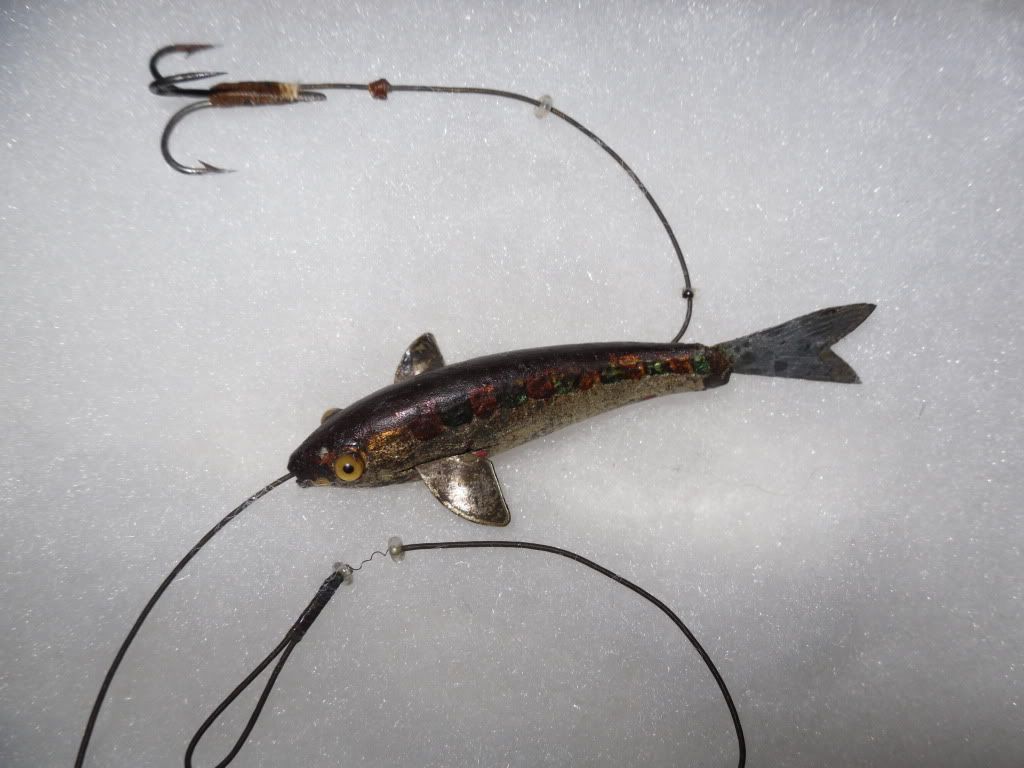
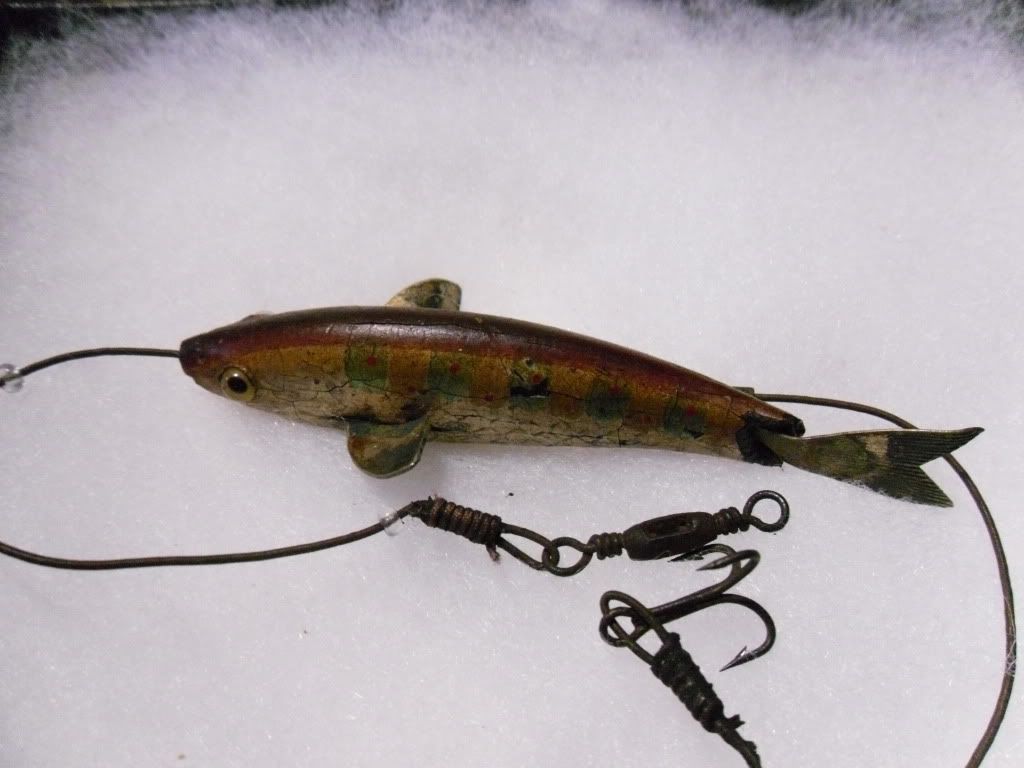
The Caledonian is also one of the few British lures that survived the American tackle making boom of the late 1870s and 1880s, that saw imported lures almost completely supplanted by lures made by Chapman, Mann, McHarg, and others. Here is a full page from the 1880 Abbey & Imbrie catalog:

Note the use of the word "Hard Rubber" to describe the A&I Caledonian.
So there you have it. The earliest American two-piece cardboard lure box I have ever seen and the lure that likely went in it. There are two very, very old cardboard boxed lures in Arlan Carter's book, including one Chapman that likely dates from 1875. But I believe this one is older.
Can anyone beat the proposed 1873-1874 date for an American tackle company cardboard lure box??
-- Dr. Todd
Recently I was emailed photos by Buck Juhasz of what I believe to be the earliest American fishing lure box, and thought I'd do some research and give a little background on the lure that almost assuredly went in this box.
The box is marked "Andrew Clerk & Co.'s Improved Hard Rubber Archimedean Minnow" and is a two-piece cardboard box with an orange paper label.
Since Andrew Clerk & Co. was renamed Abbey & Imbrie in 1875, we know for dead certain that this box pre-dates this 1875 transition. Since Andrew Clerk & Co. was known as Baker, Green & Clerk until 1864, we have a hard date for when this box was sold: 1864-1875. I believe I can more closely date the box based on some other evidence, as we shall soon see.
The Archimedean Minnow
But first a little background on the lure. What is an Archimedean Minnow? It is a fishing lure invented in Britain in 1845 by a man named Frederick Allies of Worcester. Allies received a patent for this lure on July 18, 1845, and the main innovation had a lasting impact on fishing lure design: the Archmidean fins on either side of the lure that made it spin in the water.
The term "Archimedean fins" were used to describe the two upward and downward fins that made the bait revolve. This is because they would make the bait spiral in the water like the Greek mathematician Archimedes' famous screw used to pump water in the ancient world.
Here is an example of a Townsend patented pearl phantom minnow showing the Archmidean fins from an early Cummins catalog.
The Archimedean Minnow became very popular in Britain. The first reference I can find to it is in Edward Fitzgibbon's A Handbook of Angling (1847) in which the author declared that the best artificial minnow is "the Archimedean minnow of Mr. F. Allies of Worcester...the artificial bait of Mr. Allies is sold by Mr. Farlow, of 221 Strand; by Mr. Cheek of 132 Oxord Street, and by all the other good London tackle-makers. Of small and middle size, it will kill (I guarantee it) trout, perch, jack, and occasionally salmon; of large size, it will kill the largest pike, the Salmo ferox, Salmo hucho, and the old Salmo salar in its inconstant moods."
A year later, William Carpenter in The Angler's Assistant (1848) declared "There are various descriptions of artificial minnows, one of which--the 'Archimedean minnow,' invented by Mr. Allies of Worcester--is becoming a great and deserved favourite."
By the time of the famed Crystal Palace Exhibition of 1851, Allies was clearly manufacturing a full line of Archimedean Minnows. Here is the blurb on Allies from the Exhibition's official catalog showing the range of goods he displayed:
These lures were largely used for trolling for pike and salmon, and as such remained a popular lure for over a half century. The 1866 Allcock's catalog contained a color image of the "Allies' Pectoral" minnow, referenced as the "pectoral fin minnow" at Crystal Palace, and this lure was still available in the late 1880s (see cut later in article).
The Archimedean became a standard bait for British anglers. Francis Francis wrote of it in 1874 in his By Lake & River: "I had a notion that I would spin it, and was rigging out my tackle, which, among other things, comprised a large sized, heavyish Archimedean minnow..." J.J. Manley was still touting it in 1877 in Notes on Fish and Fishing: "There is an infinite variety of artificial minnows. After trying very many, I find that practically the old 'Archimedean' horn minnow is as good as any..."
It was one of the few fishing lures to make it into English verse as well. Edward Farmer wrote of the Archimedean (and its inventor Fred Allies) in his "A Few Fishing Lines, or a Challenge to Angler" (1863) in the following stanzas:
I've learned to manufacture flies
Of every mortal form and size.
I do not mean that I can make them
As Blacker does--but fishes take them.
I've just enough of what's termed 'nouse,'
To build an artificial 'mouse'
'The Archimedean minnow' too,
Quite equal to the 'Derby-killer,'
For which men part with with so much siller;
Although the maker, sooth to say,
Has killed some rattlers in his day'
Mine take the lead, none e'er denies
Of those so noted by Allies.
Not everyone was a fan of the Archimedean. A.S. Moffat penned a blistering attack on artificial lures, naming the Archimedean specicially, when he wrote in 1865 in his Secrets of Angling: "Before, however, we speak of the art of minnow-trolling, I may be allowed a word or two respecting the various new inventions intended to increase the resources of the troller, in the shape of the new-fashioned bait--"Archimedean Minnow, "sensation baits," "nobbler flies," etc.--each one more destructive than any that have been seen in the world before. Truly, they would have one believe that the appetites of the fish were as capricious and as prone to novelty as milliners or young ladies..."
Suffice to say that the revolving Archimedean Minnow of Frederick Allies was an excellent innovation with a very long history in Britain. By the time Manley was writing in the 1870s, the term "Archimedean" had become a generic term used to describe any kind of similar style minnow as Allies' invention, whether they were made of horn, metal, gutta percha, or as we will see, hard rubber.
The Archimedean Minnow in America
Despite what Graham Turner might write, the use of actual fishing lures before the Civil War was unusual in America. This helps explain why so few examples of early lures show up. The few lures that were available to Americans anglers included the Buel Spoon, the T.H. Bate spinner, the Haskell Minnow, and various British imported devons, phantoms, and Archimedean minnows.
I am going to make a reasonable supposition based on available data as to what the lure that goes in the "Improved Hard Rubber Archimedean Minnow" box.
First of all, I think we can date the lure box a bit more specifically to the early-to-mid 1870s due to its use of the words "Hard Rubber." This is a term that was originally popularized in the late 1860s by the North British Rubber Company of Edinburgh, who wrote in their advertising copy for 1868 of items made of "Vulcanite (or Ebonite, or Hard Rubber)." So Hard Rubber was another name for Ebonite.
It first became popular in American fishing in the early 1870s as well, and soon became common in advertising. In fact, Andrew Clerk & Co. were sole agents (as I've written of before on my articles on A.H. Fowler) for the Fowler's Hard Rubber reel in 1874.
So I believe that this lure box dates from 1873-1875, as the term Hard Rubber became commonly used not just in popular parlance, but by Andrew Clerk as well.
But what does the lure look like?
The following cut comes from the 1871 Samuel Allcock & Co. catalog, and shows the "Allies Pectoral" discussed above.
The same catalog page shows what I believe to be the original Archimedean Minnow, which Allcock called the "Caledonian Minnow."
This is the lure that Abbey & Imbrie (successors to Andrew Clerk & Co.) advertised in its 1883 catalog as its "Caledonian Extra" Minnow, as seen in the cut below:
This is also the lure I believe went in the "Improved Hard Rubber Archimedean Minnow" box.
As an incredible, incredible coincidence, twelve hours before this article went to press, Stephanie Henry posted on the always amazing Joe's Board some photos of an unidentified lure. One look at it and it was clear this was a Caledonian Minnow, in fact, it is (I believe) the very lure that would have come in this box! Simply incredible. Here are Stephanie's photos, with her kind permission:
The Caledonian is also one of the few British lures that survived the American tackle making boom of the late 1870s and 1880s, that saw imported lures almost completely supplanted by lures made by Chapman, Mann, McHarg, and others. Here is a full page from the 1880 Abbey & Imbrie catalog:
Note the use of the word "Hard Rubber" to describe the A&I Caledonian.
So there you have it. The earliest American two-piece cardboard lure box I have ever seen and the lure that likely went in it. There are two very, very old cardboard boxed lures in Arlan Carter's book, including one Chapman that likely dates from 1875. But I believe this one is older.
Can anyone beat the proposed 1873-1874 date for an American tackle company cardboard lure box??
-- Dr. Todd
Tuesday, October 14, 2008
Voices from the Past: Death of a Fly Tying Expert (1887)
We know the names of so few professional fly tiers in the Victorian era, that when we can match a name to a firm it is a kind of small miracle. I ran across the following obituary entitled "Death of a Fly-Tying Expert" in The New York Times dated 02 June 1887. It details in brief the life of Michael Morrison, who we can now add to the list of expert tiers from the dawn of the professional fly tying era.
Death of a Fly Tying Expert
Michael Morrison, a man known to hundreds of anglers and employed by Abbey & Imbrie, of Vesey-Street, was found dead in bed yesterday morning of heart disease. Mr. Morrison was nearly 70 years old, and for the last 25 years he was engaged in tying salmon flies, his skill in the arty being regarded as greater than that of anybody else in the country. "Mike" Morrison, as everybody called him, knew all about the habits and tastes of a salmon, his knowledge having been gained in Ireland, where he was born, and in Scotland. His flies were so wonderfully attractive to the fish that anglers were always glad to get possession of them, and he had many applications from enthusiastic fishermen who desired to sit at his feet and learn his art. He leaves a widow and family.
Keep in mind he was important enough to warrant a fairly lengthy obituary in The Times. I would love to see some of Morrison's work, as it sounds like it would be spectacular. If you happen across any Abbey & Imbrie salmon flies--or pre-1875 Andrew Clerk & Co. counterparts--you may very well be holding an example from the hands of Mike Morrison.
-- Dr. Todd
Thursday, July 31, 2008
The Mystery of Abbey & Imbrie's Jubilee Rod
The Mystery of Abbey & Imbrie's Jubilee Rod
Noted fly rod historian Tom Kerr posted some interesting and important information about a great Abbey & Imbrie presentation rod over on Clark's Classic Fly Rod Forum that is well worth reading, as is all of Tom's research.
The problem is, I don't believe the 1876 A&I Philadelphia Exposition rod referenced was the same one displayed at the 1893 Columbian World's Fair in Chicago. What evidence do I have to support this theory? Well, first hand actually. Emerson Hough, the famed Chicago novelist and dedicated outdoor writer for Forest & Stream wrote many detailed briefs from the heart of expo, and knew intimately all of the men involved. He filed this fascinating brief in Forest & Stream on 25 May 1893, right before the exposition opening:
Mr. G.C. Hemenway, representing the well-known house of Abbey & Imbrie, was the other afternoon looking with interest at the work of installing the Abbey & Imbrie display of fine rods, the queen bee of which is a magnificent production known as the ‘Jubilee Rod.’ The rod is one of five made by Abbey & Imbrie for display in the Queen’s jubilee exposition in London. The other four were sold in London at $2,000 each, and brought the American house $75,000 trade besides. This rod now in Chicago is the equal of the others in all respects. It is a perfectly-made split-bamboo, faultless and ornamental to an unsurpassable degree. Even the ferrule plugs are exquisitely engraved. The precious metals only are used in the trimmings and fittings, the grip being of pure gold, richly and deeply chased. The butt of the rod contains a cut topaz the size of a pigeon egg and worth alone $1,200.
The "Queen's Jubilee" was Queen Victoria's Golden Jubilee held 20 and 21 June 1887 to celebrate the 50th anniversary of her coronation. Yet Tom Kerr's awesome poster, printed (I believe) in the 1920s to celebrate A&I own centenary, references what certainly sounds like the Queen's Jubilee rod and NOT the 1876 Centennial version. After all, when this brief was published, the Queen's Jubilee was only six year prior, and although memories are short, that is a very short time to forget when a rod you are in charge of was made.

A catalog cut from the 1928 A&I catalog of the rod and reel.
My belief is that the 1893 Chicago World's Fair A&I rod is the same pictured in the poster and erroneously called the 1876 Philadelphia Exposition rod. It is one of five made and if you want one, you have an 80% better chance of finding it in Britain than you do here in America. By the way, a $2000 rod in 1887 is equivalent to a $45,000 rod today. And it may seem like a lot of work to have made up such rods, but the blurb mentions it resulted in $75,000 in trade, or about $1.7 million in today's terms. Not a bad move by A&I!
As for what ever happened to the original 1876 Philadelphia Exposition rod...that is anyone's guess.
-- Dr. Todd
Noted fly rod historian Tom Kerr posted some interesting and important information about a great Abbey & Imbrie presentation rod over on Clark's Classic Fly Rod Forum that is well worth reading, as is all of Tom's research.
The problem is, I don't believe the 1876 A&I Philadelphia Exposition rod referenced was the same one displayed at the 1893 Columbian World's Fair in Chicago. What evidence do I have to support this theory? Well, first hand actually. Emerson Hough, the famed Chicago novelist and dedicated outdoor writer for Forest & Stream wrote many detailed briefs from the heart of expo, and knew intimately all of the men involved. He filed this fascinating brief in Forest & Stream on 25 May 1893, right before the exposition opening:
Mr. G.C. Hemenway, representing the well-known house of Abbey & Imbrie, was the other afternoon looking with interest at the work of installing the Abbey & Imbrie display of fine rods, the queen bee of which is a magnificent production known as the ‘Jubilee Rod.’ The rod is one of five made by Abbey & Imbrie for display in the Queen’s jubilee exposition in London. The other four were sold in London at $2,000 each, and brought the American house $75,000 trade besides. This rod now in Chicago is the equal of the others in all respects. It is a perfectly-made split-bamboo, faultless and ornamental to an unsurpassable degree. Even the ferrule plugs are exquisitely engraved. The precious metals only are used in the trimmings and fittings, the grip being of pure gold, richly and deeply chased. The butt of the rod contains a cut topaz the size of a pigeon egg and worth alone $1,200.
The "Queen's Jubilee" was Queen Victoria's Golden Jubilee held 20 and 21 June 1887 to celebrate the 50th anniversary of her coronation. Yet Tom Kerr's awesome poster, printed (I believe) in the 1920s to celebrate A&I own centenary, references what certainly sounds like the Queen's Jubilee rod and NOT the 1876 Centennial version. After all, when this brief was published, the Queen's Jubilee was only six year prior, and although memories are short, that is a very short time to forget when a rod you are in charge of was made.
My belief is that the 1893 Chicago World's Fair A&I rod is the same pictured in the poster and erroneously called the 1876 Philadelphia Exposition rod. It is one of five made and if you want one, you have an 80% better chance of finding it in Britain than you do here in America. By the way, a $2000 rod in 1887 is equivalent to a $45,000 rod today. And it may seem like a lot of work to have made up such rods, but the blurb mentions it resulted in $75,000 in trade, or about $1.7 million in today's terms. Not a bad move by A&I!
As for what ever happened to the original 1876 Philadelphia Exposition rod...that is anyone's guess.
-- Dr. Todd
Subscribe to:
Posts (Atom)