Showing posts with label Colby Sorrells. Show all posts

Saturday, January 14, 2012

Deconstructing Old Ads: The Layfield Lure: "Colby Sorrels to the Rescue" (1949)


The Layfield Lure: "Colby Sorrels to the Rescue"

The ad featured today appeared in the April 1949 issue of Outdoor Life. It is a full 2/3 page ad for a lure that I do not remember seeing advertised before. I will be the first to admit that I know very little about Texas lures and so I asked one of the best "Texas Lure Collectors" I know, Colby Sorrels, to give us an idea where this lure fits into fishing history. He as done a great job in the following account.
 

"This ad highlights a turning point for the little east Texas lure. The original lure was designed by Jester L. Layfield of Powell, Texas and was granted patent 2,179,641 on November 14, 1939. It was one of the first small, wiggling, crankbaits. Jester and his brother Floyd "Cotton" Layfield were depression era famers with little money to spend on things like marketing a fishing lure. They carved lures to fish with.
       
The Layfield brothers soon had reputations as real fish catchers and everyone wanted one of their lures. Lacking the funds to mass produce the lures they decided to allow a part-time preacher, John A. Day, to produce a plastic version of the little diving lure. His’ Sunnybrook Lure Company took out the ad in Outdoor Life. This advertisement shows three bass lying on hay along with a casting rig. The ad credits Tom King of Trinidad with catching the three fish. Even though the ad states "TEXAS Bronzebacks Layed In The Hay" there were no smallmouth bass in east Texas at that time! The fish are largemouth bass, not smallmouth.
      
The ad also mentions "Hot Secrets" on how to catch bass and suggests the reader to send 50c for a copy. These little handbooks were readily available 25 years ago but like a lot of old tackle are much less common today.
 

Twelve lure colors are listed. Collectors can still find all of these colors today and several more. The list of features includes item 2 stating "It’s the finest and most accurate casting bait you ever handled". The lure increases your casting accuracy? The ad also mentions trolling the lure for great success. Trolling was more common among bass fisherman at the time.
 
       Sunnybrook placed other advertisements during their short existence but this half page ad was meant to stir a desire for the lure that never materialized. They also created a colorful cardboard box for the lures. Money spent on half page advertisements, colorful boxes and little handbooks soon exhausted the available funds and Sunnybrook went out of business.
      
The Layfield lure saw a small surge in popularity during the 1980s and 1990s with other companies trying to re-introduce the little lure. Perhaps the most recent effort was by lure maker Storm and wrestler John "Bradshaw" Layfield. Throughout all of these many attempts, the Layfield lure never achieved much recognition and the original designers, the Layfield brothers, never made any money on the lure.
 
For those wanting more information on the Layfield lure, research past issues of the NFLCC Gazette. Houston Chronicle outdoor writer Bob Brister wrote several articles about the lure including a lengthy article for the February 1994 issue of Field & Stream."

 
Thank You Colby!


-- Bill Sonnett

Sunday, March 6, 2011

1000 Words

1000 Words

This week we have a 1000 Words mystery, sent in by Colby Sorrells, author of the great book The Flyfisher's Guide to the Texas Gulf Coast.

Colby is a dedicated Langley reel fan, and he writes:

I recently found the attached Langley banner. It shows a seal with a crown holding up a Langley Spin Deluxe 830. I believe the message is "Royal seal of approval" or "Crown seal of approval" or "Deluxe seal of approval." I would guess some person of royalty thought enough of the Langley reel to give it their seal of approval similar to the Swedish King giving ABU their Crown seal..

The attached photo was discovered showing the same banner with two men. The American flag flys from the ceiling in the background. The best we can date the photo is 1958 or 1959 based on the other reels in the photo. I know Langley reels were displayed in an exhibit in Moscow at one time.

I wanted to see if you might be able to show the photo on your blog and see if the identity of the two men could be determined. Also any help with the "seal of approval" would be appreciated.


If anyone can help out Colby, please send him an email at texasbassbugger AT yahoo DOT com.

-- Dr. Todd

Thursday, July 30, 2009

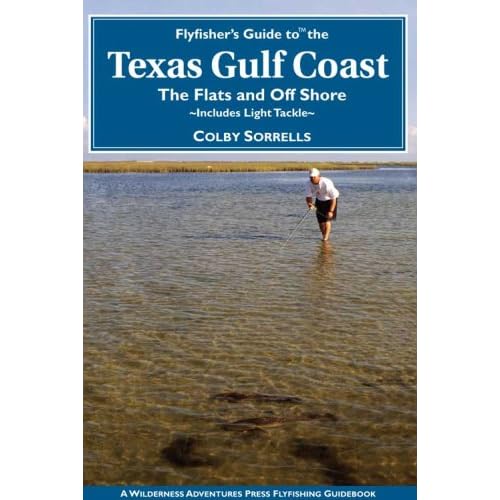
Thursday Review: Colby Sorrells' Flyfisher's Guide to the Texas Gulf Coast (2009)

Thursday Review: Colby Sorrells' Flyfisher's Guide to the Texas Gulf Coast (2009)

Growing up on the Land of 10,000 Lakes, I guess I consider myself fortunate to have been near so many diverse waters (Lake Superior, the Boundary Waters Canoe Area, etc.). But the diversity of the Great White North simply pales in comparison to the sheer variety of fishing available along the Texas Gulf Coast. A beautiful new book by NFLCC Secretary/Treasurer Colby Sorrells, Flyfisher's Guide to the Texas Gulf Coast: the Flats and Off Shore (Belgrade, MT: Wilderness Press, 2009), brought this point home loud and clear.


Another in a series of the popular "Flyfisher's Guide to..." by Wilderness Press, this book has all of the merits of the other books in the series, with the added bonus of having an author who really and truly knows his stuff. I own a few of these guides, and have looked over several others, and they are certainly nice looking books, but few of them have the feeling of authority that this one does. This is because Sorrells has written widely on the topic for over two decades, and more importantly, he's fished most of the waters that he writes about.

An example of the kind of experience and authority I'm talking about can be seen in the brief section on sharks. "I have an agreement with sharks," Sorrells writes. "I don't fish for them and they don't fish for me. If you get into an area where the sharks are taking your catch either on the line or on the stringer, MOVE. Let the sharks have the water. There are plenty of places to fish without having to deal with sharks." Although less than a paragraph (and in this day and age, being concise should be celebrated), it's the most pragmatic and best advice I've ever read on sharks for the fly angler.

The book is divided into convenient sections. The first covers gamefish likely to be fished for by the fly angler, ranging from the popular (tarpon and snook) to the less well known (sand trout). Then there are geographical sections covering the different places and kinds of fishing along the Gulf Coast (Sabine Lake, Galveston, Matagorda Bay, San Antonio Bay, Aransas Bay, Corpus Christi Bay, Upper Lagunda Madre, Lower Lagunda Madre, and Offshore). Each of these covers a wealth of details on the type of fish, methods of catching them, and other helpful tips. The book is filled out with convenient chapters on such subjects as tides, fly vs. light tackle, choosing a boat, the importance of sunblock, etc.

The book has many merits. It has numerous photos, illustrations and maps which help the reader at many points throughout the text--although the photo on Page 164 would have been better suited for the front cover (a bit of an inside joke for Texas NFLCC members). Each of the geographical sections offers contact information for numerous motels/hotels, tackle shops, etc. Like all the books in this series, it has a model Table of Contents and exhaustive index. If other publishers spent 1/4 the amount of effort on these two critical search tools, we'd all be much happier.

Since Texas has 367 miles of gulf shoreline and a further 3300 miles of bay shoreline, it offers a wealth of opportunity to the fly angler. Colby Sorrells has written what is certainly the definitive work on the subject, and one that is destined to remain not just a classic but also a model on how such books should be put together.

The book is widely available from many places, including Amazon.com. It is well worth owning for anyone who fishes the Gulf Coast, and is the perfect primer (and kick in the butt) for those who've always wanted to but haven't.

-- Dr. Todd