Wednesday, December 18, 2013

The American Snelled Hook, Part V: A Dave Cook Special


Dave Cook, who we've written about before, was an interesting guy. Not only was he a good friend, but he was a shrewd marketer as well.

Take for example our snelled hook under the microscope this week -- Dave Cook's trademarked "Speed Barb" hooks. He spent a lot of time and effort branding these hooks, declaring them to use an exclusive "special knot [which] is very difficult to tie … and is used by no other manufacturer .. because of the high cost of tieing." Cook also declared them to be "manufactured for and sold exclusively by the Dave Cook Sporting Goods Co."
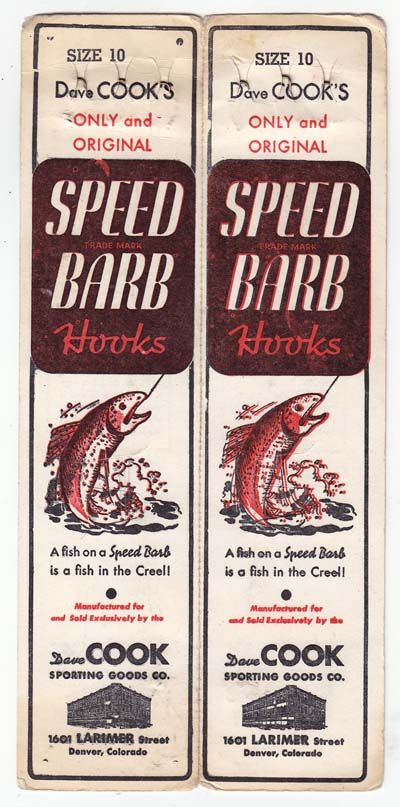
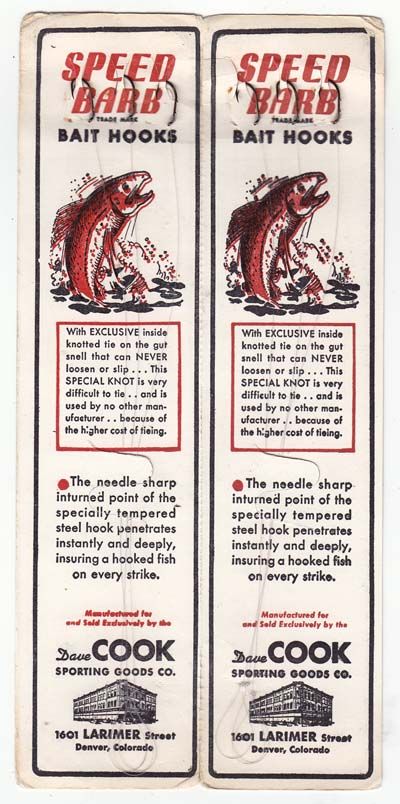


It was all a great bit of obfuscation, for the Dave Cook "Speed Barb" was nothing other than an Eagle Claw Bait Holder hook, made so famous across town from Dave Cook's headquarters.
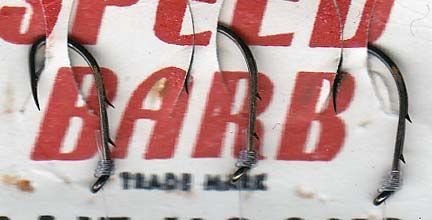


I don't often find Eagle Claw trade snells, so perhaps their close proximity allowed Cook to market his Speed Barb hooks when others had to sell the Eagle Claw brand. Anyway, it's a nice story and another feather in the cap of Dave Cook.

-- Dr. Todd

Tuesday, December 17, 2013

Voices from the Past: William Carpenter on Trolling (1848)


William Carpenter's The Angler's Assistant was an important, if often overlooked, early Victorian fishing treatise. Published in 1848, it gave a classic definition of the art of trolling, which is reproduced here:

Anglers divide trolling into three kinds: sinking and roving with live bait—trolling with gorge and snap hooks, and dead bait—and spinning, in which the fish with which the hook is baited, whether real or artificial, is given a revolving motion.

The fish to be taken by trolling are salmon, trout, pike, and perch.

Trolling is much esteemed, especially in the vicinity of London, and is practised when other modes of fishing are useless.

For trolling, properly so called—that is, with a gorge bait—the rod should be long and stout. A wellseasoned bamboo-cane, from fourteen to sixteen feet in length, is the best you can have; but in the absence of this, take the next best within reach. If you have a winch on the rod, there should be a ring on each of its joints; but if a thumb-winder is used, which some prefer, a large ring at the top of the rod, or at most two or three up it, will be ample. The rings must be large and strong, however, and the top one, two or three times the size of the rest. Trolling is sometimes practised, and not unsuccessfully, with a hedge stick, having a forked top, the line passing from the thumb-winder over the fork of the stick, which thus forms the top of the rod.

The trolling-line should be of silk, or of silk and hair; the former, however, is preferable. The length should be from fifty to sixty yards, and it should be seasoned, or dressed, by being put through cold-drawn linseed-oil, and then drawn through a piece of flannel or woollen cloth, held in the hand, after which it should be hung up for a few days in the air. The bottom line should be made of fine gimp, if for pike; or of the best gut, if for trout, about a yard and a half long, with a box swivel attached to it, about a yard distant from the hook, so that the bait may turn freely.

The gorge hook for a pike is formed of two single eel hooks, fastened back to back, to two or three inches of twisted brass wire, the end of which is formed into a loop, to be attached to the gimp or gut line, before described. Instead of using shot, as in other cases, the shank of the hook and part of the twisted wire are to be neatly covered with lead, taking care that it does not pass so far over the hook as that the jack, if he put his teeth through the bait-fish, will come in contact with the lead, as this would probably induce him to drop the bait and be off.


-- Dr. Todd
Monday, December 16, 2013

News of the Week: Dec. 16, 2013


Don't have time to read 50+ fishing and tackle collecting blogs and web sites? Well, let us do it for you! Follow all of the latest news, articles, and stories on our Whitefishpress Twitter account! Hint: You don't need to be a member...just bookmark the Twitter Feed Page or click on latest links to the right!

THE MONDAY 10: The Ten Fishing Stories of the Week You Need to Know

The Big Lead: Bloomberg's list of "favorite things" includes a Tenkara rod.

Why you should always make your own baits.


Megabass meets the bass mafia.

There are no one-size-fit-all fishing rods.

Technologies that changed fishing.

This is an unlikely Idaho monster trout.


Get yourself an Atlantic Salmon ... cushion???


Gifts to inspire young girls includes fishing rod.

New restaraunt gets its name from an old Scottish fly.

Finishing with a Flourish: How to fly cast into the wind.


Sunday, December 15, 2013

1000 Words


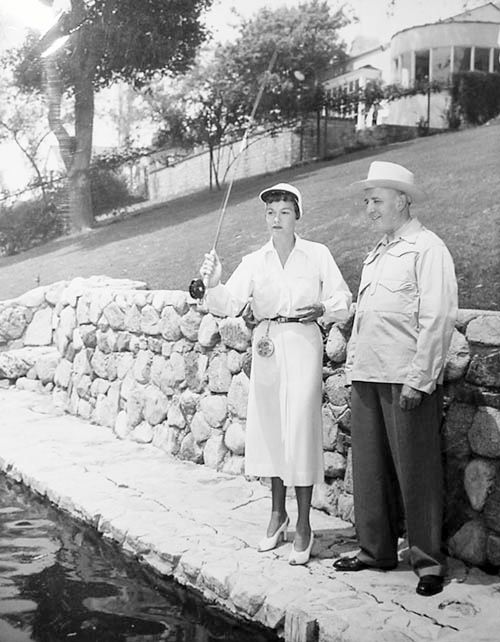
Jane Wyman (1917-2007) was an acclaimed actress who is also the only person in history to be the ex-wife of an American president, having been married for eight years to Ronald Reagan, with whom she had three children (they divorced in 1948 before he started her acting career). She was one of the finest actresses of her generation, receiving four Academy Award nominations and winning one for Johnny Belinda in 1948. She was re-introduced to a new generation of fans through her 1981-1990 evening soap opera Falcon Crest, in which she played the lead.

Here she is seen at the 1950 Los Angeles Sportsmen's Show getting a casting tip from Stanley Wright of Denver's Wright & McGill. She was testing out the company's new Fre-Line reel.

-- Dr. Todd

Friday, December 13, 2013

The Friday Funhouse


The Video of the Week

This is a neat video about fishing Boca Grande Pass in the 1950s.


12 Things I Would Buy If Only I Could Afford Them

This is an awesome 1888 American Angler magazine.


This Chubb letterhead is pretty incredible.


This is a pretty cool L.L. Bean trade rod.


This CCBC Injured Minnow is amazing.


This Shurebite Shedevil is a nifty lure.


This is a wonderful Oscar Peterson decoy.


With Seamaster launching their new line of reels, vintage items are in demand again.


This Milam #5 is a great find.


A Vom Hofe 9/0 is one of the greatest saltwater reels.


This Catalina Tuna Club pin is very rare.


These 12 Whopper Stoppers are really in demand.


As always, have a great weekend, and be nice to each other -- and yourself!

-- Dr. Todd

Thursday, December 12, 2013

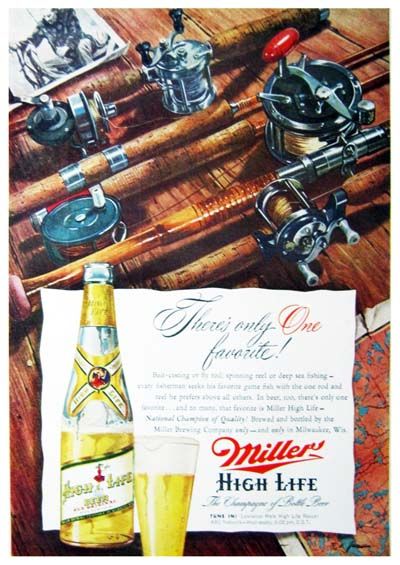
The Fishing Themed Advertisement: Miller High Life (1951)


This May 1951 advertisement for Miller High Life features a really nice image of a full set of fishing reels, including a baitcaster, a spinning reel, a fly reel, a musky reel, and a saltwater reel. It’s a really cool advertisement from a company that spent a lot of time courting the angler over the years.


-- Dr. Todd

Wednesday, December 11, 2013

An Angling Miscellany with Gary L. Miller


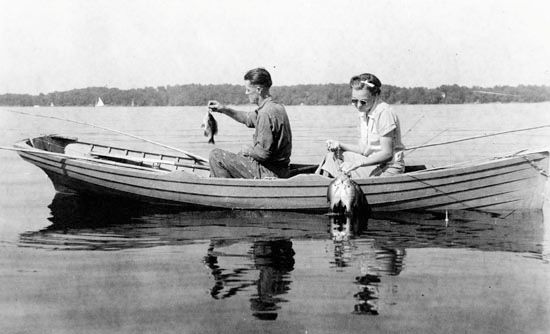
A photo from the Gary L. Miller archives. It's got everything you need. There really isn't anything one could say that would add anything substantial to the scene.


-- Gary L. Miller

Tuesday, December 10, 2013

Voices from the Past: The Final Request of William C. Boschen (1919)


The following article was published in the December 1919 The American Angler chronicling the final request of the famed angler and tackle inventor William C. Boschen. Since I had not seen this before, I thought I'd share it with anyone as it gives a lot of history to Boschen and the "B-Ocean" reel which he invented, with its incredibly influential Star Drag which is still in use today.
OBSERVANCE OF A SEA ANGLER'S REQUEST

It was the last request of William C. Boschen—the famous angler whose chief sport was sea fishing for big game fish—that within a reasonable time after his death, his ashes should be cast upon the ocean, on the course which he usually followed when enjoying the superb pastime to be found off the coast of Catalina Island, California. Mr. Boschen died on November 15, 1918, and in compliance with his final wishes the well known Captain George C. Farnsworth, of the launch Mabel F., fishing friend of the late New York sea angler, proceeded to carry out the directions as set forth. We quote the popular "Catalina Islander" of November 11, 1919, giving a graphic description of the faithful manner in which Captain Farnsworth fulfilled his promise to his departed friend.—Editor.

November 1, 1919.

Mr. Ernest Windle,

Avalon, Cal.

Dear Mr. Windle:

The late Mr. W.C. Boschen left the following definite instructions as to the disposal of his ashes:

That George C. Farnsworth, with the launch Mabel F., was to go to the Tuna Club float at 8:30 A. M., and the ashes were to be delivered to him there. He was then to proceed alone, following a certain course and to a certain point, which he and Mr. Boschen alone knew, and after reaching such point was to put the ashes overside.

It was Mr. Boschen's expressed desire that no ceremony of any kind should take place in connection with the carrying out of his wishes.

In accordance with the above instructions, at 8:30 o'clock this morning I delivered the ashes to Mr. Farnsworth at the Tuna Club float, and he in turn has carried out Mr. Boschen's instructions. I am writing you this and request that you publish this letter in full in an early edition of The Catalina Islander, in order that Mr. Boschen's friends may know in what manner his ashes were disposed of and the reasons for the procedure adopted.

Thanking you for your attention,

Faithfully yours,

Ralph Bandini.

=================================

William C. Boschen, Of New York, Who Passed Away On November 15, 1918

When The Catalina Islander received the above communication from Mr. Ralph Bandini, the launch Mabel F., with Captain George C. Farnsworth alone in the boat, was disappearing rapidly toward San Juan Capistrano on the mainland, the course usually taken by William C. Boschen on his fishing trips. Some ten miles from Avalon the course was changed to describe a circle toward the northwest. Then the craft and the lone boatman was lost to view. The Mabel F. entered Avalon Bay at 2:30 in the afternoon, after completing its mission. The day had been calm--the sky cloudless--the sea as blue as any day during the summer season. It is denied that the ashes of Mr. Boschen were placed were placed on the Pacific near the scene of conflict between the great swordfish (463-pound Xiphias gladius) and Mr. Boschen during the summer of 1917.

After his return, Captain Farnsworth said:

"At the regular trolling speed, I left Avalon, and when about a mile from the Tuna Club I opened the container and placed it on the chair on which he used to sit. Everything was done exactly as though he were in the boat. A flying fish rose from the water, and I said, 'There goes the first one.'

"I kept the first ten miles of the course toward the hills of Santa Ana, then turned northwest to cross the steamer course. It was 11:25 when I passed this point, indicated when 'Razor Back' of Santa Catalina shows half way between the third and fourth steps, with 'Black Jack' mountain to the left. It was a place where tuna and swordfish usually appeared at that hour, in the fishing season.

"It was where the boys of the steamer used to signal to us if they had seen swordfish and tuna after leaving the Breakwater. Occasionally, Harry Allen, on board the steamer, threw us a morning paper; and if bait had been scarce in Avalon, we would have them drop bait from the steamer—barracuda, mackerel, etc.

"After the steamer had passed, I shut off the engine and put up the American flag, and the Tuna Club swordfish and tuna flags. Just then a species of gull, which used to follow us for miles while we fed them, hovered above the launch and finally dropped on the water near by me.

"Then I put out the lunch, as I had done each day for the past six years when he fished from my boat. I placed the knife and spoon, glass and food, just as he had used them in life.

"In silence I ate my lunch; then smoked a cigar, fed the bird, and watched four whales that were close to me, two of them circling the boat within a hundred feet, while a school of tuna rose astern, about two hundred feet away. Truly, it was one of 'Boschen's days.'

"Aloud I said, 'I don't see a better time to carry out your wishes than the present moment.'

"Then I took the container from the chair and gently emptied the ashes on the blue surface. They floated off as I dropped the container and the food into the water.

"When I had complied with his last wish, I sat thinking over the past days for almost an hour.

"All the time when traveling over the course—about forty miles—we had so often gone together, I called attention to the various species of fish as we passed them. At these times, when I saw a swordfish, I would say to him, 'Our friend, the enemy, is in sight;' and when I saw tuna or a whale, etc., I used to say, 'Our friends are in sight.' And it is a coincidence, that only 'our friends' were in sight while I carried out his last wish.

"I pictured Mr. Boschen in his quiet way, standing in the stern of my launch putting on his belt and getting ready for the particular kind of fish he wanted to catch.

"He did not talk very much, but the first day we went fishing in the season of 1918—July 1, I think it was—we went over the same course I took today, and he then asked me to carry out his request. That day he told me about the operation he expected to have performed in November, and said that his doctors told him he could have one more year to fish. So he took the last few months, and let his chance for life wait until the angling season closed.

"His great ambition was to land the record tuna, and he worked very hard during the season of 1918 to do so. We arrived at Avalon last year with 102 tuna in three months, the largest one weighing 145 3/4 pounds. We hooked over 300 tuna that season. He never complained when a fish got off his hook or beat him in the fight; just quietly rebaited his hooks or put on new leaders. And no matter how many fish we had lost during the day, his last words as he left me for the night were, 'Never mind; we'll give them ___ tomorrow!'

"He told me to go over the same course alone, and asked that I spend the day just as if he were in the boat. His rod was near the fishing seat all the time. He passed away five days after the operation was performed—November 15, 1918."

Mr. Boschen loved the sea. To him it was more than "water and big fish"; more than strife and conflict. About Santa Catalina Island he found peace and quiet that charmed him beyond words. The sea to him was all that rural life is to the Nature lover; and it had for him beauties not to be found on land. Of those beauties, Mr. Boschen once wrote to these columns: "But the spirit is there—the love of blue water, sky, cloud effect, and the glorious hills of Catalina, with their changing colors and sometimes weird outlines. There never was such a place! . . .

"Oh, Catalina! Beloved Isle! ..."

For the season of 1915 Mr. Boschen took the largest tuna (138 pounds) and the largest marlin swordfish (285 pounds). In 1913 he captured the largest Xiphias gladius, 355 pounds, and in 1917 one weighing 463 pounds, which still stands as the world's record for that variety of fish. The Tuna Club "Boschen Swordfish Trophy" for exceeding the record is probably the dream of many enthusiastic rodmen.

Few men who visit Catalina waters have the endurance to combat these vicious swordfish for the time usually necessary to conquer them. For ninety consecutive days Mr. Boschen and his boatman covered the forty-mile course in search of tuna and swordfish. In the Mabel F. the two men would leave Avalon and return after a day spent on the ocean, sometimes with great catches of fish, fatigued and soaking wet, and at other times the fish had escaped.

Mr. Boschen was the inventor of the B-Ocean tuna and swordfish reel. He was a physical giant, over six feet in height, a great admirer of Izaak Walton, and a close observer of the wonderful beauties that Nature reveals to those who appreciate and protect her.

The surge of the sea his requiem,

The Pacific a lasting tomb.


-- Dr. Todd

Monday, December 9, 2013

News of the Week: Dec. 09, 2013


Don't have time to read 50+ fishing and tackle collecting blogs and web sites? Well, let us do it for you! Follow all of the latest news, articles, and stories on our Whitefishpress Twitter account! Hint: You don't need to be a member...just bookmark the Twitter Feed Page or click on latest links to the right!

THE MONDAY 10: The Ten Fishing Stories of the Week You Need to Know

The Big Lead: The wider world discovers April Vokey.

Is this a wooden vise? Maybe …


Why college bass fishing is catching on.
Johnny Morris is still promoting Bass Pro Shops, like the good old days.

Ice fishing tournament features the sport's "godfather."

British pol's most treasured possession is his great-grandmother's cane fly rod.

Bluegills on the fly.


An outdoorsman's Christmas list.

Horrible, horrible movie Fifty Shades of Grey will feature a fly fishing scene.

Finishing with a Flourish: Support the Henry's Fork Foundation -- I know I do.

-- Dr. Todd

Sunday, December 8, 2013

1000 Words


This week in Hollywood Goes Fishing, we get a nice 1937 publicity photo of silver screen siren Marie Wilson. Best known for her turn as Irma in My Friend Irma, a comedic show that was a hit on radio, television, and in the movies. She acted steadily (mainly in the role of the ditzy blonde) from 1934 through 1952, and sporadically after this. She is one of the few people with three stars on the Hollywood Walk of Fame -- one for radio, tv, and film.


-- Dr. Todd

Friday, December 6, 2013

The Friday Funhouse


The Video of the Week

A trip back in time to Black Marlin Boulevard.


12 Thing I Would Buy If Only I Could Afford Them

This Gene's Gem in the box is a very rare lure.


A Montague Chief in the box is a great find.


This Edwards Quadrate is reaching astronomical heights.


A Pflueger Maybug spinner is very rare.


How about a Charlie Burkheimer glass fly rod built on a Russ Peak blank?


Sage sold some nice fly reels.


A very nice Detroit Glass Minnow tube would make a great stocking stuffer.


Luminous is the toughest color in these South Bend Trout-Orenos.


An Ocean City Panama 10/0 is an amazing big game reel.


Heddon Dowagiac #100 in the box is a great find.


This Heddon Chugger comes in one of the toughest colors ever.


A Zangi Holliday spinning reel is a popular one.


Thursday, December 5, 2013

The Fishing Themed Advertisement: Shredded Wheat (1916)


This week in The Fishing Themed Advertisement we get a nifty full page ad run in the August 14, 1916 issue of The Independent, a major literary and news magazine of the day. It features the famous Shredded Wheat -- the substance of which was used to make Triscuit crackers -- as a backdrop to a fishing trip. "When you take to the woods you will want to take with you an out-door food that is easily and quickly prepared…" the advertisement declared, showing an angler putting his fly rod together on a wooden crate marked "Shredded Wheat Biscuit."

One wonders why two men would need so much Shredded Wheat for one fishing trip -- how much fiber do two men actually need? -- but since even today it is still a delicious breakfast, we'll cut the artist (it's unsigned) some slack and just enjoy a nice idyllic fishing picture, without thinking about the aftermath of eating 48 pounds of Shredded Wheat while camping in the woods.


-- Dr. Todd

Wednesday, December 4, 2013

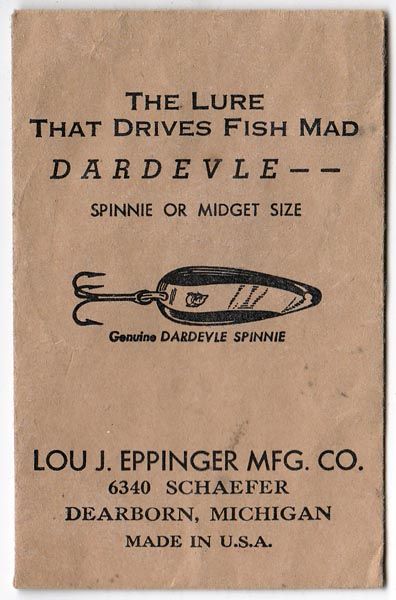
The American Snelled Hook, Part 4: Eppinger--A Tackle Maker and Dealer


Lou J. Eppinger is justly famous as one of the most important tackle makers in American fishing history. The inventor of the Daredevle casting spoon and a host of similar metal baits, his lures are so omnipresent in the fisherman's tackle box that it is easy to forget that for the first three decades of his career, Eppinger concurrently ran a tackle and taxidermy shop in Detroit under his own name. His early catalogs, in fact, are filled with tackle from many other manufacturers, in addition to his own wares, meaning he was a manufacturer and trade house as well.

Eppinger's was the place for Michigan sports to buy their tackle, and perhaps meet the man himself, in the 1910-1940 era. Not only was his presence everywhere in the shop, but he always hired the best staff. It was Lou Eppinger, for example, who hired a brilliant young taxidermist named Paul H. Young to come work for him, setting in motion the career of one of the greatest bamboo rod makers of all-time.

Today's snell is a nifty small hook envelope (2.25" x 3.5") that came with a dozen #12 trout hooks in it. It's a cool hook envelope and a reminder that even in the 1930s, when this envelope was sold, you could walk up to Eppinger's at 6340 Schaefer in Detroit and buy your fishing tackle.


-- Dr. Todd

Tuesday, December 3, 2013

Voices from the Past: Reuben Wood (1885)


The following blurb, from the June 25, 1885 issue of Forest & Stream, remembers one of the great fly casters and tackle dealers of the middle part of the ninetieth century--Reuben Wood of Syracuse, New York. A massively popular sort, this little remembrance was written by his friend, and poet, Isaac McClellan.

Reuben Wood -- In speaking of the exploit of Mr. W. H. Wood in killing a tarpon, as recorded in FOREST AND STREAM, "McClellan," in Land and Water, says of the late Reuben Wood:

"I wonder, by-the-bye, whether 'the tarpon slayer' is any relation to that dear old American angler and prince of fly casters, Reuben Wood, who was with us through the time of our Fisheries Exhibition. It seems only yesterday since he slept under the very roof which now shelters my own bend from n splendid, and most May-like, shower of hailstones. And now, alas! he sleeps under the green, mossy turf, whose every blade of glass be loved with the sweet simplicity of a guileless heart. It is no exaggeration to say that every Englishman who had the pleasure and honor to know 'Uncle Rube' loved him alike for his simplicity of nature, envied him good-naturedly for his wonderful skill with the fly-rod, and honored and respected him for his sterling qualities as a sportsman.

Poor mortals die, and make no sign,

But Nature still its life renews;

Spring woods, spring fields with glories shine,

Spring blushes Nature's face suffuse."

-- Dr. Todd