Some of you know I have been the caretaker of The Classic Fly Rod Forum, which (depending on what metric you use) is either the first or second largest fly fishing web site in the world. Well, folks, the Classic Fly Rod Forum has moved to a new home! You can access the new and improved site by CLICKING HERE.
As you can imagine, migrating such an incredibly large board from one site to another is an unbelievable amount of work. Two men who need special singling out are Tom Gould (owner of the Fiberglass Fly Rodders board, and Classic Fly Rod Forum moderator and database expert extraordinaire Mark Wendt. A third gentleman who shall remain nameless was critical in getting all of this done.
This evening, I received word a third favorite board--Ultralight Flyfishing--has also migrated from their old home to a new one.
Check out all three boards in their new homes and register for your username and password!
-- Dr. Todd
Thursday, December 22, 2011


Wednesday, December 21, 2011
52 Trade Houses Part 38: Wm. C. Hoegee Co. of Los Angeles

Over the course of the next year, we'll be detailing the history of 52 companies that sold branded fishing tackle. 52 trade houses in 52 weeks -- some obscure, some famous, and all available exclusively here on the Fishing for History Blog! If you have any items from the week's entry you'd like to share with us, please send it my way and I'll make sure it makes it on the blog.
For a discussion of what exactly trade tackle is, Click Here. Enjoy the 52 for 52!
A cool old West Coast trade house was the William H. Hoegee Company of Los Angeles. It was a large house with a long history and sold a bunch of fishing tackle, including a lot of it under proprietary trade names.
It was founded in 1889 by its namesake Wm. H. Hoegee as a tend and awning business serving the mining community. By 1907 it had expanded to include innumerable goods and occupied a building in downtown Los Angeles at 138 Main Street that was four stories and 60 x 350 feet. They employed 200 people that year, and it was run by Adolph Hartmann and John C. Hill.
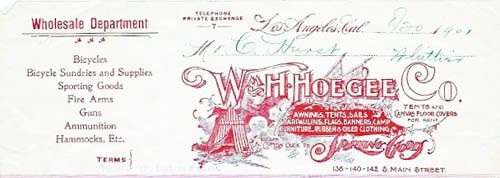
William C. Hoegee was a noted California philanthropist. With a massive residence in Hollywood, Cal., he was president of the Hollywood Improvement Association. He passed away in 1919, leaving a massive estate.
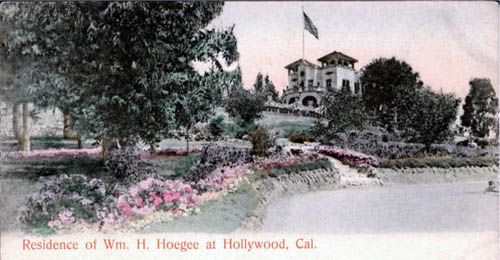
A write up in Mines and Mining on Dec. 6, 1907 declared "Orders come to his house from all parts of the world and goods are constantly being shipped to outside states and distant lands…the main success of this great establishment can be traced, perhaps, to extensive and judicious advertising, strict attention to business, meeting the wants of patrons, selling goods on close margins, integrity and a high sense of honor in all its transactions."
They carried sporting goods from an early date (1890s perhaps). Here is a 1902 Field & Stream advertisement.
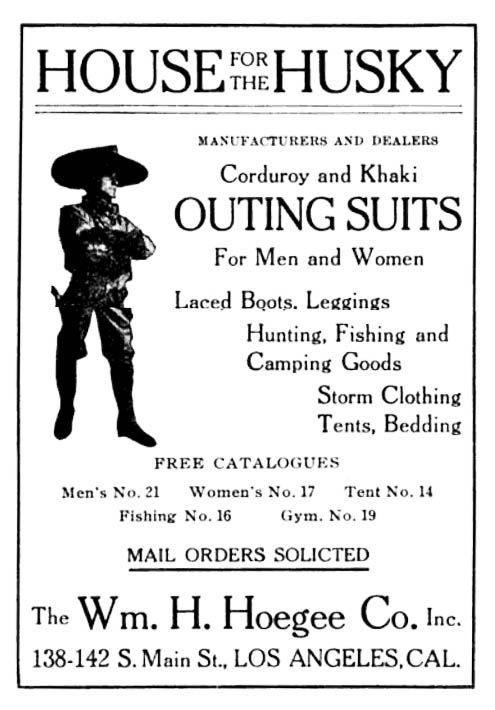
They also carried guns. This blurb from the Western Field in 1903 details the gun department in an article entitled "SPECIALISTS IN EVERY DEPARTMENT":
In addition to the other conveniences offered sportsmen by the Wm. H.. Hoegee Co. of Los Angeles Mr. H. W. Bickford, expert gunsmith in charge of their gun repair shop, makes a specialty of building fine rifle and pistol barrels. He has invented and completed a rifling machine that is marvelously accurate. The machine gives any pitch of rifling from straight to one turn in six inches, either right or left hand, increase or uniform twist. The machine will rifle any caliber from .22 to .50, and any length of barrel up to 36-inch. He also makes a specialty of rc-bluing revolvers and gun actions. The re-bluing Mr. Bickford does is not cheap oil or acid bluing, but his work is the beautiful high polished blue-black as found only on the most expensive guns. Mr. Bickford also makes telescope sights, either for hunting
or target rifles. They are finely made and practical in every respect. He personally proves every piece of finished work before it leaves the shop, making it practically impossible for poor work to get out. All rifle and pistol barrels are tested at the range and must make a small group. _ .
The stock of this famous concern is now without a peer in the vast section which they so admirably cover. Everything of any kind and price that may be thought of by sportsmen is here in complete assortment and a visit to this famous establishment constitutes in itself a liberal education in the paraphernalia of modern sport. Each department is under the care of a specialist and the courtesy extended visitors has passed into a proverb.
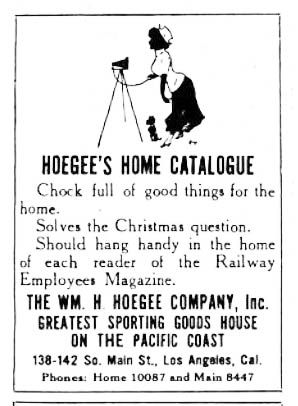
By 1912, as evidenced in this Railway Employees magazine, billed themselves as "The greatest sporting goods house on the Pacific Coast."
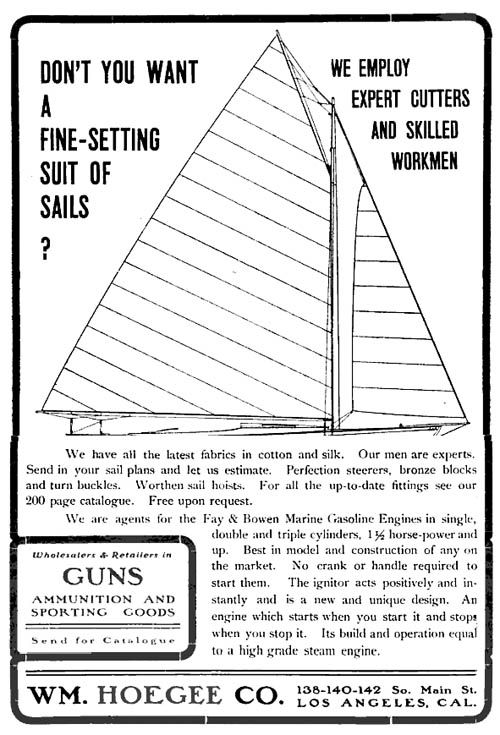
Hoegee was very committed to west coast fishing. They sponsored a number of fishing events, including giving a loving cup for the largest Albacore, and working with the famed Catalina Tuna Club.
So successful was Hoegee's tackle trade (and sporting goods sales) that in 1915 they were listed as among the largest retail sporting goods companies in the nation. After World War II, Wm. C. Hoegee Co. merged with Western to form the Western-Hoegee Company.
There is a ton of fishing tackle marketed by this firm. Up until WWII most of the tackle, as far as I can tell, was sold under the Hoegee name. After WWII, Western-Hoegee took out the trade names Huck Finn (dead 1964), Tuna King, Big Eye, and Penguin (dead 1964).


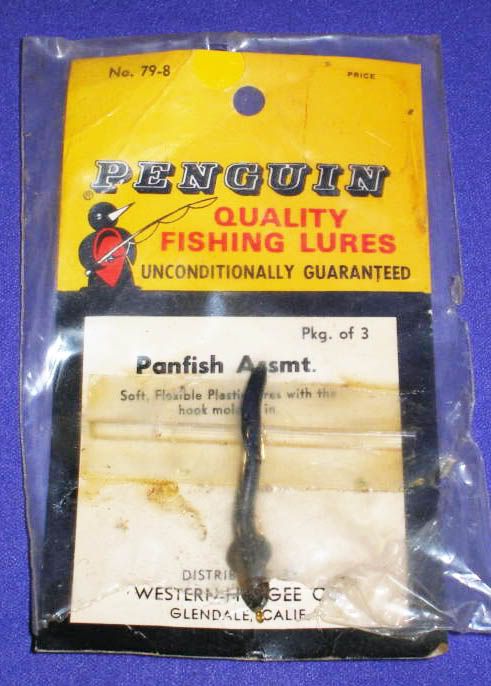


The company continued on into the 1980s and beyond. In Nov. 2004, Western-Hoegee was purchased by Maurice Sporting Goods. At the time, Western-Hoegee serviced 1500 retailers with fishing tackle and other sporting goods.
There are even still some Hoegees today in the tent and awning business, a fitting testament to the durability of this old company.
-- Dr. Todd
Tuesday, December 20, 2011
Voices from the Past: O.W. Smith (1920)

An early chronicler of the history of the Kentucky reel was Onnie Warren Smith. Here, in his book Casting Tackle & Methods, he tackles the history of the fishing reel.
In no single item of the bait-caster's outfit has there been greater development than in the reel. It is a long journey from the first single action winder down through the years to the modern quadruple, self-winding, self-thumbing, self-a-hundred-and-oneother-things reel.
Just where and when the fishing reel originated we know not, but we find mention of it in "The Complete Angler"; says Isaak Walton: "And to that end, some use a wheel about the middle of the rod, or near the hand; which is to be observed better by seeing one of them, than by a large demonstration of words." Presumably Walton had no personal knowledge of the "wheel," otherwise he would have been more explicit in his description. This first winch was undoubtedly after the fashion of the "Nottingham reel," still used in England, a large disk of wood with a grooved outer edge to contain the line; simple and efficient for the work for which it was intended, fly fishing. To-day the single action reel has diminished in size and is made of many materials, but still it follows closely the pattern of the first winch produced. From the very nature of the case this is bound to be true. Little is required of the fly fisherman's reel, ordinarily it is but a spool on which the line is stored, so obviously no great development may be expected, no radical changes looked for.
The invention of the multiplying reel, the casting reel, per se, was coincident with the discovery of the black-bass as a sporting asset. As the short rod was born to meet new fishing conditions, so the multiplying reel was produced to satisfy the demand for something different to meet the wiles of a fish that fought differently, could be taken with different methods.
The multiplying reel was born down in "the blue grass country" in the beginning of the nineteenth century. Probably Mr. George Snyder, of Paris, Ky., produced the first double multiplying reel between the years 1810 and 1840, a crude creation when compared to a modern Meek or Talbot, but in mechanism of small pinion and larger cog-wheel, essentially what the latest reel is. Mr. Snyder was president of the Bourbon County Angling Club, and when not attending to his duties of presiding officer or engaged in his favorite occupation, angling, he applied himself to his trade, that of silversmith and expert watchmaker. Naturally he first made a reel for his own use, improving upon the winch as he discovered need for improvement in actual fishing. So the multiplying reel is a fisherman's discovery, as is every piece of tackle which stands the test of time.
When Snyder's reel was all but perfect his friends were attracted by its value as an aid to sport, and we find the inventor holding the honorable position of reel-maker to the Bourbon County Angling Club. Some of Snyder's early reels are still in existence and disclose a loving care and intimate knowledge of tools worthy of emulation. Casting from the reel with artificial lures was undreamed of in those days, Snyder's reel being produced for live bait fishing only, though it was but a step from live bait casting to throwing artificial lures. In some respects, judged by modern standards, these early reels are crude, the plates being riveted in position, the drag and click cumbersome, the shaft projecting through the head and tail plate, the barrel much longer than those in use to-day. However, the multiplying reel had arrived.
Another man to turn his attention to reel making was Mr. J. F. Meek, who appeared in Frankfort, Ky., about 1833, improving the Snyder reel by operating the dick and drag with sliding buttons, placing a collar around the crank shaft, and eliminating the protruding spool-shaft. In Louisville, Ky., in 1843, a man by the name of J. W. Hardman began making reels for black-bass fishermen, and under his expert hand it may be asserted that the modern "Kentucky reel" took shape. Mr. Hardman shortened the spool, fastened the head and tailplate to the pillars with screws instead of rivets, and increased the diameter of the spool, not to mention scroll work and ornamentation. Another name to be reckoned with in connection with the production of the wodern casting winch is that of Mr. Benjamin C. Milam, who in 1836 became an apprentice to Mr. J. F. Meek, soon taking charge of the reel making industry of the firm. Later on, in connection with his son, we find him making reels under his own name. There are other individuals who should be mentioned in connection with the early history of the multiplying reel, but in so brief a resume it is out of the question. There is one outstanding fact, however, which even the careless reader will not fail to note, i. e., the important place the Blue Grass country plays in the development of the casting reel; but this is as it should be, for it was from the southeastern portion of the United States that the type specimens of both species of black-bass were secured.
-- Dr. Todd
Monday, December 19, 2011
News of the Week: 19 December 2011


Don't have time to read 50+ fishing and tackle collecting blogs and web sites? Well, let us do it for you! Follow all of the latest news, articles, and stories on our Whitefishpress Twitter account! Hint: You don't need to be a member...just bookmark the Twitter Feed Page or click on latest links to the right!
The big fish of Powai…the Zara Spook is a great Christmas gift…late ice means trouble in Maine…love of fishing leads to tackle shop…Robert Thompson--punk rocker and fly angler…trollers deserve good rods…Denali and Boo get in bed…the Punkie Spook…man uses counterfeit money to buy fishing gear…Aussies and their fisho gear…it must be THE NEWS OF THE WEEK!
The Big Lead: The Times of India on the big fish of Powai.

The Zara Spook makes the list of seasonal gifts.
Late ice means bad business in Maine.
How a love of fishing spawned a new business.
An interview with punk rocker and fly angler Robert Thompson.
Even trollers deserve responsive rods.
Denali Rods signs Boo Woods.
Man uses counterfeit bill to get his fishing rod.
The Big Thompson is still attracting anglers, even in winter.
The Punkie Spook is this week's winner at Field & Stream.

Finishing with a Flourish: Aussies offer eye-popping fisho gear.

-- Dr. Todd
Sunday, December 18, 2011
1000 Words
1000 Words
Today in 1000 words we continue our celebrity fishing series with a neat portrait of Senator Ted Kennedy and two of his boys likely fishing stripers on Martha's Vineyard.

-- Dr. Todd
Today in 1000 words we continue our celebrity fishing series with a neat portrait of Senator Ted Kennedy and two of his boys likely fishing stripers on Martha's Vineyard.
-- Dr. Todd
Saturday, December 17, 2011
Deconstructing Old Ads: Creek Chub Plunker (1928)

The Creek Chub Plunker – A Classic Bait
This advertisement from the March 1928 issue of Outdoor America magazine proclaims the Creek Chub Bait Company's “Plunker” as “new” though it is known that it was produce in 1927. Seasoned Creek Chub Bait Company collectors will recognize in this illustration the Plunker's early, full-bodied shape. It is listed as weighing ¾ oz. In a few years it would take on a slimmer appearance and have its weight trimmed to 5/8 oz. Identifying genuine early Creek Chub Plunkers can be confusing . The confusion results from the fact that later Shur Strike Plunkers (made by C.C.B.C. as a less expensive, second line of baits) are nearly identical in shape to the earliest Creek Chub Plunkers. The Shur Strike baits must have been made from a lighter wood or had a lot less paint on them as they are listed at ½ oz..
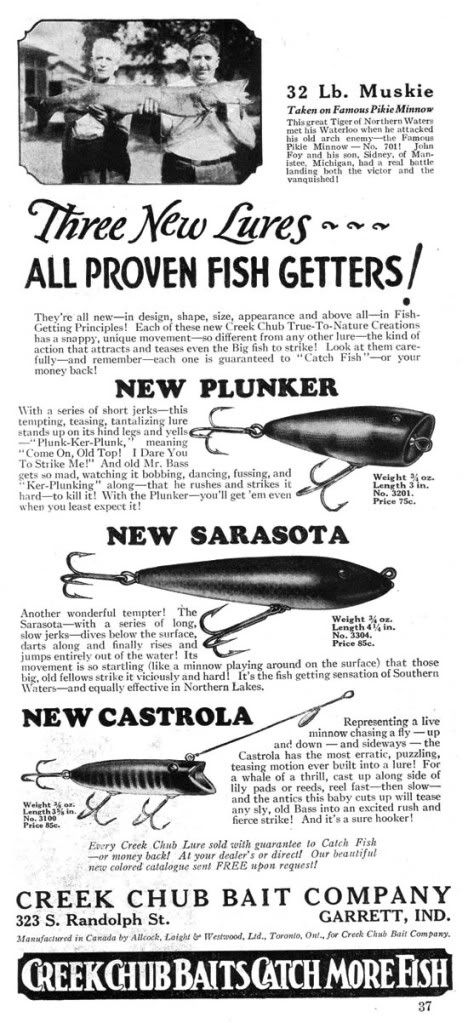
Few plugs have been featured in paintings as many times as the Creek Chub Plunker. It is usually in the mouth of a bass with the fish leaping high, as anglers in the distance look on. Most of the time it is the ubiquitous red and white.
The idea of a surface lure (with no spinners) that popped, plunked and splashed when given a good tug, seems to have evolved from Jim Heddon's “slopenose”(cc 1902) on through the various “woodpecker” style baits. The Holzaphel Mushroom Bait (cc 1912 -- see Deconstructing Old ads for October 17th 2009)) appears to me as somewhat of an intermediate between the “woodpeckers” and the Plunker. Since the Plunker proved to be an effective lure for big fish, it has been copied in countless ways by large and small companies alike. From the Heddon Chugger to the present-day Pop-R and its many morphs, the "plunking bait" has become a standard type in any line-up of surface lures.
When sportswriter Brent Frazee of the Kansas City Star was introduced by Warren Platt to bass fishing with vintage tackle, he was presented with several vintage lures to use. He first chose the Creek Chub Plunker. Brent soon started to catch bass with the bait and despite repeated encouragements from Warren and myself to try some other baits, he has steadfastly stuck with the Plunker. Frankly, he has caught about as many fish as either of us when we've fished together. If one has to be a “one-lure fisherman” you could certainly do worse.
As a boy, I spent many hours looking over the selection of plugs at the local hardware store. These always included Creek Chub Plunkers which I found very alluring, but for some reason I never chose to buy one with my hard-earned, lawn-mowing money. It was not until I got into collecting old tackle that I decided to give the Plunker a try. It has since accounted for many large bass, especially after dark. I wish I had purchased one back in the 1950's ----- just think of all the bass I missed out on!
-- Bill Sonnett
Friday, December 16, 2011
The Friday Funhouse
The Video of the Week
Holy Slabs, Matt Heron!
12 Things I Would Buy If Only I Could Afford Them
This is just the neatest dang cricket lure I've ever seen.

One of the all time rarest Mitchell reels just hit the market. Hold on to your hats, folks.

Christmas is definitely here. Check out the Hurd Supercasters.

This sure is a nifty Midget Surf Oreno in a crisp box.

This Talbot is the reason why people love Kentucky reels.

39 bids and counting on an Abu Cardinal 33.

This Australian Surfmaster reel is pretty cool.

This Winters Surface Bait is complete with the wings.

Parker Guns and Hawes Fly Rods are a sweet combination.

This Pearl Wobbler is a great bait.

I've never seen a Nichols Silver Dollar before.

A South Bend Night Luminous woodpecker is a nifty lure in the box.

As always, have a good weekend and nice to each other, and yourself!
-- Dr. Todd
Holy Slabs, Matt Heron!
Matt Heron Reels in a Gigantic Brown Trout from Filmed In Tahoe on Vimeo.
12 Things I Would Buy If Only I Could Afford Them
This is just the neatest dang cricket lure I've ever seen.
One of the all time rarest Mitchell reels just hit the market. Hold on to your hats, folks.
Christmas is definitely here. Check out the Hurd Supercasters.
This sure is a nifty Midget Surf Oreno in a crisp box.
This Talbot is the reason why people love Kentucky reels.
39 bids and counting on an Abu Cardinal 33.
This Australian Surfmaster reel is pretty cool.
This Winters Surface Bait is complete with the wings.
Parker Guns and Hawes Fly Rods are a sweet combination.
This Pearl Wobbler is a great bait.
I've never seen a Nichols Silver Dollar before.
A South Bend Night Luminous woodpecker is a nifty lure in the box.
As always, have a good weekend and nice to each other, and yourself!
-- Dr. Todd
Thursday, December 15, 2011
A Fishy Fishy Christmas?
Joe Cermele over at the great Field & Stream's Honest Angler Blog had a wonderful post yesterday on Christmas and anglers and those Heddon Punkinseed ornaments that are floating around everywhere.

I've always wondered about these things as I see them on the 'bay all the time...so if you're interested in the story Head on over and check it out!
-- Dr. Todd
I've always wondered about these things as I see them on the 'bay all the time...so if you're interested in the story Head on over and check it out!
-- Dr. Todd
Wednesday, December 14, 2011
52 Trade Houses Part 37: James G. Barry Co. of Chicago
Over the course of the next year, we'll be detailing the history of 52 companies that sold branded fishing tackle. 52 trade houses in 52 weeks -- some obscure, some famous, and all available exclusively here on the Fishing for History Blog! If you have any items from the week's entry you'd like to share with us, please send it my way and I'll make sure it makes it on the blog.
For a discussion of what exactly trade tackle is, Click Here. Enjoy the 52 for 52!
Chicago James G. Barry Co. is a rather obscure fishing tackle trade house. It's founder James Barry was a cutlery man and this is what the firm was originally founded as.
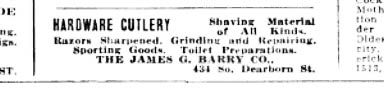
In 1913 the company was advertising from 434 S. Dearborn Street in Downtown Chicago, and was selling "Hardware cutlery, shaving material, sporting goods, toilet preparations" and was sharpening razors and grinding and repairing edge tools. The following ad came from a 1913 edition of The Advocate: America's Jewish Journal.
In 1919, the firm was recommended in The American Artisan as a razor sharpening company located at 36 South Clark Street. It was still in business in 1925, when he was listed at 86 South Clark Street, but not in 1930.
So what we have is a small cutlery company that decided to expand into sporting goods in the 1910s. Probably selling tackle to locals to use on vacation or down on the lakefront, any marked items from companies like this are exceedingly rare.
The only piece of fishing tackle I've ever seen was stamped with the company's address on the back side. It is an early pre-1925 South Bend Cast-Oreno spool and is exceptionally rare.
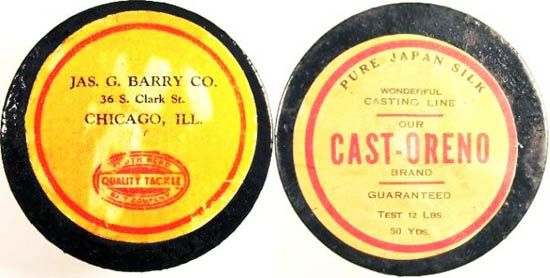
The numerous small companies like Jas. G. Barry Co. deserve to be remembered for their not insignificant contribution to the tackle world.
-- Dr. Todd
Tuesday, December 13, 2011
Voices from the Past: E.A. Pflueger (1918)
The following article on the origins of the Wooden Minnow appeared in my book Pflueger Profiles. I had found it in a 1924 edition of the League of Ohio Sportsman magazine, but wondered where the original had come from. Wonder no more. The original article was published in the May 1918 Hardware Review magazine, in response to Stimson's article in the American Angler on the same subject.
THE ORIGIN AND EVOLUTION OF THE WOODEN MINNOW
By E. A. Pflueger, Enterprise Mfg. Co.
As there seems to be some agitation on at the present time on the part of sporting writers in showing up relics of the past in the fishing tackle line, especially as regards wood minnows or plug baits, the Enterprise Mfg. Company has prepared the following for the enlightenment of all interested in this subject.
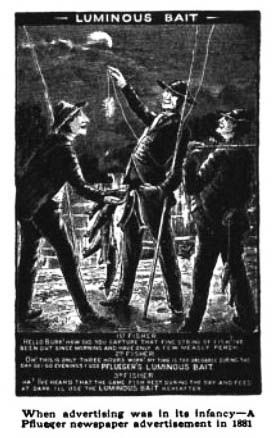
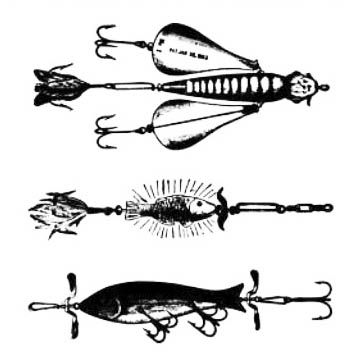
We made our first plug bait in the year 1881 in the form of a hollow glass minnow, mounted with single and treble hooks at tail and spinner at head. This was heavy enough to cast properly and the minnow being filled with a mirror substance also our "Luminous" material, made it very attractive and a good seller.
Following the Glass Minnow, we made other casting baits, all of which could be termed plug baits in the following order: Rubber Minnows, Phantom Minnows, Devon Minnows, Pearl Minnows, Metal Minnows. In the year 1883 we put out the Comstock Wood Minnow, the body being made of wood with glass eyes and spinners mounted upon the side instead of at the head and tail, according to prudent methods.
In the year 1898 we were the first to place on the market a wood minnow of the present day structure, and have been continuously manufacturing wood minnows and other forms of wooden baits ever since.
Our variety of baits and fishing tackle general to-day is by far the largest in volume and number turned out by any factory in the United States.
The best thing about the original was the two accompanying images--one I'd seen before (of the three Pflueger lures) but I'd not seen this version of the newspaper ad.
-- Dr. Todd
Monday, December 12, 2011
News of the Week: 12 December 2011
Don't have time to read 50+ fishing and tackle collecting blogs and web sites? Well, let us do it for you! Follow all of the latest news, articles, and stories on our Whitefishpress Twitter account! Hint: You don't need to be a member...just bookmark the Twitter Feed Page or click on latest links to the right!
Fish shaped mailboxes targeted by teenage theft ring...improve your fishing with just five lures...so many lure so little time...Jerry Fuller passes away...major tackle companies moving to China...luremaking helps man recover from stroke...Rapala and FLW back in bed together...Pay Me Rig = Alabama Rig?...Dick Pobst has a new book...Bedford Sportsman celebrates 40 years...kids create fishing lures...it must be THE NEWS OF THE WEEK!
The Big Lead: New Berlin, WI cops break up high school crime ring intent on stealing fish-shaped mailboxes.
xxx

How to improve fishing with five key lures.

So many lures, so little time.

Minnesota tackle pioneer Jerry Fuller passes away.

Major tackle companies are moving OUT of China.

Mexico's Roosterfish is worth crowing about.

Luremaking helps young man recover from stroke.
Rapala and FLW are back together.
Is the Pay-Me Rig the hottest lure of the year,?

Dick Pobst's fourth book hits the shelves.

Celebrating 40 years at the Bedford Sportsman.
Finishing With A Flourish: Kids create custom fishing lures.
-- Dr. Todd
Subscribe to:
Posts (Atom)