Friday, September 9, 2011

The Friday Funhouse

The Video of the Week

Don't forget to check out the Fishing For History Fishing Video Tumblr Archive where all the videos we've ever posted are stored!

This is a wonderful 1947 film by legendary angler Van Campen Heilner about striper fishing off Montauk Island.


12 Things I Would Buy If Only I Could Afford Them

This is just about the prettiest Milam & Son #3 you are likely going to find.


How often do you see a Wm. Frankfurth Hardware Co. "Garvin" minnow bucket?


This is a nifty hand made saltwater fishing reel.


Philip Geen's Combination Bait is a pretty lure from across the pond.


This is a beautiful SeaGull Polywog in rainbow. Gorgeous!


Best Creek Chub color ever? Best Creek Chub color ever.


Instant collection alert: 9 Heddon Spooks.


One of the finestlures ever made -- the Arbogast Tin Liz sunfish.


Gar Wood designed some of the finest reels ever made.


I do like these K&K animated minnows.


This Bronson Invader is the cadillac of Bronson reels.


A big Rapala lure (28") has the Rap guys going crazy.


As always, have a great and safe weekend, and be good to each other--and yourself.

-- Dr. Todd

Thursday, September 8, 2011

Thursday Review: ORCA's Reel News (September 2011)

ORCA's Reel News (September 2011)


This ain't your father's Reel News!

Some exciting new developments in ORCA are highlighted by the arrival of redesigned and upgraded Reel News, the bi-monthly magazine. Not only are the front and back covers now in glorious color, but the internal pages have been upgraded in quality so the images are much cleaner than ever before. Kudos to new ORCA president John Elder for making this happen!

The issue itself is another big winner. It starts with Bob Miller's always outstanding "Pflueger Pfacts" article, this time it's called "A Guide to Fishing With Early Pflueger Reels." It details the many options a vintage tackle angler has in fishing, cleaning, and maintaining a great old Pflueger reel. Many advanced vintage tackle anglers like Bill Sonnett use Pflueger reels, and Bob shows us why.

My own contribution this month is "Arnold's Awful Reels" which is a tongue-in-cheek analysis of the Arnold Palmer fishing reels distributed by the Keystone Corporation of Chicago, Illinois. As an Arnold Palmer reel in the box recently sold for $420 on eBay I think this is a timely article!

Ben Wright the spinning reel guru gives us an excellent look at the Italian reelmaker Zangi. Since Zangi made many of the ultralight trade reels, this was a great reference article for the reel collector.

Stu Lawson has given us the "The Raised Piller Pflueger Progress" in his on-going survey of Pflueger fly reels. Like all of Stu's work, it's excellent.

Editor Richard Lodge does a nice job of outlining the recent ORCA Nationals in Waupaca, Wisconsin. I had planned to write about this but a family emergency has kept me from many planned things of late, so it was great to revisit this excellent event.

Finally, Mike Cacioppo, author of a forthcoming book on Penn reels (more info on this soon!) gives us a great look at a restoration of a classic Vom Hofe reel. Nice job, Mike, and great color photos on the back cover of the restoration, too!

Finally, we get a great review of Bob Halver's new Airex Book by Ben Wright. He says "the book is highly recommended for all reel, lure and rod collectors, and even Lionel toy train collectors."

All in all a great issue.

If you are not an ORCA member--and why aren't you?--you can join us by Clicking Here. The Reel News is lovingly edited by Richard K. Lodge.

-- Dr. Todd

Wednesday, September 7, 2011

52 Trade Houses Part 23: Warner Hardware of Minneapolis

Image Hosting by PictureTrail.com

Over the course of the next year, we'll be detailing the history of 52 companies that sold branded fishing tackle. 52 trade houses in 52 weeks -- some obscure, some famous, and all available exclusively here on the Fishing for History Blog! If you have any items from the week's entry you'd like to share with us, please send it my way and I'll make sure it makes it on the blog.

For a discussion of what exactly trade tackle is, Click Here. Enjoy the 52 for 52!

o - o - o - o - o - o - o - o - o - o - o - o - o - o


Trade House Tackle, Part 23:

The Fishing Tackle of Warner Hardware of Minneapolis

Minneapolis/St. Paul was a hotbed of wholesale hardware in the 20th century. Our Own Hardware, Farwell-Ozmun-Kirk, Janney-Semple-Hill and other major firms all trafficked in a huge amount of hardware, and fishing tackle, from the heart of the Twin Cities. Our subject for today is Warner Hardware, and often overlooked but nonetheless important cog in the Twin City Wholesale Hardware machine.

Warner Hardware was founded by Frank R. Warner in 1875 in Grand Meadow, Minnesota. In 1882, Warner moved the firm to Minneapolis and was joined by his brother Richard at 338 Fifth Street Northeast. By 1888, the company moved to the corner of FIrst and Fifth in downtown Minneapolis, and in 1893 Frank bought out his brother, expanded by merging with the existing hardware firm of Gardner & Davis, and renamed the company Gardner-Warner Hardware Company. It was located at 304 Hennepin Avenue.


Warner Hardware ca. 1910.

In 1901 Gardner was purchased out by the Warner family, and Leon C. Warner was made Vice-President of the firm which was known as just Warner Hardware from this point on. They incorporated in May of that year as well. In 1907 the company moved in to its massive building at No. 13 South Sixth Street.

The company prospered throughout the Golden Age of Wholesale Hardware (1910-1940) and was one of the very few to survive the treacherous 1950s which saw the end of such noted names as Marshall-Wells, Simmons Hardware, and others.


Inside Warner Hardware ca. 1935 (Courtesy Minnesota Historical Society).


Water damage to Warner Hardware ca. 1925 (Courtesy Minnesota Historical Society).


Warner Hardware ca. 1941. (Courtesy Minnesota Historical Society).

From the beginning Warner Hardware sold sporting goods, with a particular emphasis on those sports popular in the upper midwest. These included such seasonal sports as water skiing, skating and tobogganing as well as fishing. They carried a full line of hunting supplies as well.


Classic 1940s Warner Hardware logo used on skis.


Remington knives display in Warner Hardware window ca. 1935 (Courtesy Minnesota Historical Society).


They also sold a ton of fishing tackle, some of it branded with their Warner Hardware name. Perhaps the most commonly found (although all such items are scarce) are the marked line spools. Some of them were sold under their "Tuff Test" trade name.


Warner "Tuff Test" line spool ca. 1950.

One cool Warner item is the following matchcover advertising their "Sportsfloor" which was dedicated completely to sporting goods.


Warner Hardware matchcover ca. 1960.


It's likely they sold other marked items, and I would bet that there are marked rods, reels and terminal tackle out there. I've only seen line spools, hook packets, and snelled hooks marked with their name, however. Some of their huge 1000+ page catalogs did contain 100 pages or more of fishing tackle. Until the 1970s Warner's held a fisherman's clinic to celebrate the opening of fishing season in early May.


1945 Warner catalog.

The company lasted until 1989, when I was an undergraduate at the University of Minnesota. I recall visiting Warner's on several occasions and remember it as being somewhat out-of-date, akin to a time machine. I do remember buying some fly tying materials there I couldn't find anywhere.


Warner was distributor for many items including this portable camp stove.


Warner was an institution in Minnesota for over a century and sold a ton of fishing tackle. To own a piece of Warner Hardware is to own a slice of Minnesota history, and a piece of fishing history, too.

-- Dr. Todd

Tuesday, September 6, 2011

News of the Week: 06 September 2011


Don't have time to read 50+ fishing and tackle collecting blogs and web sites? Well, let us do it for you! Follow all of the latest news, articles, and stories on our Whitefishpress Twitter account! Hint: You don't need to be a member...just bookmark the Twitter Feed Page or click on latest links to the right!

Smallmouth fishing in Maine...a poetic angler...becoming an outdoorswoman...smallies on the Thornapple..is it time to floatfish?...Buz is the word in fly tying...fishing the Winnipeg River...top catfish lures...three rods can now be used in New York...fishin' in Phuket...it must be THE NEWS OF THE WEEK!

The Big Lead: Smallmouth fishing in Maine.


Poet Mike Delp is a poetic angler.


How to become an Outdoorswoman.

Smallies on the Thornapple.


Is it time for a floatfishing trip?


When Buz was the word on fly tying.


Top catfishing lures.


Fishin' the Winnipeg River.


Gov. Cuomo signs fishing rod measure into law.

Finishing with a Flourish: Fishin' in Phuket.


-- Dr. Todd

Ben Wright's Spinning Reel Report (August 2011)

AUGUST 2011

SUMMER WINDS DOWN WHILE EBAY WINDS UP !!!

A new record is set for an older Japanese spinning reel !

Featured Reel:
Was an Olympic model 83 that was listed as a Mitchell 300 copy. The reel was a copy of a French Centaure.
The reel,box and cloth bag were all marked with a 5-ring logo,the same as used by the Olympic's.
not sure just how long they used this logo B/4 it was removed??
the reel was NIB and sold @$512.02 Now Thats a "HOLY COW"
Other Olympic reels:
A model 8200 e-wb w/same logo @$ 9.99
and a model 1000 e-wb w/same logo @$ 6.99

Abu:
507 SCF second version nib @ 277.63 wow
Garcia Suveran S2000M nib @ 215.00
Cardinals-
4X nib @ 232.50
4 first version Champagne exc- @ 149.73
55 ewb @ 131.30
77 repaint blue/black cup @ 91.50 why?

English:
A. Allen Spinet no 2? exc- @ 248.58

German:
Triplex Turbo exc- @ 309.43 wow
Silent spin flyte exc- @ 70.25

Italian:
Orvis 175 like new @ 249.03
Orvis 50A fb nib @ 275.00
Cargem Mariner ss clear plastic side plate exc- @474.99
Zangi---
3V same seller sold 3 at the same time why?
all second version exc one @151.38
one @167.57
and one @ 141.09

Mitchell:
300DL nib @ 814.88
440A nib @ 190.20
498 exc @ 84.84
499 exc @ 101.82 and a neat garcia 308 dealers parts kit. missing some parts sold @ 180.27

Penn:
716 nib @ 360.00 WOW
704 first version e+wb @ 77.00
neat thermometer 6"X16" like new @ 213.29

Shakespeare:
Listed as a Berkley was a model 2064 cut-a-way salesman sample exc- @ ONLY 16.27
Pres. 11 2810 nib @ 172.52
2062 first version nib @ 61.00

Zebco:
55 CF ewb @ 60.74
Omega 940XL nib @ 24.99
three omega's 940XL all minty @ 20.50 for all three
Cardinals:
7 repaint Gold,black cup @81.93 why?
6X nib @ 133.50

Other Reels:
Airex Vic black paint wear @ 72.01
A&F 250Ten nib @ 65.95
Seamartin mk 11 Blue exc- @ 205.95
Swiss Fix MPU ewb @ 58.00
Monti Super e-wb @ 99.00
A&F Yellowstone exc- @ 59.99
and a Pflueger Pelican 1020 ewb @ 50.99

-- Ben

Monday, September 5, 2011

Labor and the Fishing Tackle Industry

Labor and the Fishing Tackle Industry

Today, the majority of us will celebrate the working man in America by watching a ball game, attending a fireworks celebration, or stuffing ourselves with burgers and hot dogs. I thought I would take a minute to reflect on the meaning of Labor Day as it concerns the history of fishing in America.

Labor Day had humble beginnings, being organized by the Central Labor Union and celebrated for the first time on Tuesday, 05 September 1882 in New York City. By 1884, the first Monday in September was chosen as the official Labor Day, and was soon widely emulated. The New York Times ran a detailed article on 07 September 1886 entitled "Parades in Other Cities: How Labor Day Was Observed by All Classes of Workmen." That year in New York City itself, 14,000 working men paraded before Mayor Grace. In 1894, it became an official federal holiday.


Labor Day Parade in Buffalo, NY, ca. 1900

The fishing tackle industry was largely built on the backs of the American working man and woman. It was one of the early industries to hire women in large numbers (almost all factory dressed flies were tied by women, and women predominated in the manufacture of fish hooks) and over the years offered gainful employment to hundreds of thousands of employees, American workers who built communities, raised families, and fought and died for their nation.

Mostly, these fishing tackle industry employees' names are lost to history. For every Charley Heddon or William Shakespeare, Jr., there were 100s of workers whose names we will never know but who designed, built, and packaged the tackle we use and collect. Fortunately, a few of their names and deeds have been preserved. People like Nettie Cruse, forewoman of the dressed fly division of Enterprise Manufacturing Co. of Akron, Ohio, who died tragically in the great fire that consumed the Pflueger factory in 1891. Louis Valentine, who worked from 1906-1958 assembling Pflueger reels by hand, and who was thought to have completed 500,000 Pflueger Supremes in his lifetime. Don Martin, who left his position on the factory line at Shakespeare to join the Marines in 1941 and died in the Pacific fighting at Tarawa. I bought some Shakespeare spinner blanks from Don's baby sister who remembered that he had the kindest eyes.


Anonymous Shakespeare worker assembling reels at the Kalamazoo, MI factory

Organized Labor and the fishing tackle industry had at times a difficult relationship. Pflueger underwent a series of turbulent strikes in the 1930s, caught up in the labor turmoil in Akron spawned at the great rubber factories like Goodyear and Firestone. Shakespeare and Heddon suffered violent strikes in the post-World War II era, and even smaller companies like The Sunset Line & Twine Co. in California had labor problems that made national news. But these were exceptions; the majority of tackle companies, big and small, had placid relationships between management and labor. In fact, in my interviews with former employees of Pflueger I conducted in preparation for my next volume of Pflueger essays, everyone I talked to had nothing but good things to say about working in the tackle factory. From what I know of Shakespeare, Heddon, and other companies, there was a similar sense of community elsewhere too.

So this Labor Day, in between trips to the cooler or during the seventh inning stretch, pause for a moment and reflect how even in your chosen hobby--whether it is researching fishing history or collecting fishing tackle--the fingerprints of the American working man and woman are everywhere. They built your fishing tackle, and they built your nation.

Have a safe and happy Labor Day.

-- Dr. Todd

Sunday, September 4, 2011

1000 Words

1000 Words

This pic (from PerfectDuluthDay) shows steelhead fishermen on the Knife River in 1961. A superb photo!


-- Dr. Todd

Saturday, September 3, 2011

Deconstructing Old Ads: The Nifty Minne (1914)


Jerry Martin sends along this half page ad from the July 1914 issue of Outer's Book magazine. In 1915 there are many small ads for the Nifty Minne in various outdoor magazines. This is by far the largest Nifty Minne ad that I have seen. Notice that the transparent tube portion of the bait is not glass but an early use of clear celluloid plastic.


Ads for many different glass minnow tubes appeared around this period of time. Almost all claim that one of their strong points is that the minnow stays alive all day and consequently one needs only one minnow for a day's fishing. The Nifty Minne also has holes to allow fresh water to circulate through the tube insuring the life of the minnow. What always seems to be missing in these promotions is the effect on the minnow of being cast a fare distance through the air then striking the water repeatedly at high speed. Also, wouldn't the water drain out each time the bait was lifted out of the lake? Any remaining water in the tube would surely be flung out during the initial casting motion like holy water being sprinkled by a priest on the congregation. All this can not be much fun for the Minnow.

Given the Scarcity of Nifty Minne's in collections, my guess is that not that many were sold.

-- Bill Sonnett

Friday, September 2, 2011

Friday Funhouse

Video of the Week

Did you know Carp eat baby ducks? Neither did I. Now we both know.


12 Things I Would Buy If Only I Could Afford Them
This Zane Grey Ashaway spool is a great collectable.


These Rebel Pop Rs are heating up.


A Heddon Salmon Runt in the box is a superb find.


This 7' Phillipson Preferred is an excellent bamboo fly rod.


Instant Collection Alert: Horrocks-Ibbotson mother lode.


LOVE these old Tycoon Tackle rods.


I usually don't list items without bids, but this Hardy Zane Grey is just so awesome I had to.


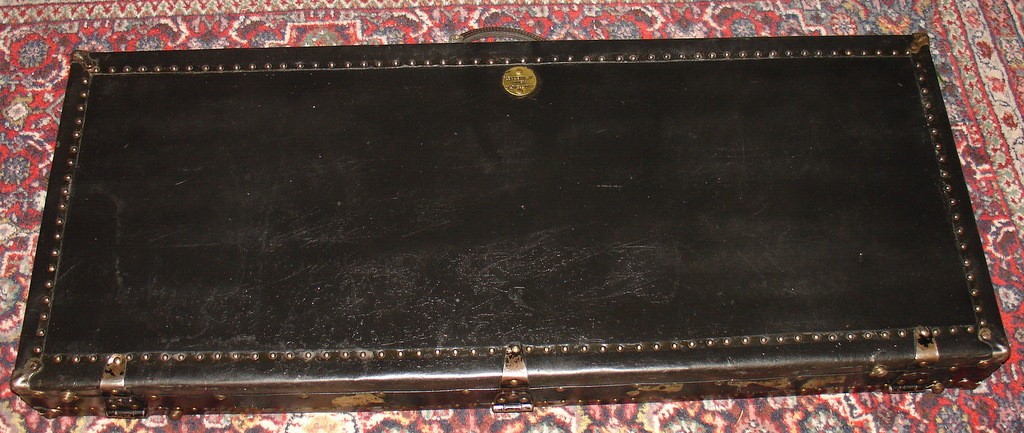
From the "You Never See THAT" files: A 1930s Glen L. Evans fly rod sample suitcase.


A High Forehead on Heddon Minnows is a good thing. We call it the "Nicolas Cage" Model Heddon 100.


A CCBC Open Mouth Shiner in the box with papers is driving the Chub boys mad.


Thompson fly reels are rare and nifty works of art.


One of my all-time favorite lures: the South Bend Vacuum Bait.


As always, have a great long weekend, and be good to each other--and yourself.

-- Dr. Todd

Thursday, September 1, 2011

Thursday Review: Hart Stillwell's The Glory of the Silver King

Thursday Review: Hart Stillwell's The Glory of the Silver King

Hart Stillwell is a name a lot of you may not know. But anyone interested in the history of fishing--especially saltwater fishing--needs to become familiar with him. Fortunately, thanks to Brandon D. Shuler and the excellent Texas A&M Press, a new generation can be introduced to a man who did much to popularize Tarpon fishing in America.

Stillwell was a popular outdoor writer for magazines like Field & Stream and Sports Afield in the 1920s through the 1950s. He had nearly completed a manuscript on tarpon fishing when he passed away, and fortunately Shuler, an excellent writer in his own right, came across the manuscript by luck and shepherded it into print.

The manuscript itself can best be described as a love letter to Tarpon and Texas. In particular, it concentrates on noted fishing sites like one of my favorite subjects--Aransas Pass, the legendary tarpon fishery. From Vera Cruz up the coast to Galveston, we are transported in time by Stilwell's writing to a different era.

Stillwell was an excellent writer with a sharp wit. Take for example his description of his friend Hurt Batsell, his fishing companion:

Eric Hoffer hadn't turned out that pile of pseudophilosophy at the time Hurt and I went back to the Rio Grande, in 1942, but I can say this for Hurt--he is the kind of man who will quit being a 'True Believer,' Eric Hoffer style, and face reality even when it doesn't fit into his preconceptions.

(NOTE: Hoffer was the author of the book The True Believer)

This book serves as both a historical chronicle of tackle, techniques, and individuals involved in Gulf coast tarpon fishing from the 1930s to the 1950s, but it is equally a book about conservation and proper fishing techniques. That's the beauty of classic outdoor writers like Stillwell. They don't hit you over the head with the "how-to" part, but slowly, over pages, you catch on to the techniques and style of fishing that is still very effective today.

One of the remarkable things about the book is Stillwell's early advocacy for the tarpon. At a time when few had the foresight to recognize the havoc humans were causing on the Gulf coast ecology, Stillwell only half-jokingly noted that he should call the book The Decline and Fall of the Silver King. It's worth remembering men like Stillwell, who saw that corrective action needed to take place. It is sad indeed the book was not released in his lifetime as it might have spurred others to greater action earlier and forestalled some of the problems that have emerged along the Gulf Coast in the past few decades.

If it is a bit sad the book never saw the light of day during Stillwell's life, it would have been a great tragedy indeed if this book had not been published at all. Thankfully, we have a beautiful hardcover to read and re-read and pass on to future generations who ask what fishing for tarpon in Texas was like in the first half of the 20th century.

I can't recommend this book more highly. It is a must for anyone who loves classic outdoor writing, the silver king, or the great state of Texas. Kudos to Shuler and Texas A&M for their hard work in bringing this to print. The book is an attractive hardcover with black-and-white photos and is available from Amazon.com, among many other outlets.

-- Dr. Todd

NOTE: NFLCC member and esteemed outdoor journalist Colby Sorrells, author of the excellent Flyfisher's Guide to the Texas Gulf Coast, writes to say "I'll have an article in an upcoming issue of Gulf Coast Fisherman and The NFLCC Gazette on the lures Stilwell used in his pursuits of Tarpon." Looking forward to it, Colby!