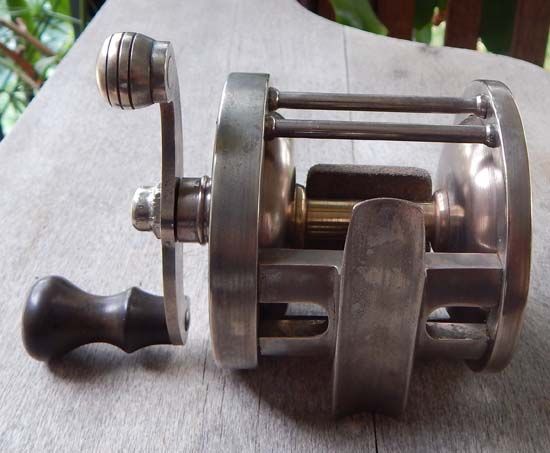
Showing posts with label ORCA. Show all posts

Thursday, September 11, 2014

Dr. Todd Goes Pier Fishing: Part II – We're Gonna Need A Bigger Pier


Dr. Todd Goes Pier Fishing, or How I (Almost) Helped Win The ORCA Antique Tackle Fishing Tournament

By Dr. Todd E.A. Larson

©2014 The Fishing for History Blog

Part II: We're Gonna Need A Bigger Pier

As others struggled to put together their jury rigged fishing outfits, we noticed the elderly couple next to us was having great success, pulling in one Spanish Mackerel after another. We asked their secret and they told us the fish were only about four feet under the water, so Butch would only let the bait sink up to where the mono leader met the linen line, and was soon rewarded with the first fish of the day, an eight inch mackerel. It was a pretty suave catch considering he had to set the hook by pulling the line with his hand.



A nice elderly couple landed about 30 mackerel, and took home nearly all the mackerel the ORCA crown caught to boot.


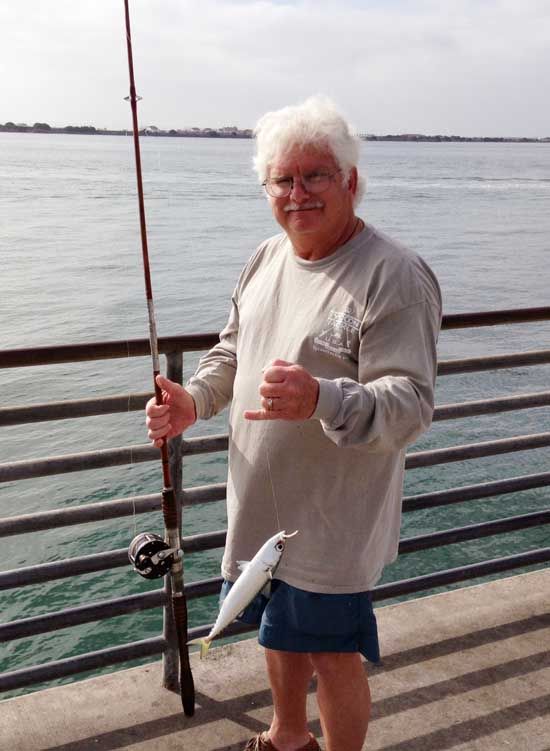
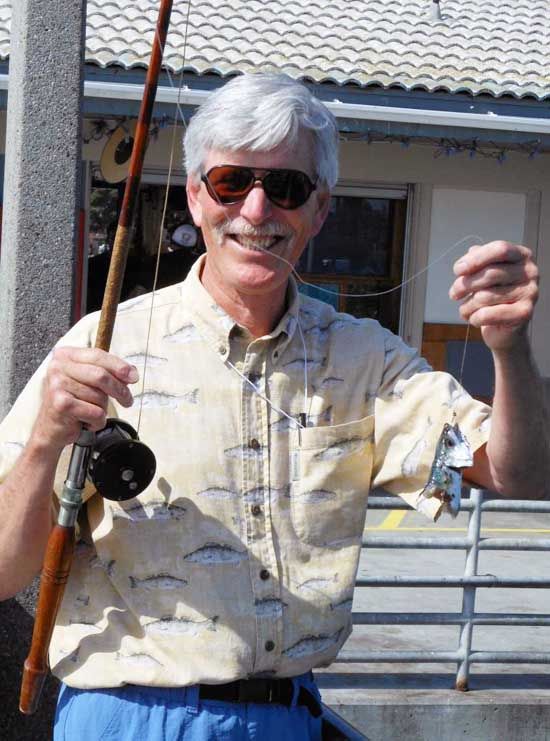
I decided to rig up the spinning rod. The ca. 1960 DAM Quick reel had about 20 pound test vintage mono which was about as stiff as a piano wire, but I was still able to do something few others could do that day: cast the line out. My first cast actually resulted in a fish.
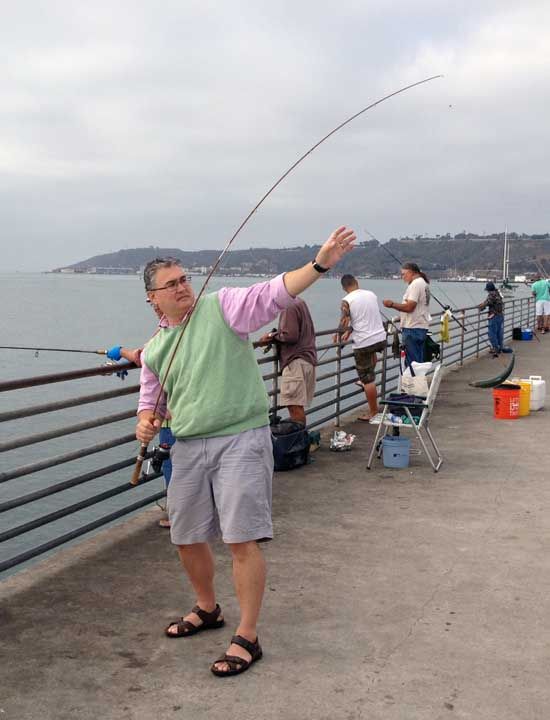
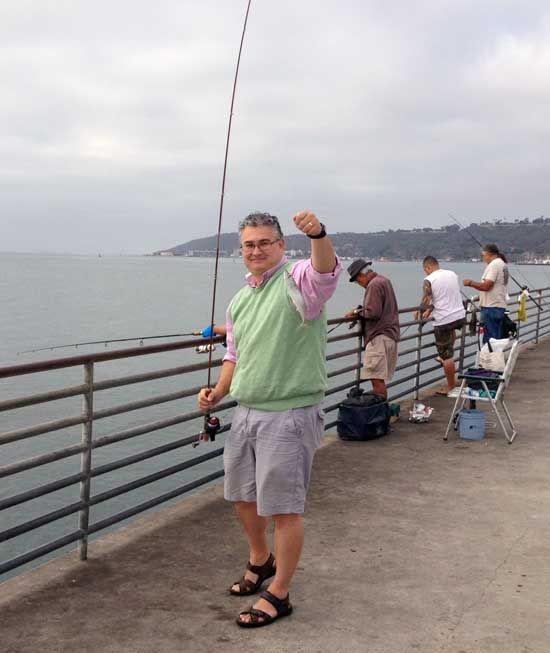

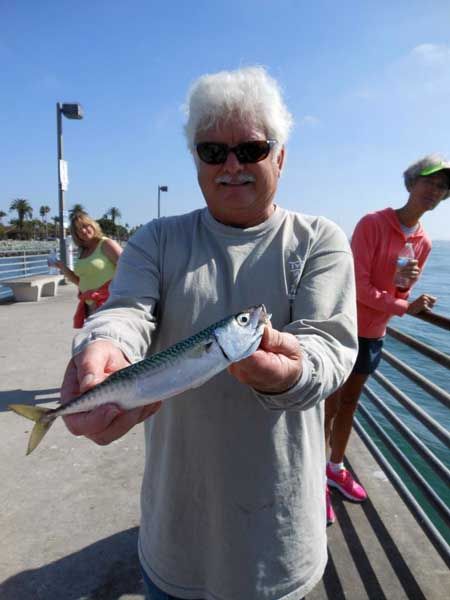
Proof positive that I can indeed catch fish.


A close up of my 7 inch mackerel.


Pleased with the results, I passed the rod on to another ORCAn. Over the course of the next hour or so, a number of fish were caught, mostly in the eight to ten inch range. Butch and Paul Berinson also managed to catch Calico Bass, which are very beautiful fish. Anglers down the pier caught a couple of Guitar Fish, a type of ray. Several anglers were keeping their mackerel alive in buckets with battery powered aerators. We were told these fish made incredible live bait.
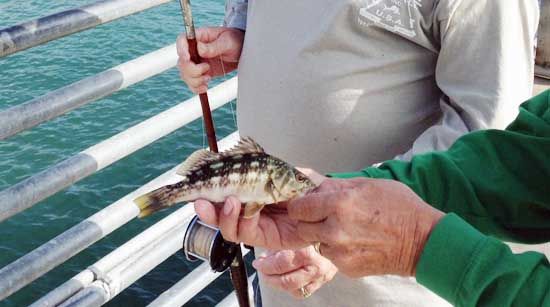

Butch became quite proficient at utilizing this pool cue rig to catch miniature fish.


We even caught a few beautiful Calico Bass.


As I watched these fishermen a thought occurred to me. With this many bait fish (there were massive clouds of anchovies everywhere), there just had to be a shark somewhere out there. I mentioned this to Clay Hood, who agreed and began to rig up the E.M. Holm surf rod (paired with the Penn trade reel) with a heavy sinker and a larger hook. I grabbed one of the smaller mackerel of around five inches, Clay baited the hook, and lowered the rig down to the bottom on the other side of the pier.
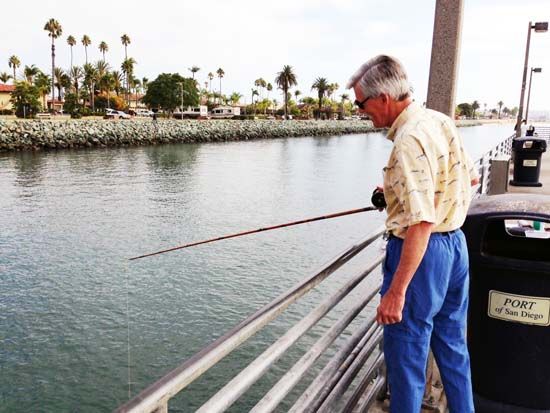


Clay Hood lowering down the mackerel bait below the peer. Remember later his thumb placement on the reel.


It was turning into a lovely day as we chatted about Clay’s tournament fishing history – he’s a really seasoned fishing vet who fished the Bassmaster Classic – when all of a sudden he noticed his bait going crazy on the bottom. As he began to reel the mackerel in, the rod quickly bent doubled and then suddenly snapped back. “Shark,” Clay said, as he reeled in the slack line. Sure enough, the line had been cut a foot above the hook.
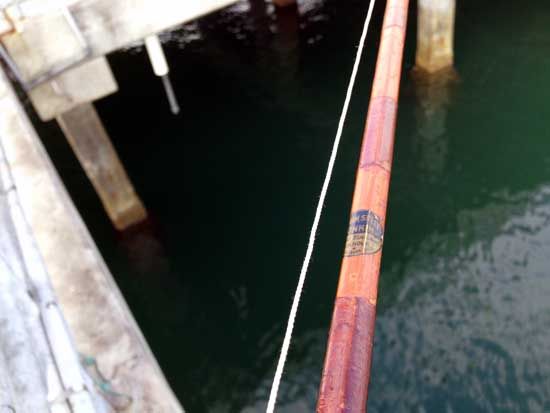


The E.M. Holm rod in action.


Something big lurked below the waters of the Shelter Island pier.

Undaunted, Clay rummaged through Brian Funai’s tackle box and found a steel leader, which he tied on. The problem was that, for some reason, the mackerel being caught were all around ten inches, twice the size of the original one Clay had used. Having no other choice, I brought a 10 inch mackerel over and Clay hooked it up to his rig and tossed it under the pier.


From Butch’s hands onto Clay’s hook went this nice mackerel.


Over an hour passed with no sign of a fish. We passed the time talking fishing reels, of course, and noted the primitive nature of reels like the Penn Deep Sea Angler model. It had no anti-reverse, no free spool mechanism, no drag, and was the very definition of a simple winch. It did not even have a leather thumb drag like most of the saltwater reels of the 1920s and 1930s.
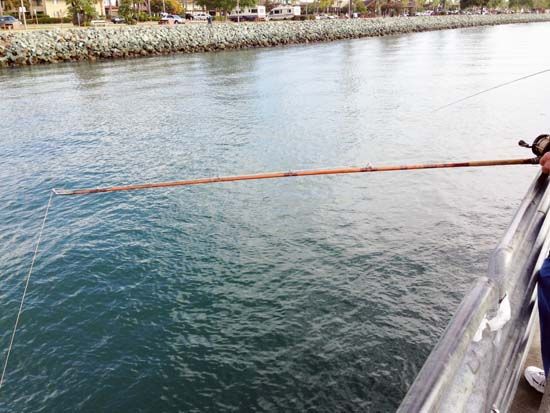

Biding the time …


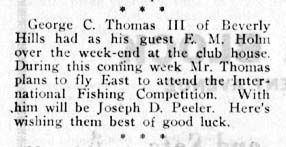
It was fascinating to recognize that the rod's maker E.M. Holm had spent time fishing these very waters back in the 1920s and 1930s; the blurb above shows he visited the Tuna Club, as reported by the Catalina Islander on August 31, 1939. He built a number of rods for the Hollywood elite including silent film actor Tom Trento.


As Clay lifted the minnow off the bottom, once again the Holm rod bent to the butt. For a second or two, I thought that he had hooked up, but once again the rod snapped back to straight and the line went slack. I thought he had been cut off, but when he pulled his line up, all that remained of that mackerel was a head cut off at the gills.
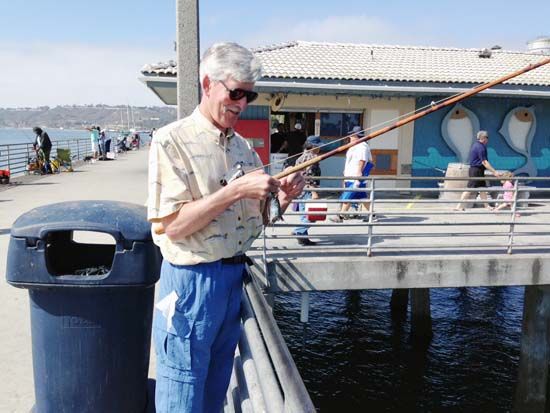

Clay looks at amazement at what remains of the mackerel.


Clay smiles for Richard Lodge as I implore him to put the bait back in the water.


“Throw the head back in!” I implored, knowing the fish was probably still down there. Clay dutifully dropped the line, and no more than two seconds after it hit the water, his line went from vertical to horizontal in an instant.

In all my days of fishing, I have never seen a fish hit so fast and so hard as the shark that hammered Clay Hood’s bait on that San Diego pier. The visual evidence was striking; since the Penn had no anti-reverse, the handle spun like a windmill in a hurricane. I had heard the term “knuckle buster” many times in conjunction with these old saltwater reels, but this was the first time I had ever seen exactly what they meant by it. Anyone foolish enough to try and grab the handle when a fish like this hits would have broken fingers in a heartbeat.

The only way to stop the fish was to thumb the line, and Clay dutifully planted his thumb on the revolving spool as the shark ran directly under the pier. The Holm surf rod bent to the butt, the reel sizzled, and then it was all over but the shouting. The shark had wrapped itself around the pier on the far side and threw the hook. In three seconds that fish had taken a hundred feet of line, which if my math is not off, is around 23 miles per hour. That’s a fast fish, folks, and a speed easily reached by Shortfin Mako and Blue Sharks, both commonly found in the area. I’m not saying it was either of these species, but there can be no doubt it was a shark of some kind that hit that mackerel.

As we stood in stunned silence, some joker in the back quipped, “we’re gonna need a bigger pier.”

It was insane. I have never, and likely will never, ever see such a vicious strike, especially in conjunction with a vintage tackle rig. The whirring of that Penn reel’s handle is an indelible memory.

Later that day, as we listened to Catalina Tuna Club historian Michael Farrior discuss the history of that esteemed organization, he noted that injuries on Catalina were so common in the first part of the 20th century from “knuckle busters” that there was a medical clinic on site to take care of the injured anglers. I looked back as soon as he said this and saw Clay staring at his thumb, which was developing a nice blister from his attempts to stop the rampaging shark. We both smiled.

So my first attempt at pier fishing was a memorable experience. Not surprisingly, Butch Carey won the contest with a 10.5” Spanish mackerel, fitting for someone with a lot of pier fishing experience. But despite the fact that everyone caught fish, it was the one that got away, once again, that formed the best memory. Having cobbled together fishing outfits from the most mismatched vintage tackle you could find, we were still able to catch fish, and have fun doing it.

That sort of the point of all this, isn’t it? And to think, I nearly helped win the 2014 ORCA Antique Tackle Fishing Tournament.

I don’t think for a minute that I am not already developing a plan to help (almost) win the 2015 edition …

— Dr. Todd

===================================================


PRE-ORDER DR. TODD’S NEW BOOK!


What do you get when you turn a Midwestern college professor loose on the Bassmaster Classic & Expo in New Orleans, Louisiana? You get Lost on the Bayou, the interesting and funny memoir of a whirlwind trip to the Delta to witness one of the greatest gatherings of bass fanatics in history. If you’ve ever wondered what it was like to see the Bassmaster Classic Expo from the other side – the side of the vendors and celebrity anglers – this book is for you. From anecdotes about some of the great bass anglers of all-time (including Glen Lau and Billy & Bobby Murray) to inside analysis of some of the great anglers on the B.A.S.S. tour today to inside details of some of the major tackle companies, this is much more than a “fish out of water” memoir, it’s a subtle and detailed commentary on the state of bass fishing in America.

Purchasers of this book will also be entitled to a free download for reading on tablets, phones, etc. You will receive instructions on how to claim your COLOR digital copy when your books ships.

PRE-ORDER YOUR COPY OF LOST ON THE BAYOU BY CLICKING HERE!

===================================================

Wednesday, September 10, 2014

Dr. Todd Goes Pier Fishing: Part I – The Iron Angler


Dr. Todd Goes Pier Fishing, or How I (Almost) Helped Win The ORCA Antique Tackle Fishing Tournament

By Dr. Todd E.A. Larson

©2014 The Fishing for History Blog

Part I: The Iron Angler

I knew the 2014 ORCA nationals, held from September 3rd through the 6th, would be something special from the moment I stepped on the airplane at the Cincinnati airport. Flying today is at best uncomfortable and at worst unbearable, particularly if, like me, you fly what the airlines generously call “economy.” There are many bad things about flying economy – no leg room, cramped seats, horrible television screens that can't be turned off ¬– but the worst is having to walk through first class as you board the plane. This is uncomfortable for everyone, as us economy folk look in envy at all the space in the first class cabin knowing we’ll soon be packed like sardines, while the first class passengers always seem to have a slight look of guilt on their faces as they steadfastly try to avoid eye contact with the hoi polloi as we are ushered to the back of the cattle car.

I am rarely on a plane these days that is not completely sold out, and my flight to San Diego is no exception. Since I booked late I could not get an aisle seat and was not looking forward to spending several hours stuck between a rock and a hard place. I dutifully plopped down in my middle seat next to a nice lady as I await the former NFL linebacker who will, undoubtedly, take the aisle seat next to me (and all of the arm rest). But a funny thing happened. The seat remains empty. Even as the stewards announce final boarding, unbelievably, the seat is unfilled. One of the stewardesses asks if anyone is sitting in the empty aisle seat. “I will be in about six seconds,” I say as I unbuckle, lift the arm rest, and slide over. For the next several hours I have two seats to myself (the lady on the window seat was already asleep and blissfully unaware of this incredible stroke of good fortune). I can only imagine the looks I am getting from my fellow economy passengers. I wouldn’t know. I steadfastly avoid eye contact with anyone for the remainder of the flight, as I stretch out like a Turkish pasha luxuriating on the royal divan.

The San Diego convention was held at the Kona Kai Resort on Shelter Island right on the harbor and conveniently located about three minutes from the San Diego airport. My gloriously comfortable flight arrives an astounding 45 minutes early, and I am in the hotel by eleven a.m. Check in is supposed to be at three. Not on my lucky streak it isn't. A very friendly employee gets me a room overlooking the harbor with no wait. Unbelievably, I am unpacked and lounging on the deck while looking over the pool about the same time my flight was supposed to land.

This is going to be a hell of a show.


The view from my balcony. Tough life these San Diegans lead.


Dr. John Elder and Brian Funai are the show hosts and over the next three days everything will run so perfectly that it is almost surreal. This is one of those things that cannot be attributed to luck. There is so much hard work that goes into making sure that everything runs smoothly it is incredible, and all credit goes to John and Brian and the rest of the ORCA volunteers.

The show itself is memorable in every way. In all my years of collecting I have never seen so many rare reels in one place. Ever. Everything else – the weather, the food, the friendship, the speakers – was beyond expectations. It was incredible.

But this is not a story of the show itself. If it was I'd have to write tens of thousands of words about the late dinners with left coast denizens Terry Ow, Joe Connors, Dennis Buranek, and Steve Ellis; I'd spend days describing the lunches with Bob Douglas, Larry Lauve, Bud Chaddock, and others; I am not sure I could even begin to capture how much fun room trading was in Dave Gaustad’s room (where I bought two beautiful tiny brass reels for my little reel collection), or the meet-and-greets where Clay Hood, Randy Anderson, Willis Logan, and so many others dazzled us with rare and unique reels. As for the speakers? Alan Barracco, Nello Armstrong, and Colby Sorrels gave a brilliant talk on San Diego’s own Langley Corporation; Dan Brock dazzled with his display of mostly unseen West coast reels; Dennis Buranek gave a brilliant talk on Thompson fly reels; and as if that was not enough, Catalina Tuna Club historian, outstanding writer, and all around good guy Michael Farrior detailed the history of this legendary organization. Amazing.

But this is not a story about those memorable experiences. No, this is a story about fishing; pier fishing to be exact. This is an aspect of the sport of which I have almost no experience. Growing up in the Northland we have what you might call dock fishing, but this compares to pier fishing in the same way that sledding in your back yard compares to skiing in the alps.

Why I am pier fishing is an interesting question. Every year ORCA holds a vintage tackle fishing contest. The San Diego nationals posed a couple of problems when it came to this staple of the convention. First, there is no freshwater fishing within reasonable distance of downtown San Diego suitable for such a contest. Second, since it was on the West coast, lots of members would not be able to fly out with the requisite fishing tackle necessary for the salt.


Lots of wildlife, including Pelicans and (in the water) a cormorant that continued stealing bait from a pair of fisherman.


Enter Brian Funai. Brian is a native of Hawaii and well versed in all kinds of saltwater fishing. He helped put together the fishing kit (including apparently buying a bag of frozen seafood so we would have squid to fish with) so we would have the necessary terminal tackle for the contest. So at least half the battle was solved by Brian’s preparation.

But where to fish? The only suitable place to hold the contest was the Shelter Island fishing pier (the only one on the island by the way) and so dutifully on Friday morning at 7:30 a.m. I arrived to see what this pier fishing was all about.

Alas, only a couple of ORCAns brought their own gear; the Langley crew (not a surprise there, these guys are prepared for anything). What about the rest of us unfortunate souls? Well, the intrepid Dr. Elder brought us out a bundle of rods and a bag of reels from his room. Added to Funai’s tackle bag and Nello Amrstrong’s tackle box we could now go fishing. But not like any fishing I'd ever experienced before, however.

There is a famous television show called The Iron Chef. The premise of this show is to present contestants with a small set of bizarre ingredients (such as squid and spinach) and then force them to try and make an edible four course meal out of it. What was happening on that pier in San Diego turned out to be the pilot for a new show: The Iron Angler. Only instead of food, we were presented with completely mismatched rods, reels, and lines and were then expected to catch fish with it. To top it off, recall this mishmash was composed of tackle mostly ninety or more years old.


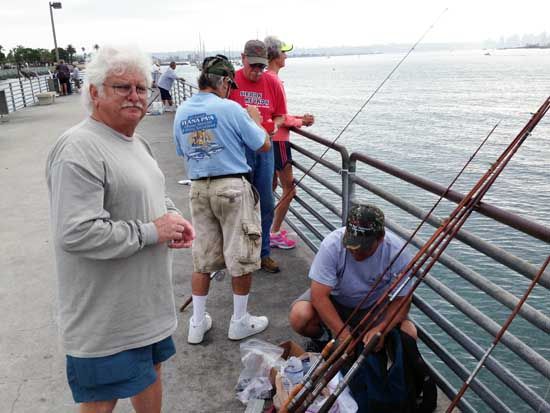
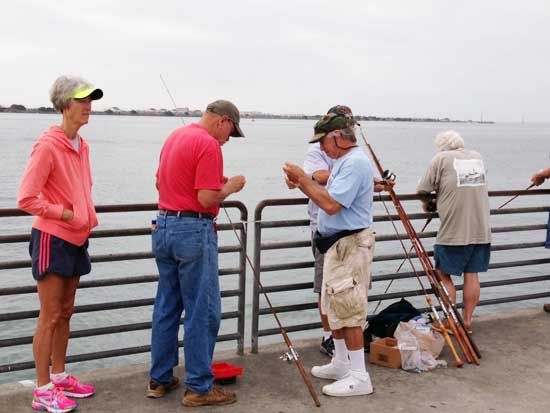
Butch Carey (wearing the "are you kidding me" look on his face) and Brian Funai (seated) go through Brian’s fishing kit. Paul Berinson, with his back to us, is ready to hit the salt.


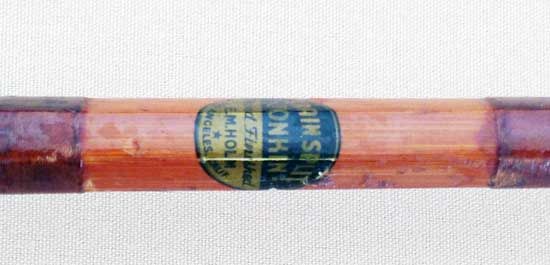
Let's discuss the rods first. All but two were vintage boat rods. For those who don't know, a vintage boat rod is a pool cue with as few as two guides designed to literally drag a fish out of the water. It bends about as easily as a baseball bat. They are about as useful for pier fishing as a microwave on Mt. Everest. There were only two non-boat rods in the mix; one was a really willowy bamboo spinning rod of about seven feet, and the other a really neat surf rod hand made by E.M. Holm of Los Angeles. It was a surprisingly collectable rod stuck amidst the other falderal John had brought us.


This E.M. Holm “Grain Split Tonkin” hand-finished rod made in Los Angeles in the 1930s.


If the rods were a bizarre mixture, so were the reels. There was a Penn trade reel marked Deep Sea Angler from around 1936, a Fox Gun Company surf reel, a Pflueger Interocean, and a couple of other similarly antiquated reels. Most still had the original line put on in the 1920s or 1930s. There was also an old DAM Quick spinning reel with some ancient monofilament on it as stiff as frozen piano wire and just as brittle.

Fortunately for us we had Butch Carey, a Floridian and self-described “Pier Rat” in his younger days. Butch knows his way around pier fishing and together we cobbled together a pool cue boat rod and a 250-yard surf reel filled with some ancient linen line to make a serviceable fishing instrument. I tied about six feet of monofilament from Nello Armstrong’s tackle box with a blood knot to the 18-thread line, put on a #8 Gamakatsu hook to the mono leader, and a single split shot. Baited with a piece of squid, Butch was able to lower the line over the side of the pier and into the water. Over time he perfected a method of setting the hook with his hand; he would have made a fine aboriginal fisherman, as it turns out.


The ORCA gang matching up boat rods and ancient reels. To say we got strange looks from the regulars would be an understatement.


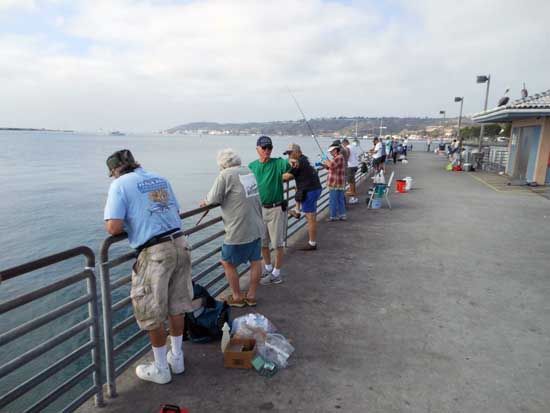
We were just a few in a long line of pier anglers.


The 2014 ORCA Vintage Tackle Contest was on!

Tomorrow: We’re Gonna Need A Bigger Pier …

— Dr. Todd

Thursday, June 12, 2014

How To Sell A Fishing Reel on eBay, or Why You Should Do A Basic Clean of Your Fishing Reels


How To Sell A Fishing Reel on eBay, or Why You Should Do A Basic Clean of Your Fishing Reels

An Essay for Dealers, Flea Marketers, and Anyone Looking to Get the Most Money Out of Their Fishing Reels

Earlier this week I showed you how to clean a fishing reel. Today, I'm going to explain to you WHY you should clean your fishing reels, even if you buy them only to resell.

There is nothing wrong with buying reels to resell them -- I (and every reel collector on earth) would have very few reels in their collections were it not for dealers. Most collectors sell some reels in order to finance the purchasing of others. I guess what I'm saying is that the majority of people who buy fishing reels are also sellers of fishing reels.

Which is why everyone should learn how to do a basic cleaning of their reels BEFORE they sell them. Trust me, you'll maximize your profits, and have happier customers to boot.

I mentioned the new ORCA book Cleaning, Restoring and Repairing Antique Fishing Reels in my post on Tuesday. If you haven't, CLICK THIS LINK and read up on the book, and perhaps buy a copy for yourself or a friend.


A quick proviso: I donated a chapter in this book on using a Vibrasonic machine to clean reels. Neither myself, nor any other writer or ORCA member, makes any money from this book. The profits are donated directly to the non-profit Old Reel Collector's Association.

This is the bible for reel cleaning, and it will walk you through the most basic cleaning techniques, which I went over in my post, to the most advanced. It is full of great information, and that information will bring you much more money if you are selling fishing reels for any reason. Selling reels that have undergone basic cleaning will increase the final price sold for your reels in some cases by 1000%. Here is an example.

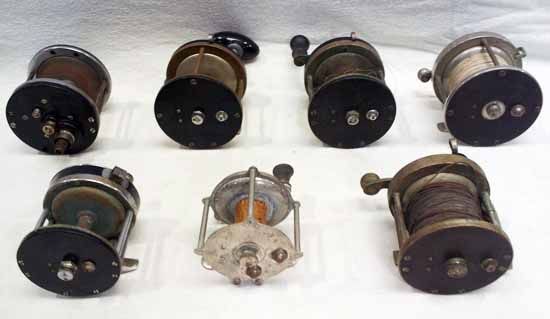
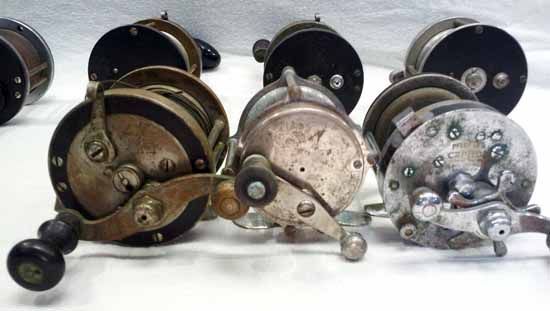
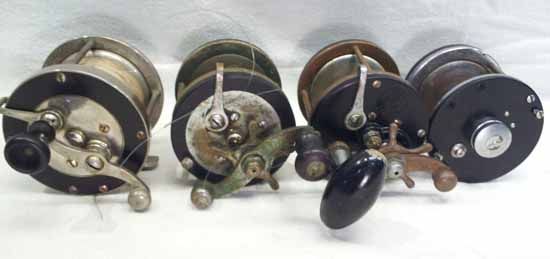
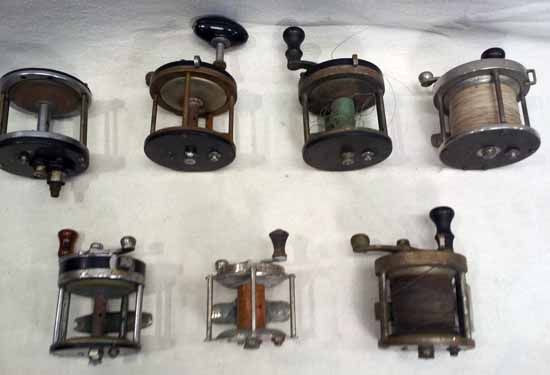
I purchased the following lot of seven fishing reels from a very nice seller on eBay (who shall remain nameless). For these seven reels I paid $25.45 including shipping. One of the reels was an incomplete parts reels (which is, of course, useful to have around) so we will discount that one. This means I paid $4.24 a piece for the six reels.

The seller did nothing wrong with the listing. It was listed in the proper category, had numerous photos that were large and clear, and a sound description explaining what they were offering for sale. The shipping was not outrageous and there was no reserve. The seller had a perfect selling record. All in all, they did everything correct in selling these reels.

Except cleaning them.

Take a look at some of the pictures from the auction:


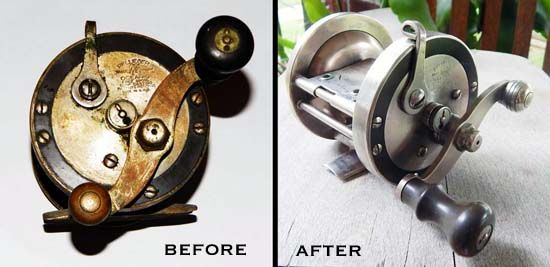
Now, take a look at the exact same reels after a very basic clean up:


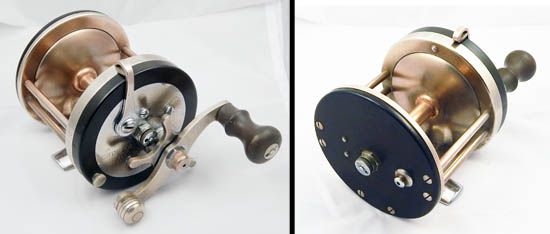
Pflueger Capitol 1985 250-Yard


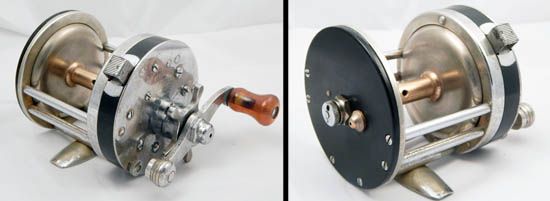
Pflueger Capitol 1985 150-Yard with Amber Pyralin Grasp


Pflueger Oceanic 300 (Patent Pending Model)


Pflueger Oceanic 250 (2nd Model)


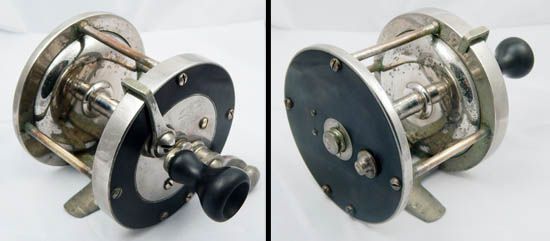
Pflueger Ohio 250-Yard Brass with Tri-Pak Aftermarket Handle


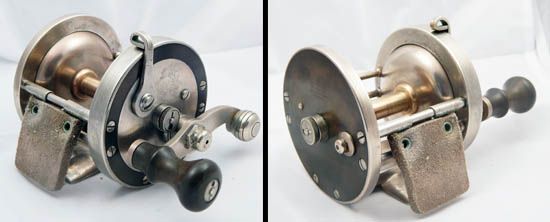
Portage Eureka 150-Yard


You can see the difference for yourself. Two of the reels are downright rare (the Oceanic 300 is the only one that was not disassembled, it only received a surface polish), and the other four despite wear ended up looking much, much better.

The total amount of time spent disassembling, cleaning, polishing, and reassembling these reels was 2 hours -- and that includes the one hour spent on just the German Silver 250-yard Oceanic, as outlined in the article on Tuesday. I also cleaned these one reel at a time; had I taken the time to do them all at once, soaking them at the same time, I am sure the amount of time needed would have been cut to less than 90 minutes total. For all six reels.

Do you have 90 minutes? I cleaned these reels while watching sports on TV and talking to my friend on a speaker phone. The act of cleaning them in now way detracted from my enjoyment of either.

Had the original seller spent 90 minutes cleaning these reels, what do you think they could have gotten for them on eBay? I would suggest that a fair assessment is that these six reels (plus the parts reel) would sell for quadruple what they went for -- $100 including shipping. And that's selling at a lot discount; listed individually? A 250-yard Oceanic German Silver sold six months ago for nearly $100 by itself. Say conservatively the two Capitols (one being an unusual size with a great amber knob) bring $25, the Ohio and Eureka and parts reel another $25, the Oceanic 250 at $75 and the Oceanic 300 at $60. That's $185 -- or 6.5X what they brought uncleaned. For ninety minutes of your time.

The point is not that the seller did anything wrong. The point is that if you are interested in making the most money you can from selling reels -- and really, who isn't? -- then you should learn how to properly and quickly clean a fishing reel. Doing so will bring you far greater Return on Investment (ROI) and put a lot of extra money in your pocket.

And the best way I know to learn how to do is by buying the ORCA book mentioned above.

One final note. Just like you can make a lot of extra money properly cleaning a reel before you sell it, you can destroy the value of a reel by cleaning it incorrectly. The article "An Appeal for Restraint" in the aforementioned ORCA book gives the best guidelines I have ever seen on when and how much to clean a valuable reel -- yet another reason you need to own the book.

-- Dr. Todd

Tuesday, June 10, 2014

Dr. Todd Restores A Fishing Reel … Or How To Clean Fishing Reels for Dummies


Dr. Todd Restores A Reel … Or How To Clean Fishing Reels for Dummies

Cleaning reels is easy. Like REALLY easy. So easy, in fact, it is rather astounding that more collectors (and dealers) don't do it. It really does not not take a lot of time or money to turn what is in many cases a worthless $5 junk reel into something of real value -- and the best part is that we now have a bible for reel cleaners and restorers. Whether you're cleaning your first reel, or you are restoring the hard rubber plate on a $3000 vom Hofe, the new book Cleaning, Restoring and Repairing Antique Fishing Reels, published by the fine folks at ORCA, is an absolute MUST HAVE, even if you only buy reels to resell them.


To show you how easy it is to turn a junker into a beauty that any collector would be proud to display, I am going to walk you through the process from start to finish -- as it is outlined in a chapter by Dr. John Elder in the aforementioned book. I am going to add a twist of my own, simply because I am an absent-minded professor about 98% of the time and often forget how to put reels back together. I developed an easy-to-use trick if, like me, you sometimes forget how reels go back together.

So let's start with the candidate reel. I am working on a documentary film about the Pflueger Supreme reel, and as ancillary part of the research, I needed to find a couple of Pflueger Oceanic Free Spool reels in order to photograph their Case-patent free spool mechanism. I was not looking forward to spending the $150 or so necessary to acquire the two early models I needed, but as luck would have it, I found a lot of 7 "beater" reels on eBay that had not one but both of the Oceanics I needed (the first generation "Patent Pending" 300-yard and the 250-yard second model). Trouble was, they were in absolutely awful condition, which explains how I was able to purchase the entire lot for $25.45 including shipping.


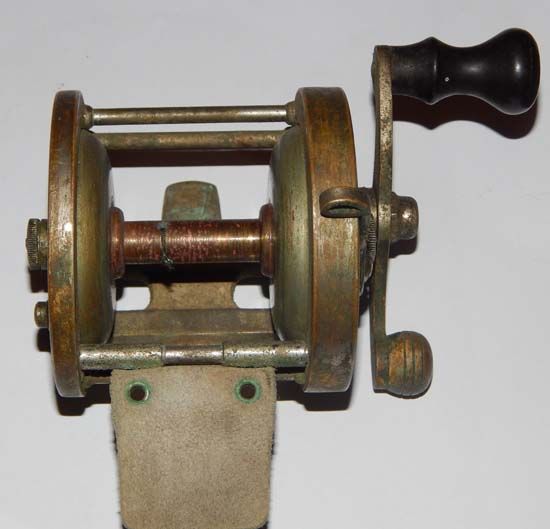
The 250-yard Oceanic is on the left in this auction photo, with the free spool lever put on backwards. As you can see, it looked terrible.

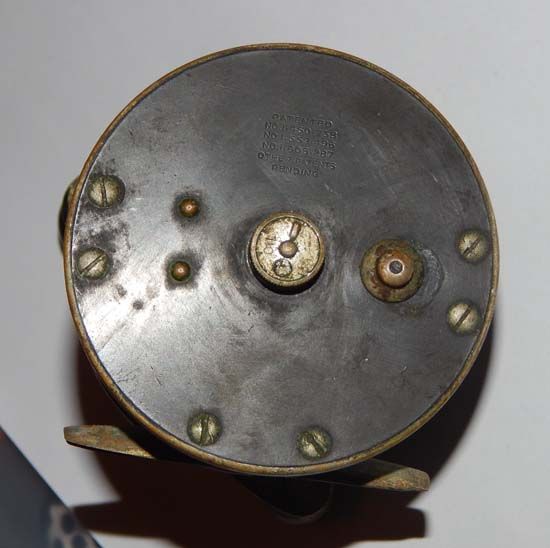
How awful? When it arrived I snapped some photos of it to show just how much corrosion and gunk had accumulated on this reel.


First thing I did was put the free spool lever back on the right way. An honest question -- looking at this reel, do you think you could get $10 at a flea market for it? If you could, you are a better salesman than anyone I know.

But knowledge is a good thing. Many of these early saltwater surf reels were built much better than we give them credit for, and could survive some significant abuse. I knew that Oceanics in their early permutation were German Silver, meaning that they avoided the pitting from corrosion better than nickel plated reels. The reel worked poorly, with a weak click. I knew that the fact it did not run well was likely due to an internal build up of gunk. It would have to be cleaned inside and out.

Since I needed this reel for the film, it had to be cleaned, because if there is one thing my ORCA friends HATE more than anything is dirty reels being used to illustrate points on reel history, I knew I had to clean this baby up the best I could. So I consulted the Cleaning, Restoring and Repairing Antique Fishing Reels book chapter by Dr. Elder and procured the necessary items for a thorough reel cleaning:

1) Vinegar

2) 0000 Steel Wool

3) Mineral Spirts

4) Metal polish (I am partial to Maas)

5) Gunsmithing screwdrivers

A tupperwear container, some old toothbrushes, and an old t-shirt rounded out the list of necessary items.

THAT'S IT. Literally, these were the tools I used to clean the Pflueger Oceanic pictured in this article.

* * * * * * * * * * * * * * *


STAGE ONE: Disassembly

A word on screwdrivers -- I strongly suggest anyone who collects vintage tackle buy a set of gunsmithing screwdrivers. I can't overestimate the importance. I am partial to Chapman screwdrivers, with interchangeable heads. A simple set costs $30 and has 20 heads that will fit almost anything you come across. The worst possible thing you can do is bugger a screw; there is lots of good information on how to avoid this in the aforementioned book.

Luckily, I had the correct size head for the screws on this reel. But as I mentioned I often forget where parts go in a reel, so I've developed to the following fool-proof method of disassembling a fishing reel.

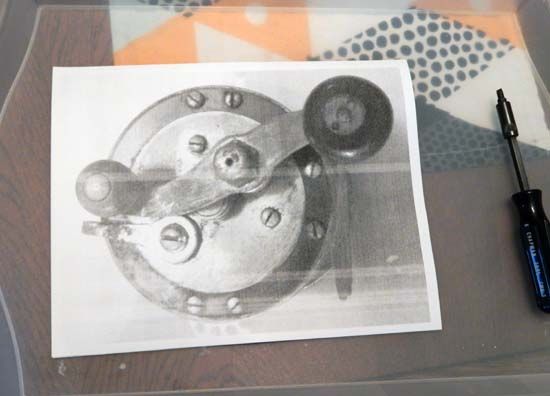
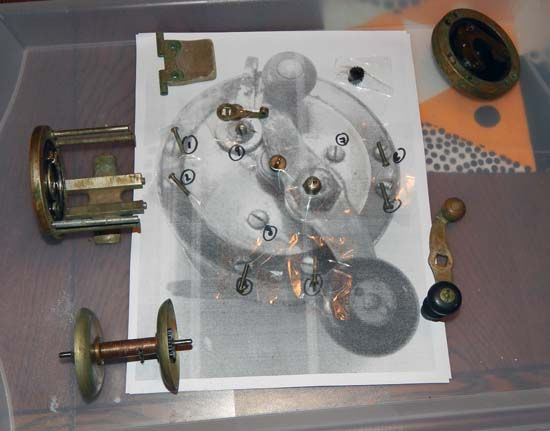
First, take a good digital photo of the reel, front and back. Then print out as large a photo as your printer will allow, like so:


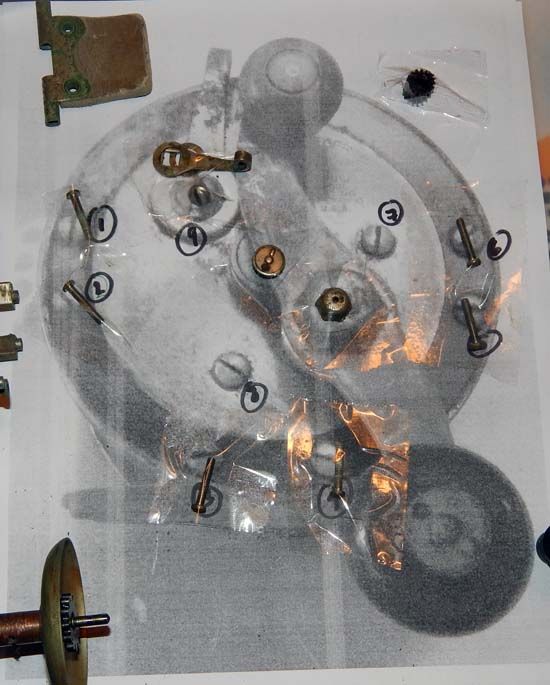
Then, take a pen and mark all the pieces you will be taking off the front plate of the reel with a number. Then simply take off each piece one by one, and tape it to the corresponding place on the photo like so:


Yep. Simple as that. You'll never forget what screw goes where. I know what you're thinking: why didn't' I think of that? Simple answer: you need to dunce up a lot of reels to come up with something this ingenious.

Anyway, since one of the screws holding the end plate to the foot was "frozen" I left that piece on, knowing that the "soak" would help me to remove the screw later.


The soak is simple: 50% vinegar and 50% water. That's it. Put your 50-50 mixture in a tupperware container and then place the reel parts in it, put the top on it, and wait overnight.

Total elapsed time spent on cleaning this reel so far: 20 minutes.

* * * * * * * * * * * * * * *


STAGE TWO: Cleaning

You can soak your reel for as little as four hours and for as long as 24; the book gives a variety of opinions on the subject. I soaked for 12 hours and then in a sink full of hot water (and TWO drain catches in case something valuable fell out) I put the reel parts, and carefully using 0000 steel wool, began to scrub the Oceanic. The vinegar did its job beautifully, lifting dirt and gunk from the tiniest of cracks and preparing the corrosion on the spool and face and end plates for cleaning.

By the way, it is the experience of the authors of the ORCA book that vinegar will not harm hard rubber.

0000 steel wool is perhaps the greatest cleaning tool you can have. It's so fine it won't leave scratch marks, but rough enough to take off the corrosion and layers of oxidation built up over years of use in saltwater.

For internal cleaning, Dr. Elder recommends a fine wire brush, but I find a toothbrush is a great tool. I use Dawn dishwashing soap and an old toothbrush to scrub the gearing and the internal of the reel. I find this is usually sufficient to clean the reel, but if there is stubborn gunk, Dr. Elder recommends a bath in mineral spirits, which would be the same process as the vinegar-water soak (and like your 50-50 solution, is completely reusable).

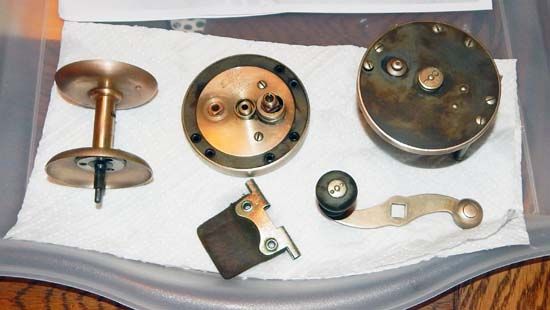
After an initial scrubbing with the steel wool, this is what the parts looked like:


Time spent on this stage: 15 minutes. Total elapsed time spent on cleaning this reel so far: 35 minutes.

* * * * * * * * * * * * * * *


STAGE THREE: Polishing and Reassembly

Now comes the polishing. Taking each of the parts from the soak, thoroughly dry them with some paper towels, and let them sit for a few hours (if you are impatient you can put them on a tray on a food dehydrator which will use gentle air and warmth to dry them in about 15 minutes).

Once dry, begin to polish the individual parts with Maas (or whatever metal polish you prefer). DON'T OVERPOLISH. In my opinion your goal is NOT to make it look brand new, but to make it look like a clean fishing reel that can be taken out and fished. So I don't try to polish until it has a mirror finish although you are welcome to do so if you desire.

Since the soak had loosened the stubborn screw on the back plate, I used the photo of the back plate and taped all the screws to the photo so I knew where they came from, and completely disassembled the reel. This allowed me, for example, to more thoroughly polish the pillars and the foot, which were far easier to do loose than when attached to the end plate. Then taking each screw I cleaned them individually (the easiest way is to take a piece of cloth and a tiny bit of polish and "screw" it into the cloth using the screwdriver -- this cleans the entire screw very effectively).

Here is where your "road map" photo will come in handy. Using the photos with the parts taped to them, after cleaning each screw, replace it back to the exact place where it came from on the reel. It's remarkably easy and you'll never have the problem of the wrong screws (that look alike) going in to the wrong part of the reel ever again.

Reassembly is a snap. It is rather shocking how different the reel appears even at this stage.


Time spent on this stage: 15 minutes. Total elapsed time spent on cleaning this reel so far: 50 minutes.

* * * * * * * * * * * * * * *


STAGE FOUR: Final polishing

The last stage is the final polishing one, which is to take the assembled reel, and using a cloth and tiny amount of polish, to do a thorough and final job of going over the reel one last time.

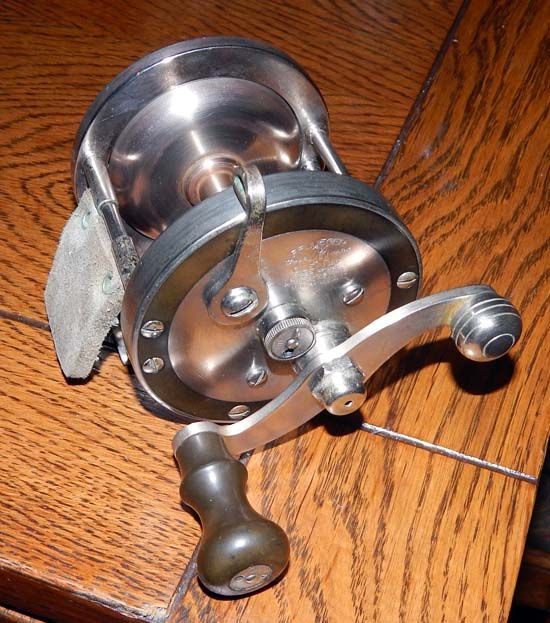
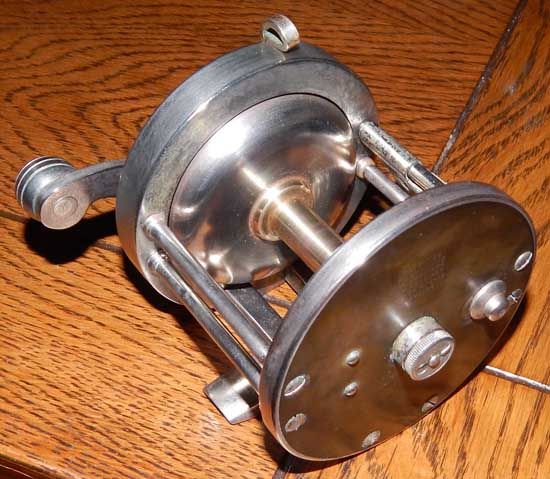
Once this is done, take a clean cloth and go back over the reel about three or four times. Make sure to clean the spool by putting a cloth on it and reeling it for a minute or so. The polish should all be gone now, and you'll have a reel that looks like this:


Time spent on this stage: 10 minutes. Total elapsed time spent on cleaning this reel so far: 60 minutes.

* * * * * * * * * * * * * * *


So that's it. A reel you wouldn't spend $5 on now would not look out of place on any collector's shelf. The transformation is rather remarkable, and is just so incredibly easy I can't believe every collector or dealer doesn't do it.


There's still a little work left to do; I always wait a week before disassembling the reel again and greasing and oiling it, just to make sure that it is completely dry. Then I take a clean cloth and give it one more polish. In this case, since it had an aftermarket leather thumb drag, I will also restore the leather as well as it can be, but that is it.

I hope you'll see how easy this was. The Cleaning, Restoring and Repairing Antique Fishing Reels book is about the only manual you'll ever need on the subject, and I hope everyone interested gets a copy. An hour of your time will do wonders to just about any reel.

Additionally, check in tomorrow -- we'll have a special announcement about reel cleaning.

-- Dr. Todd

PROVISO: The rarer and more valuable a reel, the more care that is necessary to clean it. Don't use steel wool on a fine Kentucky reel, for example. If you have a rare reel, or have any difficulties cleaning your reel, please post to the ORCA Reel Talk "Cleaning" forum. To visit the forum and ask a question, Click Here.

Thursday, May 2, 2013

Thursday Review: The ORCA Reel News for April 2013


The mail brought the most pleasant surprise: the latest issue of ORCA's Reel News for April 2013. As the official organ of my favorite organization, ORCA, it is always the magazine I am most looking forward to. And this one did not disappoint.

However, it is with a huge measure of sadness that I greet this new issue. This is because my good friend Robert A. "Bob" Miller, the legendary Pflueger Pfacts columnist, has filed his final column. After 14 years, Bob has retired from regular column writing, although he promises to pen some occasional witty pieces for which he is famous. It's a bit of a sad day, but I do have hopes that one day Pflueger Pfacts will be revived…

I also love this issue because one of my articles, "A Tale of Two Reels: Primo Livenais, the Dalmo Featherwate, and the Forgotten Tournament Surf Casting Reels of Walter E. Murad" appears in it. This article was ten years in the making, and was begun with my late friend Harvey Garrison, who has been on my mind of late. I also did a short Reels of the Trade article on Danielson Co. trade reels.

Other articles include Mike Cass' piece on colored Penn reels, Bob Douglas on JVH B Ocean reels, Ben Wright on Ambidex reels, Mike Farrier on the Underreel Controversy, and of course, Jim Schottenham on the auctions of the past two months.

It's a great issue. Richard Lodge is the capable editor of the Reel News.

-- Dr. Todd

Thursday, May 13, 2010

Thursday Review: ORCA Reel News (May 2010)

Thursday Review: ORCA Reel News (May. 2010)

The newest Reel News arrived (May 2010, Vol. XX, No. 3) and it was an excellent issue.

An incredibly important and informational article in this issue was Tom Kerr and Charles Fleischmann's "The Ustonsons of Temple Bar: 3 Generations of Master Turners." It details the often murky history of this really, really important British maker of fishing reels and rods. It is a very well researched and written piece that dispels many myths about Ustonson lineage. Kudos to the authors for tracking the story down!

Another extremely important article comes from reel guru Steven K. Vernon, who puts pen to paper and tackles the highly controversial claims of Graham Turner set out in his recent book Fishing Tackle: The Ultimate Collector's Guide as well as in the pages of the NFLCC and ORCA publications. Vernon dispels many myths surrounding the reel, and sets the record straight about a number of important aspects of the level wind story.

My own contribution this month consisted of an article about the neat Milwaukee trade house of Phillip Gross, who's unique slogan was "If it's Gross it's Good." Gross reels and other marked tackle is very hard to find, and I was happy to put a spotlight on this neat company.

I contributed a second piece about a rod-and-reel combo that came in off the street at the FATC show in Daytona. "Edward P. Follett's Rod-and-Reel Combo" tells the story of this fascinating invention, which we were fortunate enough to see intact at the Florida show when a gentleman brought it in off the street.

Jim Madden gives us the 411 on the "South Bend #1250 Model D: A Transition Reel." This nifty baitcaster shows up frequently enough that you should know the information in the article well.

Ben Wright gives us the "1st Ultra Lite Spinning Reel" that was introduced, believe it or not, 100 years ago!

Bob Miller in his popular "Pflueger Pfacts" column weighs in on two overlooked Pflueger saltwaters, the Temco and the Sumco. These affordable salties show up all the time, so you better read the article carefully if you want to know about them.

It was great to see an article by Charlie Tanner in this issue. "The UCO Steelhead Spin Fly Reel" gives us info about this obscure sidewinder reel.

Bob Halver gives us "The Airex Ultra-Lite Spinning Reel," which profiles one of the neatest little reels Airex ever made.

Regular columns did not disappoint. The Reel Fix this month by Col. Milton Lorens is the ever popular Olympic reels. I used Olympics as a kid and always liked them. Stu Lawson gives us "More Reel Stuff" and a description of a West Coast tackle show. And Jim Schottenham weighs in with "The Auction Report," which gives us all the details on the many great reels auctioned off in the past couple of months.

Another exemplary issue. If you are not an ORCA member--and why aren't you?--you can join us by Clicking Here. The Reel News is capably edited by Richard K. Lodge.

-- Dr. Todd

Thursday, March 11, 2010

Thursday Review: March 2010 Reel News

Thursday Review: March 2010 Reel News

The latest Reel News arrived (March 2010, Vol. XX, No. 2) and it did not disappoint.

In this issue, the centerpiece is a fascinatingly shrill missive from Graham Turner. "The Case for Ustonson's Winch" isn't so much a case as it is a surprisingly emotional attack against Michael Brabin, who took Turner to task in the British journal Classic Angling a couple of months ago. One wonders how Turner will respond to Stefan Duma's eviscerating review of his work in the last issue of the same journal.

Bob Miller gives us "Pflueger Vs. the Backlash: Round 1, The Redifor"--an exciting and informative look at the development of the anti-backlash system by Enterprise Manufacturing Company.

My own contribution this issue was "The Fishing Reels of the John Pritzlaff Hardware Co.," detailing this fantastic Milwaukee wholesale hardware company and the trade tackle they sold.

Richard Braun gives us Part 2 of the "Zebco 202s: Who Cares?" Dick's Zebco research seems to be reaching a boiling point and we can all hope he gets his new Zebco book out this year!

Jim Madden gives us "The South Bend #500ABL," a detailed look at this very nifty and often overlooked teardrop shaped reel. As with all of Jim's stuff, this is well researched and interesting material.

Ben Wright gives us a great mystery spinning reel from Tackle Town, U.S.A. -- Akron, Ohio. Is is a Pflueger? A Shakespeare? Read the article to find out! Stu Lawson weighs in with "The Research Value of Catalogs" in his More Reel Stuff column. Sound words from a fishing tackle sage.

Ed Slane gives us the mirthful "What Kind of Deer is a Roebuck?" A fun look at how a Sears Roebuck Mod. #311 came riding up to the author in Florida. Jim Schottenham's "Auction Report" follows a bevy of reels I can't afford and wish I had. Someday I want to have bought a reel that shows up in his column...

Col. Milton Lorens breaks down the American Classic IV spinning reel in his "Reel Fix" column.

Another exemplary issue. If you are not an ORCA member--and why aren't you?--you can join us by Clicking Here. The Reel News is capably edited by Richard K. Lodge.

-- Dr. Todd

Thursday, January 14, 2010

Thursday Review: The Reel News January 2010

Thursday Review: The Reel News January 2010

A bit late but always welcome is The Reel News, the official publication of the Old Reel Collector's Association. This issue is Vol. XX, No. 1 (January 2010) and contains some great articles.

Florida's Bill Stuart gives us the lovely "Thumbs Up for Thumb Reels" which detail the great thumb reels he had on display at the last ORCA National in Dania Beach, Florida. A great article.

The great Steve Vernon gives us "Spiral Cam Level Winds," the 14th installment in his great "Roots o' Reels" series. This one covers Spiral Winds, Smooth Casters, and others that used then oscillating spool method of level winding.

Ed Scharf weighs in with "Mitchell Salt Water Reels" which covers these ever popular larger Mitchell models.

My own contribution this month was "The Bullard & Gormley Co." that covered the trade reels of this fabulous Chicago firm. It's one of my favorite of the articles that I've written across the past five years. I also sent in a short article "Clayton Hoyle of Martha's Vineyard: Inventor of the Wood Casting Reel?" that is also reproduced directly below.

Ben Wright gives us "How Times Have Changed" in his "Spinning Lines" column that updates the Van Staal spinning reels.

Bob Miller's always anticipated "Pflueger Pfacts" column gives us a much needed bibliography on Pflueger reels, detailing the many articles on the subject that have been covered.

Dick Braun, our resident Zebco guru, sent in "A Zebco 202: Who Cares?" and lets us know in great detail why we should care very much about this, and all Zebco reels.

Jim Madden gives us another great "South Bend Bits" column on the subject of the South bend #350, their version of the Supreme.

Col. Milton's reel fix this month is the Model No. 350 Master Reel Model 1. We should all thank the Colonel for his contributions!

Ed Slane's always anticipated "Footprints in the Sand" remembers our great friend Harvey Garrison.

Stu Lawson's "More Reel Stuff" covers the ins and outs of the Kelso show.

Howard Coleman gives us a review of the latest Lang's auction.

Finally, John Elder wrote "A Look Inside an A.J. Stead Reel" that takes apart one of the saltwater monsters from this California reelsmith. A wonderful article from the learned Dr. Elder.

All in all it was an awesome and information-packed issue. Tremendous stuff, folks. If you are not an ORCA member--and why aren't you?--you can join in the fun by Clicking Here. The Reel News is ably edited by Richard K. Lodge.

-- Dr. Todd

Thursday, November 12, 2009

Thursday Review: ORCA Reel News (Nov. 2009)

Thursday Review: ORCA Reel News (Nov. 2009)

The always welcome Reel News, the official publication of The Old Reel Collector's Association, arrived and as always it was a great issue.

The cornerstone article of this issue is a piece by Graham Turner, the British collector who has published a revised edition of his Fishing Tackle: the Ultimate Collector's Guide. Entitled "Will this Multiplier Rewrite Reel History?" it posits a pretty bold claim that a newly found Ustonson reel will change the way we look at reel history. My personal take is that this is massively overstated, but I'll let others sort it out and I'm sure in future issues there will be much written in response to this article.

Steve Vernon returns to the pages with a great article on Sawitzke's Taffy reel in an article entitled "A Taste of Freshwater Taffy." It outlines perhaps the least aesthetic reel ever made, but one of the most interesting as well.

Bob Miller gives us another great "Pflueger Pfacts" article on the Oceanic surf reel. These work horse models were Pflueger's attempt to combat Penn, Ocean City, and Bronson in the inexpensive saltwater reel market.

My own contribution is an update to the first 25 episodes of "Reels of the Trade" and a new piece on Chicago's Mages sporting goods empire entitled "The Gift of the Mages." I've really enjoyed the five years I've spent writing these articles.

Ben Wright gives us "Another VERY Interesting Spinning Reel" in the form of the Mepps "Super Mecca." What a cool reel, and it was distributed not far from my cabin in Wisconsin by Todd Sheldon.

Stu Lawson gives us "Left Coast Tackle Shows" which cover the plethora of opportunities for those on the West Coast to get together and buy tackle.

Jim Madden's South Bend contribution this month is "The Best-O-Luck Reel" which details this mysterious South Bend trade reel. Kudos to Jim for uncovering this history.

Ed Slane returns with a profile of Ed Zorzi, Col. Milton Lorenz breaks down the South Bend 90 and 95, and Jim Schottenham gives us the always anticipated "Auction Report." A reprint of Mike Nogay's seminal article "So you want to Buy a Kentucky Reel?" fills out the issue.

If you are not an ORCA member--and why aren't you?--you can join in the fun byClicking Here. The Reel News is ably edited by Richard K. Lodge.

-- Dr. Todd

Sunday, August 9, 2009

ANNOUNCEMENT: ORCA Patron Program

Roger Schulz contacted me about the new ORCA Patron Program. This new program allows collectors to donate at various levels to ORCA, one of the great organizations of its kind in the world. ORCA does a lot of good and it will make you feel wonderful to donate to such a worthwhile organization. You can download an informational brochure by Clicking Here. Any questions can be addressed to Roger via his email: sroger748 AT aol DOT com.

-- Dr. Todd