Tuesday, July 17, 2012

Voices from the Past: B.F. Meek (1895)


The following article, dated 13 April 1895, was reprinted in The Frankfort Roundabout but was originally published the previous Sunday in The Louisville Courier Journal. It is the best description of the B.F. Meek reel history I've seen in a newspaper article. I don't recall if I have seen this article referenced before…

THE FISHING REEL

A Talk With the Veteran Maker, B. F. Meek.

NEVER SECURED A PATENT

Difficulties Under Which An Unexpected Order Was Filled

========

The Courier Journal of Sunday contained the following in regard to a former prominent citizen of Frankfort, which may prove of interest to many of his old friends here:

The fame of the Meek reel has spread to almost every part of the globe where the name of Old Isaak Walton himself is reverenced, and there is an interesting story connected with the first one that left the hands of Mr. B.F. Meek nearly sixty years ago.

"My brother and myself were then in the watch and jewelry business at Frankfort," says Mr. Meek. "One day Judge Brown, the father of John Mason Brown, came in to have a reel repaired. He was a great lover of angling, and a constant seeker after improvements in tackle. He was not satisfied with his reel, and so insisted upon our making one that we consented.

"For making the wheels a cutting engine was necessary, and there was only one cutting engine in Kentucky; it was at Danville, and had been brought over from England. My brother, J. F. Meek, who is now dead, went to Danville, cut the wheels, and we finished the reel with as much care as if it had been the finest piece of watch mechanism.

Judge Brown was delighted. He exhibited it to his friends, and requests became so persistent that we sent to Switzerland for tools, which could not be obtained in this country, and I devoted myself to reel making while my brother attended to the watch work. The greatest demand for reels then came from New Orleans, and a number of the orders were for England.

"Mr. B. C. Milam, who had worked in the jewelry trade, returned from Mexico about 1847, and learned the reel-making trade with me in Frankfort, where he is yet following this work. In 1852 my brother and I failed, sold out and he came to Louisville to work for Kendrick, the jeweler, while I went back to my old trade of watch-making until 1862, when I came here and resumed the making of reels. Owing to effects upon my nerves, it had become hard for me to handle the extremely delicate parts of a watch, but to this day I can make as good, yes, better, reel than I ever could. Before leaving Frankfort i was in partnership for a time with Mr. Milam, he making reels and I working on watches. Two of my sons, Sylvanus and Pitman C., have been working with me, but I fear that Pitman, who has been ill for months, will never be able to work again.

Mr. Meek was the first maker to jewel fishing reels. He uses carnelian because that is so hard to crush. Diamond, ruby, carnelian is the order he ranks stones as to resistance of crushing, but carnelian is his choice for reel work. Besides being a student of mechanical science and an expert workman, he has made the fishing reel a study in all of its parts and has designed improvements which many makers have eagerly adopted, for Mr. Meek never patented any one of his inventions, relying alone upon the excellence of his own manufacture. The care bestowed in their manufacture will appear when it is told that he and his three sons counted seven as the extreme number of fishing reels that they could complete in one month. The spiral gearing and provisions for retaining oil where most needed without permitting the oil to spread over and gum up the works are counted by Mr. Meek as his most important improvements.

For the spiral gearing he designed and had made, at a cost of $700, a complicated tool that is scarcely larger than a man's hat. By it the teeth of the wheels describe a section of a gentle curve and, furthermore, slant across the wheel so that when in use two teeth of the connecting wheels constantly have a bearing, one tooth on either edge of the wheel so that this continuing force exerts itself at all times on the very center of the rim of each wheel. The motion thus gained is as smooth as that of a leather belt over a pulley. For years, he says, he pondered and experimented before he hit upon an adjustment of all the parts so that the application of force and the smoothness of motion would be the same when making a cast as when reeling in the line. In the one case the pinion must lead the wheel, and in the other the wheel must lead the pinion.

After trying many metals Mr. Meek adopted German silver as the best for the body of the reel. At the request of the wealthy Mr. DePauw, of Indiana, he tried aluminum, but found that the steel screws would strip out the threads cut in the aluminum. Owing to its extremely light weight he thinks that this metal would be invaluable if a process could be discovered for hardening it.

Mr. Meek does not make exhibits of his reels at expositions and would never contract with firms to make exclusively for them. His prices, too, have been inflexible, the best terms offered being some years ago when he did about $7000 worth of work for a large Eastern house, giving a 10 percent discount of payment within days.

Many prominent names appear in the order book at Mr. Meek's workshop, 839 Seventh Street. One is for the reel which the Louisville Fishing Club presented to President Arthur and another is for the reel which Col. T.H. Sherley secured for President Cleveland. Among the local names will be found John E. Green, the Messrs. Dodd, George Avery, Judge R.H. Thompson, Dr. Preston Scott, John H. Weller, Col. Bennett H. Young, W.N. Haldeman, Dr. D.S. Reynolds, Dr. McMurtry, Arthur Peter, Jr., Rozel Weisinnger, G.M. Allison, C.F. Tatum, J.R.S. Brown, Emmett Logan, J.C. Burnett, B.F. Buckner, C.P. Atmore, and a host of others.

Mr. Meek is now in his seventy ninth year. He was born in Hoyle county, Ky., when it was called Mercer county, and delights to refer to himself as "a Salt river tiger." Strange to say he cares little for the angling sport, declaring that he did not have the patience to wait for bites, but until recent years he was an enthusiastic hunter and accounted a good shot in any company.


-- Dr. Todd

Monday, July 16, 2012

The News of the Week


Don't have time to read 50+ fishing and tackle collecting blogs and web sites? Well, let us do it for you! Follow all of the latest news, articles, and stories on our Whitefishpress Twitter account! Hint: You don't need to be a member...just bookmark the Twitter Feed Page or click on latest links to the right!

THE MONDAY 10: The Ten Fishing Stories of the Week You Need to Know

The Big Lead: The Chinese go to war against the piranha.

Reports on iCast are that it is booming, and Lew's is stealing the show.


Thieves in Tacoma steal $40,000 worth of fly tackle.


New tackle shop is opened by Cleveland radio DJ.

Massive game and tackle fair is cancelled in Britain with huge economic cost.


The World Series of Bass opens their door to all tournament anglers.


Shark steals woman's catch and causes her to swear a blue streak.


The Spirituality of Fly-Fishing.


Bamboo rod maker Pete Carboni strives for perfection.

Finishing with a Flourish: An old wooden boat brings back memories.

-- Dr. Todd

Sunday, July 15, 2012

1000 Words

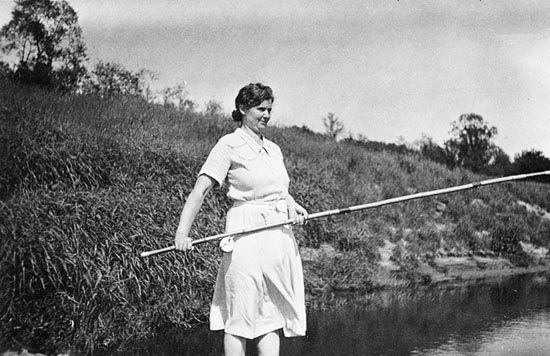
This 1930s photo of a woman salmon fishing is a favorite image of mine. There's just something about her look that means all business, and that the fish better beware.


-- Dr. Todd

Saturday, July 14, 2012

Deconstructing Old Ads: The Bon Net (1953)


The BON-NET

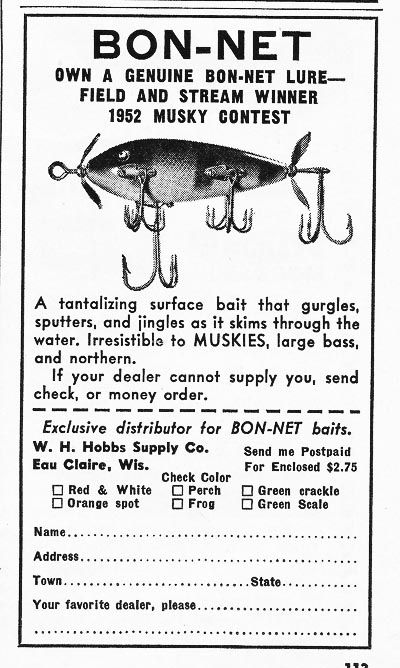
The BON-NET lure, distributed by the W. H. Hobbs Supply Company of Eau Claire Wisconsin, is the subject of the following advertisement from the June 1953 issue of Field & Stream Magazine. This is not a lure that is seen much outside the State of Wisconsin and it is not often seen advertised in nationally distributed “Outdoor” magazines.

The BON-NET's resemblance to a 6-hook version of the Heddon #300 “Surfusser” is no accident. I learned many years ago that it was produced to satisfy the demands of Musky fishermen after Heddon discontinued the 6-hook “Surfusser”.


We learn from Dick Slade's Fishing Tackle of Wisconsin that only 12,000 of these baits were ever produced and that the Arnold Bait Company of Paw Paw, Michigan was contracted to produce it. As a regional bait, it is not surprising that not much advertising is seen in the “Big Three” magazines of the day (Field & Stream, Outdoor Life and Sports Afield). Being a popular Musky lure, it is even less surprising that few are found in good shape. Not only were they being used for the “fish of a thousand casts” but a Musky is pretty rough on any painted wooden lure and the Arnold Bait Company wasn't exactly known for their durable paint jobs. Another reason for the scarcity of BON-NET's might be the price tag. $2.75 was a lot to pay for a fishing lure in 1953 when the average wage in the united States was $4,700 a year!
 
Many States today have a limit on the number of hooks one can have on the end of the line. There is a current debate in several States as to the legality of the “Alabama” type rigs due to the number of hooks involved. It would be interesting to know in how many States the BON-NET, with its six treble hooks, would currently be legal to use.

As an aside, the cover painting on this June 1953 magazine was later used as the cover of the 1956 L. L. Bean Spring Catalog. It is currently being sold in a “re-interpreted” version with updated clothing and hair styles by L.L. Bean as a wall hanger. Needless to say I prefer the original. LOL


-- Bill Sonnett

Friday, July 13, 2012

The Friday Funhouse

Video of the Week

This is a neat video of antique tackle.


12 Things I Would Buy If Only I Could Afford Them

A really cool salmon reel once owned by Lt. Col. Herries of the Light Horse Volunteers would make a great addition to any collection!


This Winchester Eureka Bait assortment is a great Horrocks-Ibbotson product.


Well, I don't know if this will bring 45k, but it is an amazing collection of Heddon Spindivers!


A B.F. Meek & Sons No. 2 tournament caster is outstanding.


I like this Heddon 100 in the wood box.


We haven't had a nice Leonard fly rod on the funhouse in a long time.


This Pflueger Freespeed #1000 in the box is going insane.


These Rush Tango 6-packs are super rare.


A South Bend Tarp-Oreno in the box is a great South Bend.


The Salties are going nuts for this Snook Co. Weasel.


Rainbow Fire is great in any lure, but especially on a CCBC Plunker.


This Detroit Glass Minnow Tube will make anyone happy.


As always, have a great weekend, and be nice to each other--and yourself!

-- Dr. Todd

Thursday, July 12, 2012

Field & Stream's Vintage Tackle Contest Winner of the Week

Some of you know Field & Stream's fishing editor Joe Cermele and myself have been doing a vintage tackle contest for the past year and a half. I'll post it here every Thursday so you can see what's out there in the field!

This Kopf Acme Wire Reel is Field & Stream's Vintage Tackle Contest winner for the week. Head on over and read all about it!


-- Dr. Todd

Wednesday, July 11, 2012

The World's First Tackle Collection

The World's First Tackle Collection

A book could be written on early collectors and collections. It could cover everything from individual collectors from the 1920s and 1930s, including those chronicled a decade ago by collector and historian Dan Basore, to now-defunct museums like the Gladding Museum in New York state, to collections tragically destroyed, such as the bombing of and subsequent fire in the New York Angler's Club back in the early 1970s that destroyed many irreplaceable pieces of tackle.

But who was first?

I'd like to offer up as my candidate for the first fishing tackle collection the one put together by the National Museum of Fisheries that opened in Washington D.C. in 1884. It was, to put it bluntly, a spectacular collection, beautifully arranged.

We get a glimpse of what the displays looked like from an article published on The Juniata (Pa.) Sentinel and Republican 11 June 1884, about a month after the exhibition was opened to the public.

The exhibit opened with a model of an Ancient Greek netting boat, complete with a "vestige of the ram which adorned the prows of the Roman triremes two thousand years ago." Other nation's marine architecture were depicted as well, including Scandinavian, lateen boats from the Mediterranean, junks of Asia, "piratical craft" from Malay, but all were dominated by the model of the three-master schooner Lizzie W. Matthewson. This model won the gold medal at the London Fisheries Exhibition in 1883, which was the impetus for much of this display.

From the exhibit entrance with its commercial fishing boats one entered the larger room, festooned with fishing nets hanging from the ceiling and life-sized figures of fishermen in action. As the reporter declared, "the plaster cast of the cuttle-fish, looking like a huge spider suspended from a mammoth cobweb, together with many other strange and grotesque objects, all meet the eye at once, presenting a novel spectacle, which is greeted by exclamations of surprise and pleasure."

Within the great room, cases were crafted that contained the history of fishing through tackle. "Beginning with the rude club of the savage," the article noted, "one can gradually trace the successive steps of improvement up to the most complex traps of civilized ingenuity." An expansive collection of wood and bone hooks, some dating back 5000 years or more, were put beside hooks of the iron age and tempered steel hooks of the modern era. A complete display of the process of making modern fish hooks was on display--likely the same one John Court donated to the Philadelphia Centennial Exhibition of 1876.

But this was just the beginning. The collection was as complete as one could hope for. "The rudely sculptured float of the Alaskan Indian can be contrasted with the brightly-painted bob from the factory of a Yankee manufacturer," the article noted. A display case adroitly detailed the history of the fishing (fillet) knife. Artificial flies "of a thousand delicate shades" were in another case. Yet another contains "filmy shells and shimmer spoon hooks [that] recall to the angler hours passed in casting for the greedy bass or trolling for the lively pickerel. Another case contained fishing lines. Several displays were necessary to display the nets from around the world, including one made from human hair from the Fiji islands. "It is not stated whether the hair is from the head of a missionary or not," the article dryly commented. There was even a display of fish traps from around the globe.

But the two displays of greatest interest to me are as follows. "In another case is the collection of reels, and the spectator can almost hear the familiar click, click of the snap as the line is drawn by the frightened and struggling fish." This case was followed by an ornate one made for fishing rods. "On a large drum covered with a beautiful shade of blue plush," the article breathlessly described, "is arranged the collection of fishing rods, from the eight and ten ounce split bamboo, bass and trout fly rods to the heavy grades used in capturing gamey salmon."

The paper took the time to editorialize on the state of American tackle making. "American workmen excel the world in the manufacture of fishing rods, and since the London exhibition [of 1883] the export trade in this branch has been multiplied several times. The superiority of American rods consists in the combination of the lightness and flexibility with tenacity and strength, and in the international contest our representative not only made the longest cast, but the flies were never snapped from his lines, although the contestants lost many."

So I offer up the National Museum of Fisheries Exhibition of 1884 as the first true collection of fishing tackle permanently displayed in history. I don't know when the collection was disbanded -- I do know that large parts of it were put in storage in the Smithsonian Institute -- but it was likely in the late 1880s or early 1890s, when the Smithsonian was making a major expansion.

The tackle included in this exhibition was supposed to be archived in the Smithsonian, but I have been told by those who have tried to access it that the majority of it "was lost." What that means, I do not know. The only person I know who has successfully viewed any tackle at the Smithsonian is Steve Vernon, and that was over three decades ago.

I'll write more about this collection at a later date…

-- Dr. Todd

Tuesday, July 10, 2012

Voices from the Past: Edwin Booth, Angler (1906)


The following snippet on Edwin Booth, famed actor and brother of presidential assassin John Wilkes Booth, was a noted piscator, and the following anecdote reflects his fishing nature well. It was originally printed in Forest & Stream and reprinted in The Palestine Daily Herald for November 23, 1906.

Booth and the Fish Line

Of Edwin Booth, Mr Whitney relates the following anecdote:

"In fishing he would exhibit the impetuosity of a Petruchio, and this cost me several rods, which broke to smithereens over small trout. He got in one day from a neighboring town a new, fairly good bamboo fly rod, which I assisted him in setting up, arranging the reel and line and pliable soaked leader, and left him afterward noosing on a Scarlet Ibis. The rod was lying on the dining room table. I was no sooner out of the rooms on the porch when I heard a tremendous rumpus in the dining room and, entering, found Booth flying about the room like a madman. He had left his fly hanging over the table, which the half grown family cat present, seeing, struck at with its paw, which the sharp hook caught in, and the frightened cat bolted under the table with rapid speed, breaking the rod tip and dragging the rod after, while Booth, crying 'Scat, cat!' had no effect on the now crazed feline, which he was following after in great excitement at high pressure with adjectives of singular note. The sequel of this was the escape of the cat with the gaudy fly well hooked on its foot, and a well mashed up rod. I was too much convulsed, with the others drawn in by the commotion, to render any aid, and Booth soon joined in with our laughter, confessing that his fishing experience was a failure and that he would have any more of it."


-- Dr. Todd

Monday, July 9, 2012

News of the Week: 09 July 2012


Don't have time to read 50+ fishing and tackle collecting blogs and web sites? Well, let us do it for you! Follow all of the latest news, articles, and stories on our Whitefishpress Twitter account! Hint: You don't need to be a member...just bookmark the Twitter Feed Page or click on latest links to the right!

Buck Perry was a bass fishing legend…Scottish museum holds lunchtime rod talk…the Helin Fly Rod Flatfish is in the news…Storage Wars finds fishing tackle…the Rainbow Trout is the most invasive species in America…Mike Trout hits homers and casts a fly rod…a musky tale…Johnny Cash bought his tackle at Kmart…man is fly angler by day, opera singer by night…don't be a glass minnow…a strange catch…it must be THE NEWS OF THE WEEK

THE MONDAY 12: The Ten Fishing Stories of the Week You Need to Know

The Big Lead: Why Buck Perry is such a fishing legend.


Aberdeen Maritime Museum is hosting a talk on Scottish fly rods.

Your F&S Vintage Tackle Winner of the Week is a Helin Fly-Rod Flatfish.


The TV show Storage Wars comes to Brainerd, and naturally finds fishing tackle.

The most common invasive species in America: the Rainbow Trout.

Famous People who fly fish: major league star Mike Trout.


A musky tale


Johnny Cash used to buy his fishing tackle at K-mart and other things learned from a walking tour in Port Richey.

Evcaro buys American Rodsmiths.


It's never good to be the glass minnow.

Washington man is fly angler by day, opera singer at night.

Finishing with a Flourish: One man catches strangest fish of his life.

Sunday, July 8, 2012

1000 Words

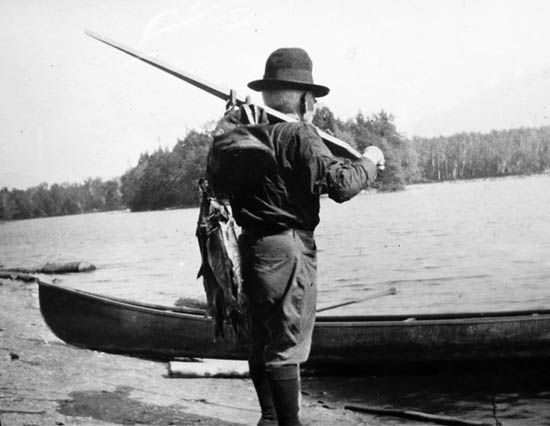
I like this photo a lot, because it leaves so many questions unanswered. Who is this old man? Where was he fishing? What bait did he use? What does he look like? A classic photo I would guess dates to around 1920.


-- Dr. Todd

Saturday, July 7, 2012

Deconstructing Old Ads: The Arbogast Jitterbug & Night Fishing (1939)


The Arbogast Jitterbug and Night Fishing

As a small child the first plug I can remember seeing was a black Jitterbug that my father was casting from shore in the evening at my grandfathers summer cottage in Ohio. As near as I can figure that was the Summer of 1948 or 1949. I was struck by the beauty of the lure and its large eyes. I was also thrilled later that night when he had me come down to the dock and see the two Bass he had caught. He was not a fisherman and cannot recall him ever fishing off our dock again.
 
I think that evening is when I was first hooked on the idea that Bass fishing was for me. These days I fish several nights a week during the summer and the Jitterbug is one of four or five baits that are regulars for me after dark. Years ago articles about fishing for Largemouths after dark regularly appeared in "Outdoor" magazines. As a young man I read them all and always had high hopes when I attempted night casting, but I seemed to get disoriented on the water and run out of patience. The person who taught me to enjoy night fishing is Herb Larsh of Lansing Michigan. Herb is the best night fisherman I've ever met. I have known him to go out on a lake in the early evening and come off at 9 o'clock the next morning. On more than one occasion I have had to ask him to pull over to shore at 3:30 am and let me out of the boat as my posterior just couldn't take it any more. Herb has passed knowledge on to me (born of his experience) that makes night bass fishing a lot more predictable.

The past 15 years I have read everything I can find on night fishing for bass. It is no accident that almost all of these articles are in magazines and books written before 1960. I recently watched a Saturday morning Bass fishing show starring one of the well known tournament fishing champions. It was suppose to be a "night fishing show," and was being presented in answer to many requests he had received from viewers for such a program. It quickly became obvious that he was not a night fisherman and the poor results were predictable. They don't hold tournaments in the dark for good reasons. They can't be filmed and they don't draw much of a crowd for the weigh-in at 3am.
 

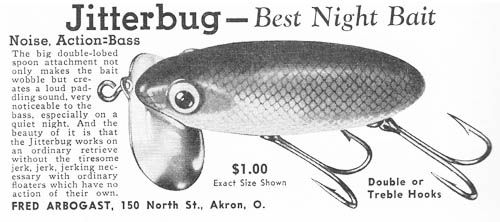
The earliest known ad for the Jitterbug appeared in the January 1939 issue of Field & Stream. The ad shown above is from the July 1939 issue of Field & Stream. 1939 “outdoor magazines” featured a series of these small, black & white ads for the “New Jitterbug” yet the same issues contained full page ads (many in full color) for Fred Arbogast's other baits such as the Hawaiian Wigglers. By the end of 1939 I believe the Arbogast folks realized they had a very popular bait on their hands, and Jitterbug ads started to show up as full page color ads. The 1939 Arbogast catalog had relegated the Jitterbug to the last page and in black and white. The following year the 1940 Arbogast catalog featured the following great full page color plate of Jitterbugs:


For those interested in the chronology of early wood Jitterbugs, the introduction of various sizes, hardware and box changes, I strongly suggest you get a copy of the November 1998 issue of the NFLCC Magazine where you will fine the most complete article to date on wood Jitterbugs. It was written by my long-time fishing apprentice Warren Platt. Warren is not a night fisherman, but he will tell you the biggest bass he's caught in Michigan is one he landed on a yellow wooden Jitterbug on a coal black night as I rowed him back to the shore at quitting time.  
 
As far as those night fishing lessons I received from the Herb ........
 
1. Know the lake and its features, don't try to fish a strange lake after dark.
 
2. Be very very quiet and don't shine any lights on the water.
 
3. The hotter the weather and the darker the night the better the fishing.
 
4. Big bass are NOT in the same places they are in the daytime. On a dark night they feed in shallow water (sometimes extremely shallow) with few weeds or obstructions. This is where they can easily chase down prey under the relative safety of darkness.
 
5. Break out the surface baits and hang on!
 
I would add, be prepared for strange noises and sights. A couple of years ago I had a Great Horned Owl attack my Jitterbug next to the boat on a pitch black night. It took me a few minutes to get back to fishing after that one.

Another of my favorite ways to employ a Jitterbug is to nurse one through some lilypads on a sunny day. Almost all of my Jitterbugs have upturned double hooks to facilitate this. The following picture is a five pounder taken last Memorial Day at 1:30 in the afternoon on a wood Jitterbug fished in heavy pads. Yes, he was released.


Good Luck!

-- Wild Bill Sonnett

Friday, July 6, 2012

The Friday Funhouse

Video of the Week

A really great video featuring Patrick Daradick's Canadian fishing lure collection.


12 Things I Would Buy If Only I Could Afford Them

This is a scarce early L&S saltwater lure.


I like this ABU 5500C in gold…


You don't see many Mitchell 810s for sale.


You will not find a nicer tackle box than this A&F wood model.


This Heddon Spindiver in Goldfish Scale is just superb.


This Edgars Lucky Strike (Canada) in the box is a nice find.


A South Bend Midget Minnow in the box will make any SB collector happy.


This neat Jim Pfeffer bait in the package would go great with Lewis Townsend's Jim Pfeffer book.


A Shimano Bantam 50 in the box is a great modern reel.


I am in love this with this first model Pflueger Supreme.


A Heddon Dowagiac 150 in green crackleback is just terrific.


A Heddon Super Spook in Rainbow is super cool.


As always, have a great weekend -- and be good to each other, and yourself!

-- Dr. Todd