Friday, May 16, 2014

The Friday Funhouse: Lang's Edition


It's that time again -- Lang's Week! As always, in lieu of the Friday Funhouse (which will run on Sunday) I am again choosing my 12 favorite items from this auction.

12 Lang's Items I Would Buy If Only I Could Afford Them

This Pflueger Sea-King is one of the toughest of the mainstream saltwater reels to find. Honestly, this is only the second one I've ever seen. It's spectacularly rare.


Well, I just can't pass up this Philbrook & Paine fly reel. The epitome of class and elegance.


Who wouldn't want this Stan Bogdan fly reel?


When's the last time you saw an E.W. Edwards bait casting rod for sale???


There's always room for a Tycoon Tackle HRH trolling rod!


This 8' Garrison is just an incredible rod.


Ray Bergman flies are a great collectable.


This pair of Ed. vom Hofe line spools is super great.


Holy schnikeys, they don't come much rarer than this Heddon Underwater Expert.


The paperwork is what makes this Howe's Vacuum combo so special.


Loving the heavy metal in this auction, including this Gregory Clipper.


They don't come much crazier than this #3000 Pikie in all luminous.


BAKER'S DOZEN BONUS ITEM:

This 25.4 pound steel mold was used to make the Pflueger fishing tackle signs we've written up on the blog before here and here. Amazing find!


As always, have a great weekend, and be good to each other, and yourself. And have fun with the Lang's auction!

-- Dr. Todd

Thursday, May 15, 2014

The Fishing Advertisement


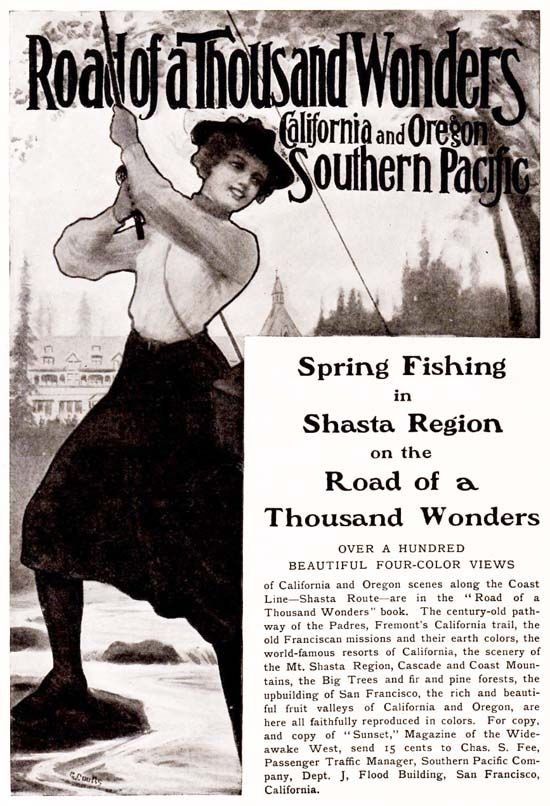
The following ad (from Harper's Weekly) comes from 1907 and is for the Southern Pacific Railroad's "Shasta" line, which was called "The Road of a Thousand Wonders" by west coasters. Indeed, few railroads traveled through more beautiful land than this one did, from Mt. Shasta and the Cascades all the way down to San Francisco. Even their Sunset magazine was a thing to behold, and vintage copies are in great demand by collectors. A spring fishing trip on the Southern Pacific would have been a memorable one ...


-- Dr. Todd

Tuesday, May 13, 2014

Voices from the Past: Oliver's 1988 Tackle Auction


As Lang's Week (the week preceding the semi-annual Lang's Auction) is always a festive time around here, it often causes me to reflect on auctions past and present. Recently collector Steve Kuchman sent me a page from the past -- a write up in the august Maine Antique Digest (dated Sep. 1988) covering a seminal event in the history of collecting: the first really big-time tackle auction.

Yes, 28 years ago this June 25th, a rather important event occurred in the history of tackle collating. Richard W. Oliver auctioned off a huge estate of prizes for tackle collectors, and in so doing helped launch the Silver Age of Tackle Collecting. Yes, I'm such a nerd for this stuff that I have periodized the history of collecting. As I see it, the "eras" of tackle collecting go as follows:

The Formative Age of Tackle Collecting (1800s - 1970)

The Golden Age of Tackle Collecting (1970 - 1988)

The Silver Age of Tackle Collecting (1988 - 2001)

The Internet Age of Tackle Collecting (2001 - Present)

Why the 1988 Oliver's Auction was so important, besides the fact it broke a half million dollars (a feat remarkable for that day and only surpassed by Lang's -- the successor to Oliver's -- today), is that it set many memorable price records. Furthermore, as the write up in the Digest suggests, it was also widely covered by the media.

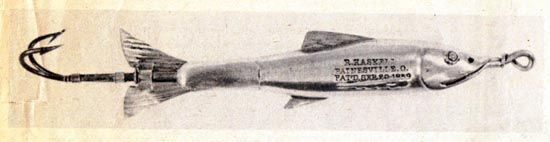
What were some of the items sold? Well, you can't go wrong with a Haskell minnow, then as now. This neat Haskell pictured below netted $22,000 (the equivalent of $43,300 today).


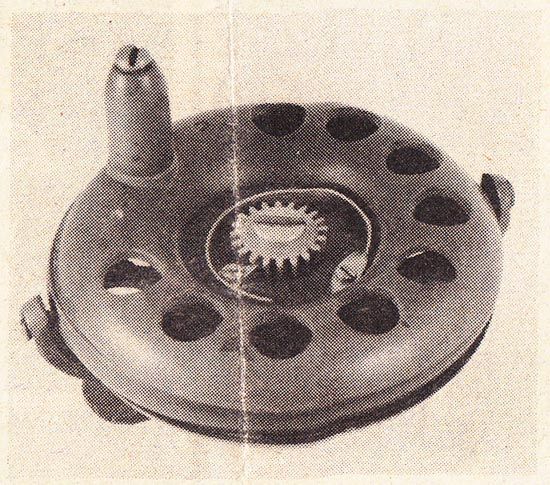
The Dr. Fowler's Gem reel, which we've written about here on the blog before, finished with a hammer price of $15,400 ($30,300 in today's money).


Other items that came in at high prices included a B.F. Meek & Sons fly reel ($18,150), a Comstock Flying Hellgramite ($9075), and a Billinghurst in the box ($12,650). An H.S. Gillum 6'9" in a labeled tube came in at $13,200, a record for a rod at the time (since broken by Lang's a number of times).

Don't think there weren't bargains to be had, though. A huge tackle chest from the estate of the legendary Zebulon Pike -- containing no less than 11 Ed. vom Hofe reels and a bunch of other Victorian tackle -- sold for a reasonable $3850 or just $350 per reel.

Nostalgia is well and good for its own sake, but sometimes it's good to recall seminal events such as the 1988 Oliver's Auction, which ushered in an unbroken stretch of remarkable growth for the hobby of tackle collecting that ended only in 2001.

Are we on the edge of another seminal event such as this with the upcoming Lang's auction? That's the great thing about Lang's Week … there is excitement everywhere and there is always the chance than ten years from now, you can look back and say "I bought this lure/reel/rod/book at THAT auction!"

-- Dr. Todd

Monday, May 12, 2014

In the News: Paul George Goes Fishing, Saves A Friend (and his Team)


Last week, we wrote about how Paul George -- the great shooting guard for the Indiana Pacers -- helped get his head right earlier in the NBA playoffs by going fishing.

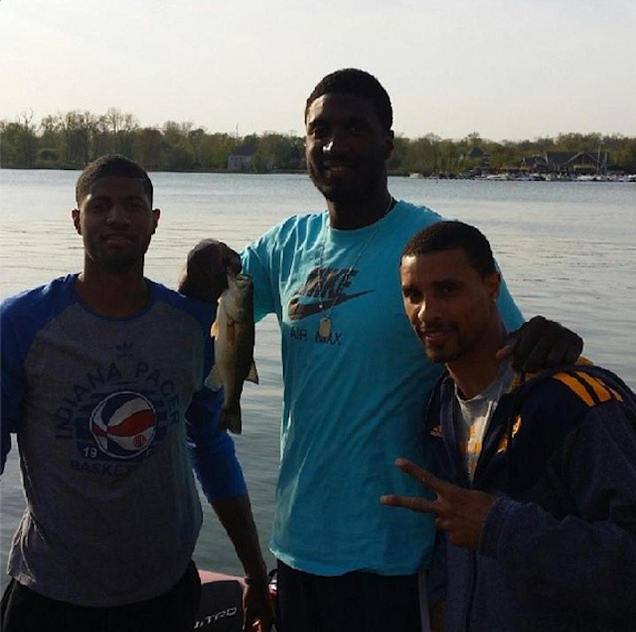
Recently, Paul George the fisherman took it upon himself to help out a teammate. Roy HIbbert, an all-pro center who has had horrible confidence problems this playoffs (three consecutive games without a point). So, what did George do? He took Hibbert fishing. Here are the immediate results:


That's Hibbert holding a bass. But how, you ask, has this affected Hibbert's play on the court? Well, since the fishing trip, Hibbert is averaging over double digits in points and has returned to being the menacing presence in the paint he was for the past two years. And his team? Up 3-1 on the Washington Wizards and looking at a return trip to the conference championships.

This seals it. FIshing heals all. As Hibbert himself declared:

We fished for about two hours and just relaxed and didn't talk about basketball. We just talked about life and tried to catch some bass. He reached out and got my mind off things and this is hopefully something I can build on. He's a great teammate, so I really do appreciate him reaching out 'cause he didn't have to.

I for one am unabashedly on the side of Team Fishing -- the Indiana Pacers.

-- Dr. Todd

Sunday, May 11, 2014

1000 Words


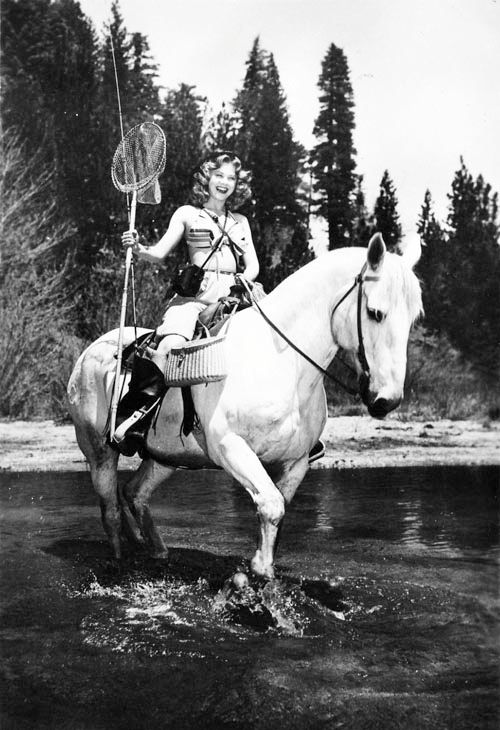
This week in 1000 Words: Hollywood Goes Fishing, we have a lovely photo of actress Vera Lynn on horseback with fishing gear. Vera Lynn (b. 1917) is a national treasure in Britain, being named Dame Vera Lynn and a living treasure in her home country. Here she poses in a publicity still likely from around 1950 for MGM studios.


-- Dr. Todd

Saturday, May 10, 2014

The Art of the Lure: Pflueger Trade Minnow “The New Winner No. 8683”


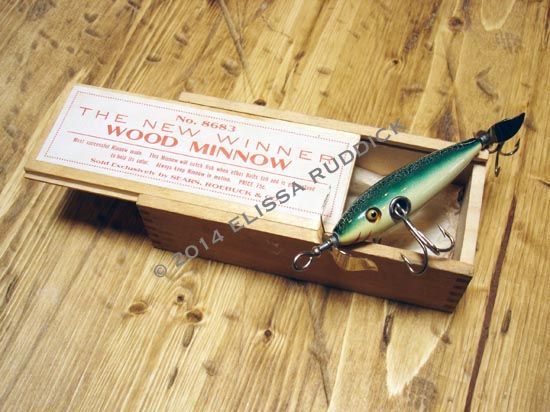
We’ve all heard the term, “what’s in a name?”, but what’s in a number? Pflueger, as well as many other major tackle companies, made “trade minnows” for hardware companies and mail order catalog companies that were slightly lesser in quality than their own name brand lures. Sears and Roebuck marketed their “The New Winner” three hook green crackle back wooden minnows as part number 9006, so why is this one in a box marked 8683? Everything about the combo is correct, except the number!


Everything about the combo seems right. It looks like it has always been together. It was found this way. Mint box, with mint lure, with original tissue paper in the bottom of the box, so what’s up with this No. 8683? This is driving me crazy! Ok, it’s only one thing on a long list, but I’ve got to find the answer!

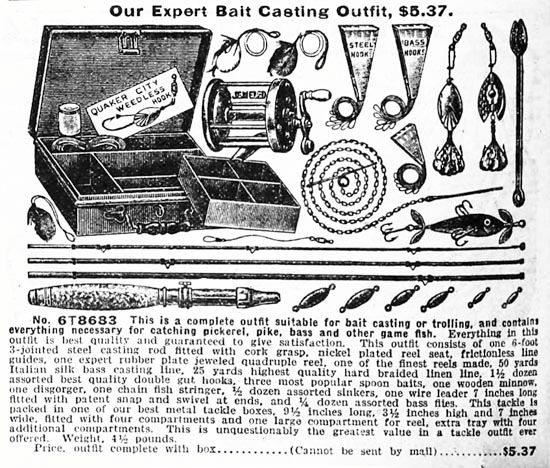
Ah, alas, the mystery has been solved! The 1910 Sears and Roebuck catalog has a No. 6T8683 complete “Expert Bait Casting Outfit” for $5.37! This is part of what makes collecting and researching our vintage fishing tackle fun, and now I can take this off of the list of things that drive me crazy. A win, win situation!


If you have any questions/comments, Elissa Ruddick can be reached at elissaruddick AT aol DOT com.

Friday, May 9, 2014

The Friday Funhouse


The Video of the Week

This is a fantastic 31-minute vintage fishing video from Wright & McGill entitled "Fishing the Blues" about saltwater fishing in the 1960s.


12 Things I Would Buy If Only I Could Afford Them

Don't know if this will get a bid or not, but anytime a Chautauqua Minnow comes up for sale, it's a pretty good day.


This is a nice Heddon Black Sucker.


This is a really pretty Talbot #43.


This is a really amazing Paw Paw ice decoy.


Winchester reels in boxes are always popular.


Dillenger glass eyed lures are always popular.


Newell reels do not get much love, and that's a shame.


Beaver Bait Co. Old Fighters are a neat plastic lure.


This Ashaway Special Boatsmen's dealer box is really cool.


Heddon Wilder Dilgs in boxes will always attract interest.


Heddon reels like this 3-15 are very undervalued.


In memory of the late Ward Coppersmith, this ebony bone tuna jig is a great reminder of a great collector who is no longer with us.


As always, have a great weekend, and be good to each other, and yourself.

-- Dr. Todd

Thursday, May 8, 2014

The Fishing Advertisement: Holeproof Hosiery (1932)


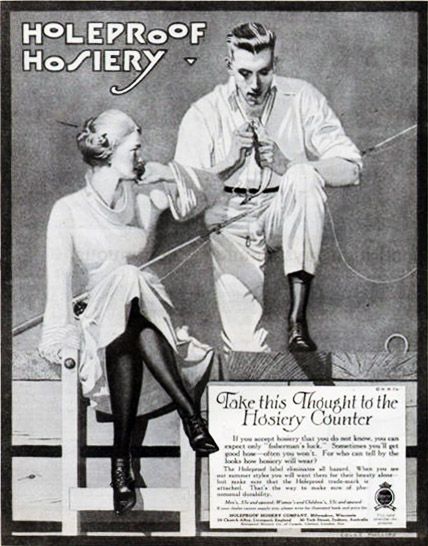
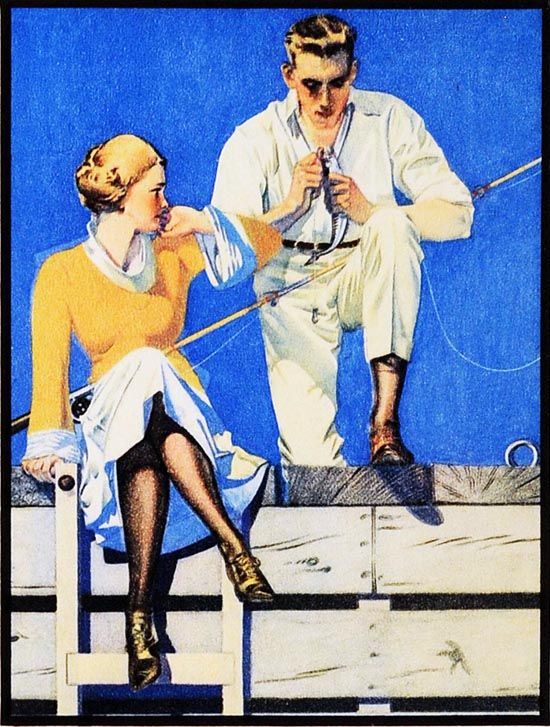
This June 1932 ad from The Saturday Evening Post for Holeproof Hosiery is a very interesting one. It features a flapper girl and her beau fishing. However, the ad as it was run misses the true beauty of this artwork, which is reproduced in color below. It's a fantastic painting, although who painted it has escaped me.


-- Dr. Todd

Tuesday, May 6, 2014

Voices from the Past: A Tour of Abbey & Imbrie's Fly Factory (1897)


The following description was published in the June 12, 1897 issue of Forest & Stream magazine, and describes as well as anything to date a trip through a fly tying factory in Brooklyn. The fly tying factory was that of Abbey & Imbrie, the well known tackle house of Fulton Street.

IN A FLY-TYING FACTORY.

While the angler of this country stands far ahead in his expertness in casting the fly, it is very doubtful if many know much about the surroundings of the art of fly-tying, or that there is in New York city the only fly factory in this country, and that it is the largest in the world.

At one time Great Britain held the palm for artificial flies and exported them to this country. Now the American flies are exported to England. The superior system of supervision of every process of manufacture and inspection of the finished product is one reason for this; but, undoubtedly the method of "team working" almost universally employed in England is largely to blame for the loss of their trade. By team working is meant that the fly-tying is done at the tenements of the workers and not in a regular factory. In this way one family will, for example, work for years on a very few patterns, and this work becomes mechanical and the tiers lose all interest in it.

In this factory the workers are recruited from the vast population, and no one is employed who does not seem to bd likely to take an interest in her work and who is not pretty well educated. Add to this, the American (as in most business) is on hand personally looking after every detail in his factory, pulling the loose ends together, active and intent on getting the very best individual work he can out of bis intelligent help.

The factory is on the top floors of a building with the best of light and ventilation, and the first section is the feather storage, where in tin-lined bins are stored feathers from almost every known bird of brilliant plumage, Europe, Asia and Africa not excepted. These are divided in the first instance into skins of seafowl and landfowl. The former are most preferred for flies wherever their colors are right, because of the greater amount of oil contained in them, which renders the fly more serviceable and more durable in the water. These feathers are bought from every available source, and so hard is it to keep an adequate supply of the smaller types that it is necessary to carry a stock for four years at least. There is no known or recognized market for them, no set price; the manufacturers find a supply here, there and everywhere, and fix the price according to the quantity. For instance, the barred feathers vary from a quarter of a cent to four cents each. These bulk feathers have to be carefully selected and sorted by girls trained to the work, and they are sorted first to colors, then to quality, then to size. The quality is determined by the closeness of the bars to each other. The size ranges from "14," which are about 1/2 in. long, to "2," which are about 4 in. long; these numbers representing the size of the fly they are intended for. Very few feathers are died, the bulk are used in their natural colors. It takes a girl about twelve months before she is considered competent, as the eye must be educated to' tell the distinction between the close running numbers at a glance. Roughly speaking, there are every year about 150 girls taken on for the various departments, to eventually become fly tiers, and out of these not more than ten have the requisite delicacy and quickness of eye and hand.

When the girls sit down to tie, there are ten girls to every hundred told off simply to wait on the fly-makers and bring them the various supplies called for; and these ten girls are kept hustling all the time. The hooks with the gut snells attached are taken in hand, and with the low-priced flies the body is first formed by deftly wrapping around the shank a piece of suitable worsted, this being the base, in varying colors, for the majority of that grade; then a strip of feather is taken of the type suitable for that particular fly, and this is wound around the upper part of the body, so that the quill section (if one may so term the film of skin) lies its full length next to the body, while the bars of the feather stand out in every direction direct from and at right angles to the body like the spokes In a wheel. This sounds very easy, but it is quite a trick to do it properly, and on this point depends the ultimate success of the fly. Then the wings are added, these being another strip of feather bars, deftly tied so that it stands up behind the collar-like strip just adjusted, at an angle of about 45°, and this effect is secured by a peculiar twisting, whipping and knotting of the silk which holds the tiny artistic creation together. While the British files have wings lying almost flat on the shank of the hook, the American fly has wings standing well up; this being necessary by reason of the more rapid streams in this country.

In the higher class of fly this process of manufacture is reversed to a great extent. Then the bronzed hook, specially tested for temper and strength, having a full hollow point, is taken, and the wing is at once whipped on to the shank, lying flat forward from the barb; then the body of chenille, etc., is whipped on securely, then the tinsel, or whatever the species calls for, and then, the body completed, the wing is bent backward and whipped in its proper position. Thus each portion is separately whipped, and all doubly whipped by the finish at the head, which is then cemented and varnished.

A girl can tie five or six dozen per day of the high grades, and of the cheaper grades a good worker ties from twelve to sixteen dozen per day. This record varies much according to pattern and minutia.

It is found necessary to take all these precautions of separate tyings, cementings and varnishings to make the fly as strong throughout as possible, for none but a fly manufacturer, possibly, fully appreciates the terrific strain placed upon a fly quickly whipped through water, a pressure to the square inch which nothing but the natural elasticity of the feather enables it to bear.

As to the designs of the flies, they are almost all modeled on some insect or bug in nature, the exceptions being certain combinations of colors which have, for some little grasped reason, proved successful in the past. Now a new feature is being taken into consideration, and that is the appearance of the natural fly when wet, and the appearance of the artificial fly when wet. In the water most blues become nearly black, reds become purple, yellow grows several shades lighter, etc., etc., according to the water, and if the insect has, for instance, a pale blue fuzz on a gray skin, and the fly should have a pale blue wing rather long and a slightly darker blue body, in the water it will look to have a body almost black with the wings widely different from the natural insect.

The flies made vary from the tiny "midge" to the great flies which would overlay a dollar; and these are all for trout. The flies for Colorado and Montana are nearly all whipped on double hooks which point out in opposite directions about Jin. apart. The most gaudy and impossible-looking specimens, which go to country sections, where there is a demand for them which must be filled, and which are of little use anywhere else in this country, prove good killers in Maine, where the waters are deep, clear and cold. These are the Silver Doctor, Jenny Lind, etc. The very large flies go mainly to Canada and California, and the Northwestern States, where there is very rapid and deep water, and the fish are plentiful; but an Eastern expert would look askance at any fisherman using them in Long Island waters. In the very high priced flies many designs are special, invented by private individuals, who in Europe would carry their own kit and tie them themselves, but who in this busy country of ours have neither time nor inclination so to do.

Some little idea of the detail in manufacturing flies may be gleaned from the fact that at this factory there are turned out every year about 5,000 flies of different kinds, qualities and sizes, and that each individual one of these is made (with few exceptions) in about 500 varieties, such as sizes of hooks, quality of gut, etc., etc , and that about 10,000 of the more commonly asked for varieties are kept in stock from day to day.

When the flies are completed, each separate one is passed before an inspector and inspected for flawless gut, perfect knotting of snell, perfect whippings of fly, perfect cementing and varnishing, and then goes down stairs into stock with a number which shows who made the inspection; and so, if after the flies have been sold and guaranteed as perfect, anything is found wrong and the customer returns the card, etc., which bears the faulty fly, the poor work can be immediately traced. This system works as a preventative and complaints are very few. This is not done in any European factory.

Eighteen years ago Mr. Imbrie (of Abbey & Imbrie, the proprietors of the company) went to Spain and made arrangements for securing proper and adequate supplies of silkworm gut. This gut on which the fly-hooks are snelled plays an important part in the factory, and is all imported from Europe, being the sac in the silkworm, which nature gave it to generate the silk. These sacs are withdrawn from the insect, and then, tightly held between the thumb and finger of each band, are stretched to about 10 or 12in., in fact, as long as the gut continues round, this being continually tested by the tip of the tongue of the operator, both hands being employed. Quality is roundness rather than weight, and as long as it is round the area of tension is more evenly distributed and the grain of gut uninjured. Thickness only indicates great strength when round, and a flat gut of great width is weaker than a thin round gut as a rule; The quality is judged by appearance, freshness, etc., and it comes ten bundles in a hand, selling by the 10,000. When these are received at the factory each bundle is opened and sorted in sizes as near as possible, and then goes to the knotter, who makes the loops at the opposite end to the hook, drawing them tight over a screw hook in a bench, thus cutting the ends very close, which when the gut (being soaked before tying) dries out, is as hard and tight as if welded. The leaders of various length are no longer lashed in the old way, but by means of a new process are closely whipped and cemented with a waterproof composition which becomes harder with age and more perfect in every way.

It may be remarked that the annoying "snapping" of the fly, breaking it off the line when casting is occasioned, as is well known, by the caster not letting his line get a perfectly straight extension before whipping it forward, but there are also other reasons. One is that the gut is too dry, and that if the gut had been adequately soaked before casting this annoyance would be minimized. Another feature is the new reinforcing of the gut for the higher priced flies, which by bringing the gut back to the free snell, strengthens the snell just where it "snaps," and incidentally gives it a certain stability which makes it "drop" better and straighter. Every piece of gut in this American factory is graded to the hook on which it is to be used, and this is done nowhere else in the world.

Thus the American fly presents almost perfection of art, graded feather, graded gut, graded book, scientific reinforcement of weak parts, waterproof cementing and greater spring to the feathers by reason of their adjustment, rendering the. domestic trout fly, as claimed by the enthusiastic manufacturer, a work of art not ranking behind the paintings of the old masters. In conclusion, the prices of these flies range from 18 cents per dozen to the fisherman, up through the grades of 25, 40, 45, 60, 80 cents, $1, $1.50, $2, $2.50, and salmon flies from $4 to $12 per dozen. Think of the endless detail of the skilled work and then look again at the prices.


-- Dr. Todd

Monday, May 5, 2014

In The News: Fishing Rods and Art


Fishing rods have been put to many uses for which they have not been intended. Thieves have often used fishing rods to steal small items, they've been used in more than a few assaults, and as I can attest from my youth, a fishing rod makes for a very nice fish spear when used by a 10-year old (don't tell your father, though).

One of the most interesting uses of a fishing rod I can recall is that used by the master painter Henri Matisse. A sickly man, Matisse was often unwell and bedridden or in a wheelchair, and because of this turned to crafting large-scale paper cut-outs which could be constructed by assistants under his direction.


Like a virtuoso, Matisse directed his assistants with … a fishing rod:

"One of Matisse's improvised artistic tools was a fishing rod, with which he pointed where his cut-outs should be pinned and, occasionally, prodded lethargic assistants."

What kind of fishing rod it was is not recorded, but the art created by this singular genius wielding a fishing rod has sold for as much as $13.8 million.

An exhibit of 130 of his fishing rod-created cut outs is currently showing at the Tate in London and is slated to come to New York's MOMA this October.

-- Dr. Todd
Sunday, May 4, 2014

1000 Words


This week in Hollywood Goes Fishing we feature a current actor. Lukas Haas is one of those working actors who quietly goes about doing fine work without seeking to attract too much attention to himself. An Emmy nominee (for playing the titular role in The Ryan White Story), he rather unassumingly has developed an outstanding resume, ranging from the criminally underrated Music Box to the award winning Inception to the terrific Lincoln.

Here he is using a Daiwa spin cast reel in an undated photograph I would guess is ca. 2000.


-- Dr. Todd
Saturday, May 3, 2014

The Art of the Lure: Johnson's Automatic Striker

Johnson’s Automatic Striker
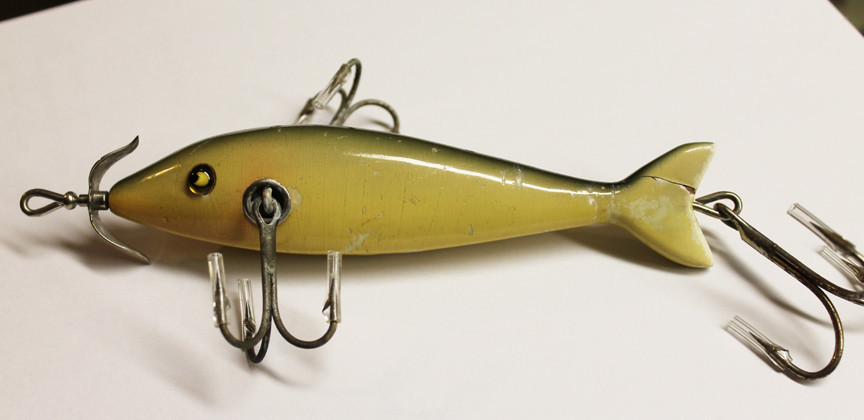
The Johnson’s Automatic Striker was patented in 1935 by a dentist named Carl A. Johnson from Chicago, Illinois. As all of the boxes state on the front -- “Strikes When The Fish Strikes” -- these lures were designed to eliminate the guess work as to when the hook should be set. They were equipped with a mechanical release so when the fish struck, the hook partially disengaged from the lure. The strike resulted in a direct pull from the line tie through a wire connected to the hook. They are believed to be the first lure to use the breakaway hook system.


They were originally made in three sizes, a Large Size for Muskie and Large Game Fish that measured 6 1/2 inches and weighed 1 3/4 ounces, a Medium Size that measured 3 inches and weighed 1 1/4 ounces, and a Small Size that measured 2 inches and weighed 3/4 ounce. Later there was a smaller size that measured 1 3/4 inches, but they are not listed on any paperwork that I have been able to find. The smallest ones are also the toughest of all to find! The first three original sizes were only offered in Gold Flash and Silver Flash - Natural Scale Finish. Gold Flash indicates orange on the bottom of the lures, while Silver Flash indicates yellow on the bottom of the lures. That part makes no sense to me, but hey…

The part of the Natural Scale Finish does make sense though, and looks very life-like. The first three original sizes sported eyes with glass pupils and tack eye centers that were all inset inside a finely detailed painted “bull’s-eye” and they also had tails that moved from side to side when retrieved. The smallest lures were painted in various less life-like colors and either had no eyes, or painted eyes.

What a clever idea Mr. Johnson had when designing these, and if you ever look up U. S. Patent #2017903, you will see just how clever and precise this man was. I could go on and on and on about the intricacies of these unique lures, but don’t worry, I won’t! For some reason, any time that I see a Johnson’s Automatic Striker lure, I think of a medieval knight in his shining armor.

If you have any questions/comments, Elissa Ruddick can be reached at elissaruddick AT aol DOT com.

Friday, May 2, 2014

The Friday Funhouse


The Video of the Week

You don't see a 1903 bass fishing video every day …


12 Things I Would Buy If Only I Could Afford Them

Can't love this Heddon Black Sucker enough!


A Heddon Crazy Crawler in yellow shore has the folks going wild.


A Wojnicki glass rod is always a treat.


The Chippewa Skipper -- an ugly but desirable bait.


Well, this Perfect Action Fishing Tackle Canadian salmon plug box is pretty crazy.


Love the Zwarg in the box.


Vince Cummings was known for his glass rods, but this is a pretty graphite he built.


Love this Chapman bait.


Australian Newell Scorpion lures are popular.


Brown's Fisheretto in the box is incredible.


CCBC Wigglers are always great.


You don't see many Croft-Coxwell Musky Spinners.


As always, have a great weekend -- and be good to each other, and yourself!

-- Dr. Todd

Thursday, May 1, 2014

The Fishing Advertisement: Lustre-Net (1957)


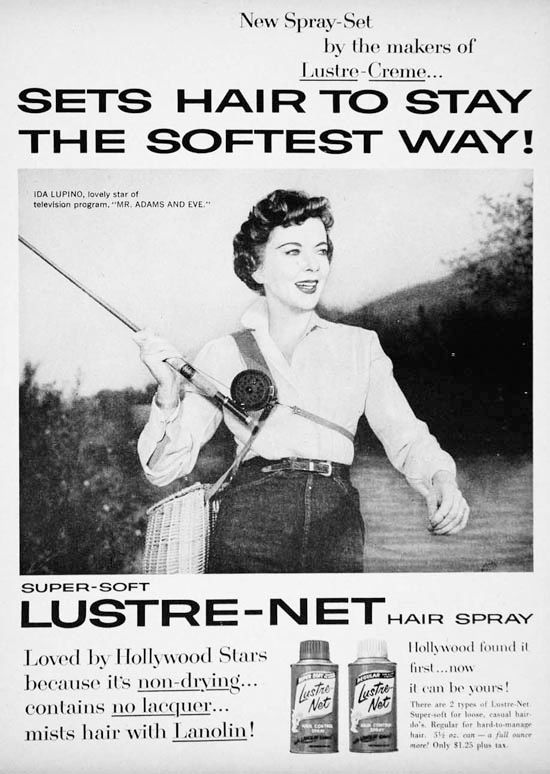
Companies have always tried to tap into the female market by using the outdoors as a background. Here we have a classic example, from the hair spray company Lustre-Net, featuring Hollywood actress Ida Lupino (1918-1985). An English-born actress, she became both noted for her screen work and her directing. She was also a noted angler, as shown in this lovely ad showing off her fly rod skills.


--Dr. Todd