Sunday, June 17, 2012

1000 Words

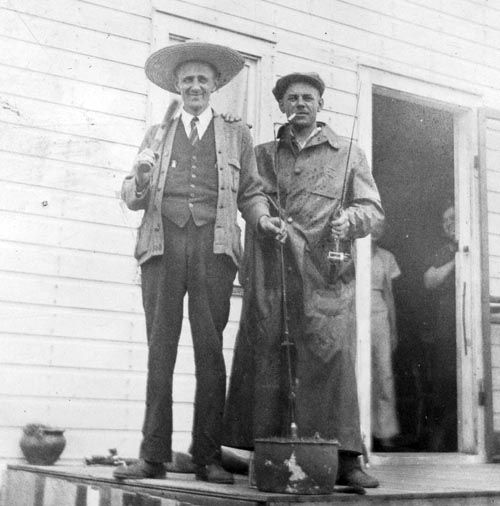
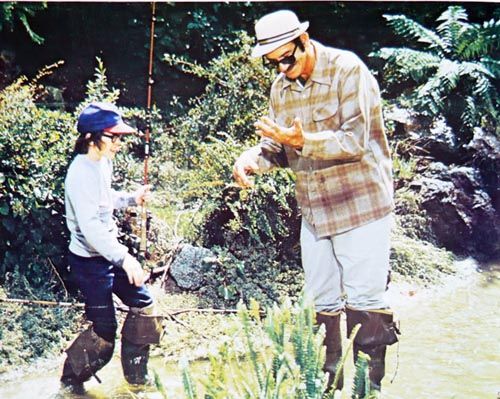
This is one of my favorite 1920s fishing photos -- two anglers and their gear. Doesn't get much better than this!


-- Dr. Todd

Saturday, June 16, 2012

Deconstructing Old Ads: What's in a Patent? Paul Junod (1902)


What's in a Patent? Paul Junod

How often do we see a Heddon Lure which is obviously from the teens or the twenties offered for sale in “1902 Box”? Turns out the only thing about the box that is 1902 is the date of Jim Heddon's first lure patent for cup and screw hook hardware. Folks in the fishing tackle industry (I'm sure there are others as well) just seem to love plastering patent numbers and dates all over their boxes, reels and even lure diving lips. Many of these patents are ones that the company holds but have nothing to do with the object at hand. They generally seem to be there to discourage imitation. In the case of lures it does not appear to discourage many of the "copycat" attempts to cash in on a successful product.

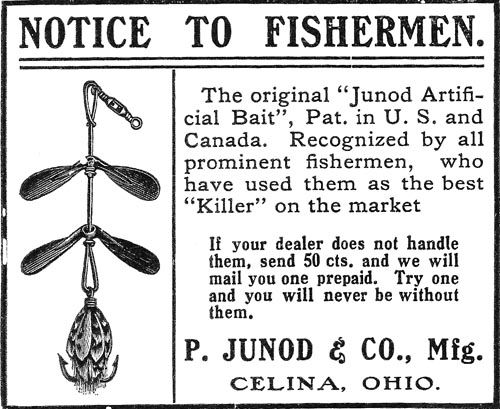
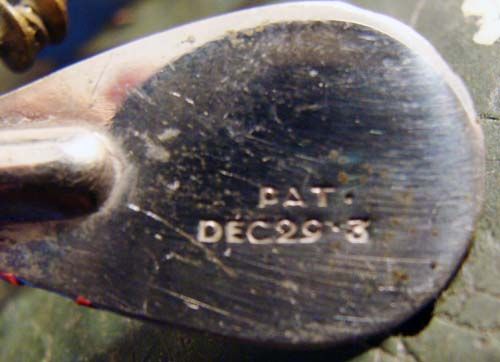
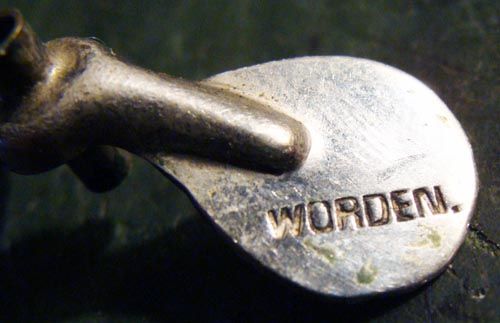
What brings all this to mind is repeated listings of Worden wooden minnows as “1903 baits” due to the patent date “Dec 29 1903” stamped on one end of the spinner and the name “Worden” stamped on the opposite blade. It has been demonstrated over and over that Mr Worden did not offer wooden minnows to the public until 1905. So where does that 1903 date come from. That is the subject of today's ad from the July 1905 issue of National Sportsman.


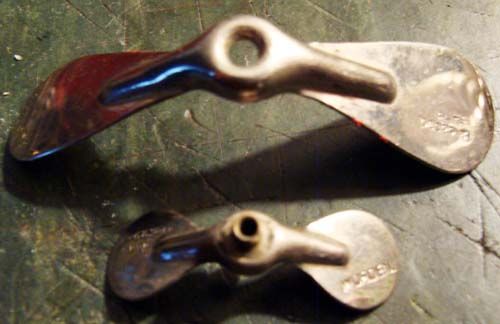
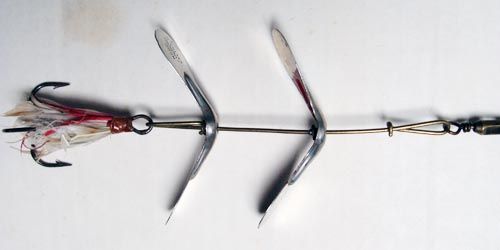
Paul Junod was a Jeweler in Celina Ohio at the turn of the last century. We must assume that Paul was a fisherman as he manufactured fishing tackle for a good many years. His first spinner patent was granted November 1st 1898 and was for a propeller-shaped spinner that turned freely on a fixed shaft. The spinner was reinforced with a metal strip soldered to the underside which gave the spinner a stiffer constitution. His second patent was granted on 29 Dec 1903 and was also for a reinforced spinner, but this time strength was achieved by stamping a raised rib along the long axis of the blade. It acts in the same way as a piece of angle iron, which of course is much harder to bend than the same piece of flat steel. Chances are that this form was far easier and cheaper to manufacture than the earlier design. It was a huge success. Not only did Mr. Junod produce his own spinner as seen in this 1905 ad, but he licensed its use to other companies such as Worden and Shakespeare. They did however have to stamp the patent date on the spinner blade. Hence we see the 1903 date on products that Worden and Shakespeare didn't produce until well after 1903.

For many years when I saw this style of tandem spinner I wondered how it was fished as it is too light for casting, especially on cc1900 equipment. We are left with two alternatives. Trolling behind a rowboat or a popular form of bass fishing in those early days that is somewhat forgotten now. Where I grew up in Ohio is was called “Flipjacking” and usually consisted on one man rowing and another standing with a very long cane pole. Unlike “Skittering," which was done with a short line on a long pole, Flipjacking used a line the same length as the cane pole--usually 16 or 18 feet. The Spinner was swung out and pumped up and down next to stumps and openings in lily pads. It was a deadly method that was still practiced by a few in my youth. Large bass were unceremoniously lifted clear of the water and swung into the boat. And we think “flipping” as practiced today is something new!

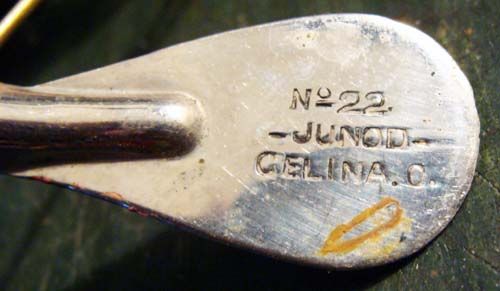
The following pictures show an original Junod Spinner., Close ups of the stamping on each end of the Junod Blade and one comparing an original Junod blade to one that Mr Worden used in South Bend.


-- Bill Sonnett

Friday, June 15, 2012

The Friday Funhouse

The Video of the Week

Watch a blue shark devour a massive dead squid.


12 Things I Would Buy If Only I Could Afford Them

Wow. This is a really rare Bronson-Coxe 4/0 reel in the box!


Andrew Clerk & Co. dates this reel to the early-to-mid 1870s, although that handle is pretty odd...


This Aldora #277 Austrian spinning reel is one rare bird.


Break open the bubbly 'cuz when this one's done, two people will be celebrating.


Wow. This Louis Rhead frog is amazing.


This Expert is very nice.


You don't see many Harry Salmon Plugs for sale…


I'm loving that this Paw Paw injured minnow in frog skin is getting so much love.


Everyone loves a Donaly Wow!


Not too many rarer colors than Gray Bar on a Lucky 13.


This Chapman & Son bass spinner is very cool.


This Heddon in the box in Rainbow is ultra sweet.


As always, have a great and safe weekend, and be good to each other--and yourself.

-- Dr. Todd

Wednesday, June 13, 2012

The Worst Fishing Scene in Cinematic History, Part II

The Worst Fishing Scene in Cinematic History, Part II

When I posted "The Worst Fishing Scene in Cinematic History" last week, I got some naysaying votes to my choice as Roger Moore as the worst on-screen angler ever. One of these was from Claude McMorris, who argued that Elvis' movie Follow That Dream had the worst fishing scene in cinematic history. I had to find out myself, so I went and got a copy of the movie, and well…the results are below!


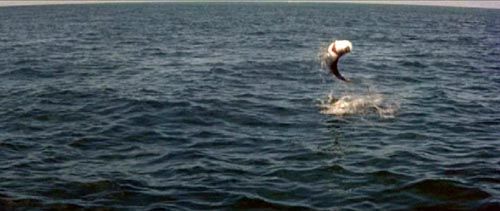
The film is set in Florida during the 1950s, where we open with a lovely stock shot of a leaping tarpon -- the king of all herrings.


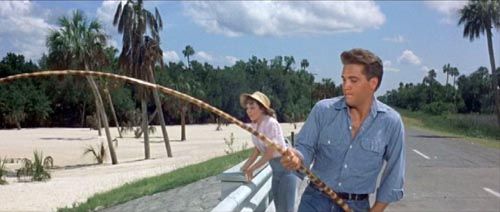
And we're off. That's Elvis fighting a 50 pound tarpon…with a cane pole? WTF? Really? A CANE POLE? Oh, Elvis. You can't catch a tarpon on a cane pole!


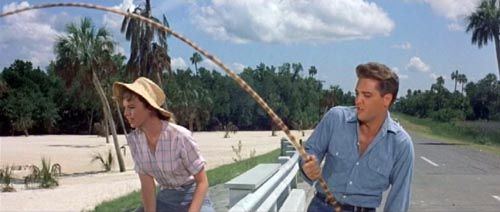
Well, that's a cane pole all right. But how can a tarpon make a run…jump…uh…Elvis!


Stock footage alert! The tarpon appears beaten. Will Elvis defy all the odds and land one of the most powerful fish in the coastal seas on a cane pole (with no reel or drag)?


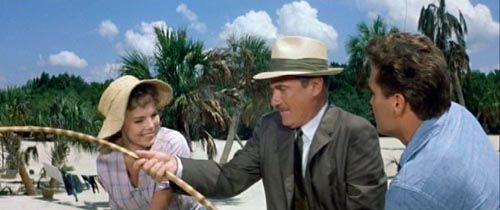
Plot twist! Enter wealthy angler, who declares he spends $65 a day and never sees a fish this big. He offers Elvis $20 just to fight the fish. Elvis, being aw shucks Elvis, accepts.


Wealthy angler is having a blast -- fishing a big tarpon on a CANE POLE. With a "diaper pin" for a hook, as Elvis helpfully notes. Repeatedly.


The tarpon leaps!


And the wealthy angler inexplicably drops the cane pole and falls down. Scratch that. The tarpon throws the "diaper pin" and the angler "falls down." That is some acting right there.


Elvis inspects the "diaper pin." Yep. That was the culprit, all right!


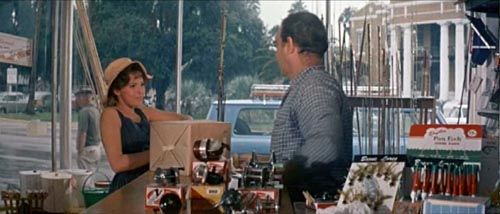
Plot twist! Enter Grandpa Joe from Willie Wonka, inexplicably arriving with a toilet. The lovely Anne Helm has an idea -- if wealthy anglers will pay $65 a day to go fishing, why not open a bait shop? She takes the $20 the angler gave Elvis and buys herself some fishing tackle.


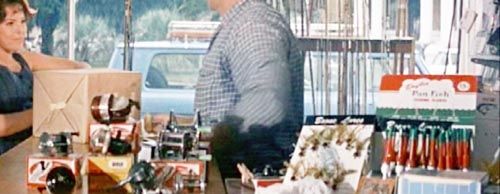
Oh, let's take a closer look at the tackle counter, shall we? On the right we have a Dayton Bait Co. display card, a Boone Lures jig card next to it, and a host of Shakespeare and Bronson reels on the counter.


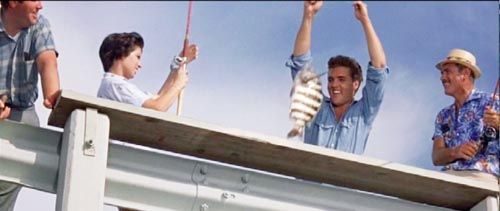
Flash forward a couple of days -- Elvis is helping a couple of anglers (including the same wealthy angler who got the idea started in the first place) land fish with brand spanking new gear. Check out the baitcasting rig and spinning rig!


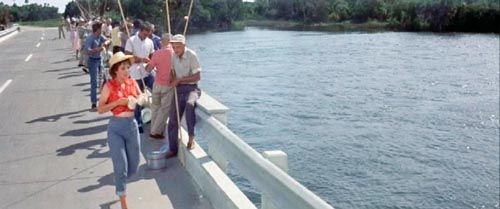
Anne Helm is taking orders for snacks as she walks down a pier full of anglers.


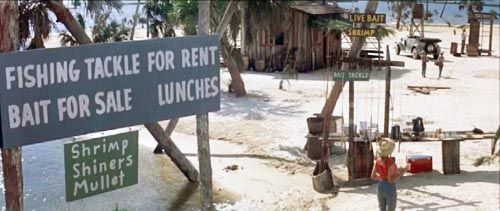
And into her new tackle business! Just like that. Elvis, a "diaper pin," and a cane pole is magically turned into financial salvation! Cue the music!


So there you have it. Our second entry in the "Worst Fishing Scene in Cinematic History." I'm currently taking suggestions for follow ups, I have two others that I will follow up on in the coming weeks. By the way, Rick Osterholt noted the place where they were fishing was the Yankeetown bridge area of Florida…

Check out the clip of Elvis fishing here:


You can buy a copy of Follow That Dream by Clicking Here. It's a fun if silly movie, like many of Elvis' flicks.


-- Dr. Todd

Tuesday, June 12, 2012

Voices from the Past: James Henry Corballis (1891)


I was recently going through a box of flies dating from the turn of the last century. I was a little surprised that these flies -- some of them still in packaging from professional trade houses -- were not the perfect ties one might come to expect from "professional" fly tiers. It reminded me of a passage I once read from Forty-Fiver Years of Sport by James Henry Corballis (1891). Corballis was a Victorian sportsman of the first order, and a dedicated salmon angler. He wrote in his section on salmon fishing:

Although in many good fishing districts it is quite possible to purchase flies, they are often but indifferently constructed, and I would therefore advise any of my readers who may contemplate making a fishing trip to be careful to obtain a good supply of the standard flies from some good maker. Of course, there are some local men whom no maker can excel in work, whether in London or elsewhere, but such cases are few and far between.

I remember once asking a professional fly-tyer and fisherman why he tied his hackles on so badly. Being an Irishman, he was not at a loss for a ready reply. 'Sure, yer honour, if a fly kills one fish, it ought to do; there would be no trade at all if it killed two fish.' If the honesty of the speaker was doubtful, he without doubt expressed himself honestly, and although his flies were of a very killing order I declined to purchase any; but I tied some flies for myself from his patterns, and found them more killing than any others I possessed, even out of a large collection.


As I looked at the rather loose construction of some of these professional ties -- unfished for certain but also designed, it seems, to fall apart in the fish's mouth -- I couldn't help but smile.

I guess "planned obsolescence" isn't such a new idea after all…

-- Dr. Todd

Monday, June 11, 2012

News of the Week: 11 June 2012


Don't have time to read 50+ fishing and tackle collecting blogs and web sites? Well, let us do it for you! Follow all of the latest news, articles, and stories on our Whitefishpress Twitter account! Hint: You don't need to be a member...just bookmark the Twitter Feed Page or click on latest links to the right!

Is the allure of lure colors worth the extra cash?…why cats and fishing tackle don't mix…Tommy Martin and Lonnie Stanley enter the Texas Freshwater Fishing Hall of Fame…Pacific Bluefin Tuna spotted 150 miles south of San Diego…A Q&A with legend Lefty Kreh…Fly fishing for sunfish is easy for kids…A review of Andrew Wayment's Heaven on Earth: Stories of Fly-Fishing, Fun and Faith…John Merwin opines on the landlocked salmon of Forest City, Maine…Going fishing and finding a gator instead is a real bummer…Meet fly fishing guide April Volkey at the Ketchum Cast Away and Fly-Tying Festival…it must be THE NEWS OF THE WEEK!

THE MONDAY 10: The Ten Fishing Stories of the Week You Need to Know

The Big Lead: Do you agree that the allure of lure colors isn't worth the cash?


Going fishing and finding a gator instead is a real bummer.


Why cats and fishing tackle don't mix.

Pacific Bluefin Tuna spotted 150 miles south of San Diego.


Meet fly fishing guide April Volkey at the Ketchum Cast Away and Fly-Tying Festival.


Fly fishing for sunfish is easy for kids.

A Q&A with legend Lefty Kreh.

A review of Andrew Wayment's Heaven on Earth: Stories of Fly-Fishing, Fun and Faith.


John Merwin opines on the landlocked salmon of Forest City, Maine.


Finishing with a Flourish: Tommy Martin and Lonnie Stanley enter the Texas Freshwater Fishing Hall of Fame.


-- Dr. Todd

Sunday, June 10, 2012

1000 Words

1000 Words

Walter Mathau was no stranger to fishing films--his brace of ice fishing movies in the Grumpy Old Men franchise were about the best depiction of winter angling in the north country as has been put on film.

But many people don't realize that the iconic role of Max Goldman was not his first fishing role. In 1972--just four years after his legendary role as Oscar Madison in The Odd Couple--Mathau starred in a film called Pete 'n' Tillie with Carol Burnett. It's a sad film that sees his lead character try to shield his terminally ill son, played by Lee Montgomery, from the sadness of his illness. He takes him fly fishing in one particularly poignant scene, depicted below.


The film received good reviews and was nominated for two Academy Awards, including best adapted screenplay. Mathau won a BAFTA award for his work in this film.

-- Dr. Todd

Saturday, June 9, 2012

Deconstructing Old Ads: My Affair with the Muskegon Handle Rod (1951)

My Affair with the Muskegon Handle Rod
 
Fairly regularly a Champion Products “Handle Rod” shows up on Joe's Board with questions as to its identity and its age. The following ads come from the February 1951 issue of Sports Afield and the March 1957 issue of Field & Stream. I particularly like the suggestions as to where the compact Handle Rod can be carried, such as in the "glove compartment" or my personal favorite the “Brief Case.” I actually met an older man a few years ago who carried one rigged with his favorite lure in his car trunk. As he had occasion to drive, he would stop at bridges over interesting looking streams and take a few cast to satisfy his curiosity.
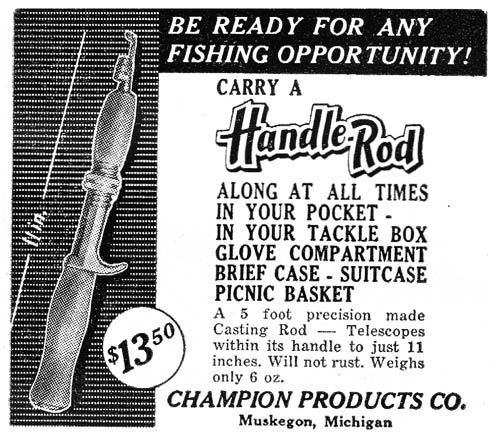
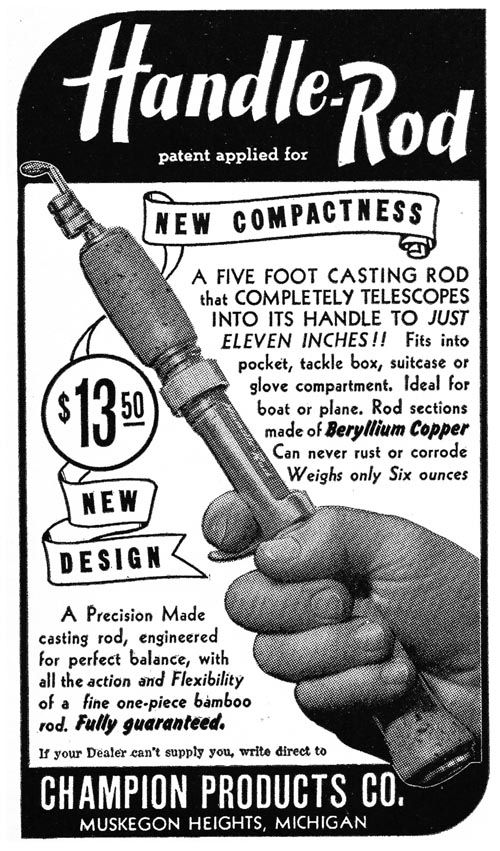

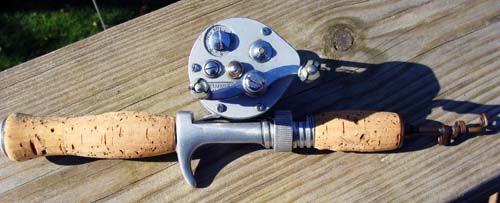
Handle rods were made of Beryllium-Copper a “miracle alloy” of Copper, Beryllium and selected other metals depending on the properties desired. Its common use came out of World War II where it was used as antennae on fighter aircraft. It was soon discovered that it made a very desirable fishing rod that resisted sets, metal fatigue and corrosion (even in salt water!). In 1949 there were several companies listed in Fishing Tackle Digest as producing Beryllium-Copper rods in the United States. One down side was that it was fairly expensive. The advent of cheaper fiberglass at about the same time quickly ended Beryllium-Copper's career as an everyday rod material. In the case of the telescoping “Handle Rod” however it was an ideal material. Strong, light, flexible, smooth of surface and thiner than glass, made it ideal for this application. Handle Rods were on the market for a long time. I have owned several of them and have noticed that they changed a bit in style (mostly cosmetic) and at one point in time were made in Pennsylvania.
 
The first time I saw one of these rods was in 1957 when I went on a canoe trip in northern Canada and my partner pulled one out of his pack. Wow! What a great idea. Fold it up and slip it into the old Duluth Pack on the portages. Take it out at the other end of the portage, extend it and take a few casts into what often amounted to virgin water. It took me another 15 years to find one, which I immediately put to good use on yearly canoe trips. Some time later a young man at work was impressed with my Handle Rod after seeing it and casually mentioned that he thought he would pick one up for his own use. My reaction was “ Good Luck, it took me 15 years to find this one!” The next week when we reported back to work he told me that he had found one on the way to work that very day in an antique store for $10. I was even more surprised when he showed me the rod as it was mint in its original packaging --- a blister pack! That was my first hint that these rods were not necessarily as old as I has assumed.

Now -- several Handle Rods later and having looked through hundreds of older “Outdoor” magazines, I find that the Handle Rod was produced well into the 1960's and one friend swears he saw an ad for it in the early 70's. There was one unforeseen problem that eventually put an end to Handle Rod production. According to Wikipedia:
 
“In solid form and as finished parts, beryllium-copper presents no known health hazard. However, breathing its dust or vapors, as formed when machining or welding, will eventually cause serious lung damage. Beryllium compounds are known human carcinogens when inhaled”.

Yikes! This discovery pretty much put the folks at Champion Products out of the rod making business. Though now at an age where long canoe trips and brief cases seem to be a thing of the past, I still have one Handle Rod just in case.....


-- Bill Sonnett