Thursday, December 13, 2007

Review: The NFLCC Magazine, Fall 2007

The mailbox delivered the latest issue of the NFLCC Magazine in glorious full color and, as always, it did not disappoint.


This issue we were treated to not one but two articles from Jerry R. Martin, one of my favorite of the cadre of writers for the magazine. Jerry specializes in fly fishing history, and offered up a pair of real gems. The first is entitled "Art Kade Flycrafters: Helen Shaw and Art Kade Fly Rod Lures," and details the history behind this innovative firm dating from around 1935-1952. While many female tiers have achieved greater fame--Carrie Stevens being just one name--Helen Shaw was as respected a name in tying circles as anyone, and she was the sole tier for Art Kade. It is a well done article identifying many varieties of Helen Shaw tied flies and deer hair fly rod lures.

The second offering from Martin is "The Weber Lifelike Fly Co.: Fly Rod Lures and History, 1936-1985" and is the second part of this two part history of a true giant in the fly rod world. An interesting and well-written offering, as are all of Jerry's articles.

Doug Bucha penned "The Sobecki Lure: Sobeski or Sobecki, What's in a Name?" which details the history behind the mysterious Anton J. Sobecki fishing lures. Bucha was able to track down descendants of Sobecki which helped him to correct many misconceptions surrounding these lures for many, many years.

My own offering this issue is a detailed history of Von Lengerke & Antoine. "A Sporting Tradition: The Legendary Von Lengerke & Antoine" should help collectors and historians identify a lot of different branded VL&A tackle, and hopefully will get everyone to appreciate the history behind this great old firm. Marked VL&A lures, spinners, reels, tackle boxes, rods, etc. are profiled.

Keith "Doc" Holliday offered up "The Neal Bait Mfg. Company: The Owners and Their Lures which covers the history of the Neal Spinner and other company lures. Interestingly, Holliday is currently the owner of the firm and is still turning out a few Neal Spinners even today.

My favorite feature of the magazine is the back page, helmed by Gary Smith. This issue he details the great story behind one of my dad's favorite baseball players, Joe "Flash" Gordon, a world-class second baseman for the champion New York Yankees in the 1920s and 1930s. Gordon was a dedicated fisherman whose tackle came to market recently, and Smith was able to track down the daughter of Joe Gordon who filled him in on the details of this great player's fishing life and times. A superb article.

Lots of great information once again offered up on in this issue. The NFLCC Magazine is capably edited by Dudley Murphy, with assistance from Gary Smith.

-- Dr. Todd

Wednesday, December 12, 2007

Fishing in Idaho in the 1930s and 1940s, by Joel Kifer

I love old fishing photos, and I love fishing history. So it was with great excitement that I read an email from Joel Kifer explaining the history behind some amazing fish photos. Joel has graciously allowed me to share these photos and his descriptions with everyone, and trust me, its worth reading.

Fishing Idaho in the 1930s and 1940s

by Joel Kifer (Anacortes, WA)

I have participated at Joe's message board since the beginning and have most recently been enjoying your blog pages.  I lived in northern Idaho for many years and had the pleasure of fishing Pend Orielle Lake and Priest Lake on many occasions.  Priest Lake was noted for the huge Mackinaw Trout, 40+ not uncommon, and Pend Orielle for its enormous Kamloops Rainbows and Dolly Varden char.  The lakes have not produced many big fish in the past thirty years but in the 30s and 40s these lakes were heavily fished for "World Record"  size fish. 

I'm attaching a couple of pics of interest. 


The first is of Wes Hamlet, Coeur d'Alene, Idaho and his world record Kamloops Rainbow trout.  It was caught on Nov. 25, 1947,  60 years ago this month and is still the world record for a fresh water catch. This photo was taken by Jack Rottier who I believe was a photographer for the US Forest Service at the time.  It was caught on a Martin plug # 5KS-11, silver scale.   It was 40.5" long, had a 28" girth, and weighed 37 pounds.  


The second is of Wes with his fish and was taken by Ross Hall a famed photographer from Sandpoint, Idaho.


Pic #3 is of a couple of hearty souls headed out for a day of action on Pend Orielle.

They're a great piece of Northwest fishing lore. I have a few hundred more that I'll dig out sometime soon.


Nifty stuff. We should all thank Joel for sharing these amazing photos from an incredible period in Northwestern fishing history!

-- Dr. Todd

Tuesday, December 11, 2007

Voices from the Past: Jim Rhody


Although many of the Voices from the Past authors have been famous national writers, I would like to profile a few local writers who penned outdoor columns but who probably escaped national attention. Such is the case with Jim Rhody, who wrote a column called Sportsman's Horizons for the Boyden Reporter in Boyden, Iowa back in the 1940s and 1950s. Here is a typical column of interest to bamboo and fiberglass rod historians and collectors, in particular Phillipson fans. It was originally published in 1951. I think it is a nice panacea to the belief that every fly fisherman simply ditched their bamboo rods the second that glass became available. And I love the last line, which is certainly an epithet I believe many talented modern makers are proving every year.

Bamboo Tops

by Jim Rhody

We think it a distinct compliment to the manufacturers of bamboo fly rods that the bamboo is still tops in the fly rod field, as attested by every manufacturer of glass and steel rods declaring that their product "has the feel of the best bamboo." That is manufacturing license, sort of like "editorial license" in that statements may be made in generalization, rather than specifically. And so it is with rods — nothing but bamboo, naturally, can have the "feel of bamboo," and what the makers of glass and steel rods mean, of course, is that their products "approximate the feel," of the best bamboo.

This superiority of the bamboo fly rod over other type rods in the matter of lightness, resiliency, "aliveness," and the supreme delight they accord the angler isn't an accident; and the fact that bamboo continues its superiority isn't an accident, either. Instead, it is due to the fact that real rod-makers spare no effort, no research, no testing techiques to keep bamboo in the enviable position it holds in the hearts of fly-rod and plug-casting anglers.

This is epitomized by manufacturers like the Phillipson rod company. "Way up in the mile-high atmosphere of Denver, the Phillipson people developed for the first time a guaranteed, waterproof, never-leak glue-joint. The little illustration accompanying this article is of a Phillipson joint which has been submerged in water for more than two years, with its bamboo sections still as strong as a weld.

In doing this article on bamboo rods, which follows treatment here previously of steel and glass rods, we contacted John A. Eble, sales mnanager of the Phillipson people to ask "how come" on this waterproof never-break glue joints. He replied that this process, exclusive with Phillipson, is one that "joins the six bamboo strips together in an ever-lasting bond that never comes apart, no matter how hard the service or how wet and disagreeable the weather."

To the angler who has never seen a fly rod come apart in his hand after being subjected to hours of soaking in a driving rain, or after haying been left out overnight in the rain, Eble's statement really mean something. Too, the bamboo-rod maker, with his own special techniques has the advantage of being able to build into his bamboo rods amazing strength without appreciable additional weight. This, to the fly rod addict who appreciates light tackle is like manna from heaven.

"Through trial and error, testing, testing and testing, experimenting here and there," Eble says, "we have been able to build into our rods a smooth, sensitive action, combined with backbone, vitality and terrific power per ounce of weight."

And that's decidedly what the fly rod angler wants—and, to paraphrase a famous automobile slogan: "When better fly rods are made, bamboo rod makers will make them."


-- Dr. Todd

Monday, December 10, 2007

The News of the Week, 10 December 2007

A 54" size limit on Wisconsin musky...angling, Moscow style...lots of Christmas ideas for the fishermen....why women are better at fishing then men...a tackle company needs a multimillion dollar loan to stay afloat...the joys of the Kiwi Moki...a revolutionary new natural fiber from Japan called Spider Silk...it must be THE NEWS OF THE WEEK!

The Big Lead: The Green Bay Press Gazette details the touchy subject of big muskellunge, and whether we should be allowed to keep them or not...

Classic Angling's Keith Elliott on fishing,
Russian style
.

The Glasgow Sunday Herald profiles Paul Devlin, the Johnny Morris of Scotland.

The Orlando Sentinel tells us that the Largemouth is overrated as a fighting fish; for real fun, try their list of the top 10 saltwater fighters.


Dave Richey--brother of the late outdoor writer George Richey--opines on f-f-f-frozen fish.

More Christmas gifts for the fisherman.

Even more Christmas ideas.

And now, more Christmas ideas for angler. Are you sensing a theme?

At least The Louisville Courier Press got it right...forget tackle, give of your time.

This week in Know Your New Zealand Fish: The Moki.


Britain's Silver Wilkie opines on his first time...fishing.

This Is North Scotland declares women are better than men at fishing.

Basszone.com interviews not one but two tackle manufacturers at the same time.


The Eden Prairie News wants your best fish stories. The real ones, that is.

Luck E Strike bait company (not to be confused with the the Lucky Strike Bait Works from Canada) gets a $2.3 million payout to avoid bankruptcy.

The Nevada Appeal writes up the trophy browns of Lake Alamanor, California.

From the Sad Files: The sturgeons days may be numbered in Alabama.

From Japan comes news of a new, super thin "Spider Silk" from Japan that may revolutionize fishing.

The Frederick News Post reports on Dan Meekins' 50 pound, 51 inch striper.


FINISHING WITH A FLOURISH: The East Oregonian profiles Cheryl Haertling's beautiful prize winning photo, "Boy Fishing".


Have a safe and productive week!

-- Dr. Todd

Friday, December 7, 2007

Friday Funhouse

The Friday Funhouse


Video of the Week


This week's video brings us an interesting mishap that befell Bill Dance. Now ol' Bill has gotten himself into a few funny situations in his day, but this one made me laugh. Robert Miller--ORCA's Pflueger Pfacts columnist and author of the recent
Stream Dynamics for the Complete Fly Fisherman
--once wrote that there were only three kinds of snakes he hated: snakes he could see, snakes he couldn't, and sticks that looked like snakes. Bill Dance would probably agree.


Things I Would Buy If I Could Afford Them

Is there any lure greater than a Chippewa in a Box?


Few Pflueger trade minnows are as pretty as this gorgeous Senate brand 3-hook Neverfail sold by H.J. Frost of New York.


Unless it is this Pflueger trade minnow in a Kingfisher box...


Here is a great pre-1893 Hawks & Ogilvy reel.


I like the description on this one: "I know very little about fishing lures, but I do know that when I see the name "W.D.Chapman" on a lure, to grab it and run like crazy."


Here is a neat piece of fishing advertising for Federated Stores.


The Cadillac of Ted Williams items.


The end of an era: the very last Vom Hofe catalog.


A couple of nice Winchester line spools are guaranteed to break the bank.


Own a piece of history! Dick Streater's original reference catalog...this was the first groundbreaking work ever done on the origins of fishing lures.


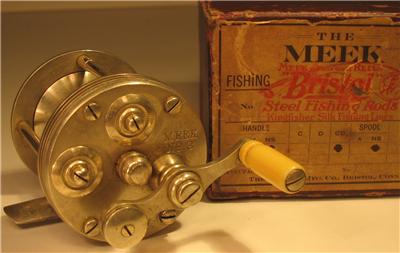
This Horton Meek #3 in the box has attracted quite a bit of attention.


The Heddon of the Week is this gorgeous Black Head/Red Body 5-hook 150.


South Bend said God bless America with this patriotic Red, White & Blue Babe Oreno.


This Wright & McGill Granger 7' fairy wand is an absolute stunner.


I'm still trying to figure this one out...what do fake prints have to do with prototype lures? At least the seller isn't charging $995 to ship a fishing reel.

Have a safe weekend!

-- Dr. Todd

Thursday, December 6, 2007

Dr. Takayuki Shiraiwa's Japanese Angling Web Site (In English)

I have recently discovered a great web site in Japan on fishing and fishing history run by Dr. Takayuki Shiraiwa, an associate professor at a national research institute who specializes in the conservation of the natural environment.


Dr. Takayuki

Dr. Takayuki's web site (called Beringia) is primarily concerned with Japanese lures, but since so many plastic collectors in America are fascinated by the Heddon Smith lures and others sold/made in Japan, this site should be a welcome addition to your bookmarks page. It has selections on crazy crawlers, American lures, handcrafted lures, and even has a message board where you can ask questions on Japanese tackle.

Of particular interest to me is the section on handcrafted Japanese lures, like the Dowluck models pictured below. They are extremely high quality and beautiful pieces and highly collectible, from what I can tell.


If he has time, Dr. Takayuki has said he will contribute a piece or two to this blog, which I'm sure would be welcomed by everyone. In the meantime, enjoy Beringia. I love how international fishing is, and this web site is one of the best international ones I have run across.

-- Dr. Todd

Wednesday, December 5, 2007

Voices from the Past: Dixie Carrol


Part II of the article on Browns and Rainbows.

The rainbow trout, like the brown, feels entirely at home in the warmer waters of the stream that have been passed up by the brook trout, and he dotes on minnows and the insects he can forage from the surface. To him a grasshopper is a dainty morsel and many of the big ones have been tricked into the creel by the wise angler who hooks on a lively hopper and casts it the same as a feathery fly, letting it float with the current in a natural manner and not trying to open it up with a bunch of jerks in an effort to fool the wise fellow.

The rainbow carries more speed in his make-up than the brown trout, making a faster fight in every way,| fact is his battle with the fly resembles the fight of the native brook trout far more than that of the brown boys. About the first thing he does when hooked is to go up into the air, both figuratively and literally speaking, and his leap is a thing of beauty, way up out of the water generally, and at this point of the game many of them depart to other waters having passed up the fly on the way.

The rainbow is a voracious fish and speedier to accept an invitation to strike than either the brown or native trout, whether you offer him the fly, minnow, spinner or the small rubber artificial minnows. While early in the season the worm, scorned by many fishermen as the "garden bunk," makes 'em sit up on their tail and take notice although later the flies and minnows are the most attractive lures. The fellow who usually howls with horror when you mention worms in the same breath with trout, is generally the cherub who sneaks out alone with a nice bait-can full of the wrigglers and proceeds to play a little solitaire on the stream. In the early season the worm with the usual light trouting tackle is no kid's bait for trout, many a sure enough fisherman finds it necessary to play the game with his utmost skill and knowledge of the trout to coax 'em into the creel even on worms.

In a selection of flies for the rainbow and brown trouts, the usual flies used for the native brook are effective, playing up strong on the hackles, making it a point to include a March Brown and a McGinty. The tackle for the big fellows can he a bit stronger than that for the brook trout, and still be in the light tackle class, say a ten foot, six ounce fly-rod and strong leader for the the fight with the husky boys in the swift waters, or the old granddaddy of the deep pool.


-- Dr. Todd

Tuesday, December 4, 2007

Voices from the Past: Dixie Carrol


Dixie Carrol was always one of my favorite writers. Today and tomorrow I'll profile a two-part article in which Dixie opines on the nature of the Brown vs. Rainbow Trout. This article dates from 1918.

Browns & Rainbows

by Dixie Carrol

My Dear Buck:

When It comes to trouting, oldtimer, the little old native brook trout holds a warmer place in the heart of the average fly tosser than either the rainbow or brown, but as a general thing these last named fins grow to a huskier size than the brook trout, and with the added weight and the regular trout instinct they put up as fancy a fight as any angler could wish for. And they have one little trick that the brook trout seldom, if ever, pulls, and that is the leaping out of the water on a slack line, just about the same kind of a leap as the bass and particularly the brown trout pulls the same all-bo y shake of the bronzebacker. For that one little old trick we gotta give 'em credit; it's the snappy, unexpected leap out of the water that puts the pep into the sport and makes the fisherman keep his mind, eye and hands in the game.

The brown trout is a harder fish than the brook trout and for that reason has been stocked in streams that have become too sluggish and warm for the brook. This change in temperature of the waters is due to the cutting out of timber and in many streams the waters have warmed up to such an extent that the native trout have passed to the happy fishing waters. Many streams of this character, if stocked with the brown brothers, would in a short time make fishing in them, sport of the highest class. The brown trout is a killer and the fact that he has been planted in streams in which the native brook trout held domain, and then routed this little sport out of his home waters, has in a way given him a bad name with some of the frat., but plant him in waters that have been deserted by the brook and you will be surprised at his rapid growth and the amount of kick he develops in his tail in a few years. He tacks on weight like an off-season ball player, running up a score of about a pound a year, which sizes him up well in a short time.

While the larger brown boys are generally found in the deeper water and the pools, which is often the hiding place of the large brook trout, the smaller fins of the tribe weighing around the one to three pound limit are found in the swifter and more broken waters, especially in the waters cut up by rocks and boulders. In this white water he is nearly always found on the upper side of the boulders, keenly on the lookout for the food as it comes down stream.

Alfhough the brown trout is not as speedy in his fight as the native brook trout, he takes to the artificial fly with a dive that sure has some punch, and it is often unnecessary to strike him for the simple reason that he has hooked himself in his energetic wallop at the feathery fancy tossed to him. And when he is hooked, old scout, he puts up a fight right up to the net, and then some. He makes a long, steady fight, and often when brought to net will start out on another round just when you think you have him "headin' in."

On water that is not too broken or swift give him a tryout with the dry fly, especially in fishing the pools and deeper water. In the fast white water the wet-fly fishing will be found more effective, in fact it is almost impossible to really fish an entirely dry fly on such waters, and you'll save time and cussin' by starting in with the wet riggin'.


-- Dr. Todd

Monday, December 3, 2007

News of the Week, 03 December 2007


The joys of Physh Ed classes...the dope on the DOA Lure Company...an Iowan boats a 40 pound Northern Pike...The Kiwis love their Trevally...a world record Croaker...mystery fish stumps locals down under...a Louisville tackle shop persecuted by local city council...it must be THE NEWS OF THE WEEK!

THE BIG LEAD: The NFLCC, ORCA, and a cast of familiar collecting characters make up the bulk of a lengthy article on fishing tackle and collecting.


Classic Angling's Keith Elliott opines on valuable fishing books.

BREAKING NEWS: Florida ranks #1 in sport angling.

The Stamford Advocate informs us on Physh Education classes.

The Pittsburgh Post-Gazette declares that Lake Erie anglers must change tactics when the weather gets cold. Next Week: How to make a football field look like a peat bog.


The Tampa Bay Tribune features Marc Nichols and his DOA Lure Company.

An Iowa angler boats a 40 pound northern pike.


This Week in Know Your New Zealand Fish: The Trevally.


Phil White weighs in with the eBay Report for November.

Ben Wright details the best in spinning reels from the past month.

Ever heard of a Croaker? Neither had I. But a Virginia fisherman has caught a world record 8 pound 11 ounce Croaker.

Forbes.com reports that Rapala is revamping its French holdings; For those who want to read the actual Rapala press release, click here.

This Is Swansea reports on the beauty of cod fishing.


Mystery fish washes up on Australian shore, puzzles locals.


The UK's Fish & Fly reports on the many fishing attractions of Belize.


The Tampa Tribune reports that the trout future is bright.

When is a bass too big? The Louisville Courier reports on moronic local officials persecuiting Pepper's Bait Shop for having a fiberglass bass they want to define as a "nonconforming" sign.


Yale's Peabody Museum and its new fishing exhibit gets some more press.


Orvis' home town newspaper unveils the latest rod from the firm.


The Conway Daily Sun opines on what not to give a fisherman for Christmas.

On the other hand, The Chico Enterprise Record tells you the perfect gift for the fisherman. Don't you like it when things balance out?

Bassfan.com reviews a Balsa lure that flat out performs.


FINISHING WITH A FLOURISH: The Toledo Blade profiles NFLCC member and beloved Univesity of Toledo head football coach Tom Amstutz, also known as Tom Toledo.

Have a good week out there. Be kind to others, and yourself.

-- Dr. Todd

Friday, November 30, 2007

Friday Funhouse

The Friday Funhouse


Video of the Week

This one you have to see to believe. WARNING: there is some harsh language in it, so watch the volume and where you watch it. But man alive, I simply can't imagine this happening. I think I'd quit fishing.


Things I Would Buy If I Could Afford Them

This Kent Frog is an absolute classic.


A beautiful B.F. Meel & Sons #2 would be a centerpiece of any Kentucky Reel collection.


Pretty much everyone into metal is looking for a G.M. Skinner Turkey Foot spinner.


Hendryx sold millions of reels, but Hendryx boxes like this just don't come up for sale as often as you'd think.


These stop-latch models are some of the neatest of the Victorian reels.


Hawks & Ogilvy was a great old New York tackle shop, and this 1878 letterhead is a very early one.


We've seen the Bronson Invader. The Hawthorne Invader. Now get the J.A. Coxe Invader.


These Colorado Floating Moths always make me think of the late Cliff McDaniel...


There probably hasn't been as nice (or rare) of a reel on eBay of late as this 16/0 Kovalovsky model.


Were it not for the previous model, this Zwarg 2/0 Fly Reel would have been the reel of the week.


While not a high ticket item, finding these Bronson Modern 100 reels with the level wind intact can be a bit of a task.


Sewell N. Dunton worked for Montague City Rod & Reel Company, and when the firm closed its doors, purchased the forms and founded his own company. This Dunton Angler's Choice model is a continuation of the Montague tradition of moderate, useable rods.


Your Heddon of the week is this amazing 700 Musky Minnow.


As always, be good to each other, and yourself.

-- Dr. Todd