Showing posts with label fish stories. Show all posts
Showing posts with label fish stories. Show all posts
Thursday, September 24, 2015
A Nostalgic Daddy - Daughter Fishing Video
Well, dang, if this video didn't make me feel all nostalgic …
Wish I had a video camera back then ...
-- Dr. Todd


Tuesday, August 13, 2013
Is this the world's smallest bass to be caught on a fly rod?
Recently I was testing out a truly atrocious fly rod from the mid-1960s for a book I'm writing on fiberglass fly rods. This was the only thing that horrible, horrible rod managed to catch:
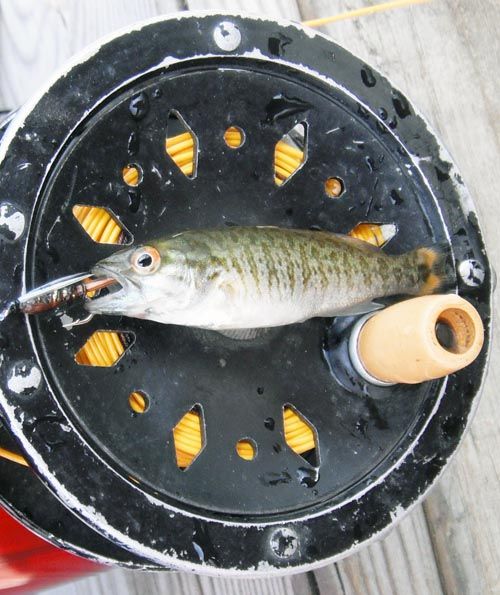
That's a Union Hardware reel with a spool diameter of 2 inches. The fish is a little over 1.5 inches in length.
By the way that is a #16 nymph. My question is, has anyone caught a smaller bass than this?
-- Dr. Todd
Sunday, July 10, 2011
Fishing Northern Wisconsin 2011, Part II
Fishing Northern Wisconsin 2011, Part II
When Hurricane Ike steamed up the Ohio Valley a few years back, I got a taste (and so did my roof) of what hurricane force straight line winds are like. Well, I never for once expected that in Northern Wisconsin I might experience a similar thing. But on Friday, July 1st in the north country, we were blasted by a bizarre storm that sent straight line winds above 70 mph roaring down over the sand country.
My brother and myself watched it from the boat house and saw it roll in. Not to sound like a stereotype, but it sounded very much like a freight train. Just a constant roar. As the wind picked up, the trees began to sway.

70 MPH winds in action.
Then we started hearing branches, and then whole trees, crack. It was surreal. Large branches were flying off trees and soaring 20 or 30 feet past the end of the dock and into the lake. Amazing.
It lasted about an hour and then darkness fell. An 18" oak missed my sister's car by about a foot, and there were about a dozen other trees down around us, but no major damage. We were lucky. In nearby Solon Springs about 20 miles away, the airport suffered massive damage.
Our friend's cabin got hit much worse. Here are some photos my brother took of the devastation.


This is what you get when big trees with shallow roots grow in sand, and meet high winds. They get uprooted, even massive Norway pines three feet across.
The next day was spent chain sawing wood, but we snuck out to do a bit of fishing on the St. Croix River. We snuck down to the Ranger Station near Gordon and here's what we saw:

St. Croix River after the storm.

Blocked trail on St. Croix.

Destruction on St. Croix 1.

Destruction on the St. Croix 2.
Fishing was only so-so. Lots of small fish like this St. Croix river sunfish even on my big water Wettering glass fly rod. It was a bit sad knowing I had to return the next day.

St. Croix river sunfish.
There was a tag to this story. I decided at sunset on the last day to try and get some bass to rise to a home-made lure. I waded in chest-deep water and starting fly casting over a brush pile. I was rewarded with a neat 12 inch smallmouth. Then a loon began to pay attention, likely attracted by the fact that I was getting fish to rise. Amazingly, he came closer and closer.

Loon goes under just as my wife shoots photo.
You really haven't lived until a loon swims less than two feet away from you underwater. They are so graceful they look like a penguin underwater.

The loon and me.
It was a perfect way to end a fishing trip.
-- Dr. Todd
When Hurricane Ike steamed up the Ohio Valley a few years back, I got a taste (and so did my roof) of what hurricane force straight line winds are like. Well, I never for once expected that in Northern Wisconsin I might experience a similar thing. But on Friday, July 1st in the north country, we were blasted by a bizarre storm that sent straight line winds above 70 mph roaring down over the sand country.
My brother and myself watched it from the boat house and saw it roll in. Not to sound like a stereotype, but it sounded very much like a freight train. Just a constant roar. As the wind picked up, the trees began to sway.
Then we started hearing branches, and then whole trees, crack. It was surreal. Large branches were flying off trees and soaring 20 or 30 feet past the end of the dock and into the lake. Amazing.
It lasted about an hour and then darkness fell. An 18" oak missed my sister's car by about a foot, and there were about a dozen other trees down around us, but no major damage. We were lucky. In nearby Solon Springs about 20 miles away, the airport suffered massive damage.
Our friend's cabin got hit much worse. Here are some photos my brother took of the devastation.
This is what you get when big trees with shallow roots grow in sand, and meet high winds. They get uprooted, even massive Norway pines three feet across.
The next day was spent chain sawing wood, but we snuck out to do a bit of fishing on the St. Croix River. We snuck down to the Ranger Station near Gordon and here's what we saw:
Fishing was only so-so. Lots of small fish like this St. Croix river sunfish even on my big water Wettering glass fly rod. It was a bit sad knowing I had to return the next day.
There was a tag to this story. I decided at sunset on the last day to try and get some bass to rise to a home-made lure. I waded in chest-deep water and starting fly casting over a brush pile. I was rewarded with a neat 12 inch smallmouth. Then a loon began to pay attention, likely attracted by the fact that I was getting fish to rise. Amazingly, he came closer and closer.
You really haven't lived until a loon swims less than two feet away from you underwater. They are so graceful they look like a penguin underwater.
It was a perfect way to end a fishing trip.
-- Dr. Todd
Thursday, July 7, 2011
Fishing Northern Wisconsin 2011, Part I
Fishing Northern Wisconsin 2011, Part I
I've been incredibly busy the past six months and actually took my first break last week when I went fishing in my favorite Northern Wisconsin waters. The Sand Country of Aldo Leopold fame is where I feel most at home, and this week offered everything I've come to love about this part of the world--frigid weather (high 40s), intense heat (97), unpredictable weather, and lovely vistas. And, of course, a few fish.
As I'm working on my new book in my spare time on glass fly rods, I thought I would take along three glass rods to fish with, two vintage and one newer one. For the first time I used my custom built "Gnome Glass" 4 weight. Jeff Hatton built this for me on a vintage Scott blank (that was marked "Save for L. Kenney). I'm sure Larry would be happy to know it has been put to its designed use. It's a lovely, lovely rod. I was fishing bass with some home made poppers but could not keep the ravenous freshwater piranhas off the hook.

The first fish of the year on a Jeff Hatton "Gnome Glass" fly rod.
The schools of large sunfish were so big, in fact, it was difficult to get a bass to hit. I decided to beat the fish at their own game. Up at 5 a.m. I stalked down to the end of a particular point on a lake I fish regularly and cast out a hand made red popper. Here's what hit almost immediately:

Great 16" smallmouth on the Gnome Glass.
A sixteen inch smallmouth that came out of the water several times. The 4 weight Gnome Glass threw that bug 50 feet with ease, and even with a two pound test tippet the fish was landed and back home in less than five minutes. What a blast!
I decided that since I was in Wisconsin I would fish one of the Badger state's home rods--a St. Croix. This was a 10th Anniversary rod dating from the early 1960s and threw a five weight line very nicely. In an effort to get down deeper I switched to a sinking line and a bead head green bug. Fat chance. This just gave the biggest sunfish a chance to hammer it. I was regularly pulling 7"-10" bluegill and punkinseeds in. A lot of fun, but not what I was after. I began to feel like Jeremy Wade in the Amazon fishing for a big catfish and only catching Pacu.

St. Croix 10th Anniversary glass fly rod with a nice 8" bluegill.

Clone of the previous fish.
The weather turned brutally hot by the end of the week. So hot I didn't want to fish, but instead decided to try out my new underwater camera.

Gorgeous afternoon.
It's nothing special, a little 12 megapixel model, but it's waterproof to 30 feet and has a nifty underwater mode. I decided to see why I couldn't get many bass. Here's why:

My first underwater photo. Sunfish everywhere.
But this one explained everything. We could see them from the canoe, but dang, there were thousands of silver shiners in huge schools.

Clouds of silver shiners.
No wonder the bass were reluctant to hit. My brother-in-law took some underwater video which I'll try to get uploaded tonight or tomorrow.
The problem was the weather felt off. It felt like something big was brewing, and even the night before--a calm, pretty night--when I tried out my 1960s custom built J.E. Van Wettering fly rod, I couldn't shake the feeling that something bad was on its way.

Sunset on the Sand Country.
My spider sense did not fail me. The storm to end all storms was about to descend on the sand country of Northern Wisconsin.
NEXT TIME: An inland hurricane.
-- Dr. Todd
I've been incredibly busy the past six months and actually took my first break last week when I went fishing in my favorite Northern Wisconsin waters. The Sand Country of Aldo Leopold fame is where I feel most at home, and this week offered everything I've come to love about this part of the world--frigid weather (high 40s), intense heat (97), unpredictable weather, and lovely vistas. And, of course, a few fish.
As I'm working on my new book in my spare time on glass fly rods, I thought I would take along three glass rods to fish with, two vintage and one newer one. For the first time I used my custom built "Gnome Glass" 4 weight. Jeff Hatton built this for me on a vintage Scott blank (that was marked "Save for L. Kenney). I'm sure Larry would be happy to know it has been put to its designed use. It's a lovely, lovely rod. I was fishing bass with some home made poppers but could not keep the ravenous freshwater piranhas off the hook.
The schools of large sunfish were so big, in fact, it was difficult to get a bass to hit. I decided to beat the fish at their own game. Up at 5 a.m. I stalked down to the end of a particular point on a lake I fish regularly and cast out a hand made red popper. Here's what hit almost immediately:
A sixteen inch smallmouth that came out of the water several times. The 4 weight Gnome Glass threw that bug 50 feet with ease, and even with a two pound test tippet the fish was landed and back home in less than five minutes. What a blast!
I decided that since I was in Wisconsin I would fish one of the Badger state's home rods--a St. Croix. This was a 10th Anniversary rod dating from the early 1960s and threw a five weight line very nicely. In an effort to get down deeper I switched to a sinking line and a bead head green bug. Fat chance. This just gave the biggest sunfish a chance to hammer it. I was regularly pulling 7"-10" bluegill and punkinseeds in. A lot of fun, but not what I was after. I began to feel like Jeremy Wade in the Amazon fishing for a big catfish and only catching Pacu.
The weather turned brutally hot by the end of the week. So hot I didn't want to fish, but instead decided to try out my new underwater camera.
It's nothing special, a little 12 megapixel model, but it's waterproof to 30 feet and has a nifty underwater mode. I decided to see why I couldn't get many bass. Here's why:
But this one explained everything. We could see them from the canoe, but dang, there were thousands of silver shiners in huge schools.
No wonder the bass were reluctant to hit. My brother-in-law took some underwater video which I'll try to get uploaded tonight or tomorrow.
The problem was the weather felt off. It felt like something big was brewing, and even the night before--a calm, pretty night--when I tried out my 1960s custom built J.E. Van Wettering fly rod, I couldn't shake the feeling that something bad was on its way.
My spider sense did not fail me. The storm to end all storms was about to descend on the sand country of Northern Wisconsin.
NEXT TIME: An inland hurricane.
-- Dr. Todd
Thursday, July 3, 2008
Fishing Handmade Lures, Part III
Fishing Handmade Lures, Part III
Home Made Lures That Work (Kind Of)
I left off our tale of fishing with hand-made lures last week with the story of how we got some nice bass and pike, but Northern Wisconsin is known as much for its walleye fishing as anything, and there is no better eating fish than a nice 25" walleye.
As I've been a walleye fisherman since I was knee high to a grasshopper, I had a good idea of what I wanted to carve for a home-made walleye bait. I have only had success in the clear-water northern lakes with two kinds of walleye lures--the thin bodies Finnish Minnows like Rapalas and Rebels, and the smaller, stubbier lures like L&S Bassmasters and River Runt Spooks.
Have you ever tried to carve a Rapala by hand? I have. It is incredibly difficult. So I chickened out this year and turned out a 3" cedar plug I called the Walleye Killer. Carved from red cedar, with cup hardware and a standard bent stainless diving lip, it had a nice, standard action--not much different than many other lures of this type except perhaps a tighter wiggle, which I favor for walleyes. I painted it gold with green spots, and a white belly. As an homage to my dad--who only used red-eye L&S Bassmasters for walleyes for about 40 years--I painted the pupil on the eye a bright red.

The Walleye Killer.
We hit the water on the longest day of the year--the summer equinox. My daughter, my dad, and myself--three generations of anglers hitting the same Wisconsin waters our family has fished for a hundred years. Nothing centers you more than that. With the old man running the show, we decided to troll for suspended walleyes near dusk.

Old Norwegians never die...they just keep catching fish.
As the Walleye Killer only dove about three feet, I added four split shot about four feet up the line. Our trolling rigs are 7 to 10 foot spinning rods (or fly rods, as my brother uses), a quality spinning reel like the Fin-Nor Ahab or Pinnacle Dead Bolt, eight pound test mono, and lots of patience. Daughter was trolling a Rebel Fast-Trac and my father a Suspending Rapala. The sun began to set on a perfect Wisconsin day.

Paradise by the outdoor light.
Just as the sun began to set, daughter sets the hook! A tussle ensues, and before long a 21" walleye is flopping in the boat. Dad and Grandpa smile proudly. Little girl beams. All is well with the world. 10 minutes later the old man is into one; a virtual twin makes it in the boat. We have found them suspended in 28 feet of water, off of a steep drop off that bottoms at 38 feet. I add a couple of extra split shot to make sure I am getting deep enough.
Two hours later and nothing. Daughter adds a 20" walleye, old man a couple of smaller ones that go back. The Walleye Killer appears to be the opposite of its fearsome name. We retire from the water to a roaring bonfire and the smell of roasting marshmallows. There is always tomorrow.

Daughter is happy with her fish.
The next night we hit the water again, in a different part of the lake. 20" walleyes are nice but we are after bigger ones. I decide it is in for a penny, in for a pound. The Walleye Killer stays on the rod. My old man rolls his eyes. "Don't worry," he says, "your daughter will catch enough fish for both of you." This time it is my turn to roll my eyes, but not where the old man can see me. Some things never change.
It doesn't take long for the Fast-Trac Rebel to put my daughter on to another fish--a decent one! This one, after skillful play and landing, rests just short of 24". The daughter is rapidly becoming a walleye-aholic. I fear she will think all fishing is this easy...10 minutes later and the Walleye Killer is on to a fish! 30 seconds of battling shows it to be a nice one, at least equal to the earlier walleye and maybe even bigger. Then disaster--the fish throws the hook! I have committed a cardinal sin in my father's eyes. I have lost a fish next to the boat.
The disappointment is palpable. I really want to catch a walleye on a home-made lure, and this was my best chance. I replay the fighting in my head--my old man offers the helpful opinion that the drag was too tight. After pondering I come to the conclusion that the fishing Gods do not like the name I have given my home-made lure. So I renounce the rather sinister name, and rechristen it "The Walleye Catcher." Not nearly as cool, but maybe it will appease the water deities who are aligned against me.
30 minutes later, daughter gets a twin to her earlier one and dad boats a 25" walleye. I have a lot of nothing. "Final turn," the old man announces, meaning we are coming around for our final pass. I feel the Walleye Catcher change rhythm as the boat makes its slow 180 degree turn and the lure's speed slows as it swings wide. Then the subtle throbbing returns down the graphite in the rod, and less than 10 seconds after the boat has straightened out, "FISH ON!" The Walleye Catcher is on to a fish! I fight this baby carefully and confidently, retrieving line until the fish is about to breach the water in the darkness. The flashlight catches the solid white eye in its reflections...a rather small solid white eye.
It is clear the fish is only about twelve inches in length. Not a keeper by any means, but I find some solace in that I was able to bring a walleye--albeit a small one--to boat with the Walleye Catcher. I pop one hook out the corner of the mouth, and the little guy (or girl) returns to the depths to either grow big and strong, or become feed for a northern pike. At least I wasn't skunked.

A nice stringer of Wisconsin Walleyes.
So what can I say about the Walleye Kil...I mean the Walleye Catcher? It won't mean the imminent retirement of the Rebel Fast-Trac or Suspending Rapala. I does, however, show you CAN catch walleyes with your own lures, although they may be small ones.
One final adventure was left for this trip--cracking out the fly rod and my home made bass bugs.
-- Dr. Todd
Home Made Lures That Work (Kind Of)
I left off our tale of fishing with hand-made lures last week with the story of how we got some nice bass and pike, but Northern Wisconsin is known as much for its walleye fishing as anything, and there is no better eating fish than a nice 25" walleye.
As I've been a walleye fisherman since I was knee high to a grasshopper, I had a good idea of what I wanted to carve for a home-made walleye bait. I have only had success in the clear-water northern lakes with two kinds of walleye lures--the thin bodies Finnish Minnows like Rapalas and Rebels, and the smaller, stubbier lures like L&S Bassmasters and River Runt Spooks.
Have you ever tried to carve a Rapala by hand? I have. It is incredibly difficult. So I chickened out this year and turned out a 3" cedar plug I called the Walleye Killer. Carved from red cedar, with cup hardware and a standard bent stainless diving lip, it had a nice, standard action--not much different than many other lures of this type except perhaps a tighter wiggle, which I favor for walleyes. I painted it gold with green spots, and a white belly. As an homage to my dad--who only used red-eye L&S Bassmasters for walleyes for about 40 years--I painted the pupil on the eye a bright red.
We hit the water on the longest day of the year--the summer equinox. My daughter, my dad, and myself--three generations of anglers hitting the same Wisconsin waters our family has fished for a hundred years. Nothing centers you more than that. With the old man running the show, we decided to troll for suspended walleyes near dusk.
As the Walleye Killer only dove about three feet, I added four split shot about four feet up the line. Our trolling rigs are 7 to 10 foot spinning rods (or fly rods, as my brother uses), a quality spinning reel like the Fin-Nor Ahab or Pinnacle Dead Bolt, eight pound test mono, and lots of patience. Daughter was trolling a Rebel Fast-Trac and my father a Suspending Rapala. The sun began to set on a perfect Wisconsin day.
Just as the sun began to set, daughter sets the hook! A tussle ensues, and before long a 21" walleye is flopping in the boat. Dad and Grandpa smile proudly. Little girl beams. All is well with the world. 10 minutes later the old man is into one; a virtual twin makes it in the boat. We have found them suspended in 28 feet of water, off of a steep drop off that bottoms at 38 feet. I add a couple of extra split shot to make sure I am getting deep enough.
Two hours later and nothing. Daughter adds a 20" walleye, old man a couple of smaller ones that go back. The Walleye Killer appears to be the opposite of its fearsome name. We retire from the water to a roaring bonfire and the smell of roasting marshmallows. There is always tomorrow.
The next night we hit the water again, in a different part of the lake. 20" walleyes are nice but we are after bigger ones. I decide it is in for a penny, in for a pound. The Walleye Killer stays on the rod. My old man rolls his eyes. "Don't worry," he says, "your daughter will catch enough fish for both of you." This time it is my turn to roll my eyes, but not where the old man can see me. Some things never change.
It doesn't take long for the Fast-Trac Rebel to put my daughter on to another fish--a decent one! This one, after skillful play and landing, rests just short of 24". The daughter is rapidly becoming a walleye-aholic. I fear she will think all fishing is this easy...10 minutes later and the Walleye Killer is on to a fish! 30 seconds of battling shows it to be a nice one, at least equal to the earlier walleye and maybe even bigger. Then disaster--the fish throws the hook! I have committed a cardinal sin in my father's eyes. I have lost a fish next to the boat.
The disappointment is palpable. I really want to catch a walleye on a home-made lure, and this was my best chance. I replay the fighting in my head--my old man offers the helpful opinion that the drag was too tight. After pondering I come to the conclusion that the fishing Gods do not like the name I have given my home-made lure. So I renounce the rather sinister name, and rechristen it "The Walleye Catcher." Not nearly as cool, but maybe it will appease the water deities who are aligned against me.
30 minutes later, daughter gets a twin to her earlier one and dad boats a 25" walleye. I have a lot of nothing. "Final turn," the old man announces, meaning we are coming around for our final pass. I feel the Walleye Catcher change rhythm as the boat makes its slow 180 degree turn and the lure's speed slows as it swings wide. Then the subtle throbbing returns down the graphite in the rod, and less than 10 seconds after the boat has straightened out, "FISH ON!" The Walleye Catcher is on to a fish! I fight this baby carefully and confidently, retrieving line until the fish is about to breach the water in the darkness. The flashlight catches the solid white eye in its reflections...a rather small solid white eye.
It is clear the fish is only about twelve inches in length. Not a keeper by any means, but I find some solace in that I was able to bring a walleye--albeit a small one--to boat with the Walleye Catcher. I pop one hook out the corner of the mouth, and the little guy (or girl) returns to the depths to either grow big and strong, or become feed for a northern pike. At least I wasn't skunked.
So what can I say about the Walleye Kil...I mean the Walleye Catcher? It won't mean the imminent retirement of the Rebel Fast-Trac or Suspending Rapala. I does, however, show you CAN catch walleyes with your own lures, although they may be small ones.
One final adventure was left for this trip--cracking out the fly rod and my home made bass bugs.
-- Dr. Todd
Thursday, June 26, 2008
Fishing Handmade Lures, Part II
Fishing Hand Made Lures, Part II:
Home Made Lures That Work
The biggest step in fishing with your own lures is convincing others that they catch fish. This is particularly true if your fishing companions include (1) the best fisherman in the world (your father); (2) the most skeptical young angler on earth (your daughter); (3) a man who only fishes once a year and really, really wants to catch fish (one of your best friends); (4) a girl who doesn’t really want to go fishing (your niece); and (5) the only witness to the time you put a dremel through your thumb trying to drill a pilot hole in a fishing lure (your wife). Not the most forgiving of crowds.
So if you’re going to try and convince others to fish with your lures, you better darn well bribe them ahead of time. A trip to Park Point in Duluth, Minnesota worked wonders in putting everyone in the proper mood for fishing with my home made lures.

Two completely divergent opinions about sitting on the beach WITHOUT a fishing rod in your hand.

WAY too happy for people NOT fishing.
Having gotten the beach thing finally out of the way, it was time to hit the Northern Wisconsin waters for a second go around. The first (as chronicled yesterday) was a great success, with the Orange Crackleback Neodingbat (as I call it) hammering the northern pikes. As an aside, I discovered first hand the reason that you find so many tack-eyed lures like Paw Paw, Best-o-Luck, and Horrocks-Ibbotson without paint on the eyes. A day of hard fishing and all the paint on the Neodingbat’s eyes were gone.

Getting prepared for a day on the lake.
This day we were after bass—smallmouth bass, to be exact. The first person I attempted to convert was my eight-year old daughter, who is already a highly skeptical person. When I put the Diving Grasshopper, as I call my creation, on her rod she looked at me like I had tied on a dead rat. “What in the world would eat THAT,” were her exact words. Touché, little one. Touché.

The Traditional Todd’s Turtle (left) and the Diving Cricket (right)
The Diving Cricket was carved out of red cedar, so it is a buoyant little bugger. About 2 ½ inches long, it has hook holders on both sides and long shank single hooks. Why, you might ask? Because they look cool. The lure would probably be more effective if it had the hook holder on the bottom, but then it wouldn’t look like a grasshopper, would it? Sometimes form wins out over function. With a mouthpiece made from a folded-over Colorado spinner blade, this little bug dives about three feet deep and wobbles with a wide wiggle. I thought the bass would go crazy for it.
I was wrong. It’s not that the lure didn’t work, it just wasn’t the best choice of lures for this early in bass season in Northern Wisconsin. The daughter began grumbling early when our fishing companion—who was NOT fishing a Dr. Todd special—began to take bass. As dad was fishing the Turtle (with little success I might add), it seemed like she would lose faith in her father’s creation.

Daughter taking a break from fishing the Diving Cricket.
Fortunately, providence struck at just the right time. Drifting over a sunken island, where the water goes from 12 to 6 feet, the daughter hooked into one of those legendary Northern Wisconsin smallies on the Diving Cricket. Once again, she made her dad proud, fighting the fish to the boat herself. Dad boated the fish, took out the hooks, and then handed it back to the girl for an obligatory photo.

Daughter holding a three pound smallmouth.
The fish could not have hit at a better time. The weather began to turn—it was one of those weird moments where the sun still shone brightly while heavy, dark clouds rolled in.

The weather started getting rough; the tiny ship was tossed. If not for the courage of the fearless crew, the Minnow would be lost.
So we rolled off the lake, having successfully proven that fish could be caught on another home made lure. And with at least one more convert to the idea that you can make fishing lures yourself that really catch fish.
It was not the end, however, of our fishing experiment.
Coming this Saturday: Walleye Fishing with Home Made Lures.
-- Dr. Tod
Home Made Lures That Work
The biggest step in fishing with your own lures is convincing others that they catch fish. This is particularly true if your fishing companions include (1) the best fisherman in the world (your father); (2) the most skeptical young angler on earth (your daughter); (3) a man who only fishes once a year and really, really wants to catch fish (one of your best friends); (4) a girl who doesn’t really want to go fishing (your niece); and (5) the only witness to the time you put a dremel through your thumb trying to drill a pilot hole in a fishing lure (your wife). Not the most forgiving of crowds.
So if you’re going to try and convince others to fish with your lures, you better darn well bribe them ahead of time. A trip to Park Point in Duluth, Minnesota worked wonders in putting everyone in the proper mood for fishing with my home made lures.
Having gotten the beach thing finally out of the way, it was time to hit the Northern Wisconsin waters for a second go around. The first (as chronicled yesterday) was a great success, with the Orange Crackleback Neodingbat (as I call it) hammering the northern pikes. As an aside, I discovered first hand the reason that you find so many tack-eyed lures like Paw Paw, Best-o-Luck, and Horrocks-Ibbotson without paint on the eyes. A day of hard fishing and all the paint on the Neodingbat’s eyes were gone.
This day we were after bass—smallmouth bass, to be exact. The first person I attempted to convert was my eight-year old daughter, who is already a highly skeptical person. When I put the Diving Grasshopper, as I call my creation, on her rod she looked at me like I had tied on a dead rat. “What in the world would eat THAT,” were her exact words. Touché, little one. Touché.
The Diving Cricket was carved out of red cedar, so it is a buoyant little bugger. About 2 ½ inches long, it has hook holders on both sides and long shank single hooks. Why, you might ask? Because they look cool. The lure would probably be more effective if it had the hook holder on the bottom, but then it wouldn’t look like a grasshopper, would it? Sometimes form wins out over function. With a mouthpiece made from a folded-over Colorado spinner blade, this little bug dives about three feet deep and wobbles with a wide wiggle. I thought the bass would go crazy for it.
I was wrong. It’s not that the lure didn’t work, it just wasn’t the best choice of lures for this early in bass season in Northern Wisconsin. The daughter began grumbling early when our fishing companion—who was NOT fishing a Dr. Todd special—began to take bass. As dad was fishing the Turtle (with little success I might add), it seemed like she would lose faith in her father’s creation.
Fortunately, providence struck at just the right time. Drifting over a sunken island, where the water goes from 12 to 6 feet, the daughter hooked into one of those legendary Northern Wisconsin smallies on the Diving Cricket. Once again, she made her dad proud, fighting the fish to the boat herself. Dad boated the fish, took out the hooks, and then handed it back to the girl for an obligatory photo.
The fish could not have hit at a better time. The weather began to turn—it was one of those weird moments where the sun still shone brightly while heavy, dark clouds rolled in.
So we rolled off the lake, having successfully proven that fish could be caught on another home made lure. And with at least one more convert to the idea that you can make fishing lures yourself that really catch fish.
It was not the end, however, of our fishing experiment.
Coming this Saturday: Walleye Fishing with Home Made Lures.
-- Dr. Tod
Wednesday, June 25, 2008
Fishing Handmade Lures, Part I
Fishing Hand Made Lures, Part I:
Home Made Lures That Work
This year for my northern Wisconsin fishing trip I planned something a bit different. I wanted to see if I could catch fish using only lures that I made with my own hands; this would include flies, poppers, and casting lures. What follows is my chronicle of the good, the bad, and the ugly of fishing with your own tackle.
Making fishing lures has been a hobby of mine for a number of years. While I respect the carvers who make “fantasy” lures, I am more of a traditionalist—if it doesn’t work in the water, it gets rejected. And although some of my lures are original, more or less, there are others that are my homage to the lures of yesterday.
One of my favorite all time fishing lures is the Creek Chub Dingbat, so it was logical that when I began the current batch of carvings, I would make an attempt to fabricate an updated version of this all-time classic.
The first thing to do was to decide what I liked about the Creek Chub version, and what I might change. Having fished a Dingbat before, there were only three things I thought would make it more appropriate for the clear, deep waters of the Northern Wisconsin lakes I frequent. First, I thought I would make it larger as I always felt the Dingbat was a bit on the small size (and the Husky Dinger was basically a different lure). Second, I wanted to make it heavier so that it would both cast further and run deeper. And third, I wanted to increase the size of the diving plate to slightly increase wiggle and diving depth.
I chose a heavy grained pine wood to turn the body, which ended up being slightly rounder and thicker than the traditional lure, and cut the slot for the mouth piece, which would be attached by a screw from below. I made the diving lip from marine brass, and the line tie on the diving plate from a nail. This was followed by a pair of rounded brass tacks for eyes.
After sanding the body, I coated it with a base of primer and then used a dremel to recess the cup hardware and set the screws in with epoxy after having attached a pair of new Mustad trebles. I then decided to paint it in an orange coach dog color. The final step was to take dyed yellow bucktail, drill out two holes for the hair legs, and epoxy them in.
Then it was to the testing pond where the lip was adjusted so the lure ran perfectly. After having ascertained that the design was sound, I turned out three more, two of which I painted green frog and a third that was also painted orange coach dog.


The lure as it appeared after some hard use.
This and a dozen other lures made up my angler’s kit for this trip—a small spinning lure, a grasshopper wobbler, a pikie minnow type, and several others including one of my favorite creations, the Turtle Lure.
It was a beautiful June day when I was first able to break out the Improved Dingbat. I discovered quickly that the lure ran about 16-18 feet deep, with a nice, tight little wiggle that would have made the original proud. It had neutral buoyancy (a nice bonus but one I did not plan).
We arrived off a large weed bed noted for being packed with fish. Literally the first cast and WHAM! A big hit that stopped the lure dead in its tracks. A few minutes later, and a new fishing lure got christened:

Several hours later and a half dozen fish in the boat, and we were satisfied. The first day of the fishing trip with homemade lures was a great success!
Stay tuned for Part II tomorrow.
-- Dr. Todd from Northern Wisconsin
Home Made Lures That Work
This year for my northern Wisconsin fishing trip I planned something a bit different. I wanted to see if I could catch fish using only lures that I made with my own hands; this would include flies, poppers, and casting lures. What follows is my chronicle of the good, the bad, and the ugly of fishing with your own tackle.
Making fishing lures has been a hobby of mine for a number of years. While I respect the carvers who make “fantasy” lures, I am more of a traditionalist—if it doesn’t work in the water, it gets rejected. And although some of my lures are original, more or less, there are others that are my homage to the lures of yesterday.
One of my favorite all time fishing lures is the Creek Chub Dingbat, so it was logical that when I began the current batch of carvings, I would make an attempt to fabricate an updated version of this all-time classic.
The first thing to do was to decide what I liked about the Creek Chub version, and what I might change. Having fished a Dingbat before, there were only three things I thought would make it more appropriate for the clear, deep waters of the Northern Wisconsin lakes I frequent. First, I thought I would make it larger as I always felt the Dingbat was a bit on the small size (and the Husky Dinger was basically a different lure). Second, I wanted to make it heavier so that it would both cast further and run deeper. And third, I wanted to increase the size of the diving plate to slightly increase wiggle and diving depth.
I chose a heavy grained pine wood to turn the body, which ended up being slightly rounder and thicker than the traditional lure, and cut the slot for the mouth piece, which would be attached by a screw from below. I made the diving lip from marine brass, and the line tie on the diving plate from a nail. This was followed by a pair of rounded brass tacks for eyes.
After sanding the body, I coated it with a base of primer and then used a dremel to recess the cup hardware and set the screws in with epoxy after having attached a pair of new Mustad trebles. I then decided to paint it in an orange coach dog color. The final step was to take dyed yellow bucktail, drill out two holes for the hair legs, and epoxy them in.
Then it was to the testing pond where the lip was adjusted so the lure ran perfectly. After having ascertained that the design was sound, I turned out three more, two of which I painted green frog and a third that was also painted orange coach dog.
This and a dozen other lures made up my angler’s kit for this trip—a small spinning lure, a grasshopper wobbler, a pikie minnow type, and several others including one of my favorite creations, the Turtle Lure.
It was a beautiful June day when I was first able to break out the Improved Dingbat. I discovered quickly that the lure ran about 16-18 feet deep, with a nice, tight little wiggle that would have made the original proud. It had neutral buoyancy (a nice bonus but one I did not plan).
We arrived off a large weed bed noted for being packed with fish. Literally the first cast and WHAM! A big hit that stopped the lure dead in its tracks. A few minutes later, and a new fishing lure got christened:
Several hours later and a half dozen fish in the boat, and we were satisfied. The first day of the fishing trip with homemade lures was a great success!
Stay tuned for Part II tomorrow.
-- Dr. Todd from Northern Wisconsin
Wednesday, February 6, 2008
Ice Fishing in Otter Tail County
Ice Fishing in Otter Tail County
Over my Christmas break, I got the opportunity to do something that I absolutely love: ice fishing with my family. For those who haven’t ice fished, you should make it a point to give it a try. It is particularly fun to introduce the young ones to ice fishing, and I can say they take to it like a duck on frozen water.

A frozen lake hides fish underneath…
The first thing you have to do, of course, is drill some holes. Since the ice was about ten inches thick, we used a power auger. I am old enough to have had to use a hand auger when I was younger, and then chip the sides of the hole with an ice chipper.

Drilling the holes in the ice used to be backbreaking work, but not anymore.

Daughter can’t wait for the ice houses, so she’s first line in.
I also am old enough to remember having to haul out a wooden ice house on sleds by hand, arduous work even for the young of heart and muscle. New portable ice houses like this Eskimo set up in just minutes and weigh under 30 pounds.

Two person portable ice house.
Quickly we are on to fish—and to our great delight one of them is a nice 19” walleye! This is quickly followed by a four pound northern, perfect size for pickling. Northerns between 3 and 6 pounds are keepers; anything smaller or larger are released. Catch-and-release practices such as this keep balance in a lake.

Two fish.
A great deal of fishing gear is unique to ice fishing, including the special short rods perfect for light lines. Here I tie on a new airplane jig because a ten pound northern cut me off on the lip of the hole. As an aside, a week later my father-in-law caught the northern and it still had my jig in its mouth.

The daughter helps her old man scooping minnows for the fluorescent jigs.

Tying on a new jig after my big northern cut me off.
A fine day of fishing indeed. The whole family catches their share of fish.

The daughter sitting in the ice house.

She soon sets the hook and lands a cute Black Crappie!

Everyone joins in the fun.
Ice fishing is a blast and grows more popular in the northern climes every year. I know several people who fish 5-7 times a week in the winter who are lucky to be seen on the lake once a month in the summer.
If you don’t ice fish, you should. If you do ice fish, get out on that frozen pond and drill yourself a hole!
-- Dr. Todd
Over my Christmas break, I got the opportunity to do something that I absolutely love: ice fishing with my family. For those who haven’t ice fished, you should make it a point to give it a try. It is particularly fun to introduce the young ones to ice fishing, and I can say they take to it like a duck on frozen water.
The first thing you have to do, of course, is drill some holes. Since the ice was about ten inches thick, we used a power auger. I am old enough to have had to use a hand auger when I was younger, and then chip the sides of the hole with an ice chipper.
I also am old enough to remember having to haul out a wooden ice house on sleds by hand, arduous work even for the young of heart and muscle. New portable ice houses like this Eskimo set up in just minutes and weigh under 30 pounds.
Quickly we are on to fish—and to our great delight one of them is a nice 19” walleye! This is quickly followed by a four pound northern, perfect size for pickling. Northerns between 3 and 6 pounds are keepers; anything smaller or larger are released. Catch-and-release practices such as this keep balance in a lake.
A great deal of fishing gear is unique to ice fishing, including the special short rods perfect for light lines. Here I tie on a new airplane jig because a ten pound northern cut me off on the lip of the hole. As an aside, a week later my father-in-law caught the northern and it still had my jig in its mouth.
A fine day of fishing indeed. The whole family catches their share of fish.
Ice fishing is a blast and grows more popular in the northern climes every year. I know several people who fish 5-7 times a week in the winter who are lucky to be seen on the lake once a month in the summer.
If you don’t ice fish, you should. If you do ice fish, get out on that frozen pond and drill yourself a hole!
-- Dr. Todd
Tuesday, January 15, 2008
Voices from the Past: Nadia Moharib

I am a sucker for big pike stories, and this is one of the best. Although not an old article (it is from the 23 March 1999 Calgary Sun), it is still a great story. A 70 inch northern is a true monster.

It was probably the biggest northern pike ever caught in Manitoba.
And they ate the evidence.
The estimated 70-inch fish was caught in Cedar Lake by a resident of Easterville, a small aboriginal community about 100 kilometers southeast of The Pas.
News of the catch surfaced when a photo was dropped off at the office of Doug Leroux, Natural Resources regional fisheries manager in The Pas.
"This is the biggest pike I've ever seen," Leroux said. "Anything over 40 inches is a good size. The current Manitoba record is 59 inches. This surpasses that by a good 10 inches."
He estimated the length of the fish by computer scanning the image and using a 2x4 foot brace on a bookshelf in the photo's background for comparison.
The size was later verified by co-workers who digitally enhanced the picture.
The impressive catch has led fishing enthusiasts from U.S. sports magazines and as far away as England to contact Leroux's office.
"They just want to know if the story is true. We've seen the picture and we believe it to be true."
But there's not much of a fish story to tell, at this point. Leroux has tried in vain to contact the fisherman for details of the capture. He doesn't even know if it was caught the past winter or the year before.
From what Leroux understands, the fisherman was simply out to stock the family fridge when he made the catch.
"He was fishing for food for his family and from what I understand, gave it to his grandmother. It would definitely feed a family for a while."
Landing a record setter can command thousands of dollars from fishing lodges wanting it for their walls.
The Manitoba record for northern pike is 42.42 pounds, set in 1977. The Cedar Lake catch is estimated to have weighed more than 50 pounds.
-- Dr. Todd
Wednesday, December 12, 2007
Fishing in Idaho in the 1930s and 1940s, by Joel Kifer
I love old fishing photos, and I love fishing history. So it was with great excitement that I read an email from Joel Kifer explaining the history behind some amazing fish photos. Joel has graciously allowed me to share these photos and his descriptions with everyone, and trust me, its worth reading.
Fishing Idaho in the 1930s and 1940s
by Joel Kifer (Anacortes, WA)
I have participated at Joe's message board since the beginning and have most recently been enjoying your blog pages. I lived in northern Idaho for many years and had the pleasure of fishing Pend Orielle Lake and Priest Lake on many occasions. Priest Lake was noted for the huge Mackinaw Trout, 40+ not uncommon, and Pend Orielle for its enormous Kamloops Rainbows and Dolly Varden char. The lakes have not produced many big fish in the past thirty years but in the 30s and 40s these lakes were heavily fished for "World Record" size fish.
I'm attaching a couple of pics of interest.

The first is of Wes Hamlet, Coeur d'Alene, Idaho and his world record Kamloops Rainbow trout. It was caught on Nov. 25, 1947, 60 years ago this month and is still the world record for a fresh water catch. This photo was taken by Jack Rottier who I believe was a photographer for the US Forest Service at the time. It was caught on a Martin plug # 5KS-11, silver scale. It was 40.5" long, had a 28" girth, and weighed 37 pounds.

The second is of Wes with his fish and was taken by Ross Hall a famed photographer from Sandpoint, Idaho.

Pic #3 is of a couple of hearty souls headed out for a day of action on Pend Orielle.
They're a great piece of Northwest fishing lore. I have a few hundred more that I'll dig out sometime soon.
Nifty stuff. We should all thank Joel for sharing these amazing photos from an incredible period in Northwestern fishing history!
-- Dr. Todd
I have participated at Joe's message board since the beginning and have most recently been enjoying your blog pages. I lived in northern Idaho for many years and had the pleasure of fishing Pend Orielle Lake and Priest Lake on many occasions. Priest Lake was noted for the huge Mackinaw Trout, 40+ not uncommon, and Pend Orielle for its enormous Kamloops Rainbows and Dolly Varden char. The lakes have not produced many big fish in the past thirty years but in the 30s and 40s these lakes were heavily fished for "World Record" size fish.
I'm attaching a couple of pics of interest.
The first is of Wes Hamlet, Coeur d'Alene, Idaho and his world record Kamloops Rainbow trout. It was caught on Nov. 25, 1947, 60 years ago this month and is still the world record for a fresh water catch. This photo was taken by Jack Rottier who I believe was a photographer for the US Forest Service at the time. It was caught on a Martin plug # 5KS-11, silver scale. It was 40.5" long, had a 28" girth, and weighed 37 pounds.
The second is of Wes with his fish and was taken by Ross Hall a famed photographer from Sandpoint, Idaho.
Pic #3 is of a couple of hearty souls headed out for a day of action on Pend Orielle.
They're a great piece of Northwest fishing lore. I have a few hundred more that I'll dig out sometime soon.
Nifty stuff. We should all thank Joel for sharing these amazing photos from an incredible period in Northwestern fishing history!
-- Dr. Todd
Subscribe to:
Posts (Atom)