Showing posts with label theodore gordon. Show all posts

Wednesday, September 25, 2013

Dr. George Parker Holden on Theodore Gordon


Dr. George Parker Holden was one of the leading voices on both fly fishing and on bamboo rod making. His book The Idyll of the Split Bamboo is considered a major classic in the field of rod making, and his 1919 book Streamcraft is one of the best fly fishing books of its era.

Holden knew Ted Gordon and wrote of him on occasion. The first instance we have of this is in article from Forest & Stream dated September 1916 on the Neversink River in New York. In it he wrote:

We were camping in the vicinity of the late home of the lamented Theodore Gordon, sage of the Neversink, super-angler and ardent nature student. It was the privilege of the writer to meet Mr. Gordon along the stream that he loved, the summer before his death, when he mentioned in the course of casual conversation that he was tying some flies for a gentleman in Nova Scotia after specimens of native insects much had been sent him. It was also my pleasure to make the acquaintance during the past winter of Dr. Edward Breck, at an interesting lecture that he delivered in the interests of the Naval Defense League. The Neversink country being mentioned, Dr. Breck inquired if I had ever met Gordon. I then recalled the incident of "the Nova Scotia gentleman." "Yes," said Breck, "I am that fellow."

The beautiful Neversink is a stream not enough appreciated by our Eastern anglers, but those who do realize its charm will be glad to learn while no one may fill Theodore Gordon's unique place as a writer beloved of all gentle anglers, that flies tied in the exquisite Gordon fashion are still obtainable from Gordon's friend and neighbor, Mr. H. B. Christian, of Neversink, who was intimately acquainted with Gordon and his work. We know of one of the Christian flies that caught nineteen goodly trout and remained in excellent working order; they certainly are tied to stay. In the July number of this magazine Dr. Breck says of the Nova Scotia trout: "I don't think our uneducated trout take much to the dry fly, but I use it mostly here, all the same, for, though the wet fly gets five where the dry lures one, the use of the dry is far more fascinating. The best luck I have had with some flies made for me by that finest of all anglers, the late Theodore Gordon. These were tied by Gordon from insects, well preserved, that I sent him from here, and were beautifully wrought."


A month later, Holden wrote a letter to Forest & Stream entitled "Note on the Gordon and Blue Grannom Flies" in which he elaborated on Gordon's influence on fly tying. Holden wrote:

In the Neversink article in September Forest and Stream mention is made of the late Theodore Gordon and of his skill as a fly tier. The accompanying photograph of flies tied in the Gordon-style by H.B. Christian of Neversink, N.Y. may interest your readers.

The fly, first made up commercially by a well-known New York tackle house, generally known as the "Gordon," was called a Golden Spinner by Gordon himself. It was never as successful on Neversink waters as the Blue Quill Gordon, shown at the left in the illustration. This fly has a quill body wound with gold wire, the effect being of a bluish body with a fine brown ribbing; the wings are wood duck and the hackle and tail of a graysh blue. The fly shown at the right is a Whitchurch Dun.
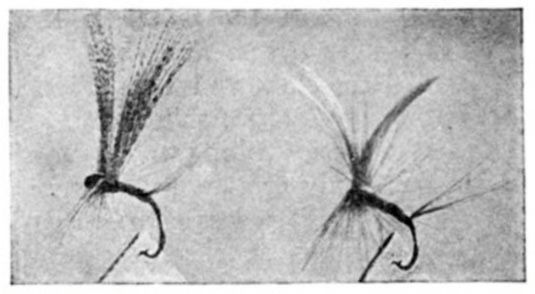


Concerning the "Blue Granite" fly noted in the same article, it is doubtless the American or Blue Grannom. Now for a pretty piece of piscatorial observation retarding the same. I have since learned that Mr. Will L. Hall, a skilful and enthusiastic angler of Brooklyn, once remained an extra week on the Neversink for the particular purpose of studying this fly, with the result that he found it to hatch out only in shallow water, and that while over the water in dense flight for a season it was very little on the water, for which reasons he regards the artificial as of very little value.

-- George Parker Holden, Yonkers, N.Y.


Later in his book Streamcraft, Holden wrote again on Gordon when he noted"

"When the late Theodore Gordon first began to use the dry fly he wrote to Mr. Halford to learn how it was tied, in response to which he received some of the Halford flies and a long letter on the subject. Gordon's experience was that the particular patterns which he received from England gave service on American streams much inferior to native creations in imitation of certain "American bugs;"…It was the writer's privilege to meet the Sage of the Neversink, super-angler, and ardent nature student the Summer before his death, alongside the stream that he loved. In the course of casual conversation he mentioned that he was tying some flies for a gentleman in Nova Scotia, after specimens of native insects which had been sent him. Some two years later it was also my pleasure to make the acquaintance of Dr. (now Lieutenant-Commander) Edward Breck, the veteran woodsman and author of The Way of the Woods, at an interesting lecture that he gave in the interest of the Naval Defense League. .

It's always interesting to see what one legendary fly angler had to say about another, so Holden's perceptions of Ted Gordon are exceptionally interesting and informative.

-- Dr. Todd

Thursday, October 7, 2010

Thursday Review: The Complete Fly Fisherman by Theodore Gordon

Thursday Review: The Complete Fly Fisherman by Theodore Gordon

Today, I want to review a book that first came out over 60 years ago. 1947, to be exact. That year, the John McDonald-edited The Complete Fly Fisherman: The Notes and Letters of Theodore Gordon was published by Charles Scribner's Sons of New York. And fly fishing was never the same.


It would be too much to say that Gordon was an unknown before this. Certainly during his lifetime he developed a lot of notoriety, first in Britain writing for The Fishing Gazette and later in America as a correspondent for Forest & Stream. But it was McDonald's seminal article on fly angling in Forbes magazine in 1946 that helped introduce this fascinating character to a new generation of writers.

The first line of the book sums it up well: "The best thing about Gordon is that he wrote well and with remarkable knowledge about contemporary fly-fishing." Actually, I think it goes beyond that. I would add as an addendum that he also was years ahead of his time in his theories about fly fishing in general.

This is a thick book (551 pages) and some of it is repetitive, and moreover the book is out of print and getting pricey to find. Which is exactly why I suggest you track down a copy sooner rather than later. Gordon was a legend and the information in this book covers everything from fly fishing theory to rod design to fly tying.

If you've never read it, you are in for a real treat. If you have read it, pick it up and read it again. It is that good.

-- Dr. Todd

Wednesday, August 15, 2007

Voices from the Past: Theodore Gordon Part II


In the second part of Ted Gordon's seminal article on flies, he talks about many important developments, particularly as they concern trying to break away from the mold of English flies because although so many insects in America resemble British counterparts, they are different in subtle and not-so-subtle ways. I also found of great interest his discussion on fish hooks.


Ted Gordon

A Little Talk About the Anglers' Flies, Part II

by

Theodore Gordon


One day last June I would have (cheerfully) paid $2 for just one more fly. I had tied only one, as I fancied it too dark for the season, and the hackles were too rare to waste. However, there was a tremendous rise of these dark caddis flies. Many were hatching out. while older insects were laying eggs and doing stunts in the air over the water. All the water and the air over it seemed full of excitement and the trout were crazy. I broke my hook in extracting it from the hard roofing of a big trout's mouth, and there I was, with the fish rising under my nose. I tried pattern after pattern and did kill one trout with a very dark hare's ear, but that was all. I put on the broken fly by way of experiment and rose six large fish one after another. We do not have these opportunities often in a season. but I shall not stock up with this fly. Its period is too short, as next day the show of fly was not great, and I had difficulty in finding the good fish. They had dropped down on to the shallow water while I was patiently fishing the pools. However, I found them before dusk and killed three, every one of which made a grand rush for his pool the instant he felt the book. After leaving the water the dun (sub-imago) does not move about much after finding a good resting place, sheltered from the wind and sun until it undergoes the transfiguration into a spinner, or perfect insect of the Ephemeridae, and the latter will often remain at rest for a day or two.

I have had them under observation at large and also in boxes. The caddis flies are perfect insects when they rise from the water and the stone flies remain among the stones for some time while growing their wings. Many queer insects appear from time to time, but they are not usually of importance to the angler. If he fishes at night he may want a few big flies. The moths and large brown caddis flies are often about, but for daylight work rather small flies usually kill best. On the high water, when the trout had fed well, I made the mistake of fishing flies too large and lost a couple of fine fish by it. I discovered that the trout were not hooking well and changed to much smaller flies with satisfactory results. The fish were probably a bit shy and indifferent, as the first conspicuous fly put up was refused by two trout. Yet many had been taken with the same pattern earlier. When the stone flies are growing wings, one may find the trout close in shore in water that will scarcely cover them. When a man takes to the floating fly, it is well for him to have had much experience of wet-fly fishing, not only with lures, but with small imitations of nature. He will not be apt to affect or feel superiority, as he knows that there is a science of the wet-fly as well as of the dry.

Big trout are at times averse to breaking the surface, and ill waters where they feed almost entirely upon minnows, the floater may only tempt the small fish. A man who confines himself to fly-fishing on free waters should be proficient with the wet, dry and even the sunk fly. If there are very big trout about, you want one of them, and there is this to be said for the artificial purist. He develops all that is inherent in the fly. Small wet flies and imitation of the nymphs are being used to some extent on the chalk streams of England; the home of the dry-fly for a great many years. If the trout are feeding just under the surface upon immature insects, why not meet them there? The larva and remains of grub cases will often be found in their stomachs. We fish the dry-fly because it is most interesting, not because [it is] superior. There have been some wonderfully clever men with the wet-fly. If a man is excited when casting a dry-fly to a large trout, he is apt to strike too quickly and too hard, pull the fly away from the fish, or leave it in its mouth. Fine gut will not endure being jerked, yet will bear a steady strain.

Fishermen should be considerate of each other and remember that other men are following them. On a big stream in a full water the trout are not so easily seared, and I have had a good day after nine men had preceded me, but a careless or indifferent angler can spoil sport for hours on low water or in a small stream.

We are greatly interested at present in the problem of providing sport on free waters for the rapidly growing army of anglers. Much can be done by restocking with fingerlings or larger trout, but probably still more by saving the streams of rapid descent, checking the terrific forces of the water and rolling stones in time of flood, and providing safe harbors with deep waters for the larger trout during long drouths. If this work is skillfully done, the cost need not be very great. Trout can go without food for a considerable time, but feed freely when the water rises. In floating flies much depends upon a well-shaped hook, and for small flies nothing seems to be better than the Hall. Big hooks may spoil sport when not well taken, and with tiniest midge hooks one is apt to miss or scratch a good many fish. I have fussed over hooks for many years and spent time and more cash than I should in the pursuit of perfect hooks, only to arrive at tile conclusion that several bends are good when well made. Also that fine wired hooks are best for fine fishing in a low water, but that stout wires are required where the trout run large. On the back cast the fly is moving at high speed, and any hook may be broken if it touches a hard object. Plenty of expensive salmon flies have been ruined in this way, even when dressed in the heaviest O'Shaughnessy or Pennell hooks.

While we have a wonderful variety in insect life, and many more large flies than are found on English waters, we also have many flies that approximate British species in size and color. For instance, we have lovely little red spinners, jenny spinners, yellow and blue duns, big spring browns and many others. We have whacking big red spinners and many caddis flies different from any described by English writers. Even when one finds insects that are very similar in size and color, they are not quite the same.

I found a lot of small Ephemeridae that appeared to be dull Jenny spinners, but saw that they were duns (sub-imagos). After shedding their coats they appeared as lonely little spinners with clear glassy wings. The markings at the tail end and thorax were similar to the English Jenny. A similar but larger fly had only a touch of color below the wings.


Ephemeridae Family--The Mayfly

When insects are plentiful upon the water or have been so recently, imitation may be of great importance, but when the trout are in position to feed, they may be quite ready to accept any natural appearing fly if it is presented attractively. Theories are interesting, but of little value unless they have been tested on the stream. We can theorize as much as we please and fish as much as we are able during many years, but there is always something new to learn; some fresh difficulty to be conquered.


-- Dr. Todd

Wednesday, August 8, 2007

Voices from the Past: Theodore Gordon


One of the most influential and important fly fishermen in history was Theodore Gordon. A legend even in his own day, his reputation was enhanced in the decades after his death to the point that he has become one of the luminaries of the field, the American alternative to the many British fly fishing writers. Gordon was a knowledgable writer and this column on flies is of particular interest as it has many lessons of great utility still today. It appeared in 1912 in Forest & Stream. The second part of this article will appear a week from today.


A Little Talk About the Anglers' Flies, Part I

by

Theodore Gordon


THE study of the insects born of the water and forming a considerable portion of the trout's food is one proposition. The imitation of these delicate creatures is another and requires much time, labor and close attention to detail. The hard-worked business or professional man, whose recreation is angling, can by close observation become sufficiently acquainted with the insects most favored by the trout for all practical purposes. He will, if he is a believer in imitation, have sufficient knowledge of the insects that prevail upon the waters he fishes, to guide him in the selection of his artificial flies and will know naturals when they appear, also their seasons, and when to expect them. He has not much leisure for fly dressing, nor for the endless task of searching for and buying perfect materials that will satisfy him and enable him to realize his ideals. Many of the best amateur fly tiers purchase a portion of their stock, thus saving time for the creation of a few favorite patterns. They know that enormous stocks of well dressed artificials, are carried by the best shops, and that they can match most flies in size and color. However, their fingers are often busy in leisure hours, and there is great satisfaction in killing trout with the work of one's own hands.

Those of us who have actually lived upon the trout streams in youth and in maturity have been favored by opportunity. We have not the diversions, the excitement and keen competition of life in a great city. In the country, sport and all things pertaining to it becomes of great importance to us, and fishing and shooting become to a great extent our only recreations. We spend our leisure in or near the water, and the habit of observation grows upon us. The flies that interest the angler and the trout, aside from those land insects occasionally blown upon the water, or like the ants, seek it in the winged state of their own will, may be divided into a few great families and may be recognized by the position of their wings and their habits when in or on the water. These insects are the day flies (Ephemeride), the stone flies (Peplidae), the case worms or caddis flies (Phryganidae) and gnats and midges which belong mostly to the order of the Diptera. There are other flies, of course, but these are by far the most important. We wish to know in advance what insects may be expected at certain times, and their sizes and colors, as we do not care to be tying flies when we would be fishing. Then we ascertain the time of the rise; that is, the hours of the day when these insects will undergo the transformation from larva, nymphs or grubs, into winged flies, and this varies with the seasons and temperature. Yet day after day it may occur at nearly the same hour. I fancy that the temperature of the water has a good deal to do with it. Early in the season the rise is usually after mid-day and before 3 o'clock P.M. As the weather becomes warmer, the flies may appear early and late in the day, but the best of days for the angler are those when the rise is at short intervals, or when a few flies continue to hatch out all day long. The day flies come from a larva that lives in the gravel, under stones or in moss or mud; the caddis flies from little cases of sand and gravel or bits of wood; the stone flies from larva and the gnats and midges from the water and the land: A well made artificial fly having a natural appearance and having good colors put into it may answer for more than one species.

Dun for instance is a common color among insects, from gray to almost purple, a dark blue dun. Yellow is another standard color, from a pale fleshy yellow through delicate primrose to orange. Brown is quite fashionable, particularly for evening wear, although in spring it is quite proper in the morning and may run from a soft yellowish brown to brown red. Black is never out of season and is comme il faut for bugs and gnats of many sorts.

I have even collected a black spinner, a perfect day fly with clear wings.

The family names of all the gnats. and midges need not trouble us over much. We want only the position of the wings, color and size of these tiny' creatures. Many of the day flies and caddis are extremely small, but are easily recognized. Tile larger trout are not much given to midging on our mountain streams, unless these insects are superabundant. If any man wishes to tackle a tough proposition, let him try for a big trout that is rising at tiny insects, in quiet water that is as clear as glass (and as smooth). Unless the fish happens to be unsophisticated and will accept a fly of respectable proportions, the task is a difficult one. Then, if ever, one wishes for invisible gut and the hand of a fairy. Trout that are feeding, or ready to feed, in rough or crinkly water are 'easy if the surroundings are such that we can present the fly from the correct position and place it so that it floats down naturally.

A fly dressed after a day fly may answer for one of the caddis of similar coloration. Pull off the tail if you like, but it assists in balancing and floating the fly. When the caddis, flutters, its wings are up. When in the air and sunlight, its buzzing wings and the legs give one the impression of a little halo around the body. The stone flies often raise their big wings when running on the water, and when laying eggs of course their wings are tip. Because of the color of the wings the English yellow Sally is often used for one of our caddis flies, but a simple yellow hackle of the right shade will often kill better, and I have seen a yellow tag do good work. Hackle flies may be made to float and kill well. I have used what are called spent spinners a great deal, and these are supposed to represent the day flies in the very last stage of their existence, but mine are not always spent. Some insects carry their eggs in a bag at their hinder ends, and when this is conspicuous, it must be quite attractive to the trout. The insect may deposit its eggs in one parcel by a single dip in the water, but then again it may not. I have seen them come down from a height, make one dip and fly away, but many flies dip a number of times in one place, then fly a short distance and do it again. I have seen an insect come out from a bush and pound up and down like a piece of machinery, then fly back to the bush. The female stone flies are heavy and clumsy in laying eggs. They are sometimes caught by the current and carried downstream a short distance before they can rise again.

The common stone fly appears on these waters in limited numbers throughout the season, but there are other species of this fly that have a short season during which they are plentiful. One of these is quite fat and more yellow than the common species. Some of the western rivers have great hatches of stone flies. We have at least two species of May fly (Ephentera) and probably many more. I have had specimens of three that I thought differed most decidedly in coloration and even in size, but color is not very reliable in distinguishing the species in fish and flies. Some familiar insects rise in multitudes one year and are scarce the next season. Any angler of experience can select an assortment of artificial flies that will kill well on all waters where the dry-fly is good medicine. As the years pass, he picks up a pattern here and there and stows it away in his box for a special occasion. He has known days when one little shabby fly made all the difference between a full creel and a few small trout, and he has an eye for any fly of perfect coloration.


-- Dr. Todd