Showing posts with label fish hooks. Show all posts

Wednesday, December 17, 2014

The Entertaining History of Rufus V. Allen's Miracle Hook by Fred Ribb


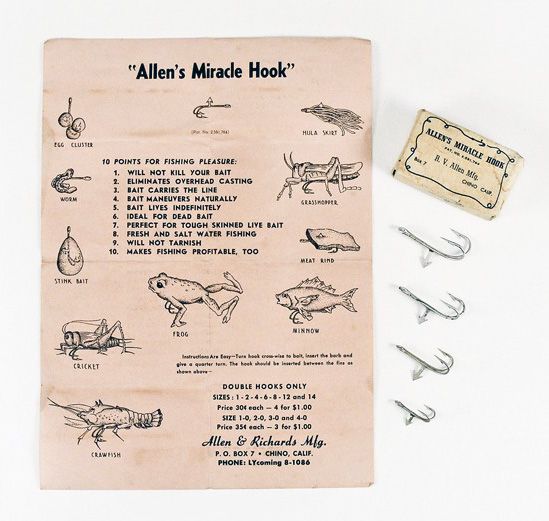
Recently I was lucky enough to pick up an extra box of R.V. Allen’s Miracle Hooks from Chino, California. They are a patented hook from 1952 and a nifty bait holder, and I put it up for sale on Joe's Board. 


Lo and behold soon after it sold I got a message from Fred Ribb, who wrote the following: 

Two years ago I found two gentleman in their upper eighties that knew Rufus V. Allen. One of them recalled Rufus selling his tackle in the back of the old San Saba Hardware Store near the Courthouse square in the 1950s. The building has changed ownership several times over the years and today it is Harry’s Department Store. There are no Family members living here now which makes it difficult to find out much more.   

I saw your board post on Joe’s and thought you might like to have this [a research article]. You should be able to open the two pictures attached. They reflect the difference between Chino, CA. and San Saba advertisement.   


Regards, Fred Ribb   


With Fred’s permission, I give you the history of the Allen’s Miracle Hook, courtesy of Fred Ribb.   


R.V. (Rufus) Allen Tackle manufacturer, San Saba, Texas 

After receiving my R.V. Allen hooks and paperwork by mail, I was eager to start investigation. San Saba is a small central Texas town with a population of just over 3,000. It's better known for being the Pecan capital of the world rather than for its fishing tackle.   


With new treasures in hand, my first stop was the San Saba Courthouse just down the street from where I live. With a little help from the clerk, we found Mr. Allen's death certificate and I was given a copy. Mr. Rufus Virgil Allen was born in Voca, Texas on 9-30-1897 and died at age 62 on 12-30-1959. As the Crow flies, Voca is 30 miles Southwest of San Saba. Mr. Allen’s occupation is listed as a poultry specialist and was considered an expert in Chickens and Turkeys. From talking with a few folks around town, San Saba was one of the Nations top poultry producing counties more than sixty plus years ago.   


Mr. Allen moved to or near Chino, California by at least 1948 as evidenced by patent #2,518,588 that he applied for on June 11,1948. The patent was for improvements to a hen house. Searching Chino, CA. online I found that they were known for their vegetable crops, dairy and chicken production. I suspect the poultry industry was what prompted Rufus Allen's move to the West coast. During his stay in California, there were several patents applied for and granted to R.V. Allen between 1950-53. Among those were live and dead bait hook types, a live bait container and one patent for a trotline which I found quite interesting.  


The trotline is comprised of metal links with eyelets on each end which are joined together with split rings. Stagings are connected by wire clips along the trotlines length at the split rings. A spring is attached to each end of the trotline which gives it flexibility. The springs can be fastened by small rope to a tree trunk or stake driven in the ground. When you're done fishing the trotline, stagings are disconnected and the trotline links are easily folded together and stored in a sack or small compact box free from tangles. Measurements for the metal links are not given but I suspect they would have been approximately eighteen inches long since trotlines generally have staging drops every 36 inches or so. 


Here is a link to his Trotline patent, here is a link to his Live bait container patent, and here is a link to Live bait hook patent. Other patents credited to Mr. R.V. Allen (There may be others I’m not aware of) include a Magnet cutoff valve (#2,576,168 issued on.Nov. 27, 1951) and a Magnetized window control (2,607,961 on Aug. 26, 1952).   


Below is what may be one of R.V. Allen's earliest advertisements, Allen & Richards Mfg. Chino, Calif. The graphics are very similar to the San Saba advertisement but are indeed different as well as the wording used. The box is 2-piece cardboard construction (as shown above). 


— Fred Ribb

Wednesday, March 13, 2013

BREAKING NEWS: 19,000 Year Old Ice Age Fish Hooks Found

I try not to do what most blogs do -- making individual posts on articles that other people have written/researched. I save these for the Fishing News of the Week every Monday. But sometimes I read something so cool I can't wait.

Today's one of those days.

Archaeologists have uncovered a 19,000 year old fish hook made from a mammoth tusk. This is huge news, as they are the oldest found in Europe. The amazing thing about this hook is that it would still work perfectly today.


It appears to be around 10 cm in length with a 3 cm gap between the point and the shank. It would have been used to catch large fish in fast moving water where nets and harpoons would not work. It reminds us that ancient hunters were also ancient anglers.

The original story was posted to the great web site livescience.com and is definitely worth a read.

-- Dr. Todd

Tuesday, January 17, 2012

Voices from the Past: Fish Hooks (1857)


The following description of fish hooks comes from Chamber's Information for the People, a Victorian encyclopedia of general knowledge ca. 1857. Note the fantastic line about ordinary English hook makers…

Hooks. These are small instruments made of tempered steel, and of whatever size, they require to possess the qualities of lightness and great strength. They have been always principally manufactured at two places-—Kendal in Westmoreland, and Limerick in Ireland. The Kendal circular bends, as they are called, are reckoned the best hooks of a small size, while the Limerick hook is preferable for salmon. Many of the fish-hooks of ordinary English makers are worthless. Hooks range in size from about an inch and a half in length down to a quarter of an inch, with a proportional diminution of thickness. Some makers number them from No. 10, the smallest, to No. 20, the largest; while others number from 1, the largest, to 14, the smallest. The Limerick hooks are denoted by letters, commencing with A, and so on. In purchasing hooks, see that the body is of equal thickness throughout, and that the barb is boldly yet firmly set. Try their power of resistance by forcing the bend with the fingers, and urging the point against the thumb-nail. Hooks for fly-fishing should be thinner in the shank than those designed for bait. An angler should keep a small stock of hooks of various sorts, to be ready on all emergencies, with the tackle to which they are attached. They require to be kept very dry.

-- Dr. Todd

Tuesday, September 14, 2010

Voices from the Past: Free Fish Hook (1896)


The following account--from the 15 February 1896 Forest & Stream, gives the story of one Congressman who's constituent got in trouble for implying the government gave away free fishhooks.

Free Fishhooks

One member of the House is in a regular stew just now. He is telling the story himself:

"I was slightly surprised a few days ago to receive a letter from a constituent as follows:

"DEAR JUDGE: Tim Dooley says that Government gives away fish to those who apply. I don't know if this is so or not; but if so I wish you would send me some. The only kind we get here are in half-pound packages, called boneless cod. And they are no account, and then they make you thirsty. If they give away any fishhooks I wish you would send me some, for the Major, Ransom Brown, Judge Kaufman and I have planned to go fishing as soon as the weather opens up. You know they all worked for you last time.

For the sake of the joke I dropped into a sporting goods store and bought a tin box of hooks for $1.50, sent it to my friend with a note saying I was very glad I had some fishhooks still left from my quota, though there had been a great demand for them and the horse book. The supply of fish had run out, and the President had been so occupied with bonds and had Congress on his hands so long that our supply was exhausted. I regretted also that the ducks have been wild or could maybe have got some, but last trip Grover only got thirteen and he needed most of those himself.

The result was fourteen requests for fishhooks within a week, and they are still coming. It is no use saying that Uncle Sam does not handle fishhooks, as here are the hooks and there is my letter, and if I don't send them every last man that I refuse will sharpen a knife for me next campaign, and I do I will go broke. Don't fool with the granger."


-- Dr. Todd

Tuesday, October 13, 2009

History of Samuel Allcock & Co. (1888)

The following history of the venerable British firm of Samuel Allcock was published in the 1888 edition of Wyman's commercial encyclopædia of leading manufacturers of Great Britain. Allcock was one of the largest -- if not the largest -- makers of fish hooks in the world and branched out to produce materials for all kinds of angling. Samuel Allcock was a bit of a crank, as well, as I illustrated in a chapter in my History of the Fish Hook in America, Vol. 1.

Samuel Allcock & Co., Fish-Hook and Fishing Tackle Manufacturers
Standard Works, Redditch
Telegraphic Address: Allcock, Redditch.

No house in this trade has entered into it in such a comprehensive way as the above Firm or infused into it such a progressive spirit and invincible determination to succeed, with the gratifying result that they stand in the van of this industry. For 
more than thirty years Mr. Samuel Allcock, the son of the founder, has 
been at the head of it. Not only do the Firm possess extensive Works 
at Redditch, where hand labour of the most skilled kind, combined 
with long experience and great judgment is employed, but to ensure the very best material for the gut of the hooks they carry on a silkworm factory at Murcia in Spain. Probably no other industry requires such a multiplicity of minute details as fishing-tackle making; to turn out a first-class fishing-rod it has to pass through some dozen sets of skilled operatives, and so with the baits and floats.

Comparatively little machinery is used, but it is the deft fingers and fertile brains of the operatives that are in constant requisition, and it is partly this fact that gives this special industry an impregnable position in this country; for, in spite of the most hostile tariffs the world over, Redditch sends its manufactures into every market, and in yearly increasing quantities; and to keep abreast of the times and still more firmly and wisely to maintain that enviable position, this Firm at once adopt all kinds of improvements, and have a special staff of intelligent employes whose business it is to study not only the different requirements of the varied markets, but to humour the tastes and fancies of the various fishes in the dress-up and appearance of the flies. Salmon, above all fish, are the most wary and fastidious, and require such a perfect presentment of nature, that the distant markets of Africa and the East Indies have to be searched to please him, and fly-making to be elevated to a fine art.


The different parts of the fishing-rod are composed of ash, hickory, greenheart, washaba, bamboo, and certain woods from China and the East Indies, but the best of all is the Dorset English ash, and it is a singular fact that although these woods are grown extensively in the United States, and the industry protected by a high tariff, they cannot rival in quality the best English goods, or keep them out of the market. The manufactures carried on at these Works consist of all kinds of floats, reels, swivels, landing-rings, gaff-hooks, gut-finishing, fly-dressing, and baits, to which there is no limit in change and ideas, comprising a spoon bait, an odd epicurean fish fancy, flexible fish, and the big "Paragon" baits for dolphins; flies, beetles, and other insects, and even lady-birds and frogs are utilised to tempt the appetites of the gourmands of the seas and rivers. The flies especially are of the most elaborate and enticing appearance, and it is no wonder young and old fall victims to the lure. No lesc than 1,700 different kinds and sizes of hooks are made, and are arranged in such order in the storerooms that at a minute's notice any given size required can be produced. Owing to the numberless articles required the stocks kept are very great, and are a picture of order, neatness, and regularity.


Messrs. S. Allcock & Co. are well-known and successful exhibitors, and were among the first to send contributions to those fishery exhibitions which attracted so much attention, and they carried off gold medals at Paris, Berlin, Wurzburg, Norwich, Toronto, Sydney, Melbourne, Adelaide, South Adelaide, Calcutta, and the highest awards at all the other exhibitions at which they were contributors, and we had the pleasure to inspect a superb case of fishing tackle previously to its departure for the Exhibition at Melbourne in the present year, 1888, and which case will be placed in Group V., Class 38, and will be numbered 725 in the Catalogue, and the contents of it will worthily maintain their present prestige and position in the trade.


-- Dr. Todd

Wednesday, August 27, 2008

The First American Fishing Tackle

The First American Fishing Tackle

As I was prepping for a course I'm teaching on the first half of American history, I recently came across a great eBook from the legendary Project Gutenberg that details a bit on the origins of American angling. New Discoveries at Jamestown: Site of the First Successful English Settlement in America by John L. Cotter and J. Paul Hudson (2005) is a very interesting archaeological look at the first major American settlement of Jamestown, Virginia, founded in 1607. As a coastal settlement, the sea and river were extremely important to Jamestown's survival. As such, they were the first Europeans to use fishing tackle. As the authors note:

When the first settlers planted their small colony at Jamestown, the tidewater rivers and bays and the Atlantic Ocean bordering the Virginia coast teemed with many kinds of fish and shellfish which were both edible and palatable. Varieties which the colonists soon learned to eat included sheepshead, shad, sturgeon, herring, sole, white salmon, bass, flounder, pike, bream, perch, rock, and drum, as well as oysters, crabs, and mussels. Seafood was an important source of food for the colonists, and at times, especially during the early years of the settlement, it was the main source.

Those in England who planned to go to Virginia were always advised to provide themselves (among other items) with nets, fishhooks, and lines. During archeological explorations, fishhooks, lead net weights, fish-gigs, and small anchors were uncovered. These are reminders of a day when fish and shellfish were abundant in every tidewater Virginia creek, river, and bay.


Fish Hooks, Fish Gigs, and Lead Net Weights unearthed at Jamestown

It is certain also that the local blacksmith produced fish hooks and spears for local use as well, making them the first pieces of American tackle ever produced in the colonies. It is possible the spear and fish hooks pictured are the earliest American colonial-made fishing tackle. Being able to see piscatorial relics from the founding of the nation over 400 years ago is a real treat.

-- Dr. Todd

Tuesday, April 3, 2007

My New Book is Here!

FINALLY! My new book has arrived. You would think the ten years of research would have been the most difficult thing, but nothing could have prepared me for the headache of getting this book back from the bindery. I finished the manuscript layout for this on January 30th. Usually, it usually takes only three weeks for the book to be professionally bound (The Whitefish Press uses one of the four professional binderies in America that manufacture all mainstream books). But due to a bizarre confluence of events (they lost the cover TWICE, for example), the book only arrived yesterday. But I must say, it looks terrific. 352 pages of hard core fishing history. Anyone interested can get more information at:

The Fish Hook in America, Vol. I

I very much appreciate all the kind words about the blog, and all the support people have rendered me for our little publishing endeavour The Whitefish Press. It has been a lot of work but also a lot of fun. I love books and know that nothing takes the place of a good professionally bound book, even though the internet and things like this blog are fun and useful. I'll still take a book any day of the week.


Cheers,

--Dr. Todd