Showing posts with label The Art of the Lure. Show all posts

Saturday, January 3, 2015

The Art of the Lure with Elissa Ruddick: The Fred Arbogast Spin-Tail Kicker


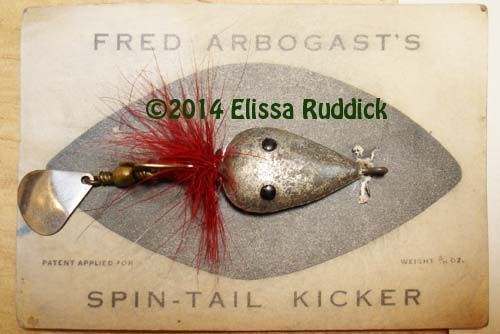
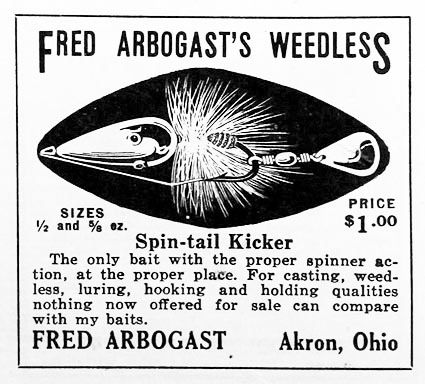
The lure that turned a hobby into a business for Akron, Ohio resident Fred Arbogast was his Spin-tail Kicker. His first commercial advertisement, which featured the Weedless version Spin-tail Kicker, ran in the June 1926 issue of Hunting and Fishing magazine. This ad, along with the lure’s ability to catch fish, would be the catalyst Fred needed to become one of Americas, as well as the worlds, most recognizable names in the fishing lure industry. Being a fisherman himself, he invented lures to overcome specific problems he had encountered while fishing various conditions in waters all over North America. He officially formed the Fred Arbogast Company in Akron, Ohio in 1928.


Fred would go on to invent many other famous fish catching lures to include the Tin Liz, Weedless Kicker, Hawaiian Wiggler, Jitterug and the Hula Popper; but the little lure that started it all, was the Spin-tail Kicker!

If you have any questions/comments, Elissa Ruddick can be reached at elissaruddick AT aol DOT com.

— Elissa Ruddick

Saturday, December 20, 2014

The Art of the Lure with Elissa Ruddick: The Michigan Life-Like Minnow


Patented on February 20, 1908, Jacob Hansen’s Michigan Life-Like Minnow was distributed by the Arntz Sporting Goods Company in Muskegon Michigan. It was made in a 3-3/4” five hook version and a 2-3/4” three hook version in nine colors. The unique vibrant and speckled paint jobs on these “NEAREST THING TO LIFE” minnows remind me of the Easter eggs I used to paint when I was a kid and when my kids were little!


No description compares to the one stated on the box paper:

“AFTER a long experience and careful study of Bait Casting and Trolling, we have gotten up this Bait, or in other words, the “Fisherman’s Friend.” It is made from selected Cedar, very strong and durable, and to represent a live minnow swimming. The improvement on this minnow over other makes, is the Jointed Tail portion, which is flexible, and when being drawn through the water the Three-Blade Propeller wiggles the Jointed Tail portion, and makes an excellent imitation of a live minnow while swimming.

It has been pronounced to be the most perfect casting and trolling bait ever put on the market and beats live bait.

The hooks are very easily detachable, and cannot possibly tangle or interlock, as they cannot swing forward. They can be replaced by any common treble hook, of any size or shape.

The bait is beautifully finished with a Special Water Proof Finish which prevents it from soaking water or peeling off. All spinners and hooks are heavily nickeled, thus preventing rust.”

The lures were complicated to make, so they were not manufactured for very many years, making them very tough to find today. The Michigan Life-Like Minnow, Jacob Hanson’s first commercially produced lure, remains at the top of many collector’s wish lists. This “Fisherman’s Friend” is a friend of mine indeed.

If you have any questions/comments, Elissa Ruddick can be reached at elissaruddick AT aol DOT com.

— Elissa Ruddick

Saturday, November 22, 2014

The Art of the Lure with Elissa Ruddick: THE CHIPPEWA BAIT – CHIEF OF RIVER AND LAKE


Omer F. Immell of Blair, Wisconsin received two patents for his unique “Chippewa” lure, number 974,493 on November 1, 1910 and number 990,984 on May 2, 1911, with the latter more closely resembling the actual production lure. A very talented man, Omer held ten patents during his life, four of which were fishing related. After founding a manufacturing company in 1904, he must have been more interested in inventing and selling fishing items, as he sold the non fishing inventions and started the Immell Bait Company in 1906, then in 1909 he changed the name to the Immell Bait and Tackle Company.


He incorporated on April 30, 1912 with three others, selling 50 shares of stock for $5,000.00. There were several versions of the “Chippewa”, including floating and sinking models, in sizes ranging from 3-1/2” to 5-1/4” that were painted in 12 different known colors, all with beautiful, round, life-like glass eyes. All sizes of the “Chippewa” lures featured an integrated metal spinner in the center of the lure that spun in the water when the lure was being retrieved to attract fish, and I’m sure it was just as intriguing to the fishermen when shopping for lures! One side of the spiral spinner was painted red, while the other side was chrome plated and stamped with “PATDNOV11910”. It is believed that the Immell Bait and Tackle Company continued making the lures until sometime in 1915, and the company ceased to exist all together on January 1, 1918 when its charter was revoked by the state of Wisconsin. From late 1912, after Omer incorporated his company, until they ceased being produced, C. J. Frost of Stevens Point, Wisconsin was the sole distributor for Immell’s “Chippewa” lures, and may have actually produced the components, or maybe even the complete lure. The last advertisement known for the “Chippewa” was in 1915 by the C. J. Frost Company.


Regardless of the unknowns, Omer Immell’s “Chippewa” lure invention remains a favorite among collectors today, and I’m sure it will for many years to come. Hmmmmm … I wonder what politically correct name these “Chippewa” lures would have to be changed to if they were still being produced today?

If you have any questions/comments, Elissa Ruddick can be reached at elissaruddick AT aol DOT com.

— Elissa Ruddick
Saturday, September 27, 2014

The Art of the Lure with Elissa Ruddick: Abbey & Imbrie “Glowbody” Minnow


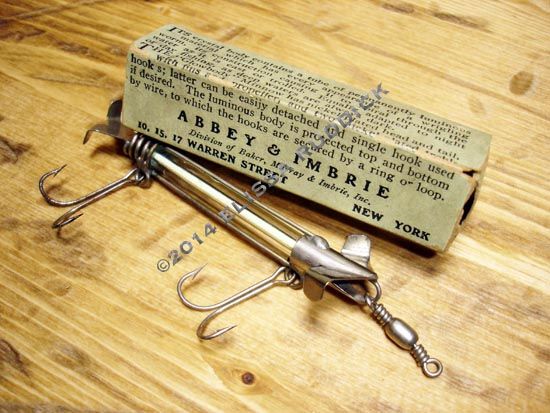
The “Glowbody” Minnow marketed by Abbey & Imbrie in their centennial year, 1920, will be glowing long after I and all who are reading this are six foot under. The “permanently luminous material” used inside the crystal body is made from radium. Radium is said to have a half-life of over l600 years, so the term “permanent” works for me! Half-life is a complicated formula that requires someone who paid a lot closer attention in algebra class than I did, but trust me, it’s a really long time!


The tube of radium inside was described as having “every appearance of a wrigling worm”. Wait, I thought this was supposed to be a minnow. Hold on; the description goes on to say that, “The “Glowbody” Minnow has nickel-plated head and tail, with fins and propeller”. Ok, is this a minnow with a glow worm inside? Well, whatever this lure was supposed to mimic is a little unclear, but one thing is for sure, the body certainly still glows as spelled out on the box label. Speaking of the box label, they really should have used a spell-checker before it went to the printer. Every time I read it, I swear I find another mistake! And I sure hope I never drop and break this thing. I’d really hate to have to call a hazmat team to come clean up and properly dispose of it…

If you have any questions/comments, Elissa Ruddick can be reached at elissaruddick AT aol DOT com.

-- Elissa Ruddick

Saturday, September 20, 2014

The Art of the Lure with Elissa Ruddick: The Viking Frog


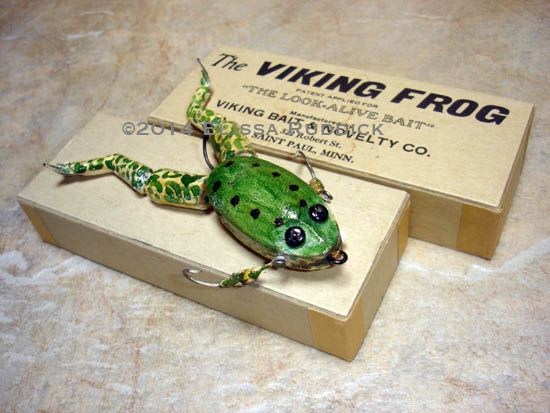
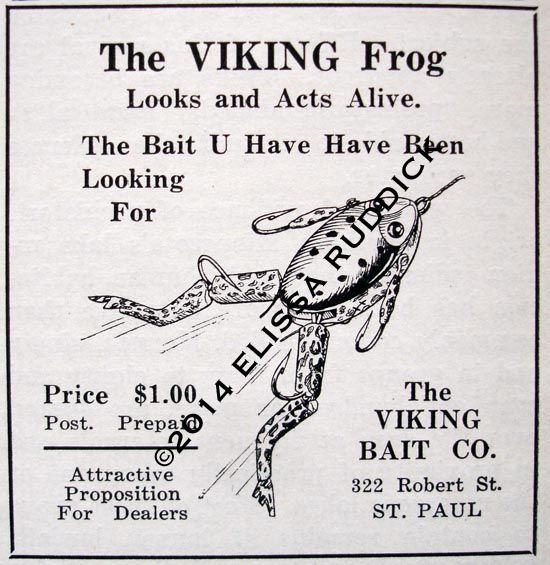
Although little is known about the Viking Frog, thankfully the box top and patent give us a fairly short, but decent history. Oscar Christensen, a shoe repair man, whose shop was located in the front of his home at 320 Robert St. in Saint Paul, Minnesota, applied for a patent for his Viking Frog on Aug. 1, 1935. Patent number 2,047,768 was granted to Christianson for “The Look-Alive Bait” on July 14, 1936. The size of the patented lure is 4-1/2” in length, although a few 3-1/2” non-jointed leg versions have been found. It is not known if the smaller ones were actually made by Oscar, or possibly by other family members, but the similarities to the patented lure seem to be unmistakable. Oscar must have used items from his shoe repair business, such as the leather for the rear feet, as well as the little nails that were used on the underside to hold on the rear legs and on the sides to hold on the front hooks, that also doubled as front legs. Some had single hooks attached inside each front quadrant of the rear legs, making them four hook versions, while others had a single hook protruding from the center rear of the body, making them three hook versions. The rear legs were designed to spread out and back in while being retrieved, mimicking the natural action of a real live frog.

I don’t know if the Viking Frog turned out to be a fish catching bait, or a novelty, but from the company name on the box top, it looks like Oscar had it covered either way!


If you have any questions/comments, Elissa Ruddick can be reached at elissaruddick AT aol DOT com.

— Elissa Ruddick
Saturday, September 6, 2014

The Art of the Lure with Elissa Ruddick: The Manuitou Minnow


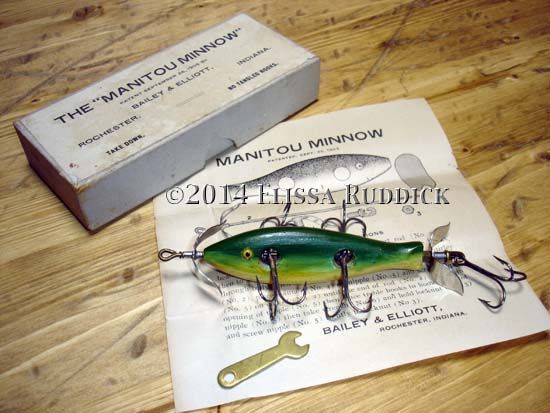
Named after Manitou Lake, a favorite nearby lake to its inventors’ home town of Rochester, Indiana, the “Manitou Minnow” was granted a patent on September 26, 1905. Simon K. Bailey and George A. Elliott, the inventors, were also business partners in a sporting goods store in Rochester where the lure was marketed. The Manitou came packaged in a two piece cardboard box along with a little brass wrench and instruction sheet showing how to use the wrench to assemble the lure, and as the box lid implies, to also use to “take down” the lure to prevent tangled hooks. The five hook 3-3/4” fish shaped lures have been found in the following colors; Solid Red, Dark Green with White Belly, and Light Green with White Belly. The lure was short lived, as its design too closely resembled the Fred Rhodes 1904 patent, so to keep from getting sued for patent infringement, Bailey and Elliott ceased making and selling their lure.


I can’t help but wonder just how many marital fights this thing caused. As I gaze into the box and look at the contents inside, I can almost hear a distant voice yelling, “Where did you put my little lure wrench?!”

If you have any questions/comments, Elissa Ruddick can be reached at elissaruddick AT aol DOT com.

-- Elissa Ruddick

Saturday, August 30, 2014

The Art of the Lure with Elissa Ruddick: The Heddon “Wiggle King”


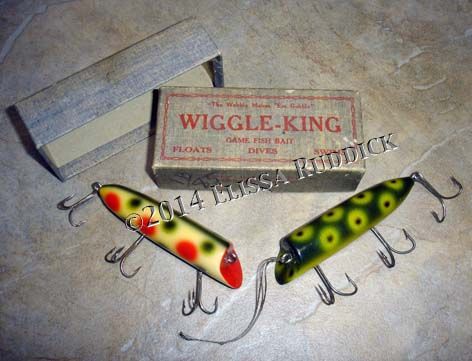
Introduced in 1918, Heddon’s No. 2000 “Wiggle King” would spark the creation of two of their most well known lures, the Lucky 13 in 1920 and the Basser in 1922. I suppose the "Wiggle King" could be considered the prototype for these two successors.

Since Heddon went to work refining their original “Wiggle King” so quickly after its introduction, it was a relatively short-lived lure on the production line. It came packaged in a unique fabric-covered-looking two piece cardboard box,which today appears gray from the natural patina to the paper, but I believe the original color was light blue denim. When the box top is removed from the box bottom, one can still see the blue tint where the elements have not taken such a toll. The darker “fabric lines” on the paper label are slightly raised, giving the illusion that the box is actually wrapped in denim fabric. Red lettering surrounded by an intricate red border, describes the lure inside, "The Wobble Makes ‘Em Gobble.”

If you have any questions/comments, Elissa Ruddick can be reached at elissaruddick AT aol DOT com.

-- Elissa Ruddick

Saturday, August 16, 2014

The Art of the Lure with Elissa Ruddick: Redin Minnow


James “Jim” L. Donaly, from Newark, New Jersey, applied for a patent for his “Redfin” Minnow on January 7, 1911, and patent number 1,093,980 was granted to him for the “Redfin” on April 21, 1914. Although the patent was not granted until 1914, Donaly made and sold them as early as 1912, and most probably even before.


The “Redfin” Minnows were adorned with three small rounded triangular-shaped metal flasher blades, usually made from aluminum and sometimes brass, that were strategically placed on the front (as a weedless feature), and on the rear and the underside of the lure to mimic tail and anal fins. The 3-1/4”, ¾ ounce “Redfin” Minnow could be ordered with treble hooks or with a “Jersey style” three-point hook configuration. Sporting beautiful round glass eyes that were set inside the dished out face, the wooden bodied “Redfin” Minnows were available in three brushed-on-by-hand paint colors; No. 27, white body with red band; No. 37, green back with white belly; and No. 47, white body with red stripes. The two piece cardboard boxes that the “Redfin” Minnows were packaged in show a beautiful drawing of the lure, depicting a pointier fish-shaped body more closely resembling the original patent drawing than the rounder faced lures that Donaly actually produced.

From ingenuity, to the drawing board, to the end product, the “Redfin” Minnows are true hand-made folk art lures that were designed and produced by Jim, then hand painted by his wife and daughter, and then each assembled by Jim inside their family home. It is really cool to think that the lure in this photo, as well as every other “Redfin” Minnow, was actually hand-made by the inventor, James L. Donaly. Now that’s quality control at its finest!

If you have any questions/comments, Elissa Ruddick can be reached at elissaruddick AT aol DOT com.

-- Elissa Ruddick

Saturday, July 26, 2014

The Art of the Lure with Elissa Ruddick: Armax Minnow


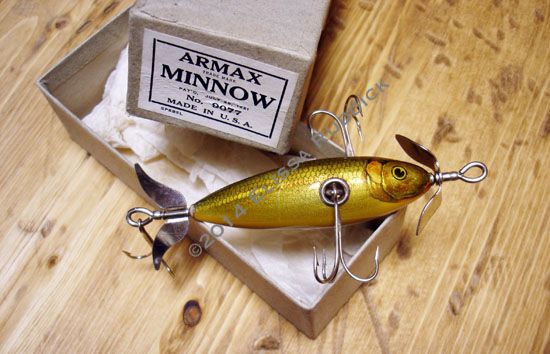
Armax was one of a few generic brand names Winchester used for their fishing tackle, which they offered to jobbers and dealers to sell. The three-hook Armax Minnow pictured with its original unadorned end labeled box, is identical to a Winchester brand name minnow, with exception to the front prop being non-stamped with the Winchester logo and part number. The Winchester branded minnows, along with their ornate boxes, could only be ordered by fully franchised Winchester stores. You won’t find very many Armax or Winchester wooden minnows, or other fishing tackle that Winchester produced for that matter, as fishing tackle was a fairly short lived venture for a company best known for the firearms they produced. Although it is unknown at this time as to which company was contracted to actually produce their brand name wooden minnows, along with their generic wooden minnows, the company produced them with a unique back propeller that presented a rather straight profile. When in a vertical position, Winchester rear props actually look more like a tail on a fish than the curved props that most other manufacturers used on their wooden minnows. And talk about a life-like appearance, the paint job on this minnow looks like the real thing! It’s hard to believe that this minnow was made back in the 1920’s or the first few years of the 1930s. I don’t know if a fish would have been able to focus his eyes enough to see the detail on this lure as it was being retrieved in the water, but I know it would have been hard for a fisherman to pass it by in a dealer’s tackle department. I know I couldn’t pass it by!

If you have any questions/comments, Elissa Ruddick can be reached at elissaruddick AT aol DOT com.

-- Elissa Ruddick

Saturday, July 19, 2014

The Art of the Lure with Elissa Ruddick: Vim Wood Minnow


Manufactured in about 1907 for the Vim Company by the Joseph E. Pepper Company, Rome, NY, is this wonderful five hook underwater minnow and picture box combo. Vim was a general merchandise company located on 68 Lake Street, Chicago, Illinois in the early 1900s. Joe Pepper produced trade minnows for several companies, and distinguished his minnows from other makers of the day, by hand painting them with reverse gill marks, and when using glass eyes, they were normally forward facing. The twisted wire through-body hook hangers and line tie, tube-type “bow tie” props, milky yellow egg-yolk glass eyes, and hand painted body all lend a true “folk-art” feel when gazing at this lure from any angle. The printing on the right hand side of the box top pretty much sums it all up for me, stating, “You Will Like It.” And indeed I do!


If you have any questions/comments, Elissa Ruddick can be reached at elissaruddick AT aol DOT com.

-- Elissa Ruddick

Saturday, July 5, 2014

The Art of the Lure with Elissa Ruddick: The “Dowagiac No. 2”


When I hear the term “No. 2,” I think of … well, I think of the same thing that you think of! So, why would a lure company call a lure they produced by such a name? Maybe they referred to it by that name because it is the 2nd lure they offered; actually a 2nd version of Heddon’s first commercially produced “Dowagiac Expert.” We may never really know, but if you read Heddon’s description of their “No. 2,” it sure seems to go along with what I think of when I hear that term!


The 1902 Heddon catalog states: “Herewith is shown an illustration of our “Dowagiac No. 2,” which is a surface bait, and in all respects the same as the “Expert” except it has four trebles (12 hooks) instead of two trebles (6 hooks). As heretofore stated, we believe a multiplicity of hooks to be, on the whole, of more disadvantage than advantage, adding practically nothing to the catching capacity of the lure, while presenting numerous disagreeable features, chiefly among which is the murderous gaffing of your already securely captured fish, thus, preventing that splendid “playing,” which attribute has given the bass his exalted position among game fish and is so pleasing to the true sportsman. We do not advocate the use of the “No.2,” but offer this pattern to those who hold to the false theory of “more hooks, more fish.”

Now wouldn’t that just make you want to order scores of these? Man, if you wanted one of these, you must be a non sportsman, bass murdering idiot! Perhaps the original owner of this combo was too embarrassed to actually take it out and use it, for fear that someone might actually see him with it! The appeal of the “Dowagiac No. 2” is far from “crappy” to a lure collector of today though, as a matter of fact quite the contrary. I do get Heddon’s point that they already had the perfect casting bait, the Expert, but to offer their “No. 2” in such a “crappy” manner, had to make anyone who wanted to purchase one feel like, well … “No. 2”!

If you have any questions/comments, Elissa Ruddick can be reached at elissaruddick AT aol DOT com.

-- Elissa Ruddick

Saturday, June 28, 2014

The Art of the Lure with Elissa Ruddick: The Heddon 150


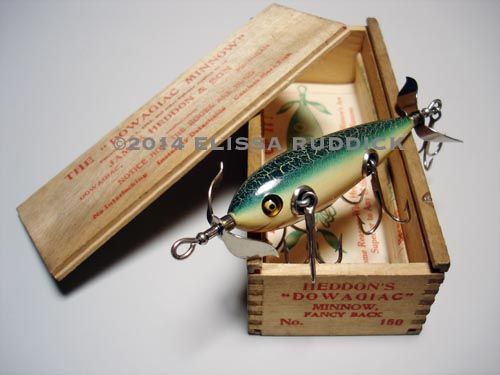
First manufactured in 1904, the Heddon 150 series five hook underwater minnows were produced until 1954. The one pictured here is circa 1907/1908, showing the era classic blunt nose with fat body, three hand painted red gill marks, glass eyes, nickel plated hooks and hardware with unmarked nickel plated props, in more than likely the most common color ever ordered, “Fancy Back.” From 1904 through approximately 1908, they came packed one each in a durable wooden box, although the earliest boxes had to be improved upon, as they were thin and would warp. The wooden box in the photo is the last phase they made before changing to pasteboard boxes, showing bold red printing on both sides, both ends and the top. Ok, you can’t see all the sides and ends in this photo, but I promise the red print is there! I suppose what I love so much about this particular era of the 150, is the all around “stocky” appearance of the lure. To quote a section in the 1907 Heddon catalog where they write about the quality of the lures they produced, they state, “We could state volumes of praiseworthy things about the “HEDDON” Minnows, but we prefer to let the goods speak for themselves.” I truly think this 150 does speak for itself!


If you have any questions/comments, Elissa Ruddick can be reached at elissaruddick AT aol DOT com.

-- Elissa Ruddick

Saturday, May 10, 2014

The Art of the Lure: Pflueger Trade Minnow “The New Winner No. 8683”


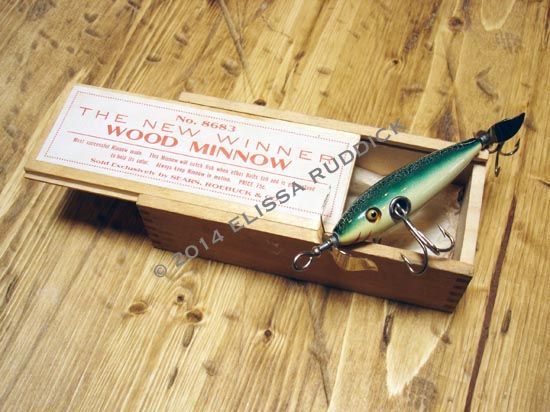
We’ve all heard the term, “what’s in a name?”, but what’s in a number? Pflueger, as well as many other major tackle companies, made “trade minnows” for hardware companies and mail order catalog companies that were slightly lesser in quality than their own name brand lures. Sears and Roebuck marketed their “The New Winner” three hook green crackle back wooden minnows as part number 9006, so why is this one in a box marked 8683? Everything about the combo is correct, except the number!


Everything about the combo seems right. It looks like it has always been together. It was found this way. Mint box, with mint lure, with original tissue paper in the bottom of the box, so what’s up with this No. 8683? This is driving me crazy! Ok, it’s only one thing on a long list, but I’ve got to find the answer!

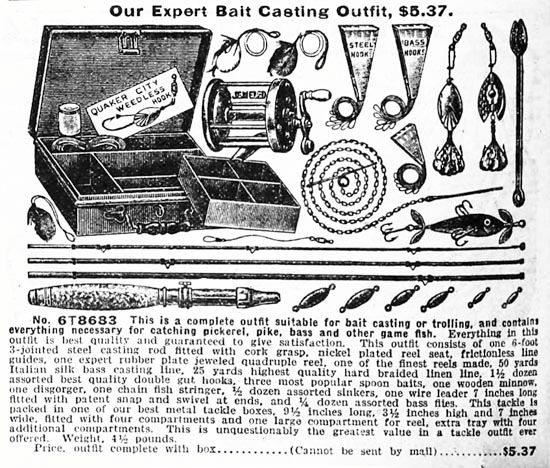
Ah, alas, the mystery has been solved! The 1910 Sears and Roebuck catalog has a No. 6T8683 complete “Expert Bait Casting Outfit” for $5.37! This is part of what makes collecting and researching our vintage fishing tackle fun, and now I can take this off of the list of things that drive me crazy. A win, win situation!


If you have any questions/comments, Elissa Ruddick can be reached at elissaruddick AT aol DOT com.

Saturday, March 15, 2014

The Art of the Lure with Elissa Ruddick: The Heddon "0" Minnow


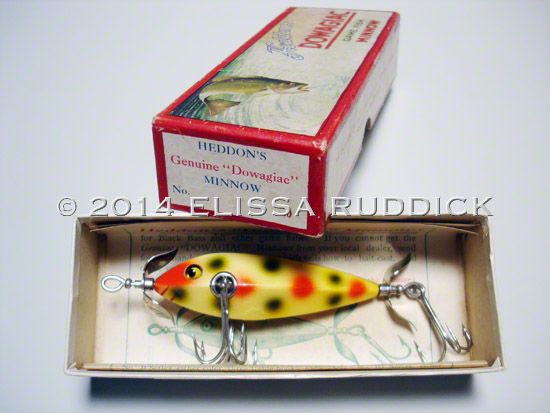
This circa 1912 Heddon "0" Minnow is in one of my favorite Heddon colors. I am not alone, there are many collectors today that share my admiration for this color. I imagine this color, as well as “The New Superior Finish Minnow” flat surface and line effect body shape, attracted fishermen of the day to purchase them by the dozen! Seriously, what natural prey does this color mimic? Nicknamed “Strawberry Spot” by collectors, Heddon cataloged the coloration as White body, Red and Green decorations. Note that the front spinner is stamped “Heddon’s Dowagiac” while the rear spinner is not stamped.

Heddon had recently started stamping their spinners, as the side of the box states, “All Genuine Dowagiac Minnows have 'Heddon’s Dowagiac' Stamped on the Spinners." The red-bordered box is labeled "0" in the same red color, versus the usual product code stamping. I was told that in this era, Heddon was trying to decide what color to use on their boxes that would help attract more attention, and in the end sell more lures. They came out with a white border, blue border and red border box. Evidently, the red border was the winner, as that is the box that they stuck with, and even used in their brand name recognition in later advertising. Add the hand painted gill marks and life-like glass eyes to round out the details, and who wouldn’t want one, or two, or three? Before a lure can attract the attention of a fish, it must first attract the attention of the fisherman!

If you have any questions/comments, Elissa Ruddick can be reached at elissaruddick AT aol DOT com.


-- Elissa Ruddick