Showing posts with label Deconstructing Old Ads. Show all posts

Saturday, January 10, 2015

Deconstructing Old Ads with Bill Sonnett: The Heddon Meadow Mouse -- A Lure that Appeals to Fishermen, Bass and Cats


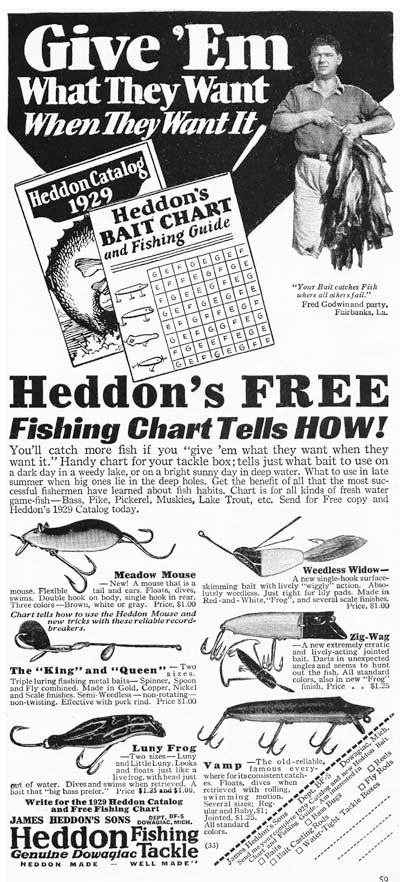
This ad from the May 1929 issue of Field & Stream introduces the Heddon Meadow Mouse. I recall as a youngster seeing the early version this lure for the first time in an older gentleman's tackle box. Its leather ears, leather tail, pointed nose and small beady eyes really impressed me. I thought now that really looks like a mouse. Apparently it impressed quite a few fisherman as despite being introduced at the beginning of the Great Depression, it is not particularly rare.
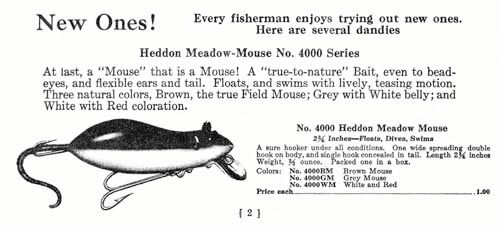


Caption to read: From the 1929 Heddon Catalog comes the introduction of a "Mouse that is a Mouse"


By the time I was old enough to buy one for my own tackle box (I’m thinking this was 1956) the lure was made of Tenite with molded ears. It still had a leather tail and with a gray flocked finish it looked more like a mouse than any other plug I had ever seen on the shelf at the local hardware store. That’s pretty much where my positive impressions of the bait ended. It did not have a particularly impressive wiggle as is swam across (or just under) the surface. I did not catch a single fish on it. I lost the lure a few years later and I was never inspired to replace it. As an avid reader of Jason Lucas, the fishing editor of Sports Afield, my opinion was bolstered in the early 1960s when he wrote in his column that lures that appeal to fisherman are not always the same ones that appeal to the fish. I believe in the article he was talking about the Pikie Minnow, a lure that keeps on catching fish despite a somewhat modest wiggle. Another example he used to illustrate the point was comparing two swimming mice lures. One looked very much like a real mouse (think Heddon here) and another mouse that didn’t look all that realistic (think Shakespeare here). He stated that the second was a far more effective bait than the more realistic looking version. I knew instantly which lures he was talking about and I have always found his observation to be absolutely true.

It has often been noted that the earliest version of the Heddon Mouse had a single hook on the rear rather than a treble and a much smaller metal lip than later versions. In fact it used the same metal lip as another bait introduced in 1929, the 110 wooden River Runt. I believe that the single rear hook was part of an effort to make this early version of the Mouse swim with a more pronounced wiggle as the shape of the wooden body, while looking very much like a mouse, prevented the kind of swimming action that the 110 River Runt demonstrated. Fairly early this problem was addressed with a new metal lip, one that was similar to the metal lip on Heddon’s successful Vamp bait. While appearing very similar to the Vamp lip, it is a downsized version, which you will find out if you ever try to replace one with the other. I found this out the hard way some years back when I acquired a large batch of experimental baits from the Heddon factory. These were baits that they had tried different hardware on, such as an SOS body with a 210 collar, a Zaragossa with a 210 collar and an 1800 Crab Wiggler with the standard diving lip on one end and a 210 collar on the other and a line tie on each end making it a reversible lure. Many other lures had holes drilled in them and impressions in the paint where one could tell what type of hardware they had tried out,then removed. There was a 110 River Runt body in the white that had been drilled to accept the second version of the mouse diving lip. Those were the only holes in the bait. I had and extra Vamp lip which I attempted to install and soon found out that none of the holes matched up. After comparing the lip of a Vamp with one on a Heddon Mouse it became instantly clear that the second was smaller than the first. It also told me that Heddon had experimented with using the new mouse lip on the wooden River Runt body. Sometime after the change in diving lips on the mouse, the rear single hook was replaced with a treble.
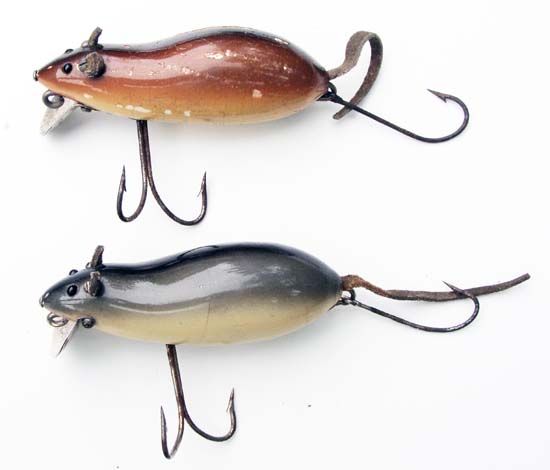
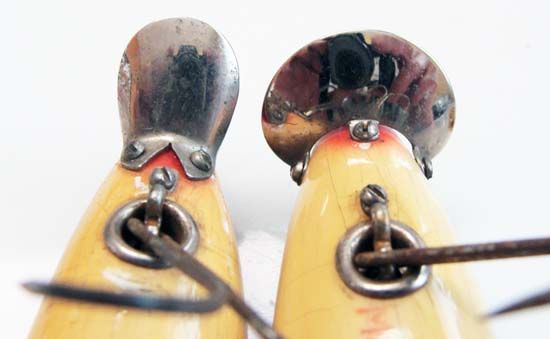


Here are presented the first two versions of the Heddon Meadow Mouse the older one is the brown one on top. There is not much difference between the two except for the diving plates. As seen from below the later gray example has the wider diving plate while the older brown model has the same plate as used on the Heddon 110 River Runt.


I visited the home of Heddon expert and collector Bill Roberts in Birmingham, Alabama about 15 ago. In addition to the greatest Heddon collection I’ve ever seen, he was showing me some beautiful antique cars in the basement of his home when I noticed a folding table with several well used Heddon Meadow Mice on it. I asked what the deal was with them and Bill said he regularly fished with them. I told him he was the only person I knew who fished with them. He said he had done fairly well on them and like me, he enjoyed fishing with antique baits. He then proceeded to tell me a very memorable story which I will attempt to do justice to here.

He and a friend were in their boat moving slowly along a lake shore casting around docks. Bill cast a Heddon Meadow Mouse very near the shore when out of nowhere a large “Tom Cat” dashed out and pounced on the bait and was immediately, solidly hooked. Bill said that after reeling this very irate cat through the water to the boat they netted it with a large landing net. The picture he verbally painted of he and his partner on their hands and knees pinning this cat to the floor of the boat with the landing net while trying with pliers to unhook the berserk feline is one I will never forget. I told him he should write up a complete version of the story as I had the perfect title for him ----”What Real Catfishing Is Like”

Tight Lines,

Bill S

Post script: Some time after writing this article I was thinking I should refresh my recollections of how a Heddon Meadow Mouse swims in the water. I proceeded to the end of the dock last evening and took three cast, the last of which is was devoured by a bass of 14 inches. Wondering if maybe my judgment on how effective this lure is was a bit hasty, I jumped into the row boat and drifted down the lake for an hour casting in all directions. I never received a hit. Pulling up to the dock at dusk I laid the rod on the dock while tying up the boat. Just as I got the first of two lines tied to a cleat a tremendous splash occurred just four feet away at the end of the dock. Investigation showed that I had laid the rod on the end of the dock with just enough line out that one fourth of the Meadow Mouse was hanging in the water where a bass had tried his best to make off with it. Apparently the jury is still out ---LOL

===========================================

BUY THE DECONSTRUCTING OLD ADS (VOLUME 1) BOOK BY CLICKING HERE!


Saturday, December 13, 2014

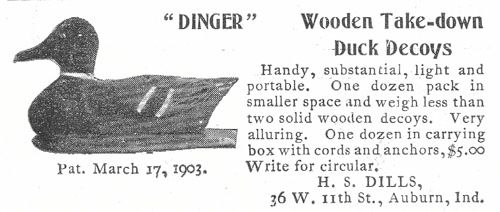
Deconstructing Old Ads with Bill Sonnett: Dill's Duck (1904)


Several years ago I was sitting in a hotel room at a National Fishing Lure Collectors Club meet when I mentioned to my roommate Dave Budd that He might want to look through an August 1904 issue of National Sportsman magazine that I had picked up. Dave is a long time collector of tackle made in Indiana. His sharp eye soon picked up an ad that I had overlooked as it did not seem to be related to fishing tackle. It was for a duck decoy made in Auburn, Indiana. It was only after it was pointed out to me that I understood its significance as related to fishing tackle.


The inventor was H. S. Dills who was only 29 years old when he filed for a patent on this decoy in 1902. 14 years later he would become one of three men who founded the Creek Chub Bait Company, which would become one of the largest manufacturers of artificials lures in the world. It is also one of the most sought after companies when it comes to today’s collector of old lures.


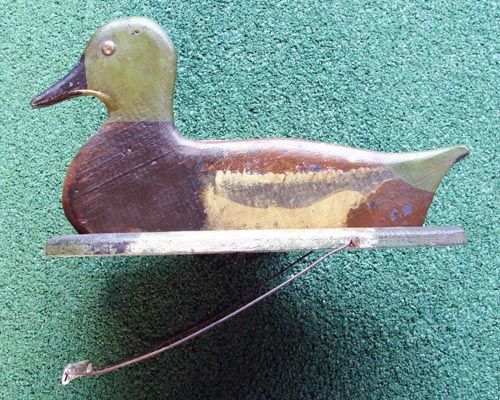
Sometime later while Dave was appraising lures in Garrett, Indiana a gentleman walked in with an example of this decoy. It took a couple of years but Dave was ultimately able to purchase the decoy. It represents a Mallard. Since that time three more Dills decoys that were meant to represent Bluebill ducks were found in a barn near Garrett.


Reading the patent papers for this decoy is interesting in that they stress the light weight and compact nature of the decoys as well as ease of set up. The folding, hinged lead weight on the decoy is meant to steady it in the water as well as keep it upright. Staples along the front and sides of the base are there as tie points for the anchor cords. Shown here are two view of an actual Dills Decoy as well as the original 1902 patent drawings.

Tight Lines,

Bill Sonnett

===========================================

BUY THE DECONSTRUCTING OLD ADS (VOLUME 1) BOOK BY CLICKING HERE!


Saturday, November 8, 2014

Deconstructing Old Ads: Pflueger Luminous Tandem Spinner -- Was I Ever Wrong (again)!

Pflueger Luminous Tandem Spinner -- Was I Ever Wrong (again)!


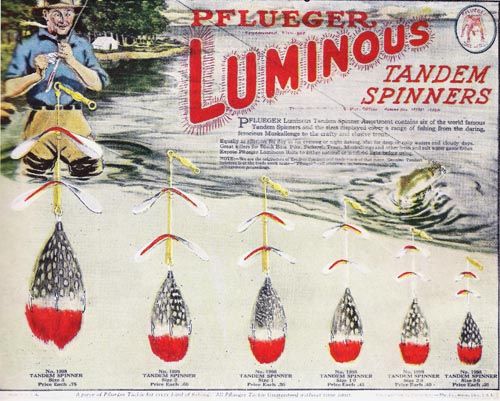
Counter display card of Pflueger Luminous Tandem Spinners as seen the the 1924 Pfluger dealers catalog.


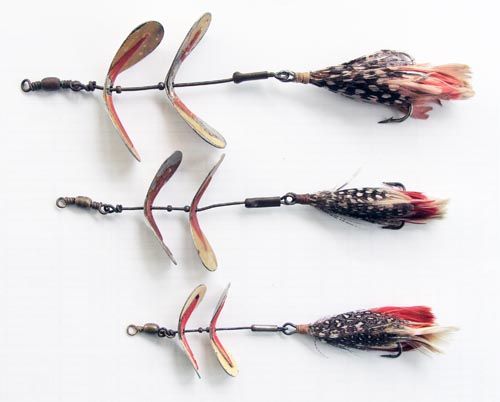
At the 2013 ORCA National Meet in Frankfort Kentucky the vintage tackle fishing contest was held on nearby Elkhorn Creek. I was paired with ORCA’s genial Vice President Bill Muth. We started down 6 miles of river by canoe with high hopes. Bill was using a Pflueger Palomine and I was using a Clark’s Water Scout, a bait that had a good reputation for river smallmouth in days gone by. After 2 miles and no action whatsoever, we both started digging in our tackle boxes for some different lures. I was a bit surprised when Bill held up a Pflueger Luminous Tandem Spinner. I remembered them being in the Hardware store as a kid and I even bought one in 1956. Older tackle boxes I’ve looked through over the years as often as not contained one or two. I do not recall ever seeing anyone use one. I know I never used mine other than to make one or two short casts to see how it worked. It seemed too light to cast well and didn’t have the kind of wiggle that gives young boys confidence.

My remark when Bill held up the Tandem Spinner for my approval was, “that thing has desperation written all over it”. We both laughed, but two casts later Bill’s bait was nailed by a nice river Smallmouth. Needless to say, I was very surprised. A picture of Bill holding that bass appears below. Bill then proceeded to land five more bass winning the contest going away with five more bass landed. Just as we were about to finish the trip Bill lost the biggest bass of the day right beside the boat and all of this on the Pflueger Tandem Spinner. Dang! sure looks like I was wrong about that bait. I made a mental note to pick up a few Tandem Spinners at the next few NFLCC meets that winter.


After acquiring a half dozen of the baits for a dollar or two apiece at the Milwaukee Antique Lure show in January, I set them on my desk. Sometime during the winter I polished the blades after which they were completely forgotten. I happened to notice them the following June and threw them in my tackle box, meaning to give them a try. Fishing was great all during June and early July and I really never thought about the Tandem Spinners again until a very slow (no fish whatsoever) evening on the 22nd of July. What the heck, I’ve nothing to lose, I’ll give one a try. I knew they were light but I was using a 6ft soft action glass casting rod from the 1950’s and a narrow spool Coxe 25 with an 8lb braided nylon line. If that outfit would not cast them, I can’t think of a vintage (pre-spinning) outfit that would. I was pleased on the first cast to see it sale out there about 50 ft. With the rod tip held high it ran a foot or so below the surface. To my pleasant surprise I actually received good hits on the second and third casts! I inspected the lure and as usual on many old baits the hooks were very dull. I took out the file and sharpened each of the three points. I was somewhat flabbergasted to catch three bass on the next five cast! Wow, where has this bait been? I can’t cast it more that 50 feet and unless one drags one’s thumb on the spool a little during the cast the line tends to loop around the first spinner. I hope I’m never too old to say I can’t learn something new!

Thanks to Bill Muth this one stays in the tackle box!


Tight Lines,

Bill Sonnett

===========================================

BUY THE DECONSTRUCTING OLD ADS (VOLUME 1) BOOK BY CLICKING HERE!


Wednesday, September 3, 2014

Deconstructing Old Ads with Bill Sonnett: The 400 Bucktail Surface Minnow


When I first started to seriously collect Heddon lures in the early 1980s, I was fascinated by a lure that collectors referred to as the “Heddon 402.” At that time it was considered to be a very rare bait. The bait was unmarked as were all of Heddon’s lures made before 1912 and it went unrecognized as a Heddon product by the majority of collectors. This probably helped establish its reputation as extremely rare. As time has passed the bait has proved to be scarce, but not nearly as rare as once thought. I acquired one in 1987 for what was considered a good price at that time -- $700. It is yet another example of a lure that has fallen in value as years have passed. Not only was it not quite as rare as had been assumed, but it was made in only three colors. In a world where color collecting has been on the increase and interest in early Heddon has “leveled off,” the days of “heady” prices for this bait seem to be in the past.

In the early days of our hobby, the best (and sometimes only) sources of information were old catalogs and advertising. In this case, the “402” appeared only in the 1909 Heddon catalog and seemed to be absent from magazine advertising. This led to the assumption that it was only made one year thus adding to its reputation as rare. Before World War Two, Heddon identified their lures with a product number but changed the last digit in that number to indicate the color of the individual bait. The lure illustrated in the 1909 catalog color plate was shown in yellow with a sienna crackled forehead. With this particular bait the color white with a green crackle forehead was listed as “0,” the rainbow color was “1” and the yellow with sienna crackled forehead was listed as “2,” Hence the pictured bait was prominently labeled “No. 402.”

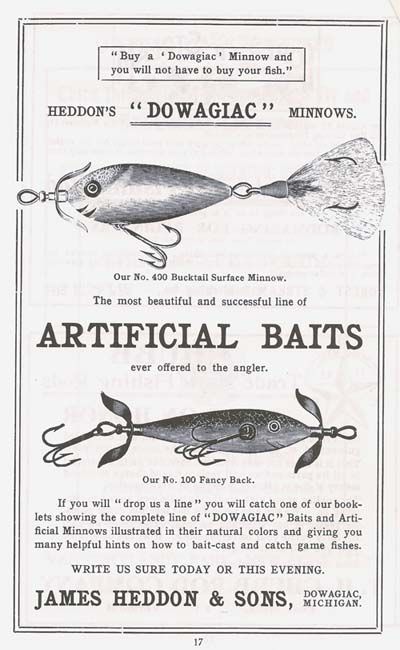
It always seemed a little odd to me that this bait was only in one catalog. One day in early 1985 when looking through Cliff Netherton’s book on the history of tournament casting, I noticed a reprinted program for a casting tournament held in August 1908. There on page 17 of the program was a full page illustrated ad which included the “400 Bucktail Surface Minnow.”


I now knew that the bait was available in 1908 and more importantly, what the real name of the bait was. It must be remembered that no 1908 Heddon catalog has been found to date. It has taken many years to shake off the “402” collector’s name which still surfaces on occasion. About a year or so later, fellow collector John Romero sent me a write up he had located in the April 1908 issue of Field & Stream on the new “No. 400 series of Bucktail Surface Minnows” It read:

“There are perhaps no articles of fishing tackle more securely wedded to the affections of the devotees of the art of baitcasting than the very excellent “Dowagiac” minnows manufactured by James Heddon & Sons, Dowagiac Mich., and found on sale wherever fishing tackle is sold or used. The latest production of this factory is their No. 400 Bucktail Surface Minnow, herewith illustrated. The body of this bait is made of white cedar, the wood being chemically treated to prevent absorption of water, the enamel and finish of that super-excellent character which is found in all “Dowagiac” products. This lure is wonderfully successful for Spring fishing, being especially adapted to use on shallow water at a time of year when bass will readily rise to the surface...”

As the years have passed, I have become less interested in accumulating old lures and more interested in how these baits were fished and why their life spans in the product line were long or short. Needless to say I was not about to “fish” with the bait for which I had paid $700. With the emphasis on “mint condition” baits these days, many formerly expensive baits with a blemish or two have become so inexpensive that experimenting with them in the water is very affordable. One Winter day three years ago a 400 Bucktail Surface Minnow showed up on Joe’s Board that was a partial repaint and very affordable. After removing some nail polish and a few more fisherman “touch ups” the bait looked better than I thought it would. I placed it in my tackle box intending to give it a workout the following Spring. As a bait that lasted only two years in the Heddon product line, I didn’t expect it to be a “killer” on bass, but with a little surface manipulation I was sure that I could take a bass or two which not only would make for a great photograph, but surely would be the first bass in a LONG time taken on this 100+ year old bait.

Spring arrived and after an hour of fishing with some of my favorites antique baits, I spotted the “402” in the bottom of my tackle box. I had forgotten that it was there. Time to try it out! I started out with a modest cast so I could observe the bait more closely. I had always assumed that it would float with the crackle painted forehead riding above the surface. The next few minutes were ones I will not forget. The bait immediately turned nose down and sunk like a “rock in a sock” straight to the bottom. After observing it next to the boat, it was obvious that it wasn’t even close to being able to float. Very fast reeling with a high rod tip barely managed to keep it near the surface but any slacking of speed sent it straight for the bottom. I removed the long shank belly hook, which was standard on the bait, and put it back in the water. Same story, it refused to float. Disappointed, but “educated,” I put the bait back in the tackle box.

Since that time I have wondered if this was a fluke. I thought I needed to try out another bait to be sure that they really did not float on the surface despite what advertising had indicated. If not, this would certainly explain its short lifespan. In desperation I took out my “clean” example and placed it in a bucket of water. While it did not sink like a brick, it floated with its nose straight down and with less than ⅛ of an inch of the tail sticking straight up out of the water! Hardly the position that one would want a surface bait to rest in. I did not let it stay in the water long enough to see if it would still cling to the surface once the buck tail became saturated. I believe any sort of tug on a line or even the weight of a wet silk casting line would immediately pull the bait below the surface. I suspect that this is the answer as to why the bait was ineffective as a surface lure and so short lived in the Heddon line. In my eyes it remains a beautiful bait in any early Heddon collection ... though I’m sure it was disappointment to the folks who purchased it as well as the Heddon Company in 1908.


A pair of 400 Bucktail Surface Minnows


Tight Lines,

Bill Sonnett

===========================================

BUY THE DECONSTRUCTING OLD ADS (VOLUME 1) BOOK BY CLICKING HERE!

Saturday, July 23, 2011

Deconstructing Old Ads: Edith Bunker, You're Not Alone!


Edith Bunker You're Not Alone!


Today's ad from the April 1938 issue of Outdoor Life features six “Dingbats” from the Creek Chub Bait Company. Careful reading of the ad shows that the “New Dingbat” has been out for “more than a year”. The “Midget Dingbat”, the “Musky Dingbat”, the “Surface Dingbat” and the two sizes of “Flyrod Dingbats” are all presented as “new” baits for 1938.

Though familiar with the more recent use of the term”Dingbat” as popularized by Archie Bunker, I attempted to find the origin of the word by consulting more than a half dozen on-line dictionaries. I wish these folks could come up with some common consensus on where this word comes from. Seems back in the 1830's is was an alcoholic drink. Since that time it has had several meanings including: a simple design used by Printers to separate paragraphs as well as outline pages, objects thrown at others and several meanings that involve subjects not appropriate for children or this website. The more recent meaning, that of “a foolish person”, seems to have been around for at least 80 years.

What most “Creek Chub” collectors would really like to know is how the name was selected for this somewhat distinctive bait. That question was answered in detail by Ron Mathews in an article in the June 2010 NFLCC Gazette. "Dingbat" was the nickname of the boyfriend, and later the husband, of a longtime Creek Chub employee.

For the complete story, check out Ron's fine article.

I have met several folks (mostly older fishermen who were fishing in the 1940's and 1950's) who were very impressed with the Dingbat's ability to catch larger bass. Recently there has been an enthusiastic revival, by many collectors, in the use of vintage equipment and baits in bass fishing. I have seen a couple of strong testimonials on Joe's Board as to the fishing catching powers of the Dingbat. There was an article in Sporting Classics magazine in the early 1980's entitled: “Forgotten Favorites” (or something close to that). It discussed plugs that were no longer made that had good reputations as fish catchers with those who used them. Among the baits featured there was a strong endorsement for the Surface Dingbat as good medicine for very large Smallmouth Bass. I must admit, in trying old baits I have never given the Dingbats (underwater or surface) a very lengthy test. Both always seemed somewhat air-resistant when cast and I never got the hang of making the Surface Dingbat do anything really exciting on top of the water. I hope ignoring these famous baits while experimenting with “old plugs” does not make me qualify as a “Dingbat”.

-- Bill Sonnett

Saturday, May 21, 2011

Deconstructing Old Ads: A Historic Reel (1939)


A Historic Reel -- The dawn of Spinning in America

I don't run into people under 50 that can remember what fishing was like before the coming of the spinning reel. I still remember my first sight of an open face spinning reel around 1951. It was green (I have no idea what the make or model was) and a young man of 16 or 17 was standing on a rickety wooden dock, reeling in his line as my Father and I passed by in a boat. The reel with its revolving bail and odd “hang down” configuration was so outside my experience, it could have just arrived from outer space. I asked my Father what kind of reel it was and after some thought he allowed as it might be one of those new spinning reels he had heard about.

Today's ad from the July 1939 issue of Outdoor Life is truly historic in that introduces the first spinning reel to the American public. A careful reading of this ad tells us that this is a new method of fishing called “European Spinning” and it also describes the bamboo spinning rod that is available with the reel as well as the available types of line.


In January 1976, Field & Stream printed a long and wonderful article by A. J. McClane entitled “The Evolution of Spinning in America”. A more significant article on the recent history of American fishing has seldom appeared in the popular 'Outdoor' press. It is impossible to improve on what Editor McClane had to say in regards to this reel. He is quoted here with the kind permission of Field & Stream.


-- Bill Sonnett

Saturday, May 14, 2011

Deconstructing Old Ads: Weedless Wizzard--Weedless Widow (1929)


Weedless Wizzard – Weedless Widow

Today's ad comes from the April 1928 issue of Outdoor Life.


Heddon was pushing the idea that “Frogs” were the answer to a maiden's prayer when it came to catching big bass. I particularly like the line, “Clean-Convenient-Effective-Humane.” One might think the “Humane” comment referred to the fact that somehow bass were less injured by using Heddon baits. Actually this alluded to the treatment of frogs. If you have ever used frogs as live bait or perhaps cleaned live frogs, harvested for a frog leg dinner, you no doubt have noticed the disquieting similarity of a struggling live frog to a small human being and heard (as alluded to elsewhere in the ad) their pitiful cries while being thus treated. There are two baits in the ad that are actually listed as “New.” The “Weedless Wizzard” and the “Zig-Wag” Both these lures were listed as new in the 1928 Heddon. Both these lures were again listed as “new” in 1929 ads. The 1929 Heddon catalog as well as 1929 ads showed the same pictures of the Weedless Wizzard but the name had been changed to the "Weedless Widow.” That name that would remain with the bait for many years to come and through many permutations until well after World War II. There has always been the story around (difficult to prove or disprove) that the name was changed to placate the Pflueger folks who had been using he name “Wizard” with one “Z” since the turn of the century.


I must admit that I always thought the Weedless Widow, particularly in the early large size, is a beautiful lure. I have noticed over the years that many new collectors are also struck by its graceful lines. When I first became acquainted with his lure in the early 1980s, I assumed from its shape that it was a plunking type surface bait. I tried fishing one of the later models thus and was quickly disappointed with its lack of action and tendency to lay over on its side. I should have read the catalog and ads. Much later I discovered, somewhat by accident, that the bait was actually intended to be reeled slowly across the surface where it wobbled in somewhat the same fashion as a later more famous bait, the Arbogast Jitterbug.

Many years later my long-time “fishing apprentice” Warren Platt mentioned that he had recently discovered the real niche for the Weedless Widow. Using the early model, Warren removed the weedguard, the wire leader and the belly hook (if it had one). The bait now landed hook-up on the water and could be “walked” with extreme side to side motion in very tight spaces. If one knew there was a bass in a particular spot, this invariably brought on a smashing strike after the lure danced briefly over the reluctant fish. There is one major problem. Hookups are very rare and landing a fish on the bait borders on nonexistent. This probably explains why a belly hook was added to the lure in 1930. So if you like lots of surface blowups but don't care about landing any fish, this is the bait for you!


Two well worn, early Weedless Widows. Remove the weed guards and you have "Warren Platt" Specials.


-- Bill Sonnett