Friday, October 10, 2008

Friday Funhouse

The Friday Funhouse

Video of the Week


Things I Would Buy If I Could Afford Them

We start out the Funhouse with a very rare Leavers casting reel.


This Heddon Punkinseed has caused a virtual riot among Seed collectors.


South Bend Musky Minnows in Green Scale is a very cool bait, especially in the box.


Everyone loves a nice Ed. vom Hofe salmon reel.


A Bagley salesman's sample is just the gift for the Bagley collector who has everything.


ABU spinning reel collectors have a lot to like in this ABU 4.


Your Texas lure of the week is this great Nichols shrimp.


Creek Chub made a lot of classic lures, including this Deluxe Wagtail Chub in Goldfish Scale.


Gar Wood designed Fin-Nor spinning reels are an awesome collectable and even more fun to use.


A W. D. Chapman "O Bass" lure doesn't come up every day.


This Paw Paw Musky Lure rarely is found in this kind of shape.


Creek Chub Injured Minnows in Gantron Fire Lacquer are beautiful lures.


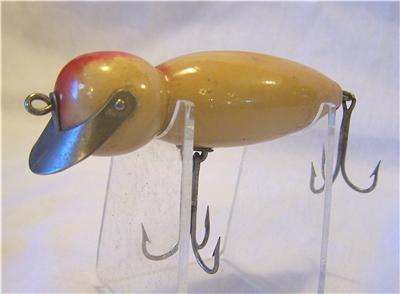
This little Heddon Tiny Go Deeper is in a bizarre color.


This dealer card of 12 Paw Paw spinners on cards has attracted a lot of bidder interest.


A Howe's Vacuum Bait in the tin is always a welcome sight.


Maybe my favorite item in months: a boxed set of Pflueger Ideal bass flies.


As always, have a safe weekend, and be good to each other, and yourself.

-- Dr. Todd

Thursday, October 9, 2008

A New Bamboo Fishing Rod Magazine: The Bamboo Journal

A New Bamboo Fishing Rod Magazine: The Bamboo Journal

I just ran across a new endeavour by the Italian Bamboo Rodmaker's Association entitled The Bamboo Journal: The IBRA Online Newsletter. This journal is the product of a dedicated group of Italian and other European rodmakers who have put together what looks like a really promising new magazine. Edited by Alberto Azzoni, it covers the European rodmaking world in depth and offers a lot for rodmakers and rod collectors alike.


The inaugural issue has much of interest, including a profile of Danish rodmaker Bjarne Fries, perhaps best known for crafting rods with bamboo ferrules. For collectors there is a great piece entitled "The C.C. De France Rod by J.J. Hardy" written by Robert Natali. There is also a charming piece on the late Walter Brunner, the esteemed Austrian rodmaker.

Overall, this is a very neat look at the state of rod making from "across the pond," and it is highly recommended for anyone with a passing interest in both making, collecting, and fishing bamboo fly rods. I look forward to reading future issues.

-- Dr. Todd

Wednesday, October 8, 2008

Dr. Todd Cleans A Fishing Reel, Part I: Vibrasonic Baby!

Dr. Todd Cleans a Fishing Reel,
Wherein the Intrepid Author Shows the Novice Reel Collector How to Clean a Fishing Reel

Part 1: Vibrasonic Baby!

One of the banes of reel collecting is the fact that so many of the collectible reels out there have been abused by the angler; now, this is not one of the epistles about how everything has to be "mint" or a lament that anyone would have the temerity to take out a piece of fishing tackle and actually fish with it. However, of all the items in the angler's kit, the average American angler--both past and present--took very little care of their fishing reels. If you don't believe me, peruse the vintage reel selection on eBay.

Most of this damage could have been avoided if the original owner had taken a few simple steps, such as cleaning the reel after use, properly oiling it, drying it when it got wet, not dropping it in the mud, etc. The hard truth is, however, that their carelessness can be your benefit. Many reels that would sell for far more can be found at a bargain, and with some time and effort, can be restored.

In the coming months I am going to walk you through a number of ways in which you can clean a fishing reel. Keep in mind I am no expert and if you've got some time, I strongly recommend you wade through the discussion on ORCA's Reel Talk Cleaning & Restoration Forum about the nature of cleaning a reel. Keep in mind, not all reels should be cleaned, and that it is always best to start with a low-end model before attacking that Frederick vom Hofe.

There are multiple methods to clean reels. Today we are going to go over the Vibrasonic method--which uses ultra fast vibrating liquid to remove any debris, dirt, gunk, etc. from a particular item. I purchased a small vibrasonic tank from eBay for something like $30, but they run the full gamut of prices.

I decided to test the Vibrasonic on a Montague trade reel marked "Waterwitch" that was pretty scummed up by years of use. The handle knob was frozen, the gears could barely turn, and had hardened gunk (probably dried grease) on the spool. Overall on an ORCA grading scale it rated about a 3/3.

This was a Sears, Roebuck & Co. trade reel that sold in the 1920s for $2.95, making it about 80 years old. Not an expensive model to begin with, the years had not been kind to this model, and so despite reasonable photographs from eBay, I was able to purchase it for under $5.


When I got it in the mail I was certain it could be restored, as it seemed to have no major damage (dents, broken gears, missing pieces, etc.). So I set out to restore it and decided to use the vibrasonic tank to clean the reel.

Like all cleaning, you start with disassembly. The best investment any reel collector (or lure collector for that matter) can have is a fine set of gunsmithing screwdrivers. I love Chapman screwdrivers as the heads are not tapered, and thus can help avoid major problem problems such as buggered screw heads, scratches, etc. They make interchangeable heads of all sizes.

Anyway, back to the Waterwitch. After disassembling, I ran the pieces under water and used an old toothbrush to remove as much of the gunk as I could, both inside and out. Then, it was into the vibrasonic tank with the pieces, making sure they were not touching so as to avoid any scratching.


This small tank fit the pieces of a disassembled baitcaster perfectly; larger reels would stick out and require flipping the pieces to get the desired effect.


Unit with the lid closed.

The unit has several benefits; first, it uses tapwater. I chose to run it with hot tapwater to help loosen the grime, and it seemed to work nicely. Second, it has an automatic shut off mechanism that runs in a three-minute cycle. I ran it for five cycles for 15 minutes of vibrating goodness. Then I took out the pieces, ran them under warm water to clean off any last debris, and dried them. Then I cleaned out the vibrasonic tank (do NOT forget to do this).


Here is how the pieces came out of the vibrasonic tank, after a quick scrub under hot water.

After the pieces dried, all that was left to do was to put a coat of Goddard's (make sure you use only a non-caustic metal polish; if you don't believe me I dare you to read this) and reassemble the reel. Here are the results:


Pretty nice, if you ask me. The reel will never pass as mint, but you would never be ashamed of having a reel that looks like this in your collection. And since its a fairly scarce Sears trade reel, I would not have hesitated to pay $30 or more for one in this condition if I didn't already have it. Instead, a $5 investment and an hour of work got me the same reel. Plus, it has the additional benefit of being squeaky clean inside and out--and runs like a top. One side benefit is that the handle knob--which was frozen tight like so many reels you find--now spins cleanly too. That vibrating water gets in almost everywhere!

It doesn't take many cleaned reels like this to make up for the price of a vibrasonic cleaner--depending on how much you pay, of course. Some vibrasonic tanks can cost several hundred dollars and I imagine work even better than the bargain unit I bought. I've used it on a dozen reels so far with good results; the best results have been on nickel-plated reels such as this. Plus you can clean your eyeglasses with it (you can't believe how dirty they are until you've cleaned them once in a vibrasonic tank).

So in my opinion, the vibrasonic tank works best with nickel-plated baitcasters. It did not appear to do any harm to the bakelite handle knob, and I have cleaned a few bakelite sideplates in it with no noticeable damage. Make sure the stainless tank on your vibrasonic is squeaky clean before putting any items in it. Always use the plastic basket so that the metal parts do not scratch the tank and vice versa. I cleaned the gears in the tank but not the screws (which I cleaned by using a screw driver to "tighten" them into a clean rag, which cleaned the threads nicely of old grease).

As a proviso, keep in mind this is only a guide and the author accepts no responsibility for any damage done cleaning a fishing reel based on the method(s) described.

-- Dr. Todd

Tuesday, October 7, 2008

Voices from the Past: Robert Page Lincoln


Here is one of my favorite poems from a great outdoor writer, Robert Page Lincoln. Lincoln was a diverse and accomplished angler and a top-notch outdoor writer who was deeply involved in the tackle industry, so much so that a famous spoon was named after him. It was manufactured by the Brainerd Bait Company of Brainerd, Minnesota.

IZAAK WALTON

Him did High Virtue perfectly endow,
Clean-wrought for living — Nature's gifted sage;
Uncoverer of Beauty on Time's gilded page,
Fine Priest of streams, of leaf and drooping bough;

Keeper of gladness, Faith's own solemn vow, —
Eschewing Gain and Competition's rage,
Measuring Life by Heaven's wiser gauge,
And breathing hope and blessedness enow!

Oh I have been much in delight to think,
How well his days were chosen to be spent.
And by the pools of Stafford, 'proached the brink
Of Paradise — and comfortably lent,

Him to sweet Themes of chaste divinity,
Kind songs of hope on skyward wings set free!

-- Robert Page Lincoln


-- Dr. Todd

Monday, October 6, 2008

News of the Week: 06 October 2008


Florida angler dumps actress Megan Fox...to go fishing??...3 year old boats 30 pound tarpon...a fishin' musician...local thief steals tackle and beer...the glory of the Sand Eel...power trolling for walleyes...a Tokyo man is arrested for fishing for women's underwear...an Aussie stage actress wants her own fishing show...a new North Carolina state record tarpon...the sweetness of split cane...it must be THE NEWS OF THE WEEK!

The Big Lead: Vero Beach firefighter Ben Leahy dumped Hollywood actress Megan Fox...because he'd rather be fishing???


One of eight known Heddon Frogs has just hit the trade market...

This Woolsery firm has a hit with its Stonze sinkers...

3-year old is Better Angler Than You: Borrows five year old sister's rod and catches 30 pound tarpon.

The Juneau Empire prints a fisherman's elegy.

From the SCTV "Scuttlebutt Lodge" Files: This musician is also a fishing guide.


Fishing for sea monsters in Mexico.

The York Daily Record gives us the 411 on fly fishing courses for women.

Local thief steals rods, reels, tackle box...and a six pack of beer.

How to make use of the abundant Sea Eel.

Langstone Harbor Teenage Girls Better Anglers than You: They even outfish the boys...

Good deeds prove that anglers do catch more than just fish...

The long wait has ended for Aussie anglers: trout season is here!

Power trolling for walleyes, the In-Fisherman way.


From the You Can't Make This Up Files: Tokyo man busted for using rod and reel to fish for...women's paties?!?

There's a new world record for Oyster Shucking.

The Naples News tells us that there are lots of fish but few fishermen.

From the Someone Get On This Right Now Files: Aussie stage actress Rhonda Burchmore wants her own fishing show.


Pro angler Chad Morgenthaler teams with Special Olympics for 3rd annual Bass Tournament.

A first hand account of a monster Silver King.

A professional guide has started a fishing tournament to help fight breast cancer.

A filmmaker captures a world record "Man-Eating Catfish of Himalaya."


Angler breaks North Carolina record for tarpon with 193 pound 5 ounce monster.

Finishing With a Flourish: Chris Yates writes of the sweet, supple mark of cane.


-- Dr. Todd

Sunday, October 5, 2008

Poll Results: The Economy & Collecting

Poll Results: The Economy & Collecting

Well, the results are in, and although less than 10% of you voted in the 48 hours the poll was up, I think we got a pretty good cross-section of the pulse of the collecting community. Here is the results of the poll:


As you can see, the poll broke down like this:

How has the economy changed your collecting habits?

1) Not at all. Now is the best time to buy. (41%)

2) Somewhat. I have limited my purchases. (35%)

3) A lot. I think long and hard before buying a valuable piece. (14%)

4) Completely. I rarely if ever buy new tackle now. (8%)

Based on a sample size of 162 voters, there are really two ways to interpret this poll.

First, I personally was surprised that the largest percentage--nearly half--said the economy did not effect their buying habits. This points to a strong base of collectors who are willing to ride out the storm and bodes quite well for the hobby as a whole.

Second, it was certainly disturbing that nearly one-quarter of collectors polled said the economy had changed their buying habits a lot or completely. This is certainly a warning sign and it would appear likely this number would go up if the economy heads further south. That one out of twelve collectors have nearly abandoned purchases due to the economic climate is certainly cause for concern.

Still, I think the salient feature of this poll is that over 75% of polled collectors have not let the economy significantly effect their hobby. That in itself is a positive sign.

I'd like to thank everyone for taking the time to fill in the poll. For the vast majority of you who didn't, there's always next time.

-- Dr. Todd

Saturday, October 4, 2008

The UNID Files #7: The Case of the Florida Flasher


UNID FILES #7: The Case of the Florida Flasher

Here's another UNID from Joe Stag. When Stag can't ID something, it's pretty much an X-Files kind of mystery...we're talking deep government conspiracy here. Anyway, here's what he has to say about it:


Here's one for your "What the hell am I" files.........As you can see, 2 different sizes, both having a soldered face plate with a hole for a line tie. Top one is stamped PAT APPLIED FOR, botttom is stamped SILVER FISH PAT APPLIED FOR. Both came in a lot of both salt and freshwater tackle, but predominantly saltwater.....from the Miami area, along with Teasers and Tarpalunges, pretty much late 20's, 30's and 40's era. I'll bet they wiggle pretty good, but I'm thinking that they were used in conjunction with some type of bait, whole or cut, or some type of chum maybe? The fact that it has a name and patent applied for is intriguing to me.

So, anyone out there who can give Stag a hand on this? I definitely think its a saltwater dodger/flasher of some kind. Perhaps some of our coastal friends have seen it before. Email me and I'll pass the info on to Joe if you have any thoughts.

-- Dr. Todd

Friday, October 3, 2008

Friday Funhouse

The Friday Funhouse

Video of the Week

Yawn...Just your average, run of the mill 400 pound catfish...


Things I Would Buy If I Could Afford Them

Talk about rare: this 1880s Orvis catalog doesn't come up very often at all.


An interesting old reel oil bottle marked Frank Hoppe.


Here's an odd but enticing collectable: a Doulton ceramic jug with Izaac Walton on it.


An awesome Zwarg salmon reel will make the owner and high bidder very, very happy.


Ho hum. Just your average$5000 Hardy solid drum fly reel...


Speaking of rare, this Wilson Staggerbug is an awesome and never found lure.


A Heddon Musky Vamp is always a happy find.


Any Heddon Black Sucker of late has gone bat-crazy.


This Arbogast Walleye is one of the neatest of the Tin Liz family.


Chippewas are classic baits, and the market is way up on them of late.


Gotta love this neat Nichols Shrimp!


Really now...a pink Devon has attracted this much attention?


Most people aren't aware that Paul Bunyan sold fly rods, but this is a nifty example of the firm's rod selection.


That is one neat Edgar's Lucky Strike box.


Minnesota-made Johnson Reels have taken an upward turn of late.


I guess I shouldn't have sold my Heddon Pepsi Tad Polly Spook for $35...


A very rare fly rod book: Colorado Classic Cane.


This is nifty Sears J.C. Higgins spincasting reel.


As always, have a great weekend, and be good to yourself, and others.

-- Dr. Todd

Thursday, October 2, 2008

Thursday Review: Classic Fly Tying Web Site

Thursday Review: The Classic Fly Tying Web Site

Lately I have been getting interested in the history of fly patterns and fly tying (you may have noticed a few historical pieces on the subject in the Voices from the Past feature). A relatively new web site that should be of broad interest to fishing historians, anglers, and collectors alike is the Classic Fly Tying board.


One of the things I like about this site is that it does not have an overwhelming number of forums; it has four--one on Classic Streamer & Wet Fly Patterns, a Classic & Artistic Salmon Fly Tying forum, one for trading and swapping, and a Lodge where you can chat about anything at all.

The Classic & Artistic Fly Tying shows off the skills of these tiers very well, and some of them are incredibly original and offer up new patterns. My interests, however, tend more towards the Classic Streamer & Wet Fly Patterns. I posted earlier this year for information on a Dr. Fowler fly--named after the great Alonzo H. Fowler, rod and reel maker from Ithaca, New York--and got an absolutely great reception. Two gentlemen undertook to tie the Fowler fly for me so I could use it in my new book Forgotten Fly Rods: Overlooked and Underappreciated American Fishing Rod Makers.


The Fowler Fly as envisioned by expert tier Royce Stearns

There is much that can be learned for any angler or collector--information about tackle icons like Ray Bergman, for example, abound. As an aside, you'll often see the acronym "M.O.M." or just MOM. This is short for Mary Orvis Marbury, who put together the first extent fly tying pattern book that serves as a seminal source for us even today.

So wade in, dig around, and before you know it, you may even break out that old Herter's vice and start tying off a few patterns of your own.

-- Dr. Todd

Wednesday, October 1, 2008

Remembering Paul Newman...Fishing Tackle Clerk?

Remember Paul Newman...Sporting Goods Clerk?

The news wires were inundated last Sunday with the passing of Paul Newman, one of the greatest actors of all time. The star of such memorable movies as Cool Hand Luke, The Hustler, and Butch Cassidy and the Sundance Kid, what deserves more than just a passing mention is that he was personally involved--albeit for a short time--as a sporting goods clerk in his father's notable Cleveland store Newman-Stern.


When he was born 26 January 1925 as Paul Leonard Newman, his father Arthur was already co-owner of a sporting goods store in downtown Cleveland. This history of the firm is interesting and tied to many other names which will be familiar to readers of this blog. The company began life as the Electro-Set Company in 1915, and turned quickly in 1917 into the Newman-Stern Co., a mail-order supply house specializing in electrical and radio equipment, for which they are chiefly remembered today. The principals were Paul's father Arthur and his uncle Joseph S. Newman.


The move to sporting goods was necessitated by the United States' entry into World War I. Fearing a proliferation of home-grown German spies who could radio home war secrets to the Fatherland, the government banned the sale of all wireless equipment during the war, and thus in desperation the duo turned to sporting goods to salvage their economic prosperity.


Newman-Stern sold Red Head brand trade items.

Their timing could not have been better. Surviving the war years, they were one of the few firms already in place to take advantage of the massive boom in sports and leisure that came in the wake of the war. They soon moved to spacious quarters at East 12th Street and Walnut in downtown Cleveland, and prospered in the inter-war years.


This prosperity was almost derailed by the Great Depression. In Paul Newman's own words, his father likely saved the family business from bankruptcy:

On a messy winter day in 1931, in the middle of the Great Depression, my father, Arthur Newman--looking as gray as the day itself--left house and family and headed for Chicago to try and negotiate with Spalding and Wilson, the two giant sporting goods manufacturers, to get sports equipment on consignment. My father and his brother owned The Newman-Stern Company of Cleveland, Ohio, purveyor of sports equipment since 1915, a surviving company in the “luxury” arena of retailing which would see 80 percent failure rate before the depression ended. Goods on consignment would be difficult to bargain for in good times, so it seemed almost impossible to expect success in bad, because the manufacturers would only be paid as the goods were sold and not upon delivery. A dicey deal to monitor. Money was scarce.

My father came home two days later with a letter of agreement from both manufacturers for $100,000 of goods on consignment, a staggering amount in those days, especially under the economic circumstances. But those manufacturers knew that if The Newman-Stern Company sold a baseball glove for nine dollars and ninety-five cents, the manufacturer would have a check in the mail from my father the next day for the five dollars owed them. Such was the reputation of the Newman-Stern Company and the gentlemen who ran it. The business survived and so did we.

I learned a great deal by my father’s example and have tried to measure up. I learned from him that honesty is the best medicine. It nourishes the soul, and at the same time, keeps meat and potatoes on the table.


It is a touching tribute to his father and a measure of the greatness of the son that despite his international success, he still idolized his man who plied the Cleveland masses with baseballs, tennis racquets, and fishing reels.

As Paul graduated from high school in 1943 and spent a stint in the U.S. Naval Air Corp as an aircraft radio operator and tailgunner, Newman-Stern survived its second world war. After the war Paul enrolled at Kenyon College and began to act. As the recent New York Times obituary declared, "Arthur Newman, a strict and distant man, thought acting an impractical occupation, but, perhaps persuaded by his wife, he agreed to support his son for a year while Paul acted in small theater companies."

Then, in May 1950, Arthur Newman passed away, and son Paul returned to run the sporting goods store. As The Times declared: "after 18 months Paul asked his brother to take over the business while he, his wife and their year-old son, Scott, headed for Yale University, where Mr. Newman intended to concentrate on directing."


Paul Newman fishing at one of his "Hole-in-the-Wall" camps for children.

The rest, they say, is history. Newman went on to become a legendary actor, and the firm his father founded thrived in the 1950s. In 1963, the famed Gateway Sporting Goods Co. of Kansas City, Missouri purchased Newman-Stern and soon after moved it to 634 Euclid Avenue. This store was shuttered when Gateway foundered in 1973. By then, the Newmans had opened the Newman-Adler Co., selling camping and outdoor equipment. They still operate a store in Chagrin Falls, Ohio.

Perhaps his brief foray into the sporting goods world is the major reason he was attracted to roles such as minor league hockey player Reggie Dunlop in the immortal movie Slap Shot and Fast Eddie Felson, the iconic pool hustler in The Hustler and The Color of Money. And of course, his life-long love affair with auto racing--with its connection to the sporting world--makes perfect sense for a man who understood the world of sporting goods. He was known to enjoy fishing in his spare time.

So let's remember Paul Newman today as a titan of the silver screen, and for 18 months, a sporting goods dealer who sold fishing tackle. If anyone has or has seen a marked piece of Newman-Stern fishing tackle, drop me a note!

-- Dr. Todd